
Particle board is a flat panel made from wood chips and sawdust bonded with resin and pressed under heat. Also called particleboard or chipboard, it is the cheapest wood panel per cubic metre and the usual core of flat-pack furniture under a melamine face. Minh Thanh Plywood, a furniture plywood manufacturer, sets out the grades, limits and where plywood takes over.
What is particle board?
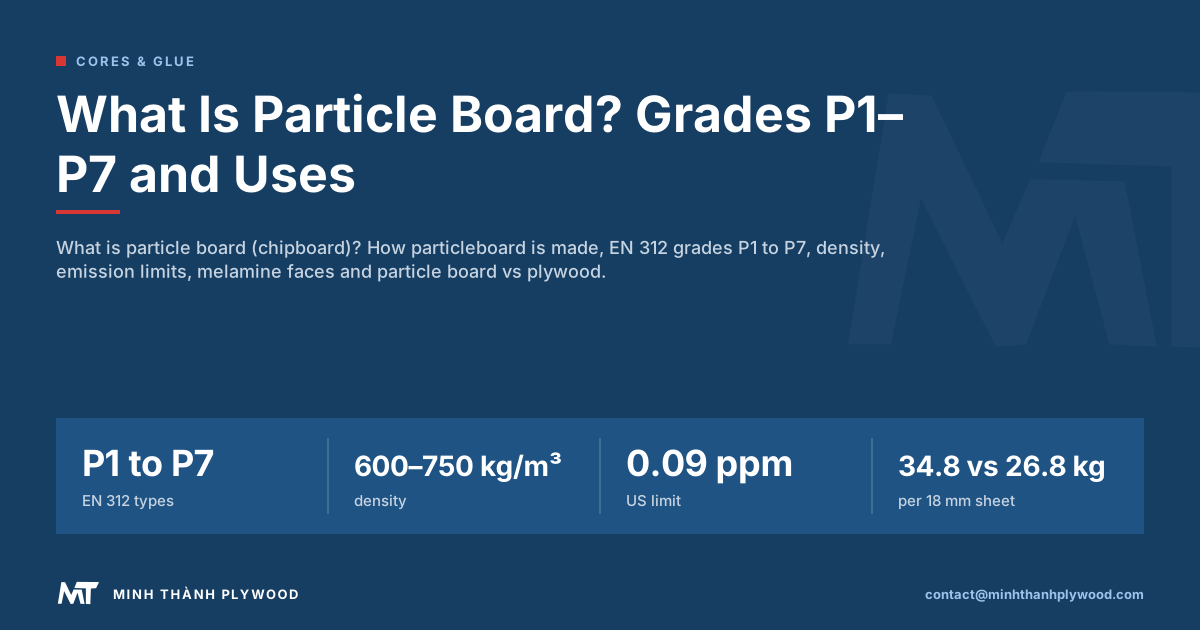
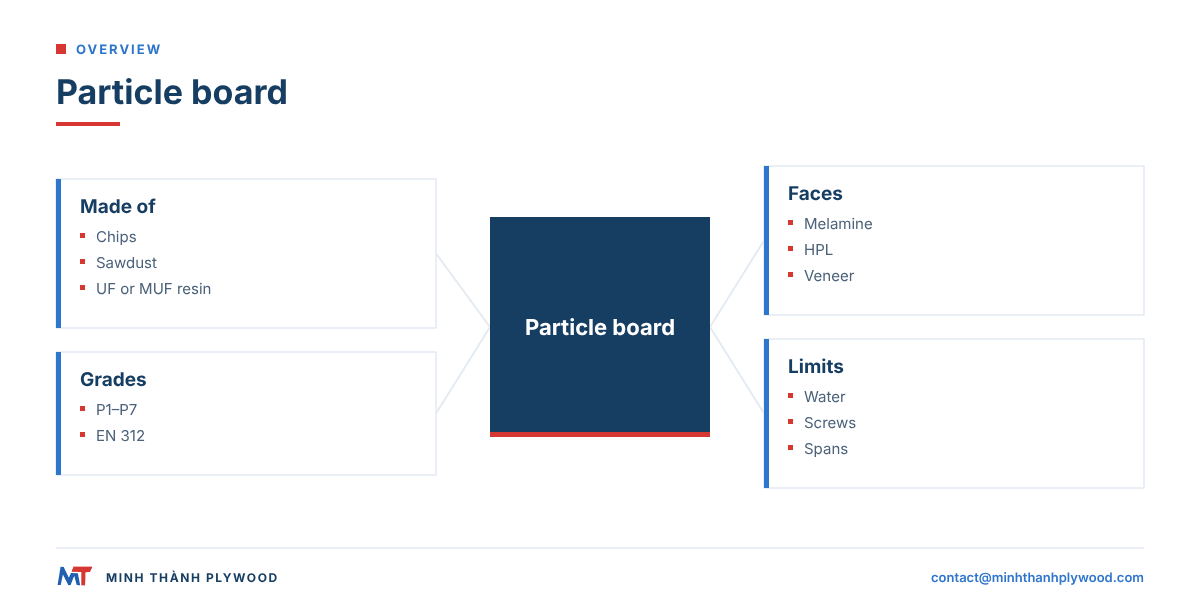
Particle board is an engineered wood panel made from wood chips, flakes, shavings and sawdust mixed with resin and pressed into flat sheets under heat. It has no grain and no veneer layers: the particles lie flat in every direction, with fine particles at the faces and coarser ones in the core.
The European product standard is EN 312, which defines seven board types from P1 to P7. In North America the standard is ANSI A208.1. Both treat particle board as a separate product from MDF, which is made of fibres, and from OSB, which is made of large oriented strands.
Particle board, particleboard, chipboard and pressed wood: one product, four names
Particle board, particleboard and chipboard are the same product. The names change by market:
- Particle board or particleboard: US and international trade.
- Chipboard: UK, Ireland, Australia and much of Europe; “chipboard sheets” and “chip board sheets” are the same boards.
- MFC (melamine-faced chipboard) or melamine board: particle board with melamine paper pressed on both faces.
- Pressed wood: a loose consumer term that can mean particle board, MDF or hardboard.
“Chip-on-board” is an electronics term, not a wood panel. When a quotation says “pressed wood”, ask for the product name and the EN 312 type.
Where did particle board come from?
Particle board dates from the 1930s: Max Himmelheber patented a process in Germany in 1932, and Farley and Loetscher Manufacturing Co. in the US became the first plant to make it in 1935, and the industry grew through the 1940s as builders and furniture makers looked for a cheap panel from sawmill waste. Plywood is older, so particle board has been the low-cost alternative for less than a century.
What is particle board made of?
Particle board is about 90 % wood particles by weight, with resin, wax and small additives making up the rest. The wood is the cheapest timber a sawmill or forest produces:
- Sawmill residues: slabs, offcuts, shavings and sawdust.
- Thinnings and small round wood chipped at the mill.
- Recycled wood from pallets and demolition, cleaned of metal and stones.
The resin is usually urea-formaldehyde (UF) for dry interior boards, and melamine-urea-formaldehyde (MUF) or polymeric MDI for moisture-resistant boards. Wax slows water uptake.
How is particle board made?
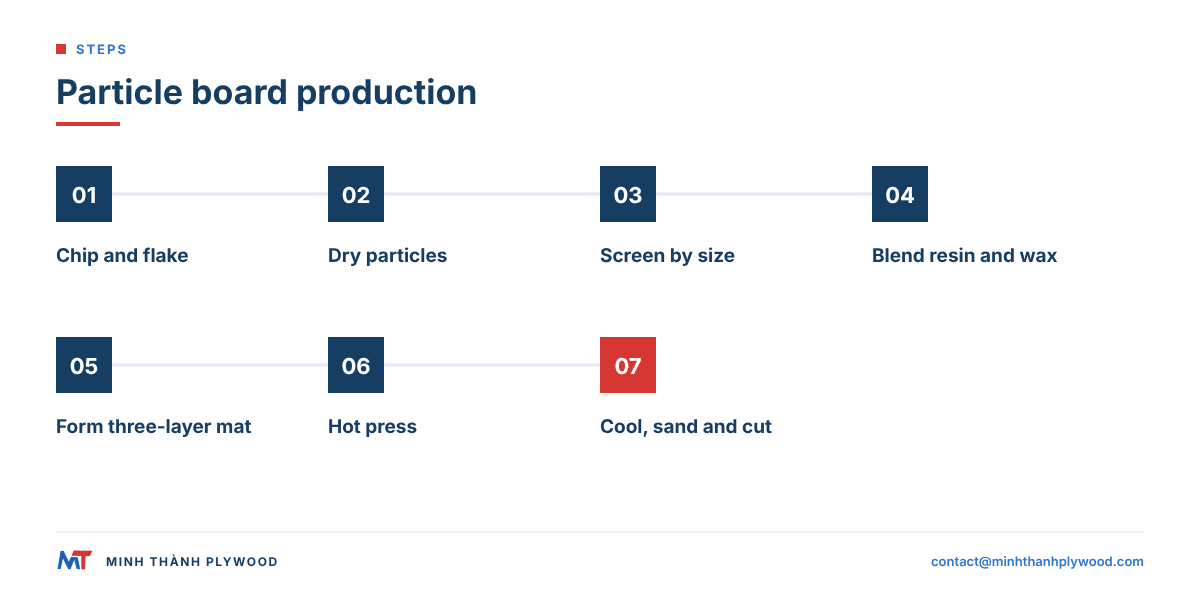
Particle board is made on a continuous line in seven steps:
- Chipping and flaking. Wood is chipped, then flaked or milled into particles.
- Drying. Particles are dried in a rotary drum to a low moisture content.
- Screening. Particles are sorted into fine ones for the faces and coarse ones for the core.
- Blending. Each fraction is sprayed with resin and wax in a blender.
- Forming. Forming heads lay a mat of fine face particles, a coarse core and fine face particles again: the three-layer or graded build.
- Hot pressing. A continuous press compresses the mat to thickness and cures the resin.
- Cooling, sanding and cutting. Boards cool, are sanded to thickness and cut to size, then faced with melamine or sold raw.
A veneer mill works the other way round: it keeps the wood whole and peels it into sheets. The difference in strength between the two panels comes from that one choice.
Particle board grades P1 to P7 under EN 312
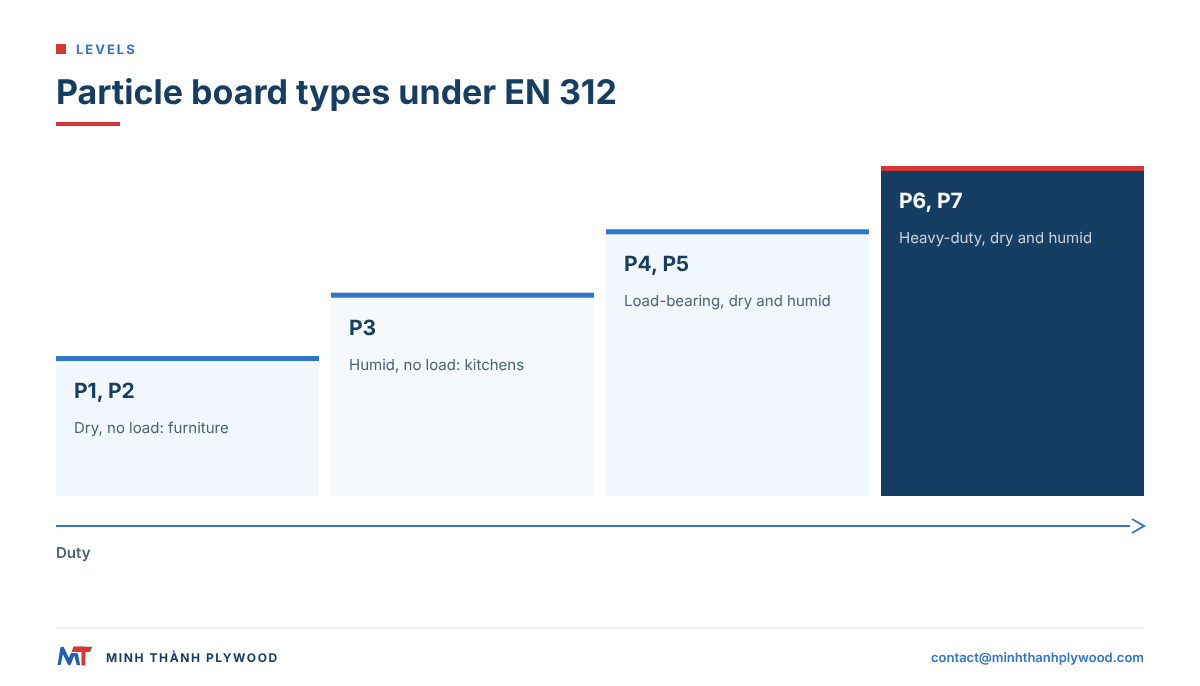
EN 312 sorts particle board into seven types by use, humidity and load. The type is the first thing to write on a European order.
| Type | Use | Conditions | Typical parts |
|---|---|---|---|
| P1 | General purpose | Dry | Packaging, low-cost backs |
| P2 | Interior fitments, furniture | Dry | Melamine-faced carcasses, shelves, wardrobes |
| P3 | Non-load-bearing | Humid | Kitchen and bathroom furniture, worktop cores |
| P4 | Load-bearing | Dry | Floors and walls in dry interiors |
| P5 | Load-bearing | Humid | Floor decking, roof boards |
| P6 | Heavy-duty load-bearing | Dry | Heavily loaded shelving and floors |
| P7 | Heavy-duty load-bearing | Humid | Heavily loaded structures in humid areas |
Each type has minimum values for bending strength, modulus of elasticity and internal bond, and a maximum thickness swelling after 24 hours in water, tested to EN 310, EN 319 and EN 317. The humid types (P3, P5, P7) also pass a cycle or boil test for moisture resistance. Furniture boards are mostly P2; kitchen carcasses in Europe are often P3.
Density and sheet weight
Furniture particle board has a density of about 600–750 kg/m³, heavier than a Styrax-core plywood panel of the same size. The faces are denser than the core, which is why the core crumbles when a screw is driven into the edge.
For an 18 mm sheet of 1220 × 2440 mm (0.0536 m³):
| Panel | Density | Sheet weight |
|---|---|---|
| Particle board at 650 kg/m³ | 650 kg/m³ | 34.8 kg |
| Furniture plywood, Styrax core | 500 kg/m³ | 26.8 kg |
| Furniture plywood, Acacia core | 580 kg/m³ | 31.1 kg |
| Furniture plywood, Eucalyptus core | 650 kg/m³ | 34.8 kg |
Particle board is also sold in larger mill formats such as 2070 × 2800 mm. The plywood weight calculator gives plywood weights at other thicknesses.
Particle board sizes, weight and price in the US
US particle board is sold in 4 x 8 ft sheets of 1/2, 5/8 and 3/4 in, and the 3/4 in sheet weighs about 81 lb (36.8 kg) at 650 kg/m³. The sheet is labelled 4 x 8 ft and 3/4 in nominal; melamine-faced panels are cut slightly oversize at 49 x 97 in. Weights below are computed at 650 kg/m³.
| Panel (4 x 8 ft) | Thickness | Sheet weight | US shelf price per sheet |
|---|---|---|---|
| Particle board | 1/2 in (12.7 mm) | 54 lb (24.5 kg) | Lower than the 3/4 in sheet |
| Particle board | 5/8 in (15.9 mm) | 68 lb (30.7 kg) | Between the 1/2 in and 3/4 in sheets |
| Particle board, sanded | 3/4 in (19.05 mm) | 81 lb (36.8 kg) | About US$30 to US$38 |
| Melamine-faced, 49 x 97 in | 3/4 in (19.05 mm) | 84 lb (38.0 kg) | About US$47 |
| Furniture plywood, Styrax core | 23/32 in (18 mm) | 59 lb (26.8 kg) | From US$350/m³ FOB, a raw example of about US$19 per sheet |
The plywood row is a raw FOB example for container buyers (0.0536 m³ at US$350/m³), before freight, duty and margin; it is not a shelf price. At the same 18 mm, plywood is lighter than particle board (26.8 against 34.8 kg), which counts when a worker lifts it overhead and when a container reaches its weight limit before its volume.
US buyers also meet the ANSI A208.1 grades, which sort particle board by strength and density in the order M-1, then M-S, M-2 and M-3, with M-1 the lowest and M-3 the highest. EN 312 types P1 to P7 do the same job in Europe, so an importer quoting to both markets should state the grade of the market on the order.
Formaldehyde limits for particle board
Particle board is one of the composite wood products every major market limits for formaldehyde emission:
| Market and rule | Limit for particle board |
|---|---|
| US: CARB Phase 2 and TSCA Title VI | 0.09 ppm |
| EU: E1 class in EN 13986 | 0.1 ppm (EN 717-1 chamber) |
| EU: Regulation (EU) 2023/1464, from 6 August 2026 | 0.062 mg/m³ for furniture and wood-based articles |
The sources are the EPA’s TSCA Title VI rule, the CARB composite wood products programme and Regulation (EU) 2023/1464. Hardwood plywood with a veneer core has a lower US limit, 0.05 ppm. Minh Thanh’s furniture plywood with UF glue at E0 emission averaged 0.014–0.032 ppm in six ASTM D6007 chamber tests, April 2025 to June 2026, by Shanghai Hongjun and ICTT Vietnam.
Melamine-faced chipboard and other faced boards
Most particle board is sold faced, because the raw board is grey-brown and rough at the edges. The faces in use:
- Melamine-faced chipboard (MFC): decor paper soaked in melamine resin and pressed onto both faces, to EN 14322. The face resists scratches and stains; the edge needs a PVC or ABS edge band.
- High-pressure laminate (HPL): a thicker laminate glued on for worktops and counters.
- Wood veneer: a thin real-wood face on a particle board core for veneered furniture.
- Foil and paint: thin foils or primer for low-cost painted parts.
The same faces go on plywood. Melamine-faced plywood on a stitched core costs more than MFC and holds hinges and screws far better in the edge.
Why flat-pack furniture uses particle board
Flat-pack furniture uses particle board because it gives the lowest cost per finished part with a flat, stable sheet. Four reasons decide it:
- Price. The raw material is sawmill residue, so the cubic metre costs least of all wood panels.
- Flatness. The even mat stays flat in large sheets, which suits melamine pressing and automatic edge banding.
- Even machining. No knots, grain or voids, so nesting and drilling programs run the same on every sheet.
- Designed hardware. Cam locks, dowels and confirmat screws are designed to hold in particle board when the part is assembled once.
The trade-off is the life of the joint: each time a cam lock is undone and tightened again, the hole wears. Furniture that is moved, rebuilt or loaded hard is built from plywood for that reason.
Can particle board get wet?
Standard particle board should not get wet: water swells the edges and the swelling stays when the board dries. A swollen edge lifts the edge band, opens the joints and loses its screws.
Moisture-resistant boards (EN 312 types P3, P5 and P7, often dyed green) use MUF or MDI resin and more wax. They resist humid rooms and short wetting; they still swell under standing water. In kitchens and bathrooms:
- Seal every cut edge, drilled hole and cut-out for a sink or hob.
- Keep particle board off floors that are mopped; use legs or plinths of plastic or plywood.
- Use plywood with MR/melamine-fortified glue for sink bases, or phenolic (WBP) glue for parts that can stand in water.
The is plywood waterproof guide explains the glue classes behind those choices.
Particle board vs plywood: the comparison
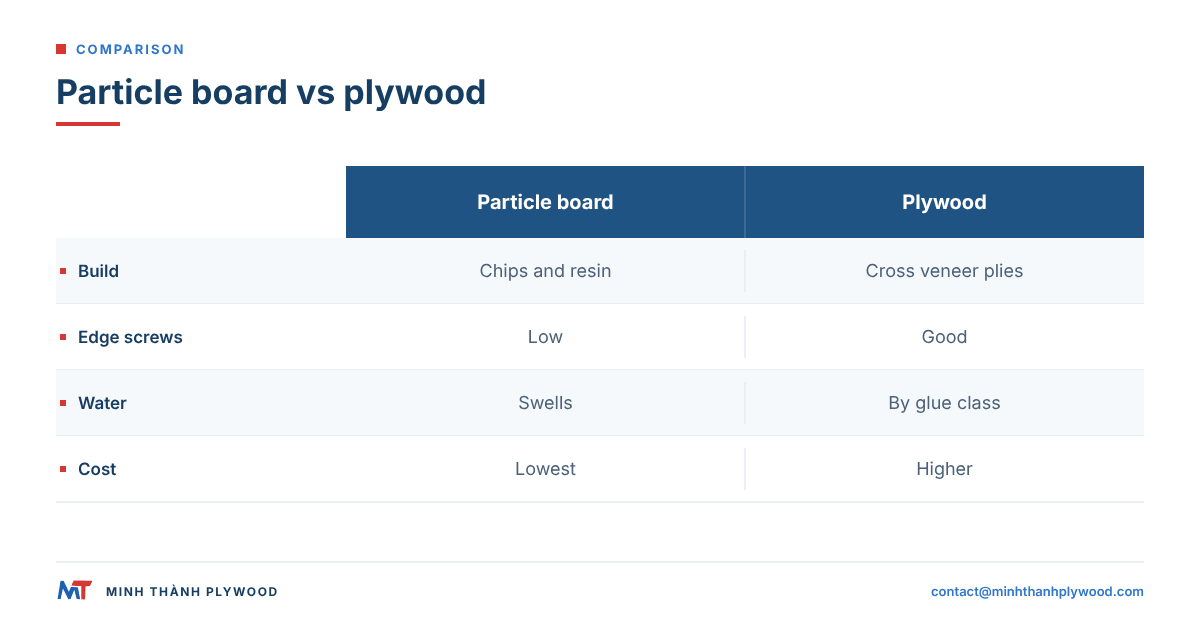
Plywood is stronger, lighter for its strength and far better in water; particle board is cheaper and flatter for melamine-faced carcasses. The table compares 18 mm boards for furniture.
| Metric | Particle board (P2, 18 mm) | Furniture plywood (Styrax core, 18 mm) |
|---|---|---|
| Build | Chips and sawdust with resin, three layers | 11–13 cross-laminated veneer plies |
| Density | 600–750 kg/m³ | 500 kg/m³ |
| Screw holding in the edge | Low; needs inserts or confirmat screws | Good |
| Bending over a span | Sags under constant load | Stiffer |
| Water at the edges | Swells, does not recover | Depends on glue; MR or phenolic for humid areas |
| Repeated assembly | Holes wear out | Holds |
| Thickness tolerance | Sanded to mill tolerance | ±0.2–0.3 mm, down to ±0.2 mm |
| Price per cubic metre | Lowest of wood panels | Furniture plywood from US$350/m³ (October 2026) |
| Typical parts | Low-cost carcasses, wardrobes, desks | Carcasses, shelves, drawers, kitchens, hotel furniture |
The particle board vs plywood guide compares them part by part, and plywood vs MDF covers the third panel.
How long does particle board last, and is it safe?
Particle board furniture lasts for many years in a dry room when it is assembled once and loaded within its design. It ages faster in three cases: humidity and spills at the edges, long shelves under heavy constant load, and furniture taken apart and rebuilt.
It is safe for indoor use when it meets the formaldehyde limit of the market it is sold in. Formaldehyde is classed as carcinogenic to humans (Group 1) by the International Agency for Research on Cancer (IARC), and sawing or sanding particle board makes fine wood dust, which UK Health and Safety Executive (HSE) guidance says must be controlled at source with extraction and a suitable mask. Ask for the emission certificate (CARB P2 / TSCA Title VI label in the US, E1 or the 2023/1464 test in the EU) and keep it with the lot number.
Particle board vs MDF vs OSB
Particle board, MDF and OSB are the three wood-based panels made from broken-down wood, and each is cut to a different size before pressing. That one choice sets the surface, the strength and the use.
| Point | Particle board | MDF | OSB |
|---|---|---|---|
| What the wood becomes | Chips, flakes, sawdust | Refined fibres | Large strands, laid in oriented layers |
| Standard (EU) | EN 312 | EN 622-5 | EN 300 |
| Surface | Fine faces, coarse core | Smooth, even through the board | Visible strands |
| Strength | Lowest of the three | Middle | Highest in bending along the strands |
| Main use | Melamine-faced furniture | Painted doors, mouldings | Roof, wall and floor sheathing |
| US formaldehyde limit | 0.09 ppm | 0.11 ppm | Exempt under TSCA Title VI |
OSB is a structural panel like softwood sheathing plywood, not a furniture board; the OSB guide and plywood vs OSB cover it. Plywood stands apart from all three because it keeps the wood as whole veneer sheets.
How to check particle board on delivery
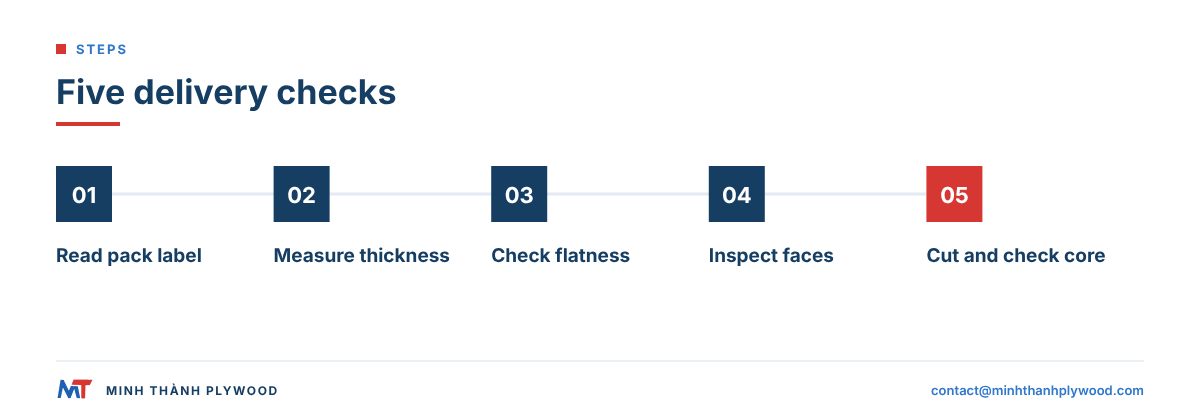
Check particle board in five steps before it reaches the line:
- Read the pack label: EN 312 type (P2, P3 and so on), thickness, decor, emission class and lot.
- Measure thickness at the four corners and the centre of three sheets per pack.
- Check flatness by laying one sheet on a flat table; melamine-faced boards should lie flat without rocking.
- Look at the faces for decor match, scratches, pressure marks and open pores in the melamine.
- Cut one sample and check the edge for a dense, even core with no soft or loose centre.
For moisture-resistant types, soak a 50 × 50 mm sample for 24 hours (the EN 317 method) and compare the swelling with the datasheet. Keep the emission certificate with the lot number.
What to write on a particle board or plywood order
Write the EN 312 type, the face, the emission rule and the size; “chipboard 18 mm” leaves all four open. A complete particle board line: “Particle board P2, melamine-faced both sides, decor white, 18 mm, 2070 × 2800 mm, CARB P2 / TSCA Title VI.”
Where the parts need screw holding, load or humidity resistance, the plywood line reads: “Furniture plywood, poplar face B/B, Styrax core stitched, UF glue at E0 emission, 1220 × 2440 × 18 mm, sanded to ±0.2–0.3 mm, CARB P2 / TSCA Title VI, export packs.” At Minh Thanh the minimum order is one 40HC with mixed specifications by agreement, production takes 15–45 days after the 30% deposit, and samples are free.
Send the line to contact@minhthanhplywood.com or through the quotation form. The plywood core types guide explains the cores you can choose, and furniture plywood from Vietnam lists the faces.
Buyer questions, answered
What is particle board?
Particle board is an engineered wood panel made of wood chips, shavings and sawdust mixed with resin and hot-pressed into sheets. It is flat, even and low in cost, and is mostly used under a melamine or laminate face in furniture.
Is particle board the same as chipboard?
Yes. Particle board, particleboard and chipboard name the same product; chipboard is the British term. Melamine-faced chipboard (MFC) is particle board with a melamine paper face.
Is plywood a particle board?
No. Plywood is made of whole wood veneer sheets glued in cross layers. Particle board is made of chips and sawdust pressed with resin, with no continuous wood fibre.
Is particle board stronger than plywood?
No. At the same thickness, plywood has higher bending strength, much better screw holding and far better resistance to water. Particle board is flatter and cheaper, which is why it is used for low-cost carcasses.
Is particle board cheaper than plywood?
Yes. Per cubic metre, raw particle board is usually the cheapest wood panel, well below furniture plywood. The gap narrows once the board is faced, edged and fitted with inserts for its hardware.
Can particle board get wet?
Standard particle board swells when wet and does not recover. Moisture-resistant grades (P3, P5, P7) resist humidity better, but no particle board should stand in water.
How long does particle board last?
Melamine-faced particle board furniture in a dry room typically lasts for many years. It fails sooner where it is wetted, overloaded on long shelves or taken apart and rebuilt, because the screw holes wear out.
Is particle board safe for indoor use?
Yes, when it meets the formaldehyde limit of the market: 0.09 ppm under CARB Phase 2 and TSCA Title VI in the US, and 0.062 mg/m³ for furniture in the EU from 6 August 2026.
What is pressed wood?
Pressed wood is a loose name for any panel pressed from wood particles or fibres with resin: particle board, MDF and hardboard. Ask which one is meant before quoting.
What do the P1 to P7 grades of particle board mean?
They are the board types of EN 312. P1 and P2 are for dry interiors, P3 for humid interiors without load, P4 and P5 carry load in dry and humid conditions, and P6 and P7 are heavy-duty load-bearing boards.