
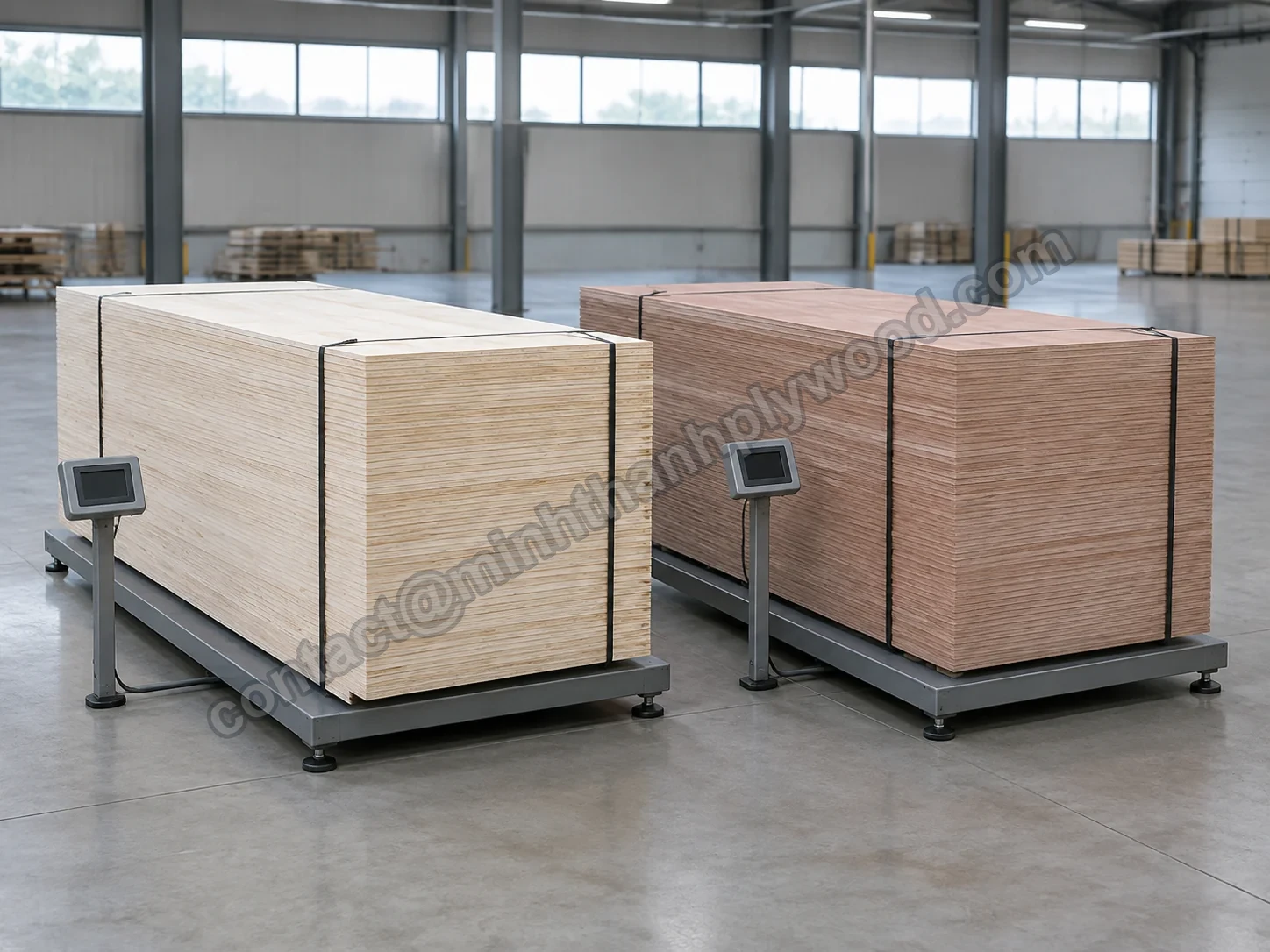
In short, a plywood weight calculator multiplies length × width × thickness (in metres) by density (kg/m³). An 18 mm 1220 × 2440 mm sheet weighs 26.8 kg on a Styrax core at 500 kg/m³ and 34.8 kg on Eucalyptus at 650 kg/m³. Minh Thanh Plywood loads 990 or 795 of those sheets in a 40HC at 28,000 kg.
What does a plywood weight calculator actually calculate?
A plywood weight calculator estimates the mass of a sheet, a group of sheets or a shipment from dimensions and material density. The useful result identifies its boundary: panels alone, packed goods, or packed goods inside the container. Mixing those boundaries creates booking errors even when the multiplication is correct.
For a buyer comparing cores, start with one sheet. For a warehouse planning a forklift movement, calculate the completed pack. For a freight booking, total all packs and loose securing materials. Each calculation needs the same physical dimensions and a density or measured mass appropriate to the ordered construction.
Use our existing plywood packing calculator for the connection between thickness, core and pack layout. This guide explains the arithmetic behind the weight result and how to turn it into a shipment worksheet. It also separates a geometrical packing plan from a cargo allowance: empty space inside a container does not authorise extra mass.
Minh Thanh’s furniture construction uses white Styrax or Eucalyptus cores beneath the selected face veneer. That core choice belongs on the quotation and the weight calculation. “Birch plywood” describes too little when the purchasing team needs to estimate mass, select handling equipment and divide freight across the delivered sheets.
Which formula and units should you use?
Sheet mass in kg = length in m × width in m × thickness in m × density in kg/m³. The three dimensions produce cubic metres; multiplying by kilograms per cubic metre produces kilograms. Convert every dimension before multiplying.
| Input | Entry on the purchase order | Entry in the formula |
|---|---|---|
| Length | 2440 mm | 2.440 m |
| Width | 1220 mm | 1.220 m |
| Thickness | 18 mm | 0.018 m |
| Density | Styrax planning reference | 500 kg/m³ |
| Sheet count | Number of full sheets | Multiply by calculated sheet mass |
A common spreadsheet error converts length and width but leaves thickness as 18. That overstates volume and mass by a factor of 1,000. Write units in the column headings and keep input dimensions distinct from converted dimensions so the error is visible.
The same equation works for a rectangular cut component. For a drilled or shaped component, use its remaining volume or weigh the finished part; multiplying the original sheet area produces the mass before machining. Keep offcuts in the dispatch total if they are also shipped.
Minh Thanh offers both full formats and cut-to-size panels. The sheet-size guide helps identify the ordered format, while the cut-to-size page describes the component supply route. A smaller shipping footprint does not automatically mean less shipped panel mass if the same total material is divided into pieces.
How do you calculate a sheet in five steps?
A 1220 × 2440 × 18 mm sheet contains 0.0535824 m³, so the reference-density calculation gives 26.7912 kg for Styrax and 34.82856 kg for Eucalyptus. These are calculations from planning assumptions, before packaging.
- Convert 1220 mm to 1.220 m, 2440 mm to 2.440 m and 18 mm to 0.018 m.
- Multiply length by width: 1.220 × 2.440 = 2.9768 m².
- Multiply area by thickness: 2.9768 × 0.018 = 0.0535824 m³.
- Multiply volume by density: 0.0535824 × 500 = 26.7912 kg, or × 650 = 34.82856 kg.
- Multiply by the required sheet count, then add the separate packing total.
Keep full precision in the worksheet and round only the displayed result. For example, rounding the Styrax sheet to 26.8 kg before multiplying is suitable for a quick conversation but introduces a difference across a full container. The loading calculation should use the unrounded input or actual measured sheet mass.
A purchasing manager should be able to reproduce this calculation without opening a second file. Put dimensions, core assumption, sheet volume, sheet mass and quantity on the same row. Identify the sample or specification revision beside that row so a later core substitution cannot pass unnoticed into the freight budget.
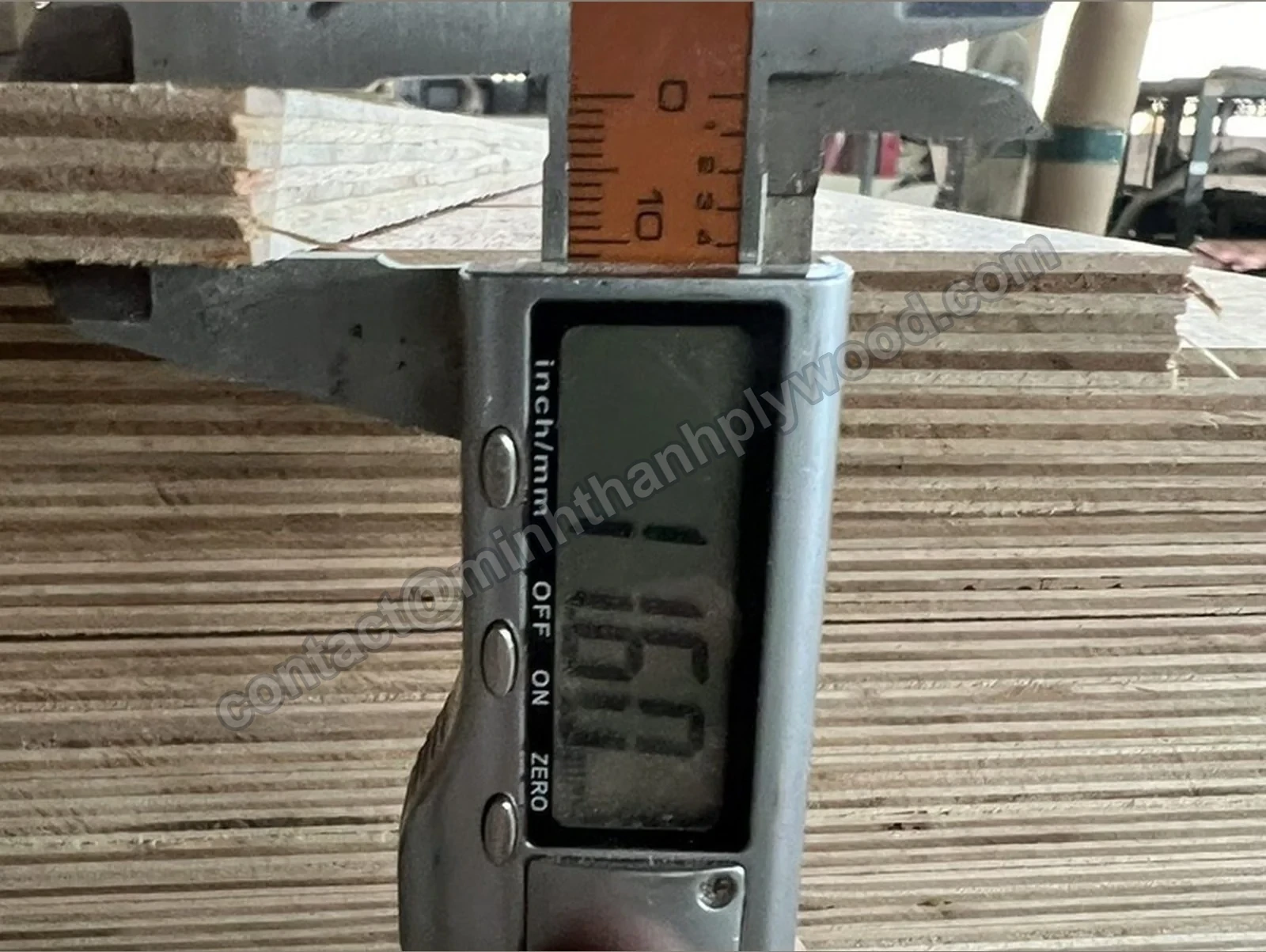
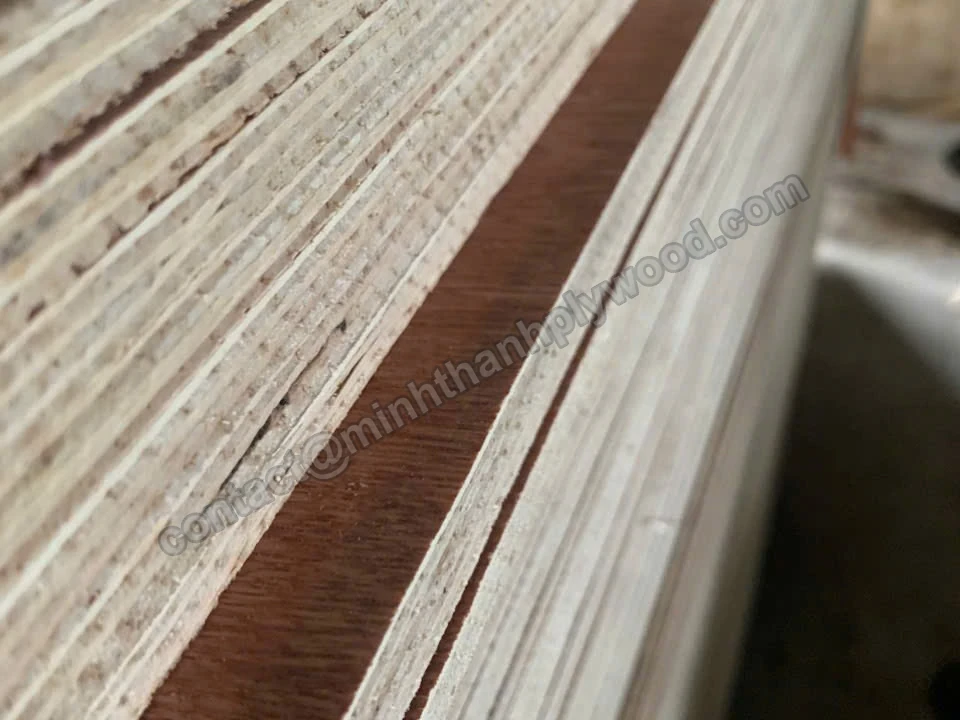
The photograph shows a thickness check on a plywood edge; use the ordered thickness for the budget and inspection measurements for the final mass estimate.
Which density belongs in the calculation?
Use the density of the complete ordered panel, with the core construction stated beside it. Minh Thanh’s reference loading calculations use 500 kg/m³ for Styrax and 650 kg/m³ for Eucalyptus.
Eucalyptus reference information also describes a 650–750 kg/m³ range. Choosing the lower loading reference is useful for reproducing the published planning calculation; measured finished-panel mass resolves the actual shipment. A buyer’s worksheet should label the selected density and avoid treating a species name as a scale measurement.
Face veneer, core layup, adhesive, compaction and material moisture all belong to the finished sheet. A birch-faced sheet over Styrax therefore needs a different mass assumption from an all-birch construction. Film-faced plywood likewise needs its actual panel construction rather than a density inferred solely from the film colour.
For repeat procurement, compare like with like: the same dimensions, core and moisture condition. Record the weighed sample’s construction, not just its face name. If the measured sheet is a different thickness or core, its kilogram value cannot be copied into the new order schedule.
Our furniture plywood range identifies the core and face choices. Select the construction for its machining and application requirements first, then use its mass in logistics planning. Density alone does not grade the face or establish a structural load rating.
What is the weight of 18mm plywood sheet and other thicknesses?
An 18 mm plywood sheet of 1220 × 2440 mm has a volume of 0.0535824 m³, so it weighs 26.79 kg at the 500 kg/m³ Styrax-core density, excluding packing. Mass rises directly with thickness. The table below is calculated for 1220 × 2440 mm panels using the same two planning densities throughout. Every value excludes packing.
| Thickness | Volume per sheet | Styrax, 500 kg/m³ | Eucalyptus, 650 kg/m³ |
|---|---|---|---|
| 3 mm | 0.0089304 m³ | 4.47 kg | 5.80 kg |
| 6 mm | 0.0178608 m³ | 8.93 kg | 11.61 kg |
| 9 mm | 0.0267912 m³ | 13.40 kg | 17.41 kg |
| 12 mm | 0.0357216 m³ | 17.86 kg | 23.22 kg |
| 15 mm | 0.0446520 m³ | 22.33 kg | 29.02 kg |
| 18 mm | 0.0535824 m³ | 26.79 kg | 34.83 kg |
| 21 mm | 0.0625128 m³ | 31.26 kg | 40.63 kg |
| 25 mm | 0.0744200 m³ | 37.21 kg | 48.37 kg |
Changing from 12 mm to 18 mm increases volume and mass by 50% at unchanged area and density. That does not mean a freight invoice rises by 50%: a container rate, its cargo ceiling and the number of usable sheets still determine freight per sheet.
Choose thickness for the manufactured component rather than reducing it solely to add more sheets to a booking. The plywood thickness guide explains the relationship between nominal size, actual thickness and application. Minh Thanh’s furniture panels are calibrated during the double-press route, so thickness and its agreed tolerance are part of the order specification.
How do inches and pounds change 3/4 in plywood weight?
Convert imperial dimensions to metres and calculate in one unit system, then convert the final mass if the receiving team needs pounds. The international foot is exactly 0.3048 m; an inch is 0.0254 m. One pound is exactly 0.45359237 kg.
These definitions are given in NIST’s unit-conversion guidance, consulted 8 October 2026. NIST’s foot-conversion table identifies the international foot used here. Divide kilograms by 0.45359237 to obtain pounds; do not mix pounds with kg/m³ inside the original formula.
A nominal 4 × 8 ft sheet converts to 1.2192 × 2.4384 m. A supplied 1220 × 2440 mm format is close, but its dimensions are slightly different. Enter the dimensions on the quotation when budgeting that order, and keep a retailer’s inch trade label separate from actual thickness.
For example, three-quarter inch converts to 19.05 mm. A full 4 × 8 ft sheet at that thickness holds 0.0566 m³, so the 3/4 in plywood weight is about 28.3 kg (62.4 lb) at 500 kg/m³ and about 36.8 kg (81.2 lb) at 650 kg/m³. An 18 mm metric sheet is about 5% lighter than that, which is why the converted thickness must not silently replace an 18 mm entry.
Our factory quotations use millimetres for dimensions and cubic metres for volume. Preserve those original fields and add converted columns for the destination team. That gives purchasing, freight and receiving a shared calculation without rewriting the product specification into rounded trade sizes.
Does plywood moisture need a separate weight allowance?
Moisture is already part of a density or measured sheet mass taken at that material condition. Minh Thanh dries veneers and finished panels to 8–12% moisture content at dispatch. That range describes the material condition; it is not an extra percentage to add automatically to the finished-panel weight.
If a worksheet uses a dry-wood density and then estimates finished moisture mass, it needs a clearly defined basis. If it uses the finished panel’s measured mass, adding moisture again double counts part of the goods. Name the density basis instead of inserting a blanket “moisture factor” without a calculation.
Measure moisture and dimensions on the same representative construction used for weighing. A wet edge, an unconditioned sample or a different core can explain why a sample does not match a planning reference. Investigate that difference before changing the full order estimate.
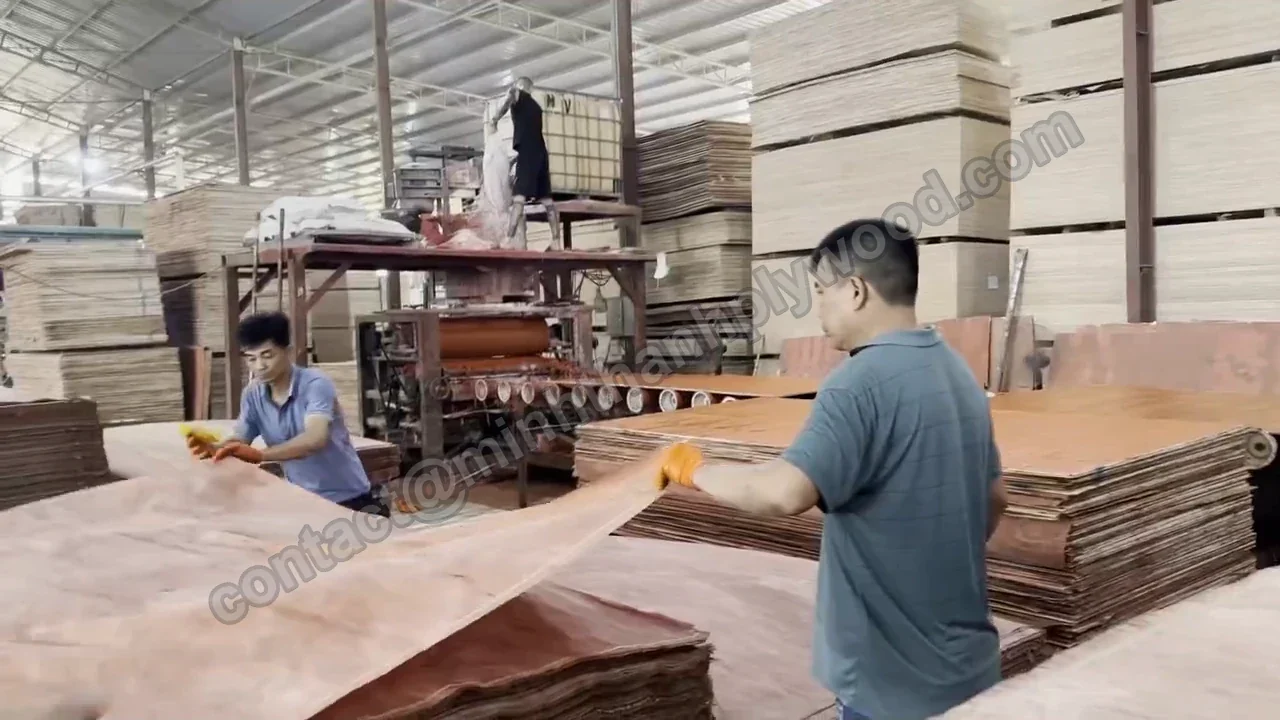
Face veneers are sorted before lay-up; the finished panel is weighed separately.
Packing protects prepared plywood during handling and transit, but it does not convert an uncertain mass estimate into a measured cargo total. Ask the logistics team to use completed pack weights for dispatch and record the packing materials used. Keep moisture observations as quality information beside those weights, rather than hiding both inside a single adjustment percentage.
What belongs in packed cargo mass?
Packed cargo mass includes every panel and every material that travels with it. Add pallets or bearers, cover boards, cardboard, wrapping, straps, corner protection and loose securing materials to the panel total. Packaging is cargo, even when it is absent from the product invoice’s cubic-metre quantity. Plywood is outside ISPM 15, but solid sawn-wood bearers under the packs are inside it and carry the ISPM 15 mark.
A practical worksheet has a net panel column and a packing column for each pack. If the pack is weighed as a completed unit, that scale result already includes its packaging. Do not add its pallet again. Loose materials loaded after pack weighing remain separate additions.
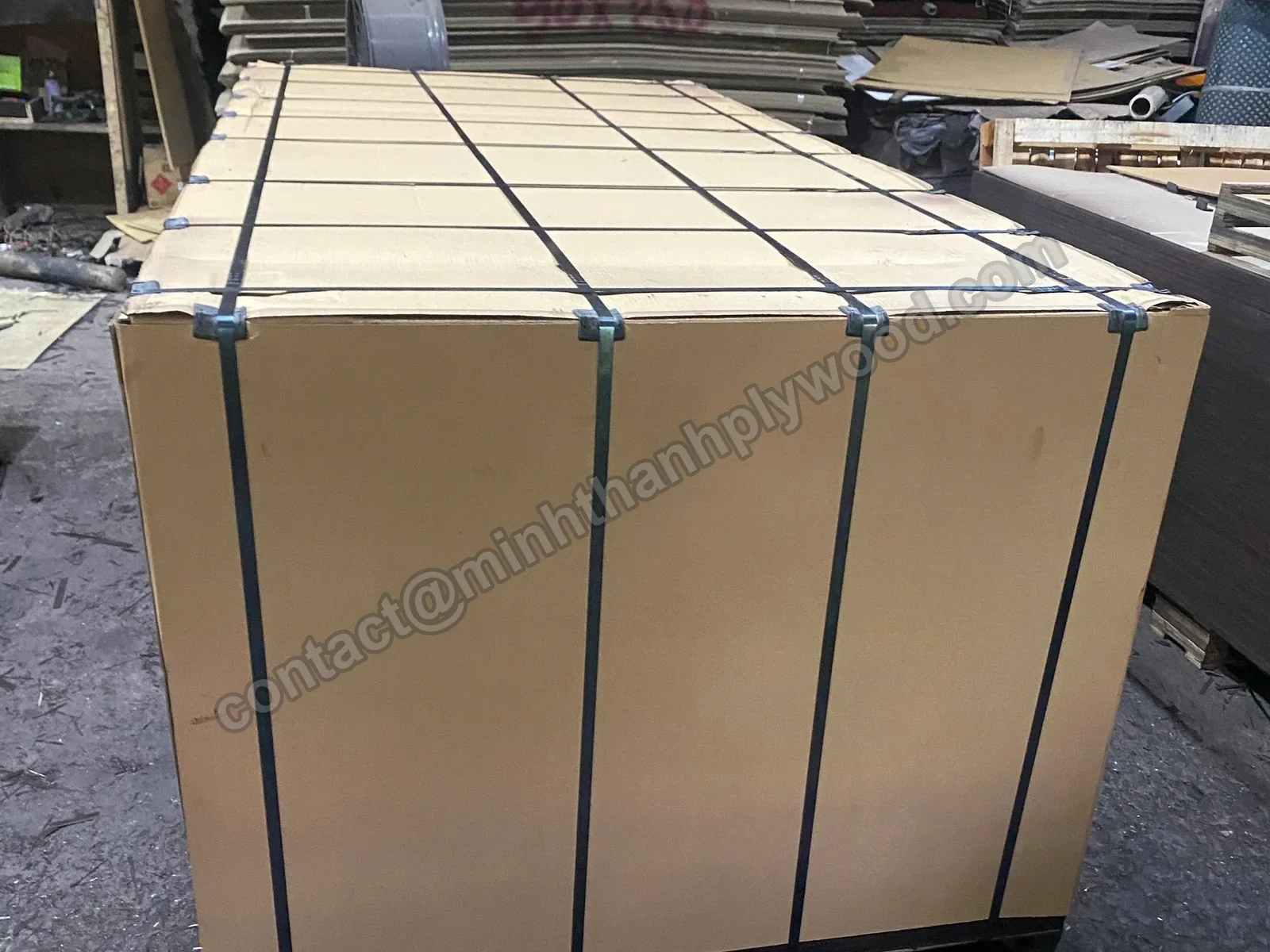
Covers, cardboard and steel straps on this pack belong in gross cargo mass.
For a mixed order, different specifications can use different pack protection. A furniture face pack needs handling protection appropriate to its surface, while the quantity and pack dimensions determine the bearers and covers. An old packing allowance from another load should not become a permanent assumption for every construction.
The export packing page explains the pack arrangement. Send packing requirements with the first quotation enquiry, particularly if the destination warehouse has a specified maximum pack mass or fork-entry arrangement. Resolving those details early produces a loading plan the receiving team can actually handle.
How do you cap sheet count by the cargo limit?
Subtract packing mass from the booking’s cargo limit, divide the remaining allowance by sheet mass, and round down. Then compare that count with the physical pack layout and use the lower feasible quantity. The result is a planning ceiling until completed pack weights and the route’s limits are applied.
Consider an explicit buyer example: a 26,000 kg cargo cap and an assumed total packing allowance of 1,000 kg. The panel allowance is therefore 25,000 kg. For 1220 × 2440 × 18 mm sheets the counts are:
| Construction, 18 mm | Our 40HC plan, 28,000 kg | Buyer example, 25,000 kg panels + 1,000 kg packing |
|---|---|---|
| Styrax, 500 kg/m³ | 990 sheets (55 × 18) | 933 sheets |
| Acacia, 580 kg/m³ | 880 sheets (55 × 16) | 804 sheets |
| Eucalyptus, 650 kg/m³ | 795 sheets (53 × 15) | 717 sheets |
The plan column is our standard 40HC layout at the 28,000 kg planning payload. The example column shows what a buyer’s lower booking cap does to the same load. Weighed packs and the route’s road limits set the final figure.
Minh Thanh’s reference 40HC layouts use different pack counts for different cores. The packing calculator helps connect those layouts with thickness. Carry the booking’s actual limit into the calculation rather than substituting the factory’s 28,000 kg planning reference for every carrier and inland route.
How should you calculate a mixed-specification load?
Calculate each specification separately and add its mass; a mixed load does not have one meaningful “average sheet weight” until its exact quantities are defined. List dimensions, core and sheet count for every line, then add packing for the actual pack arrangement.
For a simple arithmetic example, 400 Styrax sheets and 300 Eucalyptus sheets at 1220 × 2440 × 18 mm contain 21,165.048 kg of panels. The calculation is 400 × 26.7912 plus 300 × 34.82856. With the same 1,000 kg packing allowance, gross cargo mass is 22,165.048 kg.
That calculation addresses mass only. A plan also needs compatible pack footprints, safe access for handling and the quantity each pack contains. Increasing one line can force a pack-layout change even when the mass total remains below the booking cap. Finalise both worksheets together.
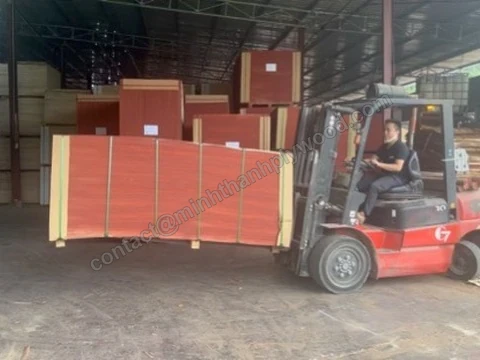
A forklift moves the completed pack, the warehouse handling unit.
Minh Thanh’s MOQ is one 40HC, with mixed specifications arranged with the factory. Write individual quantities instead of a percentage mix alone. A precise schedule lets the factory identify the packs and lets the importer reconcile receiving counts with the packing list.
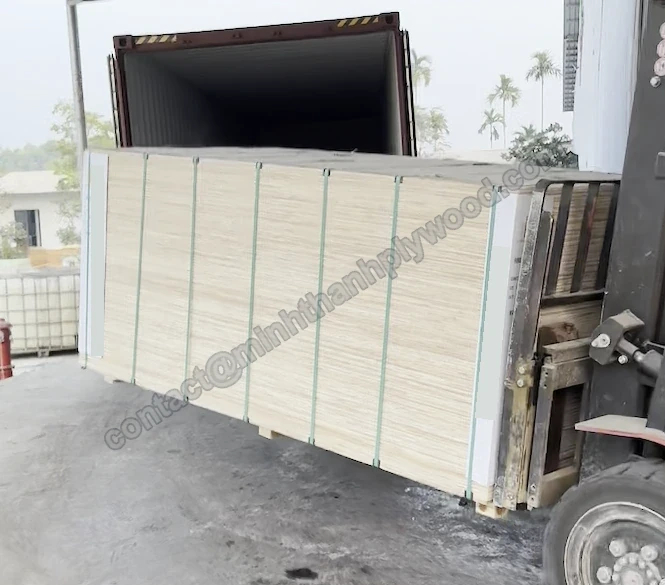
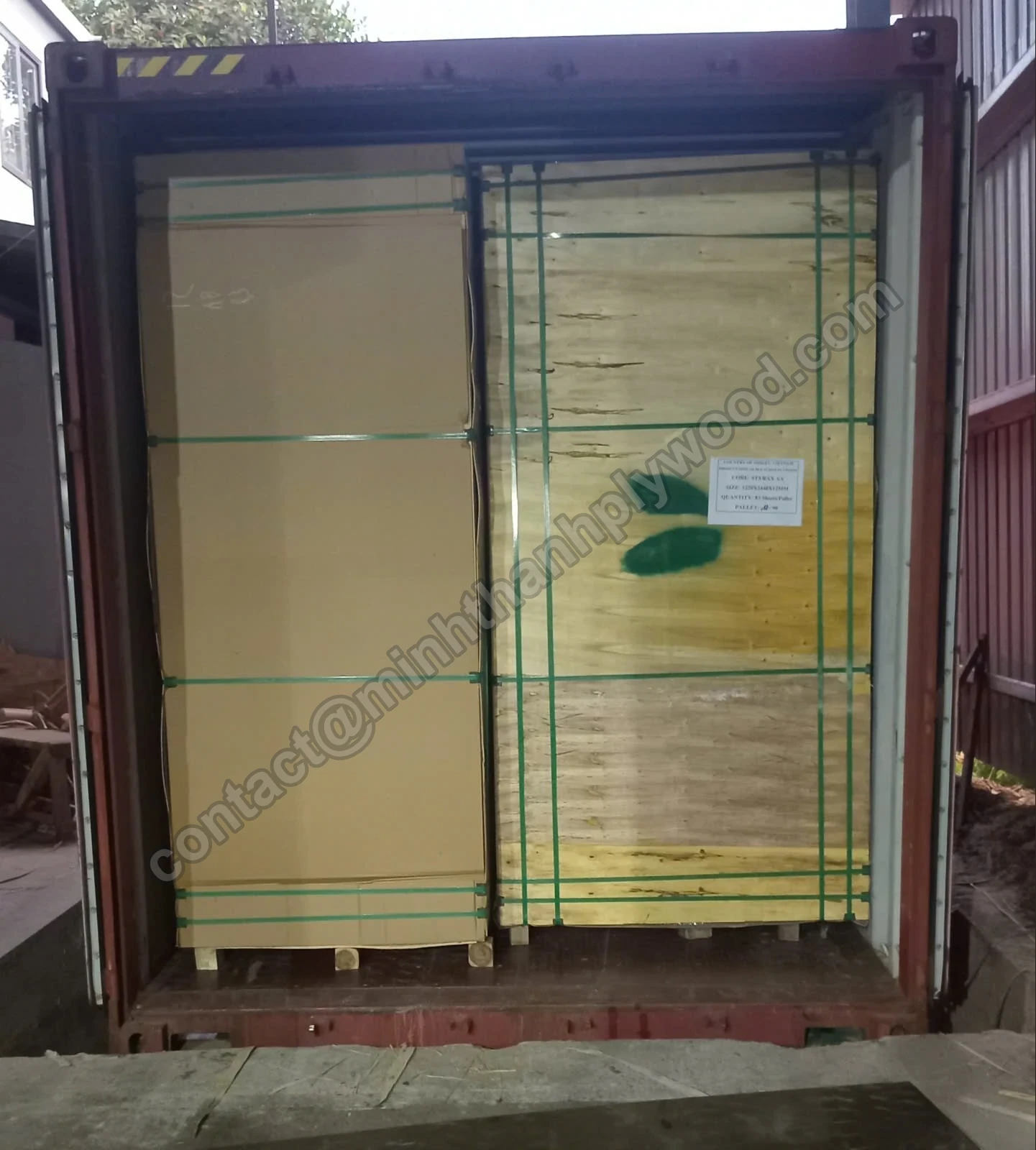
Completed packs loaded to the container door; their protection counts in the cargo total.
How are cargo mass, container tare and VGM different?
Cargo mass covers goods plus packing; container tare is the empty container mass; verified gross mass includes both. The maximum gross rating on the container and the booking’s cargo allowance therefore answer different questions.
The International Maritime Organization’s packed-container mass guidance, consulted 8 October 2026, explains the verified gross mass requirement. Its weighing framework addresses the packed container. A panel-only calculation belongs earlier in planning and cannot replace the completed shipment’s required mass process.
Use the actual container tare when turning cargo mass into gross container mass. Do not copy a generic tare from a search result into every booking. The carrier’s cargo allowance, the container rating and road or rail restrictions all need to support the intended movement.
A dispatch record should distinguish calculated net panel mass, measured pack mass and verified gross mass. That separation helps investigate discrepancies without changing the purchased quantity. If a pack count is correct but the cargo mass differs, check the packing and measurement basis before assuming sheets are missing.
The factory loading plan supports the cargo side of this process. The shipper named on the bill of lading or sea waybill is responsible for providing verified gross mass. The shipment workflow can arrange weighing and submission; state who performs each task and its timing alongside production and inspection.
Will lighter plywood always reduce freight cost?
A lighter core reduces freight per usable sheet when mass limits the load and the required application accepts that construction. If the physical pack layout limits the shipment first, lower mass alone does not increase the number of delivered sheets.
Compare freight on the basis the buyer actually purchases: delivered sheets, accepted components or usable area at the required thickness. Dividing a container rate by cubic metres can conceal the effect of a different format or yield. A cost worksheet should preserve quantity, mass and usable output together.
The plywood price guide connects factory quotation units with landed cost. Its arithmetic is separate from the shipment mass calculation, but both need the same construction and quantity. Changing the core to reduce mass must also preserve the approved machining, appearance and component performance.
A larger sheet can improve cutting yield while increasing each handling unit’s mass. Cut-to-size supply can simplify the workshop’s material flow while adding more pack lines. Evaluate those changes with the factory and receiving team rather than optimising one logistics number in isolation.
Minh Thanh’s furniture panels use stitched cores and double pressing. Those preparation steps belong in the product comparison alongside freight. The purchasing decision is the cost of the required accepted component delivered to the workshop, with a cargo plan that can be executed.
Which errors should you catch before booking?
Catch unit errors, wrong core assumptions and missing packing before the forwarder receives the cargo schedule. The highest-impact checks are simple enough to include in a purchasing handover.
- Match each worksheet line to the latest dimensions and core on the purchase order.
- Verify that millimetres became metres, including thickness.
- Recalculate one sheet independently and compare the result with the worksheet.
- Identify whether each mass is panel-only or completed-pack mass.
- Add loose securing material without counting pack packaging twice.
- Apply the actual booking and route cargo limits.
- Reconcile the final sheet and pack counts with the packing list.
Aligned sheet edges let the dispatch team count each pack before weighing.
A measured difference should lead to a documented correction of the input that changed. Increasing the density assumption without checking dimensions can hide a wrong thickness. Reducing the packing allowance to fit more sheets creates a schedule that fails when protection is added.
Keep the calculation date and revision beside the shipment plan. The factory’s production lead time is 15–45 days after deposit, so a booking made from an early enquiry may precede a final quantity or packing revision. Update the mass worksheet when the approved schedule changes.
What should you send for a weight-based quotation plan?
Send a complete panel schedule and the cargo constraints together so the quotation and loading plan describe the same order. Include application, face/back grade, core, bond and emission requirement, dimensions and tolerance, sheet quantity, packing and destination.
Add the booking’s cargo cap when it is available, plus the destination warehouse’s pack handling limits. If you already have representative sheet or pack measurements, identify the construction and moisture condition behind them. That gives the factory a useful basis for reconciling planning values with dispatch weights.
For furniture procurement, include the finishing route and component drawing so the core decision serves the product as well as the shipment. The load-capacity guide addresses supports and component loading separately. A correct material weight does not replace that application qualification.
Minh Thanh supplies free samples and quotes FOB Hai Phong, CFR or CIF. Use the contact page to send the specification lines and destination, or email contact@minhthanhplywood.com with the subject “Plywood weight and packing plan”. Start with the packing calculator to prepare the reference schedule, then carry the final pack measurements into the booking.
Buyer questions, answered
How do I calculate the weight of plywood?
Multiply length, width and thickness in metres, then multiply by the finished panel density in kg/m³. The answer is panel mass in kilograms. Add all packing materials separately to calculate the shipment's gross cargo mass.
How much does an 18 mm plywood sheet weigh?
A 1220 × 2440 × 18 mm sheet has a calculated volume of 0.0535824 m³. It weighs 26.79 kg at the 500 kg/m³ Styrax planning density or 34.83 kg at the 650 kg/m³ Eucalyptus planning density, excluding packing. Use measured panel mass for the final loading schedule.
Is 3/4-inch plywood the same weight as 18 mm plywood?
Three-quarter inch is exactly 19.05 mm, which is thicker than 18 mm. A trade-labelled sheet can have a different actual thickness. Enter its specified or measured thickness and actual length and width in the calculation.
Can I use the face species to select plywood density?
The complete panel construction determines density; a birch face does not mean an all-birch core. Minh Thanh's furniture panels use white Styrax or Eucalyptus cores. Choose the core reference for planning and check finished-panel mass before shipment.
Does the plywood packing calculator include all packaging weight?
No. Our packing calculator gives panel mass only. Add pallets, covers, cardboard, straps and wrapping as a separate line; final loading uses the completed pack weights.
How many sheets can I load under a 26,000 kg cargo limit?
For the article's example, reserve an assumed 1,000 kg for all packing, leaving 25,000 kg for panels. At 1220 × 2440 × 18 mm and the stated planning densities, the mass ceilings are 933 Styrax sheets or 717 Eucalyptus sheets. Actual pack geometry, measured mass and route limits can reduce the loading schedule.
Is container tare part of the plywood cargo weight?
Container tare is separate from the goods and packing. Gross cargo mass covers panels plus packing and securing materials; verified gross mass covers that cargo plus the actual container tare. Use the booking's cargo allowance when determining how many sheets to load.
Should I add 8–12% to the mass for moisture?
Minh Thanh's 8–12% dispatch moisture range describes moisture content, not a shipping surcharge to add to a finished-panel density calculation. Use density or measured sheet mass for the same material condition. Adding the range again can double count moisture.
Can a weight calculation tell me plywood load capacity?
Sheet mass is the weight of the material itself; load capacity concerns the supported component and its loading. Capacity requires construction, span, supports, grain direction and design or test evidence. Use the separate plywood load-capacity guide for that decision.
What details do you need for a shipment mass estimate?
Send each line's dimensions, core, panel construction and sheet count, together with the destination, booking cargo limit and required packing. Include any supplied measured sheet or pack mass. Minh Thanh can organise the specification and pack schedule around the order.