
MDF (medium density fibreboard) is an engineered wood panel made from fine wood fibres bonded with resin under heat and pressure. It has no grain and no layers, so it machines and paints cleanly, but it is heavier than most plywood and swells when wet. Minh Thanh Plywood makes furniture plywood and often quotes beside MDF, so this guide covers both sides.
What is MDF board?
MDF is medium density fibreboard: an engineered wood panel made from fine wood fibres mixed with resin and wax, formed into a mat and pressed under heat into a flat board. The fibres lie in every direction, so the board has no grain, no knots and no layers.
That structure explains every strength and weakness of MDF board. The even fibre mass routes and paints like no veneer panel can. The same fibre mass has no long wood fibres crossing each other, so it holds screws less well than plywood, sags sooner on a span and swells when water reaches the edges.
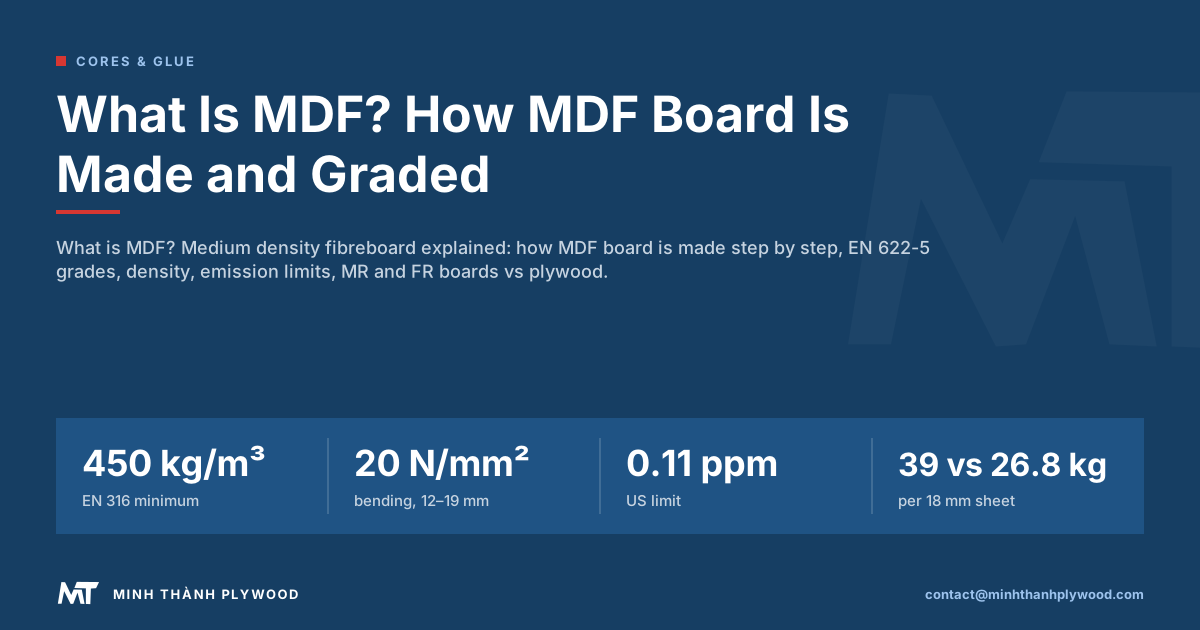
EN 316 classes MDF as a fibreboard made by the dry process with a density of at least 450 kg/m³. Most furniture MDF sits between 600 and 800 kg/m³.
What does MDF stand for, and what is MDF wood made of?
MDF stands for medium density fibreboard, spelled medium-density fiberboard in the US. “MDF wood” and “MDF wooden” panels are made of three ingredients:
- Wood fibres, about 80–90 % of the board by weight: softwood or hardwood from thinnings, plantation logs and sawmill residues. Pine and other softwoods give long, light fibres; eucalyptus, acacia and rubberwood are common in Asia.
- Resin, mostly urea-formaldehyde (UF) for dry interior boards, melamine-urea-formaldehyde (MUF) or polymeric MDI for moisture-resistant boards.
- Wax to slow water uptake, plus dyes and fire retardants for coloured or FR grades.
Because the logs are turned into fibre, MDF can use small and crooked wood that a veneer mill cannot peel.
How is MDF made? The process step by step
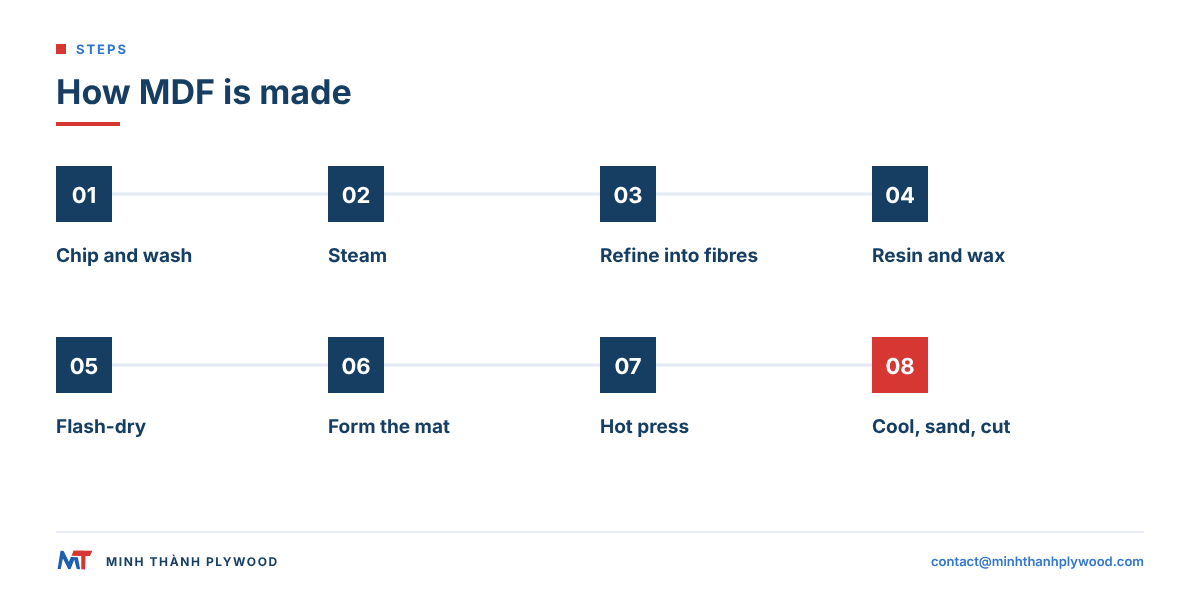
MDF is made in a continuous line that turns wood chips into finished, sanded boards in eight steps:
- Chipping and screening. Logs are debarked and chipped; chips of the right size are screened out and washed to remove sand and stones.
- Steaming. Chips are pre-heated with steam in a digester so the lignin between the fibres softens.
- Refining. A pressurised refiner with two grinding discs pulls the softened chips apart into individual fibres and fibre bundles.
- Resin and wax in the blowline. Resin and wax are sprayed onto the fibres as they leave the refiner in a stream of steam.
- Drying. The fibres are flash-dried in a tube dryer in a few seconds, down to a low moisture content for pressing.
- Forming and pre-pressing. A forming station lays the fibres into an even mat; a pre-press squeezes the air out.
- Hot pressing. A continuous or multi-daylight press compresses the mat to the target thickness and cures the resin. The press profile puts more density near the faces than in the middle.
- Cooling, sanding and cutting. Boards cool on a star cooler, are sanded to thickness and cut to sheet sizes, then labelled with type and emission class.
Plywood is made differently: logs are peeled into continuous veneer sheets, dried, glued in cross layers and pressed. The plywood vs MDF guide shows what that means for a furniture part.
MDF properties: density, strength and surface
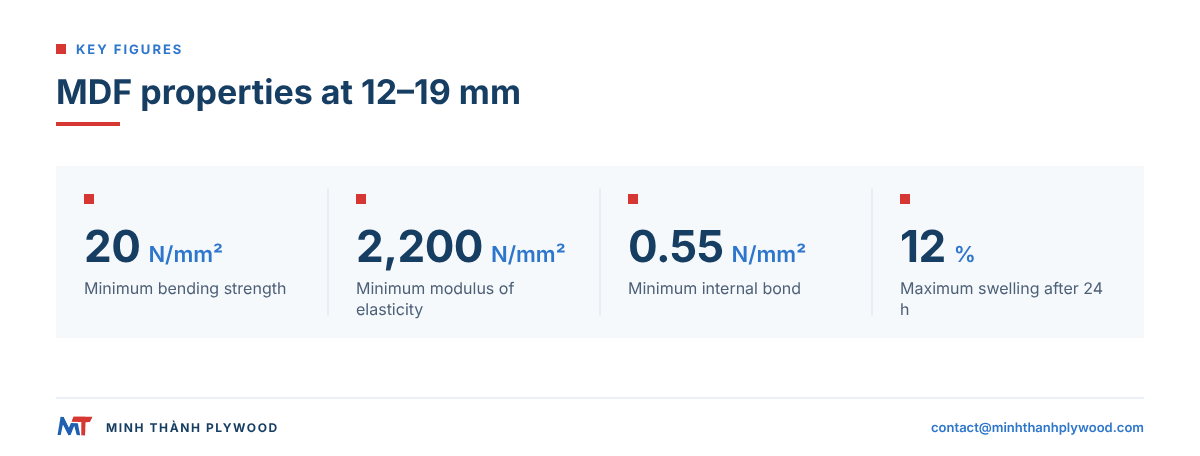
The main medium density fibreboard properties are an even density of about 600–800 kg/m³, moderate bending strength, low screw holding in the edges and a fine, smooth surface. EN 622-5 sets minimum values by thickness; for general-purpose boards of 12–19 mm used in dry conditions, the requirements read:
| Property (EN 622-5, general MDF, 12–19 mm) | Requirement | Test method |
|---|---|---|
| Bending strength | at least 20 N/mm² | EN 310 |
| Modulus of elasticity | at least 2,200 N/mm² | EN 310 |
| Internal bond | at least 0.55 N/mm² | EN 319 |
| Thickness swelling after 24 h in water | at most 12 % | EN 317 |
Two properties do not show in the table and matter on a furniture line:
- Density profile. The faces are denser than the core. Routing exposes the softer core, which needs more primer than the face.
- Edge screw holding. Screws driven into the edge split the fibres apart unless the hole is pre-drilled and the screw is designed for fibreboard.
MDF types and grades under EN 622-5
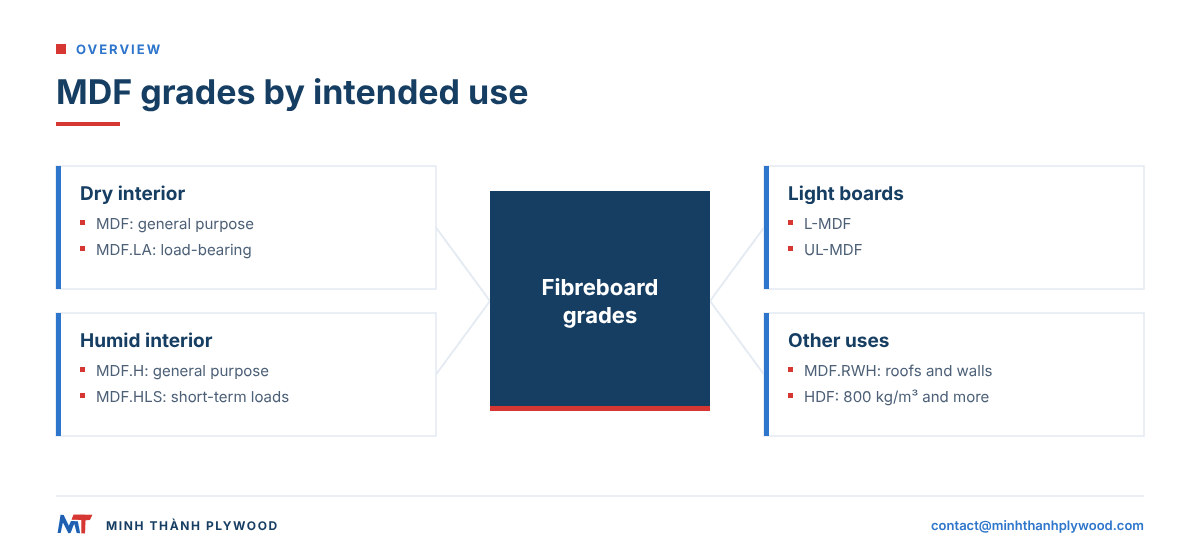
EN 622-5 names MDF types by where the board is used and whether it carries load. Buyers in Europe quote these symbols; buyers elsewhere often say “standard”, “MR” and “HDF” for the same boards.
| Symbol | Meaning | Typical use |
|---|---|---|
| MDF | General purpose, dry conditions | Furniture panels, painted doors, shelving in dry rooms |
| MDF.H | General purpose, humid conditions | Kitchen and bathroom furniture, window boards |
| MDF.LA | Load-bearing, dry conditions | Structural parts in dry interiors |
| MDF.HLS | Load-bearing, humid conditions, short-term loads | Load-bearing parts in humid interiors |
| L-MDF, UL-MDF | Light and ultralight MDF | Lighter furniture parts, display panels |
| MDF.RWH | Rigid underlay in roofs and walls | Sarking and wall boards |
| HDF | High density fibreboard, 800 kg/m³ and more | Laminate flooring cores, door skins, drawer bottoms |
In the market, the light grades are often called “light MDF” and HDF is sold as its own product. The fibreboard guide places all of them on one density ladder from softboard to hardboard.
Formaldehyde emission classes for MDF
MDF is one of the composite wood products that every major market limits for formaldehyde. The limits a buyer meets in 2026:
| Market and rule | Limit for MDF | Method |
|---|---|---|
| US: CARB Phase 2 and TSCA Title VI | 0.11 ppm; thin MDF (8 mm and under) 0.13 ppm | ASTM E1333 or ASTM D6007 |
| EU: E1 class in EN 13986 | 0.1 ppm | EN 717-1 chamber |
| EU: Regulation (EU) 2023/1464, from 6 August 2026 | 0.062 mg/m³ for furniture and wood-based articles | Chamber test under REACH Annex XVII, entry 77 |
The US limits come from the EPA’s TSCA Title VI rule and the CARB composite wood products programme; the EU limit is in Regulation (EU) 2023/1464. Boards made with no added formaldehyde (NAF), usually with MDI resin, are sold for buyers who want the lowest emission.
For comparison, the US limit for hardwood plywood with a veneer core is 0.05 ppm. Minh Thanh’s furniture plywood, made with UF glue at E0 emission, averaged 0.014–0.032 ppm in six ASTM D6007 chamber tests between April 2025 and June 2026.
Moisture-resistant, fire-retardant and coloured MDF
Coloured MDF tells the type at a glance, by a trade convention rather than a standard:
- Green: moisture-resistant (MR) MDF, made with MUF or MDI resin and more wax, sold as MDF.H in Europe. It slows swelling in humid rooms; it is not waterproof.
- Red or pink: fire-retardant (FR) MDF, treated to reach a reaction-to-fire class for shopfitting and public buildings.
- Black or through-coloured MDF for exposed decorative edges.
Exterior MDF, made with MDI resin or from acetylated fibres (sold under the Tricoya name), is a separate product for outdoor joinery. The moisture-resistant MDF guide compares MR, exterior MDF and plywood with phenolic glue in wet areas.
What MDF does well
MDF does three things better than any veneer panel: a smooth surface, clean routed profiles and an even board without defects.
- Paint and lacquer. There is no grain to raise and no veneer joint to show, so a sprayed finish is flat after sanding and primer.
- Routing and CNC profiles. Shaker doors, V-groove panels, bead and butt panelling and tongue and groove MDF panels are cut straight into the board, with no layers in the profile.
- No knots, splits or voids. Every sheet is the same, so offcuts and nesting plans behave alike.
- Price per cubic metre. Standard MDF is usually cheaper than furniture plywood of the same thickness.
Where MDF falls short
MDF falls short in four places: water, screws, weight and long spans.
- Water. Raw edges absorb water and swell; the swelling does not go back when the board dries. Seal every cut edge and drilled hole in kitchens and bathrooms.
- Screw holding. Screws in the edge strip out under repeated load. Hinges on MDF doors need cup-hole inserts or confirmat screws.
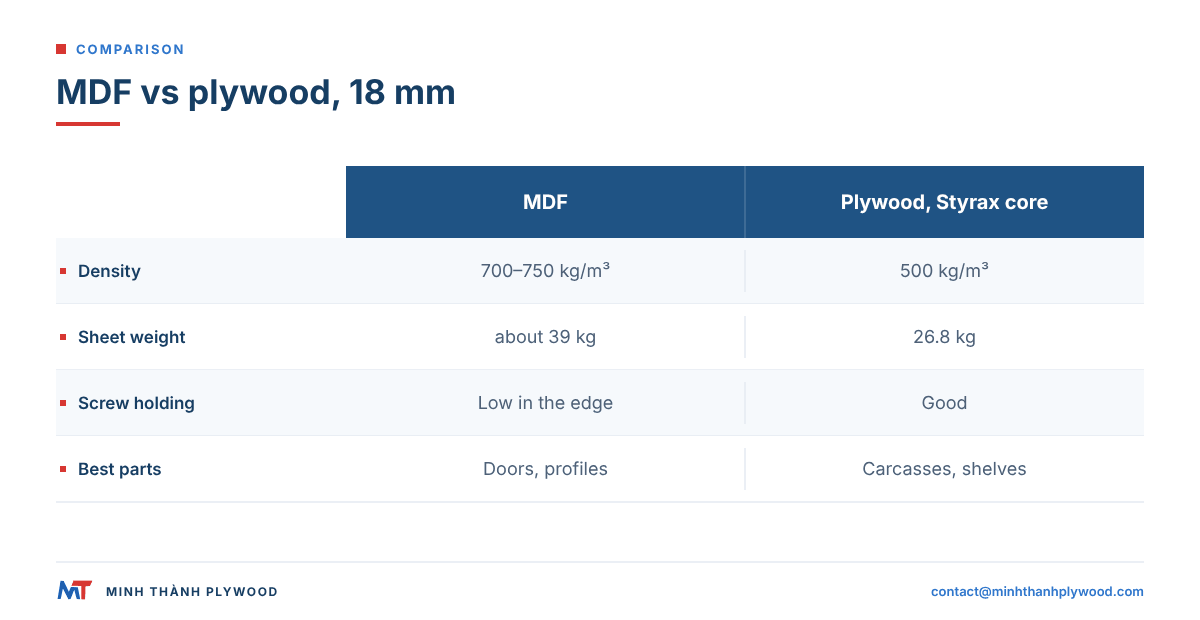
- Weight. An 18 mm MDF sheet of 1220 × 2440 mm at 730 kg/m³ weighs about 39 kg, against 26.8 kg for Styrax-core plywood. That is heavier to handle, heavier in a container and heavier on wall hangers.
- Spans. A shelf of MDF sags under a constant load sooner than plywood of the same thickness, so shelves need closer supports or a thicker board.
Is MDF safe to cut?
MDF is safe to cut with controls: it releases fine dust that irritates the eyes, nose and lungs, and the resin can release formaldehyde, which the International Agency for Research on Cancer (IARC) classes as carcinogenic to humans. Cut with dust extraction attached to the saw or router, work outdoors or in a ventilated space, and wear an FFP2 or FFP3 mask; UK Health and Safety Executive (HSE) guidance asks employers to control wood dust at source, and the same practice suits a home workshop. Seal cut edges after machining to hold the dust and emissions in the board.
MDF vs plywood: which panel for which part?
Plywood is the better panel for structure and moisture; MDF is the better panel for painted and routed faces. Most good kitchens use both, each where it works.
| Metric | MDF (general, 18 mm) | Furniture plywood (Styrax core, 18 mm) |
|---|---|---|
| Build | Fibres in all directions, no layers | 11–13 cross-laminated veneer plies |
| Density | 700–750 kg/m³ | 500 kg/m³ |
| Sheet weight, 1220 × 2440 mm | about 39 kg | 26.8 kg |
| Screw holding (face and edge) | Low in the edge | Good in face and edge |
| Bending over a span | Sags sooner | Stiffer for its weight |
| Painted finish | Flawless | Good with poplar or EV face, primer |
| Routed profiles | Clean | Shows layers in the profile |
| Water at the edges | Swells, does not recover | Depends on glue; phenolic for wet areas |
| Typical parts | Doors, fronts, mouldings, wall panels | Carcasses, shelves, drawers, worktop cores |
Minh Thanh’s furniture plywood is stitched horizontally and vertically in the core, pressed twice and sanded to ±0.2–0.3 mm, with both faces UV-ready for the buyer’s own coating. For a full part-by-part comparison, read plywood vs MDF; for chipboard, see particle board vs plywood.
MDF sheet sizes and thicknesses
MDF is sold in more sheet sizes than plywood because continuous presses cut any length. The common formats:
- 1220 × 2440 mm (4 × 8 ft), the format shared with plywood, and the full UK sheet.
- 1220 × 610 mm (4 × 2 ft) and 1220 × 1220 mm (4 × 4 ft), the cut sizes UK DIY stores stock beside the full sheet.
- 2070 × 2800 mm and 1830 × 2440 mm, common European and Asian mill sizes.
- Thickness from 2.5 mm HDF to 40 mm and more; UK cutting services list 3, 6, 9, 12, 15, 18, 22 and 25 mm.
Sheet weight follows thickness. At 730 kg/m³, a 1220 × 2440 mm sheet weighs:
| Thickness | Sheet weight |
|---|---|
| 3 mm | 6.5 kg |
| 6 mm | 13.0 kg |
| 9 mm | 19.6 kg |
| 12 mm | 26.1 kg |
| 15 mm | 32.6 kg |
| 18 mm | 39.1 kg |
| 22 mm | 47.8 kg |
| 25 mm | 54.3 kg |
| 18 mm Styrax-core plywood, for comparison | 26.8 kg |
UK shelf prices for a full 18 mm standard sheet run from about £28 at Wickes and B&Q to about £43 at a builders’ merchant; a 12 mm sheet is about £23 and a 6 mm sheet about £20.50. Moisture-resistant 18 mm sheets cost more, at about £43 to £52, and veneered MDF costs several times a plain sheet. The matching Styrax-core plywood sheet is 0.0536 m³: at US$350/m³ FOB that is a raw FOB example of about US$19 per sheet before freight, duty and margin, not a shelf price.
Cut-to-size services work to ±1 mm on CNC machines, with a minimum part of 100 × 50 mm, and they advise keeping screws at least 20 mm from an edge so the board does not crack. Primer applied by a spray service costs about £55 per side per square metre.
Plywood from Minh Thanh comes in 1220 × 2440 and 1250 × 2500 mm, plus custom sizes such as 1220 × 2500 and 1220 × 2280 mm, at 3–40 mm. Cut-to-size panels, one sheet cut into 4, 6 or 8 pieces, ship regularly to Italy and other European markets.
Where MDF is used
MDF is used wherever a part is painted, lacquered, foiled or routed and stays dry:
- Kitchen and wardrobe doors, drawer fronts and painted furniture panels.
- Skirting boards, architraves, window boards and other mouldings.
- V-groove and tongue and groove wall panelling.
- Speaker cabinets, where the dense, even mass damps vibration.
- Shopfitting and displays, with FR MDF where a fire class is required.
- HDF for laminate flooring cores, door skins and drawer bottoms.
For carcasses, shelves and parts that carry load or meet humidity, buyers switch to plywood. The best plywood for furniture guide lists the plywood grades that replace MDF in those parts.
How to check MDF on delivery
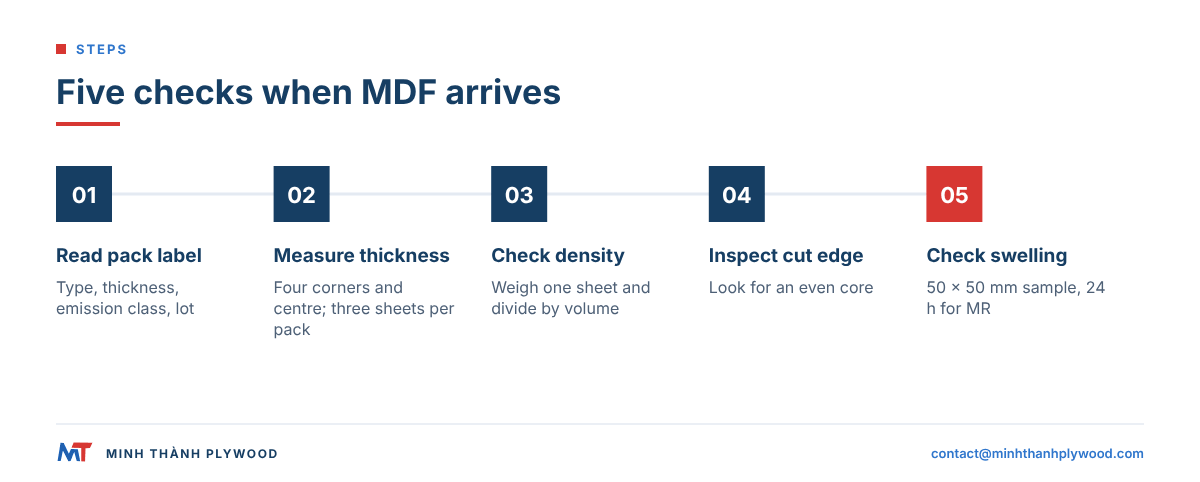
Check MDF on arrival in five steps before it goes to the line:
- Read the label on every pack: type (MDF, MDF.H, FR), thickness, emission class (CARB P2, TSCA Title VI, E1) and lot number.
- Measure thickness at four corners and the centre of three sheets per pack with a caliper; sanded MDF should be within the tolerance on the order.
- Weigh one sheet and divide by its volume to check the density against the quotation.
- Cut one sample and look at the cut edge: a fine, even core with no soft centre band.
- Soak a 50 × 50 mm sample for 24 hours in water (the EN 317 method) if the boards are sold as moisture-resistant, and compare the swelling with the datasheet.
Keep the emission certificate with the lot number for your own customer’s audits.
What to write on an MDF or plywood order
Write the type, the emission rule and the use; “MDF board, 18 mm” alone leaves the grade open. A complete MDF line reads: “MDF.H, 18 mm, 2070 × 2800 mm, CARB P2 / TSCA Title VI, density stated, sanded both faces, for kitchen doors.”
For the carcass and shelf parts, the matching plywood line reads: “Poplar-faced plywood B/B, Styrax core stitched, UF glue at E0 emission, 1220 × 2440 × 18 mm, sanded to ±0.2–0.3 mm, CARB P2 / TSCA Title VI, export packs, one 40HC.” Minh Thanh’s minimum order is one 40HC with mixed specifications by agreement; production takes 15–45 days after the 30% deposit.
Send the plywood line to contact@minhthanhplywood.com or through the quotation form for a price and free samples. For the core options behind that line, see plywood core types and the plywood core and glue guides.
Buyer questions, answered
What is MDF board?
MDF board is a flat panel made of fine wood fibres bonded with resin and pressed under heat. It has an even density through its thickness and a smooth surface, which makes it a common substrate for painted doors, lacquered panels and mouldings.
What does MDF stand for?
MDF stands for medium density fibreboard (medium-density fiberboard in US spelling). EN 316 classes it as a dry-process fibreboard with a density of at least 450 kg/m³.
Is MDF real wood?
MDF is made of wood, but it is not solid wood. Logs and sawmill residues are broken down into fibres, mixed with resin and wax, then pressed into a new panel.
Is MDF stronger than plywood?
For screw holding, bending across a span and impact at the edges, plywood is usually stronger at the same thickness. MDF is stronger where a part needs a crisp routed profile or a flawless painted face.
Is MDF heavier than plywood?
Usually yes. General MDF is around 700–750 kg/m³, while furniture plywood on a Styrax core plans at 500 kg/m³. An 18 mm sheet of 1220 × 2440 mm weighs about 39 kg in MDF against 26.8 kg in Styrax-core plywood.
Is plywood better than MDF?
Plywood is better for carcasses, shelves, hinged parts and anything that meets moisture or load. MDF is better for painted doors, routed fronts and decorative panels in dry rooms. Many kitchens use plywood carcasses with MDF doors.
Is MDF waterproof?
No. Standard MDF swells when it absorbs water, and moisture-resistant MDF only slows that down. For wet areas use exterior-grade boards or plywood with phenolic glue.
What is the green MDF?
Green MDF is moisture-resistant MDF. The green dye is a trade convention that marks the board; the moisture resistance comes from the resin and wax, not from the colour.
What is the formaldehyde limit for MDF?
Under CARB Phase 2 and TSCA Title VI, MDF is limited to 0.11 ppm and thin MDF to 0.13 ppm. In the EU, furniture and wood-based articles must stay at or below 0.062 mg/m³ from 6 August 2026.
Which is more expensive, plywood or MDF?
Per cubic metre, standard MDF is usually cheaper than furniture plywood. The finished part can cost the same or more in MDF once edge sealing, extra hardware and the heavier freight are counted.
What is the difference between MDF and multistrato (plywood)?
Multistrato is the Italian name for plywood: cross-laminated veneer layers. MDF is a uniform fibre panel with no layers, so it machines evenly but holds screws and resists water less well.