
OSB board, short for oriented strand board, is an engineered wood panel pressed from layers of wood strands bonded with resin, with the outer strands aligned along the sheet. It is a structural sheathing panel first. This guide explains how OSB is made, what OSB/1 to OSB/4 mean, and where plywood from a mill such as Minh Thanh Plywood is the better buy.
What is OSB board?
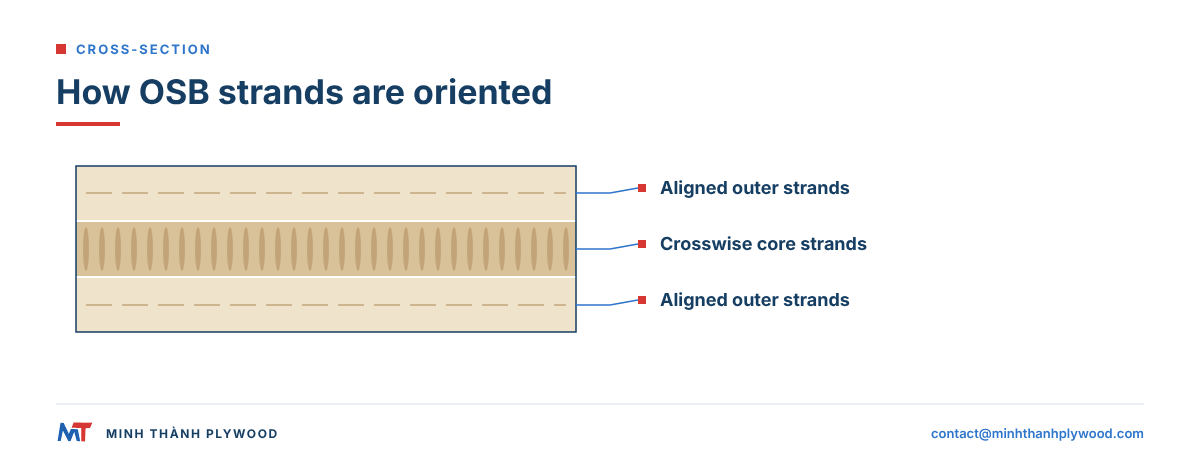
OSB board is an engineered wood panel made from thin wood strands, laid in layers and bonded with resin under heat and pressure, with the strands of the outer layers aligned along the length of the sheet. That alignment gives it strength and stiffness along the panel, the way a long grain does in solid wood.
OSB is a structural panel first. Most of it goes into wall, roof and floor sheathing in timber-frame houses, where it does the same job as structural plywood at a lower cost per sheet. Smaller volumes go into I-joist webs, packing, hoardings and shelving.
Three facts set OSB apart from plywood:
- Strands, not veneers: OSB uses short strands cut from logs, so it can use small, fast-growing trees such as aspen, pine and poplar.
- Uniform through the sheet: there are no core gaps, knots or overlaps, because there are no continuous veneer sheets.
- Sensitive at the edges: when water reaches a cut edge, the strands swell and the swelling does not fully recover.
OSB board sizes, weights and prices in the UK
Most UK OSB is OSB3 sold in three thicknesses and a few sizes. The table lists the sheets that merchants such as B&Q, DIY Building Supplies and Selco list, with trade prices read in October 2026. Prices vary by merchant, brand and pack size.
| Sheet | Size | Weight | Trade price per sheet |
|---|---|---|---|
| SterlingOSB Zero OSB3, 9 mm | 2400 × 1200 mm (B&Q lists 2397 × 1197 mm) | about 16 kg | £14.25 ex VAT, £17.10 inc VAT |
| SterlingOSB Zero OSB3, 11 mm | 2440 × 1220 mm | about 20 kg | £14.00 ex VAT, £16.80 inc VAT |
| SterlingOSB Zero OSB3, 18 mm | 2440 × 1220 mm | about 32–33 kg | £18.56 ex VAT, £22.27 inc VAT |
| SterlingOSB Zero T&G, 18 mm, TG4 | 2400 × 590 mm | about 15 kg | £14.50 ex VAT, £17.40 inc VAT |
| Handy board, 11 mm | 1829 × 607 mm | about 7 kg | £13.39 ex VAT, £16.07 inc VAT |
| Handy board, 18 mm | 1829 × 607 mm | about 12 kg | £22.28 ex VAT, £26.74 inc VAT |
At these weights OSB3 runs at about 600 kg/m³. Merchants also sell 11 mm and 18 mm handy boards in 1220 × 606 mm and 610 × 610 mm, and 9 mm boards in 600 × 600 mm and 1200 × 600 mm. Packs of 50 sheets at 18 mm, 82 at 11 mm and 100 at 9 mm are common for trade orders.
The “Zero” in SterlingOSB Zero means no added formaldehyde in the resin. The Selco range is FSC certified.
UK sheets carry CE or UKCA marking to EN 13986.
They are graded to EN 300. CE marking is set by the Construction Products Regulation (EU) No 305/2011.
For comparison, Minh Thanh’s 18 mm plywood on a Styrax core weighs 26.8 kg per sheet, about a sixth less than OSB3 of the same size. Commercial plywood starts from US$250/m³ FOB. As a raw FOB example, not a sheet price, one 18 mm sheet is roughly a nineteenth of a cubic metre, so that rate is about US$13 per sheet before freight, duty and VAT. Importers who supply sheathing, packing and hoarding work can compare it with the OSB shelf prices above.
What does OSB stand for? Sterling board OSB, Aspenite and waferboard
OSB stands for oriented strand board. The letters O-S-B describe the build: wood strands, oriented in set directions, pressed into a board. Several other names refer to the same family of panels.
| Name | What it means | Where you hear it |
|---|---|---|
| OSB, oriented strand board | The standard name | Everywhere |
| Sterling board | Ordinary OSB, named after the SterlingOSB brand | United Kingdom and Ireland |
| Aspenite | An early Canadian trade name for aspen strand panels | Canada, older usage |
| Waferboard | The forerunner of OSB, made of wider wafers laid at random | North America, older usage |
| Flakeboard | A loose name for strand and flake panels | Older usage |
| Stirling board | A misspelling of sterling board | United Kingdom |
Waferboard came first. OSB replaced it once mills learned to cut narrower strands and align them in layers, which raised the stiffness along the sheet. Today, “sterling board” and “OSB board” mean the same product in a British merchant’s yard.
How is OSB made?
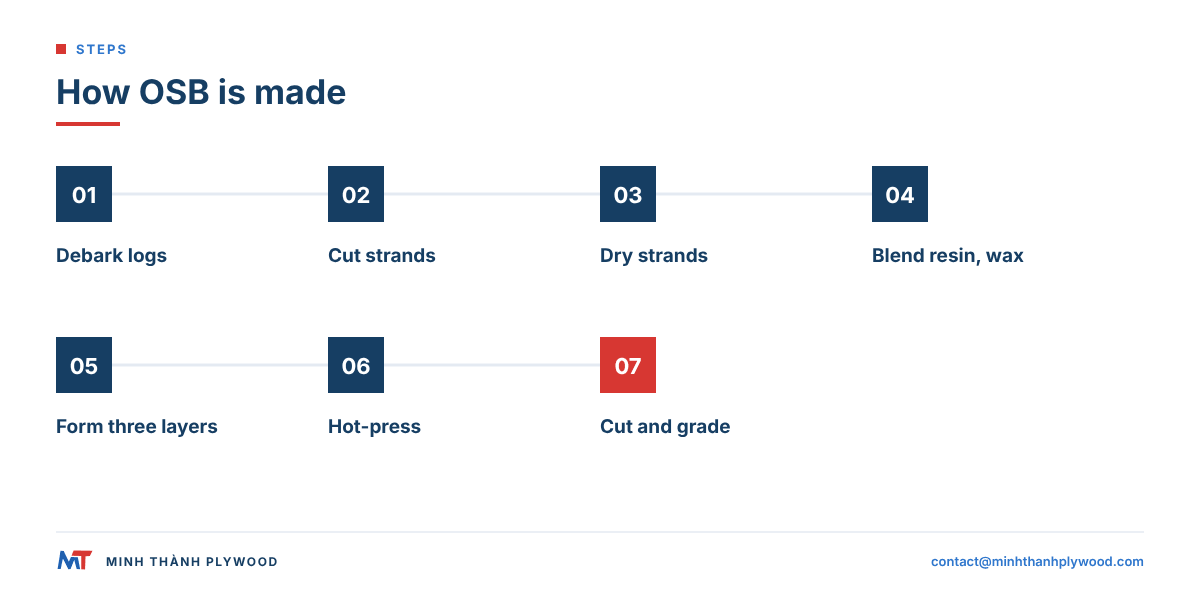
OSB is made in seven steps, from debarked logs to sanded or unsanded panels. The whole line runs continuously, which is part of why OSB is cost-effective in large volumes.
- Debark and soak the logs: small-diameter logs of aspen, pine, poplar or similar species are debarked and conditioned.
- Cut the strands: a strander slices the logs into thin, narrow strands along the grain.
- Dry the strands: rotary dryers bring the strands down to a low, even moisture content.
- Blend with resin and wax: strands are coated with resin, usually MDI for the core and MDI, phenolic or melamine-urea resin for the surfaces, plus wax for water repellence.
- Form the mat: forming heads lay three layers; the outer layers are aligned along the sheet and the core layer is laid across it or at random.
- Hot-press: the mat is pressed in a continuous or multi-opening press until the resin cures.
- Cut, grade and finish: the board is cut to size, graded, and edge-profiled for tongue and groove or sanded where the order needs it.
The aligned outer layers make OSB stronger along its strength axis, usually the long panel direction. Roof and floor panels normally span supports along that axis; wall sheathing can be installed horizontally or vertically, with the edge support and fastening required by the design.
What are OSB/1, OSB/2, OSB/3 and OSB/4?
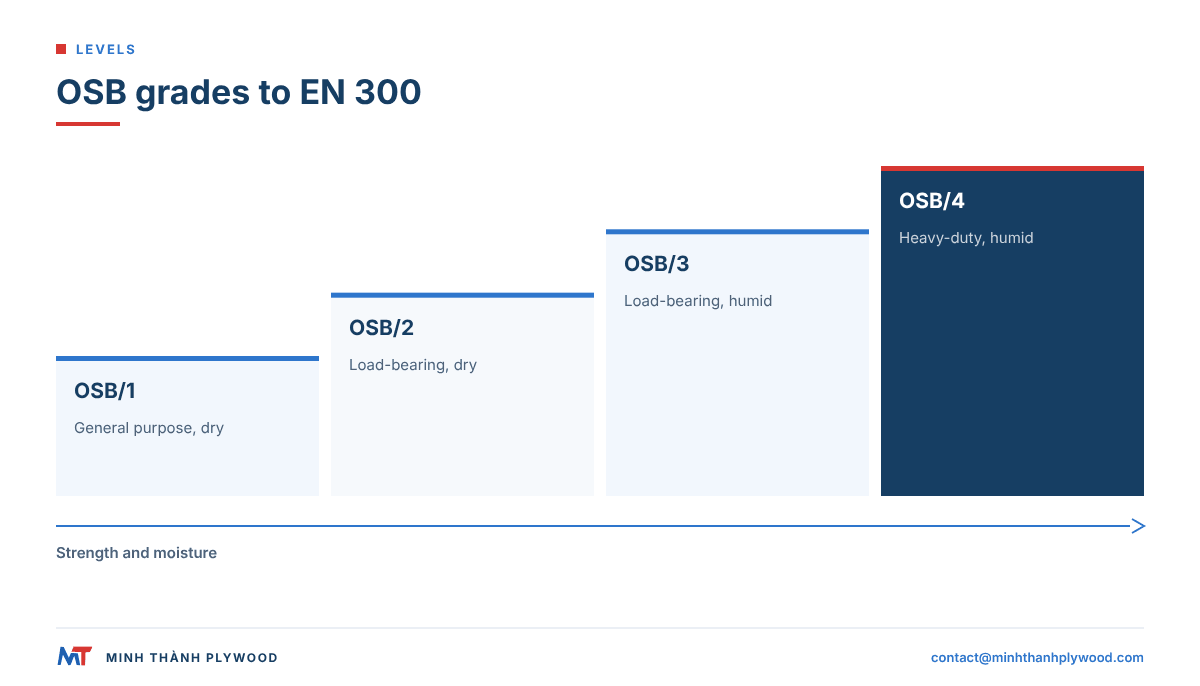
OSB/1, OSB/2, OSB/3 and OSB/4 are the four grades of the European standard EN 300, set by intended use and by the moisture conditions the board must withstand. The number rises with strength and moisture resistance.
| Grade (EN 300) | Defined use | Moisture conditions | Typical jobs |
|---|---|---|---|
| OSB/1 | General purpose and interior fitments, including furniture | Dry | Shelving, display, interior linings |
| OSB/2 | Load-bearing | Dry | Interior floors and walls in heated buildings |
| OSB/3 | Load-bearing | Humid | Roof, wall and floor sheathing, site hoardings |
| OSB/4 | Heavy-duty load-bearing | Humid | Highly loaded floors, roofs and structural parts |
OSB/3 is the grade most builders’ merchants stock in Europe, and it is what “OSB” usually means on a British or German job site. Humid conditions in EN 300 mean covered conditions with occasional moisture, such as a ventilated roof or a timber-frame wall; they do not mean permanent exposure to rain.
Common European sizes are 1250 × 2500 mm and 1220 × 2440 mm, with square or tongue-and-groove edges, in thicknesses such as 9, 12, 15, 18 and 22 mm.
OSB grades in North America: rated sheathing and Exposure 1
North American OSB is graded by performance rather than by the EN 300 classes: a panel carries a span rating, a bond classification and a grade stamp under the voluntary product standard PS 2. The APA guide to OSB describes the stamps and the uses each rating covers.
What a North American OSB stamp tells you:
- Span rating: the support spacing the panel is rated for, such as a roof and floor pair of numbers.
- Bond classification: Exposure 1 for panels that may be wetted during construction; Exterior for permanent exposure, which is rare for OSB.
- Use: rated sheathing, rated Sturd-I-Floor for single-layer floors, or siding.
Structural plywood carries the same kinds of stamps, so a plywood and an OSB panel with the same span rating can be swapped in the design. That is the basis of the “is OSB stronger than plywood” answer below.
What is OSB used for?
OSB is used mainly as structural sheathing in timber-frame building, and secondly for packing, hoardings and low-cost interior work. Its uses follow its strengths: large sheets, even strength, low cost and no core voids.
- Wall sheathing: bracing timber-frame walls and carrying the cladding.
- Roof sheathing: the deck under tiles, shingles or membranes.
- Subfloors: tongue-and-groove OSB/3 or rated floor panels over joists.
- I-joist webs: the vertical web between timber flanges.
- Site hoardings and temporary works: painted OSB/3 boards around building sites.
- Packing and crates: crate sides, pallet decks and dunnage where the load is dry.
- Interior and shop fitting: OSB/1 shelving, wall linings and display, often clear-lacquered for the strand look.
OSB is used less in concrete formwork, boat building, exposed exterior work and fine furniture. In those jobs, water exposure, repeated use or a smooth face decides, and plywood or MDF usually wins.
Is OSB stronger than plywood?
Neither panel is stronger by rule: structural OSB and structural plywood rated for the same span carry the same design loads. The differences are in stiffness per kilogram, behaviour when wet, fastener holding near edges and surface quality.
| Metric | OSB (OSB/3, rated sheathing) | Structural or exterior plywood |
|---|---|---|
| Design load at the same span rating | Same | Same |
| Weight at the same thickness | Heavier | Lighter |
| Uniformity | Very even; no core voids | Can carry core gaps in lower grades |
| Edge swelling after wetting | Higher; recovers only in part | Lower; recovers better |
| Nail and screw holding near edges | Good | Very good |
| Surface for paint or film | Strand texture shows | Smooth veneer face |
| Repeated use and reuse | Limited | Good, especially film-faced |
| Cost per sheet | Usually lower | Usually higher |
For a dry, covered sheathing job, OSB/3 and plywood perform alike, and price decides. For roofs that stay wet for weeks during building, floors under tiles, formwork and exposed edges, plywood’s recovery from wetting and its cleaner edge make the difference. The detailed comparison is in plywood vs OSB.
Is OSB waterproof?
No. OSB is moisture resistant in its OSB/3 and OSB/4 grades, but it is not waterproof. The resin keeps the board together when it gets wet; the wood strands still take up water and swell, most at the cut edges.
What happens when OSB gets wet:
- Surface wetting during building is acceptable for OSB/3 and Exposure 1 panels if the board can dry out.
- Edge wetting makes the edges swell, and the swelling stays in part after drying.
- Standing water or repeated cycles weaken the surface layers and can lead to soft, uneven floors and roofs.
The protection is the same as for any wood panel: seal cut edges, leave expansion gaps, cover the board quickly and ventilate the structure. Where the panel will be wetted often, an exterior plywood with a water-resistant glue is the safer choice.
What are the disadvantages of oriented strand board?
The disadvantages of OSB are edge swelling when wet, a higher weight than plywood of the same thickness, a rough strand surface and weaker fastener holding near edges. None of them matter in a dry, covered sheathing job; all of them matter in furniture, formwork and exposed work.
- Edge swelling: cut edges absorb water fastest and swell more than plywood edges.
- Weight: OSB is denser than most plywood, so sheets are heavier to lift and to ship.
- Surface: the strand pattern shows through paint and thin finishes; sanding helps but does not remove it.
- Fixings near edges: screws close to an OSB edge can split or pull out sooner.
- Repeated use: OSB is a poor choice for formwork or crates that are reused many times.
- Machining: routed edges and fine profiles come out rough.
Why is OSB expensive at times?
OSB is expensive when housing demand rises faster than mill capacity. Most OSB goes into new homes, so its price follows housing starts more closely than plywood does, and a small number of large producers supply most of the market.
The main price drivers:
- Housing starts in North America and Europe, the largest users of OSB sheathing.
- Mill capacity: new OSB lines are large and slow to build, so supply lags demand.
- Resin and energy: MDI resin, drying and pressing are large shares of the cost.
- Freight: OSB is heavy for its value, so long-distance freight adds a lot per sheet.
When OSB prices spike, buyers look at exterior or commercial plywood for sheathing, packing and hoardings. A plywood mill quotes those panels by the cubic metre, independent of OSB market swings.
When is plywood the better buy than OSB?
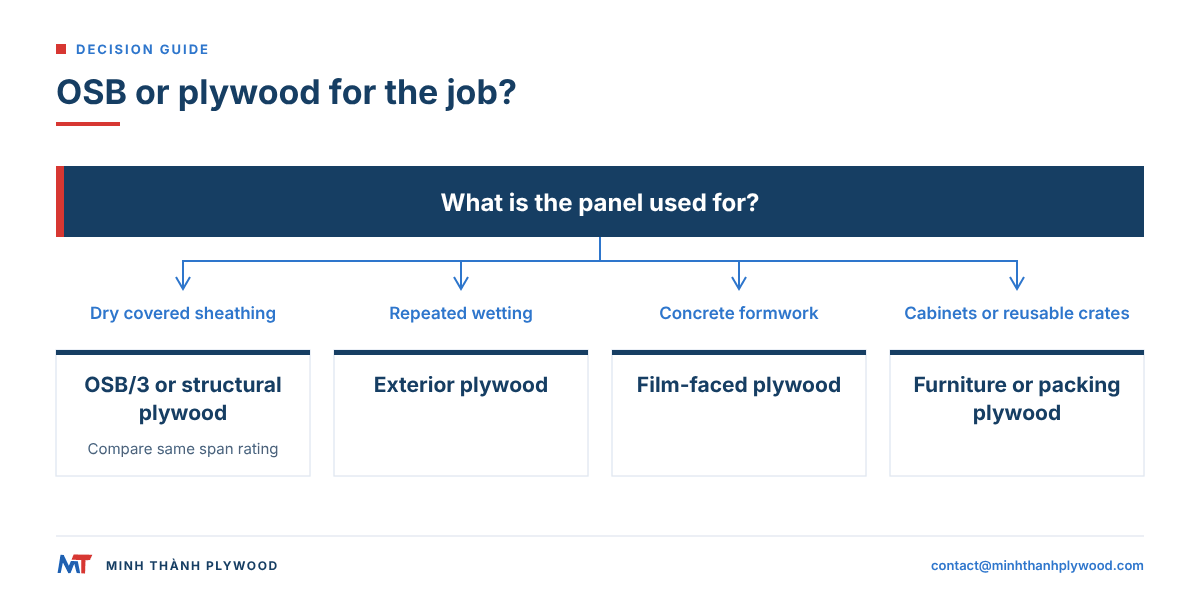
Plywood is the better buy where panels get wet repeatedly, are reused, are machined or are seen. In those jobs, the cost per use matters more than the price per sheet.
| Job | Better panel | Why |
|---|---|---|
| Dry wall and roof sheathing | OSB/3 or structural plywood | Same design loads; price decides |
| Roofs left open for weeks | Exterior plywood | Better recovery after wetting |
| Concrete formwork | Film-faced plywood | Reuse cycles and a smooth concrete finish |
| Reusable crates and export packing | Packing plywood | Lighter, holds nails near edges, cleaner cut edges |
| Stair treads and wet areas | Exterior plywood with water-resistant glue | Edge swelling is the risk with OSB |
| Cabinets and furniture | Furniture plywood | Flat sanded faces, edge screw holding |
Minh Thanh makes the plywood side of this table. Exterior and CDX-type plywood uses utility C/D faces with melamine-fortified or phenolic (WBP) glue for stair treads and wall sheathing. Commercial and film-faced plywood is held to ±0.5 mm thickness tolerance, and packing plywood to ±0.5–1.0 mm. See exterior and CDX-type plywood, packing plywood and film-faced plywood.
OSB, MDF and particle board: how do they differ?
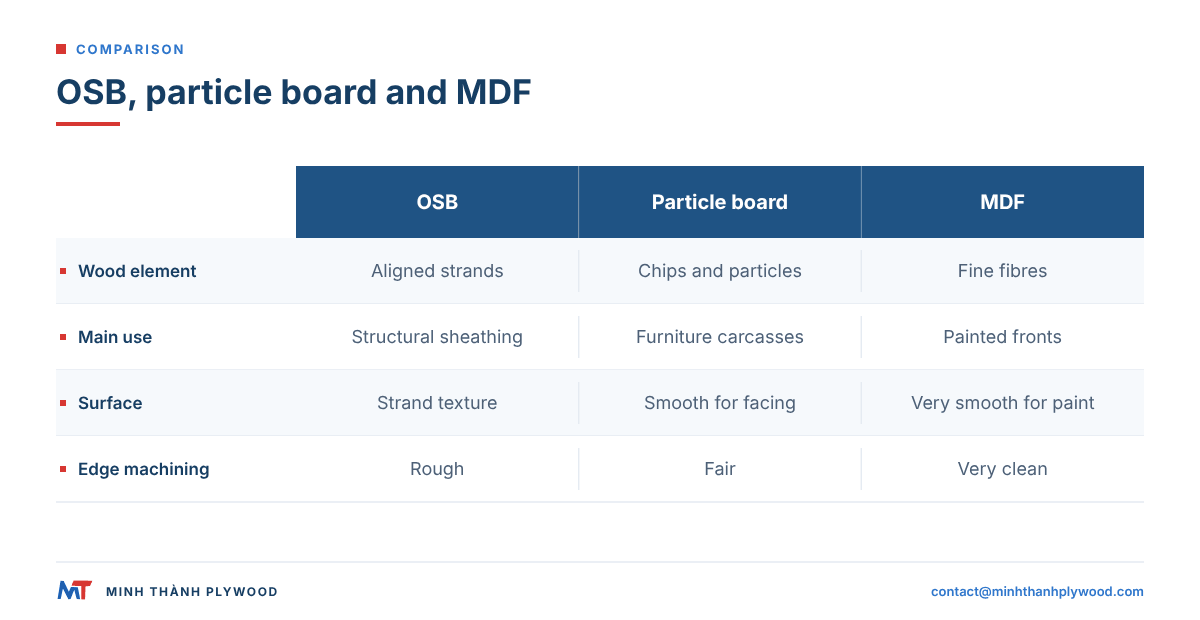
OSB, MDF and particle board are all wood panels pressed with resin; they differ in the size of the wood pieces. OSB uses long strands, particle board uses small chips, and MDF uses fibres refined almost to dust.
| Metric | OSB | Particle board | MDF |
|---|---|---|---|
| Wood element | Long, aligned strands | Chips and particles | Fibres |
| Main use | Structural sheathing | Furniture carcasses, worktops | Furniture fronts, mouldings |
| Strength along the sheet | High | Low | Medium |
| Surface | Strand texture | Smooth, for melamine paper | Very smooth, for paint |
| Edge machining | Rough | Fair | Very clean |
| Structural rating | Yes, OSB/2 to OSB/4 | Only special grades | Rarely |
Plywood sits apart from all three because it uses continuous veneers. The guides on particle board and MDF cover those panels in depth.
Does OSB contain formaldehyde?
Most OSB is made with MDI resin in the core, which contains no added formaldehyde; some boards use phenolic or melamine-urea resins in the surface layers, which do. The emission class of a board is stated by the producer and is a separate line from the resin type.
The same rule applies to plywood: glue type and emission class are two specifications. Minh Thanh’s furniture plywood uses UF glue at E0 emission, and its MR, melamine-fortified and phenolic bonds are made to the buyer’s specification. When you compare OSB and plywood offers, ask each supplier for both lines: the resin and the tested emission class with its method.
What to specify when you buy OSB or a plywood alternative
Specify the grade, the size, the edge, the thickness and the moisture conditions, so the supplier quotes the panel the job needs. For OSB, the grade line carries most of that; for plywood, write the glue and face grade as well.
- Use and conditions: for example, roof sheathing, covered, humid.
- Panel and grade: OSB/3 to EN 300, or exterior plywood with WBP phenolic glue.
- Size and edge: 1250 × 2500 mm or 1220 × 2440 mm; square edge or tongue and groove.
- Thickness and tolerance: for example, 18 mm, ±0.5 mm.
- Packing and quantity: packs per container and the destination port.
When the job points to plywood, Minh Thanh quotes exterior, commercial, packing and film-faced plywood from one 40HC, with mixed specifications by agreement and free samples. Send your sheathing or packing specification to contact@minhthanhplywood.com, or compare the panels in the cores and glue guides and the plywood core types guide.
Buyer questions, answered
What size and weight is a sheet of OSB3 in the UK?
The standard sheet is 2440 × 1220 mm in 11 mm and 18 mm, and 2400 × 1200 mm in 9 mm. An 18 mm sheet weighs about 32–33 kg, and trade prices in October 2026 ran from about £14 to £19 ex VAT per sheet depending on thickness.
What does OSB stand for?
OSB stands for oriented strand board. The name describes the build: wood strands, oriented in layers, pressed into a board.
Is OSB board the same as plywood?
No. Plywood is made of continuous veneer sheets laid cross-grain; OSB is made of short wood strands pressed with resin. Both are structural panels, but they behave differently with water, fasteners and finishes.
What is sterling board?
Sterling board is the common British name for OSB, taken from the SterlingOSB brand. It is ordinary oriented strand board, usually OSB/3.
Is OSB stronger than plywood?
Panels rated for the same span carry the same design loads, so neither is stronger by rule. Plywood is stiffer per kilogram, holds fasteners better near edges and recovers better from wetting; OSB has no core voids and is more uniform.
Is OSB waterproof?
No. OSB/3 and OSB/4 are made for humid conditions and short exposure during building, but OSB is not waterproof. Edges swell when they stay wet, so it needs cover, edge sealing and ventilation.
What is OSB used for?
Mainly wall, roof and floor sheathing, I-joist webs, site hoardings, packing and crates, and low-cost shelving. Furniture-grade OSB/1 is used for visible interior surfaces with a strand look.
What are the disadvantages of oriented strand board?
OSB swells at the edges when wet, is heavier than plywood of the same thickness, shows its strand texture through paint, and holds screws less well near the edges.
Which OSB grade should I use for roofs and walls?
In Europe, OSB/3 is the standard grade for load-bearing walls, roofs and floors in humid conditions; OSB/4 is for heavy-duty load-bearing use. In North America, use rated sheathing with the span rating the design calls for.
Why is OSB so expensive at times?
OSB prices follow housing starts closely, because most OSB goes into new homes. When building demand rises faster than mill capacity, prices jump; resin and energy costs add to it.
Can OSB be used for furniture?
OSB/1 can, for open shelving or a deliberate strand look. For cabinets, doors and painted parts, plywood or MDF gives flatter faces, cleaner edges and better screw holding.
Is OSB board cheaper than plywood?
Usually, yes, for sheathing grades of the same thickness. The gap narrows or reverses in high-demand markets, and plywood often wins on cost per use where panels are reused or exposed to water.