
Container loading · Ha Hoa, Vietnam
Plywood container loading: plan the packs and the weight
In short
Minh Thanh Plywood plans plywood container loading by pack size and cargo weight. Our 40HC plan carries 990 sheets of 18 mm Styrax-core plywood or 795 sheets of Eucalyptus core, within 28,000 kg of panels. The container has room for 16 packs on their side and 2 upright at the door. We weigh the panels, photograph the loading and send you the shipment record.
Watch the film
Plywood container loading: 990 sheets in one 40HC
The film follows the 40HC space plan, the weight calculation and the loading record. Its 18 mm examples use our standard plan of up to 28,000 kg of panels: 990 Styrax, 880 Acacia or 795 Eucalyptus sheets, checked against your booking.
Watch how nominal pack height gives the first sheet count, then how core density reduces the load. Loading-day photos show packs entering on their side, the door-end arrangement and the seal.
The final chapters cover mixed specifications and shipping documents. The measured panel and packing weights are used for the loading list; a lower booking limit governs the actual shipment.
Shipment documentation
Match the order documents to the plywood specification.
Each container ships with the compliance documents its order needs: CARB P2 / TSCA Title VI documents (ICTT mill no. 23024) for US orders and the EUDR timber-origin dossier.
What is plywood container loading?
From booking to sealed container: who does what, and when.
Plywood container loading is the last step at the factory. It runs on a fixed sequence, and you see the result before the doors close.
In shortPlywood container loading is the planned stowage of strapped plywood packs into a shipping container at the factory, by forklift, in an order that keeps the load inside the payload, stops packs from shifting at sea and makes unloading easy. For plywood the 40HC (40 ft high cube) is the standard container.
| Stage | When | Who | What you receive |
|---|---|---|---|
| Loading plan | With the quotation | Our export team | Packs per container, sheets per pack, m³ and estimated weight |
| Container booking | When production is on schedule | Your forwarder on FOB; us on CFR or CIF | Loading date and the payload allowed on that booking |
| Empty container check | Before the first pack goes in | Our loading team | Photo of the clean, dry, empty container |
| Loading | Loading day | Our loading team; your inspector is welcome | Photos and video while packs go in |
| Final count and sealing | Before the doors close | Our loading team | Photo of the full door end, pack count, seal number |
| Documents | After loading | Our export team | Draft invoice, packing list and B/L for your approval |
Want an inspector at loading? Give us the name and date with the order and we plan the loading around it.
Plywood per container
Plywood per container: lighter cores carry more sheets.
Core density changes the plywood per container before the available space changes. These calculated examples use 1220 × 2440 × 18 mm panels and the same 28,000 kg allowance for panels.
| Core | Density | Sheet weight | Sheets | Volume | Pack split |
|---|---|---|---|---|---|
| Styrax | 500 kg/m³ | 26.8 kg | 990 | 53.0 m³ | 18 × 55 |
| Acacia | 580 kg/m³ | 31.1 kg | 880 | 47.2 m³ | 16 × 55 |
| Eucalyptus | 650 kg/m³ | 34.8 kg | 795 | 42.6 m³ | 15 × 53 |
These are calculated order examples for our standard plan of 28,000 kg of panels; the payload check uses your booking, and a booking capped at 26,000 kg including 1,000 kg of packing gives 932 Styrax, 803 Acacia or 717 Eucalyptus sheets. The pack split keeps every stack within the nominal 1,000 mm height. We weigh the real panels and packing before issuing the loading list.
40HC plywood loading, step by step
40HC plywood loading in seven steps.
Every 40HC plywood loading at Minh Thanh follows the same seven steps, whether the container carries one product or six.
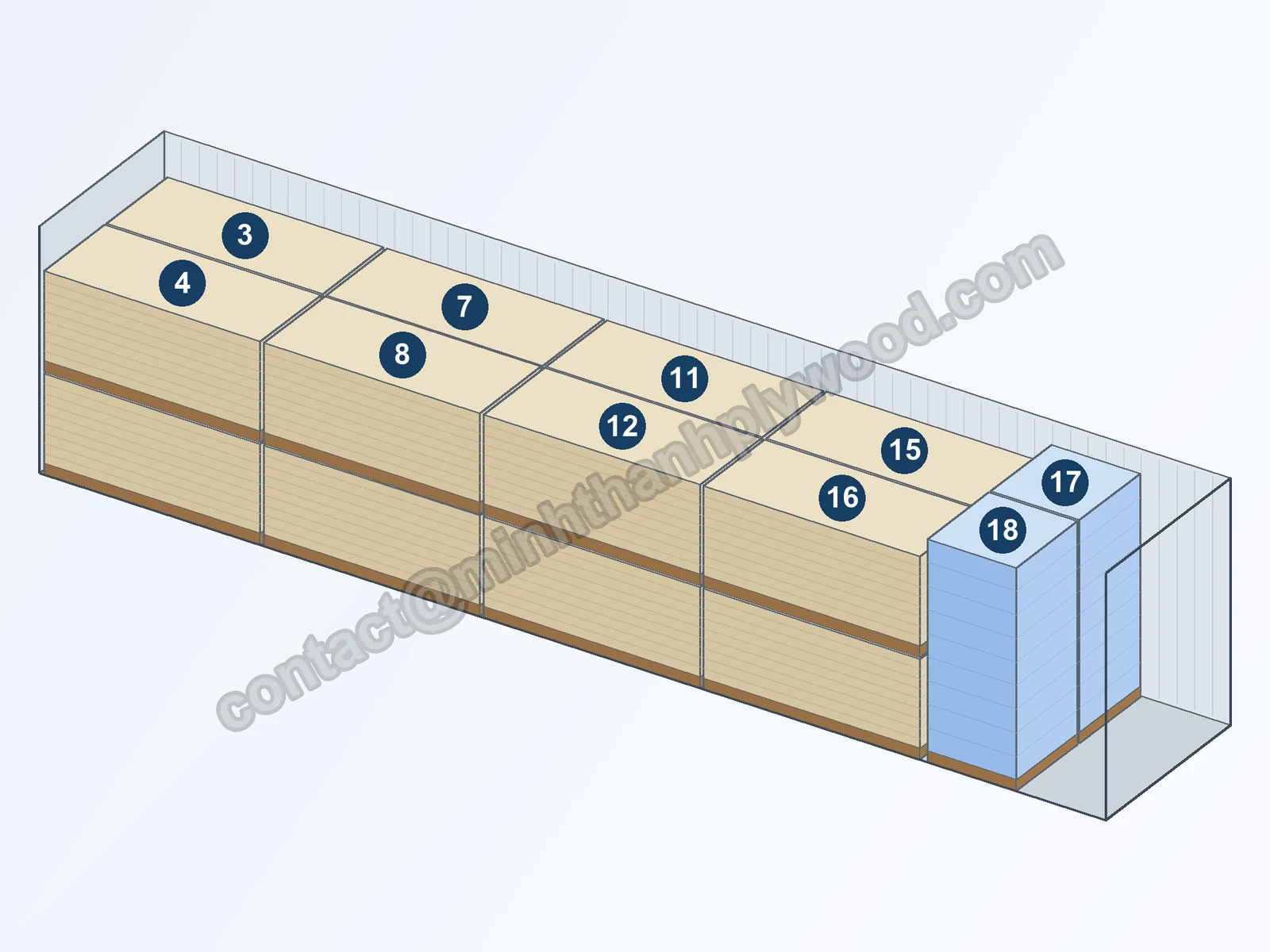
Loading plan: packs 1–16 lie two-high, 17 and 18 stand at the door end (not to scale). 01Plan the load
We calculate sheet volume and weight, reserve the packing allowance, then distribute the sheets across packs. The 18-pack space layout is a ceiling, not a promise to fill every pack to its maximum height.
- Dimensions and density entered for each specification
- Panel weight plus packing within the cargo allowance
- Pack arrangement leaves forklift access at the door
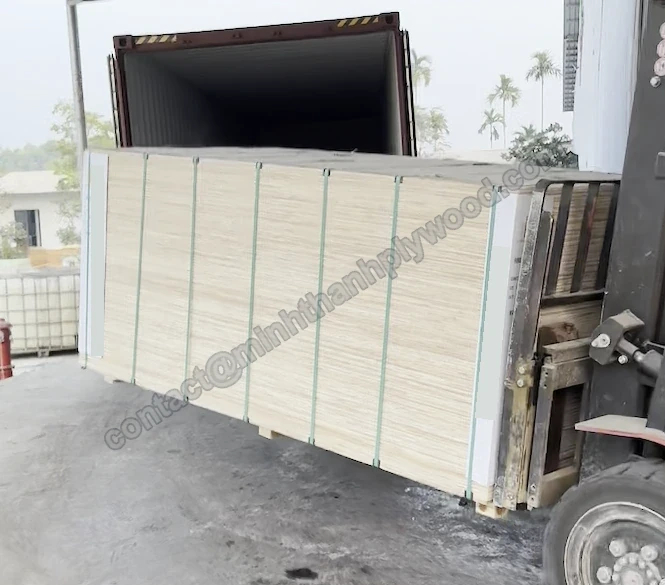
The forklift positions a pack inside the checked container. 02Check the empty container
Before the first pack goes in, the loading team checks the empty container: floor, walls, roof and door seals. A wet, holed or dirty container is sent back, because damp in a sealed box means stained faces on arrival.
- Floor solid, clean and dry
- No holes or light through walls and roof
- Doors close and lock properly
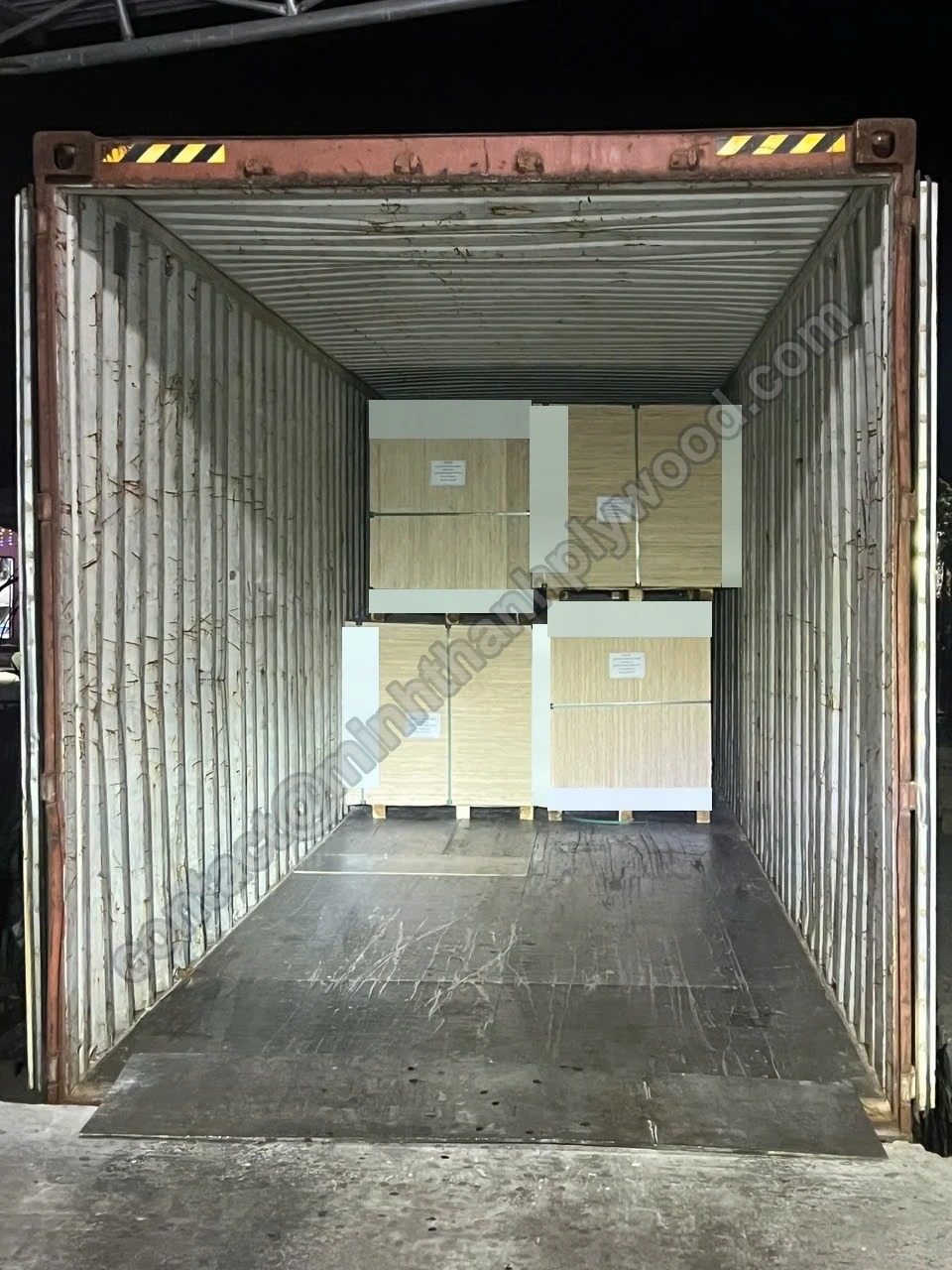
The first four packs, two-high at the front wall. 03Load the front wall first
The first packs go to the front wall, two side by side and two high. Bearers and pack supports align so the rows behind have a square start and the upper packs do not load an unsupported edge. Forks enter square to the pack; the truck follows the centre aisle without driving along the side walls.
- First four packs two-high at the front wall
- Pack supports aligned with the lifting and stacking arrangement
- No gap between the packs and the front wall
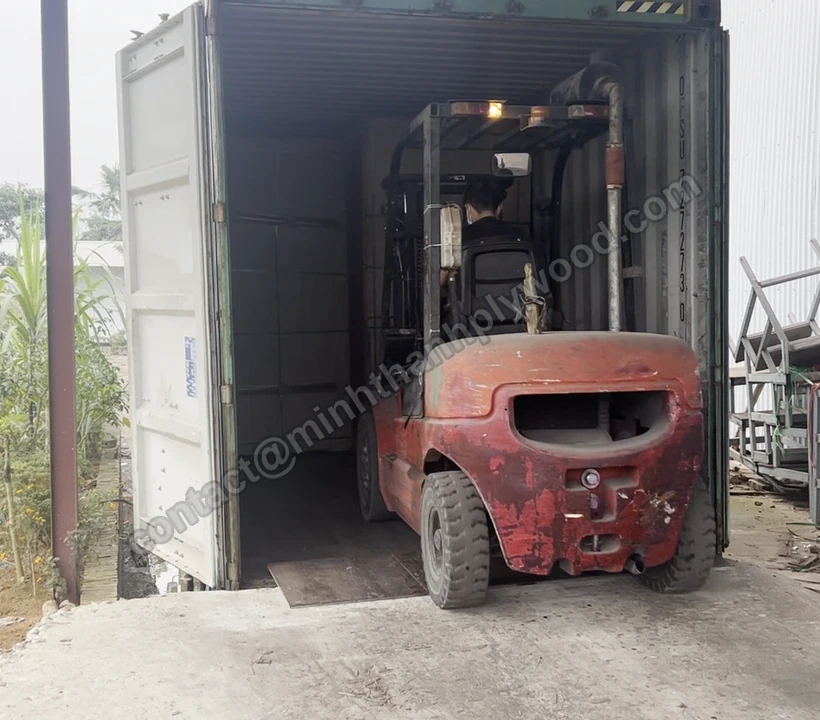
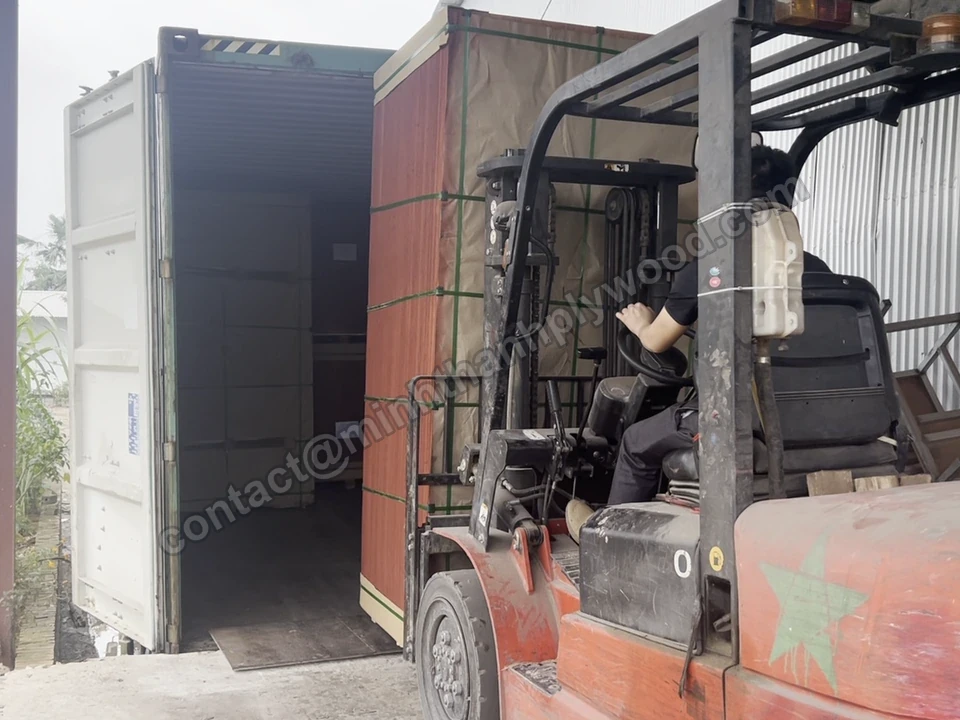
The forklift withdraws after placing a pack. 04Lay the rows of four
The loading team works from the front wall toward the doors, aligning the pack supports and keeping the rows square. Packs are carried on their side and placed two across where the specified layout permits. After each row, the team checks stack support, strap condition and clearance before bringing in the next pack.
- Row arrangement follows the packing plan
- Upper packs centred on the bearers below
- Pack numbers remain identifiable during loading
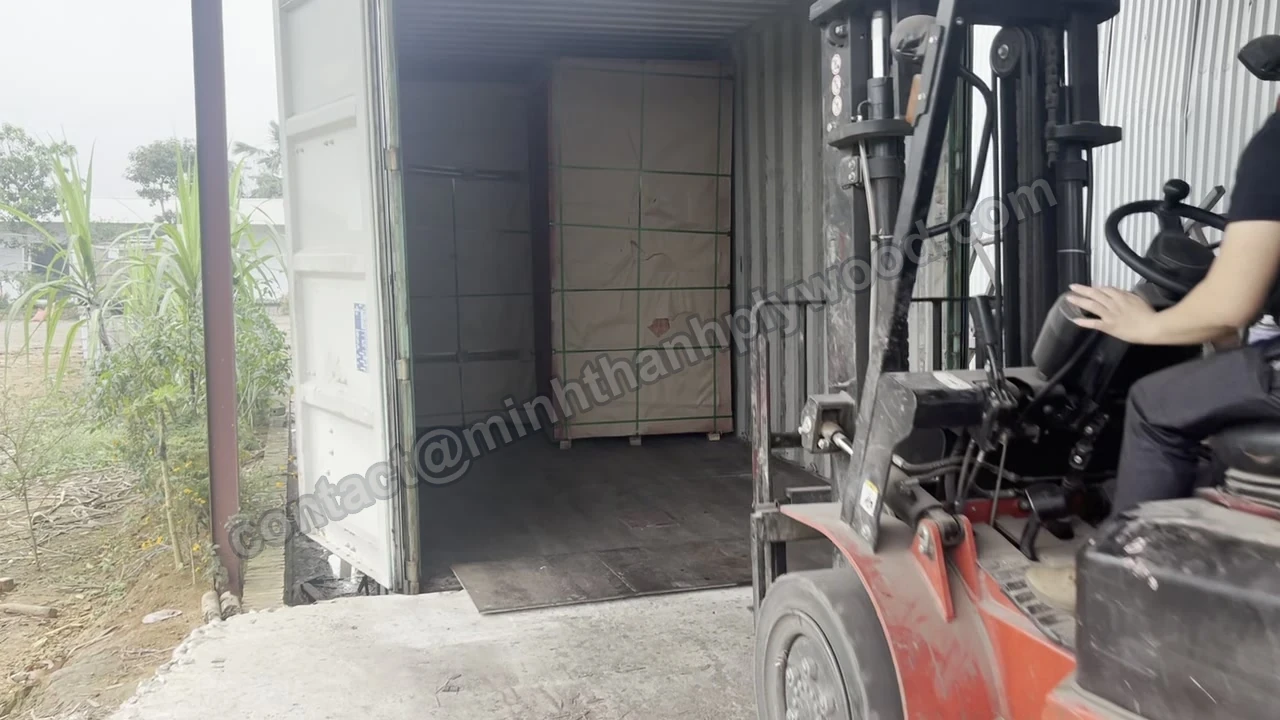
The last pack stands upright at the door end. 05Stand two packs at the door end
A full 16 + 2 arrangement uses two upright packs at the door end. For a shorter load, free space is closed with plywood bracing or air bags. Door-end packs are strapped to the container lashing rings, with clearance left for safe forklift unloading.
- Plywood bracing or air bags close free space
- Door-end packs secured to container lashing rings
- Unloading clearance checked before sealing

Loading filmed from the dock, pack by pack. 06Photograph and film the loading
The loading is photographed and filmed as it happens. Before the doors close you get the full door end, the pack count and the labels by email or WhatsApp.
- Video of packs going in
- Photo of the full door end
- Pack count checked against the packing list

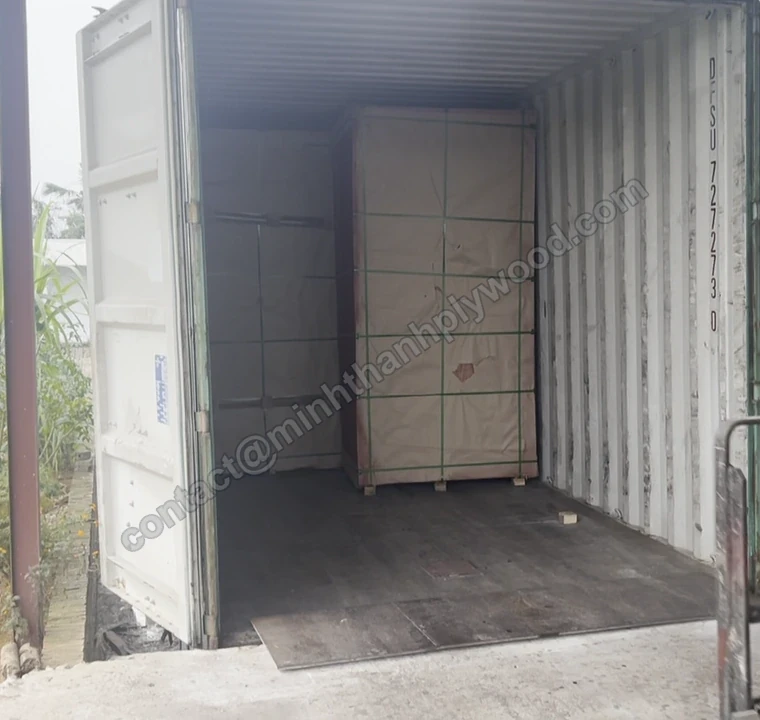
A bolt seal is fitted through the locking handle. 07Seal the container and send documents
The doors are closed and sealed, and the seal number goes on the packing list and the B/L. The container leaves for Hai Phong, and the draft shipping documents come to you for approval.
- Seal number recorded and photographed
- Packing list matched pack by pack
- Draft documents sent for your approval
Real loading videos
Watch plywood container loading at the dock.
Loading clips show packs being placed, the forklift withdrawing and the door seal being fitted. Buyers receive a loading record for their own container.
Loading mistakes we avoid
What goes wrong in plywood container loading, and how we stop it.
Overweight cargo, unsupported packs and unrestrained space cause different problems. We check the cargo mass, the pack supports and the stowage arrangement separately before sealing.
| Mistake | What happens | How we prevent it |
|---|---|---|
| Pack stack above its planned height | Unstable stacks and difficult unloading | Follow the specified sheet count and support arrangement |
| Weight not checked | Load above the booking payload: re-stuffing, delay or extra cost at the port | Panels weighed; sheets per pack reduced when the booking allows less |
| Wet or damaged container | Mould and stained faces after weeks at sea | Empty container checked; a wet or holed box is sent back |
| Unrestrained space | Packs move in transit and corners suffer impact | Plywood bracing or air bags close gaps; door-end packs secured to lashing rings |
| Weak pack bases | Packs crack under the forklift or the pack above | Laminated plywood bearers under every pack, with supports aligned |
| Mixed load without a plan | Wrong pack at the door, slow sorting at your warehouse | Mixed loads planned pack by pack; 1–2 products normally, 3–6 by agreement |
| Count not checked | Disputes over missing sheets or packs | Pack count matched to the packing list and photographed before sealing |
40HC loading numbers
Plywood container loading numbers at a glance.
Use the following inputs to reproduce the loading calculations. Actual panel and packing weights replace the estimates for shipment.
| Container | 40HC (40 ft high cube) |
|---|---|
| Nominal panel stack | 1,000 mm; plywood bearer height additional |
| Maximum full pack at 18 mm | 55 sheets before the weight adjustment |
| Space layout | 16 packs on their side, 2 upright at the door |
| Cargo allowance | 28,000 kg of panels, unless the booking sets less |
| Packing allowance | Checked against the booking; a 26,000 kg booking less 1,000 kg of packing leaves 25,000 kg of panels |
| Planning densities | Styrax 500 kg/m³; Acacia 580 kg/m³; Eucalyptus 650 kg/m³ |
| Packs per 40HC | Styrax 18; Acacia 16; Eucalyptus 15, all of equal height |
| Sheet count rounding | Down to a whole sheet |
| Measured shipment mass | Panels plus packing; container tare added for VGM |
Cargo allowance excludes container tare. Verified gross mass includes the cargo, packing and container itself.
Sources: SOLAS verified gross mass (IMO) · Incoterms 2020 (ICC) · US formaldehyde emission standards · EU timber-origin due diligence
Plywood sheets per container
How many plywood sheets fit in a 40HC, by thickness.
Calculate sheets from the available cargo mass, then check that the pack arrangement fits the container.
Start with one specification at a time. Convert the sheet dimensions to metres, multiply length by width by thickness, and multiply the resulting volume by the selected core density. Round sheet weight to the nearest 0.1 kg, then check that the total load stays within the panel allowance.
Pack height is a separate check. Dividing 1,000 mm by panel thickness gives the maximum sheets in a nominal full stack, without its bearers. A weight-limited load is then spread over suitable packs, keeping those stacks below the full height. Do not multiply the tallest possible pack by every available position and call it a loading quantity.
For mixed thicknesses, give each specification its own pack numbers. Calculate the combined weight of all sheets and packing, and allocate positions in the unloading order. A pack containing one specification lets the receiving warehouse count sheets without splitting mixed bundles.
At destination, compare the seal number before opening, photograph the door-end arrangement, then tally the pack numbers against the packing list. Record broken straps, wet wrapping or damaged corners before moving a pack. Keep the label with the pack until its sheets have been counted.
How to calculate plywood per container
Five calculation steps turn your specification into a loading estimate.
- Calculate sheet volume. For 18 mm sheets: 1.22 × 2.44 × 0.018 = 0.0535824 m³.
- Calculate sheet mass. Multiply by core density; the Styrax example gives 26.7912 kg, rounded to 26.8 kg.
- Reserve the packing mass. Our standard plan allows 28,000 kg of panels. If your booking caps cargo lower, subtract the packing from that limit; a 26,000 kg booking less 1,000 kg leaves 25,000 kg for panels.
- Round the sheet count downward. 28,000 ÷ 26.8 gives 1,044 whole sheets, more than 18 packs of 55 hold, so the Styrax load is 990 sheets. Under a 25,000 kg panel limit it would be 932.
- Replace estimates with measurements. Weigh panels and packing; use the lower cargo limit from the booking when it is below the planning allowance.
| Thickness | Full-pack height limit, sheets | Styrax 500 kg/m³ | Acacia 580 kg/m³ | Eucalyptus 650 kg/m³ |
|---|---|---|---|---|
| 3 mm | 333 | 5,994 | 5,328 | 4,815 |
| 4 mm | 250 | 4,500 | 4,000 | 3,615 |
| 5 mm | 200 | 3,600 | 3,200 | 2,880 |
| 6 mm | 166 | 2,988 | 2,656 | 2,400 |
| 9 mm | 111 | 1,998 | 1,776 | 1,605 |
| 12 mm | 83 | 1,494 | 1,328 | 1,200 |
| 15 mm | 66 | 1,188 | 1,056 | 960 |
| 18 mm | 55 | 990 | 880 | 795 |
| 21 mm | 47 | 846 | 752 | 675 |
| 25 mm | 40 | 720 | 640 | 570 |
| 30 mm | 33 | 594 | 528 | 480 |
Before sealing
Every container photographed and filmed before it is sealed.
Plywood container loading ends with a record you can check. Before the doors close you receive photos and video of your container by email or WhatsApp, and we release the shipment against the same record.
- The empty container before loading
- Packs going in, filmed from the dock
- The full door end and the pack count
- Pack labels, straps and edge protection
- The closed doors and the seal number
Your own inspector or a third-party agency is welcome at loading. Tell us the date with the order.
Seal and documents
What you receive after plywood container loading.
The loading record comes first, before the doors close. Draft shipping documents follow for your approval, and the balance is paid against the scanned B/L.
Loading photos, video and seal number
The empty container, packs going in, the full door end, the pack count and the sealed doors.
Commercial invoice and packing list
Pack by pack: product, thickness, size, sheets per pack, m³ and weight, matched to the pack labels.
Bill of lading
Draft for your approval, then the scanned B/L. The 70% balance is due against the scan.
Origin document
C/O for your market, with EUR.1 for shipments to the European Union.
Phytosanitary and fumigation
Phytosanitary and fumigation papers accompany every shipment.
Insurance on CIF
Insurance certificate on CIF shipments; on FOB and CFR you insure the sea leg yourself.
Product compliance documents are listed on our quality pages and supplied with the order.
Capacity
50,000+ m³ a year, shipped in full 40HC loads.
Minh Thanh plans and loads every container at the factory in Ha Hoa, Phu Tho. One 40HC is the minimum order, and buyers in Europe, the Americas, Asia and Africa order by the container.
About the factoryBefore you order
Six lines we need to plan your container.
Send these six lines with your enquiry and the loading plan comes back with the quotation.
- 01
Thickness and size
Nominal thickness and sheet size, e.g. 18 mm 1220 × 2440 or 1250 × 2500.
- 02
Core
Styrax, Acacia or Eucalyptus; it sets packs and m³ per container.
- 03
Quantity
Sheets, m³ or number of containers; a full 40HC is the minimum.
- 04
Product mix
One or two products per container normally; up to six by agreement.
- 05
Payload
The payload on your booking, if your forwarder has given one.
- 06
Incoterm and destination
FOB Hai Phong, CFR or CIF, and your destination port.
Questions buyers ask
Plywood container loading FAQ.
Short answers to the questions buyers ask most about container loading.
How many plywood sheets fit in a 40HC container?
The 18 mm plan gives 990 Styrax, 880 Acacia or 795 Eucalyptus sheets at 1220 × 2440 mm, in 18, 16 or 15 packs within 28,000 kg of panels. If your booking caps cargo at 26,000 kg including 1,000 kg of packing, the counts are 932, 803 and 717.
How many m³ of plywood are in one 40HC?
The 18 mm examples carry about 53 m³ of Styrax-core plywood, 47 m³ of Acacia and 43 m³ of Eucalyptus. These volumes come from the sheet count and dimensions, with the same panel-weight allowance for each core.
How many packs of plywood go into a 40HC?
The space plan has 18 positions: 16 packs on their side and 2 upright at the door end. The Styrax plan fills those positions with 55 sheets per pack at 18 mm. Acacia uses 16 packs and the denser Eucalyptus 15 packs of 53.
Why do heavier cores load fewer sheets?
The cargo reaches its weight allowance sooner. At 18 mm and 1220 × 2440 mm, the calculated sheet masses are 26.8 kg for Styrax, 31.1 kg for Acacia and 34.8 kg for Eucalyptus at 650 kg/m³ (up to 40.2 kg at 750 kg/m³).
Does the cargo allowance include the container itself?
No. The 28,000 kg plan covers the panels, and a booking limit such as 26,000 kg covers panels and packing. Container tare is added when calculating verified gross mass, the total declared for the loaded container.
Is 28,000 kg the payload of every 40HC?
No. It is the panel allowance used in our standard loading plan. The actual container rating, shipping booking and route govern shipment; a lower booking limit reduces the sheet count.
How are plywood packs secured in the container?
Free space is closed with plywood bracing or air bags, and door-end packs are strapped to the container lashing rings. Pack supports stay aligned under the load, and the loading team checks restraint and forklift clearance before sealing.
Can I mix products in one container?
Yes. One or two specifications per container is normal; three to six are arranged with the order. Each specification has separate pack numbers and its own line on the packing list.
What is the minimum order?
One 40HC container. Send the sheet sizes, thicknesses and quantities together so the quotation can include the full loading arrangement.
Do you ship plywood in 20ft containers?
Our standard quotations and loading plans use 40HC containers. A different container size needs its own dimensions, cargo allowance and packing arrangement; the 40HC sheet counts cannot simply be divided by two.
Will I see the loading record?
Yes. We photograph and film loading, including packs entering the container and the completed door end. After closing, the seal number is recorded with the shipment documents. The photos and video go to you by email or WhatsApp.
Can my inspector attend loading?
Yes. Give us the inspector’s name and attendance date when arranging the shipment. The inspector can check the empty container, pack labels, count and sealing alongside the loading team.
Which Incoterms do you offer?
FOB Hai Phong, CFR or CIF. Your forwarder arranges the booking on FOB; our export team arranges it on CFR or CIF. Payment is 30% deposit and 70% against the scanned B/L.
How do I calculate plywood per container myself?
Divide the available panel mass by the rounded sheet mass and round the count down. Then check pack height and layout. Sheet mass equals length × width × thickness in metres multiplied by density in kg/m³.
Is the loading plan my final packing list?
The loading plan is the order estimate. The final packing list records the actual shipment: specification, pack number, sheets, volume and weight. Compare it with the pack labels when receiving the goods.
Get a loading plan
Send your specification and get a container plan with the quote.
Tell us the thickness, size, core, face, glue and quantity, plus your Incoterm and destination. Lisa replies within hours by email or WhatsApp with the price and the loading plan for your 40HC. Free samples.
contact@minhthanhplywood.com