
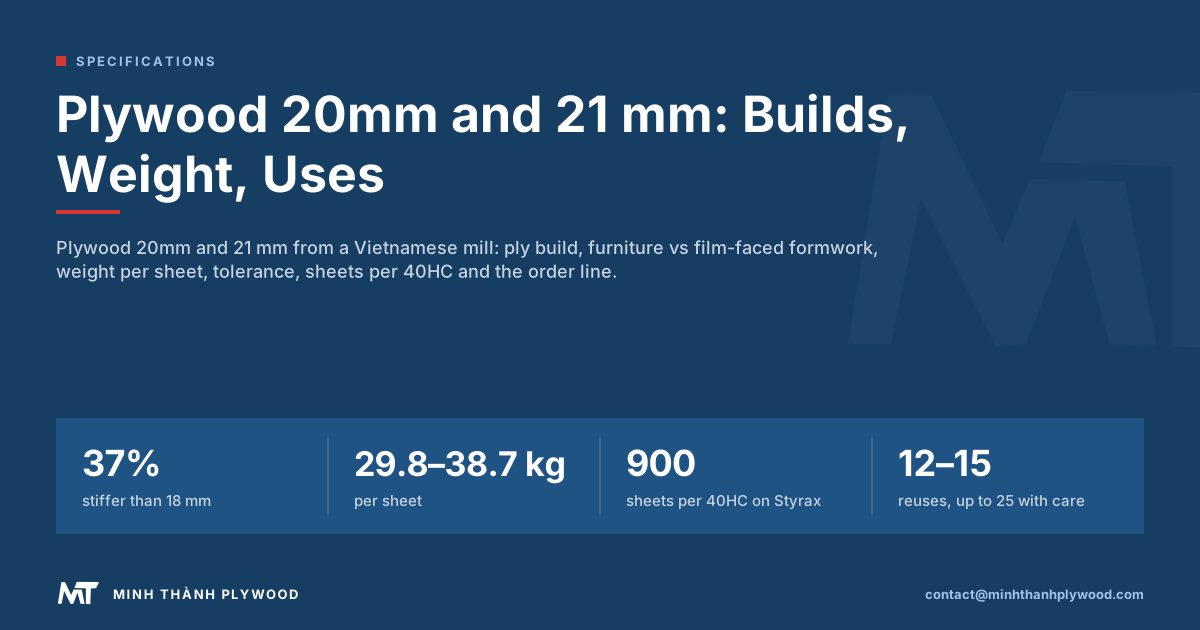
UK high-street shops stop at 18 mm and specialist yards add 21 and 24 mm birch, so 20 mm is a mill size. Two products share it. Sanded 20 mm plywood is a furniture panel for tabletops, heavy shelves and worktop substrates, about 37% stiffer than 18 mm. 21 mm is the film-faced formwork panel with a water-resistant (phenolic or melamine-fortified) bond. Minh Thanh Plywood makes both: a 20 mm sheet weighs 29.8–38.7 kg by core, and a 40HC carries 720–900 sheets.
What is 20 mm plywood, and how does it relate to 3/4 inch?
Plywood 20mm is pressed to a nominal 20 millimetres, one step above the common 18 mm furniture board, from veneers glued with the grain turned at each layer. It is a metric size: the nearest imperial sizes are 3/4 inch (19.05 mm) and 25/32 inch (19.8 mm).
That last millimetre matters more than it looks. A shelf pin, a hinge cup, an edge band or a groove set for 18 or 19 mm stock will not take 20 mm without a change. Buyers who order 20 mm usually do so on purpose: for stiffness, for a heavier-looking edge or to match a drawing.
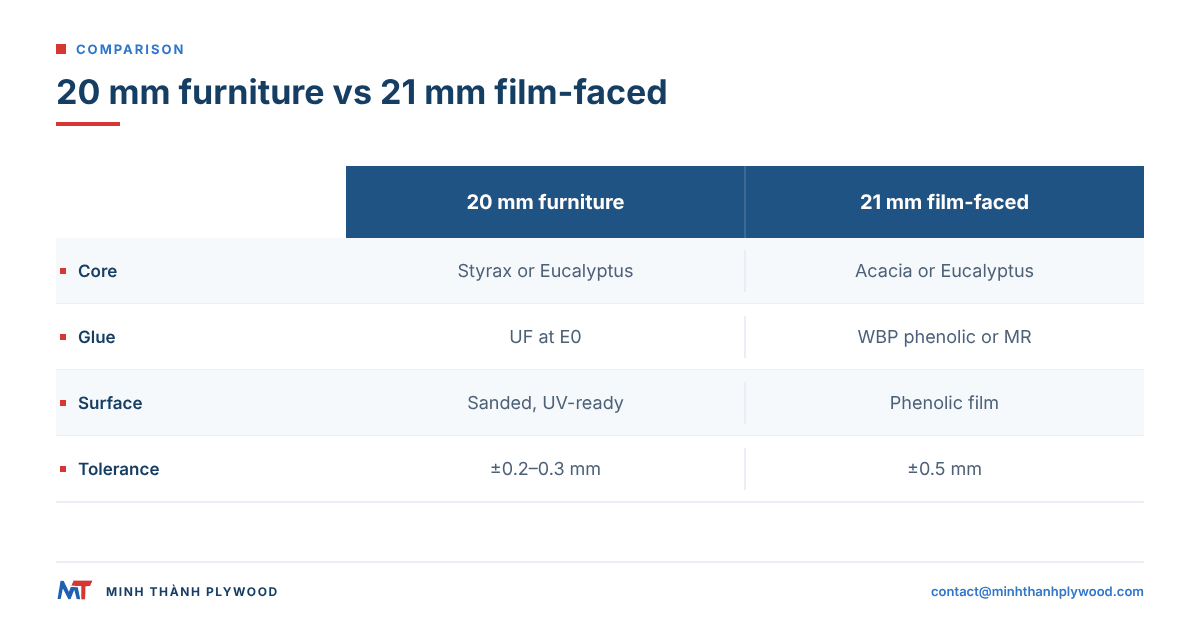
Minh Thanh Plywood makes 20 mm as sanded furniture plywood, held to ±0.2–0.3 mm, so a sheet in a ±0.3 mm order measures 19.7–20.3 mm. The same mill makes 21 mm, the formwork thickness, as film-faced plywood at ±0.5 mm. The two are different products in nearly the same size.
Can you buy 20mm plywood in the UK, or 18, 21 and 24 mm?
Not on a standard UK shelf: Wickes lists plywood at 5.5, 9, 12 and 18 mm, and the 20 mm size is made to order. UK trade buyers stock the steps either side, 18, 21 and 24 mm, and a drawing that calls for 20 mm normally comes from a mill.
| Thickness | UK-stocked product | Listed price, 2440 × 1220 mm | Labels the UK filters on |
|---|---|---|---|
| 18 mm | Non-structural hardwood (Wickes) | £35.80 | Non-structural, E1 |
| 18 mm | Structural softwood (Wickes) | £37.50 | CE2+, EN 636 |
| 18 mm | Birch BB/BB (Sheet Materials Wholesale) | £80.14 | Birch throughout, EN 636 class by glue |
| 20 mm | None on the shelf | none | Mill-made size |
| 21 mm | Sanded birch full board (Ply Direct), film-faced formwork | by quote | Birch, WBP for film-faced |
| 24 mm | Birch BB/CP, packs of 25 (Sheet Materials Wholesale) | by pack | Birch throughout |
Delivery is a real part of the UK comparison: Ply Direct charges £10 to £60 plus VAT by zone, and Sheet Materials Wholesale lists zone charges of roughly £50 to £250 ex VAT by weight and location on pallet packs. A 20 mm sheet is also heavy to move in single pieces; a container shipment spreads freight across 720 to 900 sheets.
A raw FOB Hai Phong example per sheet is the volume times the rate, not a delivered price:
| Thickness | Volume per sheet | Furniture, US$350/m³ | Commercial, US$250/m³ |
|---|---|---|---|
| 20 mm | 0.0595 m³ | about US$21 | about US$15 |
| 21 mm | 0.0625 m³ | about US$22 | about US$16 |
The labels in the table are what a UK buyer filters on. Structural CE2+ is a load-rated product with a CE mark under EN 13986; non-structural hardwood is a furniture and interior panel. A sanded 20 mm Minh Thanh panel is the second kind. The glue sets the EN 636 use class (UF for dry rooms, melamine-fortified for humid rooms, phenolic WBP for exterior), E0 emission is standard with UF glue, and the mill supplies the EUDR compliance dossier with orders. Third-party testing to the buyer’s method, for example EN 717-1, is arranged through SGS on request.
How is a 20 mm or 21 mm panel built?
A 20 mm furniture panel is normally 13 or 15 plies. Face veneers are 0.2–0.5 mm and core veneers 1.4–2.0 mm, so eleven core layers of about 1.8 mm, or thirteen of about 1.5 mm, plus two faces make the 20 mm.
| 20 mm furniture | 21 mm film-faced | |
|---|---|---|
| Plies | 13 or 15 | 13 or 15 |
| Core veneers | 11 at about 1.8 mm, or 13 at about 1.5 mm | 11 at about 1.85 mm, or 13 at about 1.6 mm |
| Core species | Styrax or Eucalyptus; Acacia and Pine on order | Acacia or Eucalyptus |
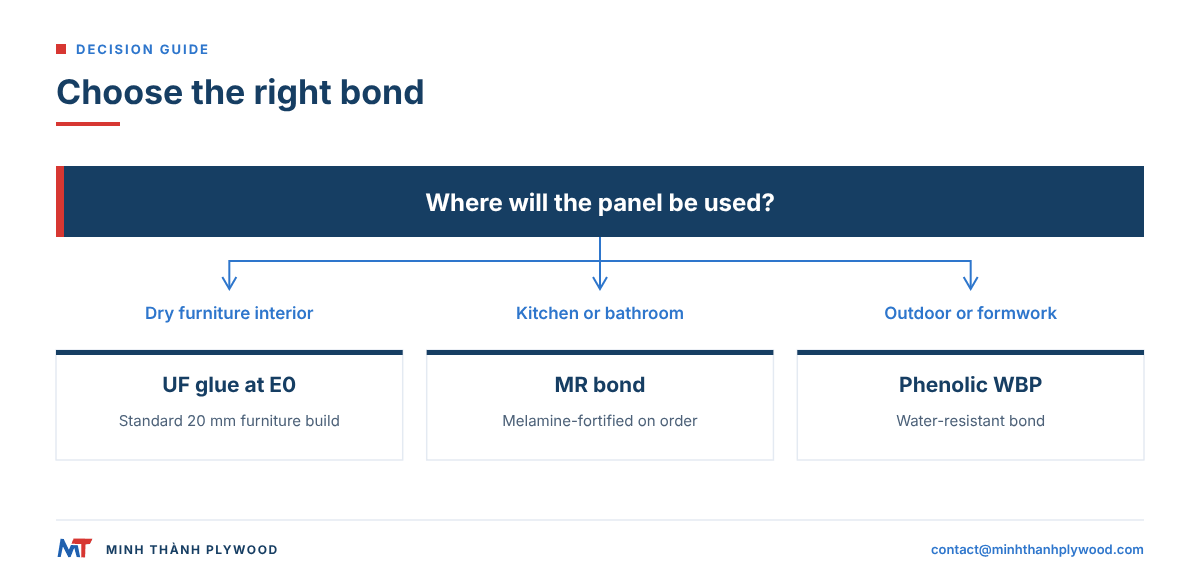
| Glue | UF glue at E0 emission; MR or WBP on order | WBP phenolic or melamine-fortified |
| Surface | Sanded and polished, UV-ready both sides | Phenolic film both sides, sealed edges |
| Thickness tolerance | ±0.2–0.3 mm, down to ±0.2 mm | ±0.5 mm |
A thick furniture panel is built in two steps. The core veneers are stitched horizontally and vertically, laid up and pressed into a core board, which is calibrated to thickness. The face and back are then pressed on. Pressing twice is what keeps a 20 mm top flat and its tolerance tight; with thirteen or more layers, a single press leaves more room for the core to settle unevenly.
Moisture content at dispatch is 8–12 %, the normal range for furniture plywood.
20 mm vs 18 mm vs 21 mm: which thickness should you order?
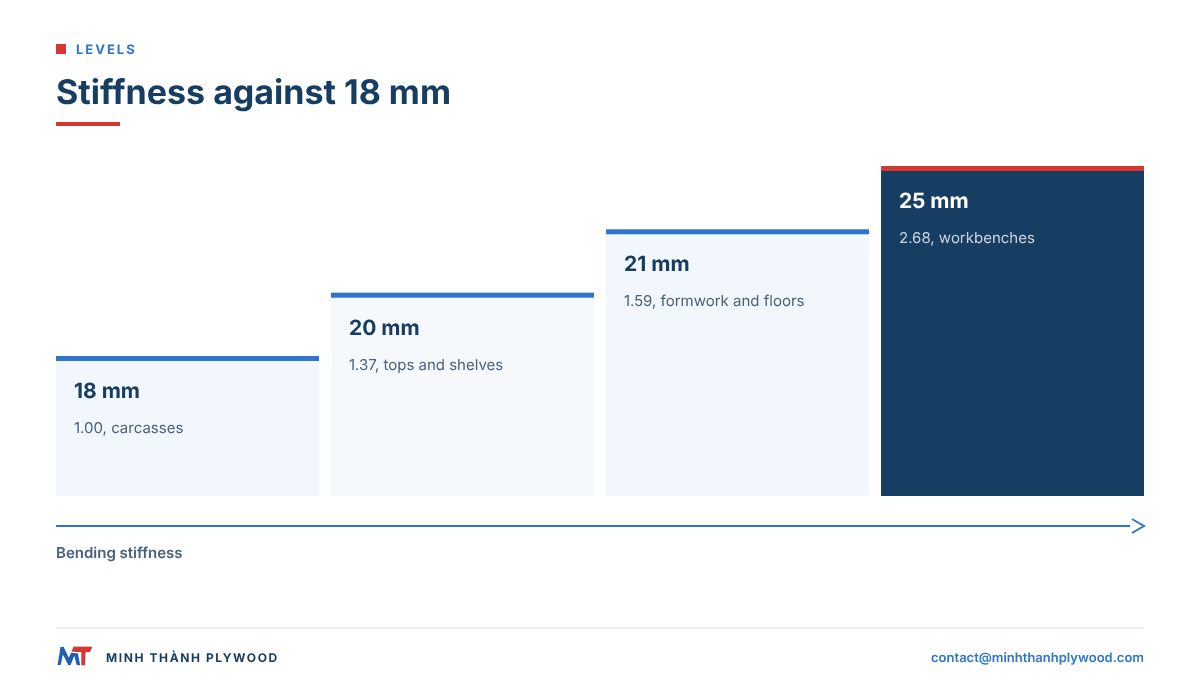
Order 18 mm for standard carcasses, 20 mm when a top or shelf must be stiffer without moving to 25 mm, and 21 mm for concrete formwork. Bending stiffness rises with the cube of thickness:
| 18 mm | 20 mm | 21 mm | 25 mm | |
|---|---|---|---|---|
| Stiffness, 18 mm = 1.00 | 1.00 | about 1.37 | about 1.59 | about 2.68 |
| Weight per sheet, Styrax core | about 26.8 kg | about 29.8 kg | about 31.3 kg | about 37.2 kg |
| Weight per sheet, Eucalyptus core | about 34.8 kg | about 38.7 kg | about 40.6 kg | about 48.4 kg |
| Sheets per 40HC, Styrax core | 990 | 900 | 846 | 720 |
| Main use | Carcasses, doors, shelves | Tops, heavy shelves, substrates | Formwork, floors | Workbenches, platforms |
Two millimetres more than 18 mm buys 37% more stiffness for 11% more weight. That is the reason to choose 20 mm: a 900 mm bookshelf or a desk top that would sag slightly at 18 mm stays straight at 20 mm, and the edge looks heavier. The 18 mm plywood guide covers the standard board; panels from 25 mm up are in the thick plywood guide.
Why is formwork plywood 21 mm?
21 mm is the thickness formwork systems, beam spacings and site practice in Europe and the Middle East are built around, so film-faced panels are made to it. A 21 mm film-faced panel has an Acacia or Eucalyptus core, a phenolic-film face on both sides, a WBP phenolic or melamine-fortified bond and painted edges.
What sets the number of pours is the bond and the handling:
- Melamine-fortified bond: about 12–15 reuses, with proper handling, release agent and edge sealing.
- Phenolic bond: up to about 25 reuses under the same conditions.
- Film weight: usually 120–135 g/m², premium from 135 g/m²; anti-slip film about 220 g/m² with a wire-mesh, hexagon or grain pattern.
A film-faced 21 mm panel is held to ±0.5 mm, the tolerance for film-faced and commercial plywood. Film brand, weight and colour are order specifications. A 40HC of premium film-faced plywood holds about 43 m³ on a Eucalyptus core and about 47 m³ on Acacia. The film-faced plywood page lists the full range.
What is 20 mm furniture plywood used for?
UK suppliers sell 21 mm sanded birch full boards for worktops, floors, van racking, stair parts and benching, not only film-faced formwork. A sanded 21 mm panel is the same family of uses as 20 mm, with the exposed edge sealed or banded and a damp-area part given a phenolic bond.
Sanded 20 mm plywood is for parts that span and carry load, and for designs that want a thicker edge:
- Tabletops and desk tops, clear-lacquered with the layered edge on show or edge-banded;
- Worktop substrates under laminate, veneer or thin stone;
- Heavy shelves for books, archives and retail stock on longer spans;
- Bed bases, bench seats and platforms;
- Exhibition and stage decks, where the panel is walked on;
- Van and trailer floors, in a phenolic or anti-slip build.
For these parts, choose the core for the load and the edge. Styrax gives a pale edge and the lightest sheet; Eucalyptus gives firmer screw-holding near the edge and resists dents better on a desk top. The face and grade follow the look: birch D+/D for a clear-lacquered top, poplar B/B under laminate.
Which core should you choose for 20mm ply board?
The core decides weight per sheet, edge colour and screw-holding. Minh Thanh uses white Styrax and Eucalyptus cores as standard and makes Acacia and Pine cores on order.
| Core | Reference density | Edge | When to choose it in 20 mm |
|---|---|---|---|
| Styrax | 500 kg/m³ | Pale, almost white | Exposed-edge tops and shelves, light furniture, most sheets per container |
| Acacia | 580 kg/m³ | Light brown | Middle weight and stiffness; also a film-faced core |
| Eucalyptus | 650 kg/m³ | Pink to light brown | Desk tops and floors that take wear, hinge and screw-heavy parts, film-faced formwork |
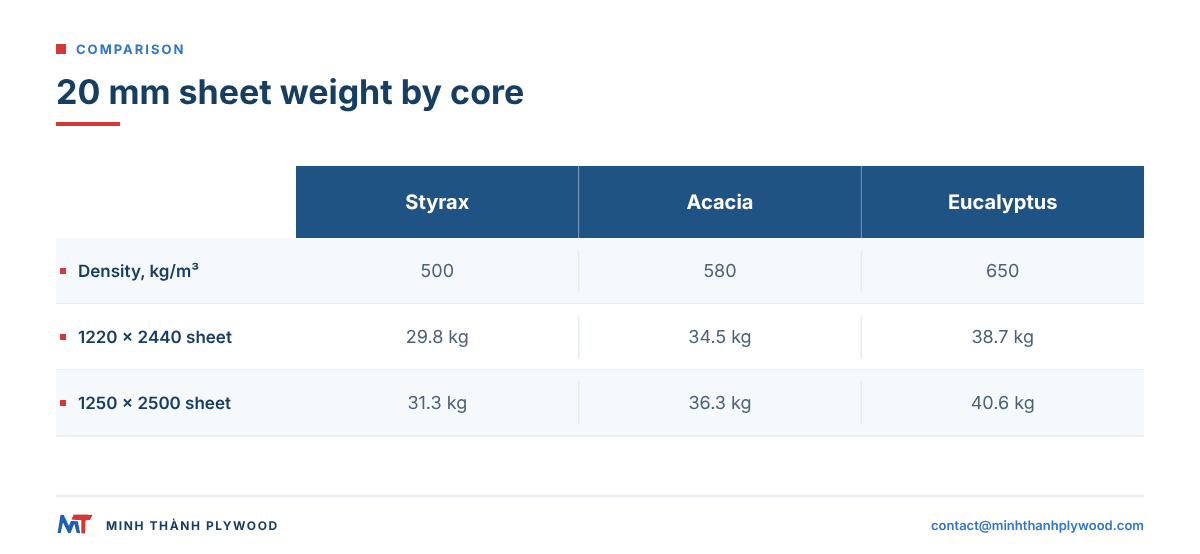
At 20 mm the weight gap between cores is large: about 8.9 kg per sheet from Styrax to Eucalyptus. For a fit-out crew moving two hundred sheets up stairs, that is almost two tonnes less to carry.
How much does a 20mm plywood sheet weigh?
A 1220 × 2440 × 20 mm sheet holds 0.0595 m³ of wood; one cubic metre is about 16.8 sheets. Sheet weight is volume times core density:
| Size and thickness | Volume per sheet | Styrax 500 kg/m³ | Acacia 580 kg/m³ | Eucalyptus 650 kg/m³ |
|---|---|---|---|---|
| 1220 × 2440 × 20 mm | 0.0595 m³ | about 29.8 kg | about 34.5 kg | about 38.7 kg |
| 1250 × 2500 × 20 mm | 0.0625 m³ | about 31.3 kg | about 36.3 kg | about 40.6 kg |
| 1220 × 2440 × 21 mm | 0.0625 m³ | about 31.3 kg | about 36.3 kg | about 40.6 kg |
Real Eucalyptus panels can reach 750 kg/m³, so weigh one sheet before you plan a payload near its limit. A 20 mm Eucalyptus sheet is a two-person lift; a Styrax sheet can be carried by one person over a short distance.
How many 20 mm and 21 mm sheets fit in a 40HC?
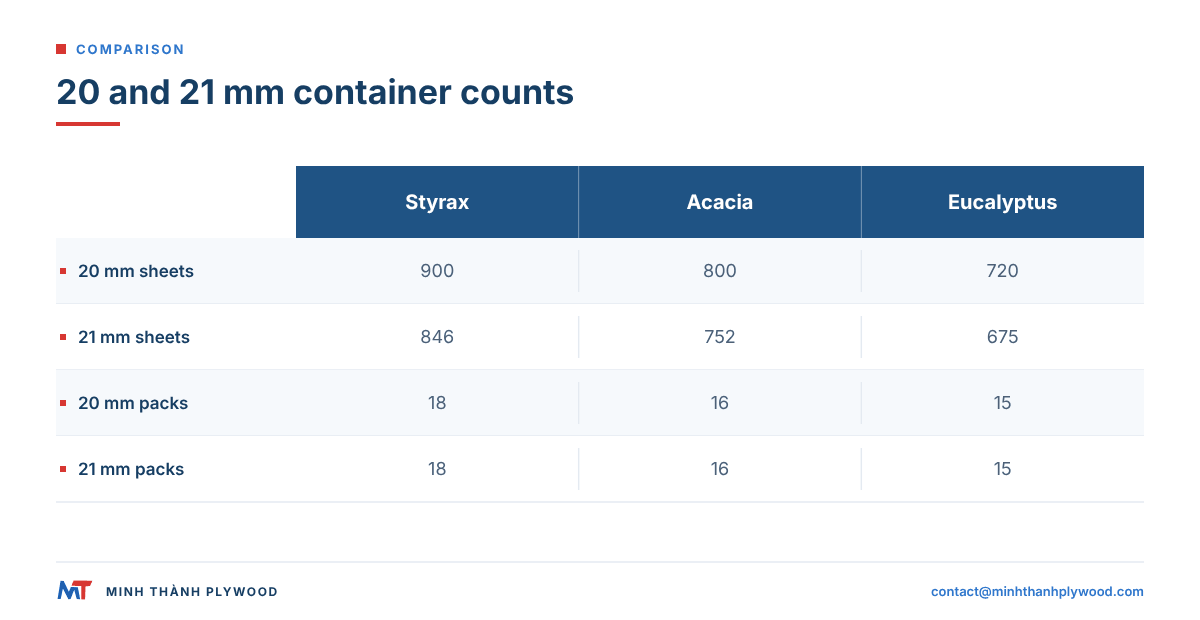
A 40HC of 1220 × 2440 mm sheets is loaded in packs about 1,000 mm high: 50 sheets of 20 mm or 47 sheets of 21 mm per pack. Styrax loads 18 packs (16 lying and 2 upright), Acacia 16 and Eucalyptus 15, within a planning payload of 28,000 kg.
| Thickness and core | Packs × sheets | Sheets per 40HC | Volume | Cargo weight |
|---|---|---|---|---|
| 20 mm Styrax | 18 × 50 | 900 | 53.58 m³ | about 26,791 kg |
| 20 mm Acacia | 16 × 50 | 800 | 47.63 m³ | about 27,625 kg |
| 20 mm Eucalyptus | 15 × 48 | 720 | 42.87 m³ | about 27,863 kg |
| 21 mm Styrax | 18 × 47 | 846 | 52.89 m³ | about 26,443 kg |
| 21 mm Acacia | 16 × 47 | 752 | 47.01 m³ | about 27,266 kg |
| 21 mm Eucalyptus | 15 × 45 | 675 | 42.20 m³ | about 27,427 kg |
On Eucalyptus the weight sets the load: 15 packs of 50 would pass 28,000 kg, so each pack is cut to 48 sheets. If your booking allows less than 28,000 kg, give the figure with the order. The container packing calculator runs the same plan for any thickness and payload.
Which sizes is plywood 20mm made in?
20 mm plywood sheets are made in 1220 × 2440 mm (8 × 4 ft) and 1250 × 2500 mm as standard. Custom sizes such as 1220 × 2500 and 1220 × 2280 mm are made on order. Length and width are held to ±2 mm.
Cut-to-size, one panel cut into 4, 6 or 8 pieces, is a regular service shipped to Italy and other European markets. For 20 mm shelf and top programmes it saves the saw step and the freight on offcuts. Film-faced 21 mm panels are usually ordered in full sheets, because formwork crews cut on site.
What tolerance should a 20 mm order carry?
Put the tolerance on the order line next to the thickness, by product line:
- Sanded furniture 20 mm: ±0.2–0.3 mm, down to ±0.2 mm for CNC nesting, hinge cups and grooves.
- Film-faced 21 mm and commercial panels: ±0.5 mm.
- Length and width: ±2 mm.
A tight tolerance matters most on a 20 mm top that is edge-banded or joined to a second panel: a 0.6 mm step between two sheets shows under lacquer. To check a delivery, measure five sheets from different packs with a digital caliper at four points 50 mm in from the edges. Every shipment from Minh Thanh is photographed and filmed before loading, and the buyer receives the files before the container sails.
Which glue and emission class for 20 mm?
Glue type and emission class are two separate lines on the order. For furniture and interior 20 mm the standard is UF glue at E0 emission. For kitchens, bathrooms, vehicle floors and outdoor parts, melamine-fortified (MR) and phenolic (WBP) bonds are made to the buyer’s specification; film-faced 21 mm always uses a water-resistant bond.
The emission proof for European and US furniture buyers:
- CARB P2 / TSCA Title VI certification for veneer-core hardwood plywood, ICTT mill no. 23024, covering 3–50 mm, under the California Air Resources Board composite wood products programme and the US EPA TSCA Title VI rule (both checked October 2026).
- Six ASTM D6007 chamber tests between April 2025 and June 2026 on 9, 15 and 18 mm panels averaged 0.014–0.032 ppm. The limit for veneer-core hardwood plywood is 0.05 ppm under 40 CFR 770.10. Three were run by Shanghai Hongjun and three by ICTT Vietnam.
- E0 tested every three months, with third-party testing to EN 717-1 or another method through SGS on request.
Which faces and grades suit a 20 mm top?
Face and grade follow the finish. Minh Thanh makes 10+ face veneers; the most produced are engineered veneer (EV), poplar, birch, okoume and pine, with bintangor, eucalyptus, gurjan and sapele on request. Grades are quoted as face/back pairs and fixed by the approved sample:
| Face | Grade pairs | 20 mm example |
|---|---|---|
| Birch | D+/D, D/D, D/E | D+/D (close to B/BB) for a clear-lacquered desk top |
| Poplar | A/A, A/B, B/B | B/B under laminate on a worktop substrate |
| Pine | A/A, A/B, B/B | A/B for a visible shelf with a pine look |
| Eucalyptus | A/A, A/B, B/B | A/A for a top seen on both faces |
A 20 mm top is often seen from below as well. Order the back grade for what the customer sees when they sit at the desk.
How do you write a 20 mm or 21 mm line on a quotation request?
A complete line names everything that changes the panel or the price. For a furniture order:
20 mm furniture plywood, birch face D+/D, Styrax core, UF glue at E0, CARB P2 / TSCA Title VI, sanded both sides UV-ready, 1220 × 2440 mm, ±0.3 mm, 8–12 % moisture, export packing, 1×40HC (about 900 sheets), FOB Hai Phong.
For formwork: “21 mm film-faced plywood, Eucalyptus core, WBP phenolic bond, film 135 g/m² both sides, sealed edges, 1220 × 2440 mm, ±0.5 mm, 1×40HC”.
Indicative starting prices, October 2026: commercial plywood from US$250/m³ and furniture and interior plywood from US$350/m³. Price follows the face, core, glue, thickness, size, quantity and delivery term.
What happens after you order 20 mm plywood from Vietnam?
- Sample. Free samples of the face, core and grade; the approved sample becomes the reference for the order.
- Deposit and production. 30% deposit; production takes 15–45 days.
- Inspection and loading. Thickness, size, face against the sample, moisture and pack counts are checked; the loading is photographed and filmed and the files go to you.
- Shipment and balance. FOB Hai Phong, CFR or CIF; the 70% balance against the scanned B/L, or an irrevocable L/C at sight.
- Documents. Commercial invoice, packing list, B/L, certificate of origin (EUR.1 for the EU), phytosanitary and fumigation certificates, insurance with CIF, plus CARB P2 / TSCA files, test reports and the EUDR compliance dossier on order.
One 40HC is the minimum; 20 mm can share a container with 18 mm carcass stock or 21 mm film-faced panels by agreement, usually one or two specifications and three to six when volumes justify it. Typical days at sea from Hai Phong: South-East Asia 5–12, Middle East 15–25, Mediterranean 25–35, Northern Europe 30–40, US West Coast 20–30 and US East Coast 35–45.
Buyer questions, answered
Can you get 20mm plywood?
Yes. Minh Thanh makes any thickness from 3 to 40 mm, and 20 mm is a regular furniture thickness, sanded to ±0.2–0.3 mm on Styrax or Eucalyptus cores in 1220 × 2440 and 1250 × 2500 mm.
Is 20 mm plywood the same as 3/4 inch?
No. 3/4 inch is 19.05 mm, so 20 mm is about 1 mm thicker. The closest imperial size is 25/32 inch at 19.8 mm.
Why is formwork plywood 21 mm and not 20 mm?
21 mm is the size formwork systems and site crews are set up for in Europe and the Middle East. Film-faced 21 mm panels carry a phenolic film face, a WBP phenolic or melamine-fortified bond, and are held to ±0.5 mm.
How much does a 20mm plywood sheet weigh?
A 1220 × 2440 × 20 mm sheet holds 0.0595 m³ of wood, so it weighs about 29.8 kg on Styrax, 34.5 kg on Acacia and 38.7 kg on Eucalyptus at reference densities of 500, 580 and 650 kg/m³.
How many plies does 20 mm plywood have?
Usually 13 or 15. Two face veneers of 0.2–0.5 mm and eleven to thirteen core veneers of 1.5–1.8 mm make up the 20 mm.
How many sheets of 20 mm plywood fit in a 40HC?
About 900 sheets on a Styrax core (18 packs of 50), 800 on Acacia (16 packs of 50) and 720 on Eucalyptus (15 packs of 48, capped by weight).
How much stiffer is 20 mm than 18 mm plywood?
About 37%. Bending stiffness rises with the cube of thickness, and 20 cubed divided by 18 cubed is 1.37; 21 mm is about 59% stiffer than 18 mm.
How many times can 21 mm film-faced plywood be reused?
About 12–15 pours with a melamine bond and up to about 25 with a phenolic bond, with proper handling, release agent and edge sealing.
What is 20 mm plywood used for?
Tabletops, desk tops, worktop substrates under laminate or stone, heavy shelves, bed bases, stage and display platforms, and floors in vans and trailers.
What is the minimum order for 20 mm plywood from Vietnam?
One 40HC, which can carry 20 mm with other thicknesses by agreement. Production takes 15–45 days after the 30% deposit, and samples are free.