
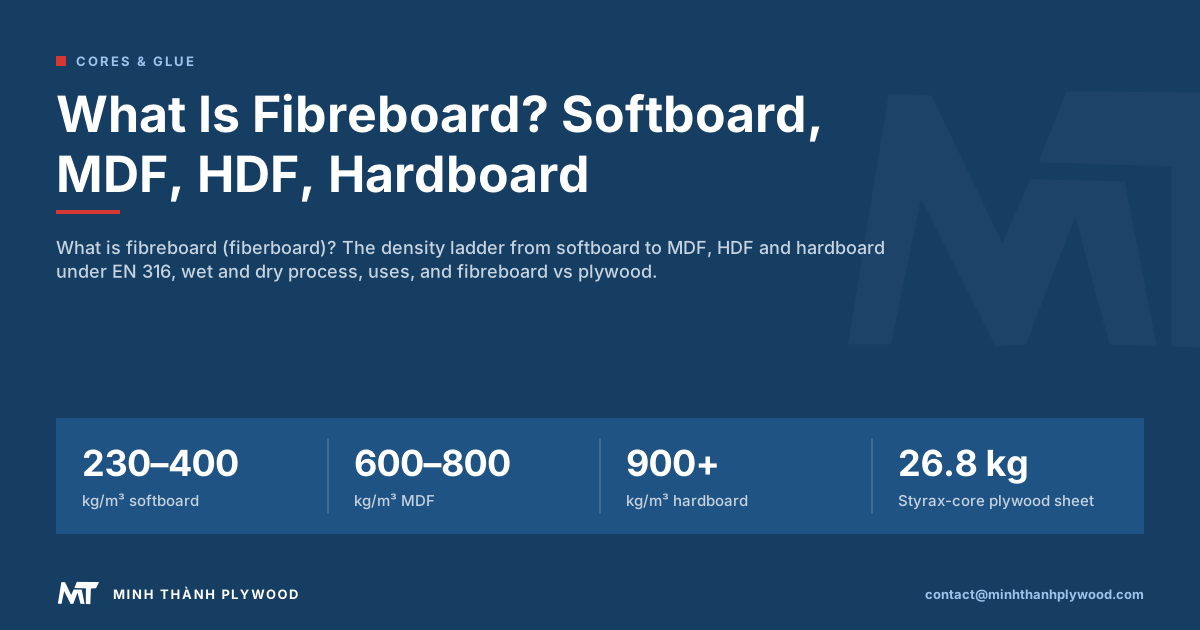
Fibreboard is a wood panel made from wood fibres, bonded by their own lignin or by added resin and pressed into sheets. Density sorts the family: light softboard for insulation, MDF for furniture, HDF and hardboard for floors, door skins and backs. Minh Thanh Plywood makes veneer plywood, and this guide places each fibreboard beside it.
What is fibreboard?
Fibreboard is a wood panel made by breaking wood into individual fibres and pressing those fibres back into a sheet. The bond comes either from the wood’s own lignin, softened by heat and water (wet process), or from added resin (dry process).
Every fibreboard is a member of one family sorted by density. EN 316 defines the classes, and the EN 622 parts set the requirements for each: EN 622-2 for hardboard, EN 622-3 for medium board, EN 622-4 for softboard and EN 622-5 for MDF.
Fibreboard differs from plywood in the one thing that decides most of a panel’s behaviour: plywood keeps the wood as whole veneer sheets with long fibres; fibreboard breaks those fibres apart and rebuilds a panel without grain.
Fibreboard, fiber board, fibre board: the names
Fibreboard, fibre board, fiberboard and fiber board are the same word in British and US spelling. Inside the family, buyers meet these trade names:
- Softboard, insulation board, pinboard: the light end.
- Medium board: a wet-process board between softboard and hardboard.
- MDF: medium density fibreboard, the dry-process furniture board.
- HDF: high density fibreboard, a dense MDF for floors and door skins.
- Hardboard: a dense, thin wet-process board, often sold under brand names such as Masonite.
- Wood fibreboard or “fibre wood”: loose terms that usually mean softboard insulation or MDF.
Fibreboard in packaging and roofing
Fibreboard also names two products that are not furniture panels. In packaging, “fiberboard” usually means corrugated fiberboard, the kraft-paper cardboard of shipping boxes; it is made of paper, not wood fibre pressed into a panel, and it is a different product from the boards in this guide. In US construction, ASTM C208 covers cellulosic fiber insulating board, the softboard sold as sheathing and as roof coverboard, a thin fibreboard layer placed over roof insulation to protect the membrane. Paper-fibreboard suppliers such as Hammond Paper sell recycled packaging board, so “fibreboard” has both meanings.
The fibreboard density ladder
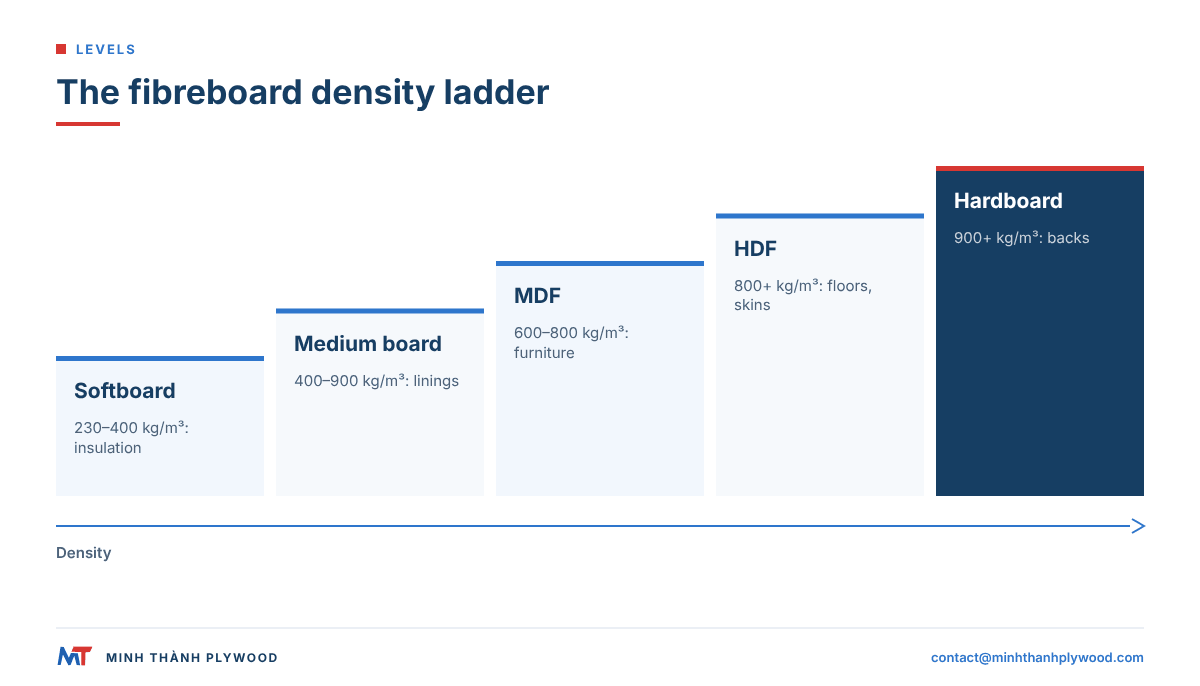
Density decides what a fibreboard is and what it is used for. The ladder from light to dense:
| Board | Density | US units | Standard (EN / US) | Process | Main uses |
|---|---|---|---|---|---|
| Softboard (SB) | 230–400 kg/m³ | 14–25 lb/ft³ | EN 622-4 / ASTM C208 | Wet, or dry for insulation | Insulation, pinboards, expansion joints |
| Medium board (MBL, MBH) | 400–900 kg/m³ | 25–56 lb/ft³ | EN 622-3 | Wet | Wall linings, ceilings, display boards |
| Light and ultralight MDF | 450–650 kg/m³ | 28–41 lb/ft³ | EN 622-5 | Dry | Light furniture parts, displays |
| MDF | 600–800 kg/m³ | 37–50 lb/ft³ | EN 622-5 / ANSI A208.2 | Dry | Furniture, doors, mouldings |
| HDF | 800 kg/m³ and more | 50 lb/ft³ and more | EN 622-5 / ANSI A208.2 | Dry | Laminate flooring cores, door skins, drawer bottoms |
| Hardboard (HB) | 900 kg/m³ and more | 56 lb/ft³ and more | EN 622-2 / ANSI A135.4 | Wet | Furniture backs, pegboard, door skins |
For comparison, Minh Thanh’s furniture plywood plans at 500 kg/m³ on a Styrax core, 580 kg/m³ on Acacia and 650 kg/m³ on Eucalyptus: lighter than MDF on the two lighter cores.
Wet process and dry process
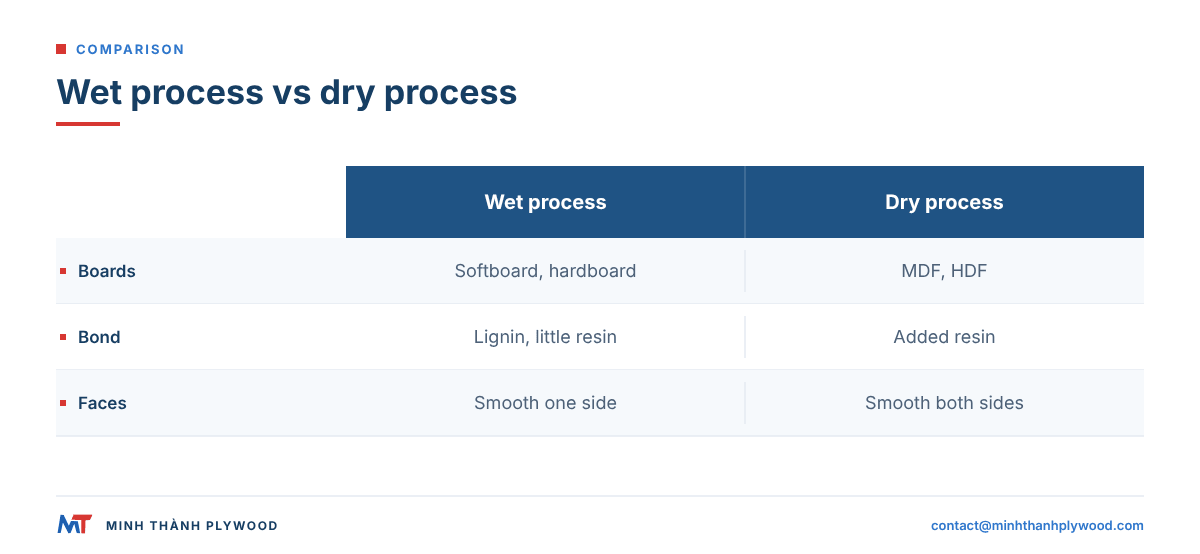
Fibreboard is made in one of two ways, and the process decides the bond and the faces.
Wet process (softboard, medium board, hardboard):
- Wood chips are steamed and refined into fibres.
- The fibres are mixed with water into a slurry.
- The slurry is spread on a screen and the water drains away, leaving a wet mat.
- The mat is pressed hot against the screen (hardboard) or dried without pressure (softboard). The lignin bonds the fibres; little or no resin is added.
The screen leaves a mesh pattern on the back of hardboard, which is why most hardboard has one smooth face (S1S).
Dry process (MDF, HDF, most insulation board):
- Chips are steamed and refined into fibres.
- Resin and wax are sprayed onto the fibres in the blowline.
- Fibres are flash-dried and formed into a dry mat.
- The mat is hot-pressed to thickness, cooled and sanded on both faces.
The what is MDF guide gives the dry process in eight steps.
What is softboard used for?
Softboard is a light, porous fibreboard of 230–400 kg/m³ used for insulation and pinboards, never for load. Its open structure traps air, so it insulates against heat and sound.
- Wood fibre insulation for walls and roofs is tested to EN 13171 and sold in thick boards and flexible mats.
- Pinboard and noticeboard panels take pins and recover.
- Expansion joint filler in concrete slabs, often bitumen-impregnated.
Softboard has no place in furniture: it crushes under a screw and dents at a touch.
Medium board and MDF
Medium board and MDF share the middle of the ladder but are different products. Medium board is a wet-process board of 400–900 kg/m³ used for wall linings and display boards; MDF is a dry-process board with resin, at least 450 kg/m³ and usually 600–800 kg/m³, made for furniture.
MDF is the fibreboard most buyers mean. Its smooth, even faces take paint, lacquer and foil, and it routes into clean profiles for doors and mouldings. EN 622-5 sets its types: MDF for dry use, MDF.H for humid use, MDF.LA and MDF.HLS for load-bearing parts. The moisture-resistant MDF guide covers MDF.H and exterior grades.
What is hardboard, and how does HDF differ?
HDF and hardboard are the dense end of the family, both 800 kg/m³ or more, used in thin sheets where a hard surface matters.
- HDF is made by the dry process, like MDF, pressed harder. It is the core of laminate flooring, where it holds the click joint, and the board for moulded door skins and drawer bottoms.
- Hardboard is made by the wet process, with little or no resin, at 900 kg/m³ and more. It is thin, low in cost and stiff for its thickness: furniture backs, pegboard, door skins, underlay for floor coverings. Tempered hardboard is treated with oil and heat for better water resistance.
Thin plywood is the veneer alternative. Minh Thanh’s thin plywood of 3–5 mm is always 5-ply, which makes it stiffer in both directions than a single fibre sheet.
Is fibreboard the same as MDF?
No: MDF is one fibreboard, and fibreboard is the whole family. Every MDF is a fibreboard; a fibreboard can also be softboard, medium board, HDF or hardboard.
The confusion comes from trade usage. In many markets, “fibreboard” on a quotation means MDF, and “fibre board furniture” means MDF furniture. On an order, write the exact type (MDF, MDF.H, HDF, hardboard) and the density, not “fibreboard”.
Fibreboard vs plywood
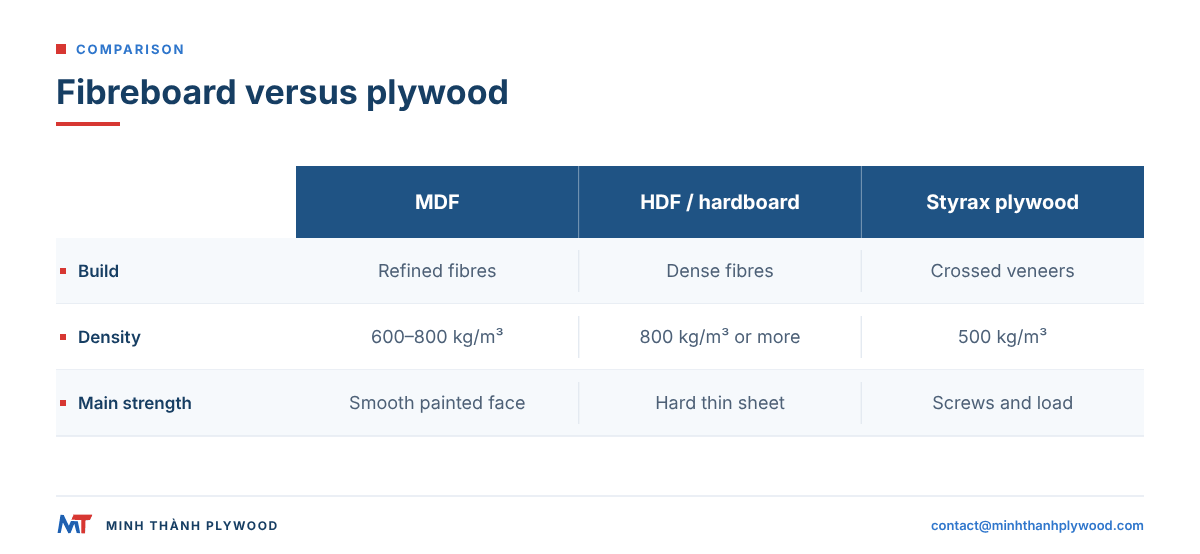
Plywood is stronger, holds screws better and resists water better than fibreboard of the same thickness; fibreboard is smoother and cheaper per cubic metre. The table sets each board against 18 mm furniture plywood or, for thin parts, against 3–6 mm plywood.
| Metric | MDF | HDF / hardboard | Furniture plywood (Styrax core) |
|---|---|---|---|
| Build | Fibres, no layers | Dense fibres, no layers | Cross-laminated veneer plies |
| Density | 600–800 kg/m³ | 800 kg/m³ and more | 500 kg/m³ |
| 18 mm sheet, 1220 × 2440 mm | about 39 kg at 730 kg/m³ | Not made at 18 mm for furniture | 26.8 kg |
| Screw holding | Low in the edge | Thin sheets, nailed or glued | Good in face and edge |
| Surface | Smooth, paints flawlessly | Hard, smooth face | Sanded veneer, UV-ready |
| Water | Swells at the edges | Swells; tempered resists better | Depends on glue; phenolic for wet use |
| Typical parts | Doors, fronts, mouldings | Backs, drawer bottoms, floors | Carcasses, shelves, drawers, worktops |
The full furniture comparison is in plywood vs MDF.
Fibreboard vs particle board
Fibreboard is made of fine fibres and has smooth, machinable edges; particle board is made of coarser chips and has a rough core. Both use the same resins and both swell in water.
| Point | MDF | Particle board |
|---|---|---|
| Raw material | Refined wood fibres | Chips, flakes and sawdust |
| Edge | Fine, can be routed and painted | Coarse, needs an edge band |
| Density | 600–800 kg/m³ | 600–750 kg/m³ |
| Price | Higher | Lowest of wood panels |
| Typical use | Painted doors, profiles | Melamine-faced carcasses |
Read what is particle board for the EN 312 grades.
Fibreboard and formaldehyde rules
MDF is limited for formaldehyde in every major market; wet-process hardboard is treated differently in the US. Under TSCA Title VI (40 CFR 770.10), MDF is limited to 0.11 ppm and thin MDF to 0.13 ppm, while hardboard is exempt from the rule.
In the EU, Regulation (EU) 2023/1464 sets 0.062 mg/m³ for furniture and wood-based articles from 6 August 2026, for every board type in the article. Hardwood plywood with a veneer core has the strictest US limit of the main panels, 0.05 ppm. Minh Thanh’s furniture plywood is certified CARB P2 / TSCA Title VI (ICTT mill no. 23024), and six ASTM D6007 chamber tests between April 2025 and June 2026 averaged 0.014–0.032 ppm.
Is fibreboard safe, and can it be recycled?
Fibreboard is safe in normal use when it meets the emission limit, and it needs a dust mask when you cut or sand it. MDF can release formaldehyde, which the International Agency for Research on Cancer lists as a human carcinogen, and its fine dust irritates the eyes and lungs. The US limits are 0.11 ppm for MDF and 0.13 ppm for thin MDF under CARB P2 / TSCA Title VI, so ask for the certificate and cut outdoors or with dust extraction.
Fibreboard recycling is limited. No commercial method turns used fibreboard back into new panels at scale, so most of it goes to landfill or to energy recovery, and research on recycling MDF is still at the study stage. That is one reason plywood offcuts, which burn cleanly and can be reused as small parts, suit shops that want to cut waste.
Which fibreboard or plywood for which part?
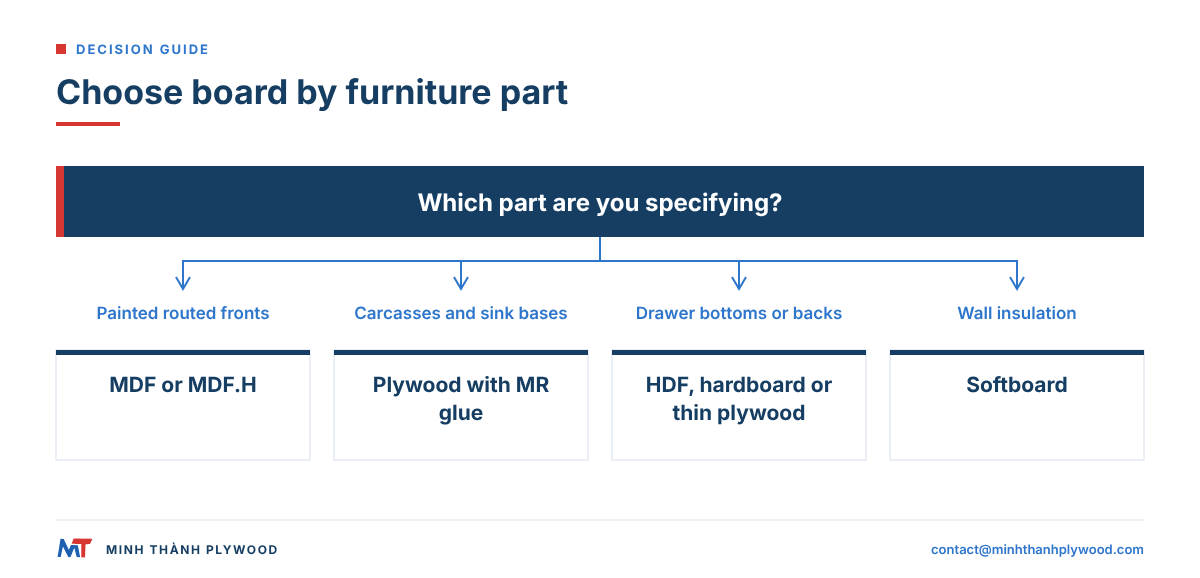
Choose the fibreboard for a smooth or hard thin surface, and plywood for anything that carries load, takes screws or meets humidity. A verdict by part:
| Part | Best panel |
|---|---|
| Painted kitchen doors, routed fronts | MDF (MDF.H in kitchens) |
| Kitchen carcasses and sink bases | Plywood with MR/melamine-fortified glue |
| Shelves with long spans | Plywood, Eucalyptus core for stiffness |
| Drawer bottoms, cabinet backs | HDF, hardboard or 3–6 mm plywood |
| Laminate flooring core | HDF |
| Wall insulation | Softboard (wood fibre insulation) |
| Hotel and contract furniture | Plywood carcasses, MDF fronts |
| Outdoor parts | Exterior plywood with phenolic (WBP) glue |
Minh Thanh’s furniture plywood is stitched horizontally and vertically in the core, pressed twice and sanded to ±0.2–0.3 mm, for the parts on the right side of that table.
How hardboard and MDF came to market
Hardboard came first. William H. Mason developed wet-process hardboard in the United States in the 1920s, which is why hardboard is still often called Masonite. Insulation softboard grew in the same years for building walls and ceilings.
MDF followed decades later, when dry-process lines with resin made it possible to press thick, smooth boards for furniture. Continuous presses then took MDF and HDF into the mass market: furniture fronts, mouldings and laminate flooring cores.
Plywood is older than all of them: veneer panels glued in crossed layers were made by hand long before the first fibreboard line, and the rotary lathe turned plywood into an industrial product. The types of plywood guide shows where it stands today.
How to check fibreboard on delivery
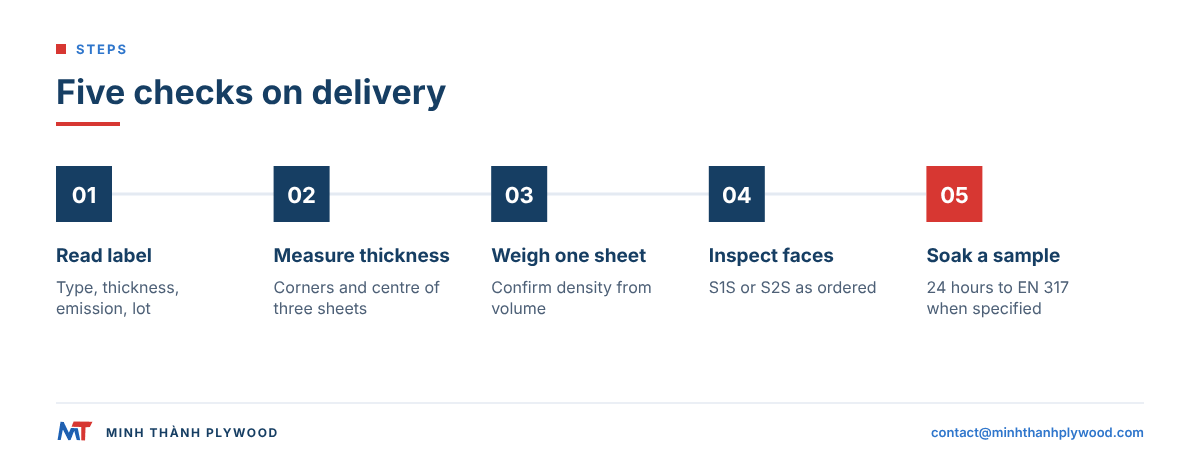
Check fibreboard in five steps on arrival:
- Read the label: type (MDF, MDF.H, HDF, hardboard, softboard), thickness, emission class and lot.
- Measure thickness at four corners and the centre of three sheets per pack; thin HDF and hardboard need a micrometer or a fine caliper.
- Weigh one sheet and divide by its volume to confirm the density class you ordered.
- Check the faces: smooth one side (S1S) or two sides (S2S) as ordered, no press marks or soft spots.
- Soak a sample for moisture-resistant or tempered boards: 24 hours in water to EN 317, against the datasheet value.
Keep the emission certificate and the lot number together for your own audits.
What to write on a fibreboard or plywood order
Name the board type, the density, the thickness and the emission rule. “Fibreboard 3 mm” can mean hardboard, HDF or thin MDF; “HDF, 3 mm, density stated, smooth both sides, CARB P2 / TSCA Title VI” cannot.
For the structural parts of the same furniture, a plywood line reads: “Furniture plywood, poplar face B/B, Styrax core stitched, UF glue at E0 emission, 1220 × 2440 × 18 mm, sanded to ±0.2–0.3 mm, CARB P2 / TSCA Title VI, export packs, one 40HC.” Production at Minh Thanh takes 15–45 days after the 30% deposit, FOB Hai Phong, CFR or CIF; samples are free.
Send the line to contact@minhthanhplywood.com or through the quotation form. For the cores behind it, see plywood core types and the plywood core and glue guides.
Buyer questions, answered
What is fibreboard?
Fibreboard is a panel made by breaking wood down into fibres and pressing them back into sheets, bonded by the wood's own lignin or by added resin. Softboard, medium board, MDF, HDF and hardboard are all fibreboards.
Is fibreboard the same as MDF?
MDF is one type of fibreboard. Fibreboard is the whole family, from light softboard of 230–400 kg/m³ to hardboard of 900 kg/m³ and more; MDF is the dry-process member of at least 450 kg/m³.
Is fiber board the same as fibreboard?
Yes. Fiberboard and fiber board are the US spellings, fibreboard and fibre board the British ones. They name the same products.
How is medium density fibreboard different from plywood?
MDF is a uniform mass of wood fibres with no layers. Plywood is made of whole veneer sheets glued with the grain crossing, which gives it better screw holding, stiffness for its weight and resistance to water.
Is fibreboard stronger than plywood?
No. At the same thickness, plywood is stronger in bending and holds screws far better. Hardboard and HDF are harder on the surface, which is why they are used for floors and door skins.
What is hardboard?
Hardboard is a high-density fibreboard of 900 kg/m³ or more, usually 2–6 mm thick, often with one smooth face. It is used for furniture backs, drawer bottoms, door skins and pegboard.
What is softboard used for?
Softboard is a light fibreboard of 230–400 kg/m³ used for thermal and sound insulation, pinboards and expansion joints. It carries no structural load.
Is fibreboard waterproof?
No. All fibreboards absorb water at the edges and swell. Moisture-resistant MDF and tempered hardboard resist humidity better; for wet use, choose exterior boards or plywood with phenolic glue.
Is fibreboard cheaper than plywood?
Per cubic metre, MDF and hardboard are usually cheaper than furniture plywood. Plywood can cost less per finished part where it saves weight, inserts and edge sealing.
What is wood fibreboard insulation?
It is a softboard made for building insulation, tested to EN 13171. It is sold for walls and roofs as a breathable insulation layer.