
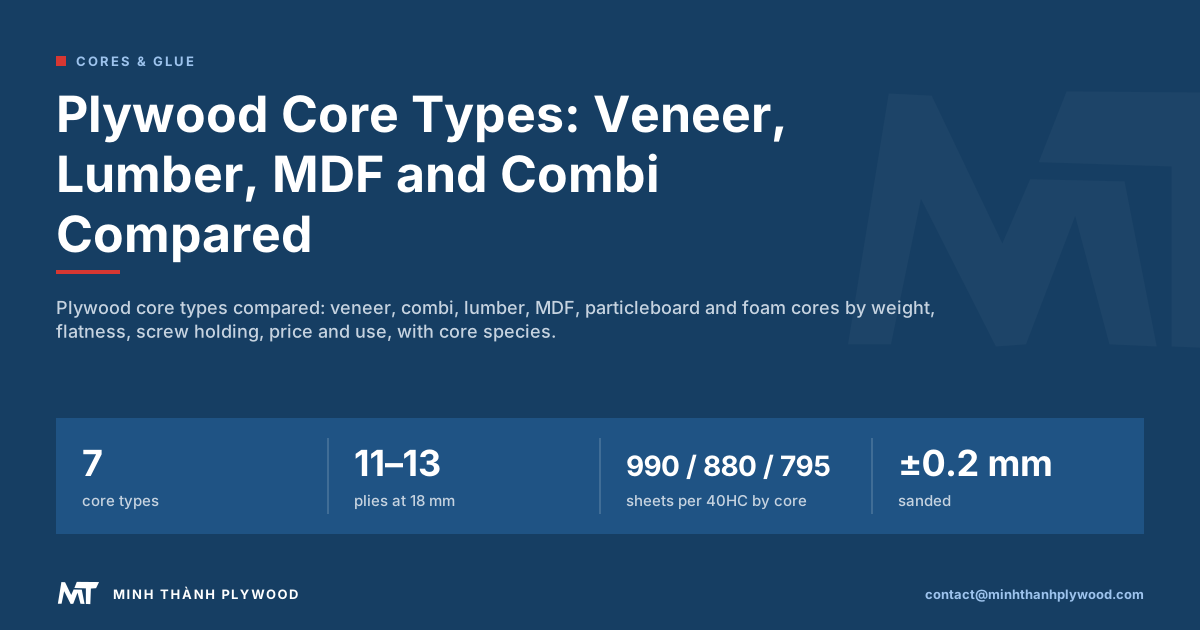
The plywood core is the inner build between the face and back veneers, and it decides weight, flatness, screw holding and price more than the face does. This guide compares every common core, from veneer and combi to lumber, MDF and foam, and shows which cores a Vietnamese furniture mill such as Minh Thanh Plywood runs every day.
What is a plywood core?
A plywood core is the inner build of the panel, everything between the face veneer and the back veneer. In most plywood it is a stack of cross-laid wood veneers; in other panels it is solid wood strips, MDF, particleboard or a light filler such as foam.
The face sells the panel; the core decides how it performs. Weight, stiffness, flatness, screw holding, edge quality and most of the price come from the core. Two 18 mm sheets with the same birch face can differ by a third in weight and by a wide margin in flatness, only because their cores are different.
Three questions describe any core:
- Material: veneer, solid strips, fibre, particles or a light filler.
- Species and grade: which wood, and how many defects the core veneers may carry.
- Closure: whether core joints are loose, butt-joined or stitched, and whether the core board is pressed and calibrated before the faces go on.
Buyers who specify all three get the panel they sampled. Buyers who write only “18 mm plywood, birch face” leave the core to the mill.
Plywood core types compared in one table
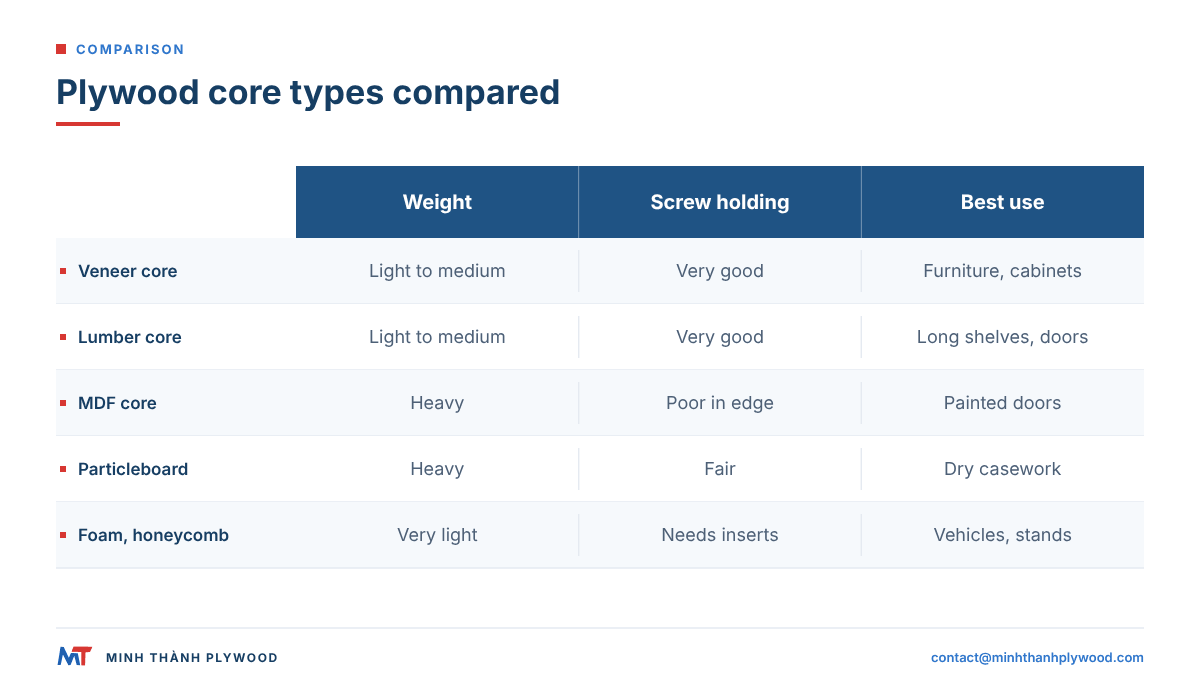
Seven core types cover almost every plywood and veneered panel sold for furniture, joinery and construction. The table compares them on the metrics buyers ask about, one metric per column, with a verdict by use.
| Core type | Weight | Face flatness | Screw holding (face / edge) | Price band | Typical use |
|---|---|---|---|---|---|
| Veneer core, plantation hardwood (Styrax, Eucalyptus, Acacia) | Light to medium | Good; very good when calibrated and pressed twice | Very good / very good | Medium | Furniture, cabinets, interiors, cut-to-size parts |
| Veneer core, birch or maple | Heavy | Very good | Very good / very good | High | Exposed-edge furniture, shop fittings, jigs |
| Veneer core, softwood (pine, fir) | Light | Fair | Good / good | Low to medium | Sheathing, construction, packing |
| Combi core (hardwood outer plies, lighter inner plies), about 550 kg/m³ | Medium | Good | Very good / good | Medium | Birch-look furniture, external-grade sheets, flooring bases |
| Finger joint (recycled) core | Medium | Fair; joints can show through thin faces | Good / fair | Low | Formwork for 3–4 pours, packing, hidden parts |
| Lumber core (blockboard) | Light to medium | Fair to good | Very good / good along the strips | Medium to high | Long shelves, doors, wardrobe sides |
| MDF core | Heavy | Excellent | Good / poor without pilot holes | Medium | Painted doors, routed profiles, thin laminates |
| Particleboard core | Heavy | Very good | Fair / poor | Lowest | Fixed shelving, dry casework |
| Foam, honeycomb or balsa core | Very light | Good | Poor unless inserts are fitted | High | Vehicles, boats, exhibition stands, lightweight doors |
Finger joint core is built from short offcuts joined end to end, and it is the cheapest solid-wood style core. Producers of film-faced panels in China publish about 3–4 reuses for it, against about 12–15 pours for melamine-bonded and up to about 25 for phenolic-bonded veneer core. The full comparison is in the guide to finger joint core plywood.
Read the table by the job, not by the top line. A painted door needs the MDF row; a kitchen carcass needs the plantation veneer-core row; a long bookshelf needs the lumber-core or dense veneer-core row. The rest of this guide explains each core and what to write on the order.
What is veneer core plywood?
Veneer core plywood is plywood built entirely from wood veneers, each layer laid with its grain at right angles to the next and bonded under heat and pressure. It is the original plywood construction and still the most common one for furniture and export panels.
Crossing the grain is what makes the panel stable: each ply restrains the swelling and shrinking of its neighbours. An odd number of plies keeps the build balanced, so the panel stays flat. An 18 mm furniture panel typically carries 11–13 plies, and 11 is the most common build.
Two names describe veneer cores by species:
- Hardwood core plywood: core veneers peeled from hardwoods such as Styrax, Eucalyptus, Acacia, poplar, birch or meranti. Most furniture and decorative plywood is hardwood core.
- Softwood core plywood: core veneers of pine, fir or spruce. Common in structural sheathing and construction panels.
Veneer core is the lightest wood core for its stiffness and the best all-round core for screws, hinges and joints. Its weak point is flatness: a loosely laid core with gaps or overlaps telegraphs through thin faces and laminates. That is why the closure of the core, covered below, decides whether a veneer-core panel is a furniture panel or a packing panel.
Which wood species make the best veneer core?
The best core species depends on the job: Styrax for light, flat furniture panels, Eucalyptus for stiffness, Acacia as a middle option, birch for exposed edges and maximum strength, and poplar or pine for light commercial panels.
| Core species | Reference density | Character | Where it fits |
|---|---|---|---|
| White Styrax | 500 kg/m³ | Light, pale, even texture | Furniture and cabinet panels, cut-to-size parts, UV-coated faces |
| Eucalyptus | 650 kg/m³ for planning (650–750 kg/m³ measured) | Hard, stiff, heavier | Shelves, tops, structural furniture parts, film-faced and exterior builds |
| Acacia | 580 kg/m³ | Between Styrax and Eucalyptus | Furniture and commercial panels, made on order |
| Birch | About 680 kg/m³ | Hard, fine, many thin plies | Exposed-edge furniture, shop fittings |
| Poplar | About 520 kg/m³ | Soft, compresses in pressing | Commercial and furniture panels from other origins |
| Pine | Light | Soft, resinous | Construction and sheathing panels; made on order |
At Minh Thanh, furniture panels use white Styrax or Eucalyptus cores as standard, and Acacia and pine cores are made on order. Many European furniture buyers choose Styrax because the panel is light and the faces lie flat on it. Eucalyptus is the choice when a shelf must not sag or a top must feel solid.
The densities in the table are the reference values Minh Thanh uses for container planning. Real sheets are weighed before a load is planned, because density moves with the core grade and the glue.
What is stitched core and full stitched core plywood?
Stitched core plywood has its core veneer strips joined edge to edge before lay-up, so each core ply goes into the press as one closed sheet without gaps or overlaps. A full stitched core has every core ply joined this way; a standard stitched core joins the outer core plies, which carry most of the face quality.
Core veneers come off the lathe as strips and pieces. In a loose-laid core, workers place the pieces side by side by hand, and small gaps or overlaps remain. Gaps leave hollow spots that show as dents under a thin face; overlaps leave ridges that sanding cannot remove. Both show under paint, lacquer and UV coating.
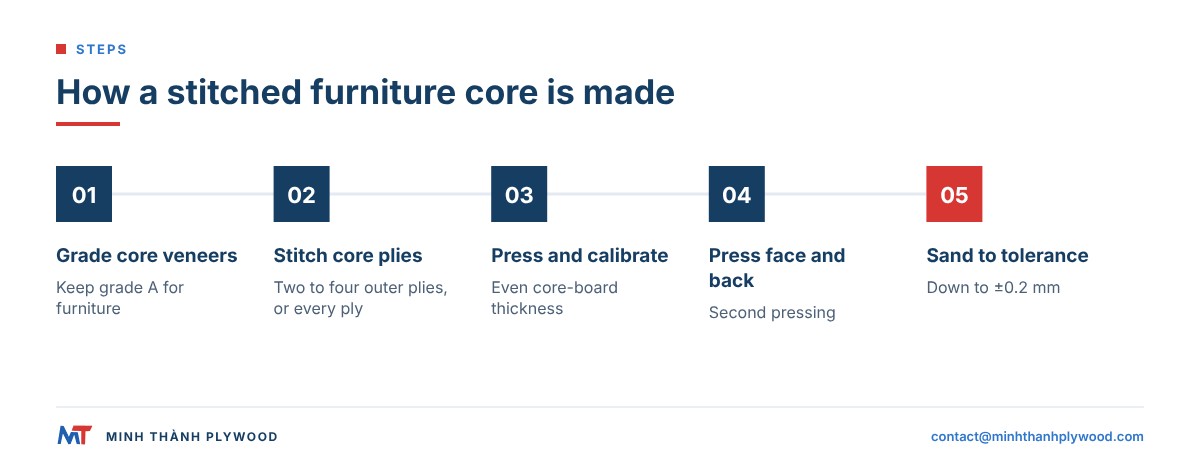
How Minh Thanh closes a furniture core:
- Grade the core veneers and keep grade A for furniture panels.
- Stitch the core plies horizontally and vertically, usually the two to four outer core plies, and every ply when the buyer asks for a full stitched core.
- Press and calibrate the core board to an even thickness.
- Press the face and back on in a second pressing.
- Sand to the order tolerance, down to ±0.2 mm on sanded furniture panels.
Commercial and packing cores skip some of these steps. A commercial core is grade AB, loose-laid or joined; a packing core is grade AB and loose-laid. That difference, more than the face, is what separates the price lines.
What is combi core plywood?
Combi core plywood, also written combicore, is plywood whose core mixes two materials or species: most often hardwood outer plies, such as birch or Eucalyptus, over lighter inner plies such as poplar. In North America, combination core can also mean a veneer core with MDF or particleboard crossbands under the faces.
The idea is the same in both meanings. The outer layers give a hard, flat base for the face and good screw holding near the surface; the inner layers keep the weight and the price down. A combi panel sits between an all-hardwood veneer core and a light commercial core on weight, stiffness and price.
The trade-off shows at the edge: a combi panel shows two kinds of plies in cross-section, so it is a poor choice where edges stay exposed. The combi core vs birch core guide covers the layups and the purchase-order wording that stops a cheaper core being substituted.
Lumber core vs veneer core
Lumber core is stiffer over long spans and lighter than MDF core; veneer core is flatter, more even in screw holding and more stable in humid rooms. Lumber core, also called blockboard in Europe, is a slab of solid wood strips edge-glued side by side and covered with crossbands and faces.
| Metric | Lumber core (blockboard) | Veneer core |
|---|---|---|
| Build | Solid strips plus crossband and face on each side | Cross-laid veneers throughout |
| Stiffness over long spans | Very good along the strips | Good; very good with dense species |
| Screw holding | Very good across the strips, weaker at strip joints | Very good everywhere |
| Flatness | Fair to good; strips can telegraph | Good to very good when calibrated |
| Edge appearance | Strips visible; needs banding | Even plies; can stay exposed on dense cores |
| Typical thickness | Mostly 18 mm | 3–40 mm |
| Typical use | Long shelves, wardrobe sides, doors | Carcasses, furniture parts, cut-to-size |
Choose lumber core for long bookshelves and wardrobe doors where sag is the main risk. Choose a veneer core for everything that is machined, drilled and assembled, because its properties are the same in every direction and at every point of the sheet. A stitched Eucalyptus veneer core is the usual answer when a buyer wants lumber-core stiffness with veneer-core machining. More detail sits in the planned guide on blockboard vs plywood.
MDF core vs veneer core
MDF core gives the flattest face and the cleanest routed profile; veneer core gives lower weight, higher stiffness and much better edge screw holding. MDF core plywood is a sheet of medium-density fibreboard with wood veneers pressed straight onto both sides, usually without crossbands.
| Metric | MDF core | Veneer core |
|---|---|---|
| Face flatness under paint or thin laminate | Excellent | Good; very good when calibrated |
| Weight at the same thickness | Heavy | Light to medium |
| Bending stiffness | Lower | Higher |
| Screw holding in the face | Good | Very good |
| Screw holding in the edge | Poor without pilot holes | Very good |
| Routed edge profile | Clean | Shows plies |
| Moisture tolerance | Swells at cut edges | Better; depends on the glue |
Particleboard core is the cheaper cousin of MDF core: flat, heavy and low in cost, but weaker in screw holding and more sensitive to water once the face is cut. It fits fixed shelving and dry casework.
The practical split in a furniture plant: veneer core for carcasses, drawer boxes and anything with hinges and knock-down fittings; MDF core for painted doors and shaped fronts. The guide what is MDF covers fibreboard grades in detail.
Which plywood core holds screws best?
Veneer core and lumber core hold screws best, in the face and in the edge. MDF core holds screws well in the face and poorly in the edge; particleboard core holds least of all.
What decides screw holding in a veneer core:
- Density: Eucalyptus and birch cores grip harder than Styrax or poplar at the same thickness.
- Closure: a screw that lands in a core gap holds nothing, so stitched cores hold more evenly than loose-laid ones.
- Bond: a fully cured glue line keeps plies from splitting apart when a screw is driven near the edge.
- Pilot holes: every core holds better with a correct pilot hole, and MDF and particleboard edges need one.
For hinges, drawer runners and knock-down fittings, specify a stitched hardwood veneer core. For heavy edge fixings, specify Eucalyptus.
What are foam, honeycomb and balsa core panels?
Foam, honeycomb and balsa cores are lightweight cores bonded between thin plywood or veneer skins, used where weight matters more than screw holding or price. They are sandwich panels more than plywood in the usual sense.
- Foam core: rigid polyurethane, PVC or polystyrene foam between plywood skins. Used in vehicle bodies, caravans and insulated doors. Foam-core boards sold for display and model-making are a different product, paper-faced foam.
- Honeycomb core: a paper or aluminium honeycomb between skins. Used in lightweight furniture, interior doors and exhibition stands.
- Balsa core: end-grain balsa blocks between skins. Used in boat building and other marine composites.
These cores need inserts or solid edge strips wherever a screw or hinge goes in. They are specialist products made by sandwich-panel plants, outside the range of a veneer-core plywood mill.
Red core, white core and poplar core: what the trade names mean
Red core, white core and poplar core are trade names that describe the colour or species of the core veneers. They tell a buyer what the core looks like at the edge, not how well it is closed.
- Red core: core veneers of reddish tropical hardwood such as meranti or keruing, common in commercial plywood from Malaysia and Indonesia.
- White core: pale core species. In Vietnam it usually means white Styrax; elsewhere it often means poplar.
- Poplar core: poplar core veneers, typical of commercial and furniture plywood from China.
- Eucalyptus core: Eucalyptus core veneers, typical of Vietnamese film-faced, exterior and stiff furniture panels.
Whichever name a quotation uses, ask for the species, the core grade and the closure in writing. A white core can be stitched and calibrated or loose-laid; the colour does not say which.
Which plywood core is best for furniture and cabinets?
For furniture and cabinets, the best core is a stitched hardwood veneer core, pressed twice and sanded: white Styrax for light, flat panels and Eucalyptus where stiffness matters. That is the build Minh Thanh’s factory is designed for, with Europe as its main market.
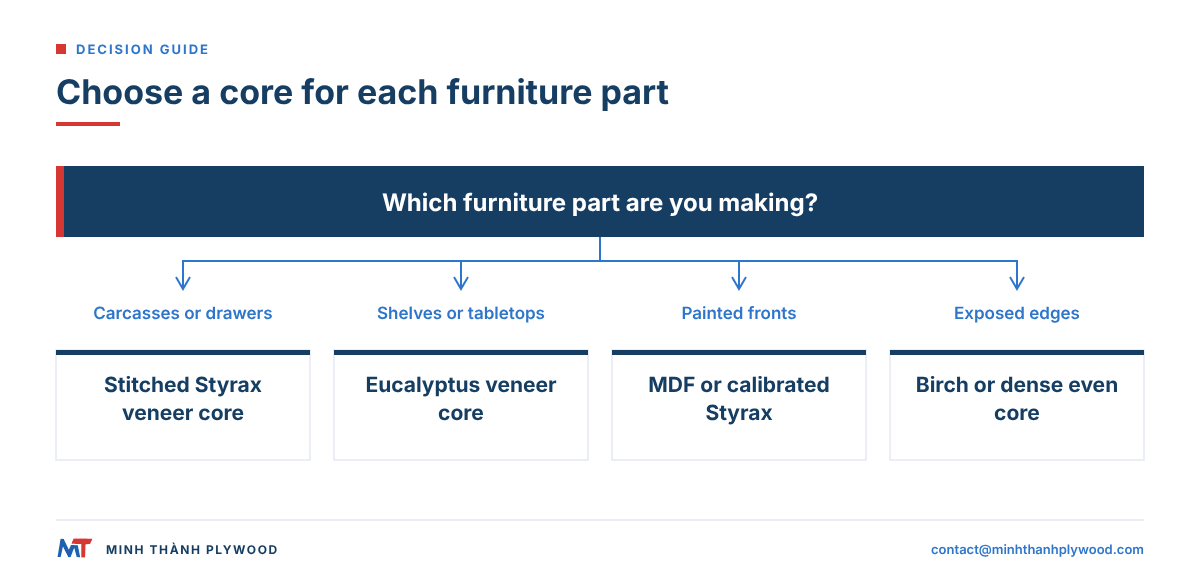
| Furniture part | Recommended core | Why |
|---|---|---|
| Kitchen and bathroom carcasses | Stitched Styrax veneer core | Light, flat, holds hinges and fittings |
| Shelves and tabletops | Eucalyptus veneer core | Stiffer, less sag, solid feel |
| Painted doors and fronts | MDF core, or calibrated Styrax core with a smooth face | Flatness under paint |
| Exposed-edge furniture | Birch or another dense, even core | Plies stay even at the edge |
| Drawer boxes | Styrax or Eucalyptus veneer core | Edge screw holding |
| Cut-to-size parts for flat-pack | Stitched Styrax veneer core | Even machining, lower freight weight |
Minh Thanh’s furniture build is a stitched core, UF glue at E0 emission, a core board pressed and calibrated before face and back are pressed on, and sanded faces ready for the buyer’s UV coating. Panels leave at 8–12 % moisture. Six ASTM D6007 chamber tests between April 2025 and June 2026 on 9, 15 and 18 mm panels averaged 0.014–0.032 ppm against the 0.05 ppm limit of CARB Phase 2 and TSCA Title VI. See furniture plywood from Vietnam and the wider guide to the best plywood for furniture.
Plywood core prices and what UK buyers should specify
In the UK, 18 mm 1220 × 2440 mm sheets with a Chinese poplar core and hardwood face are listed at merchants such as Sheet Materials Wholesale and Beesley and Fildes. Those sheets sell from about £24 to £43 each including VAT. A birch BB/BB sheet of the same size is listed, for example, at Builder Depot and Huws Gray, and runs from about £114 to £176 including VAT. Shelf prices read October 2026 and move with face grade and quantity.
For comparison, Minh Thanh’s FOB prices start at US$250/m³ for commercial plywood and US$350/m³ for furniture and interior plywood. As a raw FOB example, not a sheet price, one 18 mm sheet is roughly a nineteenth of a cubic metre, so those rates work out to roughly US$13 and US$19 per sheet before freight, duty, VAT and the importer’s margin.
What a UK or EU buyer writes on the order:
- Standards: the service class from BS EN 636, part 2 for humid and part 3 for exterior use. The bond class is EN 314-2.
- Emission: E1 as the baseline, E0 when the end customer asks, with CARB P2 / TSCA Title VI as extra evidence.
- Legal origin: FSC where required, and timber legality documents for the UK Timber Regulation.
- Core: species, grade and closure as in the five lines at the end of this guide.
Does plywood core type affect weight, container loading and price?
Yes. The core species sets the sheet weight, the sheet weight sets how many sheets fit under the container payload, and the core grade and closure set most of the price difference between quotations.
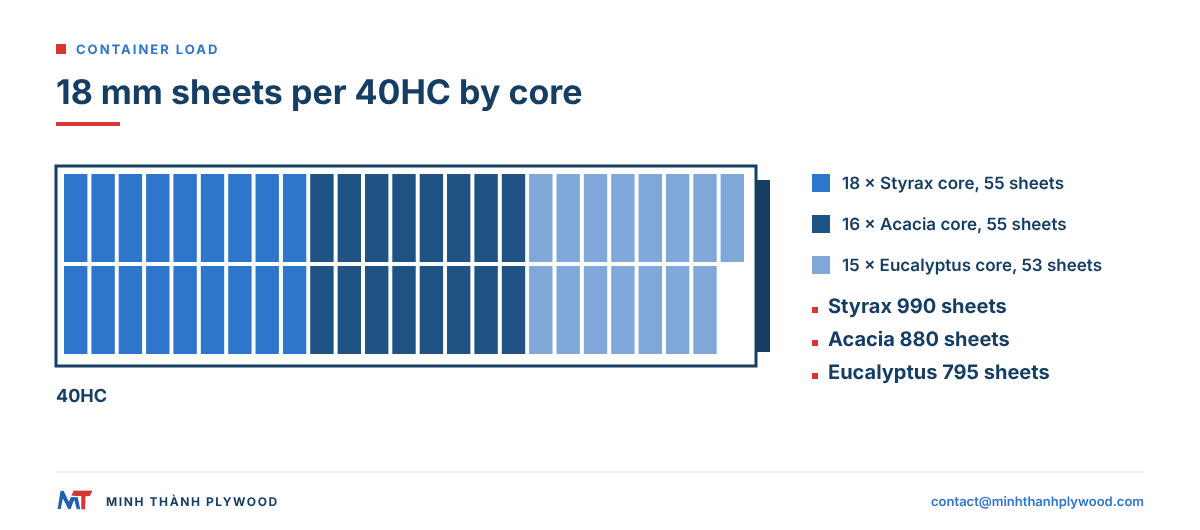
Minh Thanh plans a 40HC of 1220 × 2440 mm sheets at a 28,000 kg payload unless the booking is lower. At 18 mm:
| Core | Sheet weight | Sheets per 40HC | Packs | Volume |
|---|---|---|---|---|
| White Styrax | 26.8 kg | 990 sheets | 18 × 55 sheets | about 53 m³ |
| Acacia | 31.1 kg | 880 sheets | 16 × 55 sheets | about 47 m³ |
| Eucalyptus | 34.8 kg | 795 sheets | 15 × 53 sheets | about 43 m³ |
A Styrax-core load carries about a quarter more sheets than a Eucalyptus-core load of the same thickness, so the freight cost per sheet falls. The heavier cores reach the weight limit before the container is full by volume.
Price follows the core in three ways: species, core grade, and closure. A grade A stitched core with a calibrated core board costs more than a grade AB loose-laid core, and the gap shows in every finished panel. As a guide for October 2026, furniture and interior plywood started from US$350/m³ and commercial plywood from US$250/m³. The container loading page shows how packs are planned.
What core is under Vietnamese okoume and birch-faced plywood?
Vietnamese okoume and birch-faced plywood have okoume or birch face and back veneers on a plantation hardwood core, white Styrax or Eucalyptus at Minh Thanh. The face species is real; the core is a different, lighter species.
That build is the normal one for furniture panels. Imported face veneers go where they are seen, and the local core carries the panel at a lower weight and cost. Two points matter for the buyer:
- Okoume-faced interior plywood is not marine plywood. It is a furniture and interior panel; marine plywood is a separate build to its own standard.
- A birch-faced panel shows its core at the edge. For banded or covered edges it is the efficient choice; for exposed edges, a dense even core suits better.
Faces are chosen for the look ordered: poplar, birch, EV, okoume, pine and more, on the same stitched furniture core.
How to specify the plywood core on your order
Specify the core in five lines, and the mill has nothing left to guess. Write each line as a value, not as “standard”.
- Core type and species: for example, veneer core, white Styrax.
- Core grade and closure: grade A, stitched horizontally and vertically, or full stitched.
- Pressing: core board pressed and calibrated, face and back pressed on.
- Glue and emission: for example, UF glue at E0 emission, as two separate lines.
- Thickness, plies and tolerance: for example, 18 mm, 11–13 plies, ±0.2 mm sanded.
Add the face and back grade, the size, the packing and the quantity, and approve a sample of exactly that build. Minh Thanh’s minimum order is one 40HC with mixed specifications by agreement, production takes 15–45 days after the 30% deposit, and free samples come with the quotation. Send your core specification to contact@minhthanhplywood.com, or read more in the cores and glue guides.
Buyer questions, answered
What is the core of plywood?
The core is everything between the face and back veneers: cross-laid veneers, solid wood strips, MDF, particleboard or a light material such as foam. It carries most of the panel's strength, weight and flatness.
What is veneer core plywood?
Veneer core plywood is built entirely from thin wood veneers laid with the grain crossing at each layer and bonded under heat and pressure. It is the lightest wood core for its stiffness and holds screws well.
What is hardwood core plywood?
Hardwood core plywood has its core veneers peeled from hardwood species such as Styrax, Eucalyptus, Acacia, poplar or birch. The term also covers any hardwood-faced panel whose inner plies are hardwood rather than softwood.
Is MDF core better than veneer core?
MDF core is flatter and better for paint and thin laminates; veneer core is lighter, stiffer and holds screws better, especially at the edges. Choose MDF core for painted doors and veneer core for carcasses and load-bearing parts.
Which plywood core is strongest?
For bending over long spans, lumber core and dense veneer cores such as birch or Eucalyptus are the stiffest. For screw holding in faces and edges, veneer core and lumber core lead; particleboard core is the weakest.
Which plywood core holds screws best?
Veneer core and lumber core hold screws best, in the face and in the edge. MDF core holds well in the face but splits in the edge without pilot holes; particleboard core holds least.
What is stitched core plywood?
Stitched core plywood has its core veneer strips joined edge to edge before lay-up, so each core ply is a closed sheet without gaps or overlaps. Minh Thanh stitches cores horizontally and vertically.
What is the best plywood core for cabinets?
A stitched veneer core of white Styrax or Eucalyptus, pressed twice and sanded, is the standard cabinet core: light, flat and good for screws and hinges. MDF core suits painted doors.
Does plywood core type affect price?
Yes. Price follows the core grade, how the core is closed (loose, joined or stitched), the species and whether the core board is calibrated. Particleboard core is the cheapest; birch and lumber cores sit at the top.
Does plywood core type affect container loading?
Yes, through sheet weight. At 18 mm, a 40HC holds 990 sheets on Styrax core, 880 on Acacia and 795 on Eucalyptus, because the heavier cores reach the payload limit first.
What is red core plywood?
Red core is a trade name in South-East Asian markets for plywood whose core veneers are reddish tropical hardwood such as meranti or keruing. White core usually means pale species such as poplar or Styrax.
Is okoume plywood from Vietnam okoume all the way through?
No. Vietnamese okoume plywood has okoume face and back veneers on a plantation hardwood core such as Styrax or Eucalyptus. It is an interior and furniture panel, not marine plywood.