
In the MDF vs plywood decision, choose plywood for carcasses and exposed veneer edges; choose MDF for smooth painted doors and routed interior profiles. Selecting MDF or plywood for cabinets also means matching grade, thickness, hardware, exposure and emissions. Minh Thanh Plywood supplies stitched, double-pressed furniture plywood with Styrax or Eucalyptus core; qualify the complete component before substituting materials.
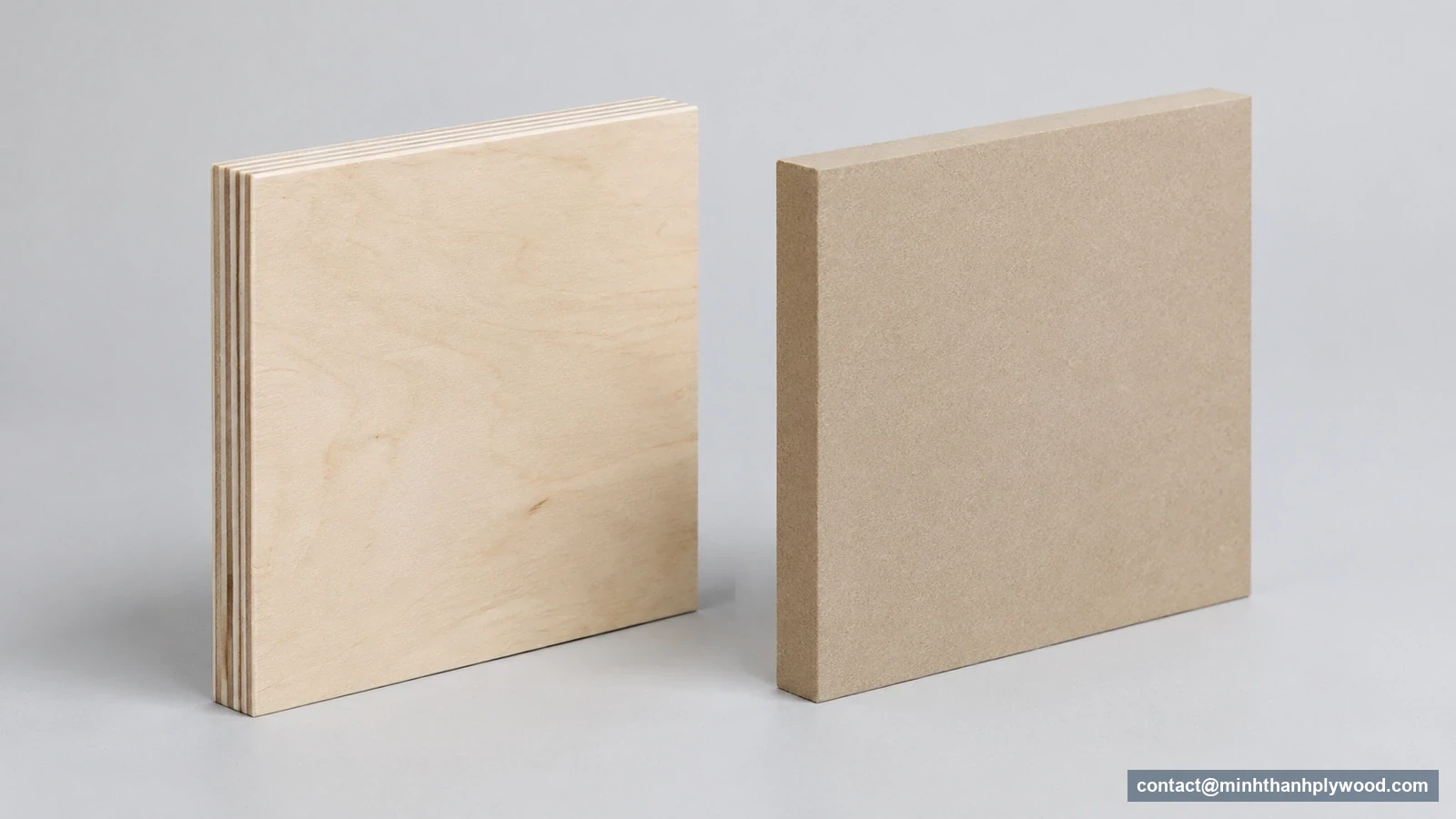
Plywood vs MDF: what is the useful buying decision?
Choose the panel for the component: plywood is a practical starting point for cabinet carcasses, jointed shelves and exposed veneer-edge furniture; MDF is a practical starting point for smooth painted doors, decorative routed profiles and covered interior panels. A cabinet can combine both materials. The purchase decision should identify which part each panel makes and what the part must withstand.
| Buying question | Veneer-core plywood | MDF |
|---|---|---|
| What is inside? | Bonded wood veneer layers, normally cross-grained | Fine wood fibres bonded into a panel |
| What does the edge show? | Veneer layers and glue lines | Fine fibre structure rather than veneer layers |
| What provides the decorative face? | Ordered face veneer such as birch, poplar or EV | Paint, a decorative overlay or applied veneer |
| What must be checked for a shelf? | Actual layup, bending data, span and load | Actual grade, bending data, span and load |
| What changes in machining? | Grain direction, veneer breakout and core continuity | Routed fibre surface, edge preparation and fixing details |
| What protects humid-service furniture? | Specified bond plus coating and exposed-edge design | Specified moisture-service grade plus coating and exposed-edge design |
| What emission evidence is needed? | Product records for the applicable market and test | Product records for the applicable market and test |
At Minh Thanh, the furniture plywood range uses white Styrax or Eucalyptus furniture cores, two-way stitching and double pressing. The factory supplies plywood; MDF here is the alternative a buyer can compare when designing a furniture line.
Start a sourcing conversation with a component schedule rather than “plywood vs MDF, which is better?” A supplier cannot select a useful construction from the material names alone. A door, supported back and long shelf place different demands on the panel, even when they belong to one furniture collection. Mark appearance, dimensions, hardware and exposure on each schedule line.
MDF vs plywood: how are the panels made differently?
Veneer-core plywood preserves wood as thin sheets; MDF breaks wood down into fibres before forming the board. The resulting internal structures are visible on a sawn edge. Cross-grained veneers provide directional properties, while a fibreboard lacks a decorative wood grain unless one is applied to the surface.
Plywood manufacture selects, dries and joins veneers, applies adhesive, lays up the layers and presses the assembly. Furniture preparation can add core calibration before the face press. Minh Thanh presses its furniture panels twice: the core board is pressed and calibrated first, then the decorative face and back are pressed onto that prepared core. This route prepares the substrate beneath the thin visible veneer.
MDF manufacture forms a fibre-and-resin furnish into a dense panel under heat and pressure. The producer’s grade determines its intended service and performance. General-purpose MDF, moisture-resistant MDF and specialist load-bearing or exterior boards should not be treated as one identical product. The same distinction applies between commercial plywood and a calibrated furniture panel.
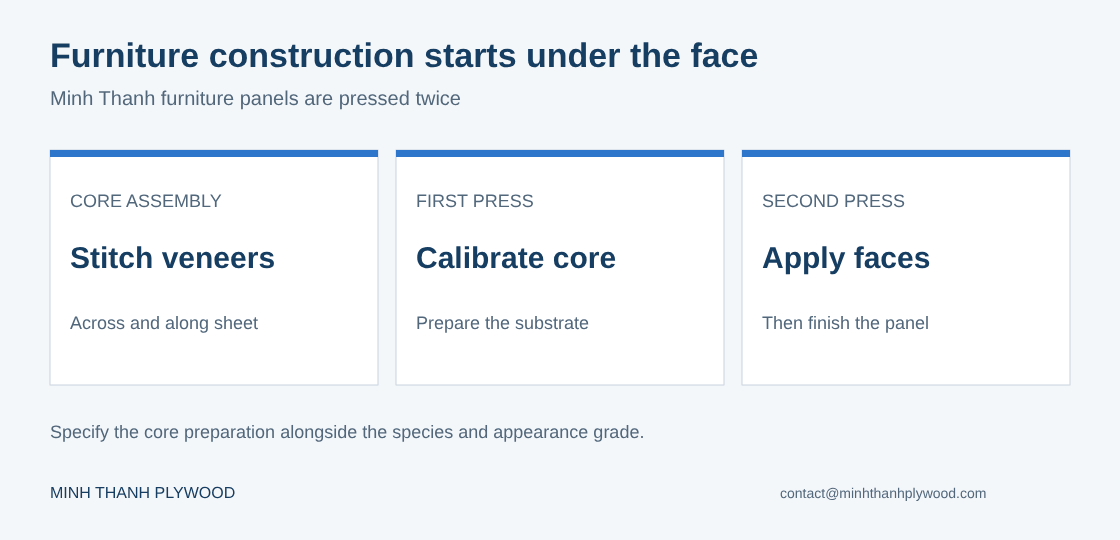
When comparing a quotation, ask for construction rather than assuming the more expensive material is superior in every property. An attractive plywood face does not reveal the core joining beneath it. A smooth MDF face does not identify its humidity grade or hardware instructions. Both quotations need a product specification and a sample tied to the grade being sold.
The types of plywood guide distinguishes veneer-core panels from other products sold under broad plywood labels. A decorative plywood face over a composite core is also a different construction from the veneer-core plywood discussed here; write the actual core on the order.
MDF or plywood for cabinets and shelves: which should you choose?
Use a specified furniture panel for cabinet boxes and evaluate shelves as assembled components. Veneer-core plywood offers a choice of internal wood species and layers, while MDF offers defined fibreboard grades. The performance comparison must hold the shelf geometry, support and loading constant.
For a shelf, identify unsupported span, shelf depth, thickness, grain direction where relevant, support arrangement and whether the load is evenly distributed or concentrated. Record the duration and allowable deflection. Short-term bending strength, stiffness and deflection under a sustained load are different criteria. A panel can resist breakage while still sagging beyond the furniture designer’s appearance limit.
Neither “18 mm plywood” nor “18 mm MDF” supplies an automatic shelf load in kilograms. A bending report belongs to the tested panel, direction and method. A furniture trial belongs to its support geometry and hardware. Connect the two records to the drawing so purchasing knows what approved performance means.
For a tall cabinet, review how the back, sides, shelves and connectors work together. A supported thin back can help an assembly behave differently from a cabinet with an open rear. A centre support changes a shelf’s span. Component design can therefore change material consumption more effectively than upgrading every sheet by one thickness.
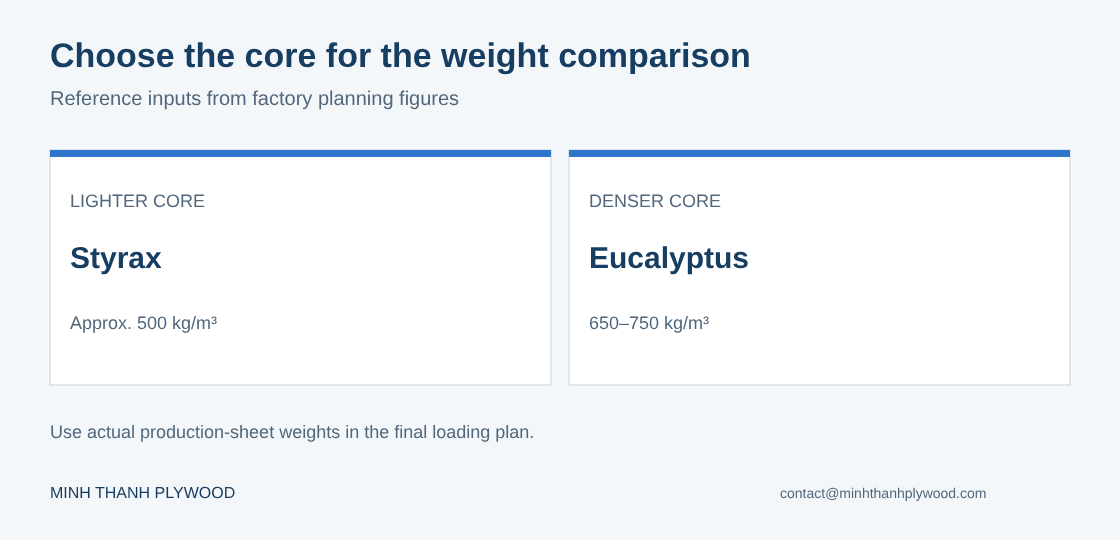
Minh Thanh’s core reference values help compare mass; they are not mechanical ratings. White Styrax is approximately 500 kg/m³ and Eucalyptus uses a 650–750 kg/m³ planning range. Choose the construction on a sample that represents the intended furniture and its joints. The furniture selection guide connects these decisions to face/back grades and a component schedule.
Which panel gives the better painted or routed finish?
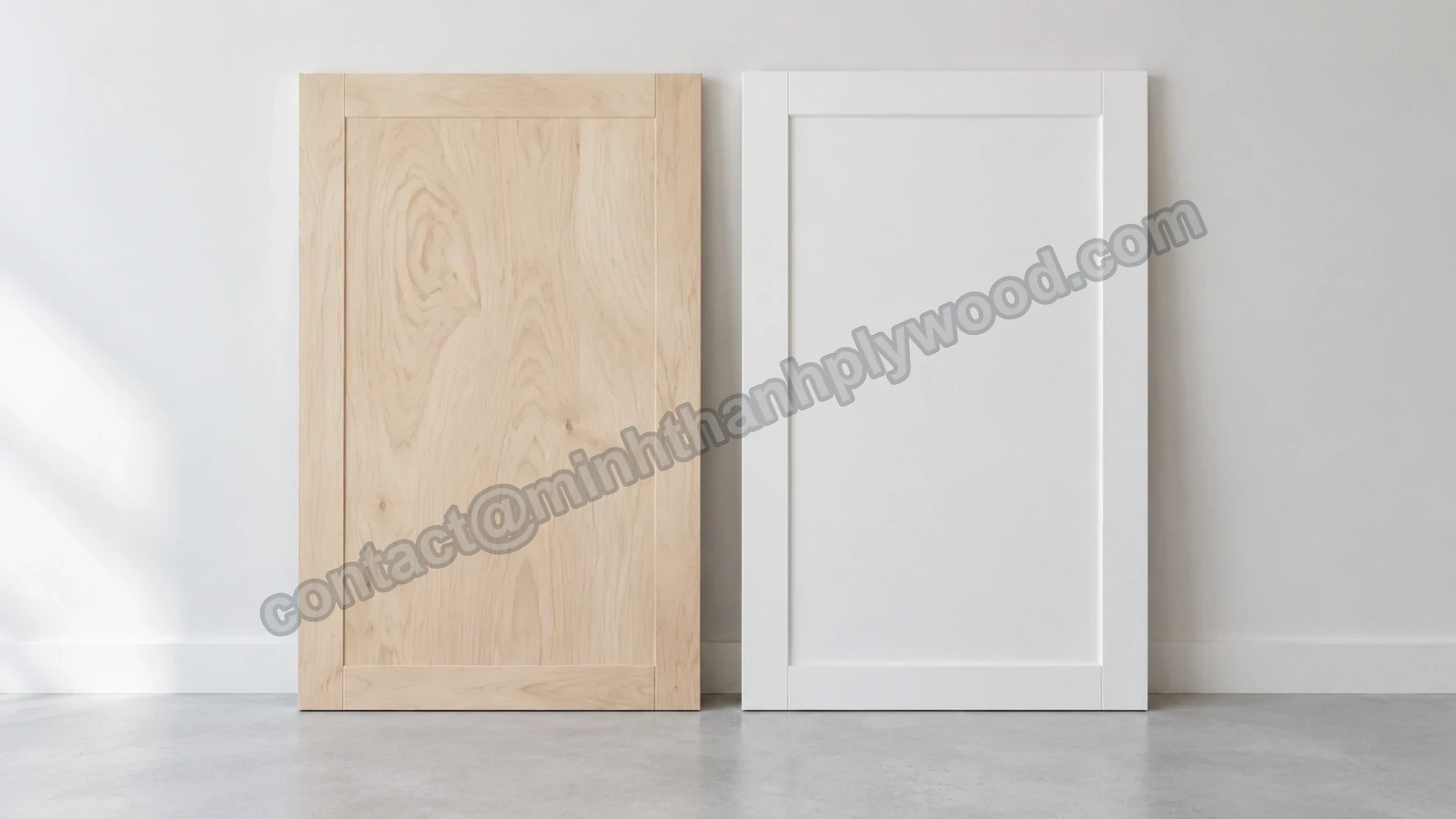
MDF offers a smooth fibre face and profiles without visible veneer layers; plywood offers natural face grain and a layered edge. For painted work, compare the finished component after primer, sanding and topcoat, rather than judging only an unfinished offcut.
A routed MDF door profile exposes the fibre substrate. Its edge preparation and coating process control the result. A routed plywood profile can expose several veneer directions and the core beneath the face. That profile needs to be evaluated for breakout, gaps and the appearance of the finished edge. Both substrates need a coating trial that includes the actual geometry.
For a painted plywood door, poplar-faced plywood is a useful starting surface. Select the face/back grades and preparation, then inspect repairs and grain after the intended coating. A smooth bare surface can still show a patch after a high-gloss finish. Conversely, an opaque finish can make a costly decorative figure unnecessary.
The rear of a door belongs in the same decision. Give it an appearance and preparation instruction; do not leave an exposed cabinet interior to whichever reverse face is standard in the supplier’s range. Compare the completed door’s dimensions and behaviour with its coating on both sides and its installed hardware.
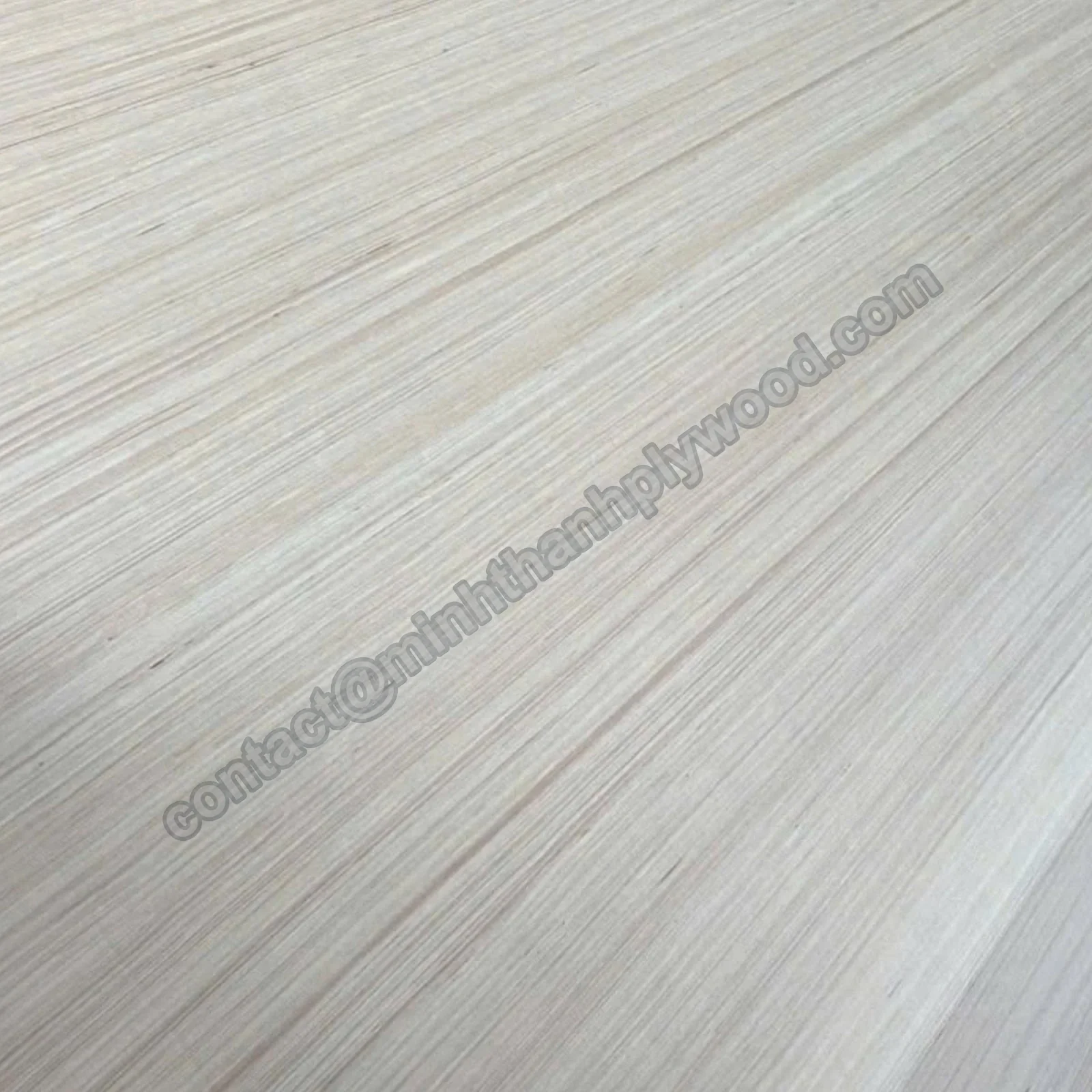
Minh Thanh supplies sanded and polished plywood, including UV-ready preparation for the customer’s coating process. UV-ready means a prepared substrate. The furniture manufacturer applies its own UV coating; the phrase does not mean the factory has supplied a cured UV finish.
Which is better for natural veneer and exposed edges?
Choose plywood when the natural veneer or layered edge is part of the design; MDF can also receive an applied decorative veneer when the design calls for that substrate. The visual result depends on the face veneer, back preparation and finished edge, not simply the word wood on the invoice.
Birch-faced plywood has birch on the outside. It does not necessarily have birch throughout. Minh Thanh supplies birch faces over the selected Styrax or Eucalyptus core. An all-birch or Baltic birch construction is a different panel, with its own layer sequence and density. Compare complete constructions before attributing the all-birch product’s properties to a birch-faced sheet.
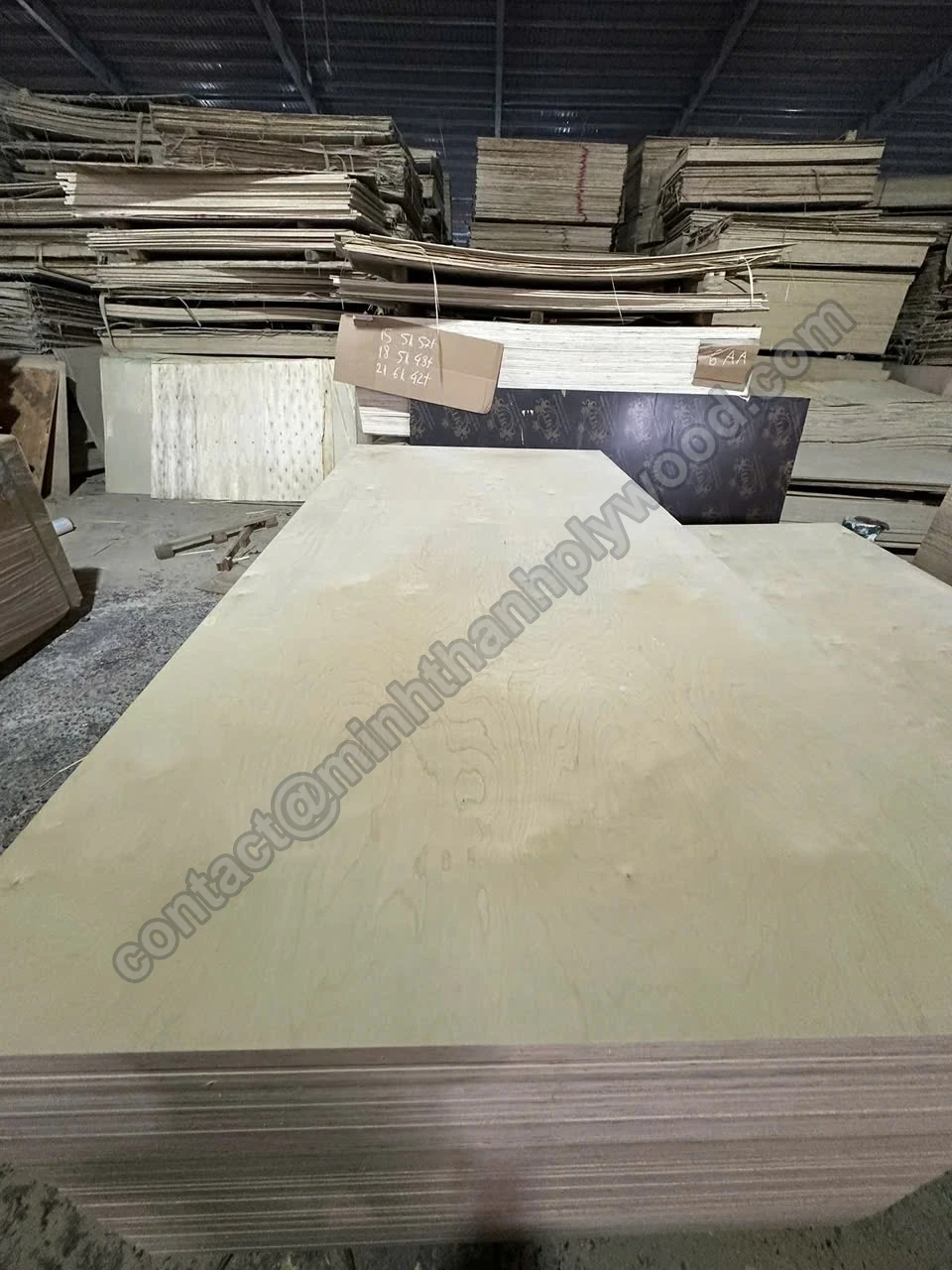
An exposed ply edge needs its own appearance sample. Inspect the layer arrangement, joining and finished sanding; check the edge after the intended clear finish. For covered edges, run the edge-banding operation and inspect the prepared substrate. A sawn corner is evidence of that corner, not a substitute for a trial of every critical machined feature.
Mark grain direction when neighbouring doors, long shelves or desktops need a coordinated appearance. Rotating a part in the cutting layout can save sheet area while producing an unacceptable visual direction. The face grade and permitted repairs should apply to the useful part area, not merely the cleanest corner of a sample.
For MDF with applied veneer, distinguish the decorative face, the fibreboard grade and the veneering process. The buyer’s surface choice and the internal panel choice remain separate. This is also why a material substitution should update the complete construction description, not only replace one word in the purchase order.
A layered edge can be a deliberate furniture detail rather than something to hide. The illustrated desk below shows broad faces and a visible ply edge. It represents an interior design application, not a supplied customer project or evidence of a named factory’s machining performance.

How do screws, hinges and connectors differ?
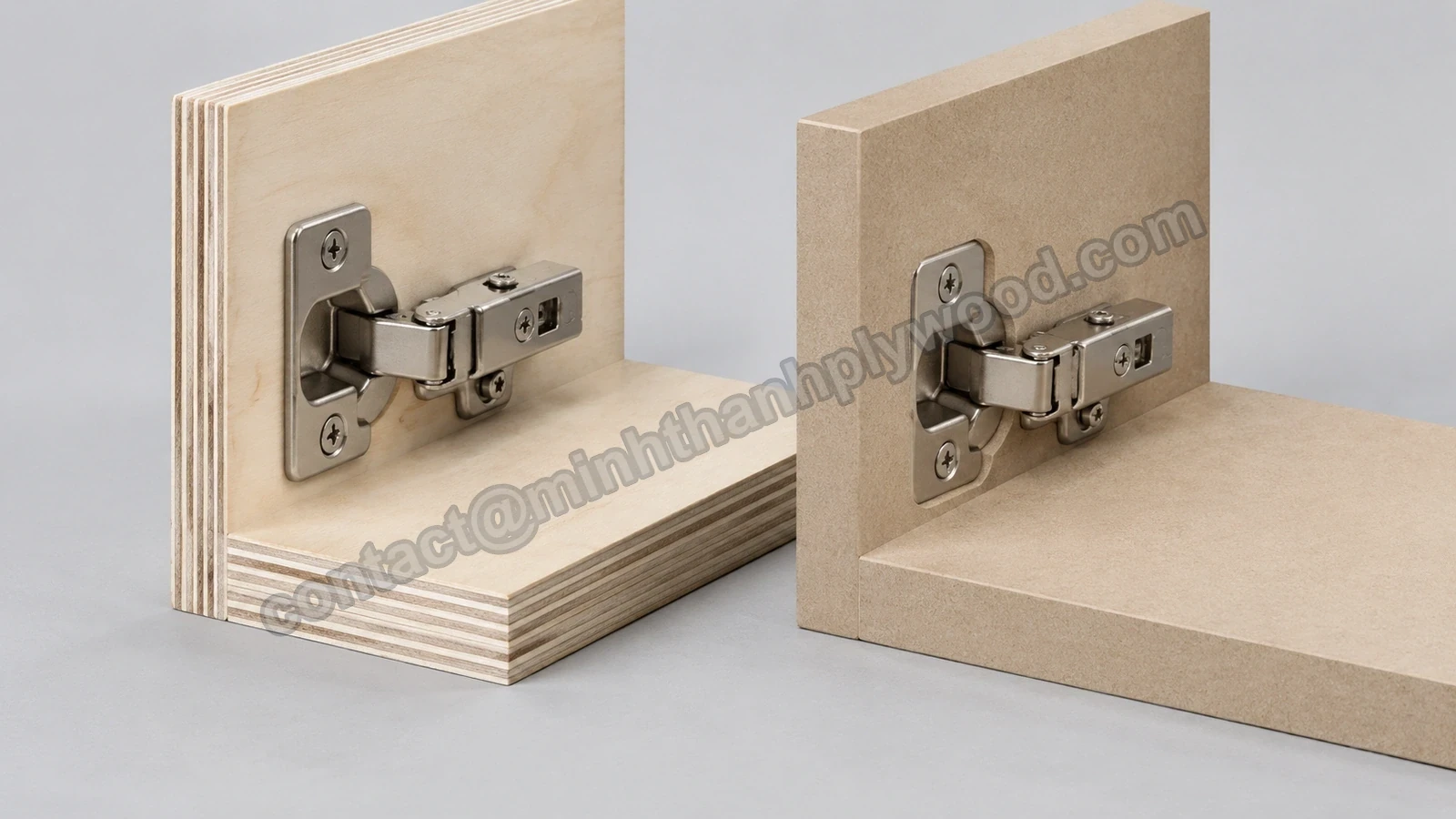
Both panels can be used with furniture hardware, but the fixing needs to suit the substrate and the actual joint. MDF is not incapable of holding screws. A poorly selected edge screw or pilot hole gives little information about the material’s properly designed performance.
The European Panel Federation’s MDF screwing guidance recommends suitable parallel-thread screws and pilot holes. Its general pilot-hole diameter is 85–95% of screw core diameter, drilled at least 1 mm beyond the expected insertion depth. It gives general face clearances of 12 mm from an edge and 25 mm from a corner, and 70 mm from a corner for screws inserted into an edge. Use the selected hardware and board producer’s instructions for the actual component.
| Joint to qualify | Keep constant in the comparison | Observe after assembly |
|---|---|---|
| Hinge fixing | Hinge model, cup drawing, screw and pilot holes | Local cracking, seating and movement |
| Drawer slide | Fixing positions and fastener engagement | Fit and component operation |
| Edge joint | Board thickness, pilot hole, screw and edge distance | Splitting, stripping or poor engagement |
| Cam-lock/dowel assembly | Connector model, drilled dimensions and insertion method | Seating and repeatable assembly |
A valid screw-withdrawal comparison uses the same fastener and test method. Retain the panel code and construction with the result. A claim that one species always holds a screw better cannot replace a joint trial involving the actual screw, hole and layer region.
On plywood, inspect freshly drilled or routed hardware locations for veneer breakout and gaps intersecting the fixing. On MDF, evaluate the specified connector, pilot hole and clearance. Record a change in hardware separately from a change in panel; otherwise the trial changes two variables at once and cannot identify which improvement mattered.
How does moisture change the choice?
Choose a panel grade and furniture design for the service exposure. Standard MDF is different from moisture-resistant MDF, and dry-interior plywood is different from plywood with a specified humid/exterior bond. Neither a green MDF core nor a hardwood face alone proves waterproof performance.
The European Panel Federation’s specialty-grade guidance distinguishes moisture-resistant and exterior MDF, including MDF.H for general use in humid conditions and MDF.HLS for load-bearing use in humid conditions. It also describes exterior grades. This is why the comparison must name the grade: the category MDF includes more than one service class.
For plywood, write the adhesive/bond requirement and the desired test method on the order. Minh Thanh’s standard furniture construction uses UF glue at E0 emission, with melamine-fortified and phenolic constructions specified for other bond requirements. The emission designation does not describe water resistance. A boiling test evaluates a sample bond; its duration alone does not certify a panel to a marine or European service standard.
Review water entry at cut-outs, lower edges and joints in sink bases or bathroom furniture. Coating the broad faces while leaving fresh installation cuts untreated creates a different finished component. Specify the edge detailing and installation instructions that match the panel grade and exposure.
Dry upper cabinets and moisture-exposed bases can therefore have different specifications in one kitchen. The water-resistance guide covers bond, wood surface and edge protection. Keep the component acceptance criterion explicit rather than buying every part under an undefined kitchen-grade name.
Is plywood lighter than MDF?
Compare actual panel density and finished dimensions. MDF is often denser than a light veneer-core plywood, but a material label does not determine one sheet mass. A dense plywood construction and a lightweight fibreboard grade can change the usual comparison.
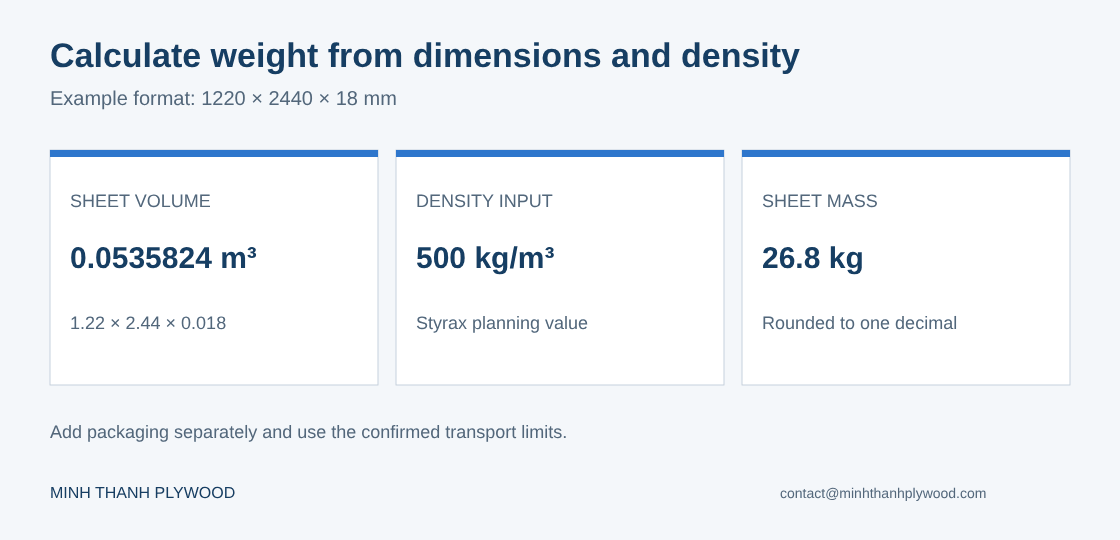
Minh Thanh’s reference sheet, 1220 × 2440 × 18 mm, has a volume of 0.0535824 m³. Multiplying that volume by the planning density gives the following board-only values.
| Minh Thanh furniture-core reference | Density | Calculated sheet mass |
|---|---|---|
| White Styrax | 500 kg/m³ | 26.8 kg |
| Eucalyptus frozen-plan reference | 650 kg/m³ | 34.8 kg |
| Eucalyptus upper reference | 750 kg/m³ | 40.2 kg |
For the MDF candidate, obtain the supplier’s density and actual sheet weights at the selected thickness. Use the same dimensions when comparing. Density from one MDF grade or plywood core should not be silently applied to another product with a different grade or construction.
Full sheets, finished doors and export cargo have different handling questions. A lighter sheet can simplify lifting, but door hardware still needs to suit the completed door’s mass. Freight planning includes packing as well as boards, and a container can reach its weight cap before using its geometric space. Weigh production boards and packaged units for the final load.
The sheet-size guide separates format from thickness. Changing to a larger sheet changes area, volume and handling even if the density stays identical. Compare mass at the actual format used by the furniture line.
Which thickness and tolerance should you order?
Specify the thickness required by the drawing and its machining interfaces. Plywood and MDF in the same nominal size do not automatically fit the same groove, hinge recess or edge profile. The delivered tolerance belongs on the quotation and sample record.
Minh Thanh supplies plywood from 3–40 mm. Thin 3–5 mm panels use five plies; at 6 mm the ply count is set with the order. Sanded furniture thickness tolerance is ±0.2–0.3 mm, with tight orders down to ±0.2 mm; commercial and film-faced plywood use a different ±0.5 mm reference. Write the line and selected tolerance beside the nominal thickness.
For an 18 mm order with ±0.2 mm tolerance, the stated band is 17.8–18.2 mm. The receiving workshop needs tooling and assembly allowances that work with that band. An 18 mm groove drawn with no clearance is a different instruction from a groove designed around the permitted board variation.
When comparing MDF, use its selected grade’s dimensions and tolerance from the producer, not Minh Thanh’s plywood values. Measure samples at several positions using a suitable instrument. Keep raw board thickness separate from the finished component thickness after laminate, veneer, adhesive or coating is added.
Thickness selection should also consider the component support, fastener engagement and assembly. A thin back, thick side and long shelf can share the same decorative face while requiring different construction lines. The plywood thickness guide develops this component-led selection rather than assigning one thickness to every part of a cabinet.
How do cutting, routing and edge finishing affect production cost?
Measure the machining and finishing work on the actual panels. Plywood’s veneer directions and MDF’s fibre structure encounter the cutter differently, while edge treatment can add operations that the sheet price does not show.
For plywood, inspect the entry and exit faces, narrow routed features and exposed core. For MDF, inspect the routed surface and edges that will be sealed or painted. Hold tool condition and setup constant during a material comparison. Record a change in blade or feed separately rather than attributing every difference to the panel.
A cutting record should distinguish accepted parts, rework and scrap. Then record the additional preparation needed for the intended finish: edge sealing, filling, sanding or banding. The less expensive sheet can require more process work, while a premium decorative face can be wasted under an opaque finish. Use the actual component line to determine which cost matters.
For edge banding, inspect the prepared substrate and run the workshop’s band/adhesive combination. An edge that looks smooth before banding can still produce a visible line after the completed operation. For exposed-edge furniture, finish the layered edge through its final sanding and clear-coating sequence instead.
Minh Thanh supplies whole sheets and cut-to-size pieces according to the drawing. A full panel can be divided into four, six or eight pieces, with the saw kerf and trimming allowances accounted for. Buying pre-cut parts changes the workshop operations and packing requirement; state who performs final sizing before comparing cost.
How should the workshop control dust from both materials?
Use dust extraction at the machining operation for both plywood and MDF, and select the controls for the actual material and task. Low-emission product certification does not remove the need to control machining dust.
UK HSE’s woodworking guidance recommends effective local exhaust ventilation during MDF machining and sanding, suitable vacuum cleaning and additional respiratory protection where required by the assessment. Compressed-air cleaning and dry brushing disperse fine dust instead of capturing it. HSE also addresses hardwood and softwood dust from other wood products.
For a production comparison, record whether the existing extraction system works effectively at the router, saw and sanding station used in the trial. Account for cleaning and filter maintenance as actual workshop operations rather than assuming a dustier-looking cut is a complete safety or cost assessment.
The product file and the workshop assessment serve different purposes. Product emissions concern the specified manufactured board or finished article under a test method. Machining exposure concerns dust and other substances released in the workshop’s process. Retain the board safety information and the coating/adhesive information alongside the process instructions.
A material substitution should therefore reach the workshop team before production begins. The change can affect dust capture, waste handling, tooling and surface preparation as well as the drawing and purchase price. These are measurable production effects, not reasons to declare one entire material category safe or unsafe.
What emissions and origin records do buyers need?
Specify the destination requirements for the actual board and finished furniture. Plywood and MDF can both use formaldehyde-based resin systems, and low-emission options exist in both categories. A face species or fibreboard label does not establish a numerical emission result.
For US supply, EPA TSCA Title VI addresses hardwood plywood, MDF and particleboard. Obtain the correct product certification, labelling and shipment records. Minh Thanh holds CARB P2 / TSCA Title VI certification, ICTT mill no. 23024; its specimen-specific emission reports are on Quality.
For EU furniture and wood-based articles, REACH entry 77 uses a 0.062 mg/m³ limit from 6 August 2026 under Appendix 14 conditions, with exemptions including exclusively outdoor articles. Match the testing plan to the article and market. A CARB/TSCA result in ppm is not an EU Appendix 14 result. SGS testing to the buyer’s method can be arranged.
For wood origin, identify every wood constituent and its supplier evidence. Minh Thanh supplies the EUDR origin dossier and geolocation files for the importer. A decorative face imported from another country is part of the construction, just as the local core is; a panel’s export origin does not replace the raw-material traceability record.
FSC is an origin/chain-of-custody requirement separate from emission performance. FSC is available*. The supplied order should identify the agreed claim and documentation on the order. Do not assume FSC establishes a chamber-emission value or that a low-emission report proves certified forestry origin. Each claim needs its own scope and records.
*Supplied directly or through qualified partner mills.
How should you compare prices and usable-part cost?
Compare current quotations for panels that can make the same accepted component, then include relevant processing costs. MDF often serves economical painted interiors, while plywood prices change with face, core, grade, bond and preparation. Compare the actual quoted amounts for the selected constructions.
Minh Thanh furniture/interior plywood is from US$350/m³ and commercial plywood from US$250/m³, as of October 2026. The furniture range entry price does not quote every veneer, thickness or delivery scope. Request the selected construction and the required FOB Hai Phong, CFR or CIF term.
| Cost input | Comparison method |
|---|---|
| Panel quotation | Match grade, thickness, format, quantity, currency and delivery scope |
| Cutting yield | Use the actual nesting layout and accepted part count |
| Hardware | Include the connectors and drilling needed by each substrate |
| Edge/finish preparation | Include actual banding, sealing, filling, sanding and coating operations |
| Rework and scrap | Use measured trial or production records |
| Freight and packing | Use the carrier quote and final packaged quantity/weight |
Cost per accepted part equals the relevant panel, processing and finishing cost divided by the number of accepted parts. Keep a material change and a change in finish separate: replacing a clear-finished veneer door with a painted MDF door changes the product appearance as well as the substrate.
Use confirmed freight and packaged cargo in the delivered-cost calculation. Do not divide a freight quotation by a geometric board-only container reference and present the result as a guaranteed shipping saving. The packing calculator supports the plywood load inputs, while actual measured cargo and booking limits determine the final shipment.
Can one furniture range combine plywood and MDF?
Yes. A furniture range can allocate plywood and MDF to different components when each construction fits its drawing, finish and service requirement. Write separate material lines so a combined approach does not become an undocumented substitution.
A practical design brief can specify a furniture-grade plywood carcass, a painted MDF door of the selected grade and a thin plywood back. That brief is an example of component allocation, not a record of a Minh Thanh customer or a guaranteed production design. The hardware, joints, finish and loads still belong to the designer’s specification.
At the interfaces, check door alignment, groove fit and the position of hinges or connectors. Account for the completed door mass and the dimensions after finishing. A material choice that works as an isolated offcut may require a different fixing or preparation when installed in the full assembly.
Keep pack and part codes distinct through cutting and assembly. The person receiving components should be able to identify the board grade from its schedule, rather than treating two pale finished faces as interchangeable. This is especially useful where the same colour finish hides different internal substrates.
For another common substrate, use particleboard versus plywood. MDF and particleboard are both composite panels, but fibreboard and particleboard are different structures. A specification that says only composite wood cannot reproduce the selected component.
How do you test a substitution before production?
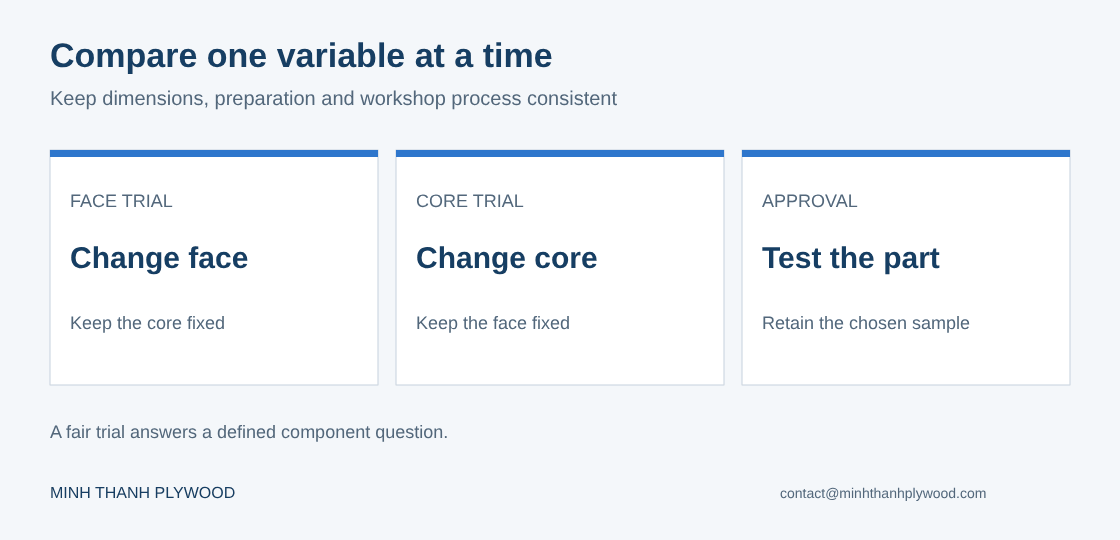
Change one material variable at a time and qualify the whole component. The purpose of the trial is to record what passes under the production process, with the construction and setup still identifiable.
- Define the part drawing, load/exposure and acceptance criteria.
- Identify each sample’s grade, thickness, construction and preparation.
- Measure dimensions and mass before processing.
- Cut and machine with recorded tools and settings.
- Install the actual hardware and edge treatment.
- Apply the intended coating or covering and complete its curing process.
- Assemble and evaluate the component, including the visible back and edges.
- Retain the accepted sample, test record and revised specification.
An appearance-only trial should keep the internal panel construction constant. A substrate trial should keep the part geometry and finish process comparable. When a change needs different hardware, record the hardware revision as part of the selected design rather than pretending the panel alone caused the outcome.
For repeat orders, use the active construction revision. A new resin/bond, different core or changed face is a new material instruction even if the product name and nominal thickness remain unchanged. A larger quantity can use the same approved construction, with its sheet and bundle counts updated separately.
Minh Thanh provides free plywood samples. Give the part and trial requirements so the sample represents the intended order. A random decorative offcut is less useful than an identified construction that can be machined and assembled through the furniture maker’s normal process.
Which panel suits speaker boxes and specialist furniture?
Specify speaker or equipment cabinets by the enclosure drawing and its engineering requirements. Material mass, panel stiffness, bracing, joint sealing and transport conditions all form part of that design. Neither MDF nor a birch-faced plywood label alone supplies a sound-quality rating.
For a fixed interior enclosure, a designer can choose MDF as a fine-fibre substrate. For equipment that is moved and handled, the designer can evaluate plywood as part of the enclosure construction. In both cases, compare the actual thickness, braces, joints, coatings and fixing details. Hold geometry and the measurement method constant when evaluating a material substitution.
A birch-faced panel on Styrax or Eucalyptus is different from all-birch plywood. If the drawing specifies all-birch, replacing it with another core requires the designer’s acceptance and an updated construction record. Do not attribute an acoustic result from one enclosure or panel to every plywood with the same decorative face.
For other specialist furniture, record the special requirement on its own line: wall fixing, transport mass, curved machining, a display surface or a flame-performance requirement. General furniture appearance grades and low-emission certification do not establish a fire classification or a structural rating. Obtain the relevant product evidence for the specific requirement rather than extending a certificate beyond its scope.
What should you specify on the furniture plywood order?
Send the application first, followed by a construction line that purchasing, production and the receiving workshop can all identify. For plywood, the face and core are independent fields; for MDF, record the producer’s specific board grade rather than using one broad fibreboard label.
For a Minh Thanh plywood enquiry, include component and exposure; face/back species and grades; Styrax or Eucalyptus core; required stitching scope and layup; sheet dimensions and count; nominal thickness and tolerance; adhesive/bond requirement; emission method and destination records; sanding or UV-ready preparation; cut-to-size drawing; packing and destination.
Public-source guidance was reviewed on 7 October 2026.
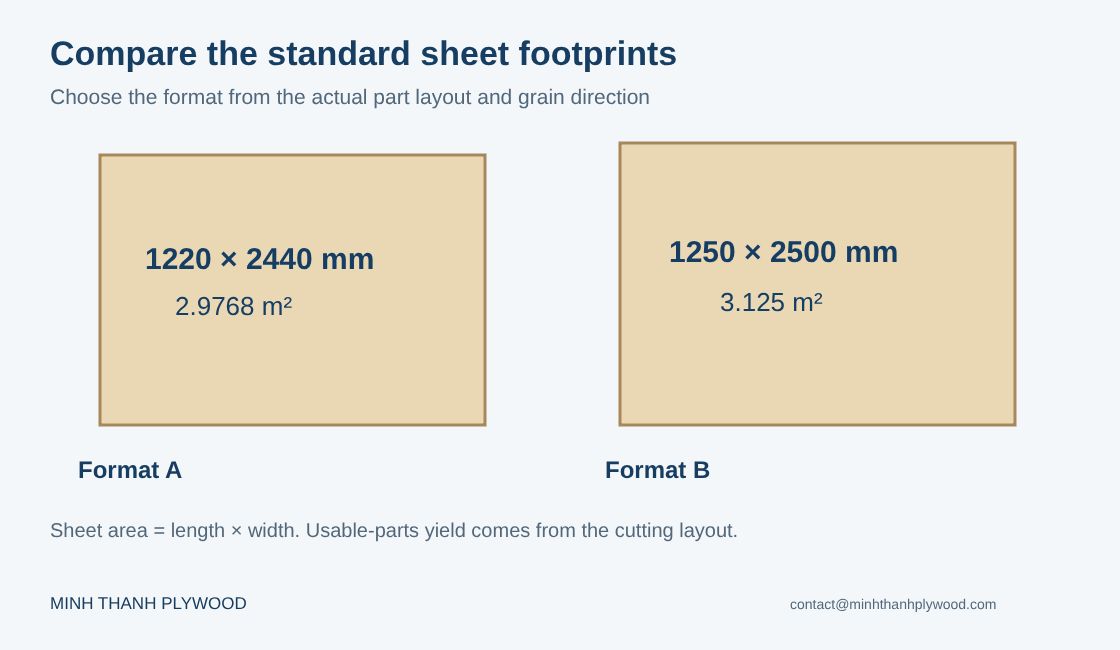
Standard formats are 1220 × 2440 and 1250 × 2500 mm, with agreed custom formats. The minimum is one 40HC, with mixed specifications by agreement. Production takes 15–45 days after deposit; standard payment is 30% deposit and 70% against the scanned bill of lading, or irrevocable L/C at sight.
On receipt, reconcile the bundle codes and sheet counts with the packing list, inspect shipping damage and keep different constructions separate in storage. Store panels supported flat and condition them for the workshop before machining. Retain the approved sample and receiving records for the next order.
For a factory quotation, send the component drawing and required plywood construction through Contact. Minh Thanh’s export team can then price the board that the furniture line has selected, with the agreed preparation and shipment scope recorded alongside it.
Buyer questions, answered
What is the difference between plywood and MDF?
Veneer-core plywood uses bonded wood veneer layers with alternating grain direction; MDF uses fine wood fibres bonded into a panel. Plywood has a layered edge and a selected face veneer, while MDF has a fine fibre surface and edge. The material construction affects machining, finishing, hardware and the grade needed for service exposure.
Is plywood stronger than MDF?
Furniture plywood is a useful choice for carcasses, shelves and assembled joints, but strength belongs to the specific panel and component. Compare bending data, thickness, span, support and load duration rather than assigning a kilogram load to either material name. Load-bearing MDF grades also exist, so identify the grade before comparing.
Is MDF better than plywood for painted doors?
MDF provides a smooth fibre surface and routed profiles without visible veneer layers, making it a useful painted-door substrate. Poplar-faced plywood can also be painted, with face repairs, grain, edges and primer checked in a finishing trial. Compare the cured finish and hinge arrangement on the actual door design.
Should kitchen cabinets use plywood or MDF?
A kitchen can use plywood carcasses and MDF painted doors when both are specified for their parts and service conditions. Separate dry upper cabinets from sink bases and moisture-exposed components. Specify the panel grade, bond or moisture requirement, edge treatment and actual hardware rather than applying one kitchen grade to every part.
Is moisture-resistant MDF waterproof?
Moisture-resistant MDF is a grade for specified humid-service conditions, not a promise that the finished cabinet withstands leaks or immersion. Check the manufacturer's grade, tests, coating and exposed-edge requirements. Standard MDF and moisture-resistant or exterior MDF are different specifications.
Is plywood always lighter than MDF?
Calculate weight from the actual density and dimensions of each panel. Minh Thanh uses planning densities of 500 kg/m³ for Styrax and 650–750 kg/m³ for Eucalyptus; a 1220 × 2440 × 18 mm sheet calculates to 26.8 kg or 34.8–40.2 kg respectively. Use the MDF supplier's density and measured sheet mass for the other side of the comparison.
Can screws hold well in MDF?
MDF can give good screw retention with suitable screws, pilot holes and fixing positions. European Panel Federation guidance recommends a pilot-hole diameter of 85–95% of screw core diameter and suitable face/edge clearances. Compare the actual joint with the same hardware and test method on both materials.
Is birch-faced plywood the same as Baltic birch?
Birch-faced plywood identifies the surface veneer and requires the core to be specified separately. Minh Thanh furniture panels use Styrax or Eucalyptus as standard cores. An all-birch panel is a different construction, so compare its complete layup rather than assuming every birch face has birch inside.
Which material is cheaper, plywood or MDF?
Obtain current quotes for the specified grades, thicknesses, formats and delivery terms, then add cutting, hardware, edging and finishing costs. Minh Thanh furniture/interior plywood is from US$350/m³ as of October 2026. The entry price does not establish an MDF price or a fixed percentage premium between materials.
Does MDF emit more formaldehyde than plywood?
Emissions depend on the actual resin, manufacturing process and tested product, so the material label alone does not rank the two. US TSCA Title VI applies to hardwood plywood, MDF and particleboard, and EU REACH entry 77 applies to covered furniture and wood-based articles. Specify the required method, certification and product records for the destination.
Can I replace MDF with plywood without changing the drawing?
Recheck thickness tolerance, grooves, routed profiles, fasteners, exposed edges, finishing and component mass before substitution. Veneer layers and fibreboard do not machine or finish identically. Approve the revised construction through the component trial and update the drawing or specification where needed.
Does Minh Thanh manufacture MDF?
Minh Thanh's range on this site is plywood, with furniture-grade Styrax or Eucalyptus cores and a choice of face veneers. This guide explains MDF as an alternative material for the buyer's component decision. Send the part drawing and required plywood construction for a factory quotation.