
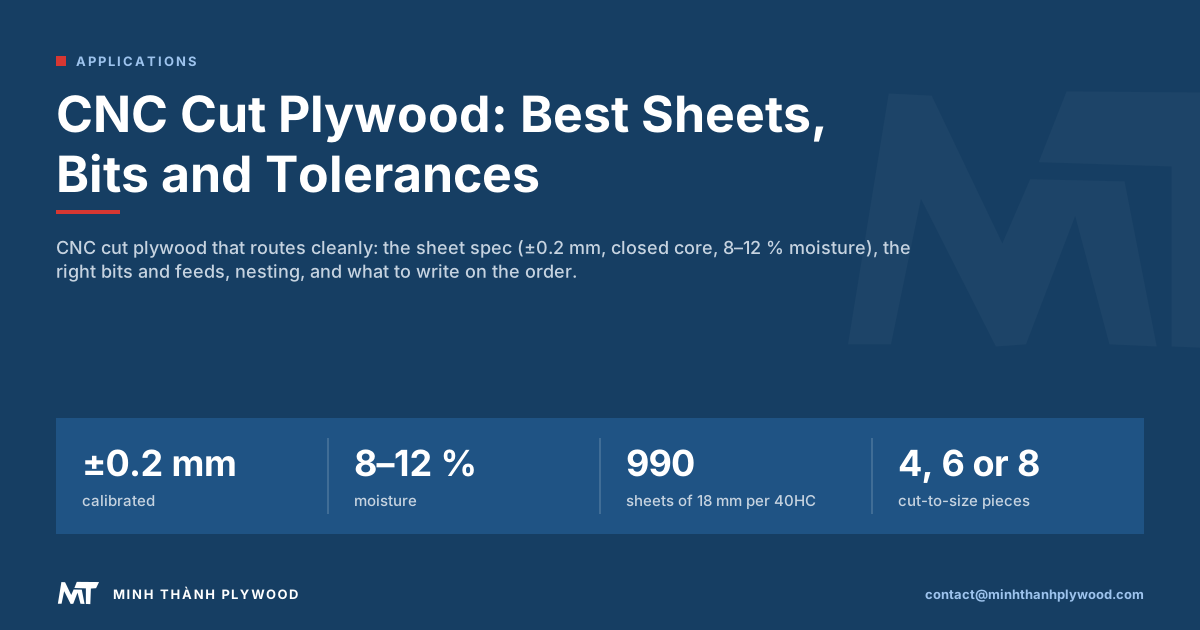
Plywood cuts cleanly on a CNC router when the sheet is calibrated, flat, dry and has a closed core: a thickness tolerance of ±0.2 mm, no core gaps and 8–12 % moisture. Use a sharp compression bit, the feed the tool maker gives for plywood, and a nesting layout that holds small parts down. Minh Thanh Plywood builds furniture panels to that spec and cuts parts to size.
CNC cut plywood service in the UK: how ordering works
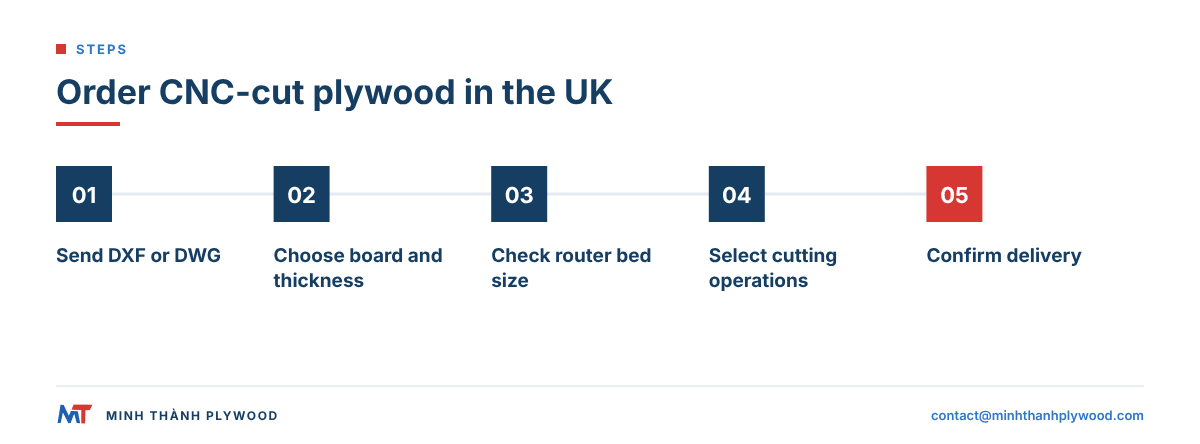
If you searched “CNC cut plywood” to have shapes cut for you, UK cutting services work the same way: send a drawing, they route the parts, you collect or take delivery. A wrong file or sheet choice costs a second run, so the order below saves most of the back-and-forth.
- Send the drawing. Services take DXF or DWG vector files, and some will redraw a simple sketch. Draw parts at final size with the tool diameter in mind: inside corners take the bit radius.
- Pick the board and thickness. Birch plywood is stocked from 4 to 30 mm at the larger UK services, with 6, 9, 12, 15 and 18 mm the common cuts. Poplar-faced and white melamine birch plywood are also offered. A full 18 mm BB/BB birch sheet retails around £118.
- Check the bed size. The largest UK routers take a full 3050 × 1525 mm sheet; most work from 2440 × 1220 mm.
- Choose the operations. Shape cutting, hole drilling, hinge-hole and handle forming, panel grooving, and perforated or fretwork patterns are all one program.
- Confirm lead time and delivery. Expect 5–6 working days for a routed job at a busy shop, and 48 hours at a small digital-fabrication service that quotes within a couple of hours. Collection or courier is the choice.
Typical jobs: wall panels, room dividers, fretwork screens, wardrobe and kitchen doors with pre-drilled hinge holes, and flat-pack furniture parts.
Where Minh Thanh fits. Minh Thanh does not route parts for UK homeowners. It makes the calibrated sheet those services and furniture makers cut: thickness held to ±0.2 mm on sanded furniture panels, closed core, 8–12 % moisture, and cut-to-size blanks in 4, 6 or 8 pieces per panel.
UK CNC shops, flat-pack makers and joinery firms buy by the 40HC, with 30–40 days at sea from Hai Phong to Northern Europe. The panels carry CARB P2 / TSCA Title VI certification; six ASTM D6007 chamber tests averaged 0.014–0.032 ppm against the 0.05 ppm limit. Ask for a free sample sheet and cut it on your own router before the first order.
Can CNC machines cut plywood?
Yes, CNC machines cut plywood well, and a calibrated, closed-core sheet is what makes the cut clean. The router decides the edge quality only once the sheet is right: flat, dry, even in thickness and free of core gaps.
The sheet spec that matters for CNC cut plywood:
| Property | CNC-grade target | Why it matters on the router |
|---|---|---|
| Thickness tolerance | ±0.2–0.3 mm, down to ±0.2 mm | Pocket depth, slot fit, tab joints |
| Core | Closed, even core, no gaps or overlaps | No breakout or voids on cut edges |
| Flatness | Flat on the vacuum table | Hold-down and even depth across the sheet |
| Moisture | 8–12 % at dispatch | Parts stay flat after cutting |
| Face | Sanded, sound face, grade for the finish | Clean top edge, finish-ready parts |
| Glue | UF glue at E0 emission for interior furniture | Even glue lines, low emission parts |
| Sheet size | 1220 × 2440 or 1250 × 2500 mm, or custom | Nesting yield on your machine bed |
Minh Thanh builds furniture panels to this list as standard: the core board is pressed and calibrated first, then the face and back are pressed on, and the core layers are stitched both horizontally and vertically so the core stays closed.
Which plywood is best for CNC routing?
The best plywood for CNC routing is calibrated furniture plywood with a closed core, a sanded face and an even veneer build, so it cuts cleanly and holds size. The face species decides the look and the price; the core and calibration decide how it routes.
| Panel | CNC routing | Best CNC uses |
|---|---|---|
| Birch-faced, Styrax or Eucalyptus core | Very good, crisp edges, hard face | Visible furniture, exposed edges |
| Poplar-faced, Styrax core | Very good, light, easy machining | Painted and flat-pack parts |
| Eucalyptus-faced | Good, dense and stiff | Shelves, tops, load-bearing parts |
| Engineered veneer (EV) | Good, consistent colour | Decorative fronts and panels |
| Okoume-faced | Good, light | Interior panels |
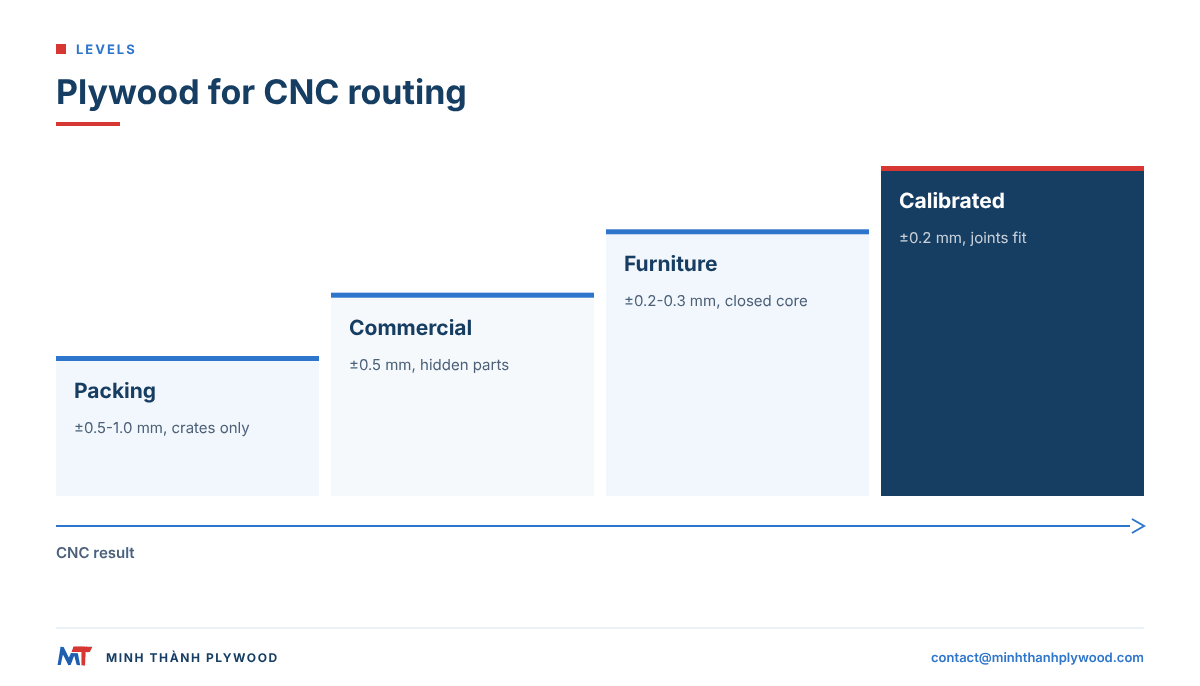
| Commercial plywood (±0.5 mm) | Fair; tolerance and core vary more | Hidden parts, jigs |
| Packing plywood (±0.5–1.0 mm) | Poor for joinery | Crates and pallets |
For exposed-edge furniture, buyers often choose birch faces on a white Styrax core: light, pale and even through the edge. For painted flat-pack, poplar faces on Styrax are the cost-effective choice. Birch faces are graded D+, D and E in Vietnam, comparable to the European birch grades, and quoted as pairs such as D+/D.
Is poplar plywood suitable for CNC?
Yes, poplar plywood is well suited to CNC routing: it is light, cuts with low tool wear and takes paint well. The points to specify are calibration, the core and the face grade, because poplar faces are soft and show tear-out from a dull bit.
- Face grade: quoted as A/A, A/B or B/B face/back pairs, matched to the approved sample. Buyers also order by the Chinese codes B/BB, BB/CC and CP, which map onto the same ladder. A/B suits parts with one visible face.
- Core: white Styrax gives a light, pale edge. Eucalyptus gives a denser, stiffer part.
- Tooling: keep bits sharp; poplar fuzzes on the top face when the edge dulls.
- Finish: sand lightly after routing and prime; poplar is a good paint base.
See poplar plywood for builds and grades.
Why does plywood chip on a CNC?
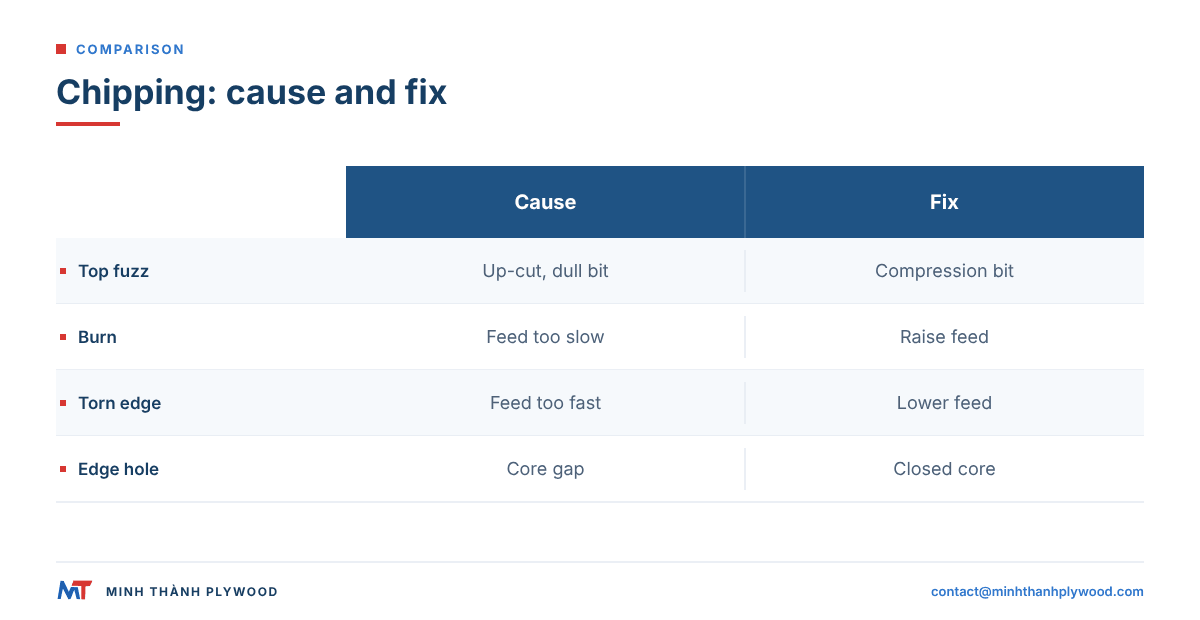
Plywood chips on a CNC because the bit pulls fibres up or pushes them out where the face is unsupported. The usual causes are a dull or wrong bit, a wrong feed for the spindle speed, a sheet that lifts, or a gap in the core under the face.
| Symptom | Likely cause | Fix |
|---|---|---|
| Fuzz and tear-out on the top face | Up-cut bit, dull edge | Compression or down-cut bit, new tool |
| Breakout on the bottom face | Down-cut bit on through-cut, worn spoilboard | Compression bit, fresh spoilboard |
| Burn marks on the edge | Feed too slow, bit rubbing | Raise feed or lower spindle speed |
| Rough, torn edge | Feed too fast, chip load too high | Lower feed, check the chart |
| Hole or crumble in the edge | Core gap or overlap | Closed-core, stitched panel |
| Small parts move | Lost vacuum on small parts | Tabs, onion skin, nesting order |
| Pocket depth varies | Sheet thickness or flatness varies | Calibrated sheet, surface the spoilboard |
Two of the last three are sheet problems, not tool problems; the third is hold-down. A stitched, calibrated core removes most of them before the sheet reaches the machine.
What bit for plywood? Choosing CNC tooling
The best bit for cutting plywood on a CNC is a solid-carbide compression bit for through-cuts and a down-cut bit for pockets and dados. A compression bit has up-cut flutes at the tip and down-cut flutes above them, so it presses fibres inward at both faces.
| Bit | Use on plywood | Edge result |
|---|---|---|
| Compression, two flute | Through-cuts on full-thickness parts | Clean top and bottom faces |
| Mortise compression (short up-cut tip) | Shallow pockets and dados with a clean top edge | Clean top, chips evacuate |
| Down-cut spiral | Pockets, dados, thin sheets | Clean top face, chips stay in the cut |
| Up-cut spiral | Deep slots where chips must clear | Fuzz on the top face |
| Straight (O-flute or two flute) | Roughing, low-cost cutting | Acceptable on hidden edges |
| V-bit | Chamfers, folding grooves, engraving | Sharp lines in the face |
| Ball-nose | 3D shaping, round-overs | Smooth curves |
Plywood glue lines are abrasive, so carbide outlasts high-speed steel many times over. Keep a tool log: edges start to fuzz and burn well before a bit looks worn.
Spindle speed, feed and chip load for plywood CNC
Set the feed from the chip load the tool maker gives for plywood: feed rate = spindle speed × number of flutes × chip load. A chip that is too thin rubs and burns; a chip that is too thick tears the edge.
Worked example: a two-flute compression bit at 18,000 rpm with a chip load of 0.25 mm per flute gives 18,000 × 2 × 0.25 = 9,000 mm per minute. If the edge burns, raise the feed or lower the speed; if it tears, lower the feed.
Rules that hold on most routers:
- Start from the tool maker’s chart for plywood and the bit diameter, then adjust in steps.
- Keep the chip load when you change speed: lower rpm means lower feed.
- Use full-depth passes with compression bits on sheets up to their flute length; the compression point has to sit inside the sheet.
- Slow down for small parts and corners, where the vacuum hold is weakest.
- Listen and look: a steady hum and dry chips mean the feed is right; dust and squeal mean the bit is rubbing.
These numbers are an example, not a setting: each machine, bit and sheet needs its own test cut.
Plywood CNC nesting: sheet size, layout and hold-down
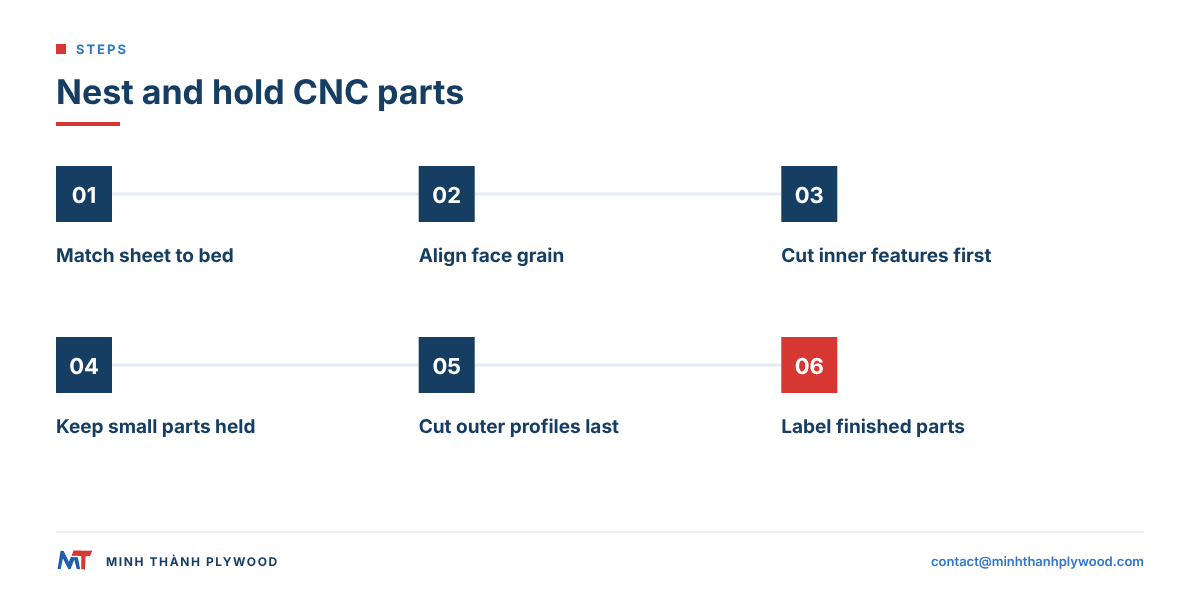
Good plywood CNC nesting fits the most parts on a sheet and keeps small parts held down until the last cut. Order the sheet size that matches your bed and your part list, and plan the cut order around the vacuum.
- Sheet size. Standard sizes are 1220 × 2440 mm and 1250 × 2500 mm; custom sizes such as 1220 × 2500 mm and 1220 × 2280 mm are made on order and can raise yield on a nested part list.
- Grain direction. Nest long parts along the face grain for looks and stiffness.
- Cut order. Cut inner features first, small parts before large ones, and the outer profile last.
- Hold-down. Leave an onion skin or small tabs on small parts, or use a down-cut pass at the end, so parts do not move.
- Spoilboard. Surface it flat, and replace it when vacuum leaks through worn areas.
- Labels. Print part labels before the last pass so parts are identified when they leave the table.
See plywood sheet sizes for the standard and custom formats.
Thickness tolerance and CNC ply cutting
For CNC ply cutting, thickness tolerance decides whether joints fit across the whole batch. Slots, dados and tabs are cut to one number, and every sheet that differs from it gives a loose or tight joint.
| Panel type | Thickness tolerance | Effect on CNC joints |
|---|---|---|
| Sanded furniture panel | ±0.2–0.3 mm, down to ±0.2 mm | Joints fit the same across sheets |
| Commercial and film-faced | ±0.5 mm | Loose or tight joints between sheets |
| Packing plywood | ±0.5–1.0 mm | Not for joinery |
| Length and width, all panels | ±2 mm | Trim the sheet edge in the nest |
Measure, do not assume: an 18 mm sheet is not exactly 18 mm. Caliper a few sheets from each pack and set slot widths to the measured thickness. Calibrated panels make one measurement good for the whole order. See the plywood thickness guide for nominal and actual thickness by panel.
Flatness, moisture and core voids
Flatness, moisture and a closed core are the three properties that decide whether a CNC part stays the shape you cut. A warped sheet loses vacuum, a wet sheet moves after cutting, and a core gap shows up as a hole in a visible edge.
- Flatness. A balanced build, pressed twice, lies flat on the table. Store sheets flat on bearers, never on edge, so they stay that way.
- Moisture. Panels at 8–12 % moisture match an indoor workshop. Let packs settle in the workshop before cutting if they come from a cold or damp store.
- Core voids. Gaps and overlaps in the core show in every cut edge and weaken joints. Stitched cores stop the core veneers moving during lay-up.
On a CNC, a sheet with a hidden core gap is wasted only when the router reaches it. That is why the core matters more on a CNC than on a panel saw: you cut through the middle of the sheet, not only along its edges.
CNC cut plywood parts: joints and edge finishing
CNC cut plywood parts join with slots, dados, tabs and fingers cut straight from the nest, and their edges can stay exposed when the core is clean. Plan joints around the real thickness and the bit radius.
- Measure the sheet and set the slot width to it, plus a small clearance for glue.
- Add dog-bone or T-bone relief at inside corners, because a round bit cannot cut a square corner.
- Keep tabs and fingers along the face grain where they carry load.
- Break the edges with a small chamfer or round-over pass so the face does not splinter.
- Sand edges lightly at 180 grit and finish with the faces. See how to sand plywood.
For exposed-edge furniture, a pale, even core shows as a clean striped edge. Furniture plywood on white Styrax core is chosen for that look. For more on CNC furniture design, see CNC plywood furniture.
Factory cut-to-size vs your own plywood CNC router
Cutting on your own plywood CNC router gives full control of parts; ordering cut-to-size from the mill saves handling, freight volume and offcuts for repeat part sizes. Many buyers do both: standard blanks from the mill, final shapes on their own router.
| Option | Best for | What the mill does |
|---|---|---|
| Full sheets | Mixed or changing part lists, your own nesting | Calibrated, sanded panels |
| Cut-to-size blanks | Repeat sizes, smaller presses or routers | One panel cut into 4, 6 or 8 pieces |
| Custom sheet size | High nesting yield on your bed | Sizes such as 1220 × 2500 or 1220 × 2280 mm |
Minh Thanh ships cut-to-size plywood regularly to Italy and other European markets. For flat-pack buyers, cut blanks arrive ready for the router, with less waste to pay freight on. See cut-to-size plywood.
Plywood CNC machine types: router, beam saw and laser
A plywood CNC machine can be a router, a beam saw or a laser, and each suits a different job. Routers shape parts, beam saws cut stacks of straight parts fast, and lasers cut and engrave thin sheets.
| Plywood CNC machine | Best for | Plywood thickness |
|---|---|---|
| CNC router (nesting) | Shaped parts, joints, pockets, holes | Thin to thick sheets |
| CNC beam saw | Straight rectangular parts in stacks | Any panel thickness |
| CNC laser | Fine profiles and engraving | Thin sheets, often 3 mm to 6 mm |
| Panel saw with CNC fence | Cut-to-size blanks | Any panel thickness |
For laser work, the panel spec changes: glue, voids and face matter even more. See best plywood for laser cutting and plywood cutting machines.
What to write on a CNC plywood order
Write the sheet spec your router needs on the order, so every pack routes the same. These lines cover a CNC furniture order:
- Use: CNC furniture parts, painted or exposed edge.
- Face and grade: for example birch D+/D or poplar A/B, sanded.
- Core: white Styrax or Eucalyptus, stitched and calibrated.
- Glue and emission: UF glue at E0 emission; CARB P2 / TSCA Title VI for US orders, the standard set out in the EPA formaldehyde rule for composite wood products. The limit for veneer-core hardwood plywood is 0.05 ppm under 40 CFR 770.10.
- Thickness and tolerance: for example 18 mm at ±0.2 mm.
- Size: 1220 × 2440 mm, 1250 × 2500 mm, a custom size or cut-to-size pieces.
- Moisture: 8–12 % at dispatch.
- Quantity and packing: one 40HC holds 990 sheets of 1220 × 2440 × 18 mm on Styrax core, about 53 m³, with a planning payload of 28,000 kg.
The minimum order is one 40HC with mixed specifications by agreement, and production takes 15–45 days after the 30% deposit. Free samples of the exact build let you run a test nest first. Send your part list or drawings to contact@minhthanhplywood.com, or read how to cut plywood for the full cutting guide. For tool safety and dust, follow the router maker’s instructions and your national rules; the UK HSE wood dust guidance is a clear reference for extraction.
Buyer questions, answered
Can CNC machines cut plywood?
Yes. A CNC router cuts plywood cleanly with a sharp compression or down-cut bit, a feed matched to the spindle speed, and a sheet held flat on a vacuum table. Plywood is one of the most common CNC materials for furniture and fit-out parts.
Which plywood is best for CNC routing?
A calibrated furniture plywood with a closed, even core, a sanded face, a tolerance of ±0.2–0.3 mm and 8–12 % moisture. Birch-faced and poplar-faced panels on a white Styrax core both route well.
Is poplar plywood suitable for CNC?
Yes. Poplar plywood is light, machines easily and takes paint well, which suits flat-pack and painted parts. Order a calibrated core and a sanded face so pockets and joints come out at the right depth.
What bit is best for cutting plywood on a CNC?
A solid-carbide compression bit is the standard choice for through-cuts, because it cuts down at the top face and up at the bottom face, leaving both clean. Use a down-cut bit for shallow pockets and dados.
Why does plywood chip on a CNC?
Chipping comes from a dull or wrong bit, a feed too slow or too fast for the spindle speed, a sheet lifting off the table, or core gaps under the face. A sharp compression bit and a flat, closed-core sheet solve most of it.
What thickness of plywood is best for CNC furniture?
18 mm is the usual carcass thickness for CNC furniture, with 12 mm for drawer sides and backs and 9 mm or less for small parts. The actual thickness matters more than the nominal one, so measure it.
Does plywood thickness tolerance matter for CNC joints?
Yes. Slot and tab joints are cut to the sheet's real thickness, so a sheet that varies in thickness gives loose or tight joints across a batch. Calibrated panels keep joints consistent.
What moisture content should plywood have for CNC cutting?
Between 8 and 12 %, the normal range for furniture plywood. Wet or uneven sheets move after cutting, so parts warp or joints change size.
Can you order plywood cut to size from the factory?
Yes. Minh Thanh cuts one panel into 4, 6 or 8 pieces and ships cut-to-size parts regularly to Italy and other European markets.
What sheet size should I order for CNC nesting?
Order the size your machine bed and nesting layout use best: 1220 × 2440 mm and 1250 × 2500 mm are standard, and custom sizes such as 1220 × 2500 mm are made on order.