
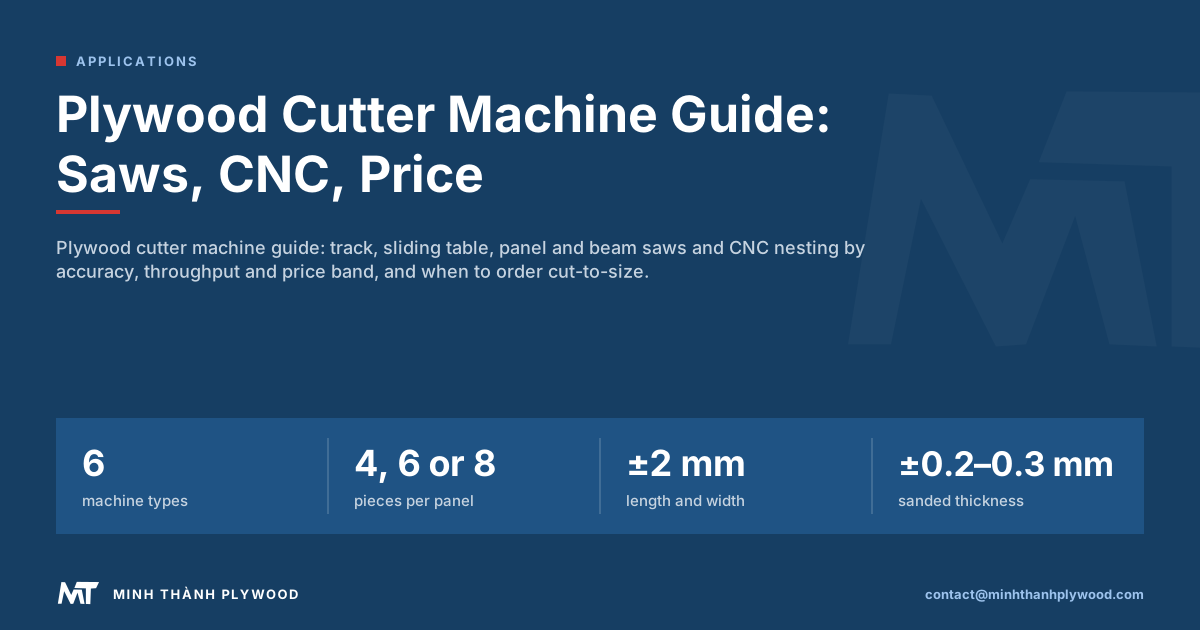
The right plywood cutter machine depends on how many sheets you cut a day and how accurate the parts must be. A track saw suits a few sheets, a sliding table saw a joinery shop, a vertical panel saw a tight floor, a beam saw a cut-to-size line and a CNC router nested parts. This guide compares them by price band and shows when ordering sized panels beats buying a saw. Minh Thanh Plywood makes furniture plywood in Vietnam.
Which machine cuts plywood sheets in a workshop?
The right plywood cutter machine is set by two numbers: how many sheets you cut a day, and how accurate and finished each part must be. A track saw suits a few sheets a week, a sliding table saw several a day, and a beam saw or CNC router production work. Everything else follows from those two.
- A few sheets a week, site or small shop: a track saw or circular saw on a cutting table.
- Several sheets a day, joinery or cabinet shop: a sliding table saw.
- Full sheets in a small space, sign shop or retail cutting: a vertical panel saw.
- Hundreds of sheets a day, cut-to-size or furniture plant: a beam saw.
- Parts with holes, curves and grooves, flat-pack furniture: a CNC nesting router.
Many shops move up this list as they grow. Others step off it: a plant that buys plywood already cut to its part sizes needs less cutting capacity on its own floor.
Ply board cutting machine types compared
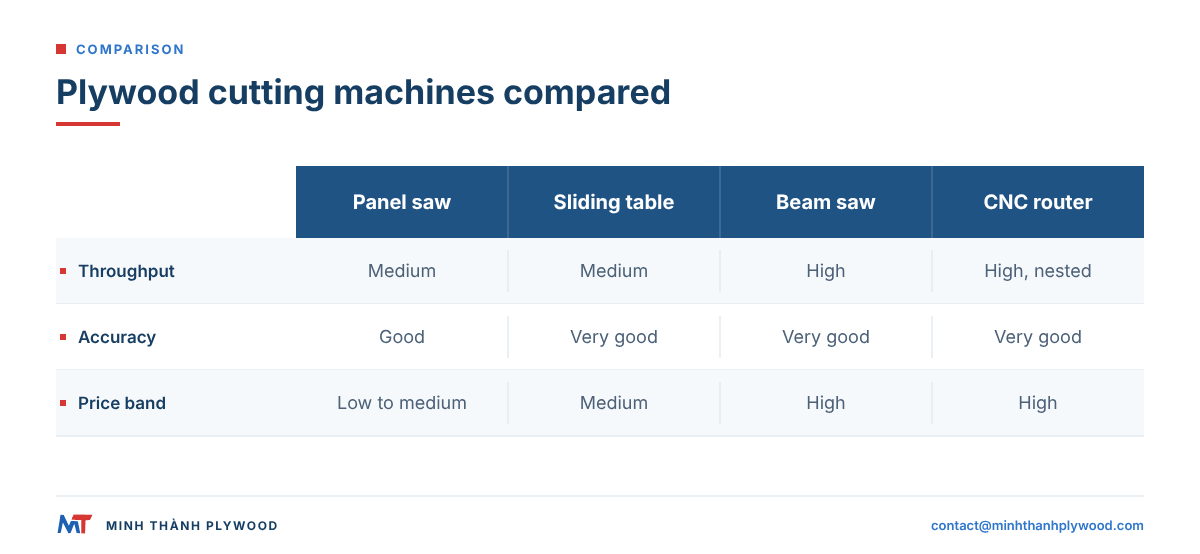
Every ply board cutting machine falls into one of a few families. The table below ranks the six main types of machine to cut plywood by sheet handling, accuracy, throughput, floor space and price band. Price bands are relative, from the entry band to an industrial investment; actual prices depend on the brand, size and options.
| Machine | Sheet handling | Accuracy | Throughput | Floor space | Price band | Best for |
|---|---|---|---|---|---|---|
| Track saw or circular saw | Sheet on a table or foam board | Good with a guide rail | Low | Very small | Entry | Site work, a few sheets |
| Table saw | Sheet pushed over a fixed table | Good on small parts, hard on full sheets | Low to medium | Small | Entry to low | Ripping strips, small parts |
| Vertical panel saw | Sheet stands on a frame, saw travels | Good for sizing | Medium | Small | Low to medium | Breaking down full sheets |
| Sliding table saw | Sheet rides on a sliding carriage | Very good, square cuts | Medium | Medium to large | Medium | Joinery, cabinets, cut-to-size by the sheet |
| Beam saw | Stack of sheets clamped, saw runs on a beam | Very good, repeatable | High | Large | High | Cut-to-size lines, furniture plants |
| CNC nesting router | Sheet on a vacuum table, router cuts parts | Very good, includes holes and shapes | High for nested parts | Large | High | Flat-pack and cabinet parts |
A useful rule: buy the machine for the part, not for the sheet. If the part needs drilling and shaped edges, a CNC router replaces several saw cuts and a drilling step. If the part is a plain rectangle, a saw cuts it faster.
Handheld circular saws and track saws
A track saw is a plunge circular saw running on an aluminium guide rail. With a sharp fine-tooth blade, it cuts a full plywood sheet straight and with little chipping, on a foam board or a grid table.
- Strengths: low price, carried to site, no infeed or outfeed space, cuts full sheets where they lie.
- Limits: each cut is measured and aligned by hand, so repeated parts take time; squareness depends on the operator.
- Best for: fitters, site joiners, shops cutting a few sheets a week, and breaking down sheets to sizes a smaller saw can handle.
An ordinary circular saw with a clamped straightedge does the same job at lower cost and lower accuracy. Score the cut line with a knife or use a zero-clearance strip on the rail to protect the face veneer.
Mini plywood cutter machines and electric plywood cutters sit at the bottom of this band: compact circular saws, jigsaws and oscillating tools. They cut openings, notches and thin panels well, but they are not built to break down full sheets every day. Buy one as a second tool, beside a saw that makes the main cuts.
Table saw vs sliding table saw
A table saw pushes the sheet over a fixed table into the blade; a sliding table saw carries the sheet on a sliding carriage past the blade. For plywood, that difference decides accuracy and safety on full sheets.
| Point | Table saw | Sliding table saw |
|---|---|---|
| How the sheet moves | Pushed by hand across the table | Clamped on a moving carriage |
| Full sheet handling | Hard: the sheet must be balanced and steered | Built for it: the carriage carries the weight |
| Square cuts | Depends on the fence and the operator | Square by the carriage and crosscut fence |
| Scoring blade | Rare | Common, prevents chipping on the bottom face |
| Floor space | Small | Medium to large: carriage travel each side |
| Typical user | Hobby and small shop | Joinery, cabinet and cut-to-size shops |
A table saw is a good ripping tool for strips and small parts. A sliding table saw is the workhorse of panel joinery, because it cuts a full sheet square and clean in one pass with the scoring blade under it.
Vertical panel saw: the ply board cutter machine for small floors
A vertical panel saw holds the sheet upright on a frame and runs a circular saw along a guide, down for crosscuts and across for rips. It breaks down full plywood sheets in the floor space of a wall.
- Strengths: small footprint, one person loads a full sheet, quick sizing, easy to learn.
- Limits: accuracy depends on frame setup; less suited to fine joinery parts and very thin, flexible panels.
- Best for: sign makers, retail cutting counters, shopfitters and cabinet shops that size sheets before final cuts.
A ply board cutter machine of this type is common in timber yards that cut sheets for customers while they wait. For furniture parts that are edge-banded, many shops cut oversize on the panel saw and finish on a sliding table saw.
Beam saw for cut-to-size production
A beam saw, also called a panel sizing saw, clamps one sheet or a stack of sheets under a pressure beam and runs the saw carriage along the cut. A pusher moves the stack between cuts, following an optimised cutting pattern.
- Strengths: cuts several sheets at once, repeats sizes exactly, optimisation software reduces waste, labels for each part.
- Limits: high price, large floor space, needs steady volume to pay back, an operator trained on the software.
- Best for: cut-to-size suppliers, kitchen and furniture plants, panel distributors.
The beam saw is the machine behind most cut-to-size panel services. It is also where the quality of the sheet shows: flat, calibrated panels stack tight under the beam and cut to the same size from top to bottom of the book.
CNC nesting router
A CNC nesting router holds the sheet on a vacuum table and cuts every part of a job from it in one setup, including holes, grooves and curves. Software nests the parts on the sheet to keep waste low.
- Strengths: finished, drilled parts in one pass, curved and shaped work, no separate drilling step, labels for assembly.
- Limits: straight cuts are slower than on a saw; tooling, spoilboards and dust extraction add running cost; programming skill needed.
- Best for: flat-pack furniture, cabinets, shop fittings, CNC plywood furniture with interlocking joints.
Plywood cuts cleanest on a router with compression spiral bits, which push fibres inward on both faces. A flat sheet with a tight thickness tolerance holds better on the vacuum and keeps pocket and groove depths even. Our guide to CNC cutting plywood covers tooling and sheet choice in detail.
Panel saw vs table saw vs CNC: which should you buy?
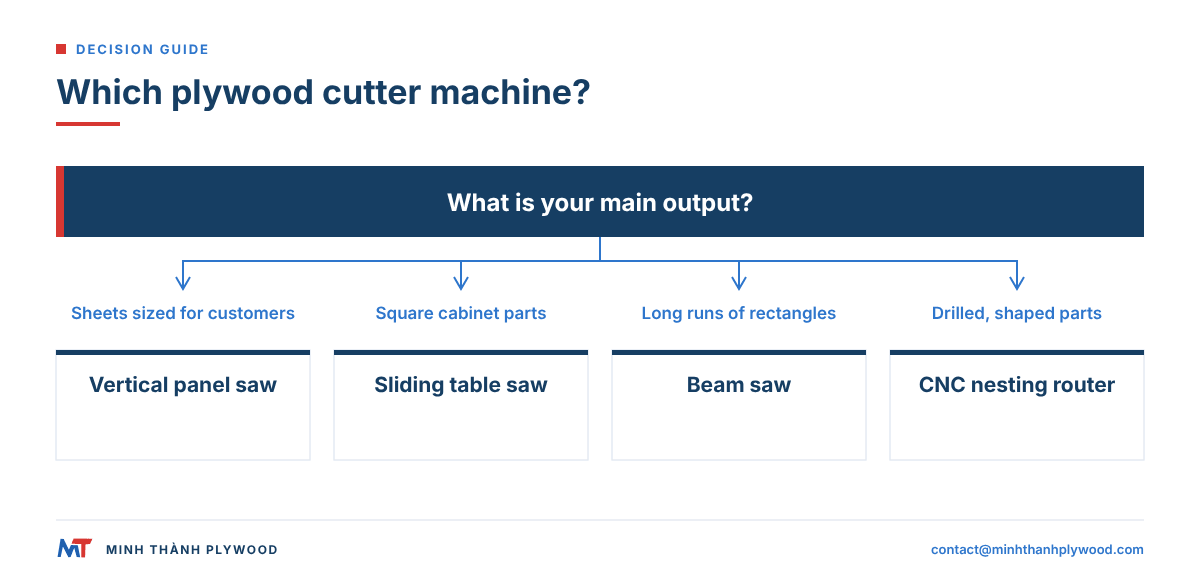
Buy the panel saw to break down sheets, the sliding table saw to make square finished parts, and the CNC router to make drilled and shaped parts. Each answers a different question about your output.
| If your main output is | Choose | Because |
|---|---|---|
| Full sheets cut in half or thirds for customers | Vertical panel saw | Fast sizing, small footprint |
| Square cabinet and shelf parts, edge-banded | Sliding table saw | Square, clean cuts with scoring blade |
| Large runs of the same rectangles | Beam saw | Cuts stacks with optimised patterns |
| Parts with holes, grooves and curves | CNC nesting router | Cuts and drills in one setup |
| Occasional sheets on site | Track saw | Low price, portable |
A growing cabinet shop often adds machines in this order: track saw, sliding table saw, edge bander, then a CNC router or a beam saw when the volume is there.
Sliding table saw or beam saw for a cut-to-size shop?
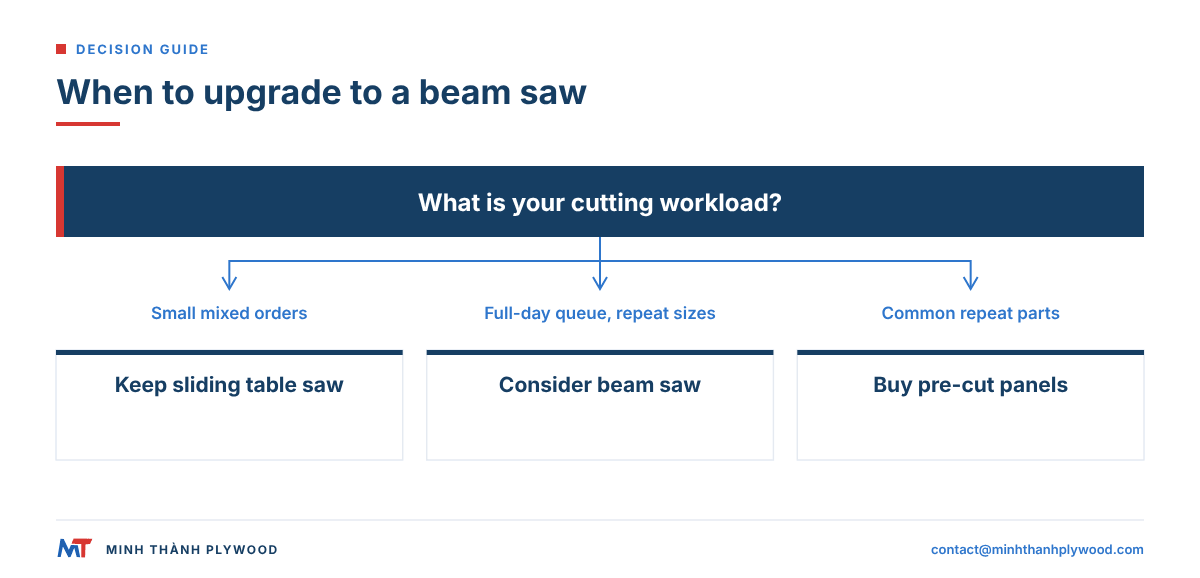
A cut-to-size shop starts on a sliding table saw and moves to a beam saw once the cutting keeps an operator busy full time. The switch point is volume and repeat sizes, not the size of the sheets.
Signs that a beam saw will pay back:
- Cutting fills the working day and the sliding table saw has a queue.
- Many orders repeat the same sizes, so stack cutting saves time.
- Waste is high, and optimisation software would recover it.
- Labelling parts by hand causes errors at assembly.
Signs that a sliding table saw is still right:
- Orders are small and mixed, one sheet at a time.
- Many cuts are angled or need hand judgement.
- Floor space is short.
- The shop also needs a saw for solid wood.
Another option is to share the work: buy panels already cut to your most common sizes, and keep the sliding table saw for one-off parts.
Plywood cutting machine price: what drives it
Plywood cutting machine price follows the type first, then size, automation and service. Within one type, a saw from a premium European maker and one from a value maker can sit in different bands.
The table gives indicative bands in US dollars and UAE dirhams (AED 3.6725 per US$, the fixed peg) from dealer and marketplace listings read in October 2026. They are asking prices, not quotes; new beam saws are quoted on request, so that row uses used-market listings.
| Machine | Brand classes you will meet | Indicative price | In AED |
|---|---|---|---|
| Track saw | Festool, Makita, Bosch | US$445-670 for the saw, more with rail and case | About AED 1,600-2,500 |
| Table saw (UAE shop listing) | ATIKA HT315 and HT315/3, ATIKA BTU 450 | AED 2,565 for the HT315; AED 6,300 for the heavy-duty BTU 450 | AED 2,565-6,300 |
| Vertical panel saw | Safety Speed, Holz-Her; Striebig at the premium end | US$2,157-5,400 for Safety Speed models; US$36,500-149,000 for Striebig | About AED 7,900-19,800; premium AED 134,000-547,000 |
| Sliding table saw | SCM Minimax, Felder, Altendorf | US$4,248 (SCM Minimax SC4W) to US$15,748 (Felder K 500 S) | About AED 15,600-57,800 |
| Beam saw | Biesse Selco, Homag Holzma, Bestin | Used from about US$25,000 (Homag Sawteq B-130, auction) to US$99,000 (2016 Selco WNT 630); new is higher | About AED 92,000-364,000 used |
| CNC nesting router | Biesse, Homag, SCM; value makers such as Blue Elephant and STYLECNC | US$9,000-35,000 for entry and mid automated models; cells above US$60,000 | About AED 33,000-128,000; cells above AED 220,000 |
Sources: Arwani for the UAE table saws; Grizzly, Mueller and WSI Machinery dealer pages for panel saws; Highland Automate for the Felder; Coast Machinery for the SCM; auction records for the used beam saws; STYLECNC and Blue Elephant for CNC routers.
Capacity and accuracy rise with the price. Beam saws cut stacks of 50-120 mm at up to 25 kW, industrial panel saws take full 1220 × 2440 mm sheets and panels up to 80 mm or more in one pass, CNC routers hold 0.1-0.5 mm over a full sheet, and laser cutters reach 0.03-0.1 mm on thin sheets of 3-6 mm, where heavy panel saws and CNC routers handle 12-30 mm and above (Bestin Group). A desktop CNC router with a 2-3 kW spindle is the entry point for prototype parts.
| Price driver | Effect on price |
|---|---|
| Machine type | The biggest step: track saw, panel saw, sliding table saw, beam saw, CNC router |
| Cutting length and carriage size | Longer carriages for full sheets cost more |
| Scoring unit and motor power | Clean cuts and thick stacks need more |
| Automation | Powered fences, programmable stops, automatic loading |
| Software | Optimisation, labelling, links to design software |
| Dust extraction | A separate system, often a large share of the project |
| Tooling | Blades, router bits, spoilboards: a running cost |
| Installation and training | Freight, rigging, power supply, operator training |
| Local service | Spare parts stock and an engineer within reach |
A plywood cutting machine low price is worth checking twice against the last three lines. A saw that waits weeks for a part or a service visit costs more than its price difference. When asking for a CNC plywood cutter machine price, ask for tooling, software, extraction and installation in the same quote.
Blades and tooling for clean plywood edges
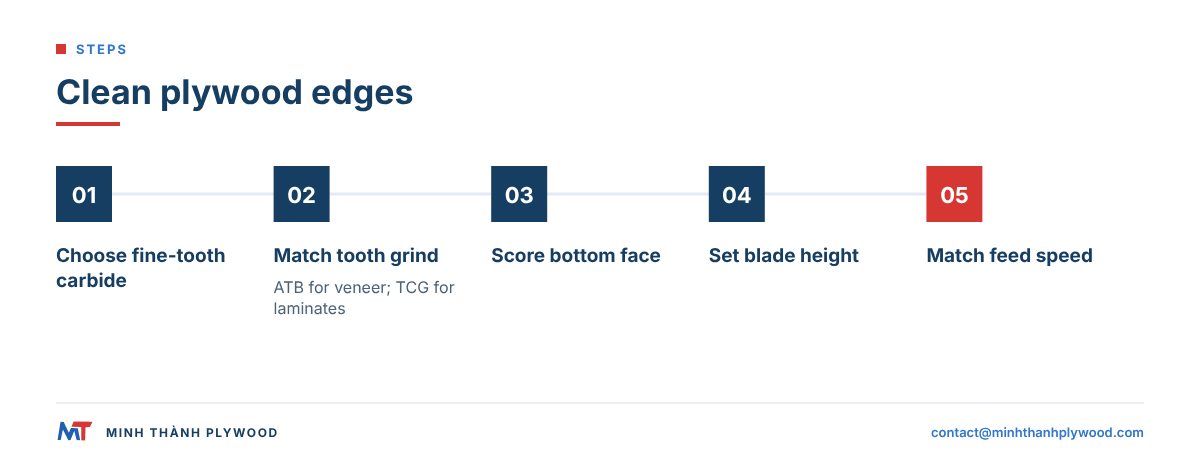
Clean plywood edges come from a sharp carbide blade with a high tooth count, the right tooth grind and a scoring blade under the sheet. Most chipping on plywood is tooling, not the panel.
- Tooth count: high-tooth blades cut cleaner, low-tooth blades rip faster; use the fine blade for visible faces.
- Tooth grind: alternate top bevel (ATB) for clean crosscuts in veneer; triple-chip grind (TCG) for melamine-faced and laminated panels.
- Scoring blade: a small blade ahead of the main blade cuts the bottom face first, so the main blade exits through a scored line.
- Blade height: on a table saw, set the blade just above the sheet for a cleaner top face.
- Router bits: compression spiral bits for CNC work on plywood; down-cut bits for shallow grooves.
- Feed speed: steady and matched to the blade; burning means too slow or blunt.
A well-made panel helps the tooling. Faces sanded flat, cores without gaps and tight thickness tolerance give an even cut along the whole sheet.
Safety and dust when cutting plywood
Every plywood cutter machine needs a guard, a riving knife or anti-kickback device where the type has one, and dust extraction at the blade. Fine wood dust is a health hazard, and extraction is part of the machine, not an option.
- Guards and riving knife: fitted and adjusted, never removed for convenience.
- Push sticks and sliding carriage: hands away from the blade on narrow cuts.
- Dust extraction: a hood over the blade and a port under it, sized to the machine.
- Hearing and eye protection for every operator.
- Training before an operator works alone.
In the US, the rule for woodworking machinery sets guarding duties, such as that “each circular hand-fed ripsaw shall be guarded by a hood which shall completely enclose that portion of the saw above the table and that portion of the saw above the material being cut” (OSHA standard 1910.213(c)(1), checked on 20 October 2026). In Great Britain, the HSE keeps woodworking guidance for sawmill, furniture and timber workplaces. In the EU, the Machinery Regulation (EU) 2023/1230 covers new machinery placed on the market from 20 January 2027.
Buying a plywood cutter machine in the UAE, Saudi Arabia and nearby markets
In the UAE, Saudi Arabia and the wider Gulf, plywood cutter machines are sold through woodworking machinery dealers in Dubai, Sharjah, Riyadh and Jeddah, who import European, Taiwanese and Chinese saws and CNC routers. The dealer matters as much as the brand.
Before choosing a supplier, check:
- Spare parts and blades in stock in the country, not shipped per order.
- A service engineer who installs, trains and visits on call.
- Power supply: the machine’s voltage and phase match your workshop.
- Dust extraction offered with the machine, sized for it.
- Training in the operator’s language, and software support for beam saws and CNC routers.
- References from shops nearby running the same model.
In Singapore, the same European and Asian brands are sold through local woodworking machinery dealers. Buyers in smaller markets, such as Laos, often buy through a dealer in a neighbouring country, such as Thailand or Vietnam. The same checks apply, with extra weight on parts stock and service travel time.
Sheet quality: what makes plywood cut well on any machine
The sheet decides as much of the cut as the machine. A flat, calibrated panel with a closed core cuts clean and square on a track saw or a beam saw; a bowed sheet with core gaps chips, binds and cuts out of square on any machine.
| Sheet property | What it does at the saw | What to specify |
|---|---|---|
| Flatness | A flat sheet lies on the carriage, beam or vacuum table without rocking | Double pressing, flat storage |
| Thickness tolerance | Even thickness keeps stacked books tight and CNC depths even | Sanded furniture panels to ±0.2–0.3 mm |
| Closed core | No gaps for the blade to tear out at the edge, no voids in routed grooves | Stitched core layers |
| Moisture | Stable panels stay the cut size after cutting | 8–12 % moisture at dispatch |
| Face quality | Tight, sanded faces chip less under the blade | Sanded and polished faces |
| Glue line | An even glue line cuts evenly and wears tools less | UF glue at E0 emission for interior panels |
Our furniture-grade panels are pressed twice as standard: the core board is pressed and calibrated, then face and back are pressed on. Core layers are stitched both horizontally and vertically, so gaps and overlaps are closed before the faces go on. On a beam saw, that means the top and bottom sheets of a book come out the same size; on a CNC router, groove and pocket depths stay even across the sheet.
A cheaper sheet that bows or hides core gaps costs time at every machine: more rejected parts, more blade changes and more parts recut. When you compare panel prices, compare the cost per good part.
Skip the machine: order cut-to-size plywood
A furniture or cabinet plant can skip part of its cutting by ordering plywood already cut to the sizes it uses. The factory cuts full sheets before packing, so parts arrive ready for edge banding, drilling or assembly.
What cut-to-size buying changes:
- Less cutting on your floor, so a smaller saw or fewer operator hours.
- Less waste shipped: you pay freight on parts, not offcuts.
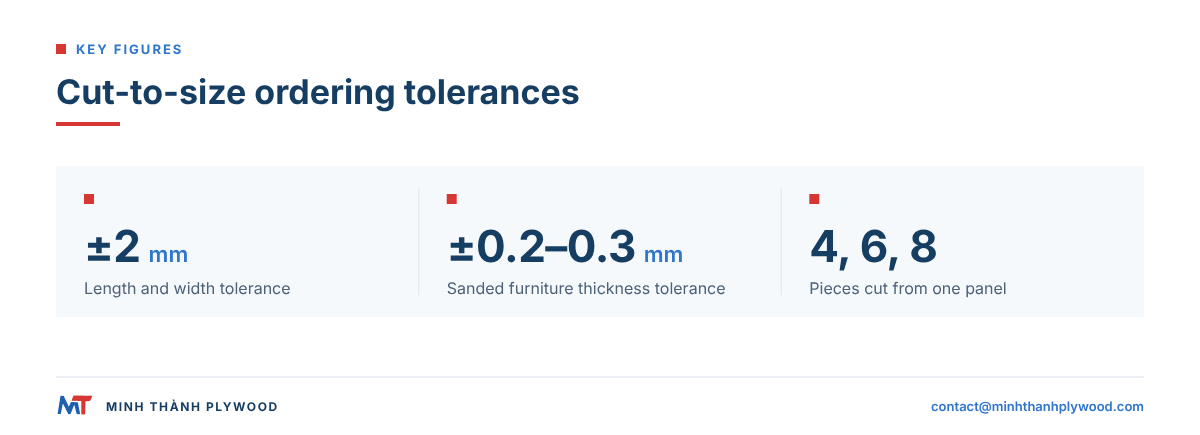
- Sizes held to the factory tolerance: our length and width tolerance is ±2 mm, thickness ±0.2–0.3 mm on sanded furniture panels.
- Packs labelled by size, so parts go straight to the line.
We cut one panel into 4, 6 or 8 pieces and ship cut-to-size panels regularly to Italy and other European markets. Full sheets are 1220 × 2440 mm or 1250 × 2500 mm, with custom sizes such as 1220 × 2500 mm and 1220 × 2280 mm. Our cut-to-size plywood page shows how it is packed.
What this means for your order
If you cut plywood yourself, order the sheet that cuts cleanest on your machine; if you would rather not, order the parts. Either way, send the cutting plan with the panel specification.
- Application: cabinets, furniture parts, shop fitting or CNC parts.
- Core: white Styrax or Eucalyptus core as standard.
- Glue and emission: UF glue at E0 emission, or MR and phenolic (WBP) bonds to your specification.
- Face: birch, poplar, EV, okoume, pine or another face, with the face/back grade.
- Size: full sheet, or your cut sizes and quantities per size.
- Packing and quantity: from one 40HC, mixed specifications by agreement.
Production takes 15–45 days after the deposit, and free samples are available. See our furniture plywood from Vietnam page, or the pillar guide on how to cut plywood. For laser work, our guide comparing birch plywood and basswood for laser cutting covers the panel side.
Buyer questions, answered
What is the best cutter machine for plywood?
For a workshop cutting a few sheets a day, a sliding table saw gives the best mix of accuracy, square cuts and price. A cut-to-size line cutting hundreds of sheets needs a beam saw, and furniture parts with holes and curves are cut fastest on a CNC nesting router.
Which machine cuts plywood sheets in a workshop?
Most workshops break down full plywood sheets on a sliding table saw or a vertical panel saw. Small shops start with a track saw on a cutting table, and production plants use a beam saw or a CNC router.
Panel saw vs table saw vs CNC: which should I buy?
A vertical panel saw breaks down full sheets in little floor space, a sliding table saw makes accurate square parts and edge-ready cuts, and a CNC router cuts finished, drilled parts from a nested sheet. Choose by the part you need at the end of the cut.
Sliding table saw or beam saw for a cut-to-size shop?
A sliding table saw suits a cut-to-size shop that cuts sheets one at a time in mixed sizes. Once daily volume is large enough to keep an operator on cutting full time, a beam saw cuts stacks of sheets at once with optimised patterns and pays back.
What is the plywood cutting machine price range?
Price rises in steps: handheld and track saws are the entry band, table and vertical panel saws the next, sliding table saws above them, and beam saws and CNC nesting routers are industrial investments. Size, automation, software, dust extraction and local service decide where a model sits.
Is a vertical panel saw accurate enough for furniture?
A well-set vertical panel saw cuts square parts good enough for carcass sizing and shelving. For visible joinery and edge-banded furniture parts, most shops finish on a sliding table saw or cut on a beam saw or CNC.
What blade gives a clean cut in plywood?
A carbide blade with a high tooth count and an alternate top bevel or triple-chip grind gives clean plywood edges. On a sliding table saw or beam saw, a scoring blade cuts the bottom face first so the veneer does not chip.
Can I avoid buying a cutting machine by ordering sized panels?
Yes. A plywood factory can cut full sheets into the sizes you use before shipping, so parts arrive ready for edge banding or assembly. We cut one panel into 4, 6 or 8 pieces and ship cut-to-size panels regularly to Italy and other European markets.
Where can I buy a plywood cutter machine in the UAE or Saudi Arabia?
Woodworking machine dealers in Dubai, Sharjah, Riyadh and Jeddah sell European, Taiwanese and Chinese saws and CNC routers. Choose a dealer that stocks blades and spare parts locally and has a service engineer who installs and trains.
Do CNC routers cut plywood cleaner than saws?
A CNC router with sharp compression bits leaves clean top and bottom faces on plywood and cuts curves and holes a saw cannot. Straight cuts are faster on a saw, so many plants use both.