
The main plywood sheet sizes Minh Thanh supplies are 1220 × 2440 and 1250 × 2500 mm. The larger format has 4.98% more nominal area, but the cutting layout decides its value. Specify finished length, width, thickness, grain direction and tolerance in millimetres; a trade name such as 4×8 does not define every dimensional requirement.
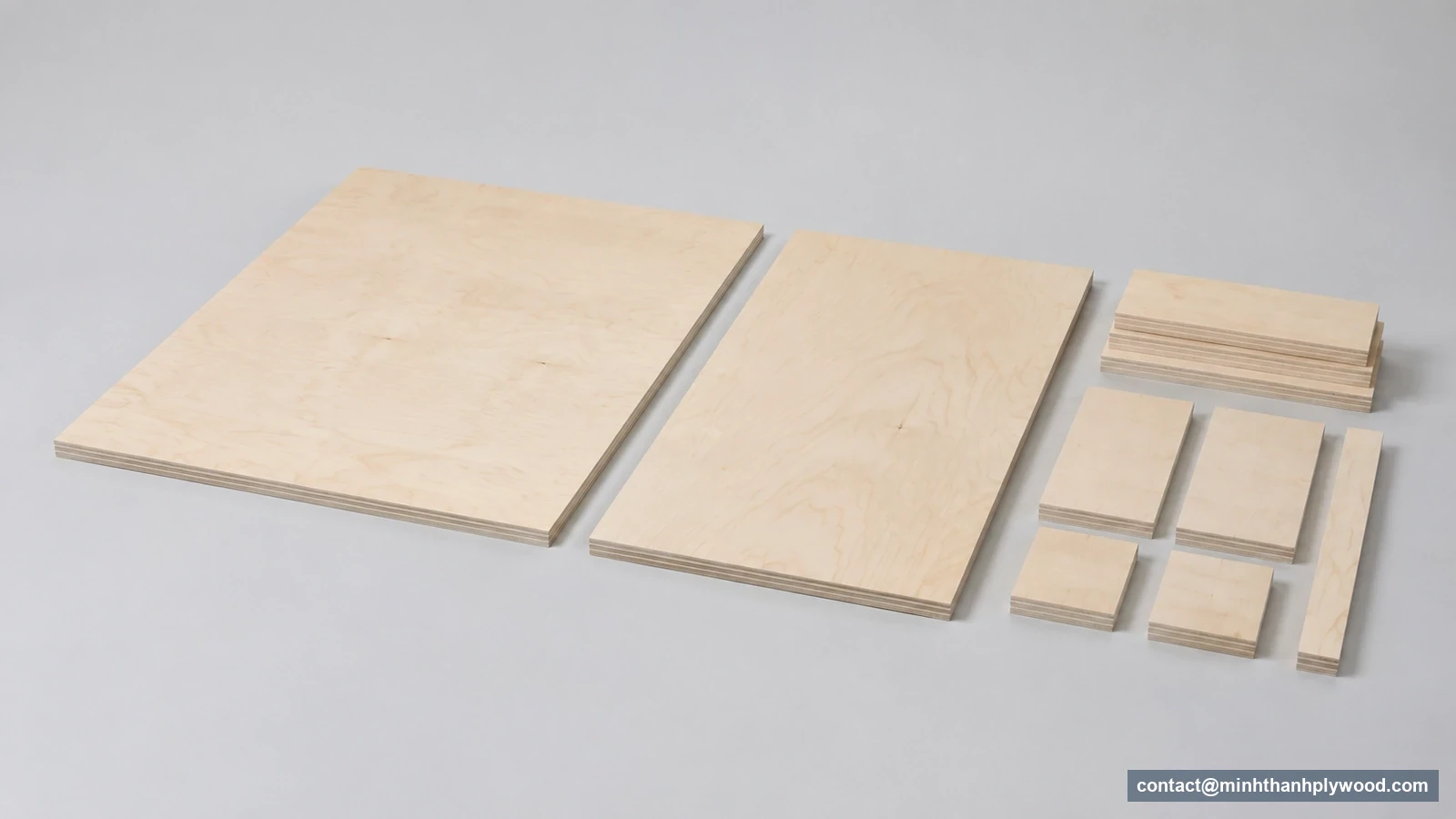
Plywood sheet sizes: Which standard plywood size should you compare first?
Compare 1220 × 2440 mm and 1250 × 2500 mm first when sourcing Minh Thanh furniture panels. These are our two main sheet formats. Custom formats include 1220 × 2500 and 1220 × 2280 mm. The component layout, equipment and receiving operation determine which of these dimensions produces the most useful material.
| Minh Thanh sheet format | Nominal area | 18 mm nominal volume | Buying question |
|---|---|---|---|
| 1220 × 2440 mm | 2.9768 m² | 0.0535824 m³ | Does the existing 4×8 cutting programme fit? |
| 1250 × 2500 mm | 3.125 m² | 0.05625 m³ | Do the extra 30 mm width and 60 mm length add accepted parts? |
| 1220 × 2500 mm | 3.05 m² | 0.0549 m³ | Does a longer component need the extra length? |
| 1220 × 2280 mm | 2.7816 m² | 0.0500688 m³ | Does the shorter format fit the component and logistics? |
Area is width × length in metres; volume is area × thickness in metres. The table uses nominal finished dimensions, before the customer’s trimming and cutting. Product scope comes from our furniture range and cut-to-size offer, reviewed 7 October 2026.
Keep sheet size separate from thickness, core and face. A familiar dimension does not describe those fields. The same 1220 × 2440 mm format can be a thin supported back or a thicker furniture part, each with its own machining and packing. Select the material construction and evaluate the cutting layout together rather than approving one dimension as the whole product.
What does a 4×8 plywood sheet mean in millimetres?
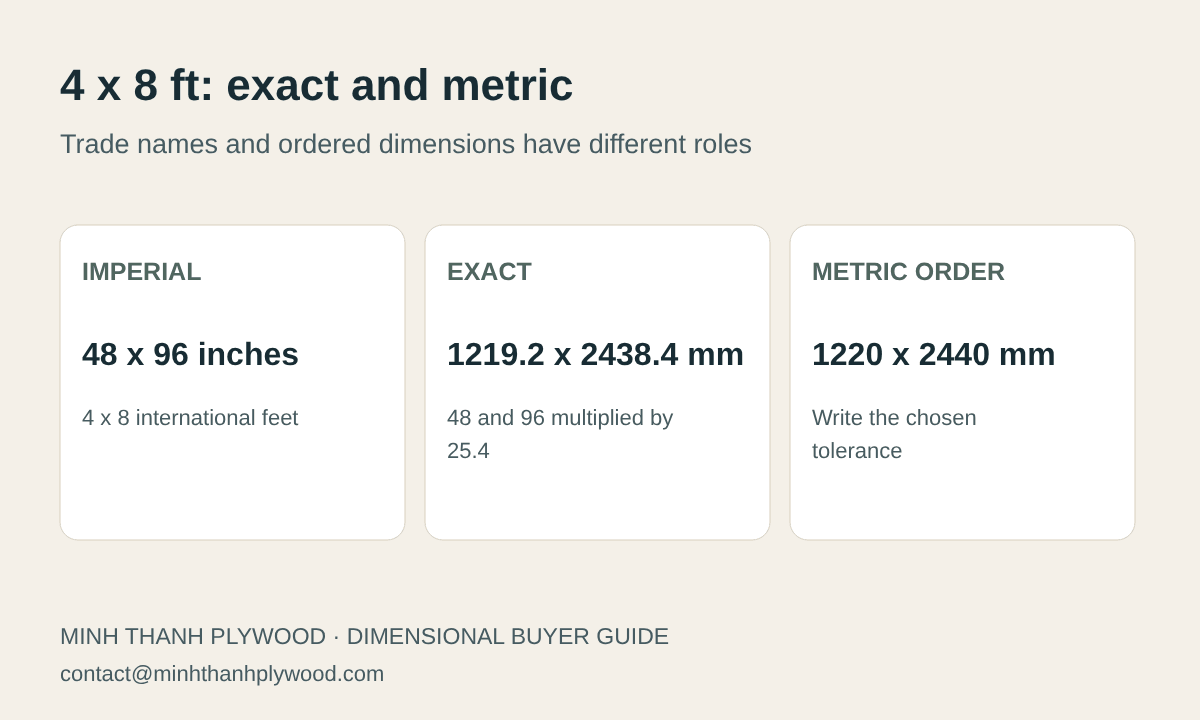
Exact 4 × 8 ft converts to 1219.2 × 2438.4 mm. The metric purchasing format 1220 × 2440 mm is slightly larger: 0.8 mm across the width and 1.6 mm along the length. The two descriptions are close in conversation but are not mathematically identical.
NIST’s length reference, checked 7 October 2026, defines an inch as exactly 25.4 mm. Multiply 48 and 96 inches by that factor to obtain the exact dimensions. For an importer, the authoritative value is the finished size ordered from the mill, with the selected dimensional tolerance attached.
A distributor can retain “4×8” on a commercial stock label while the technical sheet gives 1220 × 2440 mm. The production drawing should use the technical dimensions. Similarly, a contract calling for exact 48 × 96 inches should say so instead of expecting the mill to infer whether the buyer wants an inch dimension or the nearby metric product.
This difference also matters when comparing prices by area. A true 48 × 96 inch rectangle contains 32 square feet; a 1220 × 2440 mm rectangle contains 2.9768 m². Use the area of the specified product in the price worksheet. Avoid changing the stored sheet dimensions merely to make a familiar trade nickname appear exact in both units.
How do international sheet formats fit this comparison?
Use international format names as a reference, then specify the mill’s actual finished dimensions. Trade sizes such as 4×4, 5×5 and 4×10 appear in different product markets, but they are not a list of every size one manufacturer supplies. Availability is tied to the product and factory range.
| Reference name | Exact inch-based dimensions in mm | What the buyer must establish |
|---|---|---|
| 4 × 4 ft | 1219.2 × 1219.2 | Full manufactured format or a cut part |
| 4 × 8 ft | 1219.2 × 2438.4 | Exact inch size or nearby metric order |
| 5 × 5 ft | 1524 × 1524 | Product construction and supplier offering |
| 4 × 10 ft | 1219.2 × 3048 | Oversize product and handling requirements |
These are exact unit conversions, not Minh Thanh supply claims. Our main formats are the four metric sizes in the first table. For a drawing outside that offered range, choose a source supplying the specified product or review the design’s part arrangement. A broad industry size chart should never silently expand a factory’s own catalogue.
The other important distinction is full-sheet production versus local cutting. A retailer may sell a half sheet cut from a larger parent panel, while a mill quotes an export bundle of full sheets or a specified group of component pieces. Record the purchased dimensions and quantity at the stage being delivered. The phrase “half sheet” does not establish final cut dimensions after the saw’s kerf and any edge trim.
Is 1250 × 2500 mm worth the larger sheet price?
The 1250 × 2500 mm format has 0.1482 m² more nominal area, or 4.98% more, than 1220 × 2440 mm. At the same thickness, core density and price per cubic metre, its nominal panel mass and material value rise by the same proportion. The number of accepted parts decides whether that extra material earns its place.
For a layout producing the same number of components from either sheet, the larger format leaves more offcut unless that offcut has an identified use. A programme gaining an additional row or column from the wider sheet can see a much larger change in component output than the area increase alone. The worked layouts below show both effects.
The buying comparison should include machine capacity, rack space, pack footprint and lifting. A larger sheet that fits the saw but cannot enter the approved loading fixture is not a direct stock substitution. Check the actual outside panel and package dimensions at the operations that receive them, including any covers or support material.
Keep the commercial basis consistent. A quote per sheet and a quote per cubic metre can produce different-looking figures for these formats. Convert both to the ordered sheet volume, then compare the cost of the accepted parts. A higher invoice amount for a larger sheet is not necessarily a higher rate for the same amount of wood.
How should length, width and grain direction be written?
Write the dimension convention explicitly and mark the decorative grain direction on the drawing. A dimension pair can be shown as 1220 × 2440 or 2440 × 1220 in different catalogues. Its area is unchanged, but the orientation of the visible face and the component cut from it can change the finished appearance.
For an exposed cabinet side, a long grain direction can be part of the customer’s design. An optimiser that rotates the part across the sheet can improve a numerical yield while giving the wrong appearance. State whether rotation is allowed per part, rather than giving one blanket instruction for a mixed cutting list.
The same issue applies to paired fronts and adjacent furniture components. Identify the show face, the reverse and the visual orientation when they must be installed together. A small sample can establish face species and grade, but the complete drawing or layout explains where that face must run across the finished furniture.
Our face choices include Birch, Poplar, engineered veneer, Pine and Okoume over the selected core. The internal cross-lamination and the visible surface pattern are different aspects of the board. Name the construction separately from the cosmetic grain instruction. For cut parts, label the orientation in the packing specification so receiving does not have to infer it from a stack of similar rectangles.
How do you calculate plywood sheet area and volume?
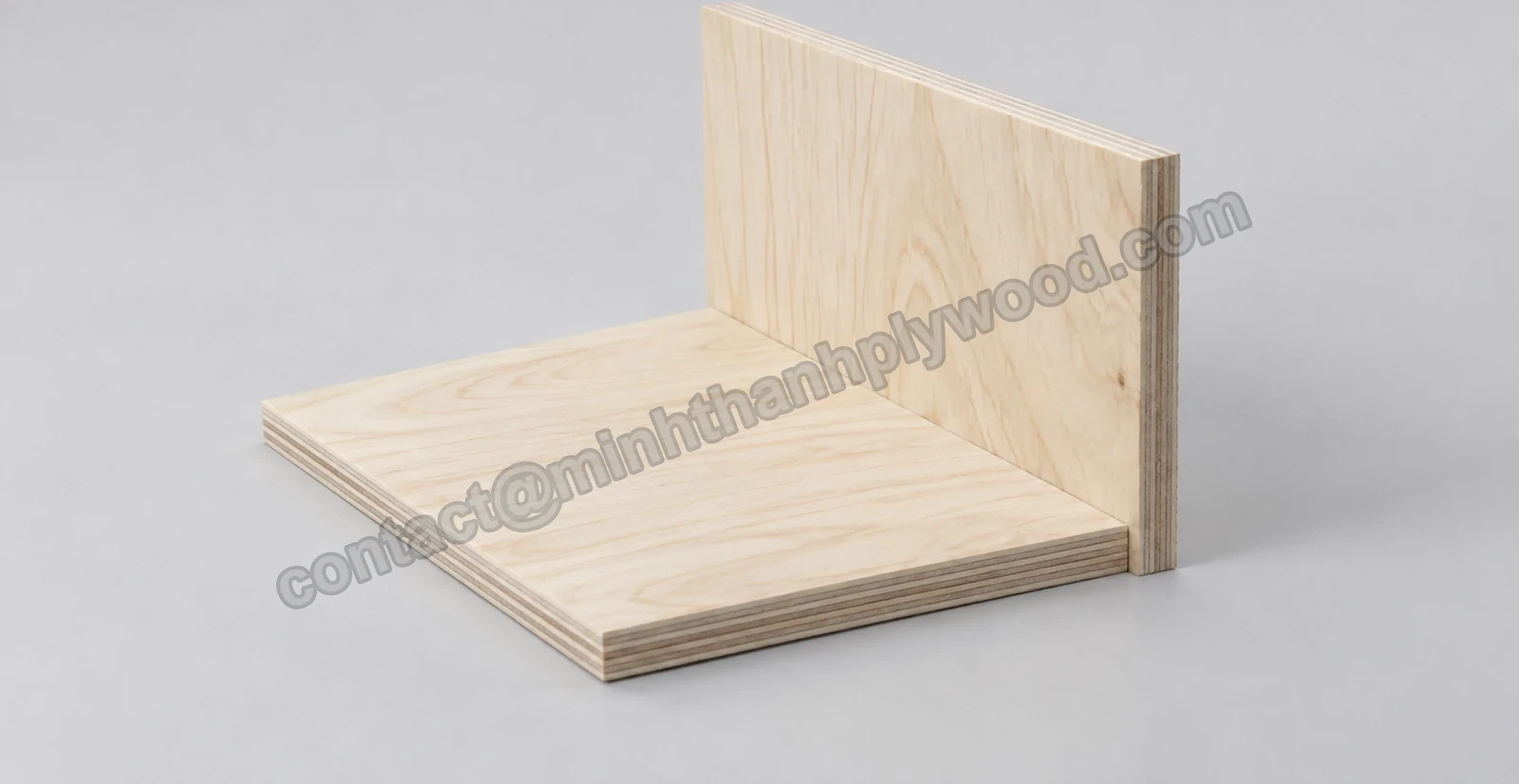
Calculate nominal sheet area as length × width in metres. Multiply area by finished thickness in metres for nominal wood volume. Keep square metres and cubic metres on different columns: one measures surface area and the other measures the amount of panel material bought.
For 1220 × 2440 × 18 mm, the area is 1.22 × 2.44 = 2.9768 m² and volume is 2.9768 × 0.018 = 0.0535824 m³. For 1250 × 2500 × 18 mm, the corresponding values are 3.125 m² and 0.05625 m³. These figures do not include any packaging or air around the sheets.
For a multi-line order, calculate each format and thickness separately. For example, 100 sheets of the first 18 mm format contain 5.35824 m³, and 100 of the second contain 5.625 m³. The total is 10.98324 m³. Keeping these lines separate also lets the packing list identify the format delivered to each workstation.
Use sufficiently precise values in the worksheet, then round the displayed result. Multiplying a rounded 0.054 m³ per sheet by a large count can introduce a noticeable invoice difference compared with the exact nominal calculation. Agree the unit and rounding convention with the quotation, while retaining the ordered millimetre dimensions as the source for the arithmetic.
What should you subtract before designing a cutting layout?
Subtract the planned edge trim from the sheet dimensions and include the actual saw kerf between adjacent parts. A cutting diagram that adds finished part dimensions without the cuts between them can promise pieces that the workshop cannot produce. Machining allowances also belong in the blank size when the final edge will be finished later.
For a simple rectangular row of equal parts, the occupied length is n × part dimension + (n−1) × kerf. If a parent sheet is trimmed on both ends, the available length is sheet length − 2 × trim. Use the same logic across the width, then check the required grain direction before combining rows and columns.
The internal cuts and edge trims have separate purposes. Kerf removes material as the blade passes through; trim removes the planned amount from the supplied edge. An offcut at the end of a row is a third quantity. Record each explicitly instead of folding them into an unexplained waste percentage.
For a furniture blank requiring later profiling, drill or edge-finishing allowance, use its production blank dimensions in the nesting programme. Compare the finished part with the blank in the component drawing. If the supplier delivers finished-size parts, specify the final dimensions and edge condition instead. The cutting quotation then matches the operation the customer expects to remove from its own workshop.
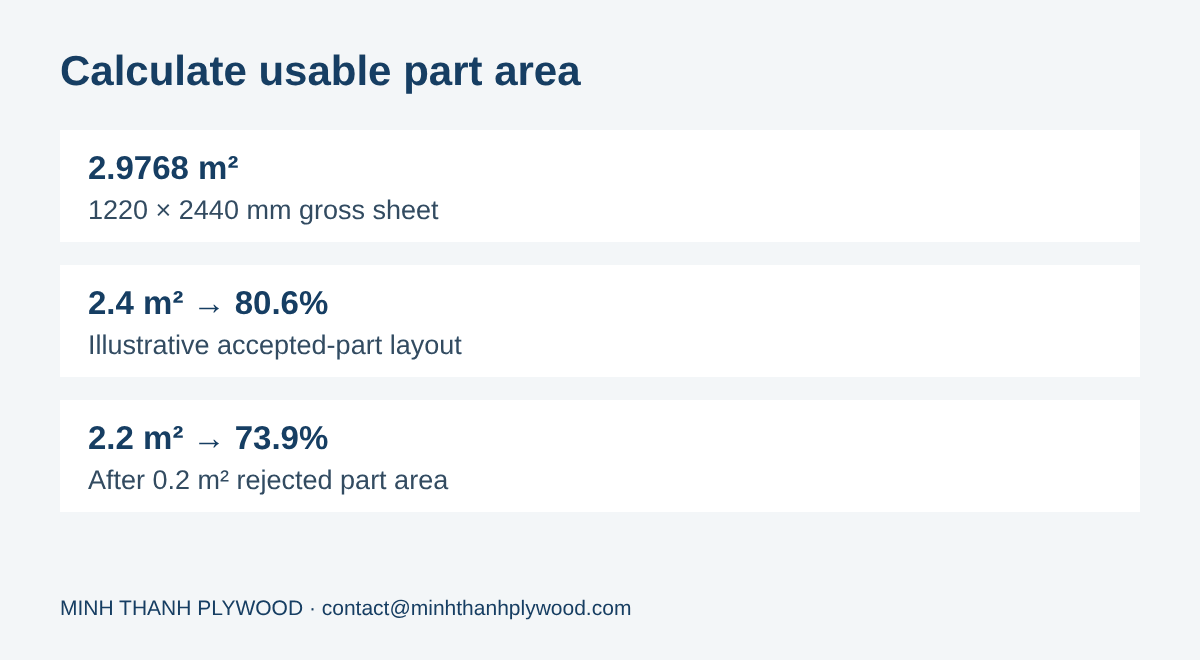
For a separate area-yield illustration, 2.4 m² of accepted parts from a 2.9768 m² sheet gives 80.6% yield. If a further 0.2 m² is rejected, the accepted area becomes 2.2 m² or 73.9%. These explicitly assumed values show why a cutting layout and an appearance acceptance both enter usable output; they are not measured performance of a particular face grade.
When do both standard sizes give the same cutting output?
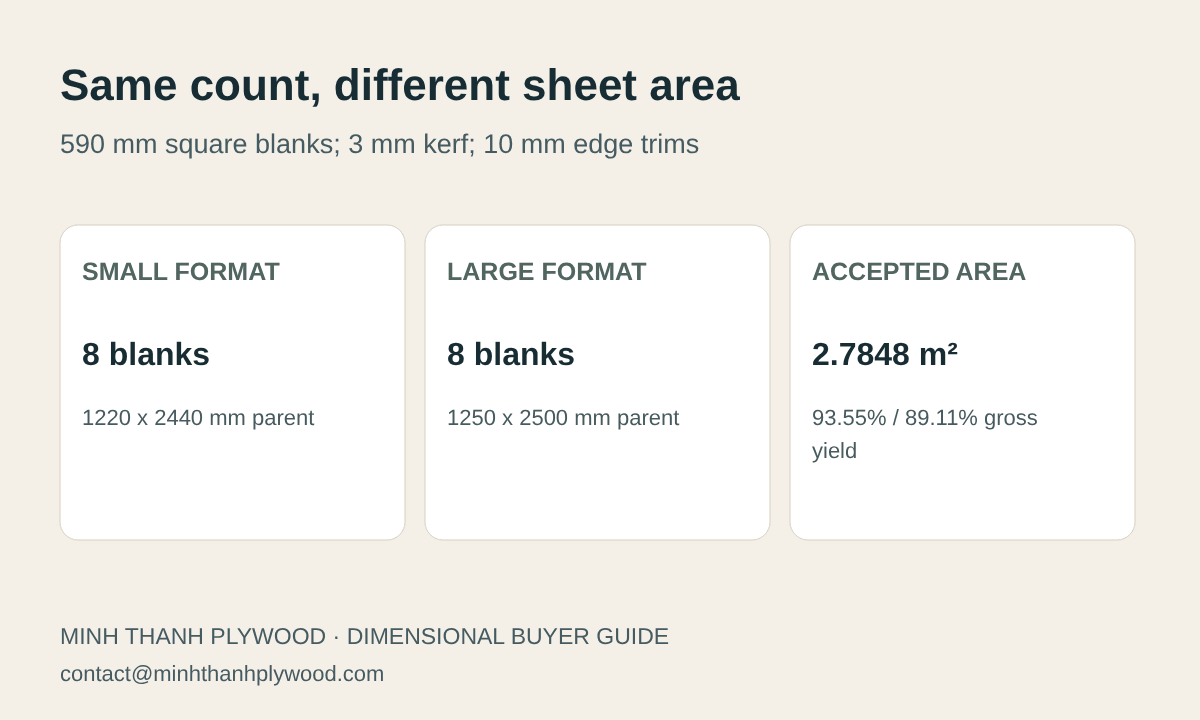
Both formats can give the same accepted-piece count even though the larger sheet contains more wood. Consider an explicitly illustrative grid layout of 590 × 590 mm square blanks, a 3 mm kerf, and 10 mm edge trim on each of the four sheet edges. The blanks can be rotated freely because the example has no grain restriction.
A 1220 × 2440 mm sheet then has 1200 × 2420 mm available. Two blanks across occupy 2 × 590 + 3 = 1183 mm; four along occupy 4 × 590 + 3 × 3 = 2369 mm. The result is eight blanks. The 1250 × 2500 mm sheet has 1230 × 2480 mm available and also fits two across by four along, giving the same eight blanks.
Eight blanks contain 8 × 0.590 × 0.590 = 2.7848 m². Their area is about 93.55% of the small sheet or 89.11% of the larger sheet. This is rectangular-blank area yield from the stated assumptions; it does not include later machining losses or claim an observed factory yield.
At the same price per cubic metre and thickness, paying for the larger sheet adds wood without adding a ninth blank in this grid. Useful offcut recovery or another component in the same nest could change that conclusion. The example demonstrates why procurement should ask for the full cutting list before assuming a 4.98% area increase translates into 4.98% more finished components.
When can a small size change add a whole row or column?
A small dimensional increase can cross a cutting threshold and produce more than a proportional increase in parts. Use a second illustrative grid: 610 × 610 mm blanks, the same 3 mm kerf, 10 mm trim on every edge, and no grain restriction. The sheet sizes remain unchanged.
In the 1200 mm available width of the smaller sheet, two blanks require 2 × 610 + 3 = 1223 mm, so they do not fit. Its 2420 mm available length fits three blanks, using 3 × 610 + 2 × 3 = 1836 mm; four would need 2449 mm. This grid therefore gives three blanks from the 1220 × 2440 sheet.
The larger sheet provides 1230 mm width and 2480 mm length after trims. It fits two blanks across and four along because 1223 × 2449 mm is within that available rectangle. The result is eight blanks. Their total area is 2.9768 m², or about 95.26% of the larger sheet’s 3.125 m² nominal area.
These are deliberately stated dimensions that explain a layout threshold, not a claim that every larger sheet gives eight pieces instead of three. Actual part sizes, grain directions, trims and kerfs govern the order. Test the real list in both formats, and record the accepted grid or optimiser output so the buying decision can be reproduced on repeat orders.
How do you estimate sheets for an area requirement?
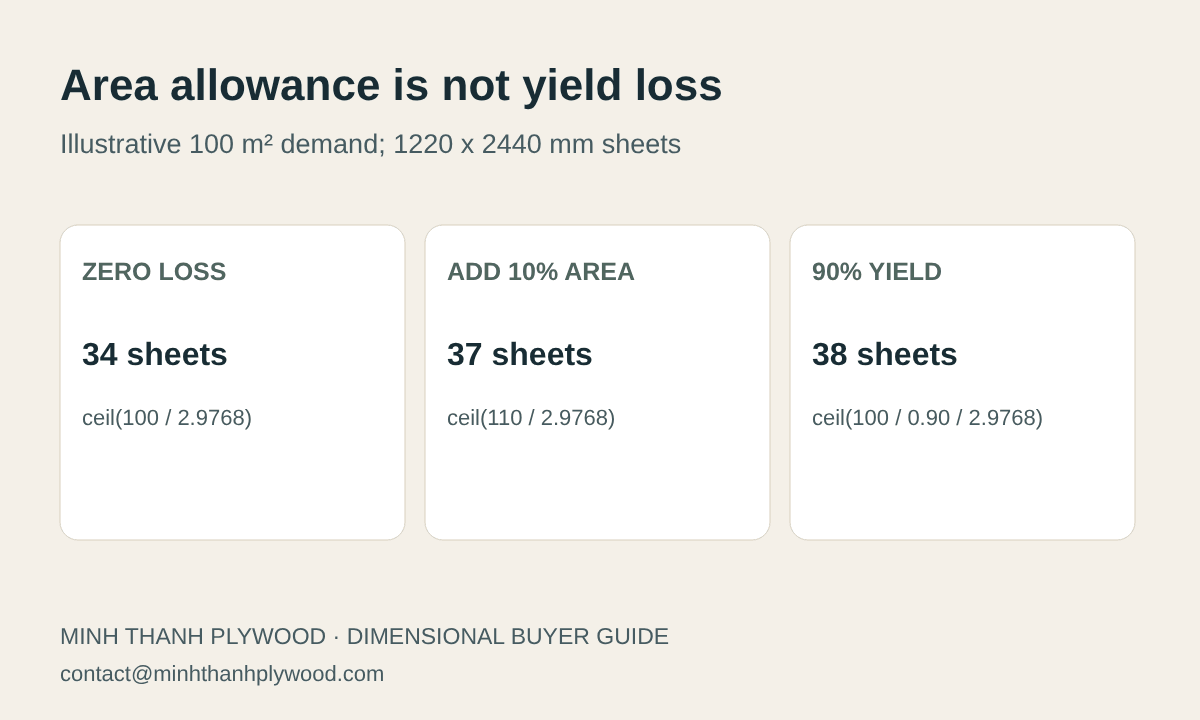
Divide the required area by the sheet’s nominal area, then round up to whole sheets. This gives an area-only minimum; a part layout or installation takeoff can require more. For 100 m² with 1220 × 2440 mm sheets, 100 ÷ 2.9768 = 33.593, so the zero-loss minimum is 34 sheets.
If the buyer deliberately assumes 10% additional area for a preliminary estimate, calculate 100 × 1.10 ÷ 2.9768 = 36.952, rounded up to 37 sheets. The 10% is an example planning assumption, not a standard Minh Thanh waste factor. For 1250 × 2500 mm, the same 110 m² allowance gives 35.2 sheets, rounded up to 36.
An area allowance and an expected yield are different mathematical inputs. If 90% of purchased sheet area is expected to become accepted output, the calculation is 100 ÷ 0.90 ÷ 2.9768, rounded up to 38 sheets. Adding 10% to the required area is not the same as losing 10% of purchased area. State which method the preliminary takeoff uses.
For furniture parts, use the component list rather than an area total whenever possible. Ten small rectangles and one large uninterrupted front can have the same combined area but require different nesting. Also separate quantity per part from spare or replacement stock, so the ordered sheet count has a traceable reason rather than an undocumented percentage.
How do cut-to-size orders differ from full sheets?
A cut-to-size order buys identified pieces with agreed dimensions and preparation, while a full-sheet order leaves the cutting operation with the receiving workshop. Minh Thanh supplies panels cut into 4, 6 or 8 pieces, with regular deliveries to Italy and other European markets. The enquiry needs the actual part list, not only a desired number of subdivisions.
For an equal-width split of a 1220 mm parent dimension into two parts with one 3 mm kerf and no edge trim, each equal part is (1220 − 3) ÷ 2 = 608.5 mm. Adding 10 mm trim on each outer edge reduces it to (1220 − 20 − 3) ÷ 2 = 598.5 mm. These examples show why “cut in half” does not automatically mean two 610 mm finished parts.
Specify whether the pieces are blanks for later machining or finished rectangular parts. Include grain direction, visible face, edge condition, tolerance and quantity. A part intended to receive an edge band can have a different delivered edge requirement from one whose layered edge remains exposed under clear finish.
Compare both supply routes on the same furniture bill of materials. Full sheets carry the customer’s sawing, offcut handling and counting work; cut pieces carry factory preparation and different packaging. Evaluate the operations actually removed, the accepted-piece count and the resulting shipping arrangement. The cut-to-size product page gives the information to send for that comparison.
When does a custom full-sheet format make sense?
A custom format makes sense when it produces an identified benefit in the part layout or receiving process. Our examples include 1220 × 2500 and 1220 × 2280 mm, alongside the two main formats. Compare them with the drawing’s longest component and the machinery that receives the sheet.
A finished part requiring a 2450 mm blank length cannot fit along a 2440 mm sheet before any end trim is considered. A 2500 mm parent can provide the needed length when the stated trim and cutting plan fit. This is a dimensional comparison; the actual part’s width, grain, edge allowance and quantity still decide its production layout.
The shorter 2280 mm format can be useful when a repeat cutting plan uses that length and the handling arrangement benefits from it. Its area is 2.7816 m², about 6.56% less than the 1220 × 2440 mm format. That wood reduction only serves the order if it preserves the accepted part output; compare the actual layouts rather than expecting an automatic saving.
Give the full custom dimension and quantity per line before production is scheduled. Standard and custom sheets should have different specification references when both appear in the same load. Keep their pack footprints and identities visible in the packing list. A custom sheet is still the selected face, core, bond, thickness and surface preparation; changing its dimensions does not authorise changing the construction.
Which plywood dimensions and tolerances matter?
Record finished length and width tolerance separately from thickness. Minh Thanh’s reference is ±2 mm for length and width. Sanded furniture thickness uses ±0.2–0.3 mm, down to ±0.2 mm for specified work. Put the selected acceptance requirements on the purchase specification and the finished inspection record.
For a 1220 × 2440 mm order at ±2 mm, the corresponding length/width intervals are 1218–1222 and 2438–2442 mm. A cutting plan that relies on the full nominal width without a margin should be checked against the accepted lower dimension. The trim and kerf example above already includes its stated material allowances, but a real drawing needs its own values.
Length and width readings do not replace a squareness check. Compare the panel’s diagonals using the inspection method and acceptance required by the contract; do not invent a universal diagonal limit. For a precision rectangular part, record how the edges and opposite dimensions are measured as well as the nominal pair.
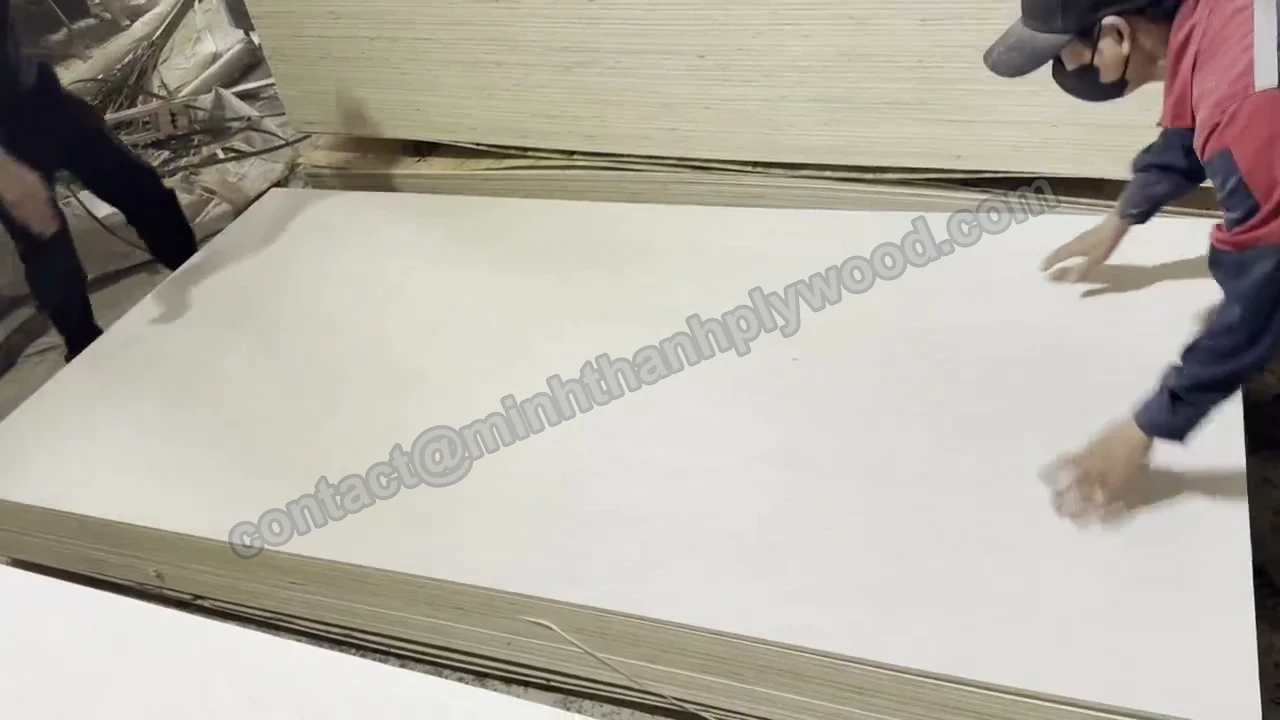
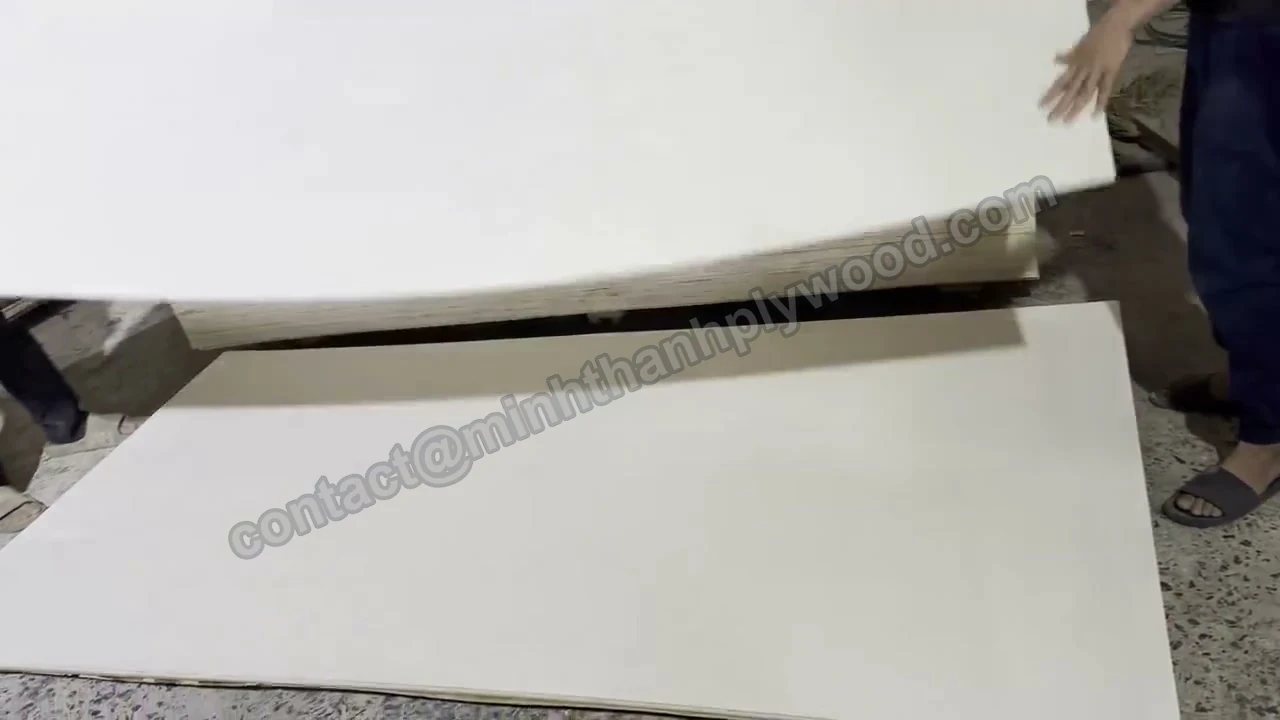
On the quality-control page, the wider inspection includes finished dimensions, thickness, moisture and appearance. For an actual order, tie those checks to a lot and sheet or pack reference. An attractive full-sheet photograph shows appearance and format, while the measurement record establishes the specific dimensions inspected before shipment.
How do sheet sizes change weight and handling?
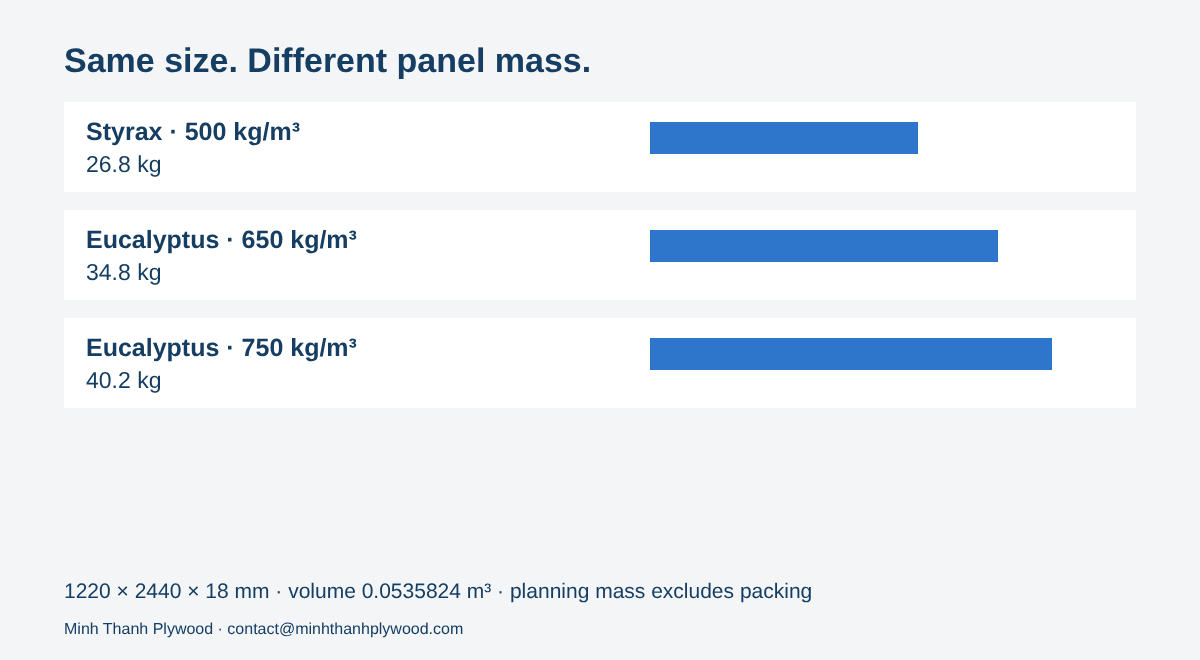
At the same thickness and density, sheet mass changes with area. Multiply the nominal volume by the construction’s planning density. For 18 mm panels, the two main formats give the following calculated masses, rounded to one decimal place and excluding all packaging.
| Core planning reference | 1220 × 2440 × 18 mm | 1250 × 2500 × 18 mm |
|---|---|---|
| Styrax, 500 kg/m³ | 26.8 kg | 28.1 kg |
| Acacia, 580 kg/m³ | 31.1 kg | 32.6 kg |
| Eucalyptus, 650 kg/m³ | 34.8 kg | 36.6 kg |
| Eucalyptus, 750 kg/m³ | 40.2 kg | 42.2 kg |
These are factory planning densities, not a claim that every finished sheet weighs exactly the rounded value. The packing calculator connects dimensions and density; actual panel or bundle weighing completes the load instruction. Birch or Poplar names the face and does not establish which core density to use.
Discuss sheet handling with the receiving workshop. A larger format changes reach, machine loading, support and pack dimensions even before its mass is considered. Keep pallet supports, covers and protection in the outside package measurement. Where a buyer prefers cut parts for handling, compare that option with the full-sheet workflow using actual piece dimensions and package mass.
How should size changes enter a container calculation?
Recalculate plywood volume, mass and the physical pack layout after changing sheet dimensions. A 40HC plan prepared for 1220 × 2440 mm panels cannot be transferred unchanged to 1250 × 2500 mm merely because both are described as standard sheets. Width, length and package clearance have all changed.
For an explicitly illustrative line of 900 Styrax sheets at 18 mm, the smaller format contains 48.22416 m³ and calculates to 24,112.08 kg of plywood at 500 kg/m³. The larger format contains 50.625 m³ and calculates to 25,312.5 kg. With an assumed 1,000 kg of packing, their cargo masses become 25,112.08 and 26,312.5 kg respectively.
The example is a mass comparison, not a verified 900-sheet layout. Changing to a heavier core, different supports or another cargo allowance needs a new calculation. The booked cargo limit and route restrictions apply to plywood plus packaging and securing material; container tare belongs in the packed container’s gross mass.
The supplier’s final packing list should identify sheets by construction and format, with pieces per pack, volume and net/gross package mass. For a mixed-size load, provide the unloading sequence and pack identity to the receiver. Minh Thanh’s standard minimum is one 40HC, with mixed specifications by agreement, so the dimension mix should reach production and logistics in the same enquiry.
How should you compare sheet, area and volume prices?
Convert all quotes to the same construction and unit, then compare accepted parts. Minh Thanh’s October 2026 starting prices are commercial from US$250/m³ and furniture/interior from US$350/m³. The actual quotation states face/back grade, core, bond, dimensions, preparation, quantity and delivery basis.
Let Q be the actual quoted rate per cubic metre for the selected construction. The 18 mm material cost is Q × 0.0535824 for 1220 × 2440 mm or Q × 0.05625 for 1250 × 2500 mm. Use each supplier’s actual rate; identical dimensions do not establish identical preparation, core or delivery scope.
For the 590 mm grid example, both sheets produce eight blanks. Divide the actual quoted sheet amount by eight before adding later machining and subtracting useful offcut recovery. For the 610 mm grid, the blank counts differ, so the same per-sheet comparison would obscure the layout benefit.
Write transport and preparation on separate lines and count each service only once according to the agreed delivery term. A factory cutting charge, an extra package, a changed lifting operation and a useful recovered offcut can each affect the component cost. Use the real cutting programme and freight quotation for the purchase; the transparent arithmetic here explains how the comparison works without inventing a customer saving.
Compare delivered parts on one calculation sheet
For a simple worked order, suppose a programme needs 800 of the 590 × 590 mm blanks used above. Both parent formats produce eight blanks in the stated grid, so the net cutting requirement is 100 parent sheets. At 18 mm, those quantities contain 5.35824 m³ in the smaller format or 5.625 m³ in the larger. For quoted rate Q per cubic metre, the material subtotals are Q × 5.35824 and Q × 5.625 respectively, before freight, later machining and offcut recovery.
If the buyer instead needs 800 of the 610 × 610 mm blanks, the demonstrated grids require 267 smaller parent sheets or 100 larger parent sheets. The first count is ceil(800 ÷ 3) and produces 801 blanks; the second is 800 ÷ 8. This is a useful size decision because the added sheet width and length cross the actual cutting thresholds. It does not rely on a general claim that European sheets always save material.
| Example demand | 1220 × 2440 mm parents | 1250 × 2500 mm parents | Why the result changes |
|---|---|---|---|
| 800 blanks, 590 mm square | 100 | 100 | Both grids produce eight |
| 800 blanks, 610 mm square | 267 | 100 | Kerf and trim leave three versus eight |
The counts use one unchanged kerf, trim and rotation assumption. They contain no allowance for defects, later profiling or spare parts. List such allowances separately when preparing the real order. If an offcut is intended for another component, give it a part reference and dimensions so its recovered value is tied to a usable output rather than an assumed credit.
For a quotation in finished cut pieces, retain the same 800-part requirement and describe the finish, tolerance and packaging being purchased. Compare the supplier’s cut-piece offer with the full-sheet material plus the customer’s actual preparation costs. The choice then answers the commercial question: how much does it cost to receive and prepare the accepted furniture parts?
What should the technical and shipment records show?
The technical sheet, quotation, invoice and packing list should use consistent dimensions and construction references. This lets the importer reconcile wood volume and package quantity while the receiving team identifies the right panel. Separate full-sheet sizes from finished part sizes when both appear in a shipment.
| Record | Size information to match |
|---|---|
| Technical sheet and approved drawing | Length, width, thickness, tolerance, grain and face orientation |
| Quotation/pro forma invoice | Quantity per construction, selling unit and cutting/preparation scope |
| Commercial invoice | Delivered specification, piece/sheet quantity and net plywood volume |
| Packing list | Pack ID, pieces, format, outside package dimensions and net/gross mass |
| Loading and inspection record | Measured dimensions, panel/pack identity and quantity reconciliation |
Keep emission or timber-origin records attached to the construction; sheet size does not replace those requirements. EPA’s composite-wood programme, consulted 7 October 2026, includes testing, labeling and records for regulated products. For European orders we supply the origin/geolocation dossier used by the importer, with the material components identified separately from the sheet dimensions.
On receipt, record unopened package condition and reconcile the pack IDs before cutting away their labels. Count different part sizes as different lines, even if their face veneer looks identical. Preserve the technical reference when stock is split between workshop areas so a size or grain requirement is not lost between purchasing and the cutting machine.
How do you request the right plywood sheet size?
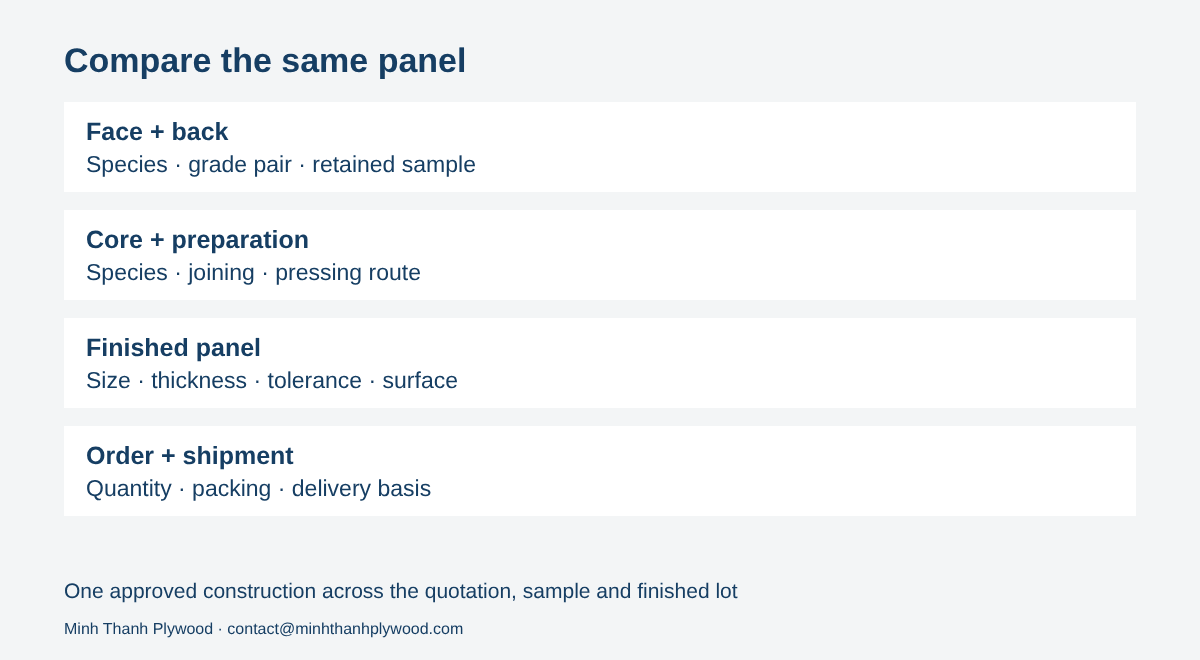
Send the full component list or finished sheet dimensions with the thickness, face/back, core, bond and separate emission requirements. Include the grain direction, permitted rotation, tolerance, preparation and quantity per line. Add packing, receiving equipment and destination so the size choice can be quoted and loaded as one defined product.
For a cutting comparison, send two possible parent sizes and one unchanged part list. Include saw kerf, edge trim and any later machining allowance. Ask the quotation to distinguish full sheets, prepared blanks and finished cut pieces. Their dimensions, counts and preparation are different deliverables and should be compared on the same intended component output.
For a repeat order, name the approved panel and drawing revision. A change from 1220 × 2440 to 1250 × 2500 mm needs its own layout and load update. A changed grain direction, face grade or core also belongs on the technical line rather than being hidden behind an unchanged product name.
Minh Thanh makes furniture and interior plywood in Ha Hoa, Phu Tho, Vietnam, with normal production of 15–45 days after deposit and a standard minimum of one 40HC. Send the dimensions and drawings for a full-sheet or cut-to-size quotation. Continue with the plywood thickness guide to set the finished section and tolerance used in your machining programme.
Buyer questions, answered
What is the standard plywood sheet size?
1220 × 2440 mm is the familiar metric format commonly called 4×8, and 1250 × 2500 mm is another main furniture-panel format. Minh Thanh supplies both, with custom formats including 1220 × 2500 and 1220 × 2280 mm.
Is 4×8 plywood exactly 1220 × 2440 mm?
Exact 4 × 8 ft converts to 1219.2 × 2438.4 mm, while a purchased metric sheet can be specified as 1220 × 2440 mm. Use the finished dimensions and tolerance on the quotation rather than treating the trade name as an exact conversion.
How many square metres are in a plywood sheet?
A 1220 × 2440 mm sheet contains 2.9768 m² of nominal area. A 1250 × 2500 mm sheet contains 3.125 m², while 1220 × 2500 and 1220 × 2280 mm contain 3.05 and 2.7816 m² respectively. Cutting and trimming reduce the area reaching finished parts.
Is 1250 × 2500 mm plywood always better value?
It has 4.98% more nominal area than 1220 × 2440 mm, but the extra dimensions only add value when the part layout uses them. Compare accepted components, grain direction, saw kerf, trim, handling and the price basis for both formats.
Can I order plywood cut to size?
Yes. Minh Thanh supplies panels cut into 4, 6 or 8 pieces and custom sheet dimensions such as 1220 × 2500 and 1220 × 2280 mm. Send each finished part dimension, grain direction, edge requirement and quantity; the piece count alone does not define the cutting layout.
Do plywood sheet dimensions include thickness?
A full specification gives length, width and finished thickness, such as 2440 × 1220 × 18 mm. Record the dimension convention and visible grain direction so reversing length and width in a price table does not rotate a decorative component by accident.
How many sheets cover 100 m²?
At 1220 × 2440 mm, 100 ÷ 2.9768 gives 33.593 sheets before losses, rounded up to 34. An explicitly assumed 10% additional-area allowance gives 110 ÷ 2.9768, rounded up to 37; an actual cutting layout or installation takeoff controls the purchase.
How do I include saw kerf in a cutting layout?
Subtract the edge trims from the available sheet dimensions, then allow the blade's actual kerf between adjacent parts. In a row of n equal parts, the internal cuts consume (n−1) kerfs; combine that with the required finished part widths before checking the row fits.
Do larger sheets change plywood weight?
At the same thickness and density, mass changes in proportion to nominal area. A 1250 × 2500 × 18 mm sheet weighs about 28.1 kg at the Styrax reference of 500 kg/m³ or 36.6 kg at the Eucalyptus reference of 650 kg/m³, excluding packaging.
Can I rotate parts to improve cutting yield?
Rotate a part only when the drawing permits its decorative grain direction and construction orientation to change. Mark that permission per part; an optimiser's larger piece count is not usable output if the visible grain runs the wrong way.
What length and width tolerance does Minh Thanh use?
The finished length and width reference is ±2 mm. Sanded furniture thickness uses a separate ±0.2–0.3 mm reference, down to ±0.2 mm for specified work; put the selected requirements on the order.
What should a plywood size quotation include?
Send the finished sheet or part dimensions, thickness and tolerance, face/back grade, core, bond and separate emission requirements, grain direction, quantity and packing. Add the destination and drawings so the product quote, cutting plan and load calculation describe the same material.