
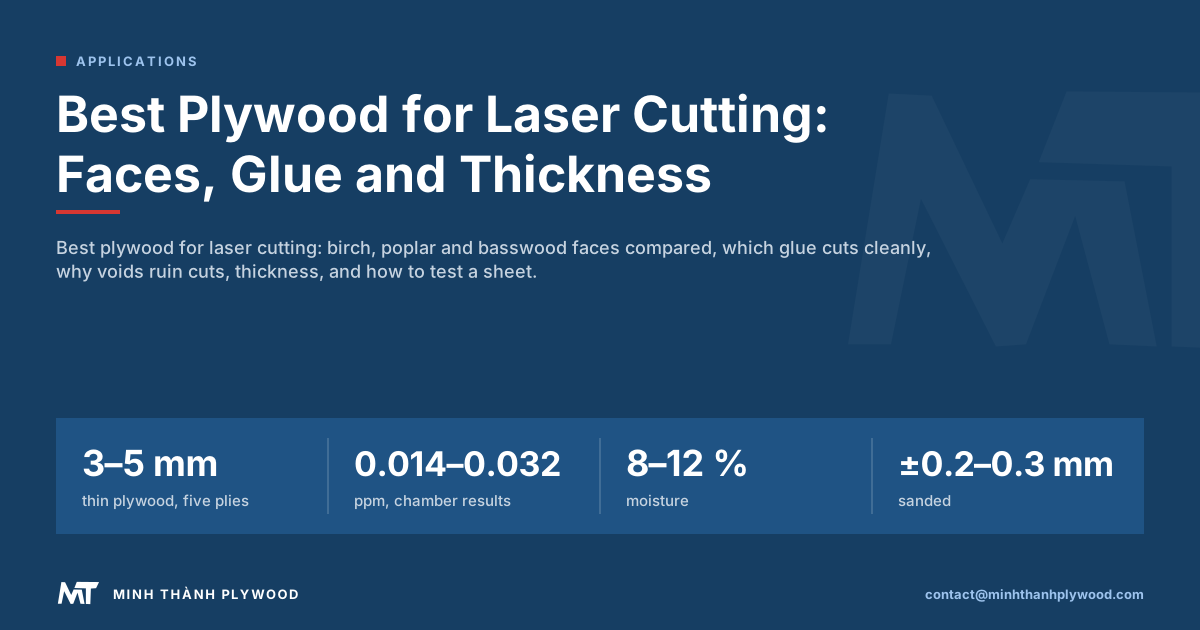
The best plywood for laser cutting is a thin, flat sheet with an even, gap-free core, a light glue line and a smooth face: birch for strength and crisp edges, poplar or basswood for fast cuts and pale engraving. Glue and voids decide the cut more than the species. Minh Thanh Plywood builds thin 3–5 mm panels as five plies, and samples let you test them on your own laser.
What is the best plywood for laser cutting?
The best plywood for laser cutting is a thin, flat sheet with an even, gap-free core, a light glue line and a smooth, sanded face. The face species sets the look and strength; the glue and the core decide whether the laser cuts through cleanly every time.
| Laser plywood | Panel density | Laser cut | Engraving | Strength | Best laser uses |
|---|---|---|---|---|---|
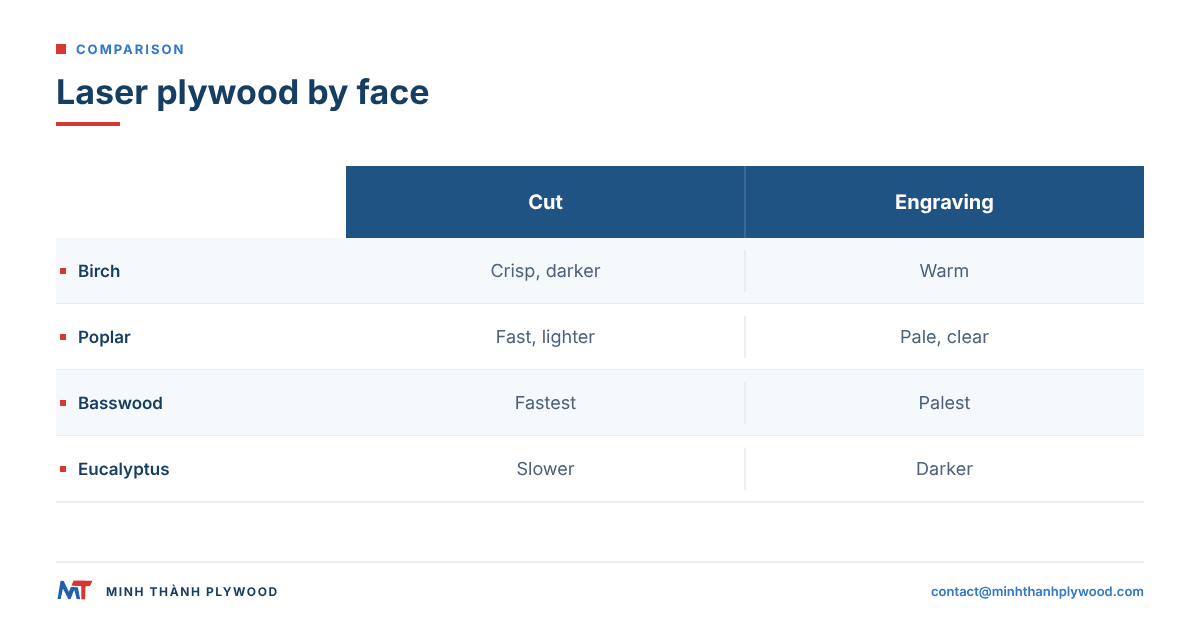
| Birch-faced, birch or hardwood core | 650–700 kg/m³ | Crisp edges, slower, darker char | Good, warm contrast | High | Models, joints, boxes, jigs |
| Poplar-faced, light core | about 455 kg/m³ | Fast cut, light char | Very good, pale face | Medium | Signs, decorations, packaging inserts |
| Basswood (linden) plywood | 400–450 kg/m³ | Very fast, very light char | Excellent, pale and even | Lower | Fine detail, architectural models |
| Paulownia plywood | 250–385 kg/m³ | Fastest, very light | Pale, but soft grain | Lowest | Light models, cut-outs where weight matters |
| Plantation hardwood face (e.g. eucalyptus) | 550–620 kg/m³ | Slower, denser | Good, darker | High | Strong parts, darker look |
| MDF-cored or coated panels | Varies | Varies by coating | Varies | Varies | Only with a known, laser-safe coating |
Density predicts the cut: at the same power, a 400 kg/m³ panel cuts through faster than a 700 kg/m³ one, and each step up in density adds char and passes. Paulownia is the lightest common laser ply. It cuts quickly, but its soft earlywood can leave fuzzy edges and its thin sheets bend easily, so test a sheet before a batch.
“Laser plywood” or “laserply” is a specification, not a species: flat, sanded, closed core, glue that cuts cleanly, made in thin sheets. The sections below explain each property and how to test it.
What makes plywood laser-safe?
Plywood is laser-safe when it is made only of wood veneers and a wood glue, with no PVC, vinyl, or unknown coating on the face. Every laser-cut wood gives off smoke and fumes, so even safe plywood needs extraction at the head and a filter on the exhaust.
What to check before the first cut:
- No PVC or vinyl. PVC releases chlorine compounds when burned, which harm people and corrode the laser. Never cut a panel with a vinyl or PVC overlay or edge band.
- Known glue. Ask the supplier which glue the panel uses. UF glue at E0 emission is the common interior furniture glue; MR (melamine-fortified) and phenolic (WBP) glues are made for damp and exterior use.
- Known coating. Lacquered, painted or film-faced panels need the coating maker’s data before laser use. Film-faced formwork plywood is not laser stock.
- Emission documents. For products sold in the US, the panel must meet the formaldehyde limits of TSCA Title VI, as the EPA composite wood rule sets out.
For a buyer in Greece or elsewhere in the EU, ask for the European proof instead: bond class to EN 314-2 (class 1 is the dry, interior class that suits UF glue), face grading to EN 635-2, and formaldehyde class E1 under EN 13986, tested to EN 717-1. Minh Thanh arranges third-party EN 717-1 testing through SGS on request, and the panels meet the emission and quality requirements European and US furniture buyers ask for.
Minh Thanh’s furniture panels use UF glue at E0 emission as standard and hold CARB P2 / TSCA Title VI certification (ICTT mill no. 23024). Six ASTM D6007 chamber tests between April 2025 and June 2026, on 9, 15 and 18 mm panels, averaged 0.014–0.032 ppm against the 0.05 ppm limit. See formaldehyde emission E0 and E1.
Which glue cuts cleanly on a laser?
Light interior glue lines cut most cleanly on a laser: UF glue at E0 emission leaves thin, pale glue lines and less char. Phenolic and heavy melamine-fortified glue lines are harder and darker, take more power to cut and leave a darker edge.
| Glue | Typical use | Under the laser | Choose it for laser work when |
|---|---|---|---|
| UF glue at E0 emission | Interior furniture plywood | Cleanest cut, light edge | Indoor parts, models, signs, toys after testing |
| MR (melamine-fortified) | Damp interior, kitchens | Harder line, a little darker | Parts that may see humidity |
| Phenolic (WBP) | Exterior, marine, formwork | Hard, dark line, more power | Outdoor parts, only after testing |
| PVA or other cold glues | Some hobby laminates | Variable | Only with the maker’s data |
Glue and emission class are two separate lines on a specification: UF is the resin, E0 is the emission class. Write both, for example “UF glue at E0 emission”.
The glue line is the hardest material in the sheet. A panel with a heavy glue spread or glue pockets cuts through in clean wood but not at the pockets, which is why the same power setting gives uneven results across a cheap sheet.
Cutting, engraving and CNC routing: three different jobs
Laser cutting, laser engraving and CNC routing ask different things of the same sheet, so choose plywood for the job you do most. Cutting needs an even core and glue; engraving needs a smooth, pale face; routing needs thickness tolerance and a closed core.
| Job | What it tests in the sheet | What matters most |
|---|---|---|
| Laser through-cutting | Every layer and every glue line | Glue type, voids, density, flatness |
| Laser engraving | The face veneer only | Face smoothness, colour, sanding |
| Laser scoring and marking | The top of the face | Flat, even face, focus |
| CNC routing | Thickness, core, face strength | Tolerance, closed core, face grade |
A sheet that engraves beautifully can still cut badly if the core hides glue pockets. A sheet that routes well on a CNC can be too dense to laser cut in one pass. For router work, see CNC cutting plywood.
Birch plywood for laser cutting
Birch plywood for laser cutting gives the strongest thin parts and the crispest edges, at the cost of slower cuts and darker char than poplar or basswood. Birch is dense and fine-grained, so joints, hinges and small tabs hold together.
When birch is the right choice:
- Structural parts: boxes, frames, mechanisms, living hinges and jigs.
- Visible edges: fine, even layers show as a neat striped edge.
- Fine detail: thin bridges and small holes survive handling.
What to specify:
- Face grade. In Vietnam, birch faces are graded D+, D and E and quoted as face/back pairs such as D+/D or D/E. The ladder is comparable to the European birch grades: D+ is roughly B, D roughly BB and E roughly CP/C.
- Core. “Birch plywood” can mean a birch face on a different core. Write the core you want, and test it, because the core decides cut-through more than the face.
- Thickness. 3 mm and 4 mm are the common birch laser thicknesses.
Laser cut birch plywood takes stain and clear finish well. For the full comparison with basswood, see birch plywood vs basswood for laser cutting and our birch plywood.
Birch supply since the Russian import ban
Russian birch plywood was the default laser sheet in Europe until the EU banned imports of Russian wood products, birch plywood included, from April 2022 (earlier contracts ran until 10 July 2022). Makers and fab labs that cut Baltic-style birch now source from other origins. Vietnamese birch-faced panels are one replacement: the factory is built for top-grade furniture and interior plywood with Europe as its main market, face grades D+, D and E are quoted against the European birch grades, and the EUDR compliance dossier (origin records and geolocation files) ships with orders. Sea freight from Hai Phong to the Mediterranean runs 25–35 days.
Birch vs poplar laser ply
Birch laser ply makes stronger, crisper parts; poplar laser ply cuts faster with less char and engraves paler. For signs, displays and light parts, poplar is usually the cost-effective choice; for mechanisms and load, birch.
| Point | Birch-faced laser ply | Poplar-faced laser ply |
|---|---|---|
| Density | Higher | Lower |
| Cut speed at the same power | Slower | Faster |
| Char on the edge | Darker | Lighter |
| Engraving contrast | Warm, good | Pale face, high contrast |
| Strength of thin parts | High | Medium |
| Face grades | D+, D, E (pairs such as D+/D) | A/A, A/B, B/B |
| Price | Higher | Lower |
Poplar faces are quoted as A/A, A/B and B/B pairs matched to the buyer’s approved sample; buyers also order them by the Chinese codes B/BB, BB/CC and CP, which map onto the same ladder. See poplar plywood.
Basswood plywood and plantation-face panels
Basswood plywood is the softest and palest common laser ply: it cuts fastest, chars least and engraves with the most contrast, but its parts are weaker. Plantation-face panels such as eucalyptus are denser and darker, for strong parts where a warm colour suits.
- Basswood (linden): for architectural models, fine detail and engraving. Store it dry and flat; soft thin sheets warp more easily.
- Poplar: the middle ground, light and pale with more strength than basswood.
- Eucalyptus: dense and stiff; needs more power and gives darker edges.
- Okoume: light and pinkish; cuts easily, with a visible figure.
Judge each panel on its actual core, not only the face. A basswood face on a dense hardwood core cuts like the core. Ask what the core is and test the full sheet. For engineered veneer and other faces, see types of plywood.
Why voids ruin laser cuts, and how to inspect them
Voids and glue pockets ruin laser cuts because the beam passes through a gap or stalls in a glue pocket, leaving parts uncut or burnt. A sheet with a closed core cuts through at the same setting everywhere.
What happens at a defect:
- Core gap (void): the beam has no wood to cut, flares, and burns the layer below; the edge shows a hole.
- Core overlap: two veneers stack in one layer; the cut stalls and the part stays attached.
- Glue pocket: a thick patch of glue absorbs energy; the part does not drop out.
- Patch or plug in the face: a different density shows as a different engraving tone.
How to inspect stock before approving it:
- Look at all four edges of several sheets for gaps, overlaps and thick glue lines.
- Cut a test grid across the whole sheet, corner to corner, at one setting.
- Count parts that do not drop and mark where they are: clusters show a defect zone.
- Hold a cut sheet to the light: voids show as bright spots in the cut lines.
- Keep the test sheet with the batch record.
Stitched cores, with the core layers stitched both horizontally and vertically, stop core veneers moving during lay-up, so gaps and overlaps are less likely. That is how Minh Thanh builds its furniture-grade cores.
Face veneer thickness vs sheet thickness
Sheet thickness is the total of all layers; the face veneer is only the outer layer, and it is much thinner. Laser engraving stays in the face, so a deep engraving can cut into the cross layer below and show a different grain.
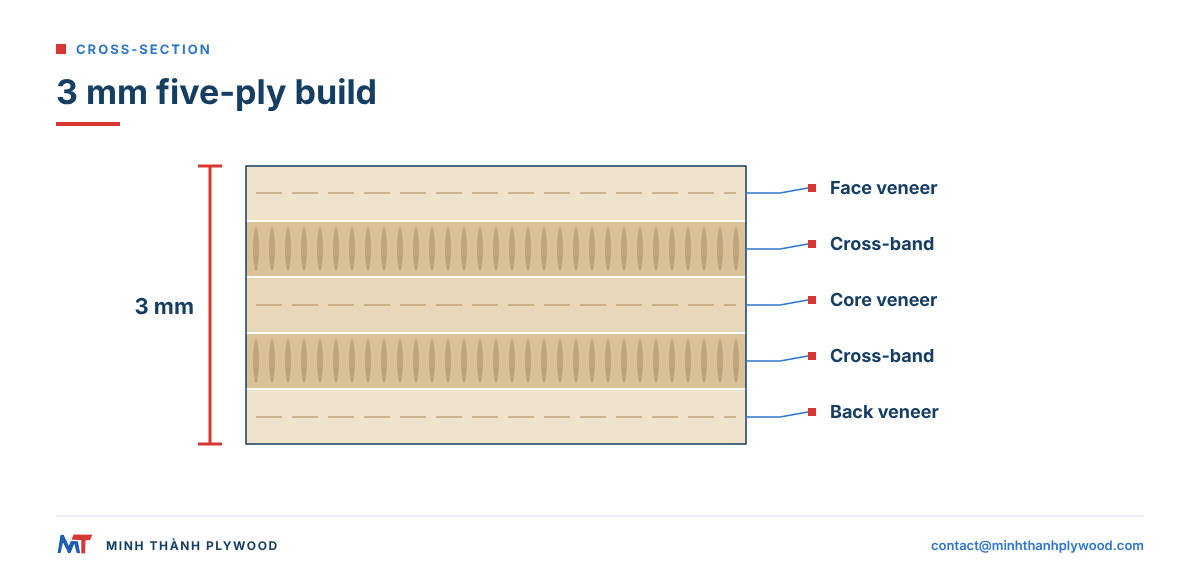
Thin plywood of 3–5 mm is built as five plies at Minh Thanh, always; the 6 mm ply count is confirmed with the order:
| Sheet | Build | What it means for the laser |
|---|---|---|
| 3 mm | One core veneer, two cross-band veneers, two face veneers | Five thin layers; light, fast cuts |
| 4 mm | Three core veneers and two faces | Stronger; for example three 1.3 mm Styrax core veneers |
| 5 mm | Three core veneers and two faces | Thicker core veneers, stiffer parts |
| 6 mm | Ply count confirmed with the order | Strongest thin build, more passes |
Because the 4 and 5 mm builds keep the same five-ply layout, the core veneers get thicker as the sheet does. That keeps the sheet balanced and flat. Premium thin face veneer is scarce, so 4 mm orders can take longer; we do not lower the standard to go faster.
For engraving, keep the depth inside the face. For cutting, every layer counts, so the build matters as much as the total.
Which thickness for laser cutting? Laser ply 3 mm to 6 mm
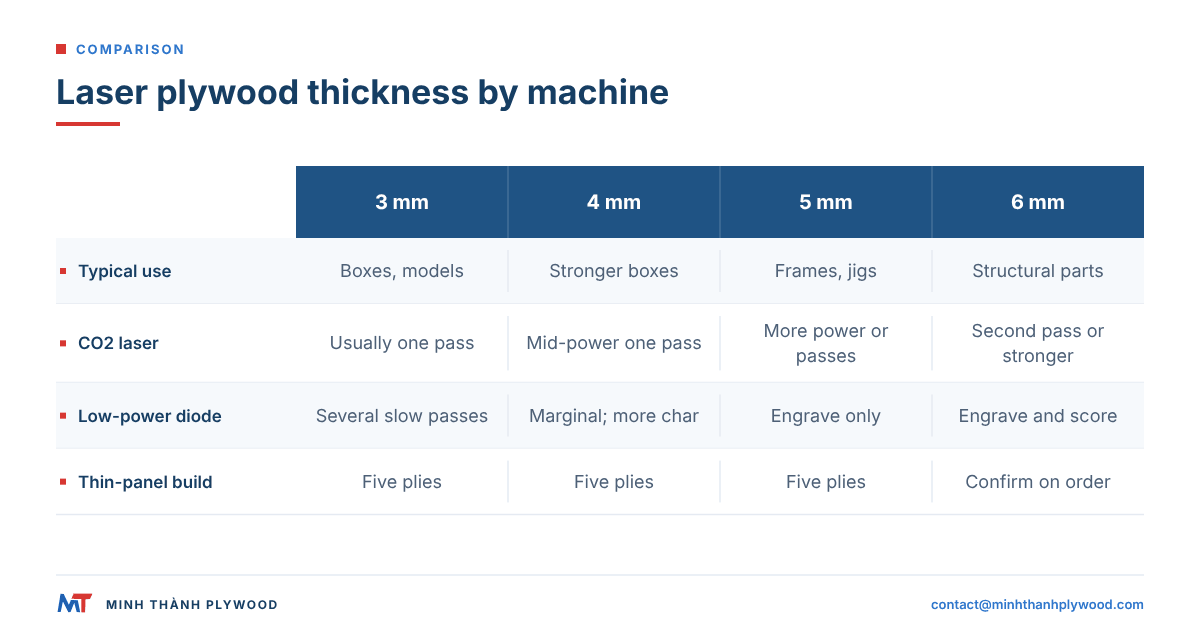
3 mm is the most cut thickness of laser plywood, 4 mm and 5 mm suit stronger parts, and 6 mm is the practical limit for most hobby and small workshop lasers in one or two passes. Thicker sheets need more power, slower speeds and give more char.
| Thickness | Typical laser uses | CO2 laser | Diode laser (low power) |
|---|---|---|---|
| 3 mm | Boxes, models, puzzles, ornaments, inlays | One pass on most machines; most popular laser ply 3mm size | Several passes, slow; poplar and basswood cut best |
| 4 mm | Stronger boxes, signs, toys | One pass on a mid-power tube, good strength and speed balance | Marginal; expect char and passes |
| 5 mm | Frames, larger enclosures, jigs | More power or a second pass | Engrave only |
| 6 mm | Structural parts, furniture models | Second pass or a stronger tube | Practical limit: engrave and score, not through-cut |
Minh Thanh’s thin plywood range is 3–6 mm, the band that most laser work uses. Ask for the exact thickness tolerance on the sample, because finger joints are cut to the real thickness. See thin plywood.
Flatness and thickness: focus and fixturing
A laser cuts at its focal point, so a sheet that bows or varies in thickness goes out of focus and cuts unevenly. Flat, calibrated plywood cuts through at one setting across the whole bed.
- Flatness. A balanced build stays flat. Store sheets flat, under light weight, in a dry room; never on edge.
- Moisture. Sheets dried to 8–12 % moisture, the normal range for furniture plywood, stay flat in a heated workshop. Let packs settle in the room before cutting.
- Thickness. Sanded furniture panels hold ±0.2–0.3 mm, down to ±0.2 mm; that keeps focus and joint widths steady.
- Hold-down. Use pins, magnets, weights or a vacuum on the honeycomb bed to keep thin sheets down.
How to flatten plywood for laser cutting that has bowed: lay it concave side down on a flat surface, weight it evenly for a day in a dry room, and cut it soon after. A sheet that was warped at the mill will warp again, so order flat, dry stock instead of fixing it at the machine.
Sheet format and nesting for laser beds
Laser beds are smaller than full plywood sheets, so the sheet format decides your waste. Order full sheets cut to blanks that fit your bed, or a custom size, instead of cutting every sheet down by hand.
- Full sheets: 1220 × 2440 mm and 1250 × 2500 mm, plus custom sizes such as 1220 × 2500 mm and 1220 × 2280 mm.
- Cut-to-size blanks: one panel cut into 4, 6 or 8 pieces at the mill. See cut-to-size plywood.
- Grain direction: state which way the face grain runs on the blank; parts nested along the grain are stiffer.
- Edge margin: leave a small margin at the blank edge, where sheets are most likely to be dented in handling.
Ordering blanks that fit your bed saves cutting time and freight volume. Write the blank size and grain direction on the order.
Laser engraving plywood: faces, contrast and finish
Laser engraving plywood works best on a smooth, pale, sanded face: poplar, basswood and birch give the most contrast. The engraving stays inside the face veneer, so the face’s grade and sanding matter more than the core.
- Face colour: pale faces show a darker engraving clearly; darker faces need deeper engraving.
- Face grade: knots, patches and colour changes show in the engraving. Choose a face grade with a clean area where you engrave.
- Sanding: a sanded face engraves evenly. Plywood faces sanded and polished at the mill need no further sanding before engraving.
- Masking: application tape on the face stops smoke staining around the engraving.
- Finish: a clear lacquer or oil after engraving deepens contrast and protects the face.
For printed and engraved finishes together, see printing on plywood.
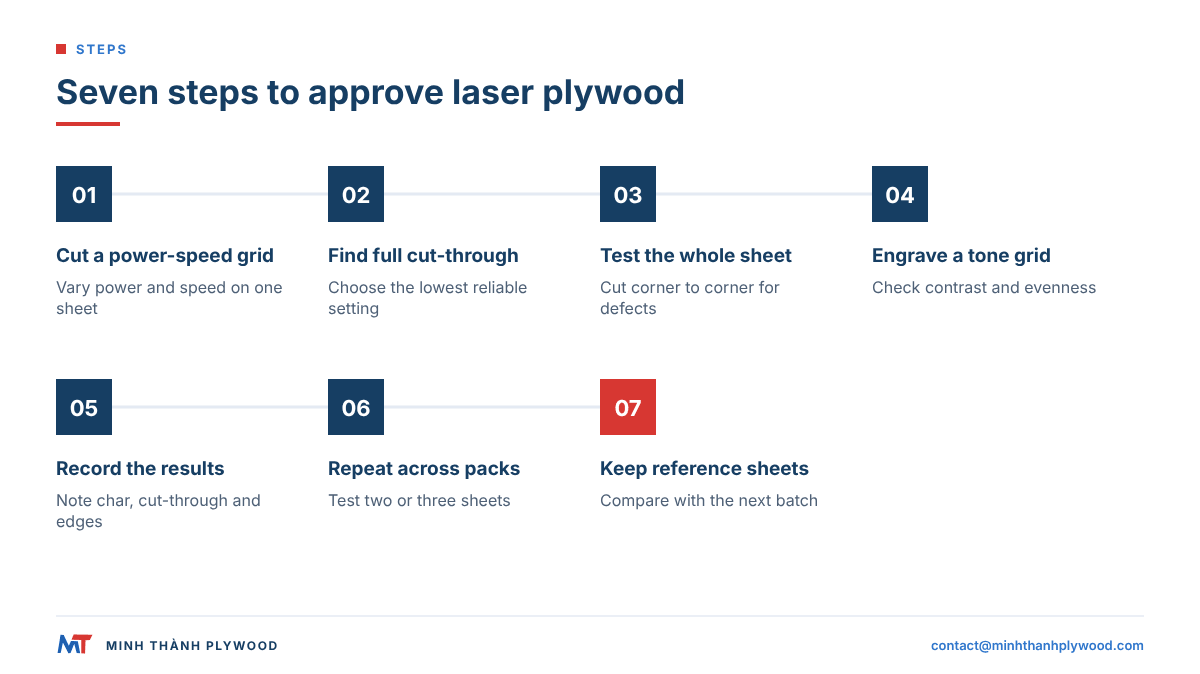
How to test laser plywood: a cut and engrave matrix
Test laser plywood on your own machine with a fixed matrix of cuts and engravings, and approve the batch on the results, not on the species name. Settings from another laser do not transfer: power, lens, air assist and bed all change the result.
- Cut a power and speed grid: a row of small squares at rising power, a column at rising speed, on one sheet.
- Find the lowest setting that cuts through everywhere on the grid, then add a small margin.
- Cut that setting across the whole sheet, corner to corner, to find voids and glue pockets.
- Engrave a tone grid of grey levels on the face to check contrast and evenness.
- Record the results: cut-through, char on the edge, engraving contrast and edge consistency.
- Repeat on two or three sheets from different packs.
- Keep the test sheets as the reference for the next batch.
| Record | What to note | Pass when |
|---|---|---|
| Cut-through | Parts that drop out at the chosen setting | All parts drop, no clusters of failures |
| Char | Edge colour | Even edge colour across the sheet |
| Engraving contrast | Tone grid result | Even tone, no blotches |
| Edge consistency | Layer lines on the cut edge | No gaps, no stalled cuts |
| Flatness | Sheet on the bed | Lies flat without extra weight |
Laser plywood by product: models, signs, toys and packaging
Each laser product asks for a different balance of strength, cut speed and face, so choose the sheet by the product, not by a general “best” list. This table matches common laser products to the plywood that suits them.
| Laser product | Suggested plywood | Thickness | What matters most |
|---|---|---|---|
| Architectural and scale models | Basswood or poplar face, light core | 3 mm | Fine detail, pale even face, low char |
| Finger-jointed boxes and enclosures | Birch or poplar face | 3–6 mm | Even thickness for tight joints |
| Signs and wall art | Poplar or birch face, sanded | 3–6 mm | Engraving contrast, flat sheet |
| Wooden toys and puzzles | Birch or poplar, UF glue at E0 emission | 4–6 mm | Strength, smooth edges, low-emission glue |
| Decorations and ornaments | Poplar or basswood face | 3 mm | Fast cut, light edge |
| Packaging inserts and displays | Poplar face, light core | 3–4 mm | Low cost per part, light weight |
| Jigs and templates | Birch face, dense core | 6 mm | Stiffness, wear resistance |
Toys and products for children follow their own safety rules in each market. Treat the plywood specification as the starting point: the finished toy is tested as a product, with its paint or finish, to the rules where it is sold.
For speaker grilles, enclosures and other acoustic parts, the build matters as much as the face; see plywood for speaker cabinets. For screws and joints in thicker laser parts, see plywood joints and screws for plywood.
Compare cost per good part, not per sheet
The cheapest laser plywood per sheet is often the most expensive per good part. Count rejected parts, second passes and cleaning time, and the sheet with the closed core usually wins.
A simple way to compare two sheets:
- Good parts per sheet: parts that cut through and pass inspection.
- Machine time per sheet: a second pass doubles laser time.
- Finishing time: cleaning soot, sanding char, re-cutting failed parts.
- Waste: offcuts and failed parts that go in the bin.
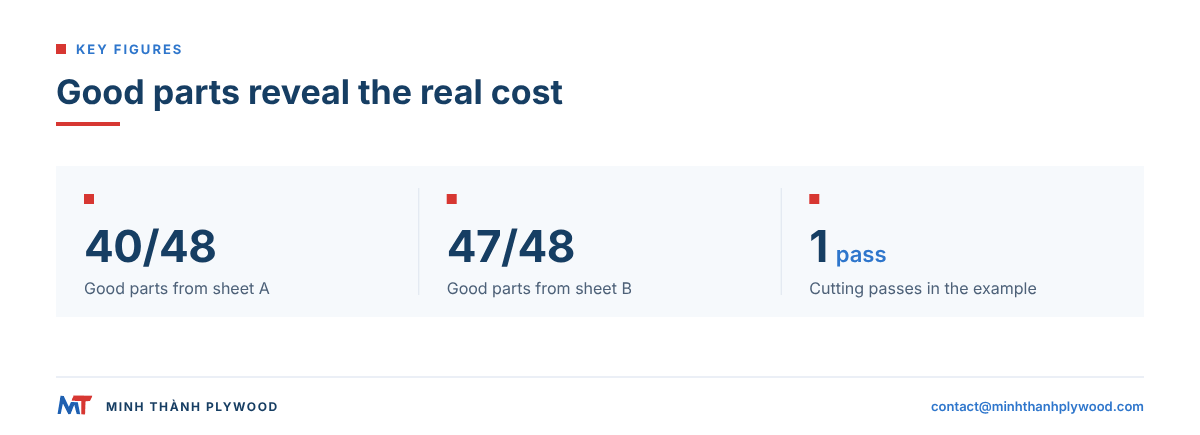
Worked example: sheet A gives 40 good parts out of 48 in one pass; sheet B gives 47 out of 48 in one pass at a slightly higher sheet price. B costs more per sheet and less per good part, before counting the time spent re-cutting A’s failures. Ask a supplier for samples and run this comparison on your own parts.
Record the approved build so repeat batches match
Once a laser plywood passes your test, write its build down and order by it, so the next batch cuts the same. “3 mm birch plywood” is not a specification; the build is.
The record to keep:
- Thickness and build: for example 3 mm, five plies.
- Face and back: species and grade pair, for example poplar A/A.
- Core: species and veneer layout.
- Glue and emission: for example UF glue at E0 emission.
- Tolerance and moisture: thickness tolerance and 8–12 % moisture at dispatch.
- Size: sheet or blank size and grain direction.
- Your laser settings and the test sheet kept as reference.
A mill that builds to a written specification and an approved sample can repeat it. Minh Thanh matches face grades to the buyer’s approved sample and keeps the build on the order.
Fumes, extraction and laser safety
Every plywood laser cut gives off smoke, fine particles and gases from wood and glue, so use the extraction and controls the laser maker specifies. Low-emission glue reduces formaldehyde in the panel; it does not make laser smoke safe to breathe.
- Extraction: vent fumes outside or through the filter unit the laser maker approves, sized for the machine.
- Air assist: reduces flare-ups and char on the edge.
- Never leave a cut unattended: plywood can catch fire, especially with low speed and high power.
- Fire control: keep the extinguisher type the laser maker recommends next to the machine.
- Material list: keep a list of approved materials, and ban PVC, vinyl and unknown coatings.
For workplace laser hazards, see the US Occupational Safety and Health Administration’s laser hazards page; for wood dust from sanding laser parts, the UK HSE wood dust guidance.
Where to buy plywood for laser cutting
Buy plywood for laser cutting in small sheets from laser-material retailers when you need a few boards, and from a plywood mill when you need repeat volume to one specification. A mill order is built to your spec, tested on samples and shipped by the container.
| Source | Best for | What you get |
|---|---|---|
| Laser-material retailer | Small runs, many materials | Pre-cut sheets, small quantities |
| Local timber merchant | Occasional jobs | Standard sheets, varying cores |
| Plywood mill (thin panels) | Repeat volume, own brand, one spec | Built to your face, core, glue and size |
Thin plywood from Vietnam is a cost-effective source of volume laser stock: plantation-grown Styrax and Eucalyptus cores, poplar, birch and other faces, and furniture-grade pressing. Minh Thanh makes thin plywood 3–5 mm, always five plies, with sizes from 1220 × 2440 mm to cut-to-size pieces. The minimum order is one 40HC with mixed specifications by agreement, and production takes 15–45 days after the 30% deposit.
What to write on a laser plywood order
Write the full build on a laser plywood order, then approve a sample of exactly that build on your own laser before production. These lines cover it:
- Use: laser cutting, engraving or both.
- Thickness: for example 3 mm or 4 mm, five plies.
- Face and back: for example poplar A/A, or birch D+/D.
- Core: species, closed core with no gaps or overlaps.
- Glue and emission: UF glue at E0 emission, no PVC or vinyl overlay.
- Surface: sanded faces, no coating.
- Tolerance and flatness: thickness tolerance on the sample, flat sheets.
- Moisture: 8–12 % at dispatch.
- Size: full sheets, a custom size or cut-to-size blanks, with grain direction.
- Packing and quantity: packs per 40HC, mixed thicknesses by agreement.
Minh Thanh sends free samples of the build you specify, so you can run the test matrix on your own machine first. Send the specification to contact@minhthanhplywood.com, and read laser cutting plywood for power, settings and thickness limits, or how to cut plywood for every cutting method.
Buyer questions, answered
What is the best plywood for laser cutting?
A thin, flat plywood with an even, gap-free core, a light interior glue line and a smooth face. Birch faces give strong parts and crisp edges; poplar and basswood faces cut faster and engrave paler.
What makes plywood laser-safe?
Wood veneers and a formaldehyde-based wood glue with no PVC, vinyl or unknown coatings. Never laser cut plywood with a PVC or vinyl overlay, and run every laser with fume extraction.
Which glue cuts cleanly on a laser?
Light interior glue lines, such as UF glue at E0 emission, cut most cleanly and leave less char. Phenolic and heavy melamine-fortified glue lines are harder and darker, so they need more power and leave darker edges.
Birch or poplar plywood for laser cutting?
Birch for strong, crisp parts such as models, joints and boxes; poplar for light parts, signs and fast cuts, with a pale face for engraving. Both work when the core is closed and the sheet is flat.
Which plywood thickness is best for laser cutting?
3 mm is the most cut, 4 mm and 5 mm suit stronger parts, and 6 mm is the practical limit for most hobby and small workshop lasers. Thicker sheets need more power, more passes and give more char.
Where can I buy plywood for laser cutting?
From laser-material retailers in small sheets, or for volume from a plywood mill that builds thin panels to your spec. A mill order needs a written build and an approved sample tested on your laser.
How do I flatten plywood for laser cutting?
Store sheets flat under weight in a dry room, and hold them on the bed with pins, magnets or a honeycomb hold-down. A sheet that is warped from the mill will not stay flat; order flat, dry stock instead.
Why do laser cuts in plywood not go through in some spots?
Glue pockets, core overlaps, denser veneer or a sheet that lifts out of focus. Each of these needs more energy than the clean wood around it.
Can you laser engrave plywood?
Yes. A smooth, pale, sanded face such as poplar, basswood or birch gives the best contrast. Engraving stays in the face veneer, so face quality matters more than the core.
Is 3 mm plywood strong enough for laser-cut boxes?
Yes, for boxes, models, puzzles and small enclosures with finger joints. For load or larger panels, move to 4–6 mm or a birch face.
Does laser cut plywood need sanding?
Usually only to remove smoke marks on the face. Mask the face with application tape before cutting, or wipe soot off with a damp cloth and sand lightly at 220 grit.
What is laser plywood (laserply)?
Laser plywood, often sold as laserply, is thin plywood selected or built for laser cutting: flat, sanded, with a closed core and a glue that cuts cleanly. It is a specification, not a species.