
Types of plywood include interior, exterior, structural, marine, film-faced and decorative panels. Core material, face grade and bond are separate classifications. Minh Thanh Plywood makes furniture and interior veneer-core panels with Styrax or Eucalyptus cores; specify the face, back, dimensions and emission requirement independently.
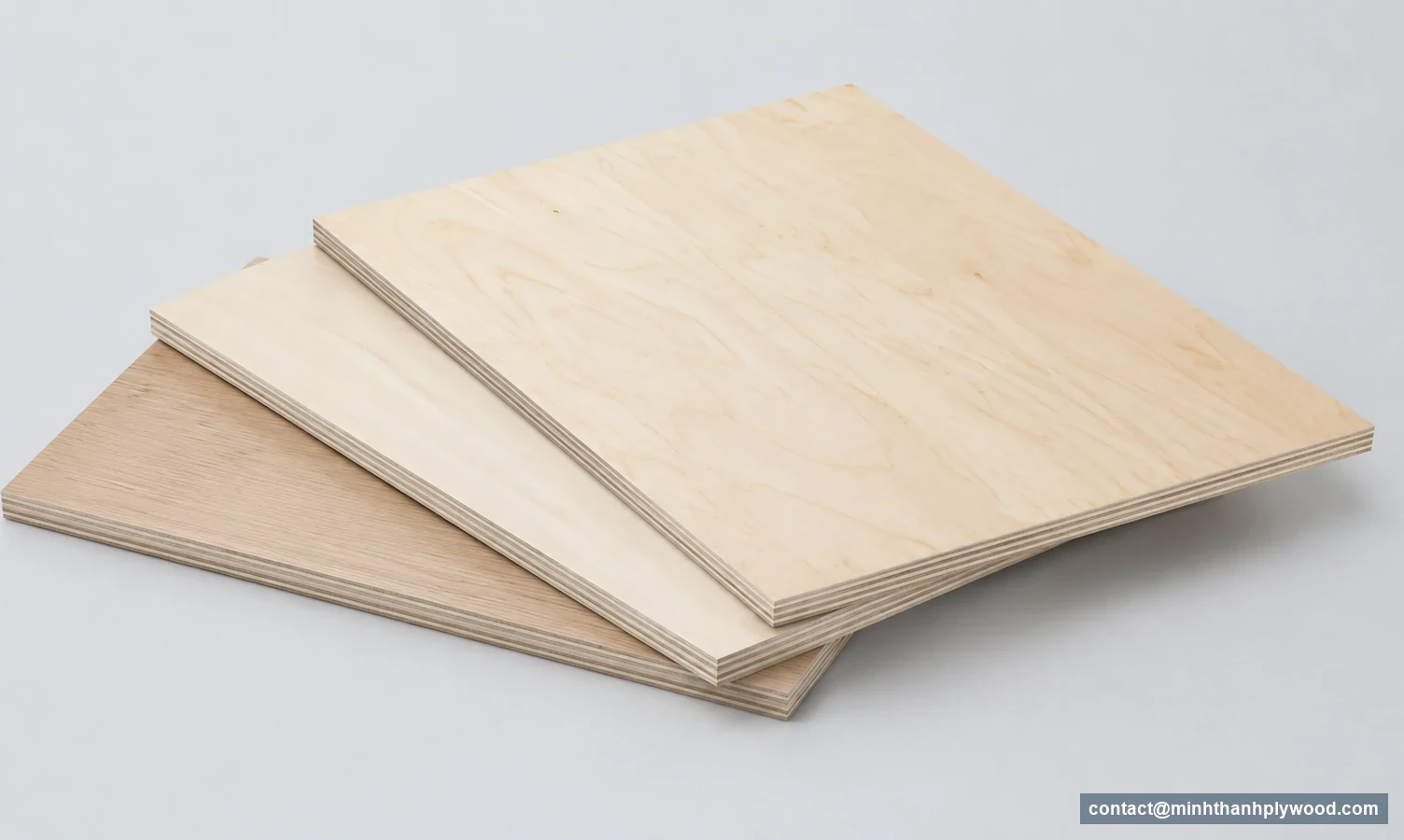
What are the 4 types of plywood?
Plywood is most often grouped by application into four types: interior, exterior, structural and marine plywood. Film-faced and decorative surfaces can overlap those groups, while face species and core construction remain separate descriptions. A purchase still needs the grade, bond, thickness and intended use specified.
Minh Thanh Plywood focuses on furniture and interior plywood with Styrax or Eucalyptus cores. Birch, Poplar, engineered veneer, Pine and Okoume describe face options. They describe appearance without automatically establishing what is inside the board. A buyer ordering a pale Birch face can choose the core separately from the visible surface.
| Classification | What it answers | Example buying description |
|---|---|---|
| Application | Where the panel works | Dry-interior cabinet component |
| Core structure | What lies under the face | Cross-laminated veneer core |
| Species | Which woods are used | Birch face, Styrax core |
| Appearance grade | Which features are accepted | D+/D face/back, approved sample |
| Bond/exposure | What moisture service is required | Specified bond test and use conditions |
| Preparation | What the buyer receives | Sanded full sheets or cut-to-size parts |
Start with the finished job, then read those fields together. “Commercial,” “hardwood” and “five-ply” each answer a different question. None describes a complete panel on its own. The selection sequence below moves from broad material families to the construction a factory can quote and a warehouse can inspect.
How does cross-laminated construction create plywood?
Plywood bonds wood veneers into a panel with grain directions arranged across adjacent layers. Cross-lamination distributes the wood’s directional behaviour through the sheet. The USDA Wood Handbook, wood-based composites chapter, explains veneer-based panels and the distinction from particle- and fibre-based boards; source consulted 7 October 2026.
The outer veneers are the face and back. Layers immediately beneath them help support the surface and cross the grain of adjoining veneers. The centre and remaining core layers complete the thickness. A cut edge lets the buyer see this arrangement, while the construction sheet identifies species and preparation that a photograph cannot establish.
For Minh Thanh furniture-grade panels, the core board is pressed and calibrated first. The face and back are then pressed onto that prepared core in a second pressing. This separates the core preparation from the decorative surface operation. The manufacturing process shows how assembly, pressing and finishing connect to a complete furniture panel.
What are the 3 types of plywood?
Three-ply, five-ply and multi-ply describe layer-count groups, not a complete classification of plywood. Layer count and total thickness remain separate quantities: a thin board can contain several thin veneers, while a thicker board can use fewer, thicker veneers. Specify the actual construction for the component.
Each arrangement changes the edge and machining result. Write the requested ply construction where a component exposes the edge or where the buyer’s drawing requires a specific layup.
For sample approval, look at the broad face, the reverse and a representative sawn edge. Check the finished thickness after sanding. These views connect the decorative choice with the internal construction and the dimensions the workshop will actually use.
Different types of plywood by core: which structures carry the name?
Veneer core, lumber core, MDF core and particle core describe different internal structures, even when each carries a similar decorative veneer. They need separate machining, weight and fastening evaluations. A natural-wood face can conceal all of these interiors, so the commercial face name should not become the core description.
Veneer-core plywood uses stacked wood veneers. The cross-laminated edge can be finished visibly or covered with edging. Minh Thanh’s standard furniture range uses this construction with Styrax or Eucalyptus core. An order for Birch-faced furniture plywood should therefore list the chosen veneer core on its own line.
Lumber-core panels use wood strips or blocks inside the veneered panel. Buyers also encounter blockboard names in this family. The location and orientation of those strips affect the machining and fixing brief. Keep that construction distinct from an all-veneer panel, particularly where a narrow groove or an edge fixing is part of the drawing.
MDF-core panels use a fibreboard substrate beneath decorative veneers. Particle-core panels use compressed wood particles. Both can present an attractive veneered face; the cut edge and supplier’s technical sheet reveal the substrate. Combination cores can mix substrates or species and deserve a layer-by-layer description rather than a guessed average performance.
Minh Thanh makes veneer-core furniture plywood. The broader alternatives are included to help buyers read other quotations accurately. When replacing an existing panel, send its edge photograph and construction sheet along with its trade name. That identifies whether the purchasing comparison changes only the veneer appearance or the whole material system.
What is the difference between hardwood, softwood and tropical plywood?
Hardwood and softwood describe botanical wood families; they do not provide a universal density or strength ranking. Tropical describes origin or a commercial species grouping. A lightweight hardwood can be useful for furniture, and a softwood construction panel can carry a defined structural rating.
In plywood names, a species can refer to the face, the core or both. Pine-faced plywood over a plantation hardwood core is different from a panel made from Pine veneers throughout. Birch-faced plywood over Styrax is different from an all-Birch panel. The quotation needs the face/back species and internal species to make the comparison readable.
Minh Thanh’s standard furniture cores are white Styrax and Eucalyptus. Planning references use 500 kg/m³ for Styrax and 650–750 kg/m³ for Eucalyptus. These inputs help calculate handling and freight. They are separate from bending, screw-withdrawal or moisture-service data for the tested construction.
Face species also changes the surface brief. A pale Poplar face, a ring-grained Pine face and an engineered veneer pattern ask for different appearance approvals. View each with the intended finish and grain direction. Species alone does not set the acceptable number of repairs or the colour range across furniture components.
When a tender simply asks for hardwood plywood, turn it into an application specification. Identify exposure, face appearance, core, thickness and required product evidence. Then compare the offered constructions under that requirement. This prevents a botanical word from replacing the choices that determine the finished part.
Which plywood types suit furniture and interiors?
Sanded furniture-grade veneer-core plywood suits components that need an agreed face, controlled thickness and a prepared surface. Specify the component before selecting the decorative face: doors, cabinet sides, drawer bottoms and shelves expose different surfaces and use different joints.
| Furniture requirement | Face route to compare | Construction detail to approve |
|---|---|---|
| Clear-finished visible front | Birch or another selected natural veneer | Face/back appearance and finished sample |
| Pale painted component | Poplar | Sanded substrate, repair finish and coating trial |
| Repeated decorative pattern | Engineered veneer | Pattern direction and adjacent-part arrangement |
| Natural softwood-grain interior | Pine | Knot character, repairs and face/back pair |
| Warm natural-wood surface | Okoume | Colour and grain under the selected finish |
Minh Thanh furniture panels are double pressed, with the core calibrated before face application. Normal finished-thickness tolerance is ±0.2–0.3 mm, with tight specifications down to ±0.2 mm. Choose the actual acceptance band for the component and write it beside the nominal thickness.
A cabinet side can be visible inside and concealed outside. A shelf can show both broad faces and its front edge. Those differences decide whether equal face/back grades are useful or whether a lower concealed-back grade fits the job. Do not pay for a decorative face that the finished assembly permanently covers.
Run a component sample through the actual sawing, hardware and finishing process. Use the best plywood for furniture guide to develop that trial. The accepted face and finished part then become a practical reference for the container order, rather than a general promise of furniture quality.
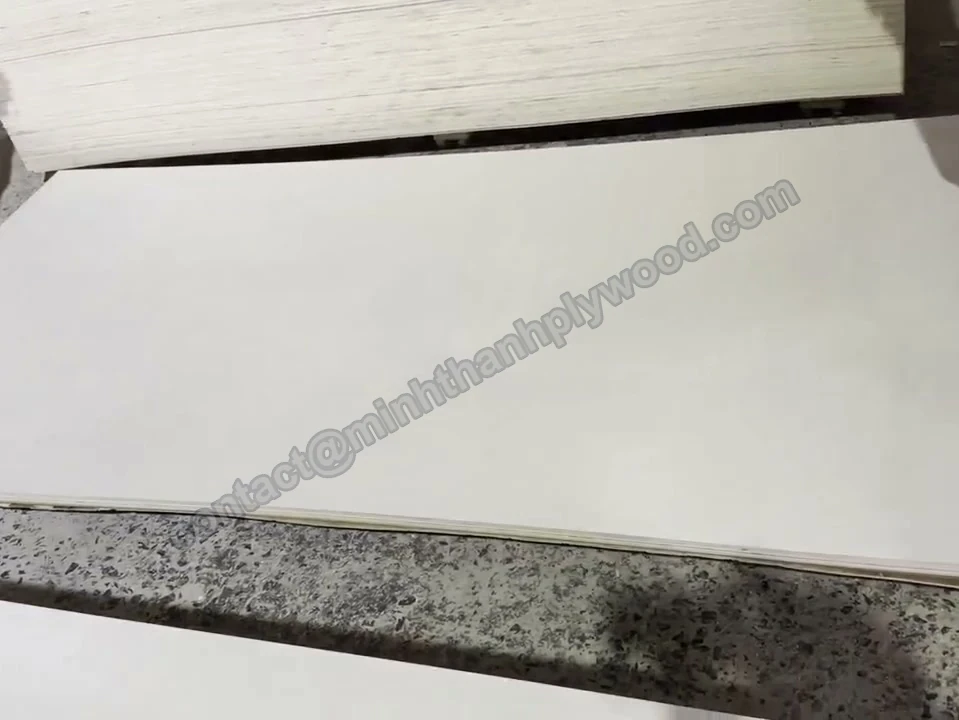
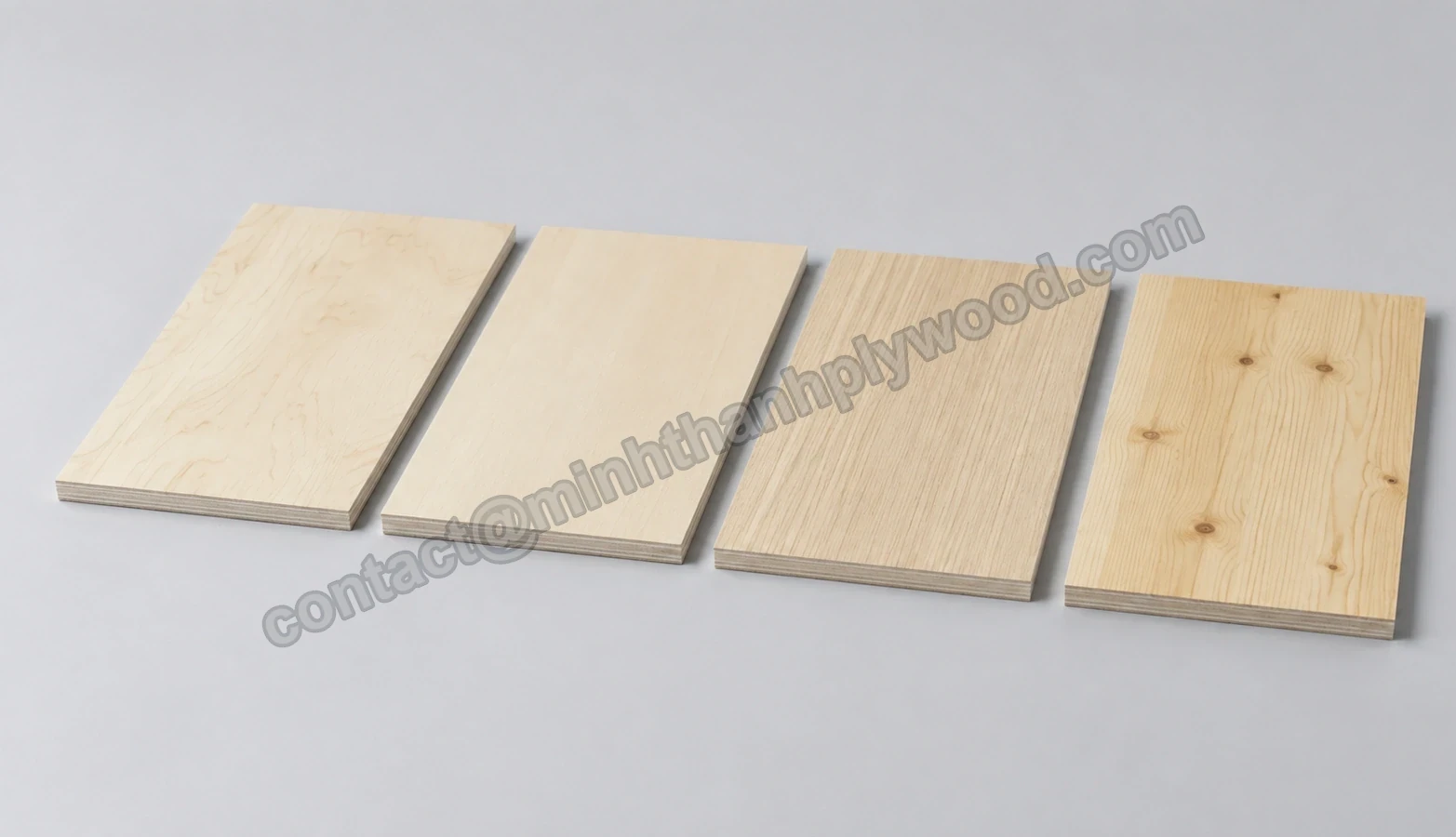
What does commercial plywood mean?
Commercial plywood is a buying category for general-purpose panels; the name does not establish one core, resin or dimensional tolerance. Specify the intended use and the complete construction, particularly when comparing a commercial quotation with a calibrated furniture panel.
General interior fabrication, partitions, utility components and covered surfaces can have different appearance priorities from clear-finished furniture. A concealed face can accept more visible repairs while still needing a sound surface for the next operation. A packing application can prioritise handling and protection rather than decorative grain. These are deliberate specifications rather than one universal low-price board.
At Minh Thanh, commercial plywood starts from US$250/m³ as of October 2026; furniture/interior plywood starts from US$350/m³. The final quotation describes face/back, core, dimensions, adhesive, emissions, preparation, quantity and delivery term. A category starting price does not tell the buyer which grade pair or construction the offer contains.
Finished-thickness tolerance differs by product line. Commercial panels use ±0.5 mm; sanded furniture panels use ±0.2–0.3 mm, down to ±0.2 mm. That difference matters when machining is set around a narrow groove or hardware fit. Keep the applicable tolerance in the quote comparison instead of treating panels of the same nominal thickness as interchangeable.
For the detailed range, see commercial plywood. Approve a sample with the intended covering, fastening or fabrication process. If a cheaper alternative changes sanding, core joining or face grade, record each change so production can evaluate the actual board.
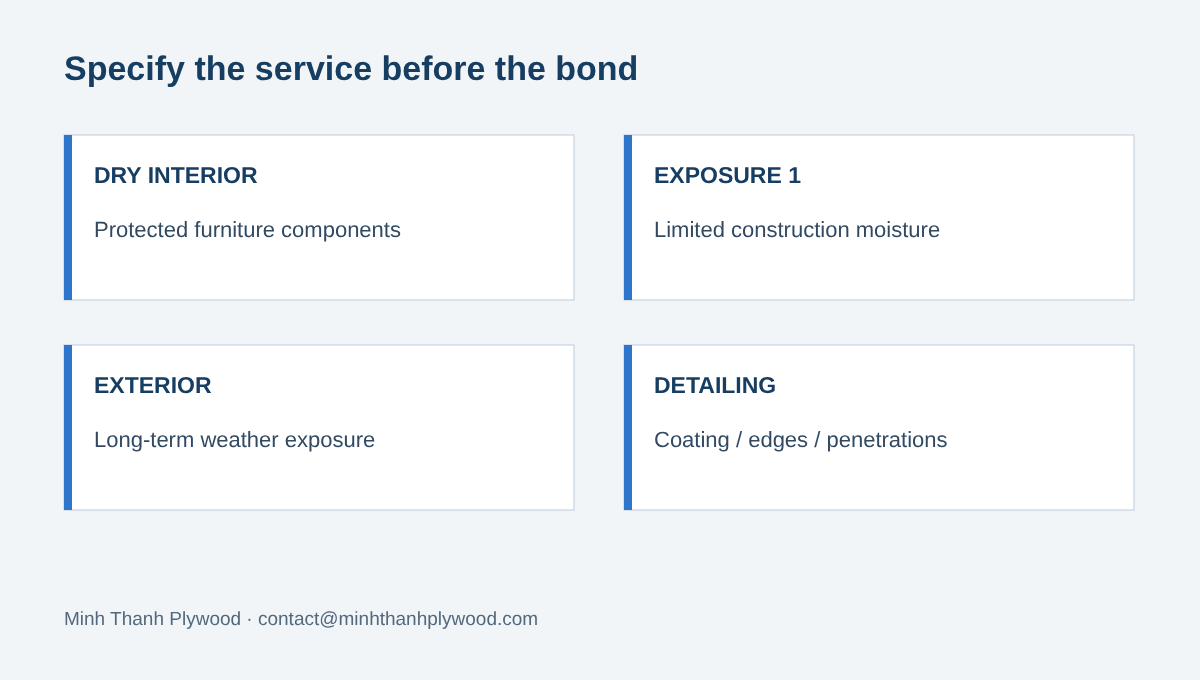
How do exterior and Exposure 1 plywood differ?
Exterior and Exposure 1 are different moisture-service classifications in North American structural plywood. Exterior addresses long-term weather exposure. Exposure 1 addresses construction moisture or similarly limited exposure, and does not mean permanent outdoor suitability. APA’s plywood guidance makes that distinction; consulted 7 October 2026.
A designation such as CDX should therefore be read with the named grading and certification system. C and D describe veneer appearance in that system, while the commercial X shorthand is frequently associated with Exposure 1. A sales description containing exterior or CDX-type needs its specified bond and intended use beside it.
Minh Thanh supplies exterior/CDX-type panels with utility face appearance and water-resistant melamine-fortified or phenolic bonds to the customer’s specification. Describe the required use, exposure and test evidence in the enquiry. Keep this range separate from dry-interior furniture panels using the standard UF construction.
Bond durability concerns the adhesive joint. The wood can still take up moisture, and exposed edges, penetrations and surface finishes need the detailing called for by the completed design. A good bond does not turn the whole assembly into a rot-proof or maintenance-free product.
For an outdoor requirement, identify permanent or temporary exposure, sheltered or direct wetting, and any structural role. Select the construction and coating system for that service. The waterproof-plywood guide explains why a moisture-service instruction is more useful than a general waterproof label.
What makes plywood structural?
Structural plywood has documented performance for the intended load-bearing use. A dense core, a thick sheet or a high appearance grade does not supply a structural rating. Structural procurement starts with the required standard, design loads, support arrangement and relevant panel marking.
In the United States, NIST lists PS 1-22 as the current Structural Plywood product standard. Product standards and editions referenced by a building design or regulation must be read for that application. The required scope is distinct from the appearance and furniture specifications discussed elsewhere in this guide.
A roof deck, bracing wall and floor panel put different demands on the sheet and its fixings. The design uses bending, shear, stiffness and fastening information for the rated construction. Panel orientation and edge support are also design decisions. Increasing thickness alone does not resolve an undefined structural brief.
For an EU construction product within the applicable harmonised scope, review the declaration and evidence for the declared use. The Commission’s construction-product guidance, consulted 7 October 2026, explains the framework. CE is available* in Minh Thanh’s supply range. *Supplied directly or through qualified partner mills.
For furniture purchasing, retain a furniture construction unless the design requires a rated structural product. A shop’s shelf trial and a building-code panel approval answer different questions. Put the standard and evidence requirement in the first enquiry when the panel participates in a structural design.
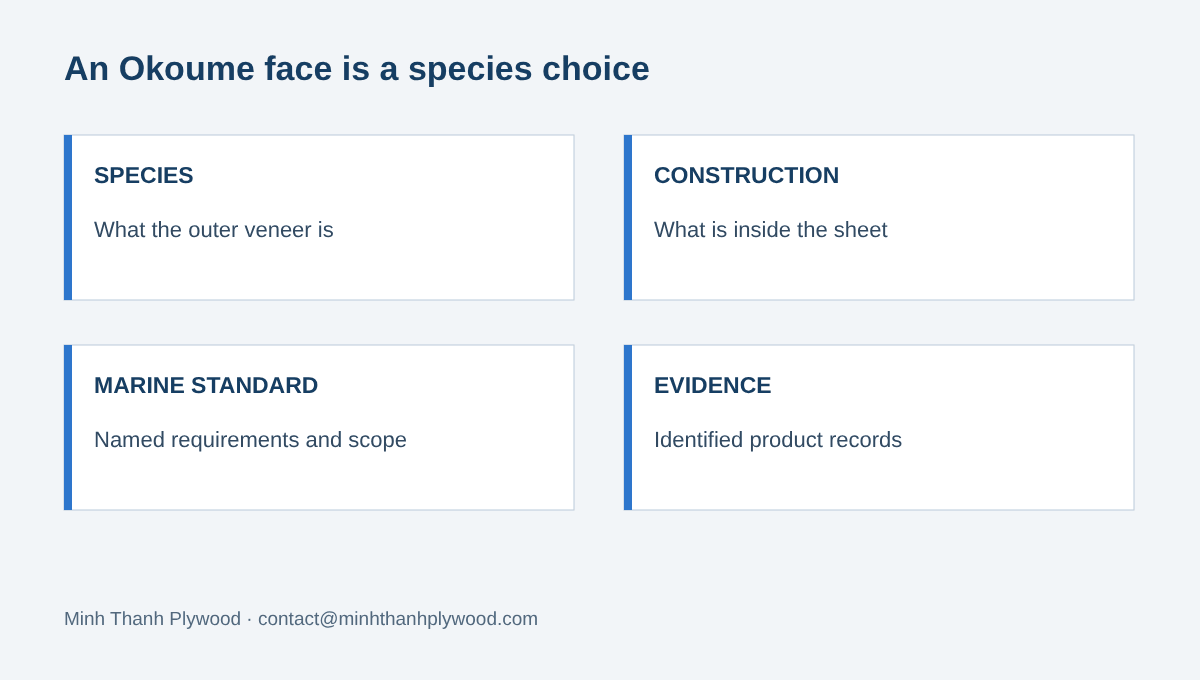
What is marine plywood, and is Okoume always marine grade?
Marine plywood is specified as a complete marine construction with the required veneer quality, bond and product evidence. Okoume is a wood species, so an Okoume face alone does not identify marine plywood or establish compliance with BS 1088.
In a marine enquiry, the buyer needs the named standard, construction, service conditions and accepted test or certification evidence. A general boiling claim or phenolic resin label describes only part of that specification. Look at the product scope and the panel edge as well as the face. The quality of internal veneers is relevant to the job, not merely the surface colour.
Minh Thanh’s Okoume-faced plywood belongs to the furniture and interior range. It is presented for those uses, with Styrax or Eucalyptus core named separately. We do not represent this decorative interior product as BS 1088 marine plywood.
The practical distinction matters when a drawing originally names marine plywood for a furniture component. Ask whether the requirement is a certified marine construction, a particular bond performance or an appearance preference. Preserve the functional requirement during evaluation. Replacing a material specified for a marine design requires that design’s acceptance process.
Keep coating, edge protection and the completed assembly in the service brief. Marine terminology does not remove the need for those details. A sourcing decision is complete when the supplied panel and the intended environment have been matched with the necessary evidence, rather than when two boards have similarly coloured faces.
How do film-faced, anti-slip, MDO and HDO panels differ?
Film-faced panels, anti-slip panels and resin-fibre overlays differ in their working surfaces. Compare the overlay and substrate separately. A dark surface does not identify the core species, adhesive bond or reuse performance.
Film-faced formwork panels use a working face chosen for concrete forming. Their order needs the film specification, face finish, edge protection, dimensions and core/bond construction. The formwork system, handling and cleaning regime also affect the result. A decorative furniture face should not be evaluated by a concrete-forming claim.
Anti-slip panels add a textured working face. The texture is relevant to the use, but an image of it is not a slip-test classification. Specify the relevant application and test requirement. The reverse face, edge sealing and mounting details belong in the purchase too, particularly where the panel works as a platform or flooring component.
MDO and HDO refer to medium- and high-density resin-impregnated fibre overlays. They should be distinguished from a generic film-faced or decorative melamine surface. The manufacturer’s sheet supplies the actual overlay and substrate description. Match paint, wear or concrete-finish requirements to the specified product rather than assuming that a similar colour means the same surface.
These are supporting ranges at Minh Thanh: film-faced plywood and anti-slip plywood are available. Our main factory focus remains natural and engineered-faced furniture plywood. Use the dedicated product specifications for the working-surface order, and use this classification guide to keep the names clear.
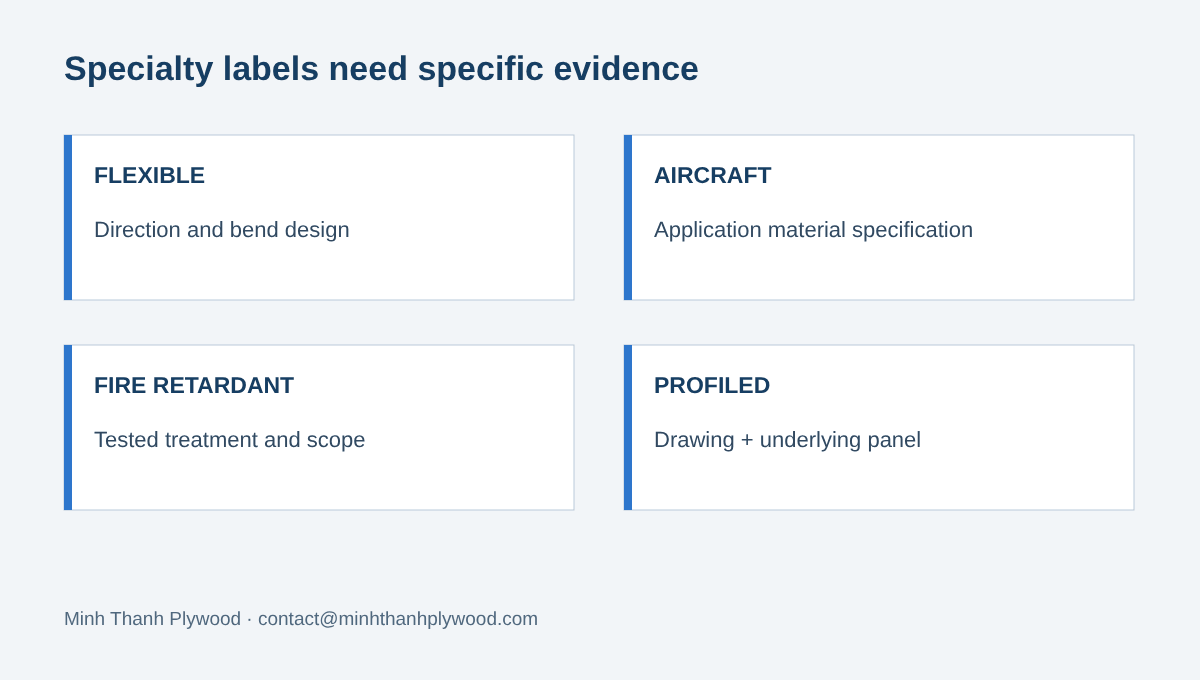
What other specialty plywood names should buyers recognise?
Flexible, aircraft, fire-retardant and profiled-edge panels describe specific construction or treatment requirements. They are not interchangeable upgrades to an ordinary furniture board. Their availability and evidence belong to the manufacturer supplying that specialty.
Flexible plywood is designed to bend in its intended direction. A thin ordinary panel is not automatically bending plywood, and a curved component needs the bend direction, radius, surface and fixing method specified together. An assembled curved part also needs to hold its shape under the intended service conditions.
Aircraft plywood belongs to an exacting application with a named material specification and acceptance process. A fine layer count or attractive edge does not establish aircraft approval. Retain the required species, construction and qualification evidence when reading an offer for that application.
Fire-retardant panels need the treatment or manufacturing system and the relevant fire classification for the completed use. A fire claim should identify the tested product and scope. Coating an ordinary board does not create a certified classification by description. Moisture exposure and the effect of treatment on machining and finishing belong in the supplier’s technical file.
Tongue-and-groove, perforated and acoustically detailed panels add machining or an assembly feature. Specify the profile or perforation drawing and identify the underlying sheet. Bamboo panels likewise need their construction and source identified; the botanical name alone does not describe a conventional wood-veneer layup. These specialties are included for classification, not as a statement that Minh Thanh supplies every product named here.
Are MDF, particleboard, OSB and LVL types of plywood?
MDF, particleboard, OSB and LVL are separate engineered wood products. They share some applications with plywood, but their internal structures differ. Counting them as ordinary plywood types hides the differences the furniture or construction buyer needs to evaluate.
MDF is made from wood fibres. Particleboard is made from wood particles. OSB uses oriented strands. Veneer-core plywood uses cross-laminated veneers, while LVL aligns most veneers along the member’s length for its intended structural or industrial role. The USDA Wood Handbook separates these product families by their construction.
For a painted routed door, the fibre surface and routed edge of MDF deserve comparison with a veneered plywood part. For a laminated cabinet carcass, particleboard’s prepared face and compatible hardware system can suit the production programme. For building sheathing, rated OSB and rated plywood belong in the design comparison. Select the board family by the job and its product data.
Minh Thanh supplies veneer-core plywood and offers LVL. LVL availability is separate from a claim about past export projects or a universal beam rating. The exact member, layup and applicable performance evidence belong in the enquiry.
Use plywood versus MDF and particleboard versus plywood for those material choices. This types guide keeps the family boundaries visible so that a decorative face, engineered core or familiar retail name does not misidentify the product being purchased.
How do appearance grades differ from bond and emission classes?
Appearance grades describe face and back features; bond classifications describe adhesive-service performance; emission requirements describe formaldehyde release under a specified method. Record all three separately. A clean face does not establish the other two properties.
| Specification field | Example in Minh Thanh furniture buying | Acceptance reference |
|---|---|---|
| Birch appearance | D+/D or D/E | Retained sample and agreed repairs/colour |
| Poplar or Pine appearance | A/A, A/B or B/B | The product’s face/back sample |
| Core construction | Styrax or Eucalyptus; stitching scope | Construction sheet and representative edge |
| Adhesive and bond | UF, or specified melamine-fortified/phenolic construction | Intended exposure and agreed bond test |
| Emissions | UF glue at E0 emission | Required method and relevant report |
Minh Thanh Birch grades are D+, D and E. As a buying comparison, D+ is close to B, D to BB, and E to CP/C. D+/D therefore compares with B/BB; D/D compares with BB/BB. Those are appearance comparisons, with the sample fixing the accepted features.
Letter systems change between markets. A US letter face/number back code is different from a Baltic face/back pair, and D+ at this factory is not the D utility face in another system. Copy the grading document and sample reference into the purchase specification rather than translating an isolated letter.
For a North American structural-plywood appearance description, the A–D ladder is a useful separate reference:
| Veneer letter | General appearance description | Buying instruction |
|---|---|---|
| A | Smooth, prepared appearance face | Read the named standard’s repair allowance |
| B | Sound face with permitted repairs | Specify accepted repairs and finish |
| C | Utility face with permitted knots and defects | Check the relevant product and bond class |
| D | Utility face with more open defects | Keep its permitted use within the stated classification |
Source: APA veneer grades, consulted 7 October 2026. These letters describe that grading context; they are not a replacement for Minh Thanh’s D+/D furniture sample.
For bonding, specify the required test and service instead of treating WBP as a complete certification. For emissions, name the method and destination requirement. Our standard furniture construction uses UF glue at E0 emission; E0 is not the resin name.
How do thickness, ply count and sheet size change the choice?
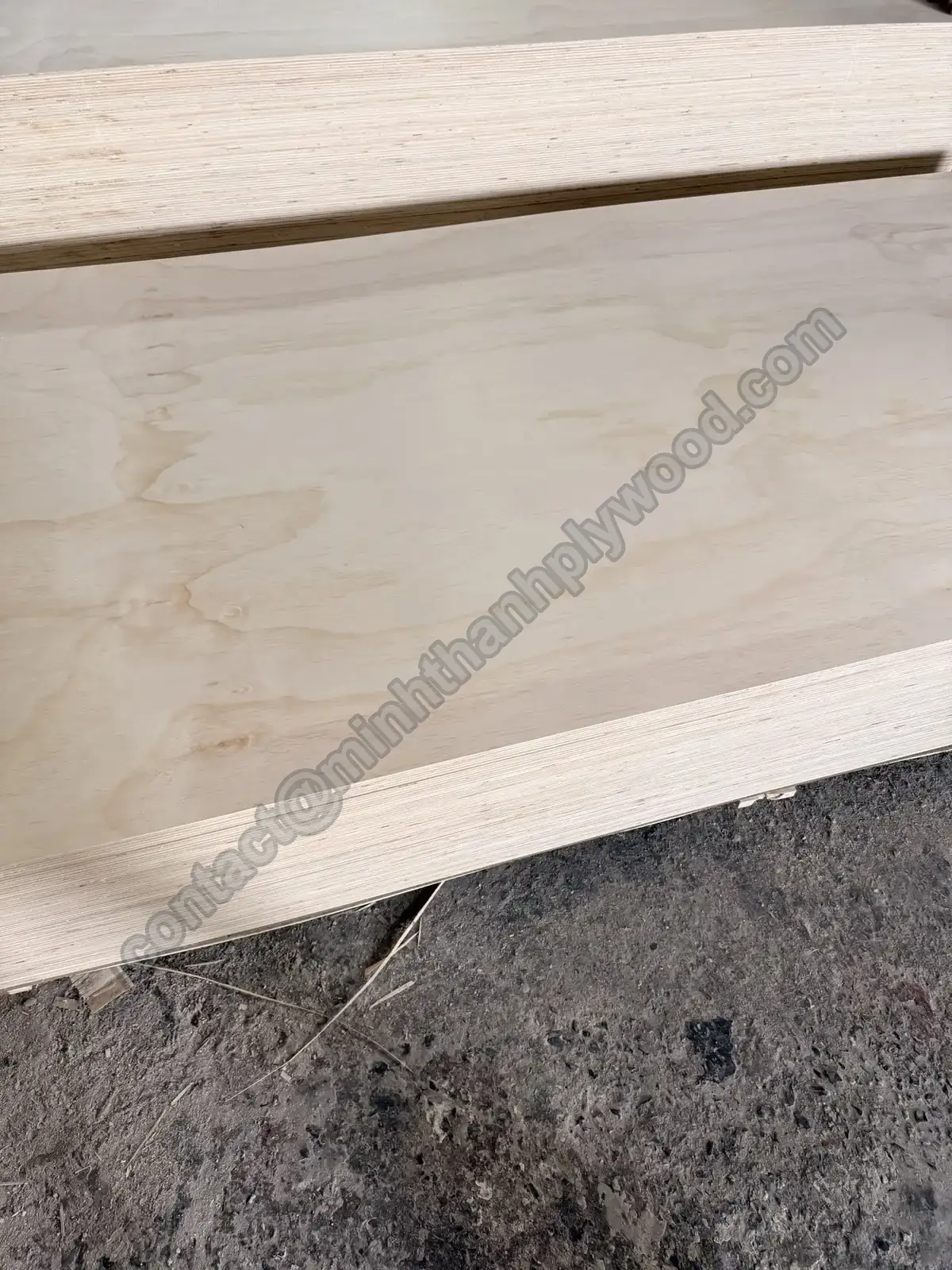
Thickness, layer arrangement and sheet size determine different parts of the component and cutting brief. Choose thickness from the part drawing and support or hardware requirements, then check its ply construction and finished dimensions. A greater layer count alone does not create a higher appearance or structural grade.
Minh Thanh supplies 3–40 mm panels. Thin furniture plywood at 3–5 mm always has five plies. At 3 mm that means a centre veneer, two cross-band veneers and two faces. At 4 and 5 mm the construction uses three core veneers and two faces, with veneer thickness adjusted to the finished sheet.
Standard formats are 1220 × 2440 mm and 1250 × 2500 mm. Custom formats include 1220 × 2500 mm and 1220 × 2280 mm. State the finished dimensions in millimetres. Familiar nominal inch names should accompany, rather than replace, the dimensions used for manufacture and inspection.
A 1220 × 2440 mm sheet has 2.9768 m² of gross area; a 1250 × 2500 mm sheet has 3.125 m². The larger format gives about 4.98% more nominal area. The part layout decides whether that extra strip becomes useful product or an offcut. Include grain direction, saw kerf and trimming in the drawing.
Use the plywood thickness guide for component selection and the sheet-size guide for format comparisons. Keep the finished thickness tolerance on the order so nominal thickness and actual fit remain connected.
Plywood types and uses: which panel fits each application?
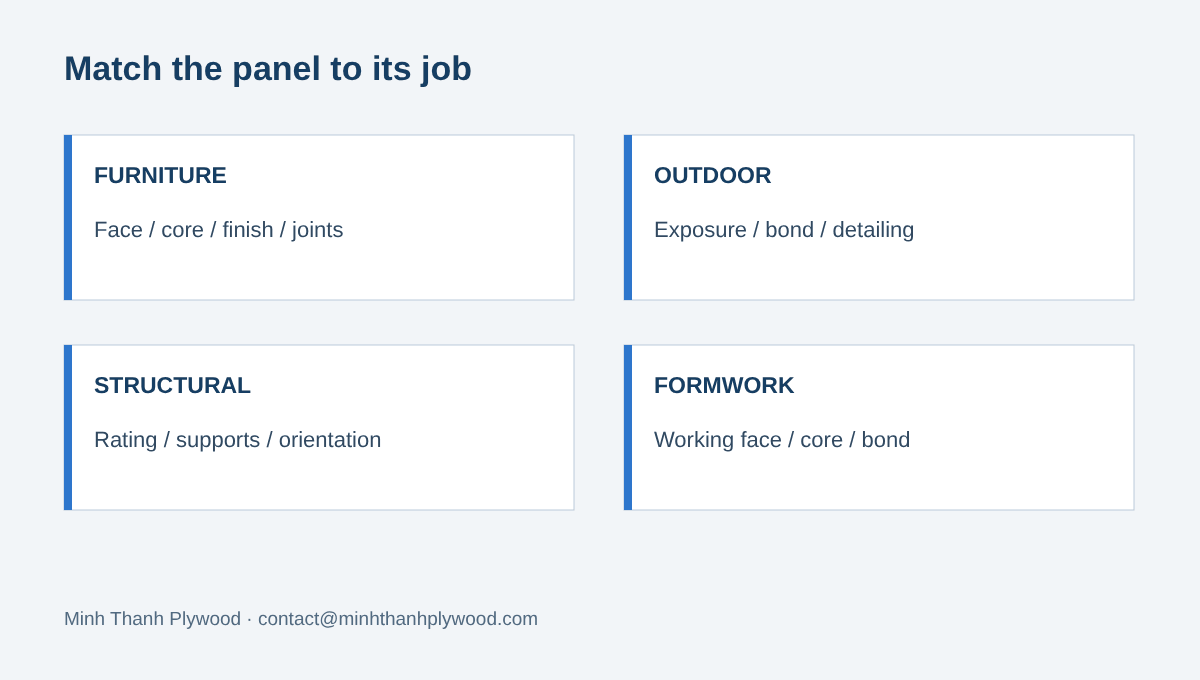
Match the panel to the component, exposure and required evidence. One furniture programme can use several constructions, and a building project can require several product ratings. There is no need to make one plywood label carry every role.
| Application | Panel route to evaluate | Requirement to settle before buying |
|---|---|---|
| Cabinet sides and visible interiors | Sanded furniture veneer-core | Face/back grade, joint fit, emissions and finish |
| Thin backs and drawer bottoms | Five-ply thin furniture panels | Groove fit, support, thickness and selected face |
| Clear-finished fronts | Selected decorative veneer on furniture core | Finished appearance and grain matching |
| Covered utility components | Commercial construction suited to use | Core, tolerance, covering and fasteners |
| Outdoor component | Specified exterior construction | Exposure, bond evidence and surface/edge detailing |
| Roof, wall or subfloor | Rated structural panel | Standard, design rating, orientation and fixing |
| Concrete formwork | Film-faced construction | Working surface, core, bond and handling |
| Platform or transport component | Specified textured working face | Surface test, mounting and load requirements |
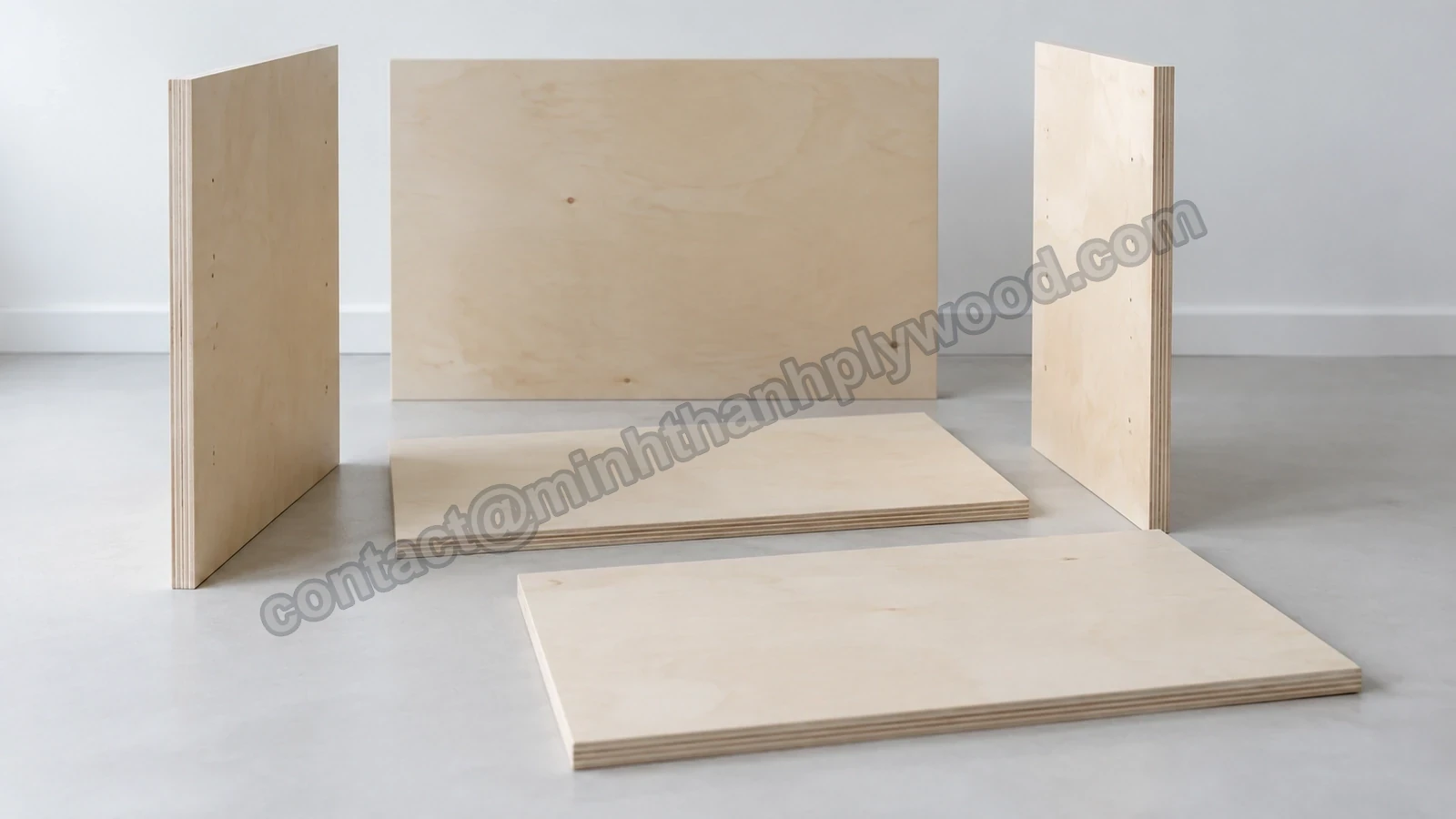
For a cabinet programme, list each component as a separate material line. Record which faces are exposed, the edge finish, hardware and assembly process. A thin back and a supported shelf can share the veneer colour without sharing the same thickness or fastening brief.
Minh Thanh can prepare cut-to-size plywood from the agreed sheets. Send the finished part sizes, quantities and grain direction, including the cutting allowance. Dividing a sheet into four, six or eight pieces is a preparation option; the component dimensions still need to be specified.
For load-bearing or special-service jobs, retain the required performance evidence in the enquiry. Decorative appearance and a factory sample can settle the visual decision, while structural or specialty acceptance follows the product specification for that role.
Which product records should accompany an interior plywood order?
An interior order needs an identified construction, an approved sample and evidence for the destination’s emission and timber-origin requirements. Match the product descriptions across those records. The document set should answer the selected panel’s requirements, rather than collect certificates for unrelated products.
Minh Thanh holds CARB P2 / TSCA Title VI certification, ICTT mill no. 23024, and ISO 9001:2015. Six ASTM D6007 reports from April 2025 to June 2026 on 9, 15 and 18 mm panels give average results of 0.014–0.032 ppm against the 0.05 ppm veneer-core hardwood plywood limit. Three reports are by Shanghai Hongjun and three by ICTT Vietnam. The quality page identifies the evidence.
For US regulated composite-wood products, EPA’s programme covers certification, labelling and records. A finished panel’s producer and lot information connect the product to the shipment. A decorative face name or E0 label alone does not replace the applicable TSCA Title VI requirements.
For EU furniture and wood-based articles, REACH entry 77 applies a 0.062 mg/m³ limit from 6 August 2026 under Appendix 14 conditions, with exemptions including outdoor-only articles. Keep that test requirement separate from ASTM D6007 results. SGS testing to the buyer’s method is arranged on request.
We supply the EUDR compliance dossier with origin records and geolocation files. Trace the face, back and core wood constituents. Vietnam is low risk under Regulation 2025/1093; simplified due diligence depends on the origins of all wood components. Legal and programme sources were consulted 7 October 2026. The traceability page explains the supplied order dossier.
How do you compare cost, weight and usable output?
Compare complete constructions on the same delivery basis, then calculate the usable components from each. The starting price, sheet area and density are useful inputs, but none alone tells the buyer the cost of an accepted finished part.
Minh Thanh’s October 2026 starting prices are commercial plywood from US$250/m³ and furniture/interior plywood from US$350/m³. Compare face/back, core, joining scope, thickness tolerance, bond, emissions and preparation before comparing quotation totals. Keep the selected Incoterm and named port beside the amount so freight scope is visible.
A 1220 × 2440 × 18 mm panel contains 0.0535824 m³. At the 500 kg/m³ Styrax reference, calculated panel mass is about 26.8 kg; Eucalyptus at 650–750 kg/m³ gives about 34.8–40.2 kg. These are calculated board masses. Add actual packaging and apply the booking and route limits when preparing the load.
For the workshop, calculate usable yield from the actual nesting layout and accepted parts. A repaired back can be economical when hidden, while a visible face can require parts to be positioned around natural features. Coating, edge preparation and machining time belong in the comparison where those operations change between materials.
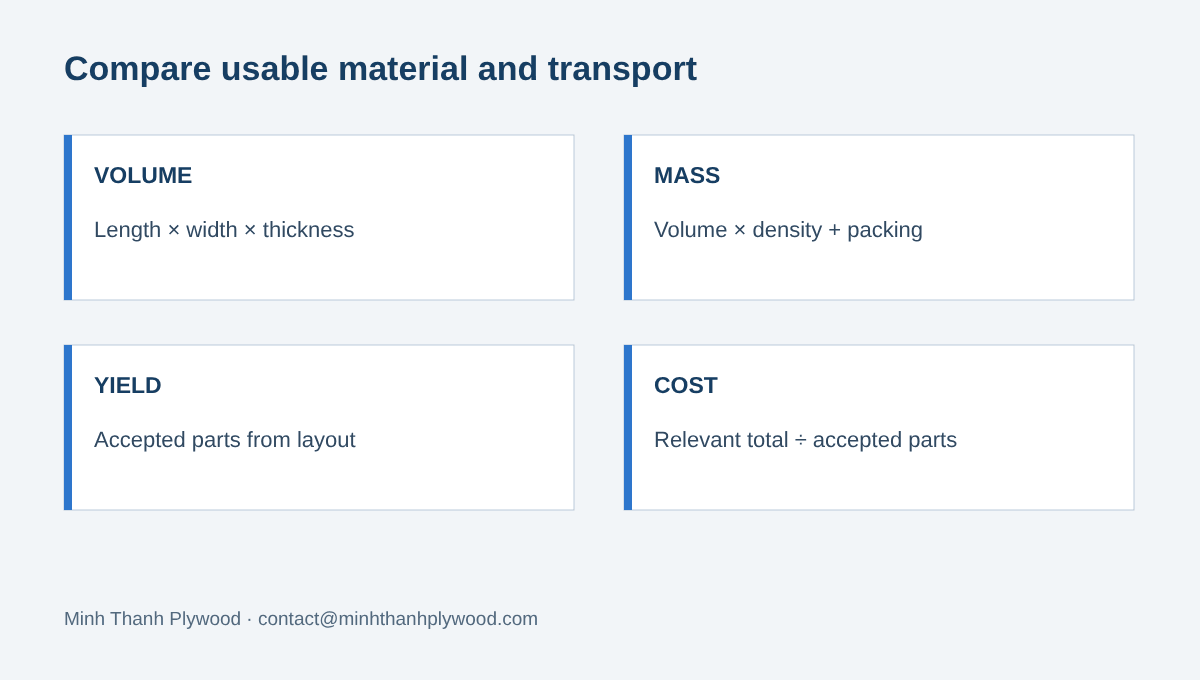
Use cost per accepted part = relevant purchase and processing cost ÷ accepted parts. The buyer supplies its actual quote and trial results; no universal savings percentage is needed. The packing calculator connects the selected plywood construction with quantity and cargo-mass planning.
How do you choose and order the correct plywood type?
Choose the panel by its application, then write the construction and acceptance evidence as an order line. This keeps the classification useful through sampling, quotation, production and receipt. A broad product family helps a shortlist; the finished specification directs the factory.
- Describe the component and its dry, humid or outdoor service.
- Identify visible faces, grain direction, edge treatment and hardware.
- Choose the core structure and species independently from the face.
- State nominal thickness, finished format and acceptance tolerance.
- Name the face/back grade pair and retained appearance sample.
- Specify adhesive/bond performance and emissions separately.
- Trial machining, assembly and the intended finish on the sample.
- List quantities, packing, destination and required product records.
For a furniture enquiry, include the part drawing where a narrow groove, exposed edge or cutting pattern matters. Send one line per face/core/thickness combination. A mixed order needs every construction identifiable in the bundle schedule and packing list.
Minh Thanh’s MOQ is one 40HC container with mixed specifications by agreement. Production takes 15–45 days after deposit. Standard payment is 30% deposit and 70% against the scanned B/L, or irrevocable L/C at sight; FOB Hai Phong, CFR and CIF are available. Samples are free.
Send your application and plywood specification to select the furniture or commercial construction for your programme. Continue with the furniture, thickness, sheet-size and material-comparison guides when a particular component decision needs more detail. The order is ready to compare when the sample, construction sheet and quotation all identify the same panel.
Buyer questions, answered
What are the main types of plywood?
The main application groups are interior, exterior, structural, marine, film-faced and decorative plywood. Specify core construction, face/back grades, bond, emission requirement and dimensions alongside the type.
Are there exactly three types of plywood?
Three-ply, five-ply and multi-ply are layer-count groupings, not a complete classification. Interior/exterior service, core material and decorative faces are separate buying decisions.
Is hardwood plywood always stronger than softwood plywood?
The botanical family alone does not set a panel rating. Compare the actual construction and its tested properties for the intended load and support arrangement.
Does birch plywood always have a birch core?
Birch-faced plywood identifies the outer veneer. Minh Thanh supplies Birch-faced furniture panels on Styrax or Eucalyptus core, specified separately.
What is the difference between plywood and LVL?
Plywood uses cross-laminated veneers. LVL aligns most veneers along the member length for its specified use, so it is a separate engineered wood product.
Is MDF a type of plywood?
MDF is a wood-fibre board, while veneer-core plywood is made from wood veneers. A decorative veneer over MDF is an MDF-core panel and needs that core identified.
Which plywood should I use for painted furniture?
Compare a prepared Poplar face over a selected furniture core with the intended coating process. Approve surface repairs, edge treatment and finished thickness on a sample.
Is marine plywood the same as exterior plywood?
A marine order needs its named marine construction and evidence. An exterior bond alone does not establish marine compliance, and an Okoume face alone does not establish BS 1088.
Is Exposure 1 suitable for permanent outdoor exposure?
APA distinguishes Exposure 1, for construction moisture or limited exposure, from Exterior for long-term weather exposure. Read the actual product classification and service requirement.
What thin plywood construction does Minh Thanh supply?
Minh Thanh supplies 3–5 mm furniture plywood with five plies. At 3 mm it has one centre veneer, two cross-band veneers and two faces; 4–5 mm uses three core veneers and two faces.
Which sheet sizes are available?
Standard formats are 1220 × 2440 mm and 1250 × 2500 mm. Custom sizes include 1220 × 2500 mm and 1220 × 2280 mm, with cut-to-size parts ordered by drawing.
How much does plywood cost?
As of October 2026, Minh Thanh commercial plywood starts from US$250/m³ and furniture/interior plywood from US$350/m³. The quotation identifies the chosen construction, quantity and delivery basis.