
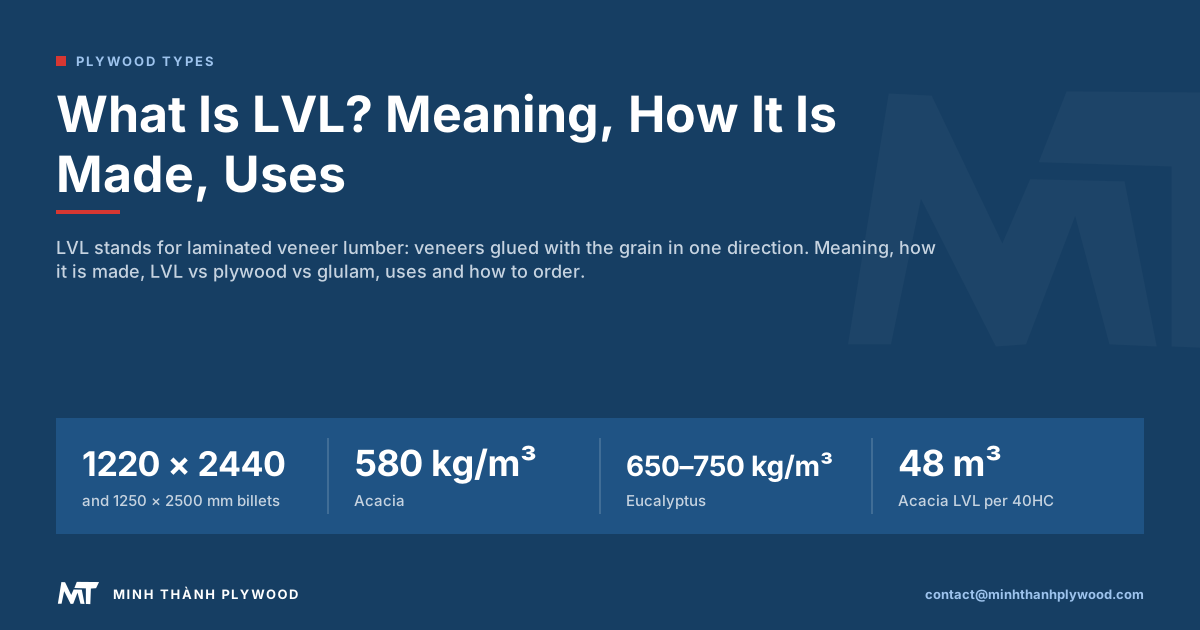
LVL stands for laminated veneer lumber: an engineered wood made from thin wood veneers glued and pressed with their grain running the same way, then sawn into beams, rails and boards. That one grain direction makes LVL stiff and predictable along its length, where plywood is built to work in two directions. Minh Thanh Plywood makes LVL in Vietnam from Acacia and Eucalyptus plantation veneers.
What is LVL? The one-sentence answer
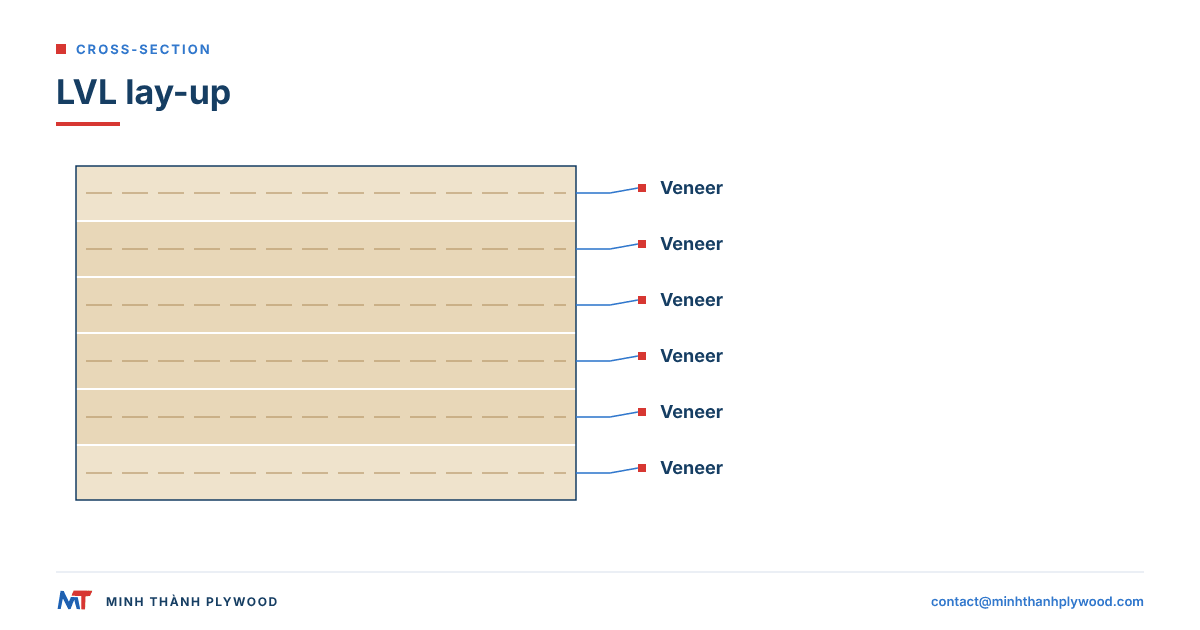
LVL (laminated veneer lumber) is engineered wood made by bonding thin wood veneers under heat and pressure with the grain of every veneer running along the length of the piece. The result behaves like a very even, very straight piece of timber, without the knots, splits and twists that make sawn lumber vary from board to board.
LVL is pressed as a large billet, then sawn into members: a beam for a floor, a header over a window, a rail for a sofa frame or a runner under a crate. Because the veneers are thin and the defects of one sheet are spread among many, two pieces of LVL of the same grade behave almost alike. Engineers and furniture plants buy it for exactly that consistency.
Minh Thanh Plywood makes LVL in Ha Hoa, Phu Tho, from locally grown Acacia and Eucalyptus plantation veneers, for furniture frames, door components and industrial packaging. Our laminated veneer lumber page lists the builds and formats.
What does LVL stand for? Meaning and abbreviation
LVL stands for laminated veneer lumber. Each word describes the product:
- Laminated: built up from layers glued together.
- Veneer: the layers are thin sheets peeled from logs, the same raw material as plywood.
- Lumber: the product is used like timber, as a linear member, not as a sheet.
In the timber trade “LVL” always means laminated veneer lumber. Other industries use the same three letters for other things: LVL Lashes is a lash-lift treatment brand (the letters stand for length, volume, lift), and “lvl” on Instagram or in games is short for “level”. This article is about the wood product.
Two related abbreviations appear on quotations. SCL (structural composite lumber) is the family LVL belongs to, with parallel strand lumber (PSL) and laminated strand lumber (LSL). LVB (laminated veneer board) is a veneer product with some cross-bands added for stability across the width.
How is LVL different from plywood?
LVL and plywood start from the same veneers and differ in one decision: the grain direction of each layer. Plywood turns every other veneer 90 degrees, so a sheet resists bending and splitting in both directions and stays dimensionally stable across its width. LVL keeps nearly every veneer parallel, so all the wood fibres work along the length of the member.
That changes how the two are used. Plywood is a sheet for floors, walls, cabinets and furniture panels. LVL is a member for spans and frames: a stick of LVL bends less than a strip of plywood of the same size because none of its layers are running the wrong way. Ripped plywood makes a poor beam; LVL makes a poor tabletop, because it can split along the grain.
Plywood from a furniture mill such as Minh Thanh is pressed twice as standard, a calibrated core first and then the faces, to stay flat across the whole sheet. LVL needs the opposite emphasis: straightness along the length. The full comparison, with uses by part, is in LVL vs plywood.
LVL vs plywood vs glulam vs solid timber
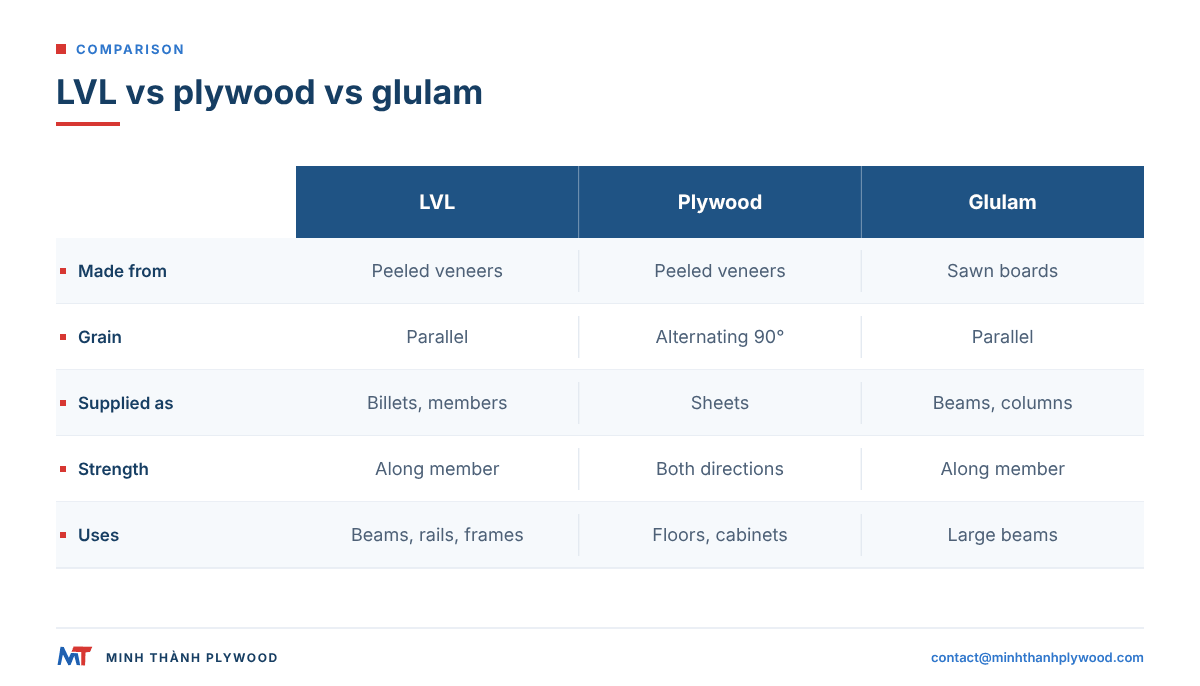
LVL, plywood, glulam and sawn timber are the four wood products buyers compare most for frames and spans. One row per property:
| Property | LVL | Plywood | Glulam | Sawn timber |
|---|---|---|---|---|
| Raw material | Peeled veneers | Peeled veneers | Sawn boards (lamellae) | One log section |
| Grain direction | Parallel along the length | Alternating 90° by layer | Parallel along the length | Along the log |
| Supplied as | Billets sawn into members | Sheets | Beams and columns | Boards and beams |
| Strength works | Along the member | In both sheet directions | Along the member | Along the grain, with defects |
| Consistency | Very even, defects spread out | Even across the sheet | Even, board pattern visible | Varies board to board |
| Typical uses | Beams, headers, rails, frames, runners | Floors, walls, cabinets, furniture | Large exposed beams, columns | General framing, joinery |
| Main standards | ASTM D5456 (US), AS/NZS 4357 (AU/NZ), EN 14374 (EU) | EN 636, PS 1, AS/NZS 2269 | EN 14080, ANSI A190.1 | National grading rules |
Glulam is closest to LVL in use. It is made from sawn boards glued face to face, so it comes in deeper and longer sections and shows a striped board pattern on the side. LVL is made from veneers a few millimetres thick, so it is denser and more uniform in a smaller section. Solid timber costs least per cubic metre but carries knots and grain deviations that limit how far it can be trusted.
How is LVL made?
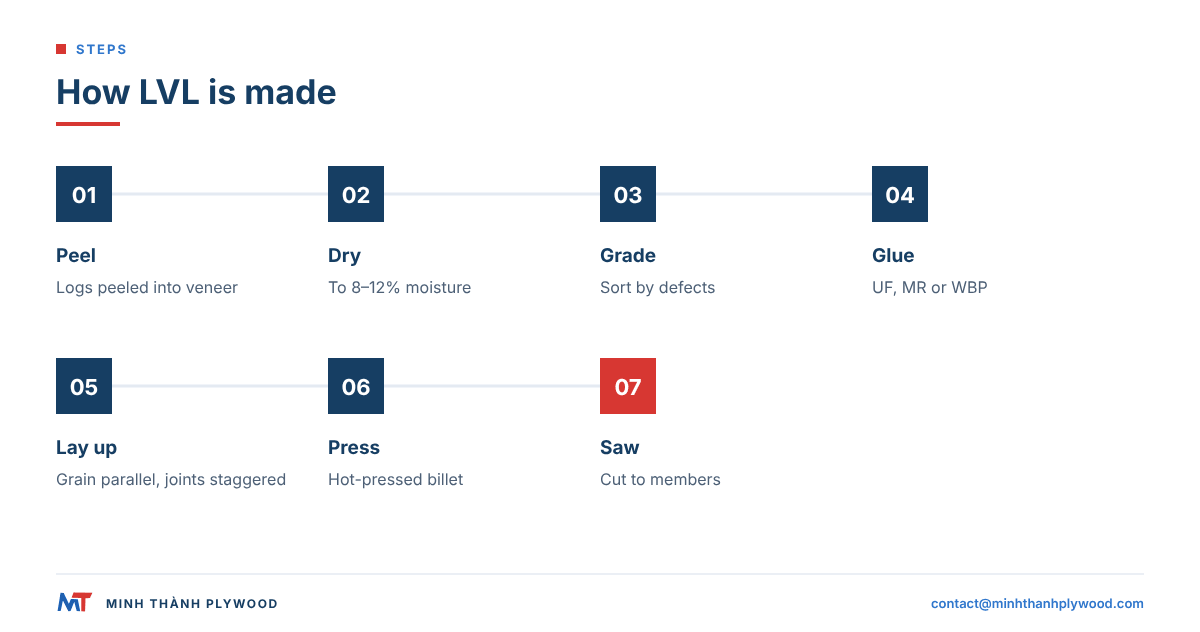
LVL is made in seven steps, the first three shared with plywood:
- Peel. Logs are soaked or steamed, then rotary-peeled on a lathe into a continuous sheet of veneer.
- Dry. The veneer is dried; at Minh Thanh veneers and finished products leave at 8–12% moisture content.
- Grade. Veneers are sorted by defects and, on structural lines, by stiffness measured with ultrasound.
- Glue. Adhesive is spread on each veneer: phenolic for structural and exterior LVL, UF or melamine-fortified for interior LVL.
- Lay up. Veneers are stacked with the grain parallel and the end joints staggered from layer to layer, so no two joints line up.
- Press. The stack is hot-pressed into a billet. Structural lines in Europe and North America use continuous presses that make billets of almost any length; batch presses make fixed-length billets.
- Saw and finish. The billet is sanded or planed, then ripped and cross-cut into members, and marked with its grade.
Minh Thanh’s LVL billets come out of the press at 1220 × 2440 mm or 1250 × 2500 mm and are cut to the member list on the buyer’s drawing. The step-by-step version, with the equipment for each stage, is in how LVL is made.
What is LVL used for?
LVL is used wherever a long, straight, predictable member is worth more than the cheapest piece of timber. The uses fall into two groups.
In buildings (structural LVL):
- Beams and girders that carry floors and roofs
- Headers and lintels over doors, windows and garage openings
- Rim boards and blocking around floor systems
- Flanges of wood I-joists, with an OSB or plywood web
- Studs for tall walls, where straightness matters
In furniture, doors and packaging (industrial LVL):
- Sofa, bed and chair frames, and bed slats
- Door stiles, rails and frames, and the edges of flush doors
- Table and cabinet rails, drawer runners
- Runners, skids and frames for crates and pallets
- Shelving members and stair components
Minh Thanh supplies LVL for the second group: furniture-frame components, door components and industrial packaging members. Sizing a structural beam is an engineer’s job with the design values of an evaluated product; the LVL beams guide explains the sizes and uses in building.
Is LVL stronger than plywood and solid wood?
LVL is stronger than plywood as a beam and more reliable than sawn timber of the same section. All of its veneers carry load along the member, so in bending along its length it outperforms a strip of plywood, where half the layers run across. Against sawn lumber it wins on consistency: a knot or split in one veneer is backed up by sound wood in the neighbouring layers.
Plywood wins where load comes from both directions, as in a floor sheet or a cabinet side. Solid timber still wins on price per cubic metre and appearance in exposed joinery.
Strength figures belong to a named product and grade, not to “LVL” in general. Structural LVL is tested and given design values under standards such as ASTM D5456 in the US, AS/NZS 4357 in Australia and New Zealand, and EN 14374 in Europe. Bending stiffness, bending strength and shear values for common grades are compared in LVL strength.
Which brand names of LVL will you see?
Much structural LVL is sold under brand names, which is why buyers search for them. Microllam is the LVL made by Weyerhaeuser in North America, Versa-Lam is Boise Cascade’s LVL, and Kerto is the spruce LVL made by Metsä Wood in Finland. Each is a proprietary product with its own design values and span tables.
These brands answer the structural market in their region. They are not interchangeable by name: a beam sized for one brand’s values cannot be swapped for another brand’s beam without checking the numbers. For industrial uses, buyers order by species, glue, section and tolerance instead of by brand, and that is how Vietnamese LVL is bought.
Which wood species is LVL made from?
LVL can be made from any species that peels into good veneer. The species decides weight, colour, screw holding and cost:
| LVL source | Typical species | What it suits |
|---|---|---|
| Northern Europe | Spruce, pine | Structural beams, roof and floor members |
| North America | Douglas fir, southern pine, yellow poplar | Structural beams, headers, I-joist flanges |
| Australia and New Zealand | Radiata pine | Structural framing, formwork beams |
| Vietnam (Minh Thanh) | Acacia, Eucalyptus | Furniture frames, door components, packaging members |
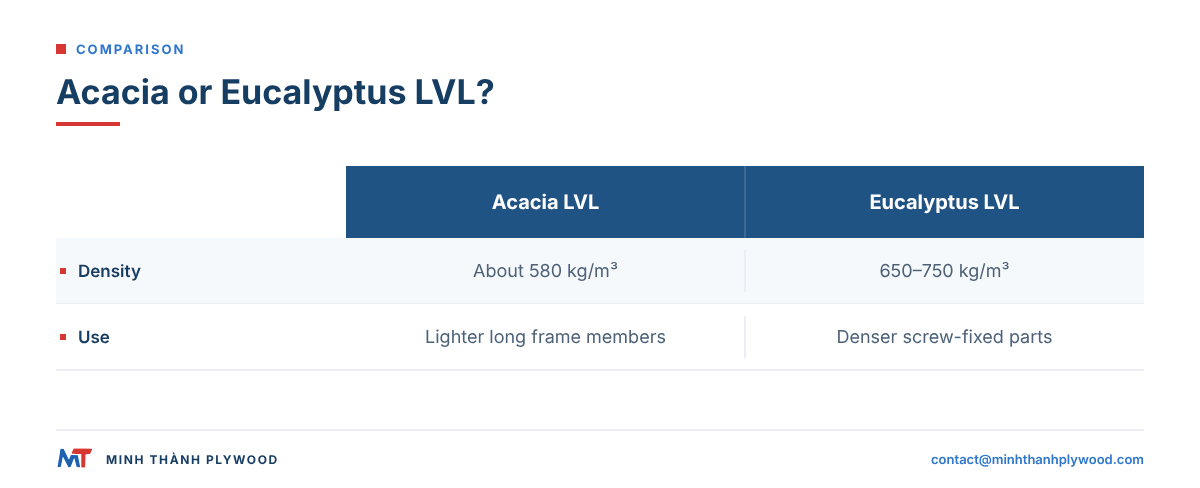
Minh Thanh’s Acacia LVL is about 580 kg/m³; Eucalyptus LVL is 650–750 kg/m³. Both are locally grown plantation timbers from around Ha Hoa, which keeps veneer supply short and traceable. Eucalyptus is the denser choice where screws and fittings must hold; Acacia is lighter for long frame members. Pine and hardwood LVL are compared in pine LVL vs hardwood LVL.
What glue is used in LVL, and does it matter?
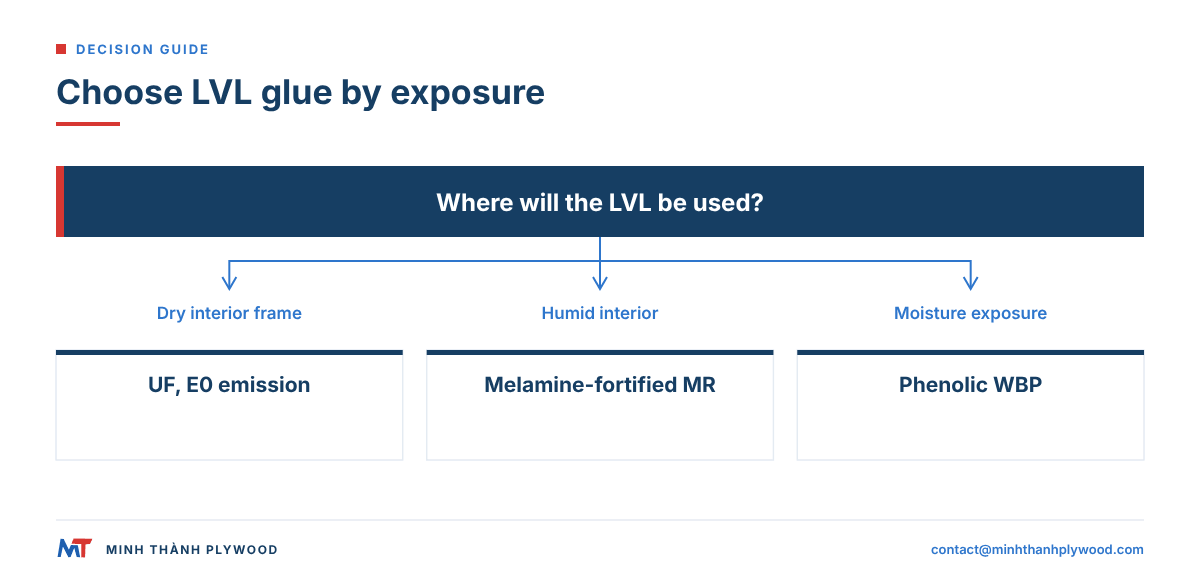
The glue decides where LVL can go, so it is the first line of the specification after the species. Three bonds are in use:
- Phenolic (WBP): dark glue lines, boil-resistant, standard for structural LVL and for parts exposed to moisture.
- Melamine-fortified (MR): light glue lines, resists humidity, for kitchens, bathrooms and humid interiors.
- UF (urea-formaldehyde): light glue lines, for dry interiors such as furniture frames.
Glue type and emission class are two separate lines on an order. Our interior LVL uses UF glue at E0 emission, with E1 available; MR (melamine-fortified) and phenolic WBP bonds are made to the customer’s specification. Formaldehyde limits and how they are tested are explained on our E0 and E1 emission page.
Can LVL be used outside?
LVL can be used outside only when it has a water-resistant bond and the wood is protected. A phenolic WBP glue line survives wetting, but the wood itself still swells and, if it stays wet, decays. Exposed LVL needs a preservative treatment or a coating, sealed cut ends and a detail that lets water drain away.
Most structural LVL is made for covered use: inside walls, floors and roofs, where it stays dry once the building is closed. During construction it must be stored off the ground and under cover. For packaging runners that travel in containers, a WBP bond is the safe choice because condensation is common at sea. The exposure classes and treatments are covered in can LVL be used outside.
What sizes and sections does LVL come in?
LVL is sold in two ways: as billets, the large pressed panels, or as members already cut to section. Structural LVL is usually stocked as members of standard depth and width; industrial LVL is usually cut to the buyer’s drawing.
Minh Thanh presses LVL billets in two formats, 1220 × 2440 mm and 1250 × 2500 mm, and cuts members to the section and length on the drawing. For a quotation, send:
- finished member thickness, width and length;
- grain direction relative to the length;
- visible faces and machining allowance;
- quantity per section, or the full cutting list.
Our sawing follows that cutting list, so a sofa plant receives rails ready for its own machining instead of panels to rip. Standard depths and span ranges of structural LVL beams are in the LVL beam span chart.
Where do LVL standards and certifications apply?
Standards matter for structural LVL, which carries load in a building; industrial LVL for furniture and packaging is bought to the buyer’s own specification. The structural standards by market:
| Market | Standard for structural LVL | Note |
|---|---|---|
| United States | ASTM D5456, product evaluation reports | Structural composite lumber family; see APA on SCL |
| Australia and New Zealand | AS/NZS 4357 | Structural LVL, sits beside AS/NZS 2269 for plywood |
| Europe | EN 14374 | Structural LVL, CE marked under the construction products rules |
| Japan | JAS for laminated veneer lumber | Japanese Agricultural Standards, MAFF |
Links consulted 20 October 2026. For EU orders, Minh Thanh supplies the EUDR compliance dossier required under Regulation (EU) 2023/1115, with origin records and geolocation files, for the Acacia or Eucalyptus timber in the LVL. Moisture content at dispatch is 8–12%.
How much does LVL cost?
LVL is priced per cubic metre, and the price follows the species, the glue, the section and the amount of cutting. A phenolic structural billet costs more than a UF billet for interior frames; members cut to many small sections cost more than full billets because of sawing time and offcuts. Freight is part of the comparison: Acacia LVL at about 580 kg/m³ fills a container by weight sooner than plywood on a light core.
For a 40HC with the 28,000 kg planning payload, that is about 48 m³ of Acacia LVL before packing (28,000 ÷ 580), or about 37–43 m³ of Eucalyptus LVL at 650–750 kg/m³. The current price drivers and how to compare quotations are in LVL price.
Who makes LVL in Vietnam?
LVL in Vietnam is made by plywood factories that peel plantation Acacia and Eucalyptus and press the veneers with parallel grain for furniture, door and packaging buyers. Minh Thanh Plywood is one of them: a manufacturer in Ha Hoa, Phu Tho, with 50,000+ m³ of capacity a year.
What a buyer gets from a Vietnamese LVL mill:
- Plantation timber at the door: Acacia and Eucalyptus grown locally, with EUDR origin records and geolocation files for EU orders.
- Cutting to the drawing: billets of 1220 × 2440 or 1250 × 2500 mm, sawn to your member list.
- The bond you need: UF at E0 for interiors, E1 as an option, MR or phenolic WBP to order.
- Trade terms of a plywood mill: one 40HC minimum, production in 15–45 days after the 30% deposit, FOB Hai Phong, CFR or CIF, free samples.
LVL and plywood can share one container: mixed specifications are loaded by agreement.
How do you order LVL?
An LVL order is complete when it names the member, not just the material. Write these lines:
- Use: furniture frame, door component, packaging runner, or other.
- Species: Acacia or Eucalyptus.
- Glue and emission: UF at E0, E1, MR (melamine-fortified) or phenolic WBP, on separate lines.
- Section and length: thickness × width × length in mm, with grain along the length.
- Faces and tolerance: visible faces, sanding, machining allowance.
- Packing and quantity: pieces per section, bundle marks, destination port.
Send it to contact@minhthanhplywood.com or on WhatsApp +84 988 586 601 (Lisa); replies come within hours, and free samples go out with the quotation. Our laminated veneer lumber page shows the builds, and the packing calculator helps plan a mixed container.
Buyer questions, answered
What does LVL stand for?
LVL stands for laminated veneer lumber. It is engineered wood made by gluing thin veneers together with the grain running along the length of the piece.
What is LVL used for?
In building, LVL is used for beams, headers, lintels, rim boards and I-joist flanges. In industry it is used for furniture frames, door stiles and rails, bed slats and packaging runners.
Is LVL stronger than plywood?
Along its length, yes: every veneer carries load in the same direction, so an LVL member is stiffer and stronger as a beam. Plywood is stronger as a sheet, because its cross-bands spread strength over both directions.
Is LVL the same as plywood?
No. Both are made from veneers, but plywood turns every other layer 90 degrees and LVL keeps the grain parallel. Plywood is a panel; LVL is a lumber product sold as members or billets.
What is the difference between LVL and glulam?
LVL is made from thin peeled veneers; glulam is made from sawn boards glued face to face. LVL is denser and more uniform per section, glulam comes in larger sections and shows a board pattern.
Can LVL be used outdoors?
Only with a water-resistant bond, such as phenolic WBP glue, and protection of the surfaces and cut ends. Most LVL is designed for covered, dry use and should be kept under cover before installation.
What wood is LVL made from?
Structural LVL in Europe and North America is mostly spruce, pine or Douglas fir. Vietnamese LVL is made from fast-growing plantation hardwoods; Minh Thanh uses Acacia or Eucalyptus veneers.
What sizes does LVL come in?
LVL is pressed as large billets and sawn to the section the job needs. Minh Thanh presses LVL billets of 1220 × 2440 mm and 1250 × 2500 mm and cuts members to the buyer's drawing.
How heavy is LVL?
It depends on the species. Minh Thanh's Acacia LVL is about 580 kg/m³ and its Eucalyptus LVL 650–750 kg/m³, measured at 8–12% moisture content.
Is LVL waterproof?
No wood product is waterproof. LVL with a phenolic WBP bond resists moisture at the glue lines, but the wood itself swells and decays if it stays wet.
Can you buy LVL from Vietnam in full containers?
Yes. Minh Thanh Plywood supplies LVL from Vietnam with a minimum of one 40HC container, production in 15–45 days after deposit and shipment FOB Hai Phong, CFR or CIF.