
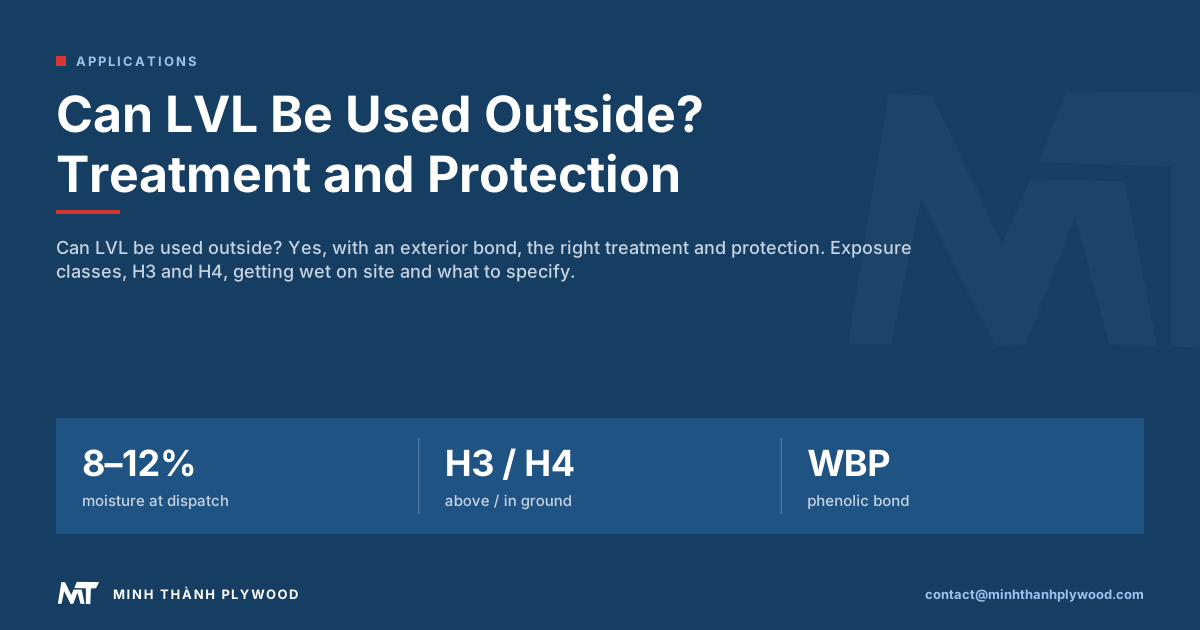
Yes, LVL can be used outside when three things are right: an exterior phenolic bond, preservative treatment for the exposure class, and detailing that sheds water. Untreated LVL left in the weather will swell, check and decay even though its glue lines hold. Minh Thanh Plywood makes LVL with a phenolic WBP option for weather-exposed components.
Can LVL be used outside? The short answer
Yes. LVL can be used outside when it has an exterior bond, preservative treatment for its exposure class and detailing that keeps water from sitting on it. Without treatment and protection, LVL in the weather behaves like any untreated timber: it swells, checks, greys and decays.
Laminated veneer lumber (LVL) is made of thin veneers glued with their grain running along the member. Two parts decide how it copes with water:
- The glue line. Structural and exterior LVL uses a phenolic (phenol-formaldehyde, PF) or melamine-urea-formaldehyde (MUF) bond that does not soften when wet.
- The wood. The veneers are still wood. They absorb water through faces, edges and especially cut ends.
So an outdoor LVL member needs a water-resistant bond for the glue and treatment plus protection for the wood. If either is missing, the member fails early.
Can LVL get wet?
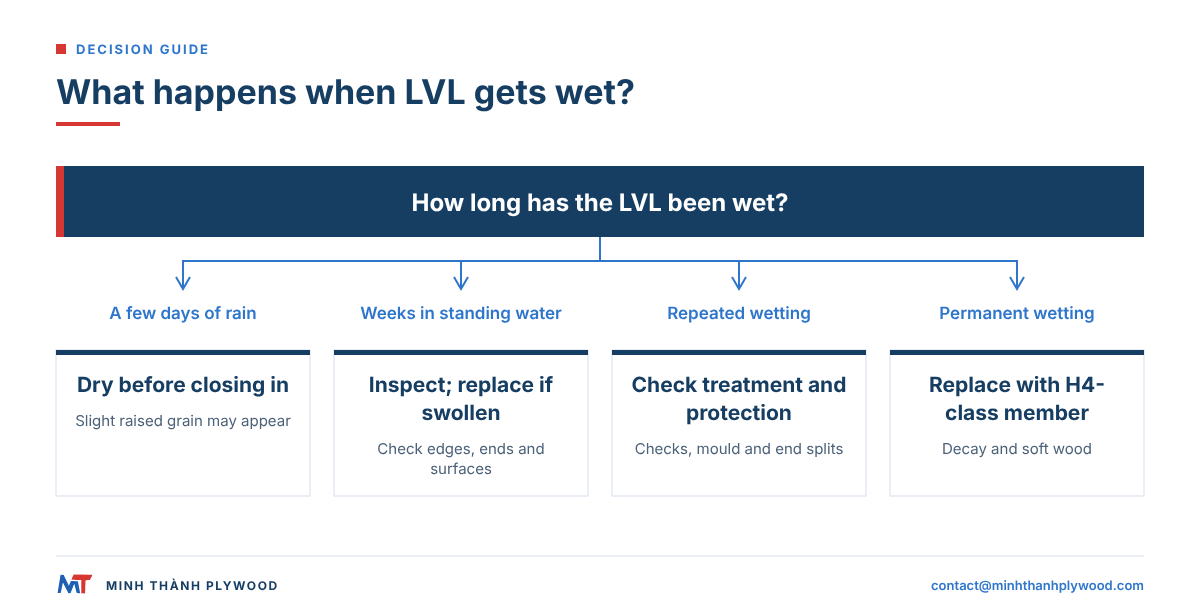
Yes, LVL can get wet for a short time and dry out again without losing its bond. Rain on a frame before the roof goes on is normal. Damage comes when LVL stays wet for weeks or is wetted again and again.
What happens as LVL takes up water:
| Exposure | What you see | Can it be used? |
|---|---|---|
| A few days of rain on site | Damp surface, slight raised grain | Yes, once dried before closing in |
| Weeks of standing in water | Swelling at edges and ends, surface checks | Inspect; replace swollen members |
| Repeated wetting in service | Checks, mould, end splits | Treatment and protection were missing |
| Permanent wetting or ground contact | Soft wood, decay | No; replace with an H4-class member |
Furniture and interior LVL leaves the factory dry. Ours is dried to 8–12% moisture content, the range for indoor use. A member that has been rained on should be dried back close to that range before it is closed in behind linings.
Is LVL timber waterproof?
No. LVL is water-resistant in its glue lines, not waterproof as a material. The phenolic bond holds when wet, but the wood between the glue lines takes up water like any timber.
The same is true of LVL beams. “Waterproof” on a building site usually means “will not delaminate when wet”, which is a claim about the bond. It says nothing about swelling, checking or decay of the wood. Ask a supplier which one they mean.
Glue type and exposure class: what bond does outdoor LVL need?
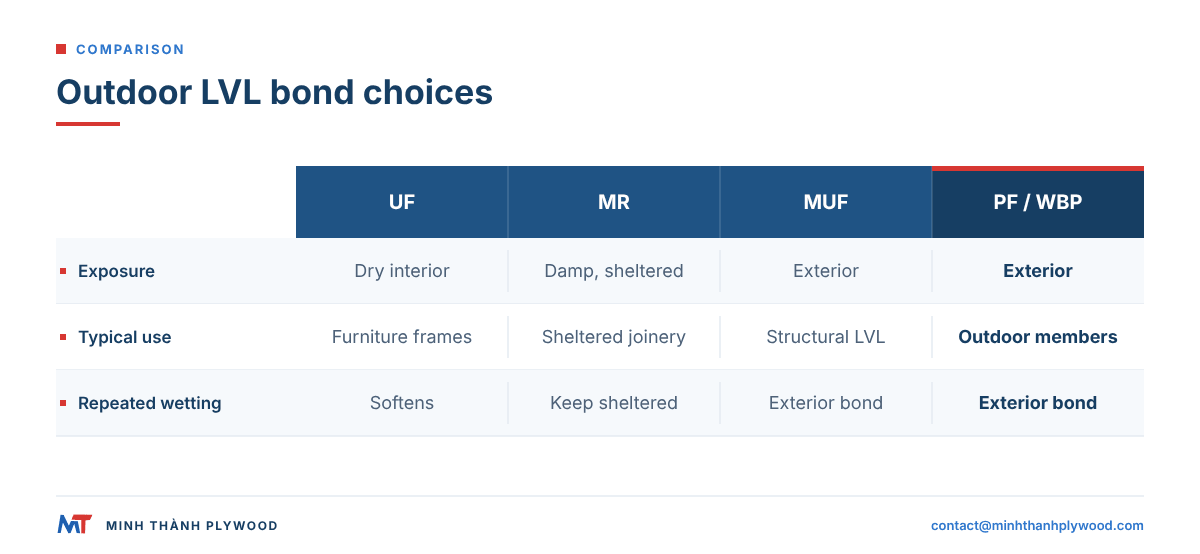
Outdoor LVL needs a phenolic (PF) or MUF bond. Urea-formaldehyde (UF) glue is for dry interiors only and softens under repeated wetting.
| Glue | Exposure it suits | Typical LVL use |
|---|---|---|
| UF glue at E0 emission | Dry interior | Furniture frames, door cores, interior joinery |
| MR / melamine-fortified | Damp interior, protected from weather | Joinery in humid rooms, sheltered packaging |
| MUF | Exterior, structural | Structural LVL in some markets |
| Phenolic (PF, WBP) | Weather-exposed, exterior | Structural framing LVL, outdoor members |
European rules describe the same ladder. EN 14279 sorts LVL by use in dry, humid and exterior conditions, which match the service classes of Eurocode 5. Choose the bond for the harshest condition the member will see, not the average.
Glue and emission are separate specifications. A phenolic bond is an exterior bond; E0 or CARB Phase 2 is an emission class. Write both on the order.
H2, H3, H4: which treatment for outdoor LVL?
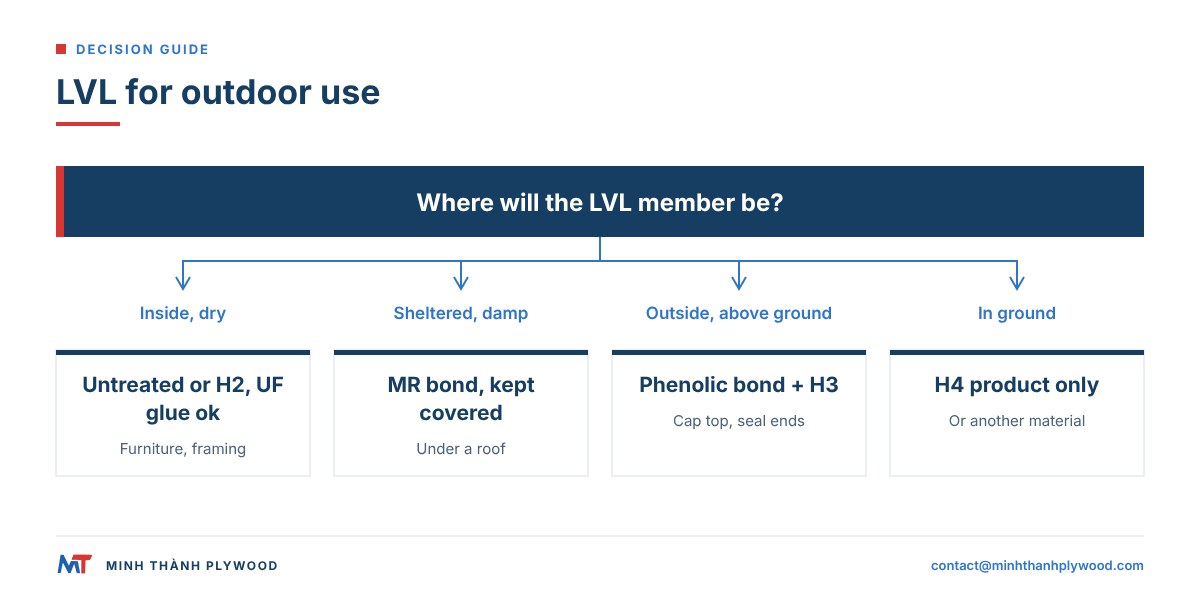
In the UK and Europe, outdoor LVL above ground is specified to Use Class 3 of EN 335 and treated to BS 8417; LVL in ground contact needs Use Class 4. Use Class 3.1 is above ground, coated, with only short wetting; Use Class 3.2 is above ground and uncoated or prolonged wetting, which suits deck bearers and exposed ends. In Australia and New Zealand the same jobs are H3 and H4 under AS 1604. Indoor framing in termite areas uses H2 or H2S.
| UK and European use class (EN 335, BS 8417) | Where | LVL example |
|---|---|---|
| UC1 | Inside, dry | Furniture and joinery |
| UC2 | Inside or covered, occasional wetting | Roof framing under cover |
| UC3.1 | Outside, above ground, coated, limited wetting | Pergola beams with a capped top and a paint finish |
| UC3.2 | Outside, above ground, uncoated or prolonged wetting | Deck bearers, exposed rafter ends |
| UC4 | Outside, in ground or fresh water | Posts set in soil |
| Hazard class (AS 1604) | European use class (EN 335) | Where | LVL example |
|---|---|---|---|
| H1 | UC1 | Inside, dry, borers only | Furniture and joinery |
| H2 | UC1–UC2 | Inside, above ground, termites | Wall framing |
| H2S | UC1–UC2 | Inside, south of the Tropic of Capricorn | Glueline-treated framing |
| H3 | UC3 | Outside, above ground | Pergola beams, deck bearers above ground |
| H4 | UC4 | Outside, in ground | Posts set in soil |
| H5 | UC4 | In ground, heavy wetting | Retaining walls, foundations |
Australian classes follow AS 1604 for preservative-treated wood; European use classes follow EN 335. The US Forest Products Laboratory Wood Handbook (2021) explains why wood decays only when it stays wet, which is the logic behind every class. In North America the American Wood Protection Association use categories UC1 to UC4 work the same way.
How LVL is treated
LVL can be treated in two ways. Glueline treatment adds insecticide to the glue as the billet is pressed; it protects against termites and borers for H2 and H2S framing. Pressure or envelope treatment after pressing pushes preservative into the finished member for H3 and above. Glueline treatment alone does not make LVL fit for outdoor exposure.
What proof backs outdoor LVL?
Outdoor LVL is backed by three kinds of proof: a third-party evaluation of the treatment, a bond test for the glue, and a structural declaration for the grade. A treated-LVL product sold in North America carries an evaluation report, for example ICC-ES ESR-3834 for a treated Douglas-fir LVL, and its maker offers a 25-year warranty (PWT Treated LVL, checked October 2026). That is the level of proof an outdoor buyer should expect from any supplier, and it should be asked for by name.
From Minh Thanh, the proof you can ask for on an outdoor order is the glue and the test: a phenolic (WBP) bond to EN 314-2 Class 3, the exterior bond class, with third-party bond testing arranged through SGS on request and a free sample you can boil-test yourself. A structural declaration of performance under EN 14374 and a preservative treatment certificate are separate documents. Name them in the enquiry, so the order states which of them the project needs and who supplies them.
How do you waterproof LVL beams outside?
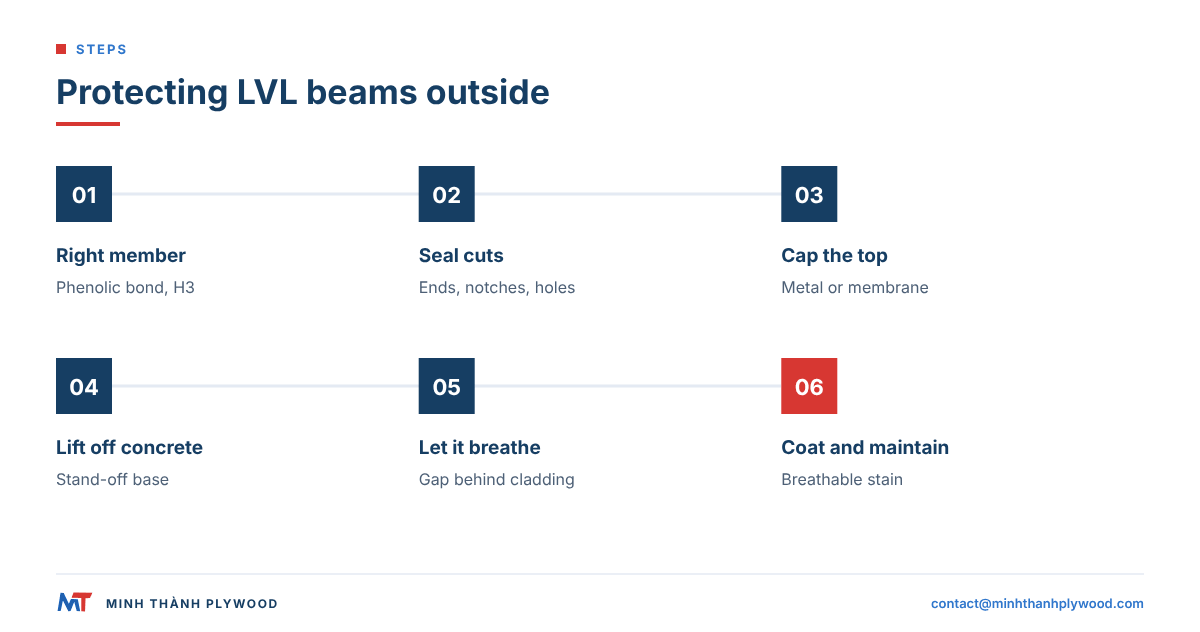
Waterproofing LVL beams outside is a system: treated LVL for the exposure class, sealed ends, a protected top edge, air flow and a stand-off from concrete. Each step closes one path for water.
- Specify the right member: exterior phenolic bond and H3 or Use Class 3 treatment for above-ground use.
- Seal every cut: brush preservative and an end sealer onto cut ends, notches and bored holes on site. Cutting opens untreated wood.
- Cap the top edge: a metal or membrane cap stops water from sitting along the beam. Where the cap is self-adhesive flashing tape, specify one that has passed AAMA 711-13 Level 3 with a stated UV exposure rating, so the tape does not fail before the beam does.
- Lift it off concrete: use a post base or bearing plate with a stand-off, so the end grain never sits in water.
- Let it breathe: leave a gap behind cladding and avoid sealing the member in plastic.
- Coat it: a breathable exterior paint or stain slows wetting and UV greying.
- Maintain it: recoat and check the caps and fixings every few years.
A roof overhang does more than any coating. LVL that never sees direct rain lasts as long as interior framing.
Coatings and finishes for outdoor LVL
A breathable exterior coating slows wetting and UV greying of outdoor LVL, but it does not replace treatment. Choose a finish that lets moisture out, and keep it maintained.
| Finish | What it does | Maintenance |
|---|---|---|
| Penetrating oil or stain | Slows water uptake, keeps the wood look | Recoat every one to three years |
| Film-forming exterior paint | Blocks UV and most water | Repaint when it cracks or peels |
| End sealer | Closes the end grain at cuts | Apply on every site cut |
| Metal or membrane cap | Keeps water off the top edge | Check fixings and laps |
| No finish | Greys and checks on the surface | Only on treated, sheltered members |
Paint the member on all faces before fixing where possible, so the back and the ends are covered too. A coating on one face only lets water in behind it.
Storing LVL on site: wrapping and protection
LVL should stay wrapped, off the ground and under cover until it is installed. Most site damage happens in storage, before the member is ever fixed.
- Keep the wrap on: open the factory wrap only to take out what will be installed that day.
- Store off the ground: rest bundles on level bearers, close enough together that the members cannot sag.
- Cover from the top: a tarp over the bundle sheds rain but should leave the sides open so condensation can escape.
- Do not store on end: water runs into the end grain of upright members.
- Close in quickly: get the roof and wall wrap on, then let the frame dry before linings go up.
The same rules apply in a warehouse after import. Keep bundles flat, dry and away from open doors.
LVL for outdoor use: where it works and where it does not
Treated, protected LVL works well outdoors above ground. It is a poor choice for permanent wetting or ground contact unless the product is made and treated for it.
| Use | LVL suitable? | What it needs |
|---|---|---|
| Pergola and carport beams | Yes | H3, capped top, sealed ends |
| Deck bearers above ground | Yes, with care | H3, ventilation, no standing water |
| Exposed rafters and outriggers | Yes | H3, sealed ends, coated |
| Posts on a stand-off base | Yes | H3 or higher, post base off concrete |
| Posts set in soil | Only H4-treated product | H4 treatment and the maker’s approval |
| Deck boards and walking surfaces | No | Use decking timber or composites |
| Marine and in-water use | No | Use marine-grade materials |
| Concrete formwork bearers | Yes, short reuse cycles | Exterior bond, cleaned and dried between pours |
For posts and columns, see our guide to LVL posts and columns. For beam sizing, see LVL beams: uses and sizes.
Does outdoor LVL need a structural grade?
Yes, when the member carries a building load. A structural outdoor beam or post must be a certified structural LVL with published design values, sized by an engineer or from the maker’s span tables.
Structural LVL is certified to the rules of its market:
- Australia and New Zealand: AS/NZS 4357.0, with design to AS 1720.1.
- Europe: EN 14374, with CE marking for structural use.
- United States: an evaluation report from ICC Evaluation Service, with design to the National Design Specification.
- Canada: CSA O86 design values.
Non-structural outdoor uses, such as screens, trims and packaging runners, do not need a structural grade. They still need the exterior bond and the treatment for their exposure.
Is LVL better outside than solid timber?
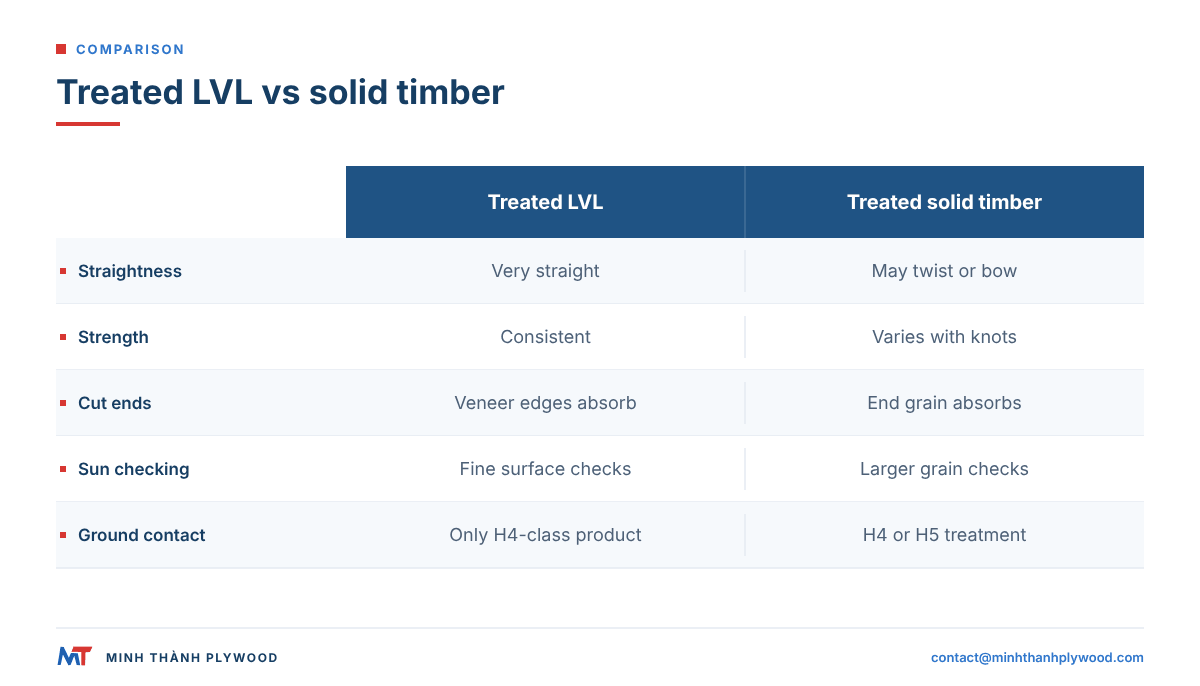
LVL is straighter and more even than solid timber outside, but not more durable. Its strength is consistent, it resists twisting, and its phenolic glue lines hold when wet. Its weakness is the many glue lines and veneer edges that take up water at cut ends.
| Point | Treated LVL | Treated solid timber |
|---|---|---|
| Straightness | Very straight, little twist | Can twist and bow as it dries |
| Strength consistency | Even along the member | Varies with knots and grain |
| Long lengths | Made to long lengths | Limited by the log |
| Water at cut ends | Absorbs along veneer edges | Absorbs along end grain |
| Checking in sun | Fine surface checks | Larger checks along the grain |
| Ground contact | Only H4-class product | Common with H4 or H5 treatment |
What should you ask a Vietnamese LVL factory before ordering outdoor LVL?
Ask what bond the LVL uses, whether it is treated and to which class, what moisture it ships at, and how it is wrapped. These four answers decide whether it will last outside.
- Which glue? For outdoor use, ask for a phenolic (PF) or MUF bond, written on the proforma.
- Treated or untreated? Ask whether the mill treats, and to which hazard or use class, or whether you will treat locally.
- Moisture at dispatch? Ask for the range; ours is 8–12%.
- Packing? Ask for wrapped, strapped bundles on bearers, with end protection for sea freight.
- Species and density? A denser species holds fixings better. Our LVL uses Acacia at about 580 kg/m³ or Eucalyptus at 650–750 kg/m³.
- Formats? Our billet formats are 1220 × 2440 and 1250 × 2500 mm, cut to the member sizes on your drawing.
- Documents? Ask for the bond and emission declaration and, for the EU, the EUDR compliance dossier under Regulation (EU) 2023/1115.
Minh Thanh LVL for outdoor and sheltered components
Minh Thanh Plywood makes LVL from Acacia or Eucalyptus plantation veneers in Ha Hoa, Phu Tho. For outdoor or weather-exposed components we offer a phenolic WBP bond; for damp sheltered use, an MR / melamine-fortified bond; for interiors, UF glue at E0 emission, with E1 as an option.
Our LVL serves components: furniture frames, door members, packaging runners and engineered members specified by the project. Each order is pressed in our 1220 × 2440 or 1250 × 2500 mm billets and cut to your drawing. We supply the EUDR compliance dossier (origin records and geolocation files) with the order. Full specifications are on our LVL laminated veneer lumber page, and the LVL price guide explains what moves the cost.
For outdoor sheet uses, such as wall sheathing and stair treads, our exterior plywood uses a water-resistant melamine-fortified or phenolic bond.
Outdoor LVL: what to put on your order
Send the member sizes, the exposure (sheltered, above ground or in ground), the bond, the treatment class you need, the quantity and your destination port. We reply within hours with a quotation, and free samples let you check the bond and the veneer before the container is booked. For the background, start with what LVL is and how it is made.
Buyer questions, answered
Can LVL be used outside?
Yes, when it has an exterior phenolic bond, preservative treatment for the exposure class and a design that sheds water. Untreated LVL left in the weather swells, checks and eventually decays.
Can LVL get wet?
LVL can get wet for short periods during construction and dry out again without losing its glue bond. Problems start when it stays wet: swelling, surface checks, mould and decay.
Is LVL timber waterproof?
No. The glue lines of exterior-bonded LVL resist water, but the wood veneers absorb it like any timber. Waterproofing comes from treatment, coatings, flashing and ventilation.
Are LVL beams waterproof?
No. LVL beams are water-resistant in the bond, not waterproof in the wood. Keep beams covered on site and protect them in service with cladding, capping or a roof overhang.
What treatment does LVL need outside?
H3 (or Use Class 3) treatment for outdoor use above ground, and H4 (Use Class 4) for ground contact. Indoor framing in termite areas uses H2 or H2S.
How do you waterproof LVL beams?
Specify treated LVL for the exposure class, seal every cut end and bored hole, cap or flash the top edge, keep it off concrete with a stand-off base and let air move around it.
Can LVL be used for a deck or pergola?
Yes, as treated LVL in an above-ground H3 or Use Class 3 member with a capped top edge and sealed cut ends. Do not bury it or let it sit in standing water.
How long can LVL be left uncovered on site?
Keep exposure as short as possible: unwrap only what is installed that day and close the roof quickly. Check the manufacturer's guide for its stated limit, and dry the members before closing in.
Which glue does exterior LVL use?
Exterior LVL uses a phenolic (phenol-formaldehyde, PF) or melamine-urea-formaldehyde (MUF) bond. Urea-formaldehyde (UF) glue is for dry interior use only.
Can LVL be painted for outdoor use?
Yes. A breathable exterior paint or stain on treated LVL slows wetting and UV greying. Paint does not replace treatment and must be maintained.