
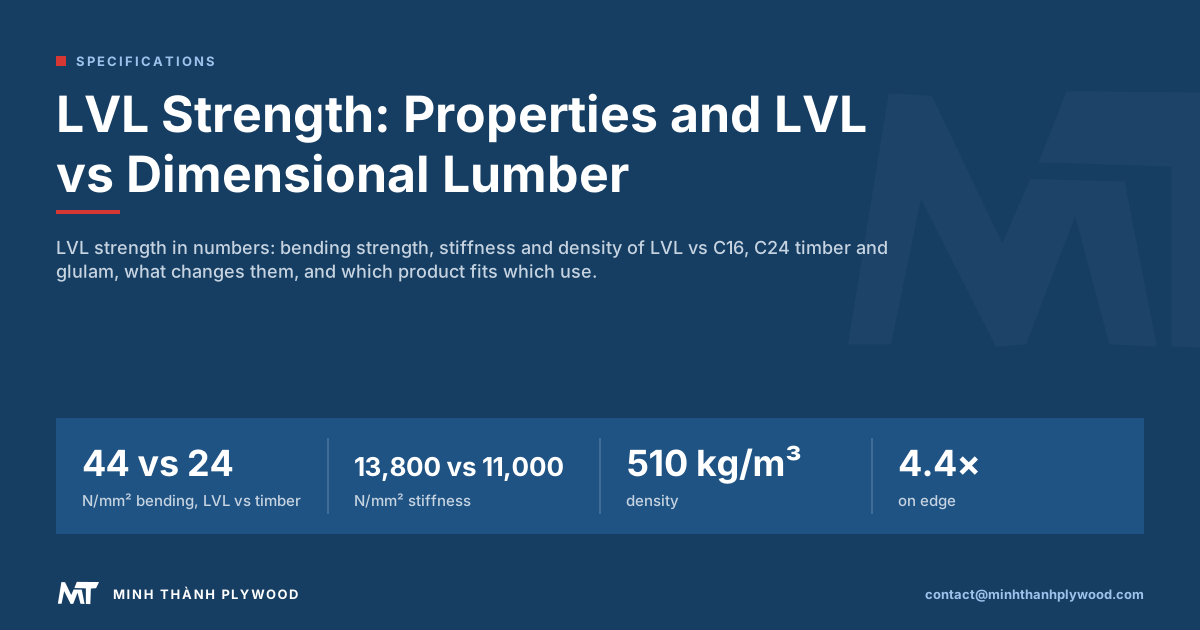
LVL strength is high along the member: Kerto-S, a European softwood LVL grade declares 44 N/mm² characteristic edgewise bending strength, against 24 N/mm² for C24 timber in EN 338. A US 2.0E grade is about 13,800 N/mm² stiff, against 11,000 N/mm² for C24. Minh Thanh Plywood, an LVL maker in Vietnam, sets out the properties, what changes them and which product fits which job.
How strong is LVL? The numbers first
LVL, laminated veneer lumber, is about 1.8 times as strong in bending as C24 structural timber and about a quarter stiffer. Kerto-S, a European softwood LVL grade made to EN 14374 declares 44 N/mm² characteristic edgewise bending strength, against 24 N/mm² for C24 in EN 338:2016.
For stiffness, a US 2.0E LVL grade is about 13,800 N/mm², against a mean of 11,000 N/mm² for C24.
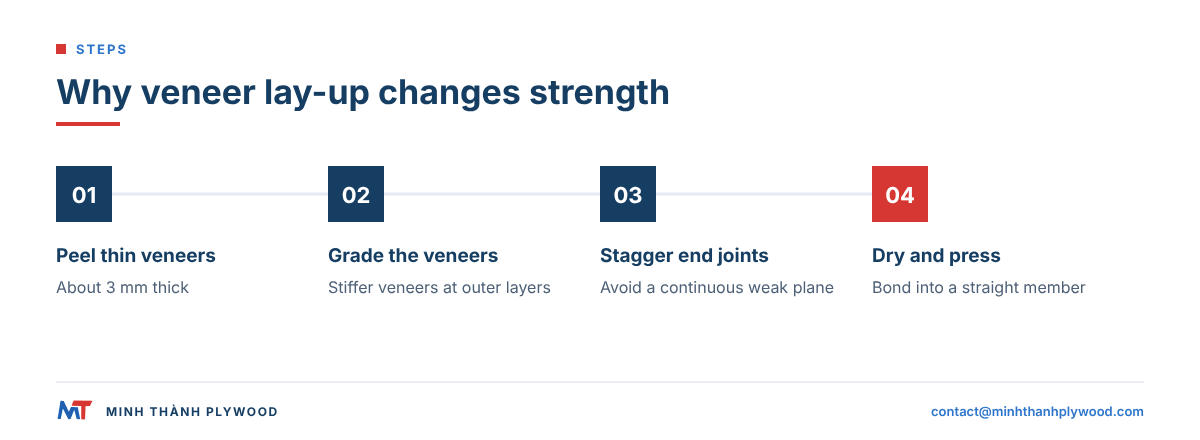
LVL strength comes from how it is made. A log is peeled into veneers about 3 mm thick, the veneers are dried and graded, and they are glued back together with the grain of almost every layer running along the member. Knots, slope of grain and splits that would weaken a sawn joist are spread across dozens of glue lines, so the weakest LVL piece is close to the average piece.
That is the case for LVL in one paragraph. The rest of this guide gives the property table, the comparison with dimensional lumber and glulam, what changes the strength of one LVL against another, and the verdict by use.
LVL properties: the table
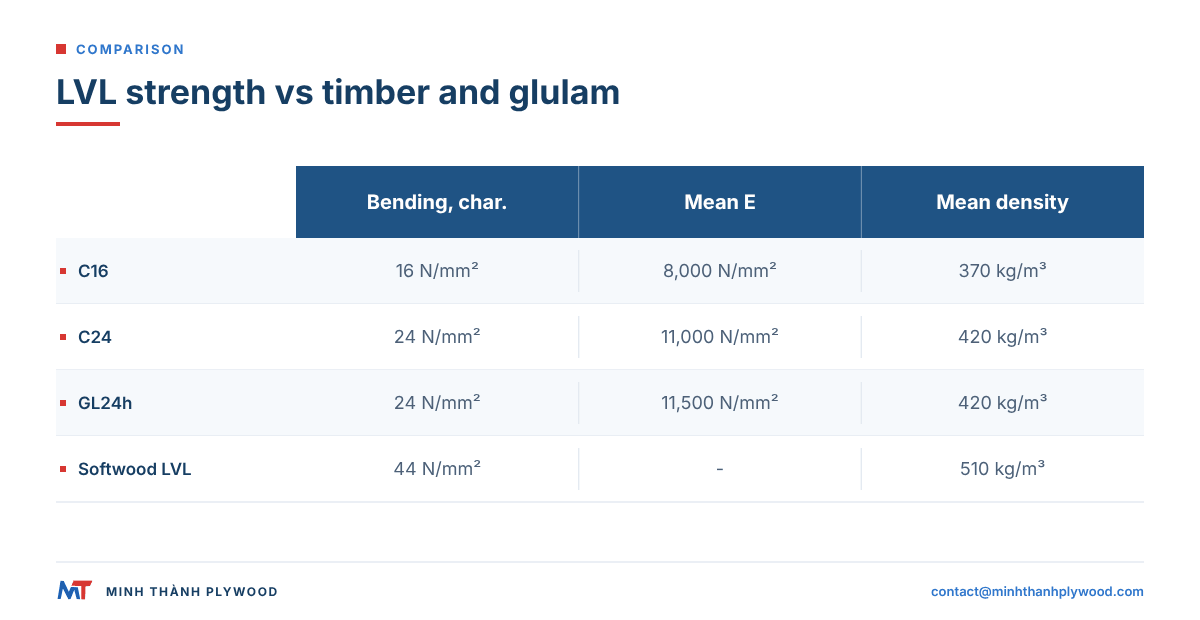
The table puts LVL properties next to timber and glulam on the European basis, characteristic values for use with Eurocode 5. A characteristic value is the 5th-percentile strength: 95 % of pieces in the grade are stronger.
| Property | C16 timber (EN 338) | C24 timber (EN 338) | GL24h glulam (EN 14080) | Kerto-S softwood LVL (EN 14374) |
|---|---|---|---|---|
| Bending strength, characteristic | 16 N/mm² | 24 N/mm² | 24 N/mm² | 44 N/mm² edgewise, 300 mm depth |
| Mean modulus of elasticity | 8,000 N/mm² | 11,000 N/mm² | 11,500 N/mm² | not compared here; US 2.0E grade about 13,800 N/mm² |
| Mean density | 370 kg/m³ | 420 kg/m³ | 420 kg/m³ | 510 kg/m³ |
| Shear, characteristic (edgewise for LVL) | 3.2 N/mm² | 4.0 N/mm² | 3.5 N/mm² | 4.2 N/mm² |
| Tension parallel to grain, characteristic | 8.5 N/mm² | 14.5 N/mm² | 19.2 N/mm² | 35 N/mm², 3,000 mm reference length |
| Compression parallel to grain, characteristic | 17 N/mm² | 21 N/mm² | 24 N/mm² | 35 N/mm² edgewise |
| Bending strength ratio to C24 | 0.67 | 1.00 | 1.00 | 1.83 |
The LVL column is Metsä Wood’s Kerto-S, a spruce LVL made to EN 14374: bending, modulus and density come from the producer’s leaflet of February 2018 (Kerto-S leaflet), and shear, tension and compression from the producer’s Kerto LVL mechanical properties manual (April 2024), which also carries the EN 14374 declaration of performance.
The 44 N/mm² is one producer’s declared value; other LVL products declare their own values, and the engineer designs with the values of the product actually bought. Structural LVL sold in Europe carries CE marking under the Construction Products Regulation (Regulation (EU) No 305/2011). The bending value is quoted at a reference depth of 300 mm, with a size-effect rule for other depths.
The pattern holds across grades: per square millimetre, LVL bends further before failing than sawn timber or standard glulam of the same species group, and its values are tighter around the mean.
LVL vs dimensional lumber strength: a side-by-side comparison
LVL is stronger, stiffer, straighter and more consistent than dimensional lumber of the same size; dimensional lumber is lighter, cheaper per metre and easier to buy at a local yard. The comparison by metric:
| Metric | LVL | Dimensional lumber (C16/C24, No. 2 framing) |
|---|---|---|
| Bending strength, characteristic | 44 N/mm² for a published softwood grade | 16–24 N/mm² |
| Stiffness (mean E) | about 13,800 N/mm² for a 2.0E grade | 8,000–11,000 N/mm² |
| Spread of strength within the grade | Narrow: defects dispersed through veneers | Wide: one knot can govern a piece |
| Straightness and twist | Very low; made dry and pressed flat | Can bow, cup and twist as it dries |
| Lengths | Long lengths from a continuous lay-up | Limited by the log |
| Sections | Thin billets ripped to depth | Fixed nominal sizes |
| Weight per metre for a given load | Lower: smaller section carries the load | Higher |
| Price per metre | Higher | Lower |
| Workability | Cuts and nails like timber; holes only where permitted | Cuts, nails and notches freely within code |
The practical result: an LVL header or beam is usually shallower than the sawn timber it replaces, and it stays straight in the wall. For studs and plates in ordinary framing, dimensional lumber stays the lower-cost choice.
Why is LVL stronger than dimensional lumber?
LVL is stronger because peeling and re-gluing removes the reason sawn timber fails early: a single large defect in a critical place. Four steps make the difference.
- Peeling spreads defects. A knot that would sit at the edge of a joist becomes a small patch in one 3 mm veneer.
- Grading sorts veneers. Veneers are graded by appearance or by stiffness, and the stiffest go to the outer layers where bending stress is highest.
- Staggered joints. Veneer ends are joined with scarf or lap joints, and the joints in neighbouring layers are kept apart, so no plane of weakness crosses the member.
- Pressing and drying. The veneers are dried before gluing, so the finished member is straight and dimensionally stable from the start.
The result is a high average and a narrow spread. Design values are set from the weak end of the spread, so a narrow spread raises the design value more than the average does.
What affects LVL strength?
Six things change the strength of one LVL against another, and a buyer can ask about each.
- Species and density. Denser species are stronger and stiffer. Softwood LVL in Europe is mostly spruce or pine; hardwood LVL uses birch, poplar, eucalyptus or acacia. Our Acacia and Eucalyptus veneers are planned at 580 and 650 kg/m³, denser than the 510 kg/m³ mean of the published spruce grade.
- Veneer grade. Graded veneers with few open defects give higher values; ungraded veneers give a wider spread.
- Joint layout. Veneer joints staggered well apart along the member keep the strength; joints that line up form a weak plane.
- Glue and pressing. Structural LVL uses a phenolic or other exterior-type bond; furniture LVL commonly uses UF glue at E0 emission. The bond must hold every veneer in contact across the whole member.
- Cross veneers. Some LVL grades put a few veneers across the length to stop splitting and add width-wise strength; they lower the length-wise bending value a little.
- Moisture and load duration. Wet service and long-term loads both reduce the design values of LVL, as they do for sawn timber.
The pine LVL vs hardwood LVL guide compares the species in more detail.
How do edgewise and flatwise loading change LVL strength?
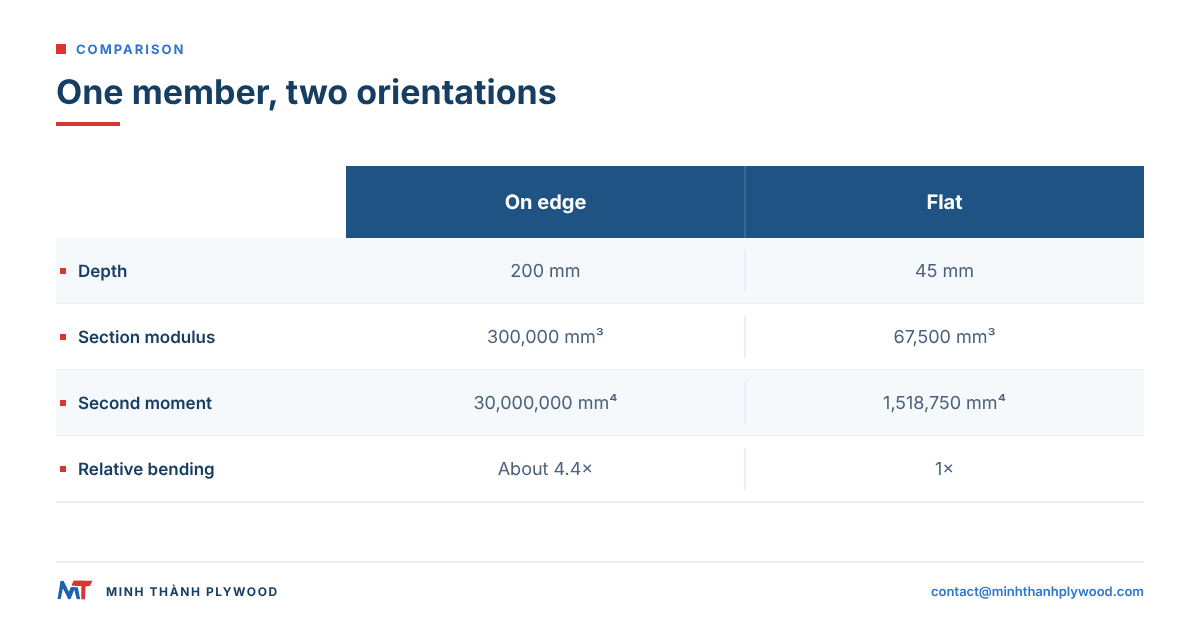
LVL is strongest as a beam when it is loaded on edge, with the veneers vertical, because the member’s depth then works against the bending. For a rectangular section the bending capacity rises with width times depth squared (section modulus S = b × h² ÷ 6).
| Same 45 × 200 mm LVL member | On edge (200 mm deep) | Flat (45 mm deep) |
|---|---|---|
| Section modulus S | 300,000 mm³ | 67,500 mm³ |
| Second moment of area I | 30,000,000 mm⁴ | 1,518,750 mm⁴ |
| Bending capacity, relative | about 4.4 times | 1 |
| Stiffness against deflection, relative | about 20 times | 1 |
The same wood, turned through 90 degrees, carries about four times the load and deflects about one twentieth as much. That is why LVL beams and headers are installed on edge, and why the drawing for any LVL part must show which face is up. Published grades also declare separate edgewise and flatwise strengths per square millimetre, because the veneers act differently in each direction.
LVL vs glulam, plywood and steel
LVL sits between sawn timber and steel: stronger per square millimetre than glulam and timber, lighter than steel for the same load, and made in straight rectangular sections only.
- LVL vs glulam. Glulam is built from sawn lamellae, so GL24h declares 24 N/mm² against 44 N/mm² for Kerto-S LVL. Glulam is made deeper, wider and curved, which suits long exposed roof beams. Our glulam vs LVL comparison covers costs and spans.
- LVL vs plywood. Plywood crosses the grain of every second veneer so the panel is strong in both directions; LVL runs nearly all the grain one way so the member is strong along its length. Plywood is for decks, walls and panels; LVL is for beams, rails and frames. See LVL vs plywood.
- LVL vs steel. A steel section carries far more load per square millimetre, but an LVL beam of the same capacity weighs less, is cut with ordinary saws and does not form a thermal bridge. Our LVL vs steel guide sets out where each wins.
For furniture, packaging and door parts, the useful comparison is LVL against solid hardwood: LVL is straighter, does not split along a screw line, and comes in any length the lay-up allows.
How to read an LVL design value sheet
Read the basis before the number. A European sheet gives characteristic values for Eurocode 5; a US sheet gives allowable design stresses for the NDS method. The two cannot be compared directly.
- Check the basis. “fm,k” or “characteristic” means a 5th-percentile strength for limit-state design. “Fb” in psi means an allowable stress that already includes safety reductions.
- Check the direction. Edgewise (joist, on edge) and flatwise (plank, flat) values differ.
- Check the reference depth. Bending values are quoted at a reference depth (300 mm in Europe, 12 inches in the US) and adjusted for other depths.
- Check the service class. Values assume dry use unless the sheet says otherwise.
- Check the product identity. The values belong to one named product and grade from one producer; another LVL does not inherit them.
A US 2.0E grade, for example, is published with an allowable bending stress of 2,600–2,900 psi (about 17.9–20.0 N/mm²) in joist orientation. Its shear value is 285 psi (about 2.0 N/mm²), and its compression perpendicular to grain 750 psi (about 5.2 N/mm²). Those numbers look lower than 44 N/mm² only because they are allowable stresses, not characteristic strengths.
Why does span change LVL load capacity so much?
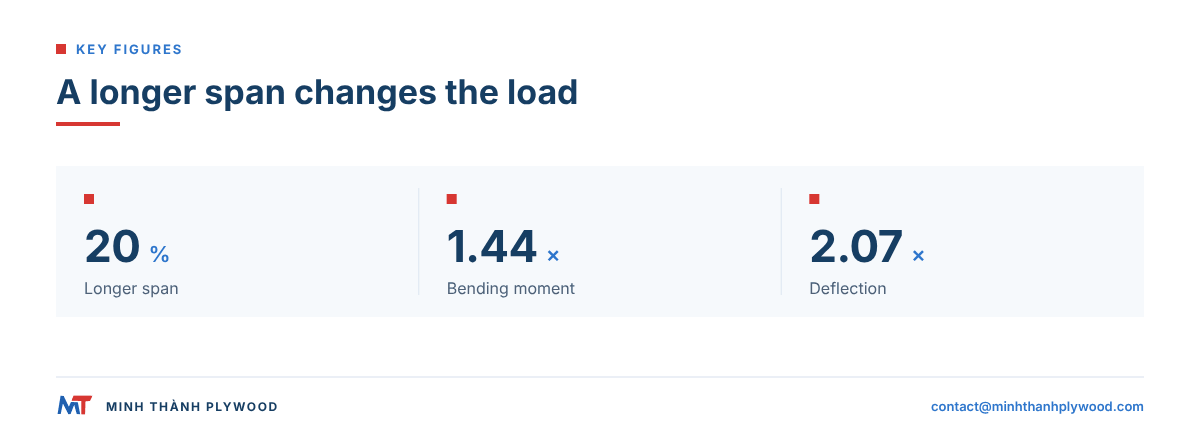
Span changes everything because bending grows with the square of the span and deflection with the fourth power. For a simply supported beam with an even load, the bending moment is q × L² ÷ 8 and the deflection is 5 × q × L⁴ ÷ (384 × E × I).
Make the span 20 % longer and the bending moment rises by 1.2² = 1.44 times, the deflection by 1.2⁴ = 2.07 times. A beam that was comfortable at 3.0 m can be overloaded at 3.6 m with the same load per metre. The LVL beam span chart shows how producers turn these formulas into tables.
Deflection often governs before strength. A stiff LVL grade (a higher E) is chosen for floors with tiled finishes or long spans, where a beam that is strong enough can still bend too much.
How far can an LVL beam span, and what does it cost?
A 1-3/4 x 11-7/8 in. (44 × 302 mm) LVL beam typically spans up to about 20 ft (6.1 m) in a residential floor, and spans run from 8 to 12 ft (2.4 to 3.7 m) for small beams, 12 to 20 ft (3.7 to 6.1 m) for floor beams and 20 to 30 ft or more (6.1 to 9.1 m) for deep beams (SXH Wood, Unique Materials). Both guides were read on 21 October 2026.
These are typical ranges only: the engineer sizes the beam from the load, the support and the producer’s design values.
| Beam use | Typical span | Typical span in metres |
|---|---|---|
| Small residential beam | 8 to 12 ft | 2.4 to 3.7 m |
| Floor beam | 12 to 20 ft | 3.7 to 6.1 m |
| Deep beam, heavy duty | 20 to 30 ft or more | 6.1 to 9.1 m or more |
A basic 1-3/4 x 9-1/2 in. LVL beam costs about US$6 to US$10 per linear foot at US merchants, so a 20 ft beam costs roughly US$120 to US$200, and a heavier engineered 20 ft beam can reach US$500 or more (SXH Wood, 21 October 2026).
For a UK reader, the rate on 20 October 2026 was US$1.3345 to £1 (exchangerates.org.uk). At that rate the cost is about £15 to £25 per metre, £90 to £150 for the 6.1 m beam and about £375 for the heavier one. Stock lengths of 16 and 24 ft are common; 40 ft beams are ordered specially.
Installation mistakes that cut strength:
- Notching or drilling outside the permitted zones. A notch in the tension face at mid-span removes the veneers carrying the load.
- Short bearing. The beam end must sit on the full bearing length the design states, or the support crushes.
- Wrong nailing of multi-ply beams. Follow the producer’s nailing schedule for ply count, row and spacing; too few nails leave the plies working separately.
- Leaving the beam wet. Cover the beam on site and keep it dry until the roof is on.
Verdict by use: when to choose LVL, timber or glulam
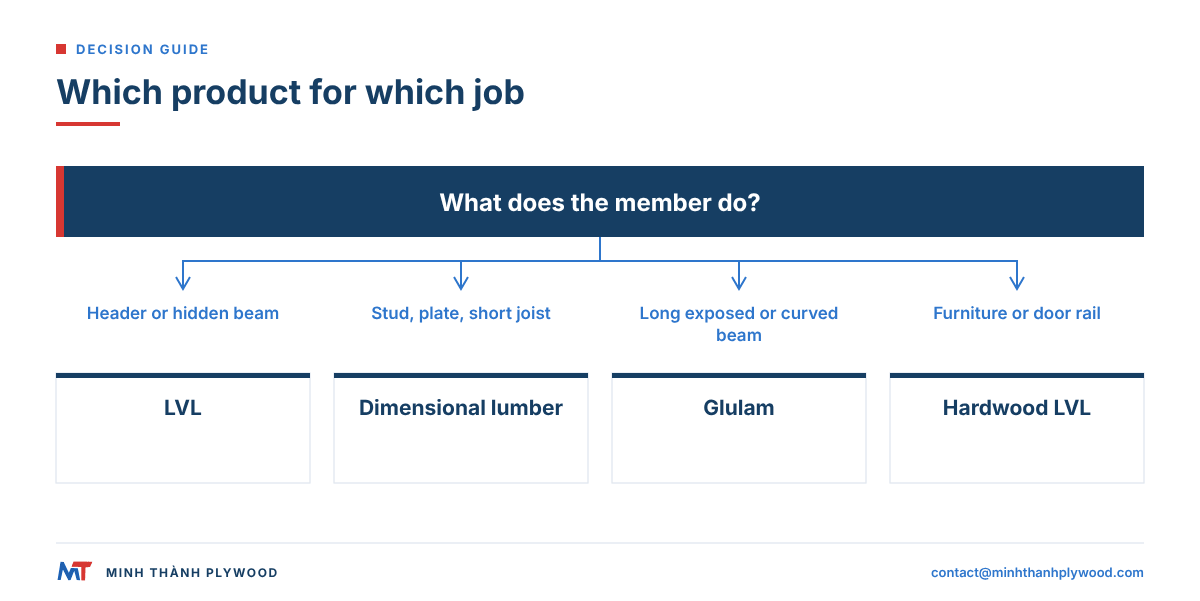
Choose by the job the member does.
| Use | Best choice | Why |
|---|---|---|
| Headers over wide openings, flush beams | LVL | Strong in a shallow section, stays straight |
| Floor and roof beams in light framing | LVL or glulam | LVL for hidden beams; glulam where the beam is seen |
| Studs, plates, short joists | Dimensional lumber | Lowest cost, strength is ample |
| Long exposed or curved roof beams | Glulam | Large and curved sections, finished appearance |
| Furniture frames, bed rails, sofa frames | Hardwood LVL | Straight, does not split at screws, any length |
| Door stiles, rails and cores | LVL | Stays straight across the door height |
| Pallet runners, crate skids | LVL | Long, straight runners that hold nails near ends |
For building structures, the engineer names the product and grade from its published values. For furniture, door and packaging components, the drawing and an assembly trial set the specification.
What LVL does Minh Thanh make, and how is it specified?
We make LVL from Acacia or Eucalyptus plantation veneers grown around our mill in Ha Hoa, Phu Tho, for furniture frames, door components and industrial packaging. The grain runs along the member, and the bond is chosen for the use: UF glue at E0 emission for indoor furniture, E1 as an option, or a water-resistant bond where the part meets humidity.
What makes our LVL strong for these parts is the same list as above: dense hardwood veneers, graded and dried to 8–12 % moisture, joints staggered through the lay-up and a calibrated finished section. Visible faces are graded to the approved sample, and the member is cut to your drawing. We supply the EUDR compliance dossier, with origin records and geolocation files, with every order, as Regulation (EU) 2023/1115 requires of wood products placed on the EU market.
Our certificates and test reports are on the quality page. When your project needs a test, bending tests to your method are arranged through SGS on request. For a building beam or other structural member, the engineer names a product with published design values; the LVL product page explains how we quote components.
What to send for an LVL quote
Send the use and the drawing first; the rest of the specification follows from them.
- Application: furniture frame, door stile, pallet runner, or other component.
- Section and length: finished width, depth and length, with the face that is up.
- Species: Acacia or Eucalyptus veneers.
- Glue and emission: UF glue at E0 emission for interiors, or the water-resistant bond needed.
- Visible faces: which faces show and the appearance grade.
- Packing and quantity: pieces per bundle and total pieces per length.
- Port and Incoterm: FOB Hai Phong, CFR or CIF.
Production is 15–45 days after the 30 % deposit, with the 70 % balance against the scanned B/L. The minimum order is one 40HC, with mixed sections by agreement, and free samples come before the order. Lisa answers on WhatsApp at +84 988 586 601 or at contact@minhthanhplywood.com, usually within hours.
Sources: EN 338:2016 Structural timber, strength classes; EN 14080:2013 Glued laminated timber; EN 14374:2004 Structural LVL; the Metsä Wood Kerto-S leaflet (2018) and Kerto LVL mechanical properties manual (2024), which carry the EN 14374 declared values; US 2.0E LVL technical guides; the USDA Forest Products Laboratory Wood Handbook, 2021, chapter 9, for the beam formulas; and the APA overview of structural composite lumber. Values checked 20 October 2026.
Buyer questions, answered
Is LVL stronger than solid wood?
Along its length, yes, grade for grade. A published softwood LVL grade declares 44 N/mm² characteristic bending strength edgewise, against 24 N/mm² for C24 and 16 N/mm² for C16 timber in EN 338. LVL is also more uniform, because defects are spread through many veneers.
What is the E value of LVL?
E is the modulus of elasticity, the stiffness used for deflection. The common US grades are 1.9E and 2.0E, meaning 1.9 or 2.0 million psi, about 13,100 and 13,800 N/mm². C24 timber has a mean E of 11,000 N/mm².
Is LVL stronger than glulam?
Per square millimetre, LVL usually declares the higher bending strength: 44 N/mm² for Kerto-S softwood LVL against 24 N/mm² for GL24h glulam in EN 14080. Glulam is made in larger and curved sections, so for long exposed spans it is often the practical choice.
Can LVL replace dimensional lumber?
Yes, where the engineer sizes the LVL member from its own design values. An LVL member is usually shallower or lighter than the timber it replaces for the same load. It is not a like-for-like swap by size.
Why is LVL stronger than sawn lumber?
Peeling the log into thin veneers and gluing them back with the grain aligned spreads knots and other defects through many layers. No single defect can cross the whole section, so the weakest piece in a grade is much closer to the average.
What affects the strength of LVL?
The wood species and its density, the veneer grade, how veneer joints are staggered, the glue and pressing, the share of cross-grain veneers, the loading direction (edgewise or flatwise), the member depth and the moisture in service.
Is LVL stronger on edge or flat?
Laid on edge, a member resists bending far better because its depth is larger: a 45 × 200 mm section has about 4.4 times the bending capacity on edge as flat. Per square millimetre, published grades also declare separate edgewise and flatwise values.
Does moisture reduce LVL strength?
Yes. Design values for LVL, like timber, are reduced for humid or wet service, and most structural LVL is made for dry, covered use. Exterior use needs a product qualified for it and protection of the ends and faces.
What is the density of LVL?
Kerto-S, a European softwood LVL grade declares a mean density of 510 kg/m³. Hardwood LVL made from Acacia or Eucalyptus veneers is denser; we plan those species at 580 and 650 kg/m³.
Can Minh Thanh supply structural LVL beams?
Our LVL is made for furniture frames, door components and packaging, to the buyer's drawing. For a building beam, use the product with published design values that your engineer names.