
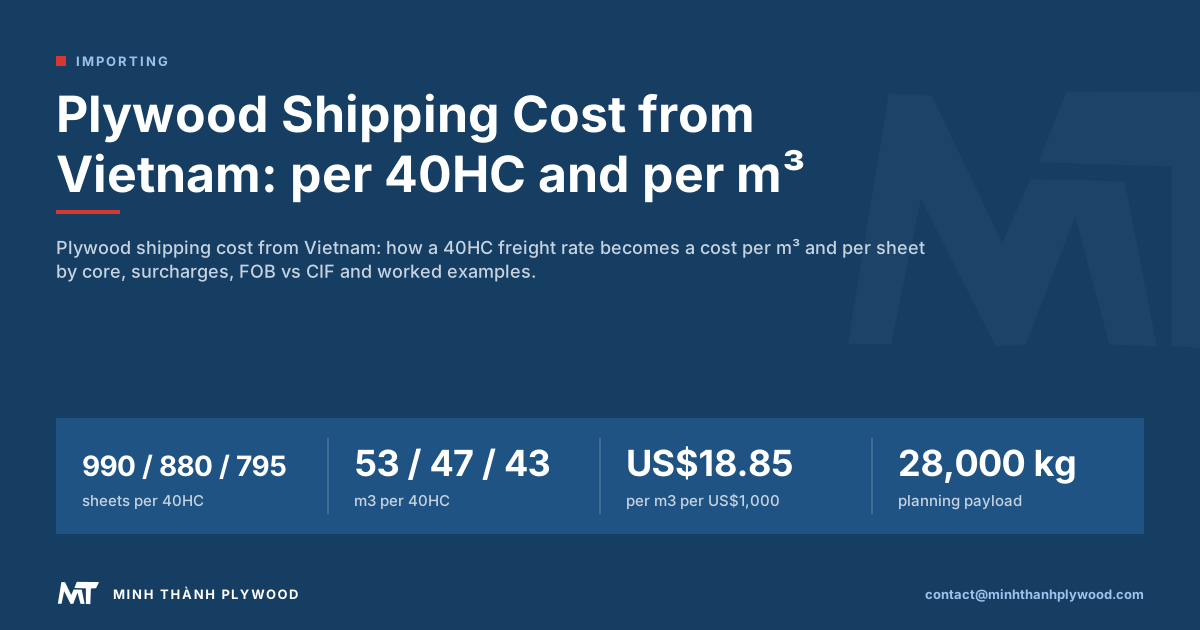
Plywood shipping cost from Vietnam is the freight for one 40HC from Hai Phong divided by the cubic metres the payload allows: about 53 m³ of 18 mm panels on a Styrax core, 47 m³ on Acacia and 43 m³ on Eucalyptus. At Minh Thanh Plywood, each US$1,000 of freight therefore adds US$18.85, US$21.21 or US$23.48 per m³.
How do you work out plywood shipping cost per CBM (per m³)?
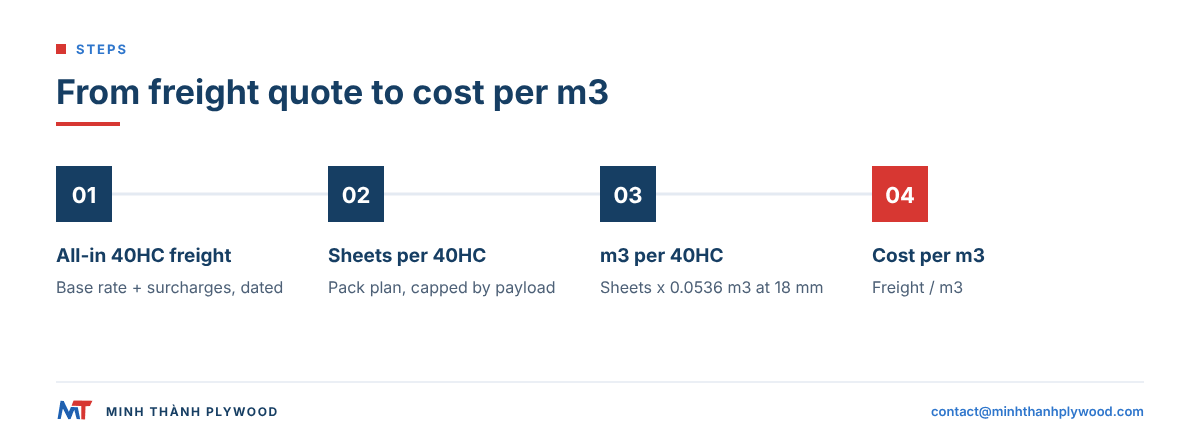
Plywood shipping cost per m³ equals the freight for one 40HC divided by the cubic metres of plywood that container actually carries. The divisor is the part buyers miss: it depends on the core, because plywood fills a container by weight before it fills it by volume.
The formula has three inputs, all known before you book:
- Freight per container: the all-in rate for a 40HC from Hai Phong to your port, including surcharges, on the day of booking.
- Volume per container: sheets per 40HC × sheet volume. One 1220 × 2440 × 18 mm sheet is 0.0536 m³.
- Cost per m³: freight ÷ volume. Per sheet: freight ÷ sheets.
At Minh Thanh, an 18 mm 40HC carries about 53 m³ on a white Styrax core, 47 m³ on Acacia and 43 m³ on Eucalyptus. The rest of this guide shows where those numbers come from, what moves the freight rate, and how to compare quotes. The full order sequence is in how to import plywood from Vietnam.
How many m³ of plywood fit in a 40HC container?
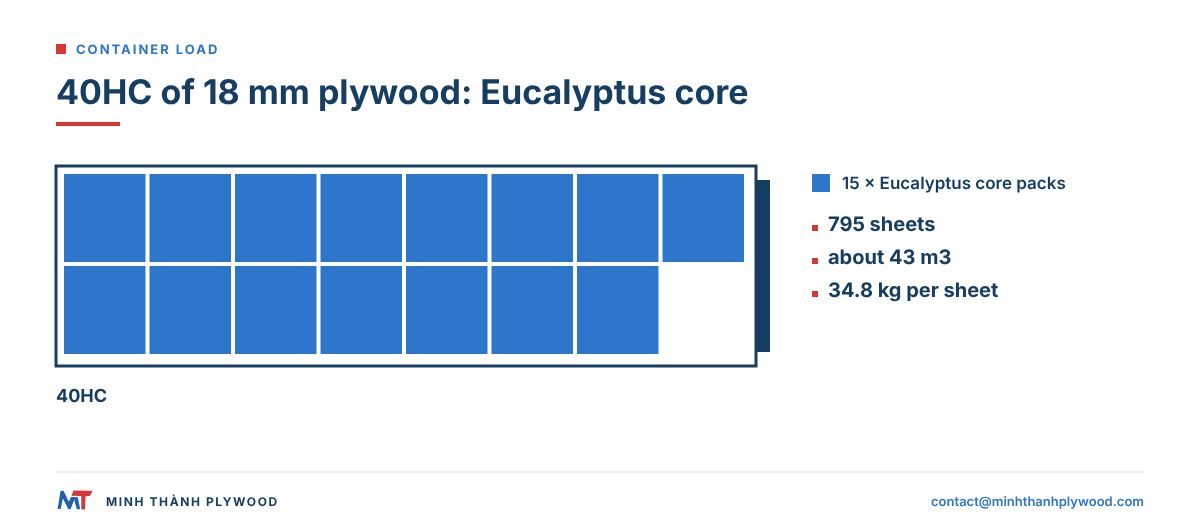
A 40HC carries between about 43 and 53 m³ of 18 mm plywood in 1220 × 2440 mm, depending on the core: 990 sheets on white Styrax, 880 on Acacia and 795 on Eucalyptus. Packs are about 1,000 mm high, and sheets per pack are 1,000 mm divided by the thickness, rounded down, then capped by weight.
| Core (reference density) | Packs per 40HC | Sheets per pack at 18 mm | Sheets per 40HC | m³ per 40HC | kg per sheet | Panel weight per 40HC |
|---|---|---|---|---|---|---|
| White Styrax (500 kg/m³) | 18 (16 lying + 2 upright) | 55 | 990 | About 53 | 26.8 | About 26,500 kg |
| Acacia (580 kg/m³) | 16 | 55 | 880 | About 47 | 31.1 | About 27,400 kg |
| Eucalyptus (650 kg/m³) | 15 | 53 | 795 | About 43 | 34.8 | About 27,700 kg |
The plan uses a planning payload of 28,000 kg unless the booking is lower. That is why a Eucalyptus load stops at 15 packs while the box still has space: one more pack would take it over the weight. Panel weight is sheet volume × density, so a heavier core simply carries fewer m³.
A shipping line or a road haulier at destination can set a lower payload than 28,000 kg. Tell the mill your booking limit before it plans the packs, and the sheet count is cut to fit. Our packing calculator runs the same arithmetic for other thicknesses and sizes.
How does core density change shipping cost per m³?
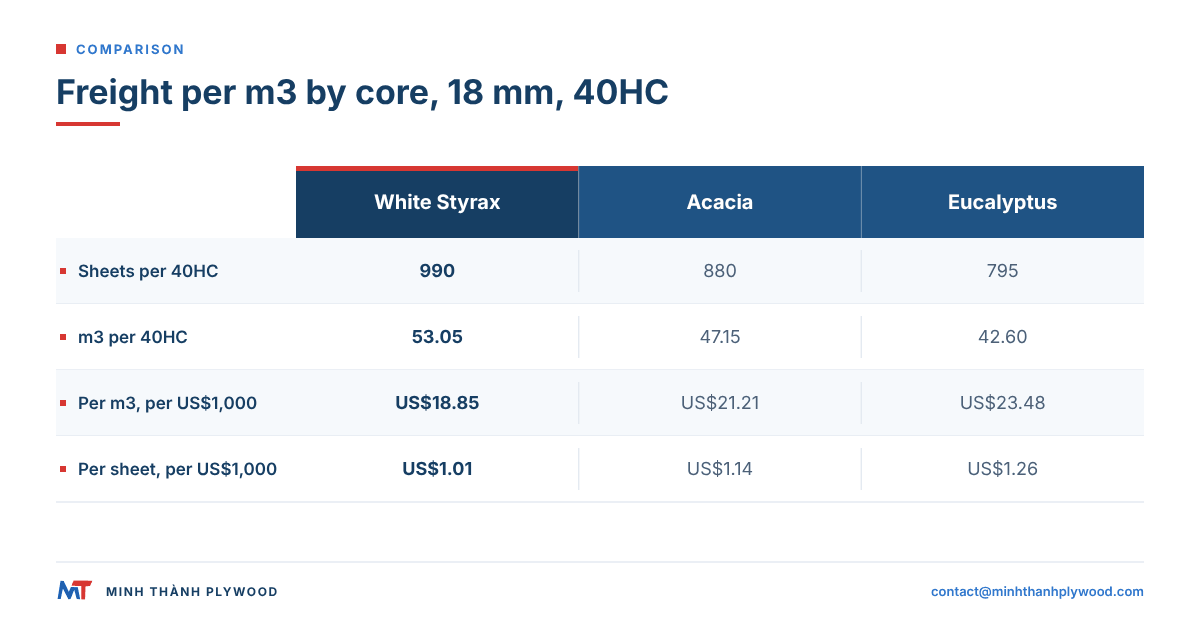
A lighter core spreads the same freight over more m³, so it lowers the shipping cost per m³: on 18 mm panels, Eucalyptus costs about 25% more per m³ to ship than white Styrax. The difference comes straight from the container plan above.
| Core | m³ per 40HC at 18 mm | Freight per m³ for each US$1,000 of 40HC freight | Freight per sheet for each US$1,000 |
|---|---|---|---|
| White Styrax | 53.05 | US$18.85 | US$1.01 |
| Acacia | 47.15 | US$21.21 | US$1.14 |
| Eucalyptus | 42.60 | US$23.48 | US$1.26 |
The per-US$1,000 figures make any quote comparable: multiply by the freight in thousands. A 40HC freight of US$3,000 becomes US$56.55 per m³ on Styrax and US$70.43 per m³ on Eucalyptus.
Core choice is a product decision first. White Styrax gives a light, pale core for furniture and interiors; Eucalyptus gives a harder, heavier core where stiffness and screw holding matter. Both are standard at Minh Thanh, with Acacia and Pine on order. When two cores meet the application equally, the lighter one wins on freight, and the furniture range is on the furniture plywood page.
What does a 40ft container of plywood cost to ship from Hai Phong? Worked examples
The freight for a 40HC from Hai Phong is a dated market rate, so the useful number is what a given rate does to your cost per m³. The table runs four example freight levels through the 18 mm container plan; the levels are round figures for the arithmetic, not quotes.
| Example 40HC freight | Styrax core, per m³ | Acacia core, per m³ | Eucalyptus core, per m³ | Styrax core, per sheet |
|---|---|---|---|---|
| US$1,500 | US$28.28 | US$31.81 | US$35.21 | US$1.52 |
| US$2,500 | US$47.13 | US$53.02 | US$58.69 | US$2.53 |
| US$3,500 | US$65.98 | US$74.23 | US$82.16 | US$3.54 |
| US$5,000 | US$94.26 | US$106.04 | US$117.38 | US$5.05 |
Read it from your own quote: find the row nearest your freight, or scale from the US$1,000 figures above. Against an indicative furniture plywood price from US$350/m³ (October 2026), a freight of US$2,500 per 40HC adds about 13.5% to the panel price on a Styrax core (US$47.13 ÷ US$350).
Where do you find a dated freight rate?
Ask a forwarder or the mill for a quote on your lane with its date and validity, and track the trend on public container indices. The Drewry World Container Index and the Freightos Baltic Index publish weekly 40ft rates on the main Asia–Europe and transpacific lanes. They are measured from Chinese ports, so use them for direction and timing, and the Hai Phong quote for the number.
How does plywood freight from Vietnam to Europe compare with other lanes?
Lanes differ in transit and in the surcharges that ride on them more than in the cubic metres a container carries. The 40HC plan is the same, so the cost per m³ moves exactly with the freight. Five common lanes from Hai Phong compare like this.
| Lane from Hai Phong | Typical days at sea | What usually moves the rate | Cost per m³ on Styrax 18 mm for each US$1,000 |
|---|---|---|---|
| Northern Europe (Rotterdam, Antwerp, Hamburg) | 30–40 | Suez or Cape routing, bunker cost, peak season | US$18.85 |
| Mediterranean (Genoa, Valencia, Piraeus) | 25–35 | Suez or Cape routing, transhipment | US$18.85 |
| US West Coast (Los Angeles, Long Beach) | 20–30 | Transpacific season, port congestion | US$18.85 |
| Middle East (Jebel Ali, Jeddah, Dammam) | 15–25 | Red Sea security, regional surcharges | US$18.85 |
| Australia (Sydney, Melbourne, Brisbane) | 25–35 | Transhipment at an Asian hub, sailing frequency, port congestion | US$18.85 |
For a 40HC freight rate from Vietnam to Europe, ask for the all-in figure to your port, because Asia–Europe quotes are often split into base rate and several surcharges. Days at sea are typical figures by carrier and route; transhipment adds days at the hub. The country steps for each market are in the guides for Europe, the USA and the Middle East.
What does plywood shipping cost from Vietnam to Australia?
Plywood shipping cost from Vietnam to Australia follows the same formula as every other lane: the 40HC freight to Sydney, Melbourne or Brisbane divided by the m³ the container carries. It is then converted to Australian dollars at the rate of the booking day. Sailings from Hai Phong usually tranship at an Asian hub, so allow about 25–35 days at sea and ask the forwarder for the sailing frequency of your port.
To turn the table above into Australian dollars, multiply each US$ per m³ figure by the AUD per US$ rate of the day you book; the Reserve Bank of Australia publishes it daily. Freight is quoted in US dollars on this lane, so the exchange rate moves your cost between quote and payment.
Australia adds goods and services tax (GST) of 10% on the value of the taxable importation, which is the customs value plus freight, insurance and any duty. Worked on a 40HC of 18 mm Styrax-core plywood (53.05 m³ at the October 2026 starting price of US$350/m³ for furniture plywood, a raw FOB example) with US$2,500 freight. The customs value is US$18,567.50, which plus freight of US$2,500 gives US$21,067.50, and the GST is US$2,106.75 before any duty.
Vietnam and Australia are both parties to the ASEAN-Australia-New Zealand Free Trade Agreement (AANZFTA), so a certificate of origin from the mill supports a preferential duty claim. The Australian Border Force tariff lists plywood with a tropical or eucalyptus outer ply (4412.31, 4412.33) at a general rate; goods that meet the AANZFTA rules of origin with a Form AANZ certificate enter at the preferential rate. Your customs broker confirms the tariff line and the rate before the first order.
What surcharges are added to plywood ocean freight?
On top of the base ocean rate, a plywood container usually pays a fuel surcharge, terminal handling at both ends and documentation fees. In some seasons it also pays a peak season surcharge or a general rate increase. Ask for each one by name, with its amount and date.
| Surcharge | What it covers | Who pays on FOB | Who pays on CIF |
|---|---|---|---|
| BAF (bunker adjustment factor) | Fuel cost of the voyage | Importer | Mill, in the price |
| PSS (peak season surcharge) | High-demand weeks on the lane | Importer | Mill, in the price |
| GRI (general rate increase) | Carrier-wide base rate rise | Importer | Mill, in the price |
| Origin THC | Terminal handling in Hai Phong | Mill | Mill |
| Destination THC | Terminal handling at your port | Importer | Importer |
| Documentation (B/L fee) | Issuing the bill of lading | Mill | Mill |
| Contingency or emergency surcharges | Route diversions, security, congestion | Importer | Mill, in the price |
When carriers route Asia–Europe services around the Cape of Good Hope instead of through the Red Sea and the Suez Canal, the voyage gets longer. Contingency surcharges appear on both Europe and Middle East lanes. A quote that looks low on base rate can end higher once these lines are added, so compare totals.
Should you buy plywood FOB or CIF to control shipping cost?
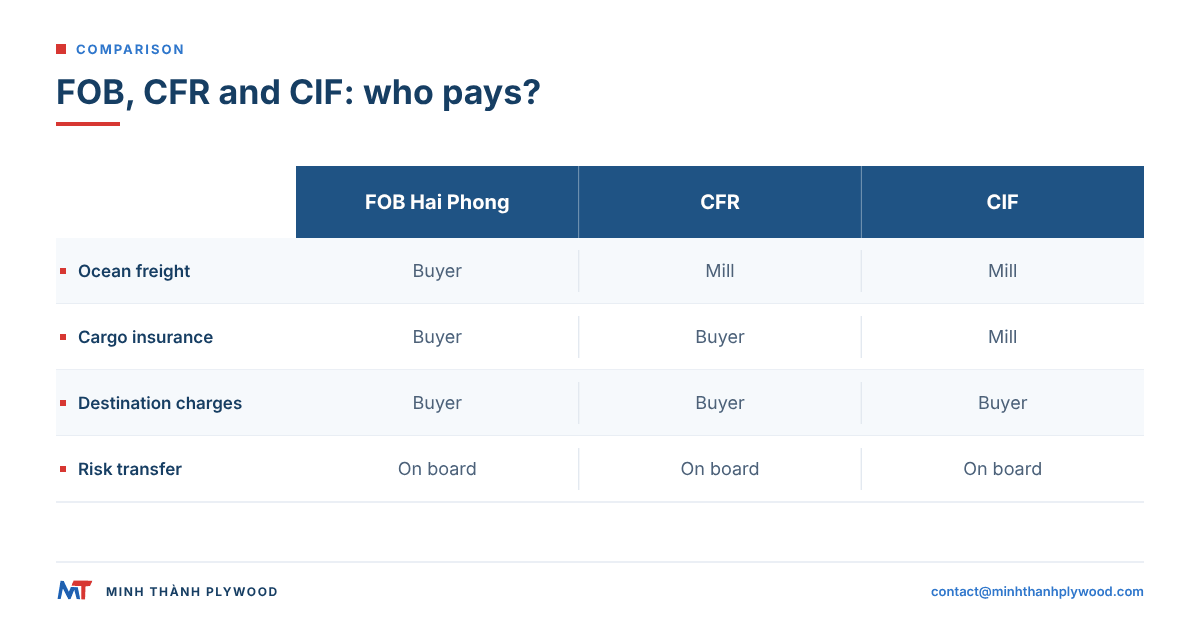
Buy FOB Hai Phong when your forwarder holds contract rates on your lane, and CFR or CIF when you prefer one price to your port and a single invoice. The panels and the container plan are the same on all three; only who books and pays the freight changes.
| Term | Mill pays | You pay | Suits |
|---|---|---|---|
| FOB Hai Phong | Panels, packing, origin charges, export clearance, loading on board | Ocean freight, insurance, destination charges, duty | Importers with a forwarder and contract rates |
| CFR | FOB scope plus ocean freight to your port | Insurance, destination charges, duty | Buyers who want freight in the price and their own insurance |
| CIF | CFR scope plus cargo insurance | Destination charges, duty | A first container; buyers without a forwarder |
Risk passes when the goods are on board in Hai Phong under all three terms, so the loading photos and video Minh Thanh sends for every container are your record of what left the mill. Cargo insurance is usually taken for the CIF value plus a margin, as the policy terms state. Our terms are on the trade terms page.
Is DDP a cheaper way to buy plywood than FOB or CIF?
DDP (delivered duty paid) puts freight, duty, taxes and delivery into one price, which is easy to read and hard to compare, because the lines you could cut or negotiate are hidden.
Some Vietnamese suppliers offer it on small orders. Minh Thanh quotes FOB Hai Phong, CFR and CIF, so each cost line stays visible. Your broker lodges the entry under your own importer registration and you can recover the GST or VAT where the law allows it. To compare a DDP offer with ours, add the freight, insurance, duty, GST or VAT and delivery lines of the FOB table to the FOB price and set the totals side by side.
Who pays if plywood is damaged during shipping?
The party that carries the insurance is paid first, and the loading record settles what the panels looked like when they left. Risk passes when the goods are on board in Hai Phong under FOB, CFR and CIF, so a claim for damage at sea goes to the cargo insurer, not to the mill. Under CIF the mill buys the policy; under FOB and CFR you buy it, and it should cover the CIF value plus a margin, as stated above.
Make the claim file from four documents: the policy, the bill of lading, Minh Thanh’s photos and video of the sealed container taken before loading, and your photos of the packs on arrival with the pack labels visible. The comparison shows whether the damage happened in transit or was present at loading, and it is the same record used in the arrival check in the importing guides.
Direct sailing or transhipment: which costs less?
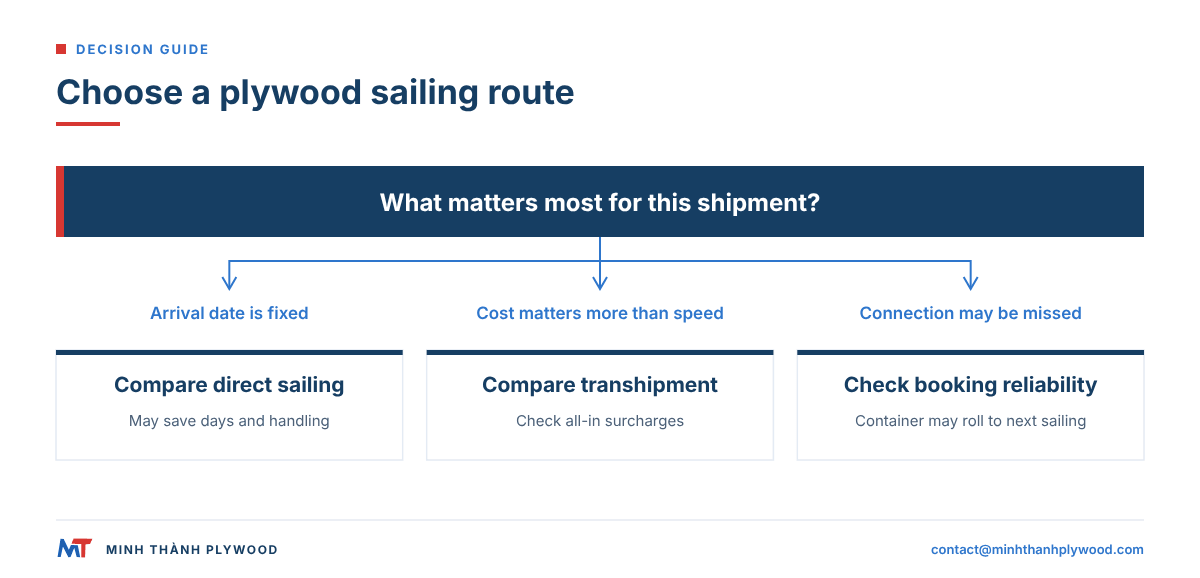
A direct sailing costs more per container on some lanes but saves days and handling. A transhipment through a hub such as Singapore is often cheaper on the base rate and adds days at the hub. For plywood, which is heavy and not perishable, the cheaper routing usually wins unless the arrival date is fixed by a project or a production plan.
Points to weigh in the choice:
- Days: transhipment adds the dwell time at the hub to the typical days at sea.
- Handling: each transfer lifts the container again; packs strapped and wrapped well take this without damage.
- Total cost: compare all-in totals with surcharges, not base rates.
- Booking reliability: a connecting vessel can roll the container to the next sailing in busy weeks.
The pre-loading photos and the pack labels let you check that the packs arrived as they left, whichever routing you choose. How the container is packed is on our container loading page.
How can you lower plywood shipping cost from Vietnam per m³?
You lower plywood shipping cost per m³ by putting more panel volume under the same freight, and by booking at the right time. Five levers work on every lane.
- Choose the lighter core where the use allows. White Styrax carries about 53 m³ at 18 mm against about 43 m³ on Eucalyptus.
- Fill the container with mixed specifications. One or two lines per 40HC as standard, three to six by agreement, instead of a part load.
- Give the mill your real booking payload. The packs are planned to your limit, not to a lower safe guess.
- Book ahead of peak weeks. Peak season surcharges and rate increases follow demand on the lane.
- Compare FOB with CFR on the same day. Your forwarder’s contract rate and the mill’s booking rate can differ.
Thickness matters too: thinner panels pack more sheets per pack, and the 40HC plan for each thickness is set by pack height and weight. For any size or thickness, run the numbers in the packing calculator.
What else adds to the landed cost besides freight?
Freight is one line of the landed cost. The full landed cost per m³ is the FOB panel price, plus freight and insurance, plus duty and taxes in your country, plus destination handling and inland delivery.
| Cost line | Typical basis | Where to read it |
|---|---|---|
| Panel price | Per m³; from US$350/m³ for furniture plywood and from US$250/m³ for commercial plywood (October 2026) | Mill quotation |
| Ocean freight and surcharges | Per 40HC ÷ m³ per 40HC | Forwarder or mill quote, dated |
| Insurance | Share of cargo value | Policy |
| Duty | Tariff rate × customs value | Your customs broker |
| Import taxes | National rate | Your customs broker |
| Destination charges | Per container | Forwarder at destination |
| Inland delivery | Per trip | Haulier or rail operator |
The duty basis differs by market: the EU charges duty on the CIF value, while the US uses the transaction value, normally FOB. The market guides above set out each country’s lines.
For Vietnamese origin the duty is often lower than the headline rate. The EVFTA took effect on 1 August 2020 and removes the EU’s duties on Vietnamese goods either at entry into force or in annual cuts on 1 January, and the last standard EU staging category becomes duty-free on 1 January 2027 (European Commission, EU-Vietnam trade agreement). In Great Britain, plywood from Vietnam enters at a lower duty rate under the UK-Vietnam trade agreement than the third-country rate, when the origin proof is in order (UK Trade Tariff, checked on 21 October 2026).
What does Minh Thanh need to quote shipping cost with the plywood?
Send your specification lines, your port and your booking payload, and Minh Thanh replies within hours with a quotation, the packs plan and, on CFR or CIF, the freight of the day for your port. Minimum order is one 40HC, and samples are free.
- Lines: core, glue, face and back, thickness, size and quantity.
- Port and term: FOB Hai Phong, CFR or CIF to your port.
- Payload: the limit your forwarder or haulier accepts.
- Timing: the month you want the container to sail.
Production takes 15–45 days after the 30% deposit, and the 70% balance is paid against the scanned bill of lading, or by irrevocable L/C at sight. Write to contact@minhthanhplywood.com, use the contact form, or message Lisa on WhatsApp at +84 988 586 601.
Buyer questions, answered
What is the typical plywood shipping cost per CBM from Vietnam?
Divide the 40HC freight by the m³ the container carries. At 18 mm in 1220 × 2440 mm that is about 53 m³ on a Styrax core, so every US$1,000 of freight adds about US$18.85 per m³; on Eucalyptus, with 43 m³, it adds US$23.48.
How does core density affect plywood shipping cost per container?
Heavier cores reach the container payload with fewer sheets. A 40HC carries 990 sheets of 18 mm Styrax-core plywood but 795 sheets on a Eucalyptus core, so the same freight costs about 25% more per m³ on Eucalyptus.
What does a 40ft container of plywood cost to ship from Hai Phong?
The freight for a 40HC changes weekly with the lane, the season and surcharges, so take a dated quote from a forwarder or the mill on the day you book. Container indices such as the Drewry World Container Index and the Freightos Baltic Index show the trend week by week.
Can I mix different plywood specs in one 40HC to save freight cost?
Yes. Minh Thanh loads one or two specifications per container as standard and three to six by agreement, so a smaller buyer fills one 40HC instead of paying for two part loads.
What surcharges are added on top of the base ocean freight rate?
Common ones are the bunker or fuel surcharge (BAF), peak season surcharges, general rate increases, terminal handling at both ends, documentation fees and, when routes change, contingency or emergency surcharges.
Is it cheaper to buy plywood FOB or CIF from Vietnam?
FOB is cheaper when your forwarder has contract rates on your lane; CIF is simpler when you want one price to your port. The mill books CFR and CIF at the rate of the day, so compare both quotes on the same date.
How long does plywood take to ship from Vietnam to Europe?
Typical days at sea from Hai Phong are 25–35 to Mediterranean ports and 30–40 to Northern Europe, by carrier and route.
What does plywood shipping cost from Vietnam to Australia?
Divide the 40HC freight to Sydney, Melbourne or Brisbane by the m³ on board, then convert to AUD at the rate of the booking day. Allow about 25–35 days at sea with a transhipment hub, and add 10% GST on customs value plus freight, insurance and duty.
Is rail freight from Vietnam to Poland an option for plywood?
Rail services from northern Vietnam through China to Europe exist, and a forwarder can quote one when time matters more than cost. For a full 40HC of plywood, sea freight from Hai Phong is the standard mode.
How many sheets of 18 mm plywood fit in a 40HC?
At Minh Thanh, in 1220 × 2440 mm: 990 sheets on a Styrax core (18 packs of 55), 880 on Acacia (16 packs of 55) and 795 on Eucalyptus (15 packs of 53), capped by a planning payload of 28,000 kg.
Does a 20ft container make plywood shipping cheaper?
Rarely. A 20ft carries about half the plywood of a 40HC for a freight that is often well over half the 40HC rate, and Minh Thanh's minimum order is one 40HC, which spreads freight over the most panels.