
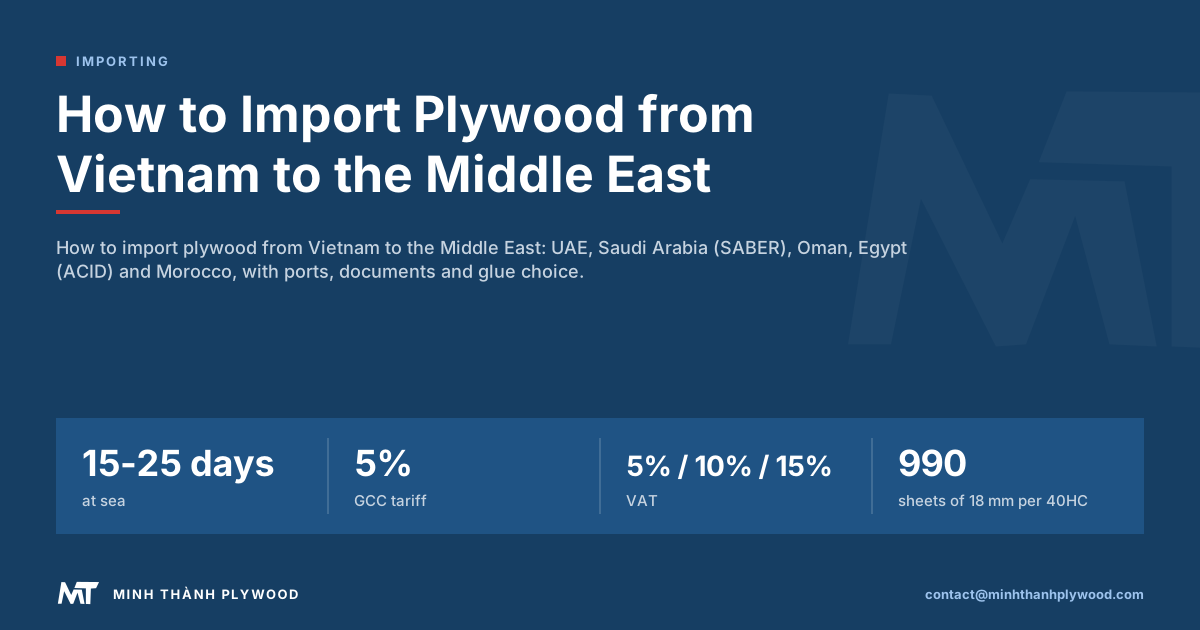
To import plywood from Vietnam to the Middle East, register as an importer in the destination country, confirm the HS 4412 line with your clearing agent, complete any national platform step (SABER in Saudi Arabia, ACID in Egypt), then order on FOB, CFR or CIF from Hai Phong. Minh Thanh Plywood ships in 15–25 days at sea to Gulf ports.
How do you import plywood from Vietnam to the Middle East, step by step?
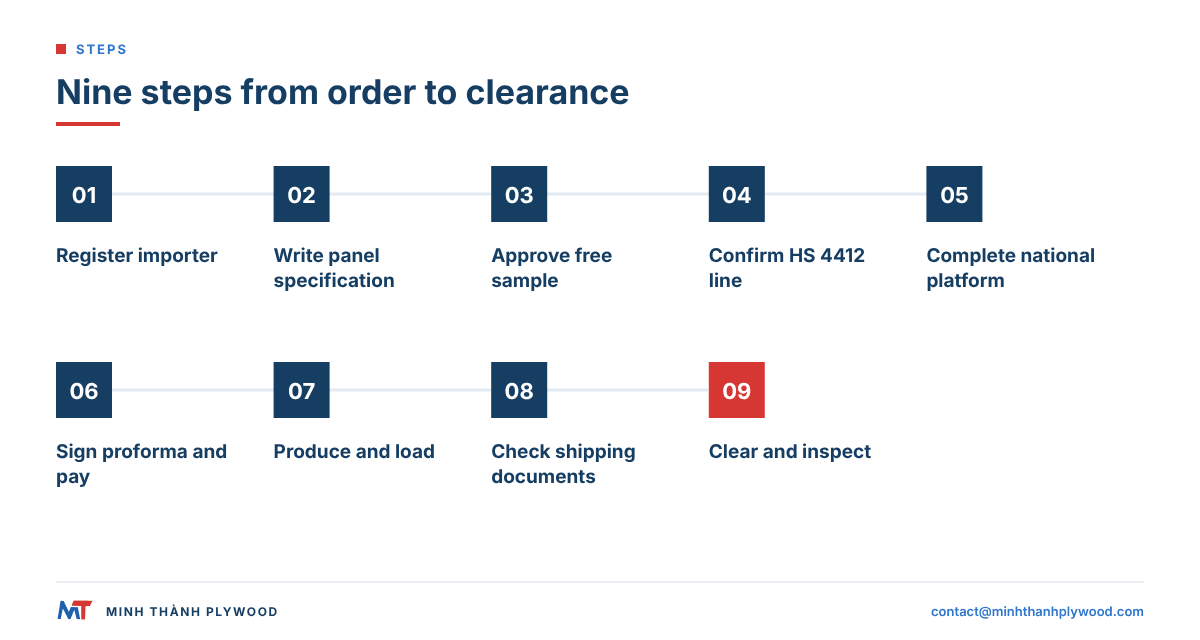
You import plywood from Vietnam to the Middle East in nine steps, and the steps that differ by country are the first and the fifth: importer registration and the national pre-shipment platform. The rest follows the same order from Hai Phong whether the container goes to Jebel Ali, Jeddah or Casablanca.
- Register as importer. A trade licence or commercial registration that covers wood or building materials, and a customs code in the country of entry.
- Write the specification. Use, core, glue, face and back, thickness, size, tolerance, packing and quantity per line.
- Approve a free sample. It fixes face, colour and core build for the order.
- Confirm the tariff line. Your clearing agent fixes the HS 4412 subheading and the duty for your country.
- Complete the national platform step. SABER shipment certificate for Saudi Arabia, ACID number for Egypt, and any product approval your country’s standards body asks for.
- Sign the proforma and pay the deposit. FOB Hai Phong, CFR or CIF; 30% T/T deposit, or an irrevocable L/C at sight.
- Production and loading record. 15–45 days after the deposit; the container is photographed and filmed before loading and you receive the photos and video.
- Documents and payment. Invoice, packing list, bill of lading and certificate of origin, plus legalisation where your country asks for it; 70% balance against the scanned bill of lading.
- Clearance and arrival check. The agent clears the container; you count packs and caliper sheets on arrival.
The sea leg is short: 15–25 days from Hai Phong to Gulf ports. The full process for any market, with the specification in detail, is in how to import plywood from Vietnam.
Which rules apply to plywood imports in each Middle East country?
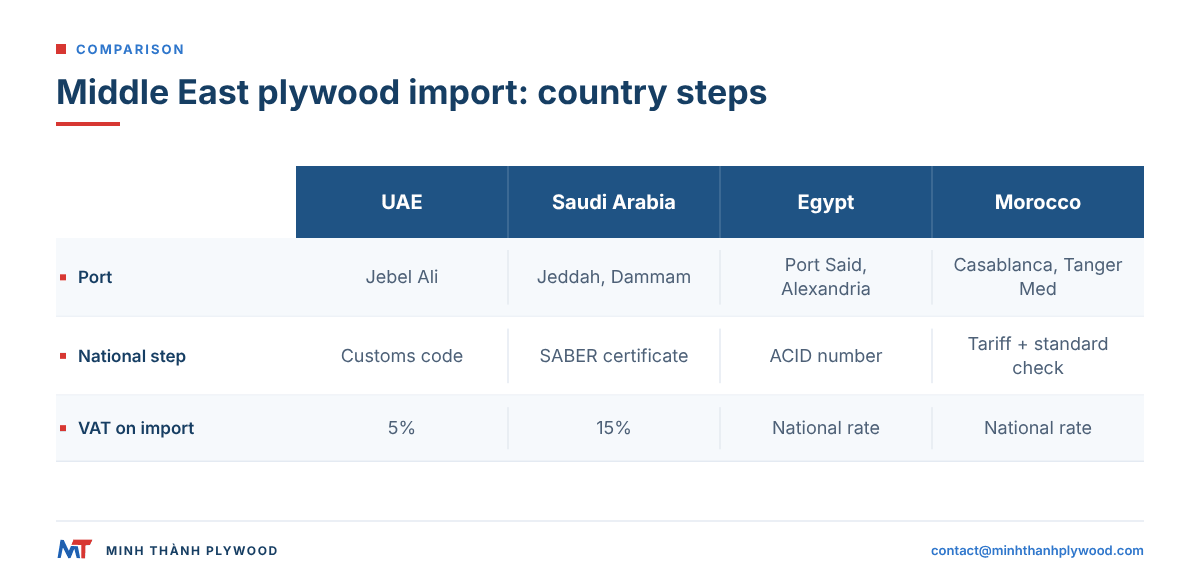
Each Middle East market has its own customs authority and, in some countries, a pre-shipment platform; the six Gulf states share one customs law and tariff. The table puts the country steps side by side.
| Country | Customs authority | Main ports for plywood | National step before or at shipment | Days at sea from Hai Phong |
|---|---|---|---|---|
| United Arab Emirates | Dubai Customs; Abu Dhabi Customs and the other emirates | Jebel Ali, Khalifa Port | Customs code under the importer’s trade licence | 15–25 |
| Saudi Arabia | Zakat, Tax and Customs Authority (ZATCA) | Jeddah, Dammam | SABER product registration and shipment certificate | 15–25 |
| Oman | Oman Customs | Sohar, Salalah | Importer registration | 15–25 |
| Qatar | General Authority of Customs | Hamad Port | Importer registration | 15–25 |
| Kuwait | General Administration of Customs | Shuwaikh, Shuaiba | Importer registration | 15–25 |
| Bahrain | Bahrain Customs Affairs | Khalifa Bin Salman Port | Importer registration | 15–25 |
| Egypt | Egyptian Customs Authority | Port Said, Alexandria, Sokhna | ACID number before shipment | By route via Suez |
| Morocco | ADII (Customs and Indirect Taxes Administration) | Casablanca, Tanger Med | Tariff line and any product standard confirmed by your transitaire | By route |
| Israel | Israel Tax Authority, Customs | Ashdod, Haifa | Standards Institution approval where the product falls under a mandatory standard | By route |
Transit for the Gulf states is the typical 15–25 days at sea from Hai Phong, by carrier and route. Egypt, Israel and Morocco sit on routes through the Red Sea and Suez or via a transhipment hub, so the forwarder quotes the routing for the sailing you book.
A container that enters any GCC state pays customs duty at its first point of entry into the GCC, under the GCC customs union rules, in force since 1 January 2003. Moving it on to another member state inside the union does not add a second duty.
How do you import plywood from Vietnam to the UAE and Dubai?
To import plywood from Vietnam to the UAE, you need a trade licence with an activity that covers wood or building materials. You also need a customs code with Dubai Customs (or the customs authority of your emirate) and a clearing agent who files the declaration at Jebel Ali or Khalifa Port. Most plywood for Dubai and the northern emirates enters through Jebel Ali.
What the UAE importer prepares:
- Licence and customs code: issued under the company’s trade licence; free-zone companies clear through the free-zone procedures.
- Declaration data: HS 4412 line, value, origin Vietnam, consignee as on the bill of lading.
- Documents: commercial invoice, packing list, bill of lading and certificate of origin; some importers also ask for the invoice and certificate of origin to be legalised or attested, so agree this before shipment.
- Duty and VAT: the GCC tariff duty on the customs value, and UAE VAT at 5% on import.
Dubai is also a re-export hub for the wider region. A container cleared into a free zone and re-exported to a neighbouring country does not pay UAE duty, which suits distributors who split loads. Ask the mill for one packing list line per specification and pack labels in English, so re-export paperwork follows without repacking.
Which plywood suits UAE fit-out and construction?
Two groups of lines cover most needs: furniture and joinery panels for fit-out (poplar, okoume, EV and birch faces on white Styrax or Eucalyptus cores) and construction lines: film-faced plywood for concrete formwork and packing plywood for industrial crates. Fit-out panels run on UF glue at E0 emission or MR glue; formwork panels on phenolic (WBP) glue.
How do you import plywood from Vietnam to Saudi Arabia?
To import plywood from Vietnam to Saudi Arabia, register the company with Saudi customs (ZATCA), then register each product line on the SABER platform of the Saudi Standards, Metrology and Quality Organization (SASO). Check the exact HS code on SABER first: regulated products follow their applicable conformity assessment; non-regulated products use an importer self-declaration. Both routes lead to a shipment certificate requested through SABER before Saudi clearance. The official SABER non-regulated-product instructions set out the self-declaration route.
The SABER sequence for a plywood order:
- Product registration: the importer registers the plywood lines on SABER, with the HS code and the product description.
- Select the correct route: if the HS line falls under a Saudi technical regulation, complete the required product conformity assessment with an approved body; otherwise the importer registers a self-declaration for the non-regulated product on SABER. Do not assume every plywood type has the same classification.
- Shipment certificate: for each consignment, the importer requests the shipment certificate on SABER against the shipping data, following the regulated or non-regulated route applicable to that product.
- Clearance: the customs declaration at Jeddah or Dammam is matched to the shipment certificate.
What the mill supplies for SABER: the technical data sheet per line (dimensions, thickness tolerance, glue, face and core species, moisture at dispatch), the emission test reports and the ISO 9001:2015 certificate (KAC25/0185). Start the HS/product-category check while the free sample is in transit; regulated-product conformity review can add lead time.
Saudi Arabia charges VAT at 15% on imports, on top of the GCC tariff duty. Red Sea ports such as Jeddah serve the west and Mecca region; Dammam serves the Eastern Province and Riyadh by rail or road.
Which plywood suits Saudi construction and fit-out?
For concrete work, film-faced plywood with phenolic (WBP) glue, specified by thickness; for trailer floors and platforms, anti-slip plywood, which Minh Thanh accepts on order. Fit-out and furniture work takes the same furniture panels as in the UAE. Each use goes on its own line, because the glue and the face differ.
How do you import plywood from Vietnam to Oman, Qatar, Kuwait and Bahrain?
Oman, Qatar, Kuwait and Bahrain follow the same GCC customs law and unified tariff, so the import steps match the UAE. You need an importer registration, a clearing agent, the HS 4412 line, and the four shipping documents with a certificate of origin. The differences are the port and the VAT.
| Country | Usual port | VAT on import | Notes for a plywood order |
|---|---|---|---|
| Oman | Sohar, Salalah | 5% | Sohar for the north and Muscat; Salalah for transhipment and the south |
| Qatar | Hamad Port | None | Direct or via Jebel Ali feeder |
| Kuwait | Shuwaikh, Shuaiba | None | Often via Jebel Ali or Dammam routing |
| Bahrain | Khalifa Bin Salman Port | 10% | Also reached by road from Dammam |
To import plywood from Vietnam to Oman, register as an importer with Oman Customs, book to Sohar for the northern governorates, and clear with the invoice, packing list, bill of lading and certificate of origin. Duty paid on first entry into the GCC covers onward movement inside the union, which matters when a Qatar or Kuwait load arrives through a UAE hub.
How do you import plywood from Vietnam to Iraq, Egypt, Morocco and Israel?
Egypt, Morocco and Israel sit outside the GCC customs union, and each adds one step before shipment: an ACID number for Egypt, a confirmed tariff and product standard for Morocco, and a standards check for Israel.
Egypt. Egypt’s Advance Cargo Information (ACID) system requires the importer to obtain an ACID number before the goods are shipped, and the exporter to register and upload the invoice and shipping data through the approved platform. The ACID number goes on the invoice, packing list and bill of lading. The mill registers on the platform as exporter and uploads the invoice and shipping data for each order.
Iraq. To import plywood from Vietnam to Iraq, the main gateway is Umm Qasr near Basra, served by direct and feeder sailings from the Gulf hubs. Iraq is a growing construction market that buys formwork, packing and building plywood. You need an importer licence, a commercial invoice, packing list, bill of lading and a certificate of origin legalised for the destination; your clearing agent confirms the tariff line for heading 4412 and any inspection step before the first order. Minh Thanh quotes FOB Hai Phong, or CFR or CIF Umm Qasr.
Morocco. To import plywood from Vietnam to Morocco, clear through Casablanca or Tanger Med with the Customs and Indirect Taxes Administration (ADII), using a licensed customs broker (transitaire). Confirm the tariff line for heading 4412 and whether the product falls under a mandatory Moroccan standard before the deposit; the base documents are the commercial invoice, packing list, bill of lading and certificate of origin.
Israel. Clear through Ashdod or Haifa with the Israel Tax Authority. Products under a mandatory Israeli standard need the Standards Institution approval before clearance; your importer or agent checks whether your panel’s use (furniture, construction, packing) falls under one.
For Egypt, Morocco and Israel, the routing runs through the Red Sea and Suez or via a transhipment hub; the forwarder quotes the transit for the sailing.
Which documents travel with a plywood container to the Middle East?
The commercial invoice, packing list, bill of lading and certificate of origin travel with the container; the destination may add a pre-shipment number, legalisation or a fumigation certificate. Agree the full list in the proforma, so no document is requested after the vessel sails.
| Document | Issued by | Why the destination needs it | When you receive it |
|---|---|---|---|
| Commercial invoice | Minh Thanh | Customs value, HS line, consignee | Copy at loading |
| Packing list | Minh Thanh | Packs, sheets, m³ and weights per line | Copy at loading |
| Bill of lading | Shipping line | Release of the container | Scan after sailing |
| Certificate of origin | Vietnamese issuing authority | Origin Vietnam on the declaration | After sailing |
| Legalisation or attestation | Chamber or embassy, where asked | Required by some Gulf importers and banks | Before the documents are couriered |
| SABER shipment certificate | Importer requests via SABER; issuance follows product category | Saudi clearance | Before arrival |
| ACID number | Egyptian importer, on the platform | Egyptian clearance | Before shipment |
| Phytosanitary or fumigation certificate | Vietnamese provider | Solid wood bearers; some ports | After sailing |
| Insurance certificate | Insurer | CIF orders; L/C terms | After sailing |
Plywood is processed wood and sits outside the ISPM 15 standard; solid sawn-wood bearers under the packs are inside it and carry the ISPM 15 mark. Certificate files are sent with the order: CARB P2 / TSCA Title VI, the chamber reports, ISO 9001:2015 and TCVN 11902:2017. The general list is in the plywood import documents checklist.
Which certificate of origin do Middle East importers need?
A standard (non-preferential) certificate of origin issued in Vietnam covers most Gulf and North African clearances. Where a trade agreement with Vietnam gives a preferential rate, your agent names the origin form it needs. What changes is the form around it. Some importers and banks ask for the certificate and the invoice to be legalised by a chamber of commerce or the destination country’s embassy, and an L/C may name the issuing body. Put the exact wording and the legalisation in the proforma, so the certificate is issued once and correctly.
The certificate must match the invoice and the bill of lading on consignee, description and quantity. For a mixed container, one certificate covers all lines, with the description listing each specification as on the invoice.
What does an L/C need from the plywood documents?
An irrevocable L/C at sight pays against a complying presentation. For credits governed by UCP 600, document data must be consistent with the credit and other required documents; identical wording is not a universal requirement. Send the mill a draft of the L/C before it is issued. The description of goods, the number of originals, the legalisation and the latest shipment date must all be ones the mill and the port can meet. A conflicting goods description or a missing required document can delay payment.
What import duty and taxes apply to plywood in the Middle East?
In the six GCC states, plywood pays duty under the unified GCC tariff, with a general rate of 5% on most imported goods. National VAT comes on top where a state has one: 5% in the UAE and Oman, 10% in Bahrain, 15% in Saudi Arabia. Qatar and Kuwait have none. Your clearing agent confirms the rate for the exact HS 4412 line.
| Market | Duty basis | VAT on import | Pre-shipment or product step |
|---|---|---|---|
| UAE | GCC unified tariff on CIF value | 5% | Customs code |
| Saudi Arabia | GCC unified tariff on CIF value | 15% | SABER shipment certificate |
| Oman | GCC unified tariff on CIF value | 5% | Importer registration |
| Bahrain | GCC unified tariff on CIF value | 10% | Importer registration |
| Qatar, Kuwait | GCC unified tariff on CIF value | None | Importer registration |
| Egypt | Egyptian tariff, HS 4412 line | National VAT | ACID number |
| Morocco | Moroccan tariff, HS 4412 line | National VAT | Tariff and standard confirmed |
| Israel | Israeli tariff, HS 4412 line | National VAT | Standards approval where required |
The HS subheading follows the species of the face and back plies. Birch, poplar and eucalyptus faces sit in the hardwood lines, and okoume and other tropical faces in the tropical lines. Pine has the coniferous line, and LVL its own lines. Write the face and back species per line on the invoice, so the agent classifies from the document and not from a sample.
Which plywood specifications suit the Middle East climate?
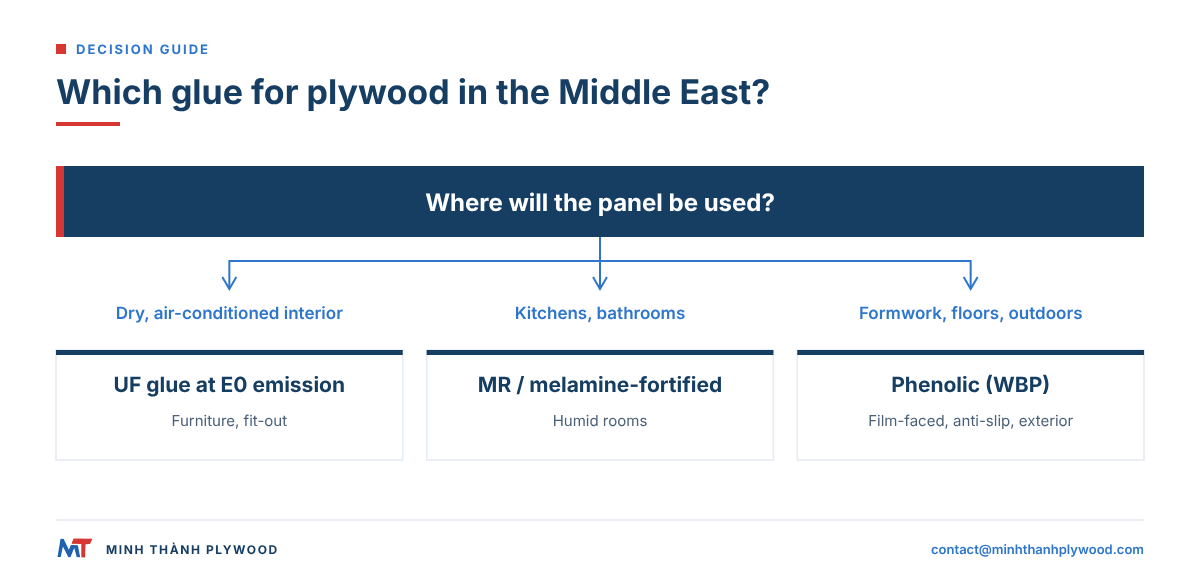
Specify glue by where the panel will live: UF glue at E0 emission or MR / melamine-fortified glue for furniture and joinery in air-conditioned interiors, and phenolic (WBP) glue for formwork, exterior work and wet areas. Heat and dust at the port and on site are handled by the packing; the panel’s service life is decided by the glue line.
| Use in the region | Panel | Glue | Face | Why this glue |
|---|---|---|---|---|
| Fit-out, furniture, joinery | Furniture plywood, white Styrax or Eucalyptus core | UF glue at E0 emission, or MR | Poplar, EV, okoume, birch | Dry, conditioned interiors |
| Kitchens and bathrooms | Furniture plywood | MR / melamine-fortified | As above, UV-ready if coated | Humid rooms |
| Concrete formwork | Film-faced plywood | Phenolic (WBP) | Film on both faces | Wet concrete, repeated pours |
| Trailer floors, platforms | Anti-slip plywood (on order) | Phenolic (WBP) | Textured film | Outdoor exposure, washing |
| Crates and pallets | Packing plywood | MR or as specified | Utility faces | Dry or covered storage |
| Exterior work | Exterior / CDX-type plywood | Melamine-fortified or phenolic (WBP) | C/D utility faces | Sun and rain |
Thickness tolerance follows the panel type: sanded furniture panels ±0.2–0.3 mm and down to ±0.2 mm; commercial and film-faced ±0.5 mm; packing ±0.5–1.0 mm; length and width ±2 mm. Panels leave the mill at 8–12% moisture content, the normal range for furniture plywood.
Which film-faced plywood suits Gulf concrete formwork?
Select the thickness from the formwork design, including supports, concrete pressure and deflection limits; 18 and 21 mm are quotation examples, not load ratings. Specify the film weight and bond separately. Minh Thanh’s usual smooth film is about 120–135 g/m², with premium film from 135 g/m²; confirm the ordered weight and colour in the quotation. Standard sheet formats include 1220 × 2440 mm and 1250 × 2500 mm.
| Formwork line | Thickness | Film | Glue | Use |
|---|---|---|---|---|
| 18 mm quotation example | 18 mm, subject to design | Brown or black; weight per order | Phenolic (WBP), with required bond evidence | Slabs, walls or columns as designed |
| 21 mm quotation example | 21 mm, subject to design | Brown or black; weight per order | Phenolic (WBP), with required bond evidence | Applications requiring the specified panel and supports |
Reuse depends on film weight, edge sealing, release agent and handling, so put the reuse you plan on the order and ask the mill for the film weight and edge sealing in the quotation. Heat adds one more point: keep the packs wrapped and out of direct sun between pours, as in the next section. For strength, name the bending test (EN 310 for bending strength and modulus of elasticity) on the order, the same way a European buyer does.
How do panels behave in a dry Gulf warehouse?
A panel at 8–12% moisture slowly gives up moisture in a dry, hot warehouse, as all wood does. Keep packs wrapped until use, store them flat on level bearers away from direct sun, and open a pack a day or two before machining so the sheets settle to the workshop. Stitched cores (stitched horizontally and vertically at Minh Thanh) and twice-pressed furniture panels keep their faces flat through that change. Our film-faced range for formwork is on the film-faced plywood page.
How long does it take to import plywood from Vietnam to the Middle East?
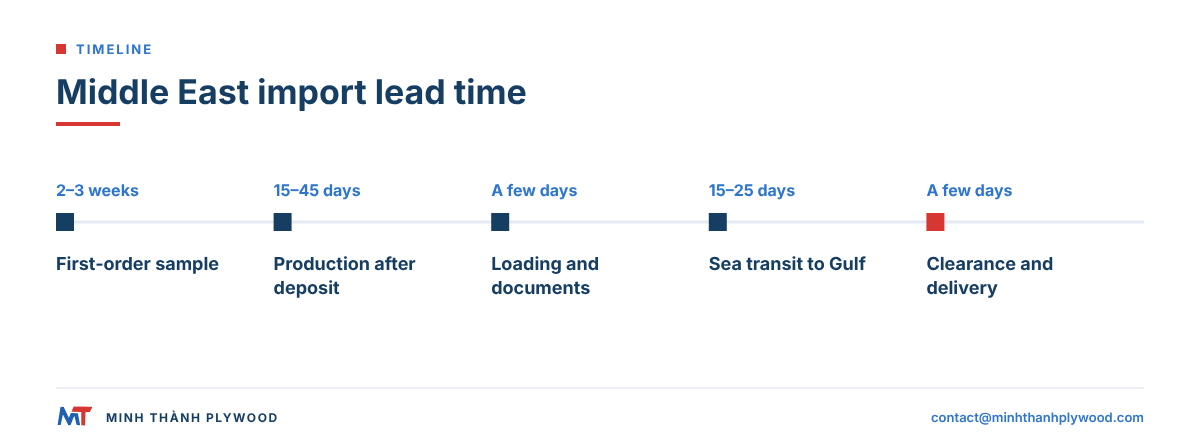
A repeat order to a Gulf port takes about 5 to 11 weeks from the deposit: 15–45 days of production, a few days for loading and documents, and 15–25 days at sea. A first order adds 2–3 weeks for the sample and any SABER or ACID step started in parallel.
| Stage | Duration | Runs in parallel with |
|---|---|---|
| Specification and free sample | 2–3 weeks | Importer registration, SABER product registration |
| Proforma and deposit | A few days | L/C issue, ACID request for Egypt |
| Production | 15–45 days after deposit | Shipment certificate request, booking |
| Loading, photos, documents | A few days | Legalisation of documents |
| Sea transit to Gulf ports | 15–25 days | Clearance preparation |
| Clearance and delivery | A few days | — |
The 15–45 days are production after the deposit, not the sailing date. Thin 4 mm furniture panels with premium faces can take longer, because premium thin veneer is scarce and we do not lower the standard to go faster.
Port-to-port sailing days differ by Gulf port. These are the typical sea days quoted for the main Gulf ports on ranking supplier guides, counted from Ho Chi Minh City; from Hai Phong add the feeder or the northern leg and use the 15–25 days above.
| Gulf port | Typical sea days from Ho Chi Minh City |
|---|---|
| Jebel Ali (UAE) | 14–18 days |
| Hamad (Qatar) | 15–20 days |
| Jeddah (Saudi Arabia) | 16–22 days |
When should the SABER or ACID step start?
Start it the day you approve the sample. A SABER product registration and an ACID request both run on their own clock, and neither needs the panels to exist. Run them while the mill produces.
For Saudi Arabia, register the product lines on SABER and check whether each HS line is regulated. For regulated products, ask the approved conformity body for its evidence list; for non-regulated products, complete the importer self-declaration on SABER. The mill supplies the technical data sheet and available test reports. Request the shipment certificate when the shipping data are ready.
For Egypt, the importer requests the ACID number before shipment. The mill then registers as exporter and uploads the invoice data. The number goes on every shipping document, so it must exist before the documents are printed.
What does plywood cost to land in the Middle East?
The landed cost per m³ in a Gulf port is the panel price, plus freight and insurance to the port, plus GCC duty on the CIF value, plus port charges and inland delivery. VAT is added on top where it applies. Minh Thanh’s indicative starting prices, October 2026, are from US$350/m³ for furniture and interior plywood and from US$250/m³ for commercial plywood, depending on face, core, glue, thickness, size, quantity and delivery term.
| Line | Basis | FOB order | CFR / CIF order |
|---|---|---|---|
| Panels | Per m³ by specification | Importer pays the mill | Importer pays the mill |
| Ocean freight | Per 40HC, Hai Phong to port | Importer’s forwarder | Included by the mill |
| Insurance | Share of cargo value | Importer | Included on CIF |
| Customs duty | Tariff rate × CIF value | Importer | Importer |
| VAT | National rate | Importer | Importer |
| Pre-shipment fees | SABER, ACID, legalisation | Importer | Importer |
| Port and inland | Handling, trucking | Importer | Importer |
Freight per m³ depends on the core. At 18 mm in 1220 × 2440 mm, a 40HC carries about 53 m³ on a Styrax core, 47 m³ on Acacia and 43 m³ on Eucalyptus, because heavier cores reach the payload limit with fewer sheets. The worked figures are in plywood shipping cost from Vietnam.
How is a plywood container to the Middle East packed and loaded?
A 40HC for the Middle East is packed in packs about 1,000 mm high, each on a base with cardboard protection, wrapping film and straps, and loaded to a plan that keeps the gross weight within the booking. Heat, dust and long port dwell times in summer are the reason the wrapping and the corner protection matter more than on a short Asian leg.
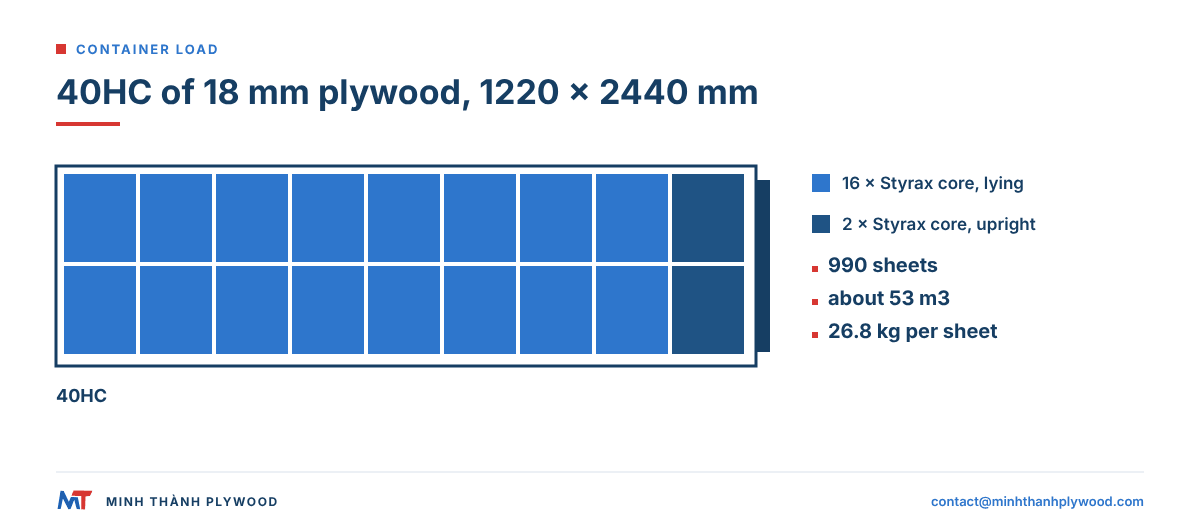
The 40HC plan for 1220 × 2440 mm panels at Minh Thanh:
| Core | Packs per 40HC | Sheets at 18 mm | Volume at 18 mm | Weight per 18 mm sheet |
|---|---|---|---|---|
| White Styrax (about 500 kg/m³) | 18 (16 lying + 2 upright) | 990 (55 per pack) | About 53 m³ | 26.8 kg |
| Acacia (about 580 kg/m³) | 16 | 880 (55 per pack) | About 47 m³ | 31.1 kg |
| Eucalyptus (about 650 kg/m³) | 15 | 795 (53 per pack) | About 43 m³ | 34.8 kg |
Sheets per pack are 1,000 mm divided by the thickness, rounded down, then capped by weight; the planning payload is 28,000 kg unless the booking is lower. Every container is photographed and filmed before loading, and the photos show pack labels, wrapping and the door view. How the packs go in is on our container loading page.
How are plywood packs protected for heat and dust?
Each pack is built to keep its shape and its faces clean through port dwell and trucking in heat. It has a base under the sheets, cardboard corner and top protection, wrapping film around the pack, and steel or plastic straps. The film keeps dust and sand off sanded faces; the corner protection stops strap marks on the edges.
On arrival, keep the film on until the panels are used, store packs flat on level bearers, and keep them out of direct sun. A pack left standing on uneven ground in the sun can bow, whatever the panel; stored flat and wrapped, sheets stay as they left the mill.
Can one container carry several specifications?
Yes. One container usually carries one or two specifications, and three to six by agreement, for example fit-out poplar in 18 mm with film-faced 18 mm for the same contractor. Each specification gets its own packing-list line and pack labels, which keeps the SABER and invoice lines matched.
How do you choose a Vietnamese plywood supplier for the Middle East?
Choose a supplier who makes the panels in its own factory, can show the technical files your national platform needs, and loads to a written plan with photos. A short check before the first deposit separates a manufacturer from a reseller.
| What to check | Ask for | What a manufacturer shows |
|---|---|---|
| Own production | Factory photos and video, or a video call | Peeling, lay-up, pressing and sanding lines of its own factory |
| Technical files | Data sheet per line, test reports | Thickness tolerance, glue, moisture, chamber reports with lab and date |
| Certificates | Certificate copies | ISO 9001:2015 (KAC25/0185), TCVN 11902:2017 (VietCert 141.1-VNC-HC), CARB P2 / TSCA Title VI (ICTT mill no. 23024) |
| Range | Panels for your uses | Furniture, film-faced, anti-slip, packing and exterior lines |
| Loading | Plan and record | Packs plan before loading; photos and video of every container |
| Terms | Proforma | FOB Hai Phong, CFR or CIF; T/T or L/C at sight |
Minh Thanh is a plywood manufacturer in Ha Hoa, Phu Tho, with a capacity of 50,000+ m³ per year, and exports across Europe, the Americas, Asia and Africa. A full supplier checklist is in how to choose a plywood supplier in Vietnam.
What should a Middle East importer write on the plywood specification?
Write one line per panel, in the order the mill builds it, and add the national file you need for clearance. A complete line lets the mill quote, prepare the SABER or ACID data and plan the container in one round.
- Use: fit-out, furniture, formwork, flooring, packing or exterior.
- Core: white Styrax or Eucalyptus as standard; Acacia or Pine on order.
- Glue: UF glue at E0 emission, MR / melamine-fortified, or phenolic (WBP).
- Face and back: species and grade pair, such as poplar A/B, okoume, birch D+/D, eucalyptus B/B, or film on both faces.
- Thickness and tolerance: 3–40 mm; tolerance for the panel type.
- Size: 1220 × 2440 or 1250 × 2500 mm, or custom such as 1220 × 2500.
- Packing and quantity: sheets per line, labels in English (and Arabic where asked).
- Port, term and files: port of entry, FOB, CFR or CIF, certificate of origin, legalisation, SABER or ACID data.
Our construction lines are on the construction plywood page, and the furniture lines on the furniture plywood page.
How do you check a plywood container on arrival in a Gulf port?
Open the container in the shade, against the packing list, and measure before the packs are spread across a hot yard. The checks are the same as anywhere, done fast.
- Seal: photograph and compare the seal number with the bill of lading.
- Packs: count against the packing list; photograph the pack labels.
- Wrapping: note any torn film or corner damage before the packs move.
- Thickness: caliper sheets from several packs per line.
- Size: length and width within ±2 mm.
- Faces and film: compare with the approved sample; for film-faced panels, check the film edges and the edge sealing.
- Report: photos and readings with pack numbers, sent the same day.
Every container is filmed before loading, so any question is checked against the same packs on video. Store the packs flat and wrapped after the check, as described in the climate section above.
Why import plywood from Vietnam to the Middle East?
Middle East importers buy plywood from Vietnam for a short sea leg, many panel types from one mill, and plantation cores made into furniture-grade panels with the files that go with them. From Hai Phong, Gulf ports are 15–25 days at sea, shorter than the 30–40 days to Northern Europe.
What a Vietnamese manufacturer such as Minh Thanh brings to a Gulf or North African order:
- One mill, many lines: furniture panels, film-faced plywood for formwork, anti-slip plywood on order, packing plywood, exterior / CDX-type plywood and LVL, so one supplier can fill a mixed container.
- Plantation cores: white Styrax and Eucalyptus cores as standard, from timber grown around Ha Hoa, Phu Tho; Acacia and Pine on order.
- Faces for fit-out: 10+ face veneers, mostly engineered veneer (EV), poplar, birch, okoume and pine, with bintangor, eucalyptus, gurjan and sapele on request.
- Built for demanding specifications: cores stitched horizontally and vertically, furniture panels pressed twice, sanded and polished faces, thickness tolerance down to ±0.2 mm.
- Sizes: 1220 × 2440 and 1250 × 2500 mm, custom sizes such as 1220 × 2500 and 1220 × 2280, and cut-to-size panels.
- Files for platforms and projects: ISO 9001:2015, TCVN 11902:2017, CARB P2 / TSCA Title VI certification and six third-party chamber reports.
Capacity is 50,000+ m³ per year, with over 20 years of plywood-making experience, and the factory is built for top-grade furniture and interior plywood. Indicative starting prices, October 2026, are from US$250/m³ for commercial plywood and from US$350/m³ for furniture plywood.
How do you plan a mixed plywood container for a Gulf distributor?
Plan a mixed container by listing each line with its quantity in sheets, then let the mill fit the packs to the payload: one or two specifications per 40HC as standard, three to six by agreement. Heavy and light lines balance each other, and every line keeps its own packing-list entry and pack labels.
A distributor in Dubai or Dammam often wants fit-out panels and site panels in one box. A workable plan groups lines like this:
- Fit-out line: 18 mm poplar or EV faces on a white Styrax core, UF glue at E0 emission, sanded.
- Site line: 18 mm film-faced plywood with phenolic (WBP) glue for formwork.
- Utility line: packing plywood for crates, in the thickness your customers use.
Send the lines in priority order. If the payload cuts the plan, the mill reduces the lowest-priority line first and tells you the new sheet counts before loading. Light Styrax-core lines carry more sheets per pack weight than Eucalyptus-core lines, so a plan heavy in film-faced panels on hardwood cores fills by weight sooner. The packing calculator shows the arithmetic for any thickness.
For a re-export load through a free zone, ask for one packing-list line per specification and per final buyer, and labels in English. The re-export paperwork then follows the packs without repacking.
Which mistakes delay plywood clearance in the Gulf and North Africa?
Most delays in Gulf and North African ports come from a missing platform step or a document mismatch, and each is fixed before the vessel sails. These are the usual ones.
- No SABER shipment certificate: a Saudi container without it cannot clear; request it while the panels are in production.
- No ACID number on the documents: an Egyptian shipment without the ACID number on the invoice, packing list and bill of lading is held.
- Legalisation forgotten: an importer or bank that needs attested documents receives unattested originals.
- Conflicting L/C and invoice data: check the goods description and required documents against the credit before presentation.
- Face species missing on the invoice: the agent cannot fix the HS 4412 line from “plywood” alone.
- Untreated solid wood bearers: sawn-wood bearers under the packs without the ISPM 15 mark.
A draft check of the invoice, packing list, certificate of origin and L/C by your agent and the mill, before loading, removes all six. More buying errors are listed in mistakes when importing plywood from Vietnam.
What does Minh Thanh need to quote plywood for the Middle East?
Send your specification lines, your port of entry and the national file you need, and Minh Thanh replies within hours with questions or a quotation and a packs plan. Minimum order is one 40HC, and samples are free.
- Lines: use, core, glue, face and back, thickness, size.
- Quantity: sheets or m³ per line; mixed lines listed separately.
- Port and term: Jebel Ali, Jeddah, Dammam, Sohar, Hamad, Port Said, Casablanca or other; FOB Hai Phong, CFR or CIF.
- Files: certificate of origin, legalisation, SABER data, ACID upload, test reports.
- Payment: 30% T/T deposit and 70% against the scanned bill of lading, or an irrevocable L/C at sight.
Write to contact@minhthanhplywood.com, use the contact form, or message Lisa on WhatsApp at +84 988 586 601; office hours are Monday to Friday, 08:00–17:00 Vietnam time (UTC+7). The full range is in the plywood catalogue, and our standard terms are on the trade terms page.
Buyer questions, answered
How do I import plywood from Vietnam to Saudi Arabia?
Register with Saudi customs and register each plywood line on SABER. Check its HS code and whether it falls under a Saudi technical regulation: regulated products follow the required conformity assessment, while non-regulated products use an importer self-declaration. Obtain the shipment certificate through SABER before clearing at Jeddah or Dammam.
How do I import plywood from Vietnam to the UAE?
Hold a trade licence that covers building materials or wood products and a customs code with Dubai Customs or the customs authority of your emirate. Your clearing agent files the declaration at Jebel Ali or Khalifa Port with the invoice, packing list, bill of lading and certificate of origin.
How do I import plywood from Vietnam to Oman?
Register as an importer with Oman Customs, choose Sohar or Salalah as port of entry, and clear the container with the standard shipping documents and a certificate of origin; Oman applies the GCC common customs law and tariff.
How do I import plywood from Vietnam to Morocco?
Clear through Casablanca or Tanger Med with the Moroccan customs administration (ADII), using the invoice, packing list, bill of lading and a certificate of origin. Ask your transitaire to confirm the tariff line for heading 4412 and any standard the product falls under before shipment.
What is the import duty on plywood in the GCC?
The six GCC states apply one common customs law and a unified tariff, with a general rate of 5% on most imported goods. Your clearing agent confirms the rate for the exact HS 4412 line of your panel.
Do I need a SABER certificate for plywood in Saudi Arabia?
For a Saudi plywood shipment, the importer registers the product and requests a SABER shipment certificate. If its HS classification is regulated, the applicable conformity assessment and product certificate may be needed; if non-regulated, SABER uses the importer self-declaration route. Check the current classification on SABER before booking.
What is ACID for plywood imports to Egypt?
Advance Cargo Information (ACID) is Egypt's pre-shipment registration: the importer obtains an ACID number before the goods are shipped, and the exporter uploads the invoice and shipping data through the approved platform. The number must appear on the shipping documents.
How long does shipping plywood from Vietnam to Dubai take?
Typical days at sea from Hai Phong to Middle East ports are 15–25, after production of 15–45 days counted from the deposit.
Which plywood glue is best for the Middle East climate?
For furniture and joinery in air-conditioned interiors, UF glue at E0 emission or MR / melamine-fortified glue; for formwork, exterior work and wet areas, phenolic (WBP) glue. Write the glue and the use on each line.
Can I pay for plywood from Vietnam by letter of credit?
Yes. Minh Thanh accepts an irrevocable L/C at sight, or T/T with 30% deposit and 70% against the scanned bill of lading.
What is the minimum order for plywood shipped to the Middle East?
One 40-foot high-cube container. One container can carry one or two specifications as standard and three to six by agreement.
Does plywood need fumigation for Middle East ports?
Plywood is processed wood and is outside ISPM 15. Solid wood bearers under the packs need the ISPM 15 treatment mark, and some ports or importers also ask for a fumigation certificate; agree this before loading.