
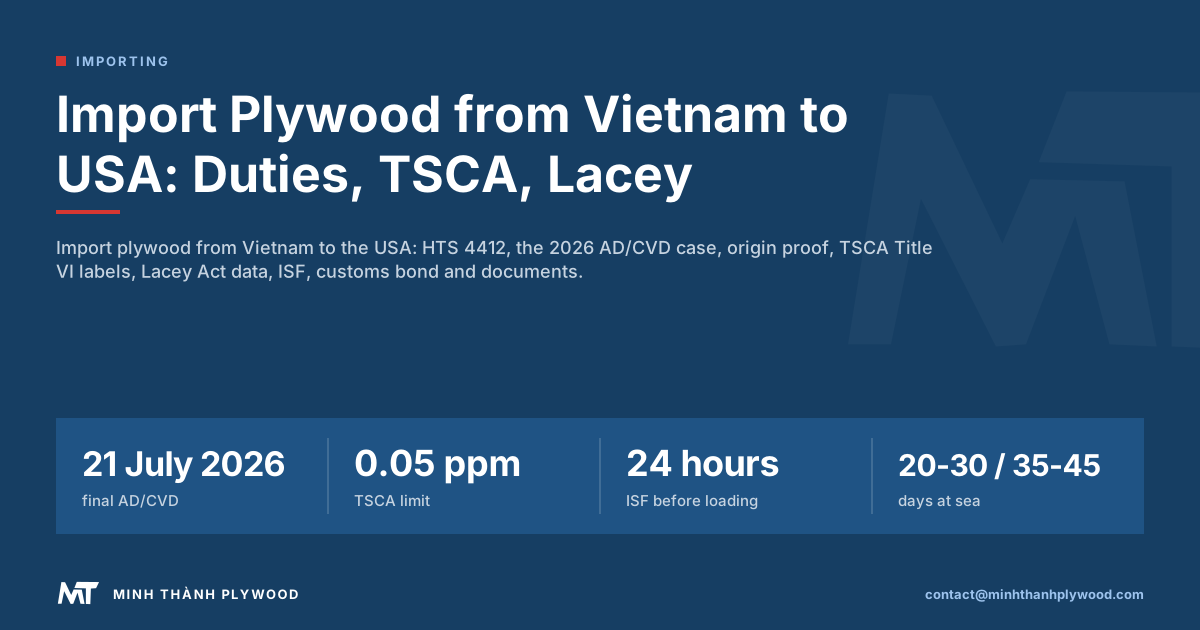
To import plywood from Vietnam to the USA you need a customs bond, an Importer Security Filing before loading, TSCA Title VI labelled panels, Lacey Act species and origin data, and a broker who checks the HTS 4412 line and the 2026 anti-dumping case scope. Minh Thanh Plywood holds CARB P2 / TSCA Title VI certification and supplies every file.
What are the plywood import procedures in the United States, step by step?
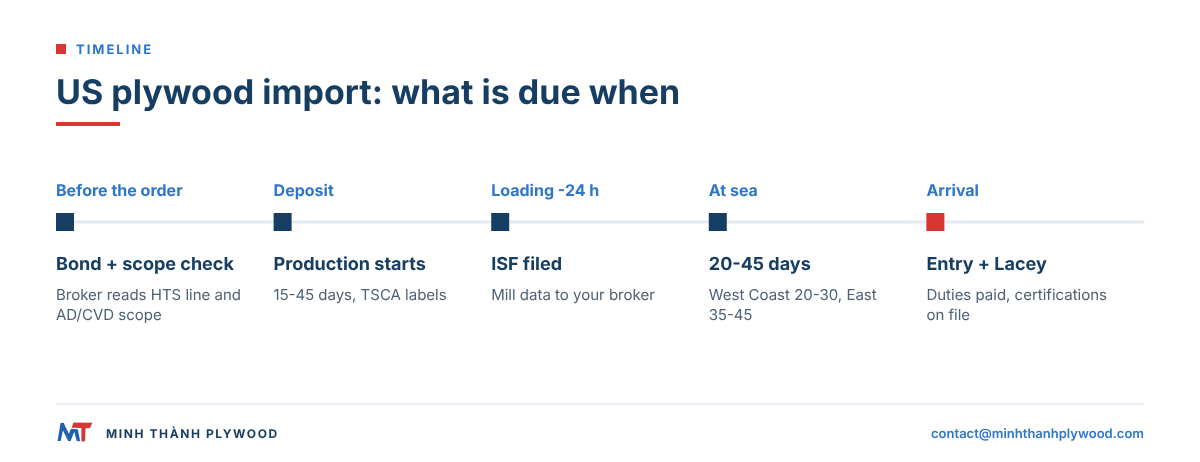
You import plywood from Vietnam to the USA in nine steps, and four of them are US filings that the mill’s data must feed on time: the ISF, the Lacey declaration, the TSCA labelling and the entry. Here is the order a US importer follows with Minh Thanh.
- Set up as importer of record. Get a customs bond (single-entry or continuous) and appoint a licensed customs broker.
- Check the tariff line and the case scope. Your broker confirms the HTSUS 4412 subheading for the panel and checks it against the 2026 anti-dumping and countervailing duty case on hardwood plywood from Vietnam.
- Specify and sample. Write the specification lines and approve the free sample, which fixes face, core and glue.
- Order. Sign the proforma on FOB Hai Phong, CFR or CIF; 30% deposit by T/T, or an irrevocable L/C at sight.
- Production with TSCA labelling. 15–45 days after the deposit; panels for US orders carry the TSCA Title VI label.
- ISF and Lacey data. The mill sends the shipper, manufacturer and species data; your broker files the ISF at least 24 hours before loading and prepares the Lacey declaration.
- Loading record. The container is photographed and filmed before loading; you receive the photos and video.
- Entry and clearance. The broker files the entry with the invoice, packing list, bill of lading, Lacey declaration and any origin certifications, and you pay the duties.
- Arrival check. Count packs and caliper sheets before the panels go into production.
Steps 2 and 6 are where US plywood imports usually stall: a case-scope question discovered after loading, or ISF data that arrives late. The general ten-step process for any market is in how to import plywood from Vietnam.
Which HTS code covers plywood from Vietnam, and what duty applies?
Plywood enters the US under heading 4412 of the Harmonized Tariff Schedule of the United States (HTSUS), and the subheading follows the species of the outer plies and the thickness of each ply. The general (normal trade relations) rate is set per ten-digit line in the USITC HTS, because the US has no free trade agreement with Vietnam that lowers plywood duty.
How the face of a Minh Thanh panel maps to the structure of heading 4412:
| Outer ply on the panel | Where it sits in heading 4412 | Minh Thanh panel |
|---|---|---|
| Birch | Hardwood (non-coniferous) outer ply, birch line | Birch plywood |
| Poplar | Hardwood outer ply, poplar line | Poplar plywood, many EV faces |
| Eucalyptus | Hardwood outer ply, other hardwood lines | Eucalyptus-faced plywood |
| Okoume, Sapele, Bintangor, Gurjan | Tropical wood outer ply | Okoume, Bintangor, Gurjan plywood; Sapele on request |
| Pine | Coniferous wood on both outer plies | Pine plywood |
| Veneer layers parallel (LVL) | Laminated veneer lumber lines | LVL |
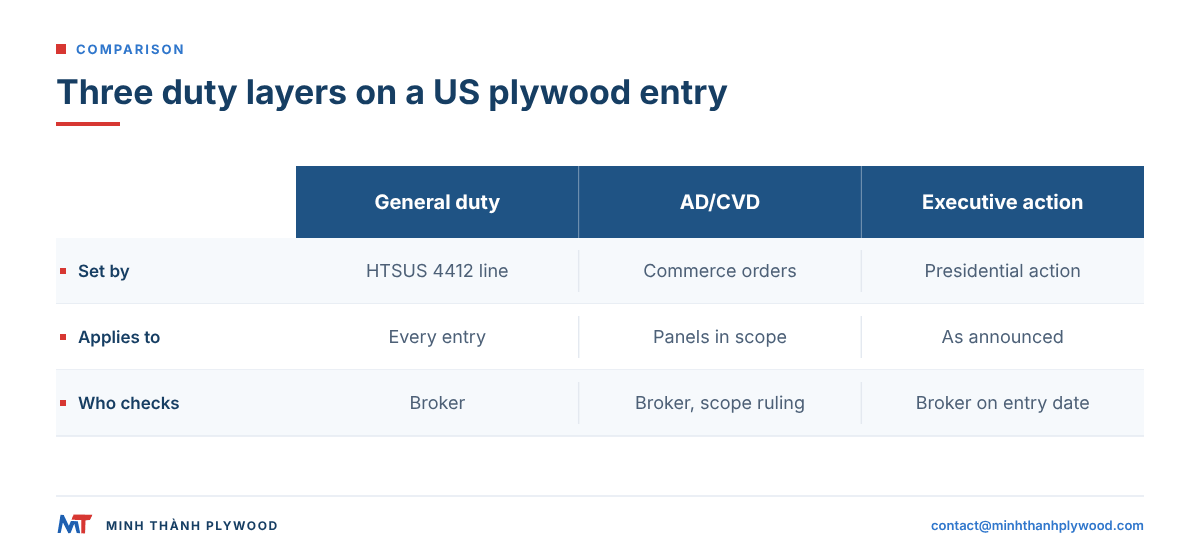
Three duty layers can apply to the same container, and the broker adds them up line by line:
- General HTSUS rate for the 4412 subheading.
- Anti-dumping and countervailing duty cash deposits, where the panel is inside the scope of an order (next section).
- Additional duties set by executive action, which have changed several times since 2025; the broker reads the current stack on the entry date.
Duty is charged on the transaction value, which for US entries is normally the FOB value: ocean freight and insurance are not part of the dutiable value. Write the face and back species on the invoice exactly as on the specification, so the line and the Lacey data agree.
What is the status of US anti-dumping duties on Vietnamese hardwood plywood?
On 21 July 2026 the US Department of Commerce published final determinations in the anti-dumping (A-552-851) and countervailing duty (C-552-852) investigations of hardwood and decorative plywood from Vietnam, and on 19 August 2026 the US International Trade Commission voted affirmatively on injury. As of 20 October 2026 the orders had not yet been published in the Federal Register.
| Item | Anti-dumping (AD) | Countervailing duty (CVD) |
|---|---|---|
| Case number | A-552-851 | C-552-852 |
| Final determination | Federal Register 2026-14614, 21 July 2026 | Federal Register 2026-14613, 21 July 2026 |
| Rate for companies without their own rate (AD period investigated: 1 October 2024 to 31 March 2025) | Vietnam-wide entity: margin 90.12%, cash deposit 84.95% after subsidy offsets | All others: 47.68% |
| Injury | US International Trade Commission, affirmative vote, 19 August 2026 | Same |
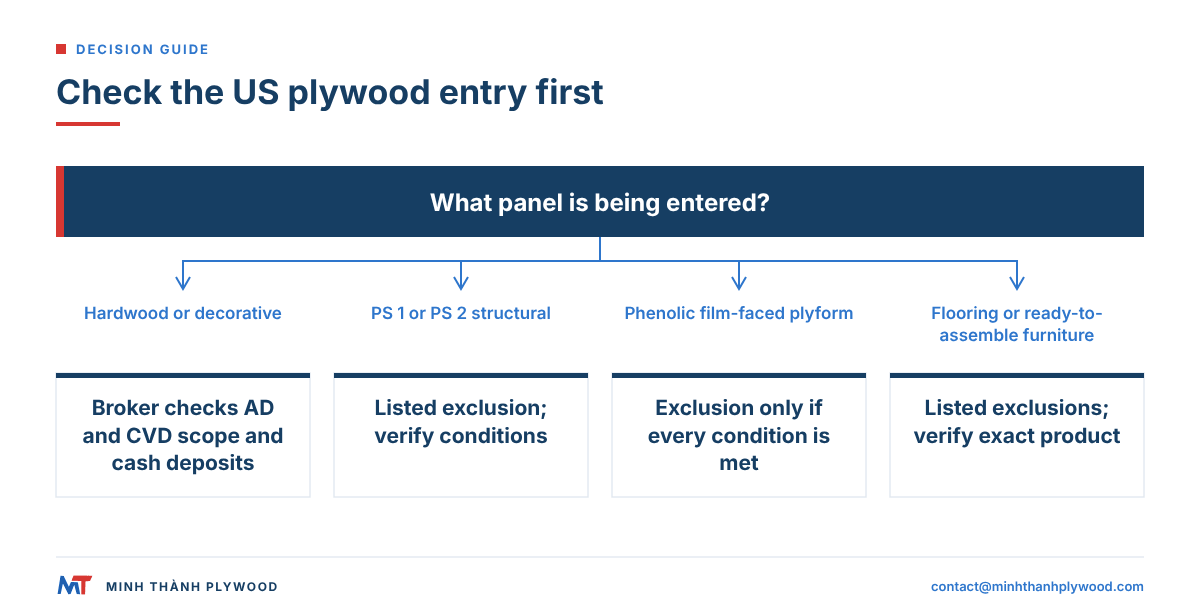
Both determinations list product exclusions. Among them are structural plywood made to PS 1 or PS 2, flooring, and ready-to-assemble furniture. Phenolic film-faced plyform (PFF) is excluded only when it meets every condition of the definition: exterior or Exposure 1 bond, opaque phenolic film of 90 g/m² or more on both faces, and the coating conditions in the notice. A panel outside the listed exclusions with a hardwood or decorative face is the core of the scope.
Earlier cases show how high the rates can run for companies named in a finding. A July 2024 summary by a US flooring importer of the earlier circumvention determination reports potential duty rates of 183.36% anti-dumping and 22.98% countervailing for 37 Vietnamese companies named in it, which is why the origin certifications and the mill’s production records matter before the first entry, not after it.
What this means for an order: before you sign, send your broker the specification line, the face and back species and the core build, and ask for a scope opinion against the published order. Minh Thanh sends the full construction of each line with the quotation for that purpose. The cases are trade law, not a product rating; the panels themselves meet the same TSCA Title VI and buyer requirements either way.
How is Vietnamese origin proven for US plywood entries?
Origin for US plywood entries is proven by production records and, since the 2023 circumvention finding, by matching importer and exporter certifications kept on file. The rule comes from the US Department of Commerce determination in Federal Register 2023-15431 under the China orders A-570-051 and C-570-052, applicable from 20 July 2023.
The finding names five production scenarios where hardwood plywood completed in Vietnam is treated as Chinese and pays the China-order duties. The first three, in the words of the notice, are plywood completed in Vietnam using:
- “face/back veneers and assembled core components (e.g., veneer core platforms) manufactured in China”;
- “fully assembled veneer core platforms manufactured in China and face/back veneer produced in Vietnam or third countries”;
- “multi-ply panels of glued core” made in China, as the notice defines them.
The remaining two scenarios cover further combinations of Chinese veneers and cores; the full text is in the notice, and your broker reads your construction against all five.
Plywood assembled in Vietnam outside those five scenarios is not subject, and no China-order cash deposit is required, on one condition. The exporter prepares and keeps an exporter certification with documents that support it, and the importer prepares and keeps an importer certification. Non-cooperating companies listed in the notice cannot use the certification route.
Which records support a Vietnamese origin claim?
Records that trace each layer to a Vietnamese source or to a named non-Chinese source. For a Minh Thanh panel these are the peeling records for the plantation core: white Styrax or Eucalyptus as standard, Acacia on order. Add the purchase records of imported faces such as birch or okoume with their country. Then the lay-up, pressing and sanding records of the order in Ha Hoa, Phu Tho. The same species and origin data feed the Lacey declaration, so the two files tell one story.
What does TSCA Title VI require for imported plywood?
TSCA Title VI requires hardwood plywood sold in the US to come from a producer certified by an EPA-recognised third-party certifier, to meet the formaldehyde limit of 40 CFR Part 770, and to be labelled “TSCA Title VI compliant”. The EPA states that composite wood products have had to carry the label since 22 March 2019.
| Requirement | Rule | Minh Thanh evidence |
|---|---|---|
| Emission limit, hardwood plywood with veneer core | 0.05 ppm (40 CFR 770.10) | Six ASTM D6007 chamber tests, April 2025 to June 2026, averaged 0.014–0.032 ppm |
| Certified producer | Third-party certifier recognised by EPA | CARB P2 / TSCA Title VI, ICTT mill no. 23024, hardwood plywood veneer core 3–50 mm |
| Label on panels or bundles | Producer, lot, certifier number, “TSCA Title VI compliant” | Label with producer, lot, certifier number TPC-43 and the compliance statement |
| Statement on documents | Compliance stated on invoice and bill of lading | Commercial invoice and B/L state TSCA Title VI compliance |
| Routine testing | Ongoing testing under the certifier’s programme | E0 emission tested every 3 months |
The six chamber reports split between two laboratories: Shanghai Hongjun (HJ-QAT-250597, HJ-QAT-251303, HJ-QAT-261036) and ICTT Vietnam (ICTTVN-QAT-250841, ICTTVN-QAT-251173, ICTTVN-QAT-260272). The tests were run on 9, 15 and 18 mm panels, and the reports identify UF resin at E0 grade. The certificate and reports are on our CARB P2 / TSCA Title VI page.
Do finished-goods makers also need TSCA labels?
Yes. A US cabinet or furniture maker that builds products from the panels labels its finished goods as TSCA Title VI compliant, or keeps the panel records that support its label. Keep the panel lot numbers on your receiving records so each production run traces back to a labelled lot.
How do you check a Vietnamese mill’s TSCA Title VI certificate?
Check three things on the certificate before you order. It names the mill itself as the certified producer. Its product scope covers your panel: hardwood plywood with a veneer core, in your thickness. The certifier is an EPA-recognised third-party certifier. Then check that the label and the chamber reports point to the same mill and certifier.
| What to check | Where | Minh Thanh |
|---|---|---|
| Producer named | Certificate | Minh Thanh’s mill, ICTT mill no. 23024 |
| Product scope | Certificate | Hardwood plywood, veneer core, 3–50 mm |
| Certifier | Certificate and label | ICTT, certifier number TPC-43 on the label |
| Test evidence | Chamber reports | Six ASTM D6007 reports, two laboratories, April 2025 to June 2026 |
| Label wording | Panel or bundle | Producer, lot, certifier number, “TSCA Title VI compliant” |
A certificate in another company’s name, or a scope that covers only particleboard or MDF, does not cover your plywood. Ask for the certificate and the latest chamber report with the quotation, and keep both with your import records.
What does the Lacey Act declaration need from the plywood mill?
The Lacey Act declaration for plywood needs the scientific name of every wood species in the panel, the country where each was harvested, the quantity and the value. The importer files it with the entry, on USDA APHIS PPQ Form 505 or electronically through the broker.
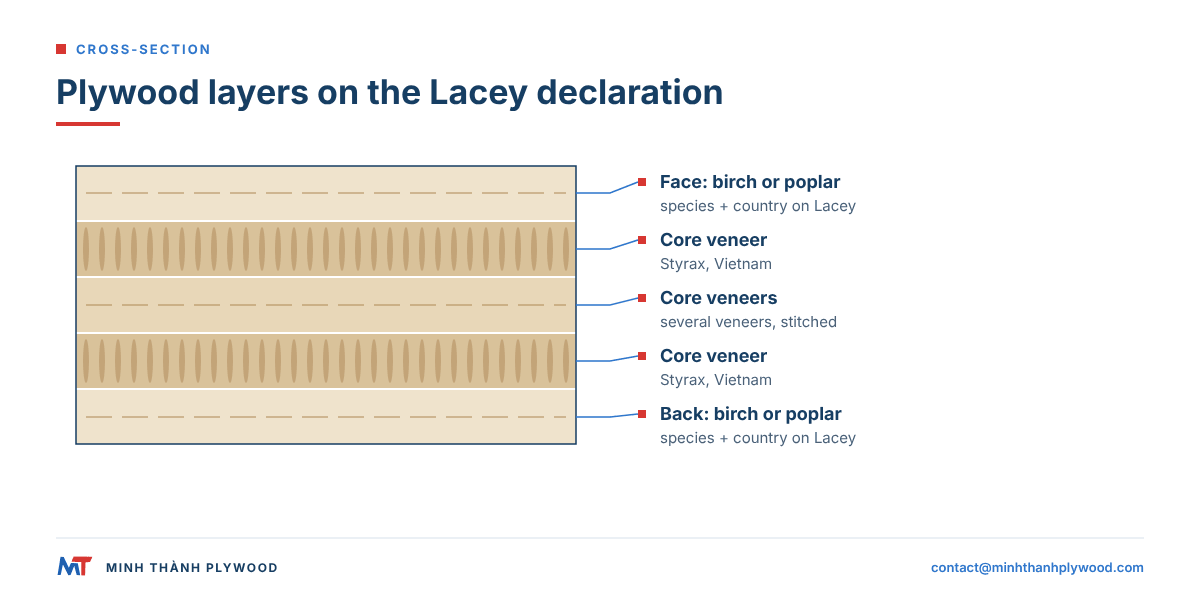
A plywood panel holds several species, and each layer counts:
| Layer | Example on a Minh Thanh panel | Data in the declaration |
|---|---|---|
| Face veneer | Birch (Betula spp.), imported | Genus and species, country of harvest |
| Back veneer | Birch or poplar | Genus and species, country of harvest |
| Core veneers | White Styrax (Styrax tonkinensis) or Eucalyptus | Genus and species, Vietnam |
| Glue | UF resin | Not declared: not a plant product |
Minh Thanh supplies the face and core species and the Vietnamese harvest origin for every US order, line by line, so your broker files the declaration without guessing. A declaration that names a different face from the invoice, or leaves out the core species, is the most common reason the paperwork is questioned. The same data supports the origin certification described above.
Which species names go on the Lacey declaration?
Use the scientific name of each species, with the genus alone only where the species varies. These are the names for the faces and cores Minh Thanh uses.
| Wood | Scientific name | Used as |
|---|---|---|
| Birch | Betula spp. | Face and back, imported |
| Poplar | Populus spp. | Face and back |
| Okoume | Aucoumea klaineana | Face and back, imported |
| Pine | Pinus spp. | Face and back |
| Eucalyptus | Eucalyptus spp. | Face; core |
| White Styrax | Styrax tonkinensis | Core |
| Acacia | Acacia spp. | Core on order |
| Bintangor | Calophyllum spp. | Face |
| Gurjan | Dipterocarpus spp. | Face |
| Sapele | Entandrophragma cylindricum | Face, on request |
Engineered veneer (EV) faces are declared by the species the veneer is made from. The mill states it per line, so the declaration matches the panel.
What is ISF 10+2 and when is it filed for a plywood container?
The Importer Security Filing (ISF, also called 10+2) is the advance cargo data a US importer files with CBP no later than 24 hours before the container is loaded on the vessel at the foreign port. For a plywood container from Vietnam, that means 24 hours before loading in Hai Phong, not before arrival in the US.
The importer files ten data elements and the carrier two; the ones the mill must supply are:
- Seller and buyer names and addresses.
- Manufacturer (or supplier) name and address: the mill.
- Ship-to party and consignee.
- Country of origin: Vietnam.
- HTSUS number to six digits: the 4412 subheading your broker confirmed.
- Container stuffing location and consolidator: the loading place in Vietnam.
Minh Thanh sends these details with the booking confirmation, before production ends, so the filing is ready days ahead of the cut-off. Late or wrong ISF data can bring penalties and holds at the US port; CBP’s rules are on its ISF page.
Do you need a customs bond to import plywood?
Yes: a commercial plywood container is a formal entry, and US Customs and Border Protection requires a customs bond for it. The bond guarantees that duties, taxes and penalties will be paid.
| Bond type | Covers | Suits |
|---|---|---|
| Single-entry bond | One shipment | A first trial container |
| Continuous bond | All entries for one year | Importers bringing several containers a year |
The bond amount is set by CBP rules on the duties and fees of the entries it covers, and cases with anti-dumping or countervailing duty cash deposits raise it. Your customs broker arranges the bond through a surety and files it before the first entry; CBP explains the process on its bonds page. Order it early, because a new continuous bond takes some days to be accepted.
What documents are needed to import plywood into the US?
A US plywood entry needs the three shipping documents, two filings made from the mill’s data and the compliance record for formaldehyde. This is the full set, with what each one is for.
| Document or filing | Prepared by | Used for | Timing |
|---|---|---|---|
| Commercial invoice | Minh Thanh | Entry value, HTSUS line, TSCA statement | Copy at loading |
| Packing list | Minh Thanh | Packs, sheets, m³, weights per line | Copy at loading |
| Bill of lading | Shipping line | Release of the container; TSCA statement | Scan after sailing |
| ISF data | Mill data, filed by your broker | CBP security filing | 24 hours before loading |
| Lacey Act declaration | Mill data, filed by your broker | Species and harvest country | With the entry |
| TSCA Title VI labels and certificate | Minh Thanh | Formaldehyde compliance | On the panels; certificate with the order |
| Importer and exporter certifications | Both parties | Origin under the 2023 circumvention finding | Kept on file |
| Customs bond | Your broker and surety | Guarantee for duties | Before the first entry |
| Fumigation or ISPM 15 marks | Vietnamese provider | Solid wood bearers under the packs | With the documents |
Plywood is processed wood and is outside the ISPM 15 standard; any solid sawn-wood bearers under the packs need the ISPM 15 mark. The full document list for all markets is in the plywood import documents checklist.
What happens at US customs when the plywood container arrives?
When the container arrives, your broker files the entry and the entry summary, CBP reviews them against the ISF and the Lacey declaration, and the container is released, held for an exam, or asked for more documents. Duties and fees are paid on the entry summary, and the entry closes later at liquidation.
- Entry filed: the broker files the entry with the bill of lading, invoice and bond, usually before the vessel berths, so release can come on arrival.
- Review and release: CBP matches the data to the ISF filed before loading; most entries are released without an exam.
- Exam, if selected: a container picked for exam is moved to an exam station; complete, consistent documents shorten it.
- Entry summary and payment: the broker files the entry summary with the HTSUS lines, the Lacey declaration and any AD/CVD case numbers, and you pay the duties, cash deposits and fees.
- Liquidation: the entry is finalised later; for goods inside an AD/CVD order, liquidation is suspended until the final rate is set, through an administrative review when one is requested.
The last step matters for budgeting: a cash deposit under an AD or CVD order is a deposit, and the final duty can be higher or lower after the review. Your broker explains the exposure for your lines before the first entry.
Which North American certifications matter for imported plywood?
For furniture and interior hardwood plywood, the certification that matters in North America is CARB Phase 2 / TSCA Title VI for formaldehyde emission. Structural and building-code panels follow a different system of product standards and grade stamps.
| Panel use | Certification or standard | What it proves | Minh Thanh |
|---|---|---|---|
| Furniture, cabinets, interiors | CARB Phase 2 / TSCA Title VI | Formaldehyde emission ≤ 0.05 ppm, certified producer | Held: ICTT mill no. 23024 |
| Decorative hardwood plywood | ANSI/HPVA HP-1 (voluntary industry standard) | Face grades and construction | Faces graded to the approved sample |
| Structural sheathing, subfloor | PS 1-22 (NIST Voluntary Product Standard) with an agency grade stamp | Structural performance for building codes | Outside the furniture range |
| Quality system | ISO 9001:2015 | Managed production and checks | Held: KAC25/0185 |
NIST lists PS 1-22 as the current edition of the structural plywood standard. When a US buyer says “certified plywood” for cabinets, the question is almost always the TSCA label. For roof or wall sheathing it is the PS 1 or PS 2 stamp, and that product is outside the furniture range. Our panels for interiors are on the furniture plywood page.
Which US ports and transit times apply from Hai Phong?
From Hai Phong, plywood containers reach the US West Coast in a typical 20–30 days at sea and the US East Coast in 35–45 days, depending on carrier and route. The port follows your warehouse and your forwarder’s contracts.
| US coast | Common ports | Days at sea from Hai Phong | Suits importers in |
|---|---|---|---|
| West Coast | Los Angeles, Long Beach, Oakland, Seattle, Tacoma | 20–30 | California, the Pacific Northwest, the Mountain states by rail |
| Gulf Coast | Houston | Longer than the West Coast; by route | Texas and the South Central states |
| East Coast | New York and New Jersey, Savannah, Charleston, Norfolk | 35–45 | The Northeast, the Southeast |
Inland rail from the West Coast reaches the Midwest in days and can beat an all-water East Coast route for Chicago or Dallas; your forwarder compares both. A West Coast port also brings the container in ahead of the ISF and entry timetable, which makes it the usual choice for a first trial container.
How much do freight and duty add to export plywood from Vietnam to America?
The landed cost of Vietnamese plywood in the US is the FOB price, plus ocean freight and insurance, plus duties on the FOB value, plus entry fees, port charges and inland delivery. Minh Thanh’s indicative starting prices, October 2026, are from US$350/m³ for furniture and interior plywood and from US$250/m³ for commercial plywood; the final price depends on face, core, glue, thickness, size, quantity and delivery term.
| Cost line | How it is calculated | Paid by on FOB | Paid by on CIF |
|---|---|---|---|
| Panels | Per m³ by specification | Importer | Importer |
| Ocean freight | Per 40HC, Hai Phong to US port | Importer’s forwarder | Mill, in the price |
| Cargo insurance | Share of cargo value | Importer | Mill, in the price |
| General duty | HTSUS rate × dutiable value | Importer | Importer |
| AD/CVD cash deposits | Rate × entered value, where in scope | Importer | Importer |
| Entry fees | Merchandise and harbor fees set by CBP | Importer | Importer |
| Port and inland | Terminal handling, drayage, rail | Importer | Importer |
Freight per m³ falls as more volume fits under the payload. At 18 mm in 1220 × 2440 mm, a 40HC holds about 53 m³ on a Styrax core, 47 m³ on Acacia and 43 m³ on Eucalyptus. The lightest core spreads the freight over the most panels. Worked figures by core are in plywood shipping cost from Vietnam.
What do US distributors charge per sheet for imported birch plywood?
A US distributor’s list prices, checked in October 2026, for 4 × 8 ft imported birch plywood show the shelf you sell against. The page lists Vietnamese-origin birch at US$58.51 per sheet in 15 mm and US$63.54 in 18 mm, Cambodian birch at US$60.57 in 15 mm and US$70.86 in 18 mm, and UV-finished imported birch at US$90.67 in 18 mm.
| Sheet, 4 × 8 ft | Distributor list price per sheet | Raw FOB example per sheet |
|---|---|---|
| Vietnamese birch, 15 mm | US$58.51 | - |
| Vietnamese birch, 18 mm | US$63.54 | US$18.76 |
| Cambodian birch, 18 mm | US$70.86 | - |
| Imported birch UV two sides, 18 mm | US$90.67 | - |
The raw FOB example is not a sheet price. It is US$350/m³ (our furniture and interior starting price, not a birch-faced price) times 0.0536 m³ per 18 mm sheet of 1220 × 2440 mm, before freight, duty and fees. Take your own FOB quote for the exact face, add the cost lines above and compare the landed total with the distributor line to see your margin.
FOB or CIF for a US import?
Most US importers buy FOB Hai Phong, because their forwarder holds contract rates and the dutiable value is the FOB value anyway. CIF suits a first container if you prefer one price to the port. Risk passes when the panels are loaded on board in Hai Phong under FOB, CFR and CIF alike.
How do you choose a Vietnamese plywood supplier for the US market?
Choose a supplier who can hand you every file the US entry needs before the first deposit. That means a TSCA Title VI certificate in its own name, chamber test reports, species data for Lacey, the full construction of each line for the case-scope check, and loading photos. This checklist separates a mill ready for the US from one that is not.
| Check | Ask for | What a ready mill shows |
|---|---|---|
| Producer certification | CARB P2 / TSCA Title VI certificate | Certificate in the mill’s own name, with mill number and product scope |
| Emission data | Chamber test reports | Reports with laboratory, method (ASTM D6007), date and panel thickness |
| Panel construction | Layer-by-layer build per line | Core species, face and back species and their origin |
| Lacey data | Species and harvest country | Scientific names for face, back and core |
| Production | Own factory | Real photos and video of peeling, pressing, sanding |
| Loading record | Pre-loading photos and video | Every container filmed before loading |
| Terms | Proforma | FOB, CFR or CIF; deposit and balance terms in writing |
Minh Thanh is a manufacturer in Ha Hoa, Phu Tho, with a capacity of 50,000+ m³ per year and over 20 years of plywood-making experience. Our checks for a supplier visit or video call are in how to choose a plywood supplier in Vietnam.
What should a US importer put on the plywood specification?
Put the panel on one line per specification, in metric, in the order the mill builds it, and add the two US lines: TSCA labelling and the Lacey data. A complete line lets the mill quote, plan the container and prepare the US files in one round.
- Use: cabinet box, door, shelving, furniture component, fixture or packing.
- Size: 1220 × 2440 mm (the 4 × 8 ft format), 1250 × 2500 mm, or custom such as 1220 × 2500 or cut-to-size.
- Thickness: in millimetres, 3–40 mm; for example 18 mm where your drawings say 3/4-inch nominal, 12 mm for 1/2-inch.
- Tolerance: sanded furniture panels ±0.2–0.3 mm, down to ±0.2 mm; length and width ±2 mm.
- Core: white Styrax or Eucalyptus as standard; Acacia on order.
- Face and back: species and grade pair, such as poplar A/B, birch D+/D or eucalyptus B/B for painting; UV-ready faces when you coat in-house.
- Glue and emission: UF glue at E0 emission with TSCA Title VI labelling.
- Quantity and packing: sheets per line, pack height, label language.
- Destination: US port, Incoterm, and the files: TSCA certificate, chamber reports, Lacey data, construction sheet for the scope check.
Thickness in millimetres matters: a US shop that machines to inch hardware can still work from metric panels, but the drawings should name the metric panel. Our full furniture range is on the furniture plywood page.
How do you check plywood when it arrives in the US?
Open the container against the packing list and the TSCA label first, then measure. A US arrival check adds the label and lot record to the usual count and caliper.
- Seal: photograph the doors and the seal and compare the number with the bill of lading.
- Packs and labels: count packs against the packing list; photograph the TSCA labels and lot numbers.
- Thickness: caliper several sheets per line, at the edge and in the field.
- Size and square: length and width within ±2 mm.
- Moisture: 8–12% at dispatch is the normal range for furniture plywood.
- Faces: compare with the approved sample under the same light.
- Record: send photos and readings with pack numbers the same day.
Every container is photographed and filmed before loading, so any question is compared against the same packs on video. Keep the lot numbers with your receiving record: your own TSCA label on finished goods will need them.
Which panels do US cabinet and furniture makers order from Vietnam?
US cabinet and furniture makers order three kinds of panel from a Vietnamese mill. Sanded 18 mm panels go into boxes and shelves, 12 mm panels into drawer parts, and thin 3–6 mm panels into backs and drawer bottoms. Each goes on its own specification line, with TSCA Title VI labelling on all of them.
| Part | Typical panel | Face and back | What to write on the line |
|---|---|---|---|
| Cabinet box sides, tops, bottoms | 18 mm (3/4-inch nominal), sanded | Poplar A/B or birch D+/D, UV-ready if prefinished in-house | Tolerance ±0.2–0.3 mm for CNC and edge-banding |
| Shelves | 18 mm | As the box | Same line as the box when the faces match |
| Drawer sides and fronts | 12 mm (1/2-inch nominal) | Birch for visible edges | Edge quality and face grade both sides |
| Backs and drawer bottoms | 4–6 mm thin plywood | Poplar or birch | Thin panels are always 5-ply (3–5 mm) |
| Painted doors and fronts | 18 mm | Eucalyptus B/B for painting | Smooth sanded faces |
Thin plywood 3–5 mm at Minh Thanh is always 5-ply. A 3 mm panel has one core veneer, two cross-band veneers and two faces. Panels of 4 and 5 mm have three core veneers and two faces, with the core veneer thickness adjusted to the panel. A 4 mm furniture panel uses three 1.3 mm white Styrax core veneers. Premium thin veneer is scarce, so 4 mm lines can take longer; we keep the standard instead of rushing.
Both faces can be supplied UV-ready, sanded and polished to the standard a coating line needs, which suits shops that prefinish panels before machining. Our thin range is on the thin plywood page.
How do you import plywood from Vietnam to the USA with a first trial container?
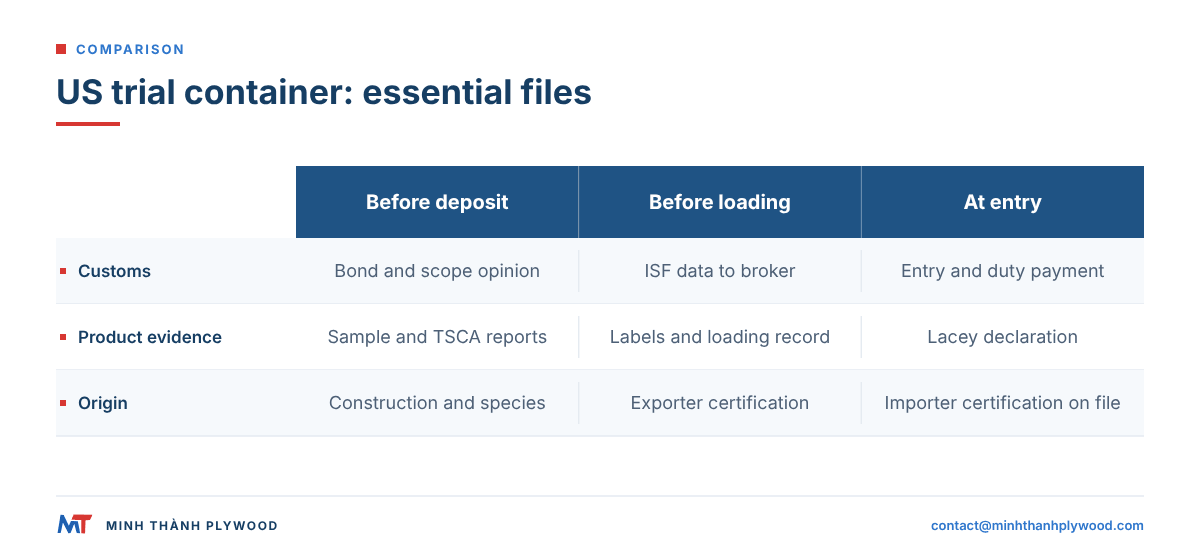
A first trial container to the US is usually one 40HC with one to three specification lines, shipped to a West Coast port on CIF or FOB terms. The bond, the scope check and the ISF data are settled before the deposit. It tests the panel, the paperwork and the timing in one round.
How to set it up so the second container is a repeat, not a new project:
- Pick the lines you buy most. Two or three lines that cover most of your volume, such as 18 mm poplar A/B and 6 mm poplar backs.
- Approve the free sample per line. Keep the approved sample as the reference for arrival checks.
- Settle the files first. Single-entry bond, HTSUS line and case-scope opinion, Lacey species list, TSCA certificate and chamber reports.
- Book the ISF timetable. Agree with the mill the date the ISF data reaches your broker, a few days before loading.
- Watch the loading record. Check the photos and video of the packs and labels before you pay the balance against the scanned bill of lading.
- Measure on arrival and report once. One report with pack numbers and readings becomes the baseline for every later order.
On a mixed trial load, each line gets its own packing-list entry and pack labels, so the Lacey declaration, the invoice and the arrival check match line by line. Payment terms stay the same as any order: 30% deposit and 70% against the scanned bill of lading, or an irrevocable L/C at sight.
Which mistakes hold plywood at a US port?
Most US holds on plywood come from data that disagrees between filings, not from the panels. These six are the usual ones, and each is avoided before the container sails.
- Late or wrong ISF: the filing is due 24 hours before loading in Hai Phong; data sent after loading is already late.
- Lacey species that do not match the panel: a declaration listing only the face species, or a face different from the invoice.
- Missing TSCA statement: the compliance statement left off the invoice or the bill of lading, or panels without labels.
- No scope opinion: a hardwood panel entered without checking the anti-dumping and countervailing duty case scope.
- Missing origin certification: no importer and exporter certifications on file under the 2023 circumvention finding.
- Untreated solid wood bearers: sawn-wood bearers under the packs without the ISPM 15 mark.
A draft check by your broker, with the invoice, packing list, Lacey data and ISF data side by side, removes all six. Ask the mill for those drafts before loading, not after. Other errors in the buying process are covered in mistakes when importing plywood from Vietnam.
What does Minh Thanh need to quote plywood for the US?
Send your specification lines, your US port and your timing in one message, and Minh Thanh replies within hours with questions or a quotation, the construction sheet for your broker’s scope check and a packs plan. Minimum order is one 40HC, and samples are free.
- Lines: use, size, thickness, core, face and back, glue and emission.
- Quantity: sheets or m³ per line.
- Port and term: West, Gulf or East Coast port; FOB Hai Phong, CFR or CIF.
- Files: TSCA certificate, chamber reports, Lacey species data, construction per line.
- Timing: arrival month and the date your broker needs the ISF data.
Payment is a 30% deposit and 70% against the scanned bill of lading, or an irrevocable L/C at sight; production takes 15–45 days after the deposit. Write to contact@minhthanhplywood.com, use the contact form, or message Lisa on WhatsApp at +84 988 586 601 (Monday to Friday, 08:00–17:00 Vietnam time, UTC+7). The range is in the plywood catalogue, and our terms are on the trade terms page.
Buyer questions, answered
What documents are needed to import plywood into the US?
Commercial invoice, packing list and bill of lading for the entry; the Importer Security Filing data before loading; a Lacey Act declaration with species and harvest country; TSCA Title VI labels on the panels with the compliance statement on the invoice and bill of lading; and a customs bond.
Do I need a customs bond to import plywood?
Yes, for a commercial container. US Customs and Border Protection requires a bond on formal entries; importers take a single-entry bond for one shipment or a continuous bond that covers a year of entries.
Are there anti-dumping duties on plywood from Vietnam to the USA?
On 21 July 2026 the US Department of Commerce issued final determinations on hardwood and decorative plywood from Vietnam (A-552-851 and C-552-852), and the US International Trade Commission voted affirmatively on injury on 19 August 2026. Your broker checks the published order and whether your construction is in scope before you order.
What HTS code is plywood from Vietnam?
Plywood is classified under HTSUS heading 4412, with the subheading set by the species of the face and back plies and the ply thickness. The broker confirms the ten-digit line before the invoice is issued.
Is TSCA Title VI required for imported plywood?
Yes, for hardwood plywood sold in the US. Panels must come from a certified producer, meet the 0.05 ppm limit for veneer-core hardwood plywood and carry the TSCA Title VI compliant label; Minh Thanh is certified as ICTT mill no. 23024.
What information does the Lacey Act declaration need for plywood?
The scientific name of each wood species in the panel, the country where it was harvested, the quantity and the value. Minh Thanh supplies the face and core species and the Vietnamese harvest origin for every order.
When is the ISF filed for a plywood container from Vietnam?
The Importer Security Filing is due no later than 24 hours before the container is loaded on the vessel in Hai Phong, so the shipper and consignee data must reach your broker before the loading date.
How long does shipping plywood from Vietnam to the USA take?
Typical days at sea from Hai Phong are 20–30 to the US West Coast and 35–45 to the US East Coast, after 15–45 production days counted from the deposit.
What is the minimum order for plywood from Vietnam to the US?
Minh Thanh's minimum is one 40-foot high-cube container. Mixed specifications in one container are possible by agreement, usually one or two lines and up to six.
Does Vietnamese plywood with Chinese veneers pay Chinese duties in the US?
Yes, in the cases set out by the 2023 circumvention finding (A-570-051 and C-570-052): plywood completed in Vietnam using Chinese cores, core platforms or core veneers (with Chinese or other faces) is treated as Chinese. Chinese face or back veneers on a Vietnamese core are not one of the five scenarios, but the panel still needs the importer and exporter certifications. Other Vietnamese plywood is entered with importer and exporter certifications.
Can a US importer buy furniture plywood in 4 x 8 ft sheets from Vietnam?
Yes. The 1220 × 2440 mm sheet is the 4 × 8 ft format; thicknesses are made in millimetres from 3 to 40 mm, and an order states the metric thickness the plant expects, such as 18 mm for a 3/4-inch nominal panel.