
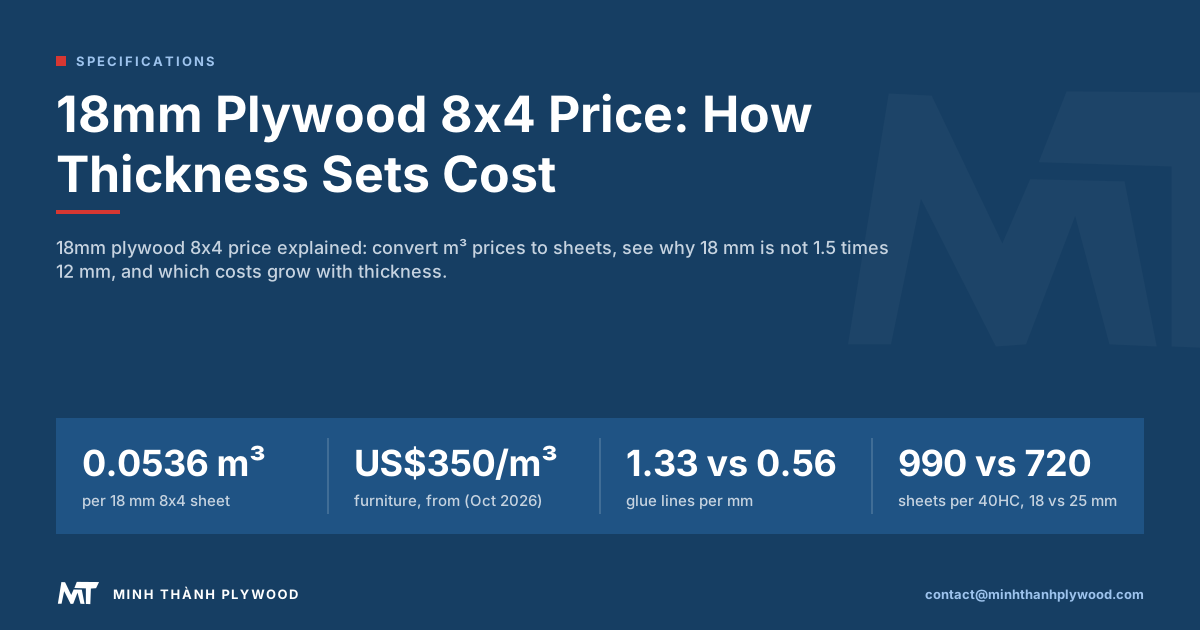
An 18 mm plywood sheet of 1220 × 2440 mm (8x4) holds 0.0536 m³ of panel, so its price is the price per cubic metre times 0.0536. At Minh Thanh Plywood, furniture plywood starts from US$350/m³ and commercial plywood from US$250/m³ (FOB, October 2026). Thickness changes the sheet price less than the volume suggests, because faces, sanding and handling cost the same on every sheet. This guide shows the conversion and the cost drivers.
What sets the 18mm plywood 8x4 price?
The 18mm plywood 8x4 price is the price per cubic metre multiplied by the volume of one sheet: 1.22 m × 2.44 m × 0.018 m = 0.0536 m³. Every mill quotes export plywood per cubic metre, and that figure depends on the face, core, glue, thickness, size, quantity and delivery term.
At Minh Thanh Plywood, indicative starting prices in October 2026 are:
| Product line | From (FOB Hai Phong) | 18 mm, 1220 × 2440 mm sheet |
|---|---|---|
| Furniture and interior plywood | US$350/m³ | about US$18.75 of panel |
| Commercial plywood | US$250/m³ | about US$13.40 of panel |
These are starting points, not a price list. A birch or okoume face, a calibrated sanded finish, a low-emission glue and special packing all move the figure up from there. Freight, duty and inland transport come on top.
The rest of this guide explains why the sheet price does not simply follow the thickness, and how to read a quote at 6, 9, 12, 18 or 25 mm.
What do UK merchants charge for an 8x4 sheet at each thickness?
A UK merchant sells an 18 mm general-purpose 8x4 hardwood plywood sheet for about £27 ex VAT (£32 with VAT), and 25 mm for about £64 ex VAT. The table lists Selco prices. Exchange rates come from exchangerates.org.uk. The Selco prices are for 2440 × 1220 mm sheets, read on 21 October 2026, and the exchange rate on 20 October 2026. Our raw FOB panel value is US$350/m³, converted at US$1.3345 to £1.
| 2440 × 1220 mm sheet | Selco ex VAT | Selco inc VAT | Our FOB panel, furniture, per sheet |
|---|---|---|---|
| 3.6 mm general purpose | £12.04 | £14.45 | about £2.81 |
| 5.5 mm general purpose | £17.02 | £20.42 | about £4.29 |
| 9 mm general purpose | £21.23 | £25.48 | about £7.03 |
| 12 mm general purpose | £24.29 | £29.15 | about £9.37 |
| 18 mm general purpose | £26.85 | £32.22 | about £14.05 |
| 25 mm general purpose | £63.92 | £76.70 | about £19.52 |
| 12 mm sheathing | £20.00 | £24.00 | |
| 18 mm sheathing | £28.13 | £33.76 | |
| 18 mm DryGuard water-repellent, FSC | £40.00 | £48.00 | |
| 18 mm marine, BS 1088 | £79.10 | £94.92 |
Wickes and B&Q sell the same sheets under the names non-structural hardwood plywood and structural CE2+ softwood plywood (12 and 18 mm), and cut them into half-width 606 × 1220 mm and 607 × 1829 mm boards (Wickes, B&Q). Both pages were read on 21 October 2026. Selco prices a 1829 × 607 mm half-width 18 mm board at £22.28 ex VAT, which is 83% of a full sheet’s £26.85 for 37% of the panel: cut boards cost much more per square metre.
What a UK importer pays for the same 18 mm sheet: US$18.75 of furniture panel at FOB plus about US$3.56 of sea freight per sheet (a 40HC at the Drewry Shanghai to Rotterdam rate of US$3,522, spread over 990 Styrax-core sheets) is US$22.31, about £16.72, with 0% UK duty on Vietnamese plywood and 20% VAT recoverable. The freight rate comes from the Drewry World Container Index. The duty rate is on UK Trade Tariff 4412339090. Both were read in October 2026.
Commercial plywood lands at about £12.71. Against the £26.85 merchant price, that leaves the reseller about £10 of margin per sheet before port, haulage, storage and bank charges. Hai Phong rates differ from the Shanghai index, so use your forwarder’s quote for the final figure.
How do you convert a price per m³ into a price per 8x4 sheet?
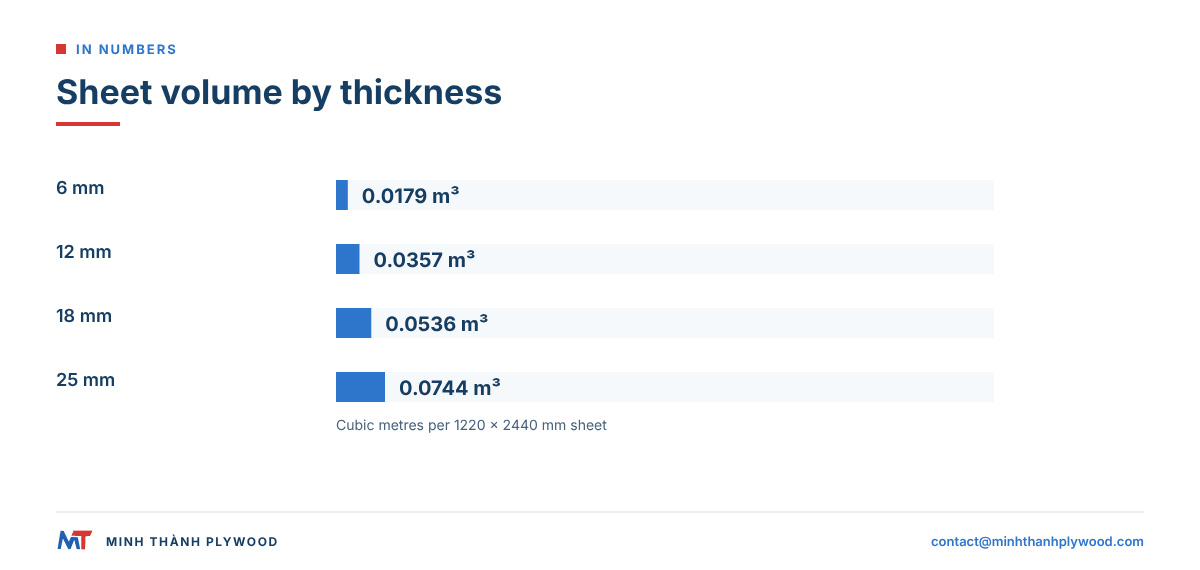
Multiply the price per cubic metre by the sheet volume, or divide it by the number of sheets in one cubic metre. The sheet volume is length × width × thickness, in metres. For an 18 mm 1220 × 2440 sheet that is 0.0536 m³, about 18.7 sheets per cubic metre.
| Thickness | 1220 × 2440 mm sheet | Sheets per m³ | 1250 × 2500 mm sheet | Sheets per m³ | FOB panel per 1220 × 2440 sheet, commercial / furniture |
|---|---|---|---|---|---|
| 3 mm | 0.0089 m³ | 112.0 | 0.0094 m³ | 106.7 | US$2.23 / US$3.13 |
| 6 mm | 0.0179 m³ | 56.0 | 0.0187 m³ | 53.3 | US$4.47 / US$6.25 |
| 9 mm | 0.0268 m³ | 37.3 | 0.0281 m³ | 35.6 | US$6.70 / US$9.38 |
| 12 mm | 0.0357 m³ | 28.0 | 0.0375 m³ | 26.7 | US$8.93 / US$12.50 |
| 15 mm | 0.0447 m³ | 22.4 | 0.0469 m³ | 21.3 | US$11.16 / US$15.63 |
| 18 mm | 0.0536 m³ | 18.7 | 0.0563 m³ | 17.8 | US$13.40 / US$18.75 |
| 21 mm | 0.0625 m³ | 16.0 | 0.0656 m³ | 15.2 | US$15.63 / US$21.88 |
| 25 mm | 0.0744 m³ | 13.4 | 0.0781 m³ | 12.8 | US$18.61 / US$26.05 |
Use the nominal thickness for the volume. If a sheet arrives at 17 mm on an 18 mm order, you received about 5.6% less wood than you paid for, which is why the thickness tolerance belongs on the quote.
A quote in cubic metres and a quote per sheet only compare when both use the same size and thickness. Convert one into the other before reading the totals.
Why is an 18 mm sheet not 1.5 times the price of 12 mm?
An 18 mm sheet holds exactly 1.5 times the volume of a 12 mm sheet, but its price per sheet rises by less than 1.5 times. Part of the cost of every sheet does not depend on thickness at all.
Costs that stay the same on every sheet of one size:
- The face and back veneers. A 12 mm and an 18 mm panel carry the same two faces. On a birch, okoume or EV face, this is the most expensive veneer in the sheet.
- Sanding and polishing. One calibrating and sanding pass per face, whatever the thickness.
- Handling, grading and packing per sheet. Each sheet is inspected, stacked and counted once.
Costs that grow with thickness:
- Core veneer, in proportion to the thickness.
- Glue, with the number of glue lines.
- Pressing time, because heat takes longer to reach the centre of a thick panel.
- Freight, by volume and weight.
The result: per cubic metre, an 18 mm panel is usually cheaper than a 12 mm panel of the same build, and per sheet it costs less than 1.5 times as much. A buyer comparing an 18 mm offer with a 12 mm offer should compare them per cubic metre and per sheet, not scale one from the other.
Which costs grow with thickness and which stay fixed per sheet?
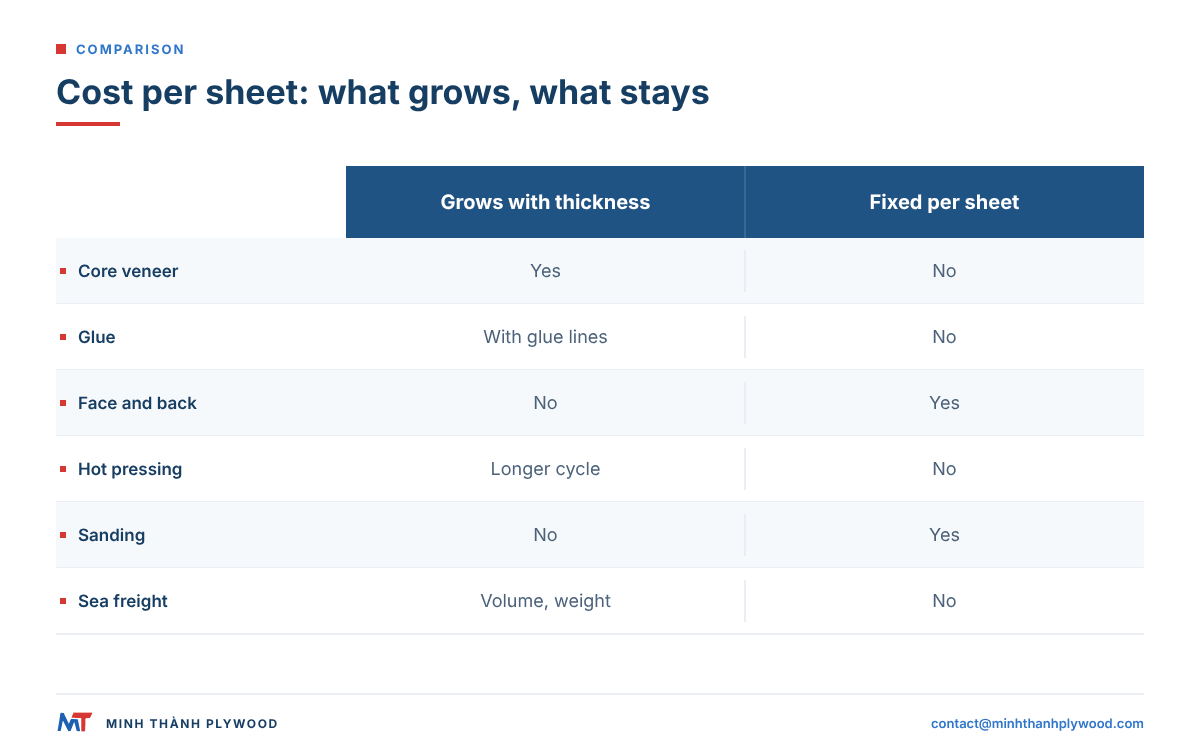
The table sorts the main cost lines of a plywood sheet by how they react to thickness. It is a relative guide for reading quotes, not a price breakdown.
| Cost line | Grows with thickness | Fixed per sheet | What it means for the price |
|---|---|---|---|
| Core veneer | Yes, in proportion | — | The largest share of a thick panel |
| Glue | With the number of glue lines | — | More plies, more glue |
| Face and back veneer | — | Yes | The largest share of a thin panel |
| Hot pressing | Longer cycle for thick panels | — | Thick panels tie up the press longer |
| Calibrating and sanding | — | Yes | Same pass for 6 mm or 25 mm |
| Grading and packing | — | Mostly | Per-sheet cost weighs more on thin sheets |
| Sea freight | By volume and weight | — | Heavy cores fill the weight limit first |
Thin panels therefore cost more per cubic metre, and thick panels cost more per sheet. The cheapest thickness per cubic metre is usually in the middle of the range, where the faces are spread over a reasonable volume and the press cycle is still short.
How many plies does each thickness have, and why does that change the price?
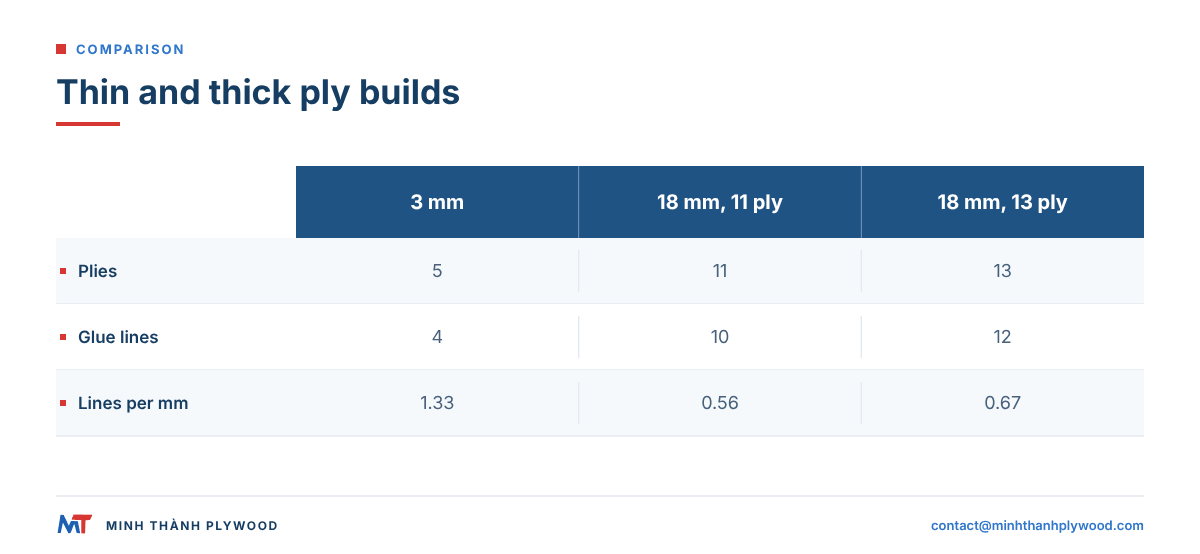
The ply count sets how many glue lines and how much handling go into a sheet. At Minh Thanh, thin panels of 3–5 mm are always 5-ply, and an 18 mm panel usually has 11–13 plies, most often 11.
| Thickness | Plies | Glue lines | Glue lines per mm |
|---|---|---|---|
| 3 mm | 5 | 4 | 1.33 |
| 4 mm | 5 | 4 | 1.00 |
| 18 mm, 11 plies | 11 | 10 | 0.56 |
| 18 mm, 13 plies | 13 | 12 | 0.67 |
The glue lines per millimetre show why thin plywood costs more per cubic metre: a 3 mm sheet has more than twice the glue lines per millimetre of an 11-ply 18 mm sheet, and every veneer in it has to be laid up and checked.
Within one thickness, a quote with more plies costs more because it uses thinner veneers, more glue and more labour. It also gives a flatter, more stable panel with better screw holding. Two 18 mm quotes, one at 11 plies and one at 9 plies, are two different panels, and their prices should differ.
Why do 3–6 mm thin panels cost more per cubic metre?
Thin plywood costs more per cubic metre because the faces, sanding and handling are spread over very little wood. A 3 mm sheet holds 0.0089 m³, one sixth of an 18 mm sheet, yet it carries the same two faces.
The build adds to that. Our 3 mm panel is one core veneer, two cross-band veneers and two face veneers. The 4 and 5 mm panels are three core veneers and two faces, with the core veneer thickness adjusted to the panel; a 4 mm furniture panel, for example, uses three 1.3 mm Styrax core veneers.
Premium thin core veneer is scarce, so 4 mm can take longer to produce. We do not lower the standard to go faster. For a buyer, that means the price per cubic metre of a 4 mm or 6 mm order sits well above the 18 mm price of the same face, and the lead time is worth agreeing on the quote.
6 mm ply price per sheet
A 6 mm 8x4 sheet holds 0.0179 m³, so it takes 56 sheets to make one cubic metre. Divide the price per cubic metre by 56 for the sheet price, and expect the per-cubic-metre figure for 6 mm to be higher than for 12 or 18 mm.
12mm plywood 8x4 price: what changes from 18 mm?
A 12 mm plywood 8x4 sheet holds 0.0357 m³, two thirds of an 18 mm sheet, so its price per sheet is the price per cubic metre times 0.0357. Its price per cubic metre is usually a little higher than the 18 mm figure for the same face and core.
Three things change between 12 and 18 mm:
- The share of the face. The same two faces sit on two thirds of the wood, so the face weighs more in the cost.
- Ply count. A 12 mm panel has fewer plies and glue lines, which lowers its cost per sheet.
- Weight and freight. A 12 mm sheet on a Styrax core weighs about 17.9 kg, against 26.8 kg at 18 mm, and 1,494 sheets fit a 40HC against 990.
Where both thicknesses would do the job, for drawer sides, backs or shelves, 12 mm saves wood and freight. Where screws go into the edge or the part carries load, 18 mm is the safer choice and costs less per cubic metre.
9 mm and 15 mm: where the middle thicknesses sit
A 9 mm sheet holds 0.0268 m³ and a 15 mm sheet 0.0447 m³. Their prices per cubic metre sit between the thin-panel and 18 mm figures, closer to 18 mm as the thickness rises.
These two thicknesses fill specific parts: 9 mm for drawer bottoms, backs and light panels, 15 mm for carcasses and shelves in European furniture where 18 mm is not needed. Our emission tests ran on 9, 15 and 18 mm panels: six ASTM D6007 chamber tests between April 2025 and June 2026 averaged 0.014–0.032 ppm against the 0.05 ppm limit of CARB Phase 2 and TSCA Title VI.
Why does 25 mm plywood cost more per sheet than its volume suggests?
A 25 mm sheet holds 0.0744 m³, 1.39 times the 18 mm volume, and its price per sheet rises a little faster than that. Thick panels press longer, weigh more and fill the container weight limit with fewer sheets.
- Pressing. Heat has to reach the centre glue lines, so the press cycle is longer for a thick panel, and the press makes fewer sheets per shift.
- Weight. On a Styrax core a 25 mm sheet weighs about 37.2 kg; on eucalyptus about 48.4 kg.
- Freight per sheet. A 40HC takes 720 sheets of 25 mm Styrax-core plywood against 990 sheets at 18 mm, so each 25 mm sheet carries 990 ÷ 720 = 1.375 times the freight of an 18 mm sheet.
For tabletops, stair treads and heavy shelving, a 25 mm panel is the right choice. Our guide to 25 mm plywood covers its build and weight in detail.
How does the core species change the price at each thickness?
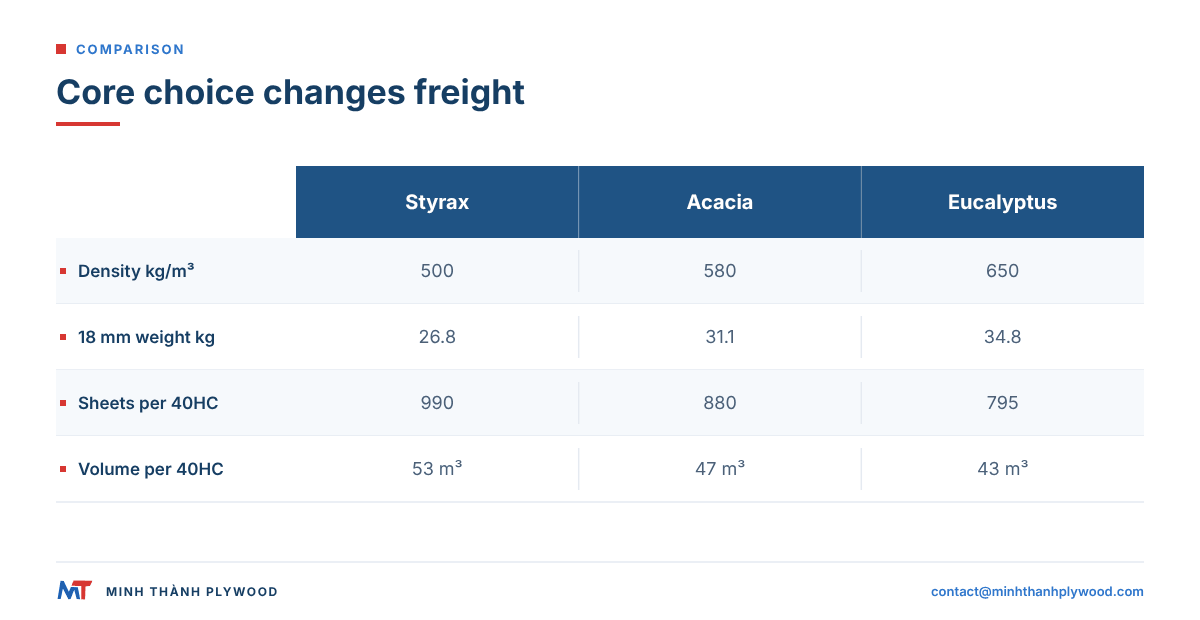
The core species changes the price because the core is most of the panel’s volume and decides its weight. At Minh Thanh, furniture panels use white Styrax or eucalyptus cores as standard; acacia and pine cores are made on order.
| Core (reference density) | 18 mm sheet weight | Sheets per 40HC at 18 mm | Volume per 40HC |
|---|---|---|---|
| Styrax (500 kg/m³) | 26.8 kg | 990 (55 × 18 packs) | about 53 m³ |
| Acacia (580 kg/m³) | 31.1 kg | 880 (55 × 16 packs) | about 47 m³ |
| Eucalyptus (650 kg/m³) | 34.8 kg | 795 (53 × 15 packs) | about 43 m³ |
Packs are about 1,000 mm high, and the planning payload is 28,000 kg unless the booking is lower. A light Styrax core puts about 53 m³ in a container against about 43 m³ for eucalyptus, so the same freight is spread over 23% more panel. Many European furniture buyers choose Styrax for that reason and for its pale, even core.
When you compare two quotes at the same thickness, ask for the core species first. A lower price on a heavier core can turn into a higher delivered cost per cubic metre.
How do 1220 × 2440 and 1250 × 2500 sheets compare on price?
A 1250 × 2500 mm sheet has 3.125 m² of area, 5% more than the 2.977 m² of a 1220 × 2440 mm sheet, so it costs about 5% more per sheet for the same build. Per cubic metre, the two formats price close together.
We press both formats as standard, plus custom sizes such as 1220 × 2500 and 1220 × 2280 mm. The European format suits buyers whose cutting plans and machines are set to 2500 × 1250. The 8x4 format suits North America, the Middle East, Asia and most of Africa.
Choose the format by cutting yield, not by sheet price. If your parts nest better on 1250 × 2500, the 5% higher sheet price buys less waste. Our plywood sheet sizes guide compares the yield of both formats.
How does freight per sheet change with thickness?
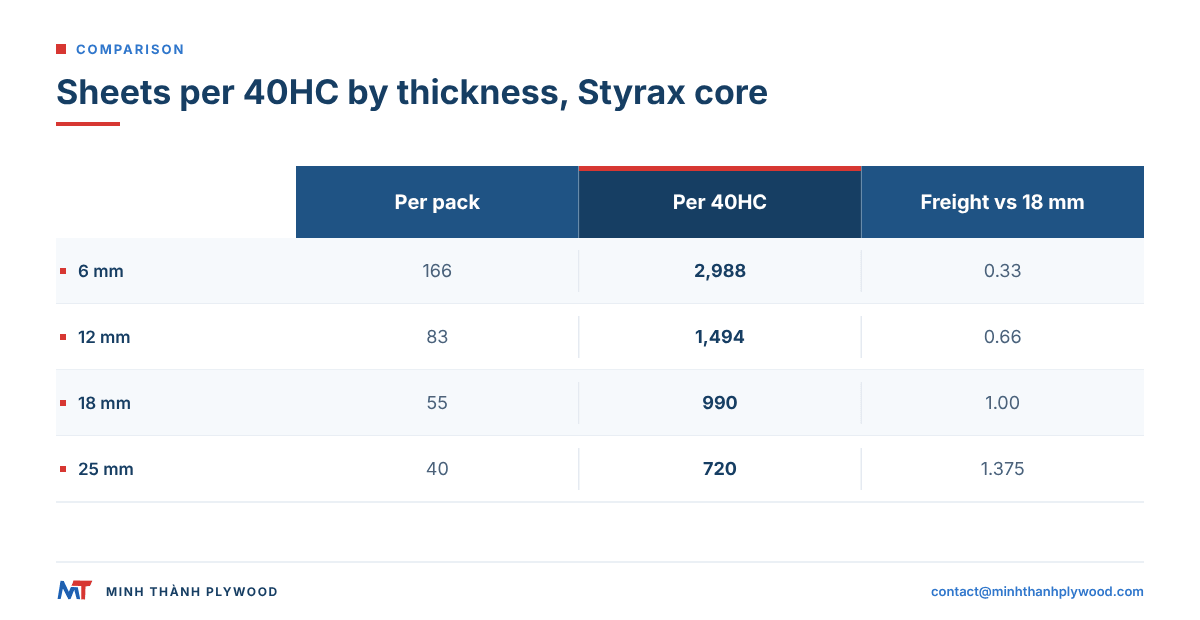
Freight per sheet rises with thickness, because a container holds a fixed volume and weight. To compare delivered costs, divide the container freight by the number of sheets it carries at each thickness.
| Thickness, Styrax core, 1220 × 2440 mm | Sheets per pack | Sheets per 40HC | Freight share vs 18 mm |
|---|---|---|---|
| 6 mm | 166 | 2,988 | 0.33 |
| 9 mm | 111 | 1,998 | 0.50 |
| 12 mm | 83 | 1,494 | 0.66 |
| 15 mm | 66 | 1,188 | 0.83 |
| 18 mm | 55 | 990 | 1.00 |
| 25 mm | 40 | 720 | 1.375 |
Sheets per pack are the 1,000 mm pack height divided by the thickness, rounded down, with 18 packs on a Styrax core. On acacia and eucalyptus the weight limit cuts the count earlier, so the freight share per sheet is higher.
Sea time from Hai Phong runs 30–40 days to Northern Europe, 25–35 days to the Mediterranean and 20–30 days to the US West Coast, by carrier and route. Ask your forwarder for the freight per container and divide it by these counts.
Which specification lines move the price most?
After thickness, the face and the core move the price most, followed by glue and emission, size, quantity and the delivery term. Each line below is a reason two quotes for “18 mm plywood” can differ.
| Price driver | What raises the price | What lowers it |
|---|---|---|
| Face and back | Birch, okoume, EV; higher face grade such as A/A or D+/D | Eucalyptus or utility faces; B/B or lower back |
| Core | Grade A, stitched both ways, calibrated | Grade AB, loose-laid core |
| Glue and emission | UF glue at E0 emission; MR or phenolic (WBP) bond | Standard interior glue for packing grades |
| Thickness and tolerance | Thin panels per m³; ±0.2 mm calibrated | ±0.5–1.0 mm for packing grades |
| Size | Custom formats, cut-to-size | Standard 1220 × 2440 mm |
| Quantity | Many specifications in a small order | One or two specifications per 40HC |
| Delivery term | CIF or CFR includes freight | FOB Hai Phong |
Furniture panels at Minh Thanh are pressed twice as standard: the core board is pressed and calibrated, then the face and back are pressed on. That second press costs more than a single press and gives a flat panel with even thickness, which is why sanded furniture panels hold ±0.2–0.3 mm.
How do 8x4 price lists in India, the UK and the Gulf compare with an import quote?
Local price lists quote a retail or merchant price per sheet or per square foot, while an import quote is per cubic metre, FOB or CIF. To compare them, bring both to the same unit and the same point of delivery.
- India: rate per square foot. An 8x4 sheet is 32 sq ft, so the sheet price is the rate per square foot times 32. Indian lists often quote by ply grade and brand, so match the grade before comparing.
- UK and Europe: price per sheet, VAT included or not. Merchant prices include stock holding, delivery and margin. Take VAT out and compare with your landed cost per sheet.
- Gulf and Middle East: price per sheet or per bundle. Sea time from Hai Phong to the Middle East is 15–25 days, so landed costs move with freight more than with the mill price.
- Import quote: price per m³. Multiply by the sheet volume, then add freight, insurance, duty and inland transport per sheet.
A local list is the right benchmark for a few sheets. For a container, the import quote per cubic metre, converted to a landed sheet price, is the figure to compare. Our plywood price guide walks through the landed-cost calculation.
What is the price of 18mm marine plywood 8x4?
Marine plywood sits in its own price band, well above furniture or commercial plywood of the same thickness. It is built to a marine standard such as BS 1088, with selected durable species and a boil-proof bond, and it is sold for boats and permanently wet use.
A “waterproof” 18 mm panel with a phenolic (WBP) bond is not the same product as BS 1088 marine plywood. For exterior uses such as stair treads and wall sheathing, we make exterior panels with melamine-fortified or phenolic (WBP) glue, priced per cubic metre like our other lines. For a boat hull, buy certified marine plywood and compare marine quotes with each other. Our guide to marine plywood price covers that band.
Does quantity or order size change the price per thickness?
A full container of one or two specifications usually prices lower per cubic metre than a load split into many thicknesses. Long runs of one build keep the lay-up, press and sanding lines set, and they need fewer pack sizes.
Our minimum order is one 40HC. Mixed loads are made by agreement: usually one or two specifications per container, and three to six by agreement. Production takes 15–45 days after the 30% deposit, with the 70% balance against the scanned B/L or by irrevocable L/C at sight.
When a mixed container is the right choice, ask for each thickness to be priced on its own line. You can then see what the 6 mm or 25 mm line costs per cubic metre against the 18 mm line.
What should you send for a thickness-based quote?
Send one line per thickness, with the same fields on every line, so the mill can price each one and you can compare them per cubic metre and per sheet.
A complete line reads like this:
Furniture plywood, 18 mm ±0.2 mm, 1220 × 2440 mm, Styrax core stitched, double pressed, UF glue at E0 emission (CARB P2 / TSCA Title VI), EV face A/A sanded both sides, 990 sheets per 40HC in 18 packs, FOB Hai Phong.
Add the same line for 12 mm, 9 mm or 25 mm, and the destination port. Send it through the furniture plywood page or by email to contact@minhthanhplywood.com. We reply within hours, and samples are free.
Buyer questions, answered
What is the price of 18mm plywood 8x4?
The sheet price is the price per cubic metre times 0.0536 m³, the volume of a 1220 × 2440 × 18 mm sheet. Minh Thanh furniture plywood starts from US$350/m³ and commercial plywood from US$250/m³ FOB (October 2026), about US$18.75 and US$13.40 of panel per sheet before freight.
Is 18 mm plywood 1.5 times the price of 12 mm?
No. An 18 mm sheet holds 1.5 times the wood of a 12 mm sheet, but both carry two faces, one sanding pass and the same handling. Those per-sheet costs make the 18 mm sheet cost less than 1.5 times the 12 mm sheet.
Why is thin plywood more expensive per cubic metre?
A thin panel has more glue lines, more face area and more handling per cubic metre. A 3 mm sheet has 1.33 glue lines per millimetre against about 0.56 for an 11-ply 18 mm sheet, and premium thin veneer is scarce.
How many 18 mm 8x4 sheets are in one cubic metre?
About 18.7 sheets of 1220 × 2440 × 18 mm, because each sheet holds 0.0536 m³. A 1250 × 2500 × 18 mm sheet holds 0.0563 m³, about 17.8 sheets per cubic metre.
Does the core species change the price at the same thickness?
Yes. The core is most of the panel's volume and decides its weight. An 18 mm sheet weighs about 26.8 kg on Styrax, 31.1 kg on acacia and 34.8 kg on eucalyptus, which changes how many sheets fit under the container weight limit.
How do I convert an Indian price per square foot to a sheet price?
Multiply the rate per square foot by 32, the area of an 8x4 sheet in square feet. Then compare the result with a sheet price worked out from a price per cubic metre, at the same thickness and grade.
Is 1250 × 2500 mm plywood more expensive than 8x4?
Per sheet, yes: a 1250 × 2500 mm sheet has 5% more area and volume than a 1220 × 2440 mm sheet. Per cubic metre the two formats price close together when the build is the same.
What is the price of 18mm marine plywood 8x4?
Marine plywood is a different product, built to a marine standard such as BS 1088 with a weather and boil-proof bond, and it prices well above furniture or commercial plywood. Compare marine quotes only with other marine quotes of the same standard.
Does ordering more sheets reduce the plywood price?
A full container of one or two specifications costs less per cubic metre than a small mixed load, because set-up and pressing run longer on one build. Our minimum order is one 40HC, with mixed specifications by agreement.
Why does 25 mm plywood cost more per sheet than its volume suggests?
Thick panels need longer pressing for heat to reach the centre, and they reach the container weight limit with fewer sheets. A 25 mm sheet carries about 1.375 times the freight of an 18 mm sheet on the same core.