
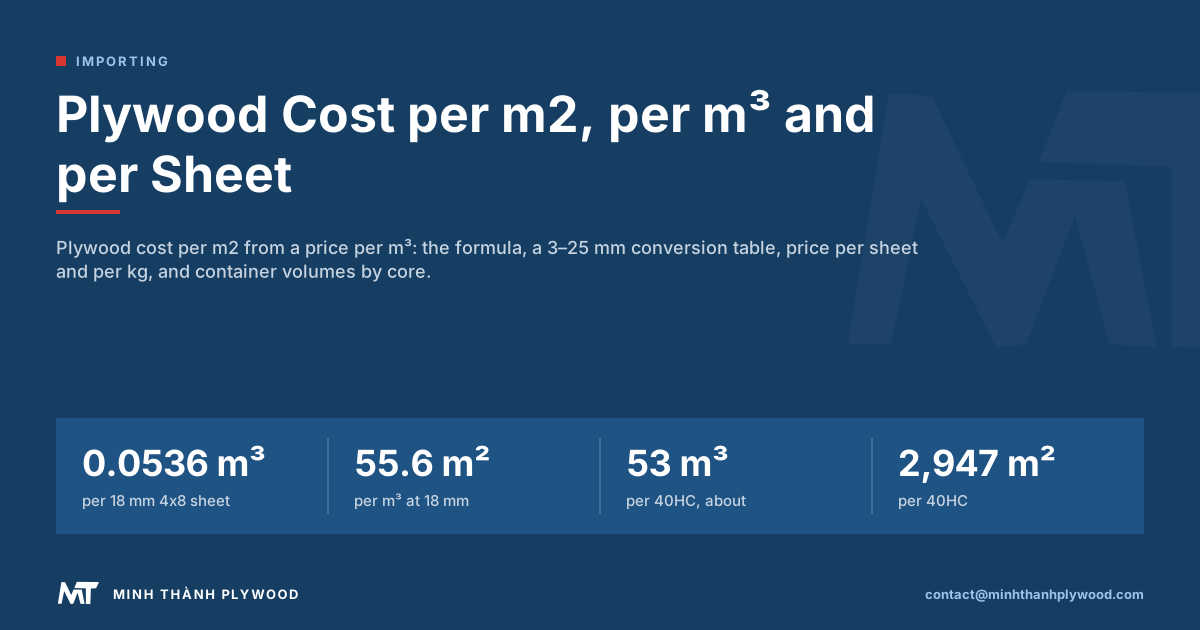
Plywood cost per m2 is the price per cubic metre multiplied by the thickness in metres: an 18 mm panel priced per m³ costs 0.018 times that rate per square metre. Mills that export quote per cubic metre because it compares every thickness on one scale; buyers then convert to square metres, sheets or kilograms for their own costing. This guide gives the formulas, a conversion table from 3 to 25 mm, container volumes by core and the common conversion mistakes, from Minh Thanh Plywood, a manufacturer in Phu Tho.
Plywood cost per m2: the short answer
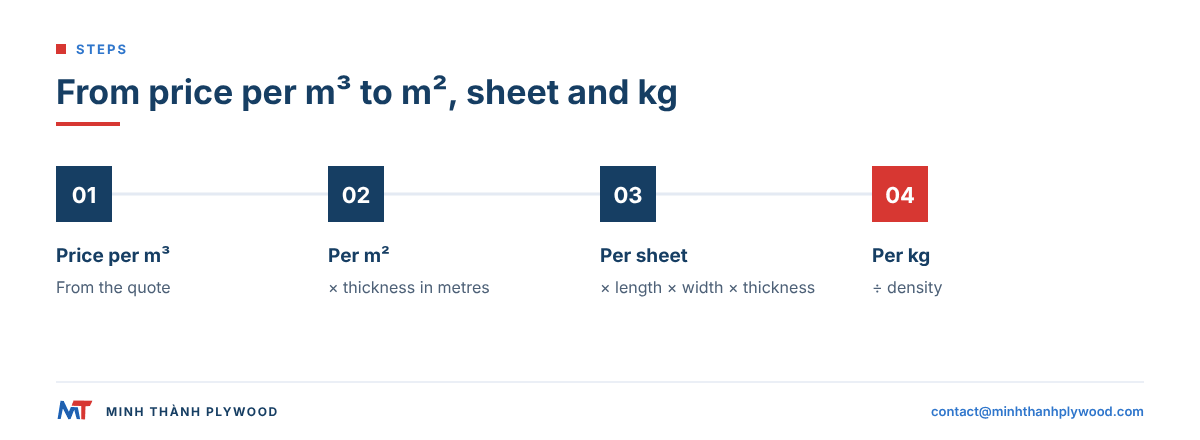
Plywood cost per m2 equals the price per cubic metre multiplied by the panel thickness in metres. Three formulas cover every conversion a buyer needs.
- Price per m² = price per m³ × thickness (m). For 18 mm: × 0.018.
- Price per sheet = price per m³ × length (m) × width (m) × thickness (m). For 1220 × 2440 × 18 mm: × 0.0536.
- Price per kg = price per m³ ÷ density (kg/m³). For a Styrax core of about 500 kg/m³: ÷ 500.
Worked through at the October 2026 starting reference of US$350/m³ for furniture plywood, an 18 mm panel converts to about US$6.30 per square metre and about US$18.75 per 1220 × 2440 mm sheet, before freight and duty. These are conversions of a starting price, not a quote: the final price follows the specification.
Why do plywood exporters quote per cubic metre?
Plywood exporters quote per cubic metre because one rate then covers every thickness and size of the same build. A mill’s costs grow with the volume of wood, glue and pressing in a panel, not with its face area.
- One scale for all thicknesses: a 9 mm and an 18 mm panel of the same build sit on the same rate.
- Production planning: veneer is bought and peeled by volume, and presses are loaded by volume.
- Container loading: a 40HC is planned in cubic metres and capped by weight.
- Freight: sea freight is paid per container, so a buyer divides it by cubic metres.
Retailers price per sheet, and flooring or lining contractors often think per square metre. Both are conversions of the mill’s rate per cubic metre.
How do you convert a plywood price per m³ into a price per square meter?
Convert a plywood price per m³ into a price per square meter by multiplying it by the thickness in metres. Thickness in millimetres divided by 1,000 gives thickness in metres.
- Take the price per cubic metre from the quote, with its currency and Incoterm.
- Convert the thickness to metres: 18 mm = 0.018 m.
- Multiply: price per m³ × 0.018 = price per m² for 18 mm.
- Keep the Incoterm: a FOB rate gives a FOB price per square metre.
- Add freight per square metre separately if you need a landed figure.
The plywood price per square meter rises in step with thickness. At the same rate per cubic metre, 18 mm costs twice as much per square metre as 9 mm, because it holds twice the wood.
What does one cubic metre of plywood convert to?
One cubic metre of plywood converts to a fixed number of square metres and sheets at each thickness. The table uses the 1220 × 2440 mm sheet, which covers 2.9768 m².
| Thickness | m² per m³ | Volume per sheet | Sheets per m³ | Price per m² at rate R |
|---|---|---|---|---|
| 3 mm | 333.3 | 0.00893 m³ | 112.0 | R × 0.003 |
| 6 mm | 166.7 | 0.01786 m³ | 56.0 | R × 0.006 |
| 9 mm | 111.1 | 0.02679 m³ | 37.3 | R × 0.009 |
| 12 mm | 83.3 | 0.03572 m³ | 28.0 | R × 0.012 |
| 15 mm | 66.7 | 0.04465 m³ | 22.4 | R × 0.015 |
| 18 mm | 55.6 | 0.05358 m³ | 18.7 | R × 0.018 |
| 21 mm | 47.6 | 0.06251 m³ | 16.0 | R × 0.021 |
| 25 mm | 40.0 | 0.07442 m³ | 13.4 | R × 0.025 |
Keep full precision through the calculation and round only the final money figure. Rounding the sheet volume first, then multiplying across a container, adds an error to every line of a costing sheet.
What is the cost of plywood per square meter at a given rate?
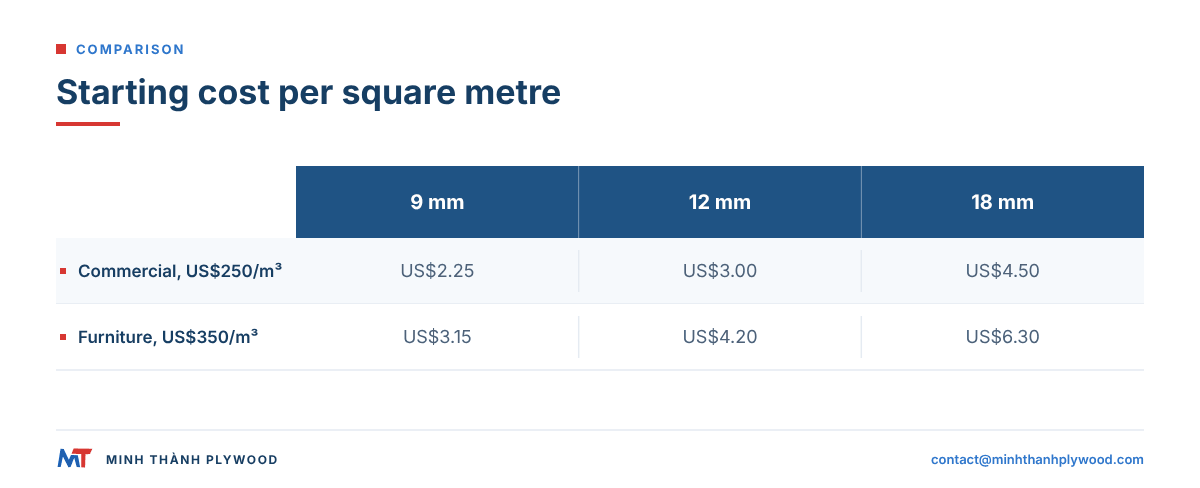
The cost of plywood per square meter at a given rate is that rate times the thickness in metres. Minh Thanh’s indicative starting prices (October 2026) are US$250/m³ for commercial plywood and US$350/m³ for furniture and interior plywood.
| Thickness | Commercial, from US$250/m³ | Furniture, from US$350/m³ |
|---|---|---|
| 9 mm | about US$2.25 per m² | about US$3.15 per m² |
| 12 mm | about US$3.00 per m² | about US$4.20 per m² |
| 18 mm | about US$4.50 per m² | about US$6.30 per m² |
These are unit conversions of starting rates held constant to isolate thickness. They are not quotations for those thicknesses: a real quote also prices the face, core, glue, size, quantity and delivery term, and thin panels carry more handling per cubic metre.
How do you convert a price per m³ into a price per sheet?
Multiply the price per cubic metre by the sheet’s volume: length × width × thickness, all in metres. For the common 1220 × 2440 mm sheet the area is 2.9768 m², so the volume is 2.9768 × thickness in metres.
- 18 mm, 1220 × 2440 mm: 1.22 × 2.44 × 0.018 = 0.0536 m³ per sheet.
- 12 mm, 1220 × 2440 mm: 1.22 × 2.44 × 0.012 = 0.0357 m³ per sheet.
- 18 mm, 1250 × 2500 mm: 1.25 × 2.50 × 0.018 = 0.0563 m³ per sheet.
A 4x8 sheet is made as 1220 × 2440 mm, and a 3/4 inch order is usually filled with 18 mm metric plywood. If the supplier quotes a true 19 mm sheet, the volume and the sheet price both rise by about 5.6%.
The birch plywood price guide applies the same formula to birch-faced panels, and the plywood price guide has a per-sheet table at one rate.
Plywood price per square meter vs per sheet: which should you use?
Use the price per square meter for coverage jobs and the price per sheet for parts cut from whole sheets. Use the price per cubic metre to compare suppliers.
| Unit | Best for | Watch |
|---|---|---|
| Per m³ | Comparing suppliers and thicknesses | Same nominal size and thickness on both quotes |
| Per m² | Lining, flooring, sheathing, wall panels | Always state the thickness beside the rate |
| Per sheet | Furniture and cabinet parts cut from sheets | Yield of parts per sheet, not only sheet price |
| Per kg | Comparing cores and freight | Density differs by core and by order |
A furniture plant that cuts eight cabinet sides from one sheet should cost per part: sheet price ÷ parts per sheet. A slightly dearer sheet size that yields one more part is the cheaper buy.
How do sheet size and custom sizes change the conversion?
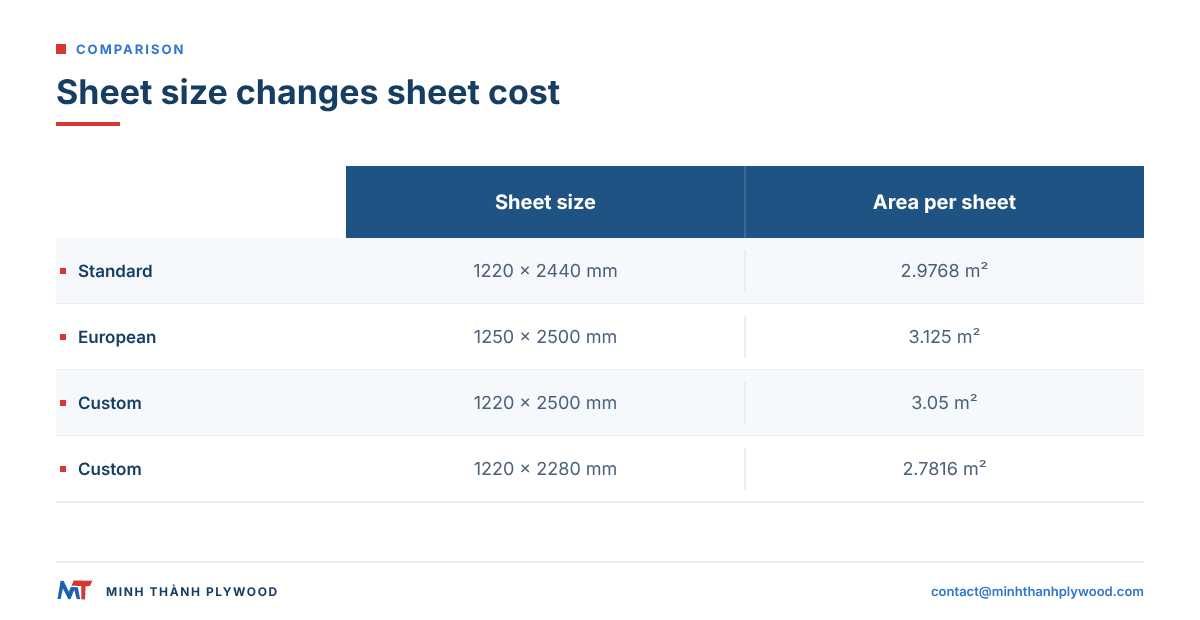
Sheet size changes the volume per sheet, and so the price per sheet, but not the price per square metre or per cubic metre. Minh Thanh presses 1220 × 2440 and 1250 × 2500 mm, plus custom sizes such as 1220 × 2500 and 1220 × 2280 mm.
- 1220 × 2440 mm: 2.9768 m² per sheet.
- 1250 × 2500 mm: 3.125 m² per sheet, about 5% more than 1220 × 2440 mm.
- 1220 × 2500 mm: 3.05 m² per sheet.
- 1220 × 2280 mm: 2.7816 m² per sheet.
- Cut-to-size: one panel cut into 4, 6 or 8 pieces; cost the pieces from the parent sheet.
When comparing a 1220 × 2440 mm quote with a 1250 × 2500 mm quote, convert both to cubic metres or square metres first. Comparing sheet prices directly makes the smaller sheet look cheaper.
How do you convert a plywood price per m³ into a price per kg?
Divide the price per cubic metre by the panel density in kilograms per cubic metre. Weight-based prices appear in some markets and in freight costing, and the core species decides the density.
| Core | Reference density | Price per kg at rate R | 18 mm sheet weight |
|---|---|---|---|
| Styrax | about 500 kg/m³ | R ÷ 500 | 26.8 kg |
| Acacia | about 580 kg/m³ | R ÷ 580 | 31.1 kg |
| Eucalyptus | about 650 kg/m³ | R ÷ 650 | 34.8 kg |
A price per kilogram rewards heavy panels and penalises light ones. A Styrax-core panel at the same rate per cubic metre looks dearer per kilogram than a Eucalyptus-core panel, while it covers the same square metres. Compare per cubic metre or per square metre, and use weight only for freight and handling.
How does the core change plywood cost per m2 delivered?
The core changes the delivered cost per square metre because it sets how many cubic metres fit in a container before the weight limit. Freight is paid per container, so a lighter core spreads it over more square metres.
| 18 mm, 1220 × 2440 mm, 40HC | Styrax core | Acacia core | Eucalyptus core |
|---|---|---|---|
| Packs | 18 | 16 | 15 |
| Sheets | 990 | 880 | 795 |
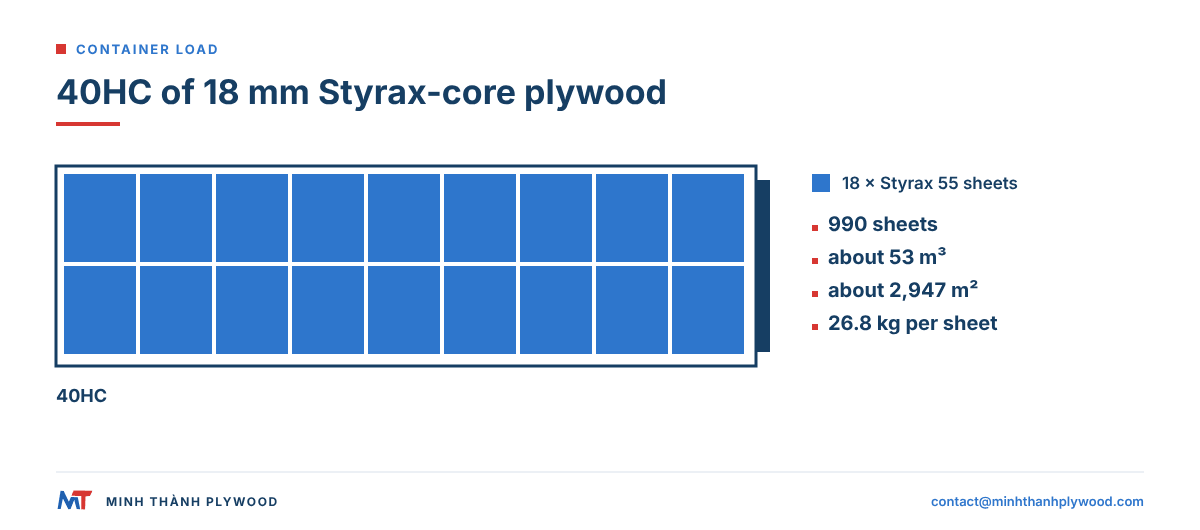
| Volume | about 53 m³ | about 47 m³ | about 43 m³ |
| Area | about 2,947 m² | about 2,620 m² | about 2,367 m² |
Freight per square metre = container freight ÷ square metres in the container. With the same freight, a Styrax-core container spreads the cost over about a quarter more square metres than a Eucalyptus-core container.
These loads are planned with packs about 1,000 mm high and a 28,000 kg planning payload, unless your booking sets a lower limit.
How many cubic and square metres fit in a 40HC at each thickness?
A 40HC of Styrax-core plywood in 1220 × 2440 mm holds about 53 m³ at every common thickness; the square metres fall as the thickness rises. The table shows 18 packs of about 1,000 mm, with sheets per pack = 1,000 ÷ thickness, rounded down.
| Thickness | Sheets per pack | Sheets per 40HC | Volume | Area |
|---|---|---|---|---|
| 3 mm | 333 | 5,994 | 53.53 m³ | about 17,843 m² |
| 6 mm | 166 | 2,988 | 53.37 m³ | about 8,895 m² |
| 9 mm | 111 | 1,998 | 53.53 m³ | about 5,948 m² |
| 12 mm | 83 | 1,494 | 53.37 m³ | about 4,447 m² |
| 15 mm | 66 | 1,188 | 53.05 m³ | about 3,536 m² |
| 18 mm | 55 | 990 | 53.05 m³ | about 2,947 m² |
| 21 mm | 47 | 846 | 52.89 m³ | about 2,518 m² |
| 25 mm | 40 | 720 | 53.58 m³ | about 2,143 m² |
A mixed container combines packs of different thicknesses in the same space. Minh Thanh loads 1–2 specifications per container as usual, and more by agreement.
What drives the price per cubic metre itself?
The price per cubic metre is set by the build: face, core, glue and emission, thickness and tolerance, size, sanding, packing, quantity and delivery term. The conversions in this guide only change the unit; these lines change the rate.
| Line | Lower rate | Higher rate |
|---|---|---|
| Face | Commercial face, low grade | Birch, okoume, high grade |
| Core | Commercial core, loose layers | Stitched, calibrated furniture core |
| Glue and emission | Standard interior glue | UF glue at E0 emission, MR or phenolic (WBP) |
| Tolerance and sanding | ±0.5 mm, unsanded | ±0.2 mm, sanded and polished |
| Size | Standard sheet | Custom size, cut-to-size |
| Quantity | Full 40HC, few specifications | Many specifications |
| Delivery term | FOB Hai Phong | CFR, CIF |
Two quotes in the same unit are only comparable when these lines match. Our guide on how to compare plywood quotations gives a line-by-line comparison sheet.
What does plywood cost per m² on a UK shelf, next to the factory rate?
On a UK shelf, a 1220 × 2440 mm hardwood plywood sheet costs about £8.59 to £12.60 per m² at 9 to 18 mm, against about US$3.15 to US$6.30 per m² as a factory starting rate for furniture plywood at the same thickness. The difference is what freight, duty, VAT, the importer’s and the retailer’s margin and stock-holding add between the mill and the shop.
| Thickness, 1220 × 2440 mm | Wickes sheet price (October 2026) | Wickes price per m² | Factory starting rate, FOB Hai Phong |
|---|---|---|---|
| 9 mm | £25.60 | £8.59 | about US$3.15 per m² |
| 12 mm | £29.00 | £9.74 | about US$4.20 per m² |
| 18 mm | £37.50 | £12.60 | about US$6.30 per m² |
Source for the shelf prices: Wickes plywood range, non-structural hardwood plywood, delivery not included. B&Q lists 18 mm hardwood plywood boards from £15.97 up to £45.10 by board size and grade, with delivery charged separately. Shelf prices move week to week, so check the page on the day you compare.
Two cautions keep the comparison honest. The shelf sheet is a retail grade, sold one board at a time with delivery, and the factory rate is a rate for a full container, so the factory figure is the starting point for your own landed-cost build in the next section, not a promise of a retail margin. Cut-down boards cost far more per m²: the same Wickes range prices a 606 × 1220 mm 18 mm board at £27.70 per m², more than double the full sheet.
Which thickness for which job?
Buyers asking for a price per m² usually also need to choose the thickness first, because the price scales with it.
| Thickness | Typical use | Where the m² price sits |
|---|---|---|
| 4 to 6 mm | Linings, drawer bottoms, cabinet backs | Lowest per sheet |
| 9 to 12 mm | Cabinetry, shelving, panels | Middle |
| 18 to 25 mm | Worktops, carcasses, structural and flooring uses | Highest per sheet, lowest handling per m³ |
Our plywood thickness guide gives tolerances and uses for every thickness from 3 mm to 40 mm.
How do you go from a price per m³ to a landed cost per m2?
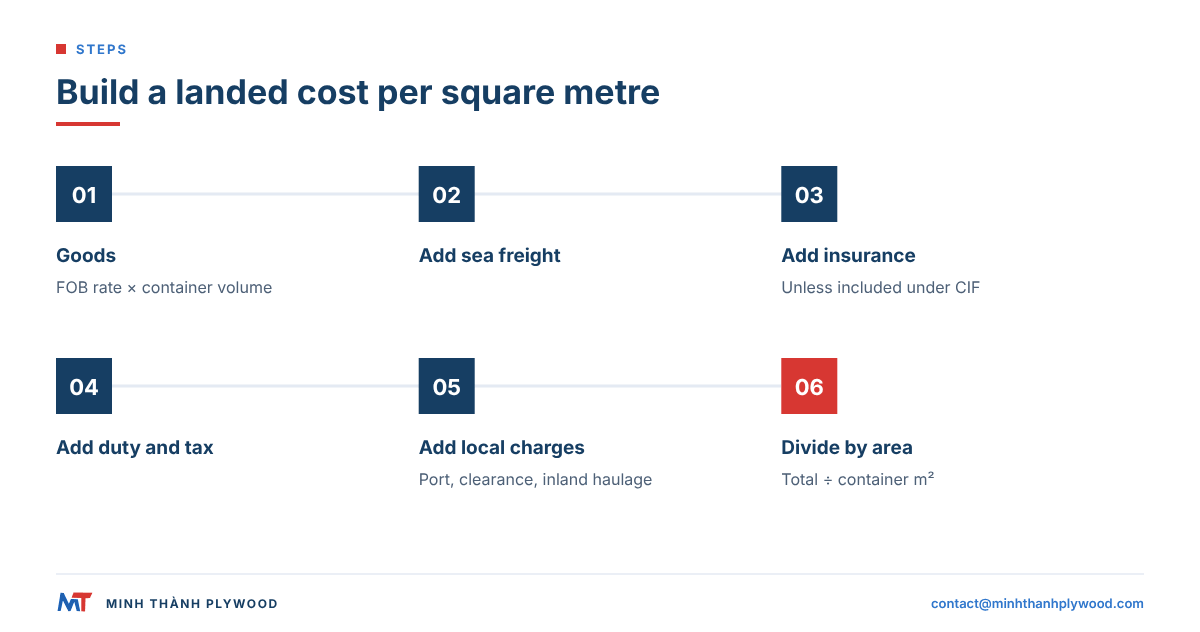
Go from a price per m³ to a landed cost per m2 by building the container cost first, then dividing by the square metres in the container. Working per container avoids double counting.
- Goods: FOB price per m³ × m³ in the container.
- Sea freight: the container rate from Hai Phong to your port.
- Insurance: on the cargo value, or included under CIF.
- Duty and import tax: on the customs value at your border.
- Port, clearance and inland transport.
- Total ÷ square metres in the container = landed cost per m².
The same total ÷ sheets gives a landed cost per sheet, and ÷ cubic metres gives a landed cost per m³. Use the sheet count from the packing list, not an estimate.
Duty depends on the destination. The UK Trade Tariff entry for plywood commodity 4412331012 lists a lower rate for Vietnam under the UK-Vietnam trade agreement than the third-country rate. In the 2026 Canadian Customs Tariff, chapter 44, plywood lines show Free under the most-favoured-nation and CPTPP columns.
What mistakes skew a plywood cost per m2 comparison?
Most mistakes come from mixing nominal and real dimensions, or units from different thicknesses. Check these before you trust a comparison:
- Nominal vs real thickness: an 18 mm panel delivered at 17 mm holds about 5.6% less wood.
- Inch vs metric sheets: a 4x8 sheet is usually 1220 × 2440 mm; check the actual size on the quote.
- Square metres without thickness: a rate per m² means nothing without the thickness beside it.
- Different Incoterms: a CIF rate per m² includes freight that a FOB rate does not.
- Volume from rounded sheets: round only the final money figure.
- Weight-based comparisons across cores: a price per kg favours the heavier core.
What does this mean for your order with Minh Thanh Plywood?
Minh Thanh Plywood quotes per cubic metre and states the sheet count, so you can convert to any unit. Indicative starting prices (October 2026) are US$250/m³ for commercial plywood and US$350/m³ for furniture and interior plywood. Final prices depend on the specification, so every quote states the sheet count and the unit it uses.
- Sizes: 1220 × 2440 and 1250 × 2500 mm, custom sizes, cut-to-size into 4, 6 or 8 pieces.
- Thickness: 3–40 mm, with tolerance down to ±0.2 mm on sanded furniture panels.
- Cores: white Styrax or Eucalyptus as standard; Acacia and Pine on order.
- Glue: UF glue at E0 emission as standard, CARB P2 / TSCA Title VI under ICTT mill no. 23024.
- Terms: MOQ 1×40HC, 15–45 days after the 30% deposit, 70% against the scanned B/L or an irrevocable L/C at sight, FOB Hai Phong, CFR or CIF. Free samples.
See furniture plywood from Vietnam for the builds, and our eucalyptus plywood price in Vietnam guide for a heavier core.
What should you send for a price per m³ you can convert?
Send the specification with the unit you need, and we quote per cubic metre with sheets and square metres alongside. A request looks like this:
Application: wall lining · Core: white Styrax · Glue: UF glue at E0 emission · Face: poplar B/B, sanded · Sheet: 12 mm, ±0.3 mm, 1250 × 2500 mm · Quantity: 1×40HC, CIF your port · Please state m³, sheets and m²
Email it to contact@minhthanhplywood.com, or message Lisa on WhatsApp at +84 988 586 601. We reply within hours, Monday to Friday, 08:00–17:00 Vietnam time (UTC+7).
Buyer questions, answered
How do I convert a plywood price per m³ to a price per m2?
Multiply the price per cubic metre by the thickness in metres. For 18 mm plywood, the price per square metre is the m³ price × 0.018; for 12 mm it is × 0.012.
How many square metres of plywood are in one cubic metre?
Divide 1 by the thickness in metres. One cubic metre of 18 mm plywood covers about 55.6 m², of 12 mm about 83.3 m² and of 9 mm about 111.1 m².
How many sheets of plywood are in one cubic metre?
Divide one cubic metre by the volume of one sheet. A 1220 × 2440 × 18 mm sheet holds 0.0536 m³, so one cubic metre is about 18.7 sheets; at 12 mm it is about 28 sheets.
Why do plywood exporters quote per cubic metre?
Because a price per cubic metre compares every thickness and size on one scale, follows the way mills buy veneer and plan production, and matches how containers are loaded and freight is costed.
What is the plywood price per cubic meter from Vietnam?
Minh Thanh Plywood quotes commercial plywood from US$250/m³ and furniture and interior plywood from US$350/m³ (October 2026). The final price depends on face, core, glue, thickness, size, quantity and delivery term.
How do I convert a price per m³ into a price per sheet?
Multiply the price per cubic metre by length × width × thickness in metres. A 1220 × 2440 × 18 mm sheet is 0.0536 m³, so the sheet price is the m³ price × 0.0536.
How do I convert a plywood price per m³ into a price per kg?
Divide the price per cubic metre by the panel density. At about 500 kg/m³ for a Styrax core, the price per kilogram is the m³ price ÷ 500; at about 650 kg/m³ for Eucalyptus it is ÷ 650.
Does the core change plywood cost per m2 delivered?
Yes. A lighter core fits more cubic metres in a container before the weight limit, so freight per square metre falls. A 40HC holds about 53 m³ of 18 mm Styrax-core plywood and about 43 m³ on Eucalyptus.
Should I compare plywood quotes per m³ or per sheet?
Use both. Per cubic metre compares the material across thicknesses and suppliers; per sheet or per square metre is what you use and sell. Check that both quotes calculate volume from the same nominal size and thickness.
How many square metres are in a 4x8 plywood sheet?
A 4x8 sheet made as 1220 × 2440 mm covers 2.98 m² (2.9768 m² exactly). A 1250 × 2500 mm sheet covers 3.125 m².