
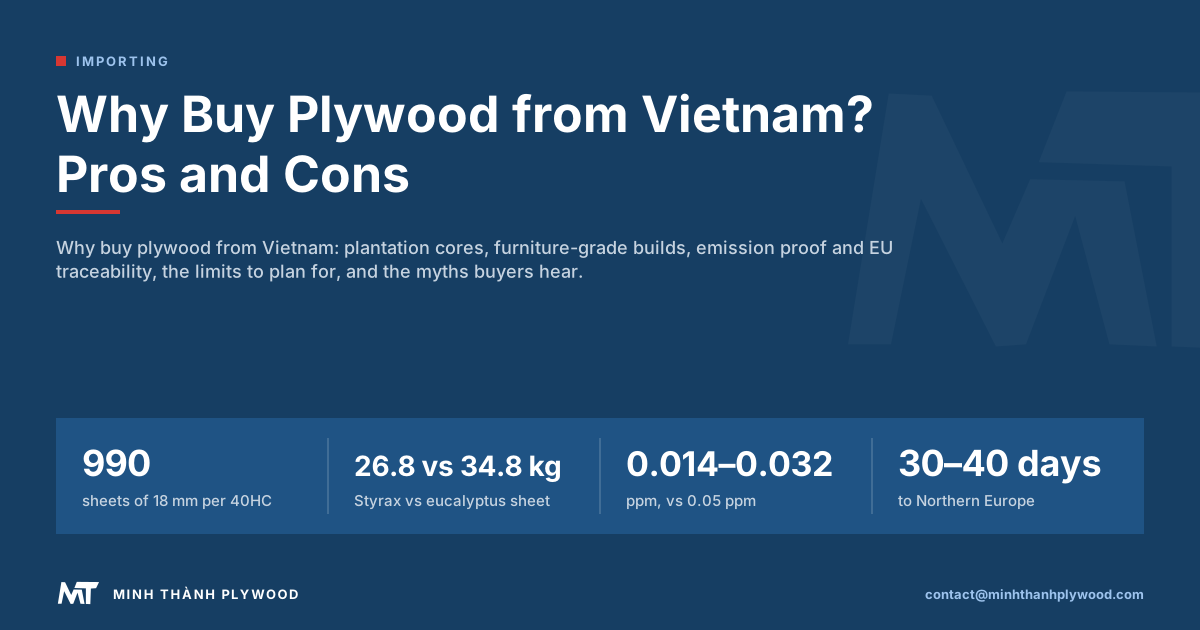
Buyers choose Vietnamese plywood for light plantation cores, furniture-grade builds pressed twice, documented low emission and EU traceability files, at a cost that beats comparable mills elsewhere. Minh Thanh Plywood makes these panels in Phu Tho for European furniture plants; plan for one-container orders and five weeks at sea, and specify every panel in writing.
Why buy plywood from Vietnam? Six reasons importers give
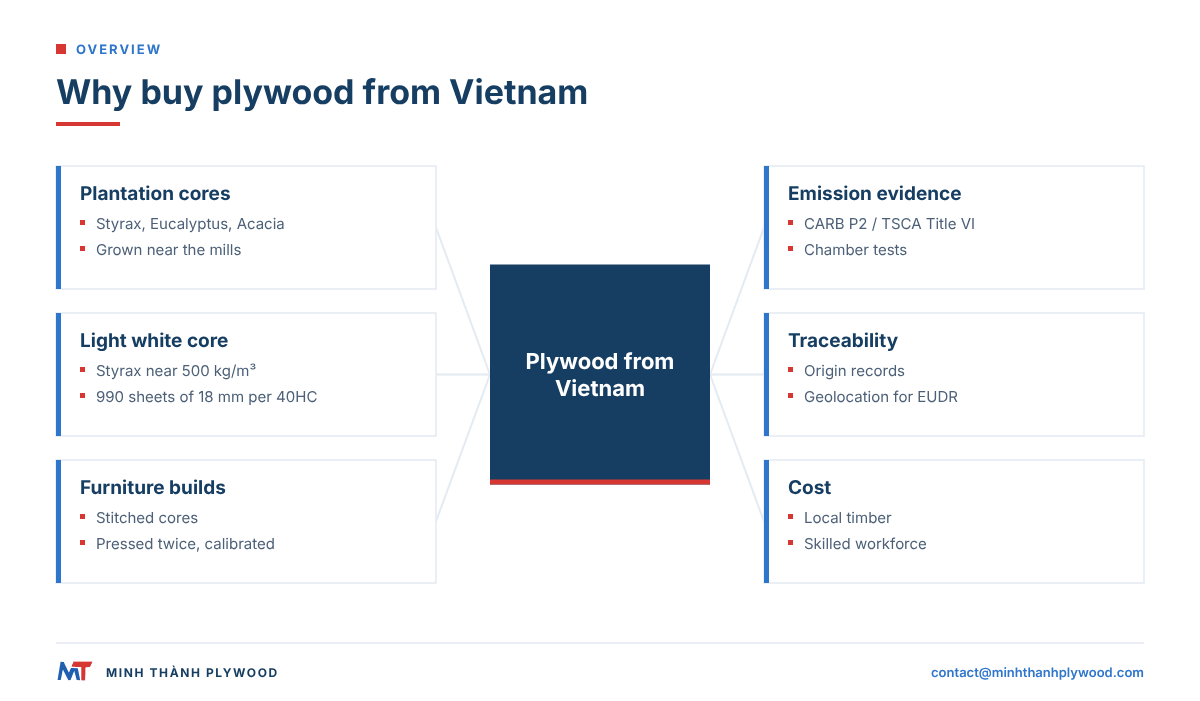
Importers buy plywood from Vietnam for six reasons: plantation cores, light white cores, furniture-grade builds, emission evidence, traceability files and cost. They fit the furniture and interior trade better than any other use, and each one comes from how the panels are made.
- Plantation cores grown near the mills. Styrax, Eucalyptus and Acacia are planted and harvested in northern and central Vietnam, so core veneer is local and steady.
- Light white cores for furniture. Styrax gives a pale, even edge at a reference density near 500 kg/m³, light enough to carry 990 sheets of 18 mm in one 40HC.
- Furniture-grade builds. Stitched cores, pressing twice and calibrated sanding give flat faces and tight thickness tolerance.
- Emission evidence. Furniture mills that sell to Europe and the US hold CARB P2 / TSCA Title VI certification and run chamber tests.
- Traceability files. Origin records and geolocation files for the EU deforestation regulation are supplied with each order.
- Cost. Local timber and a skilled workforce let a mill such as Minh Thanh Plywood reach high-grade quality at a better price than comparable mills.
The rest of this article takes each reason apart, shows what to check, and clears up the misconceptions buyers still hear.
Where does Vietnamese plywood come from? Plantation wood and regions
Vietnamese plywood is made from fast-growing plantation timber, mainly in the northern provinces and the central coast. The cores are Vietnamese; the faces are whatever the buyer orders.
| Core species | Where it grows | Reference density | Typical use |
|---|---|---|---|
| Styrax (white core) | Northern provinces only | 500 kg/m³ | Light furniture and interior panels |
| Eucalyptus | North and centre | 650 kg/m³ (650–750 kg/m³ in practice) | Stiffer furniture panels, heavier builds |
| Acacia | North and centre | 580 kg/m³ | Commercial, packing and film-faced panels |
| Pine | On order | — | Special builds on request |
Minh Thanh Plywood sits in Ha Hoa, Phu Tho, inside the northern plantation belt. Core logs come from local plantations, which keeps veneer supply close to the press and the cost per cubic metre down. The factory is built for top-grade furniture and interior plywood, with Europe as its main market.
What are the advantages of Vietnamese plywood for European buyers?
For a European furniture or interior buyer, the advantage is a panel built to the furniture specification, on a light plantation core and with emission and EUDR origin documents, at a price that leaves margin. That shows up in five places on the order.
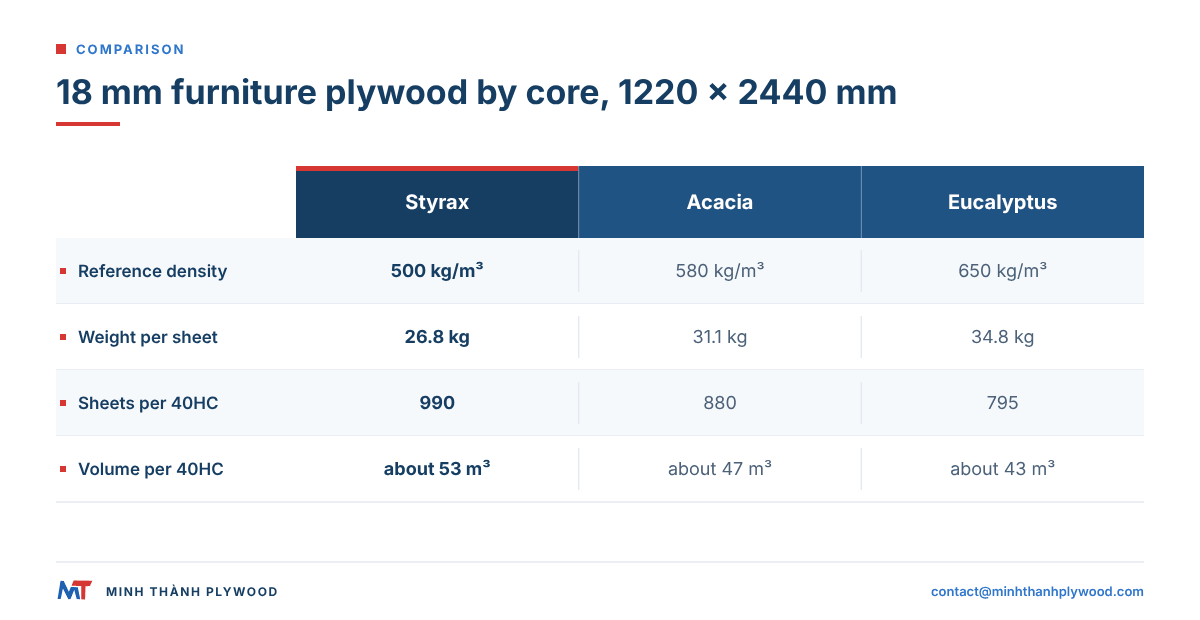
- Weight and freight. A white Styrax core loads 990 sheets of 18 mm per 40HC, against 880 on Acacia and 795 on Eucalyptus. More sheets per container lowers freight per panel.
- Face choice. More than ten face veneers: engineered veneer (EV), poplar, birch, okoume and pine as the main ones, plus bintangor, eucalyptus, gurjan and sapele on request.
- Sizes for European lines. 1250 × 2500 mm next to 1220 × 2440 mm, custom sizes, and cut-to-size panels shipped regularly to Italy and other European markets.
- Tolerance. Sanded furniture panels down to ±0.2 mm thickness tolerance, which keeps edge-banding and CNC settings stable.
- Documents. Emission certificate and test reports, a packaging test under the EU packaging regulation, and the EUDR compliance dossier with orders.
These are the points to compare when you weigh a Vietnamese offer against a local merchant or another origin; see how to compare plywood quotations.
What are the disadvantages, and how do you plan around them?
The limits of buying from Vietnam come from distance and order size. Each one has a plain answer.
| Limit | What it means | How importers plan for it |
|---|---|---|
| Container minimum | One 40HC per order | Mix specifications in one container by agreement |
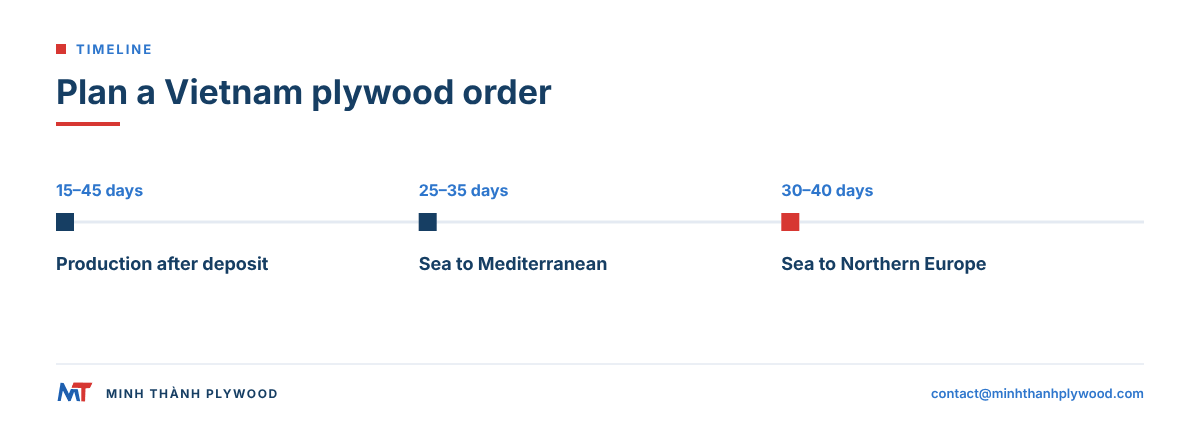
| Production time | 15–45 days after the deposit | Order on a call-off schedule, not when stock runs out |
| Time at sea | 30–40 days to Northern Europe, 25–35 days to the Mediterranean | Plan stock for the voyage and order the next container early |
| Specification work | Every panel must be written down | Use a one-page spec sheet per panel |
| Mills differ | Builds and QC vary between factories | Verify the mill and approve a sample |
None of these stop a buyer once they are on the calendar. Importers with steady demand set a monthly or quarterly container and keep the same specification, which is what the trial order to long-term supply guide describes.
What should you check before buying Vietnamese plywood?
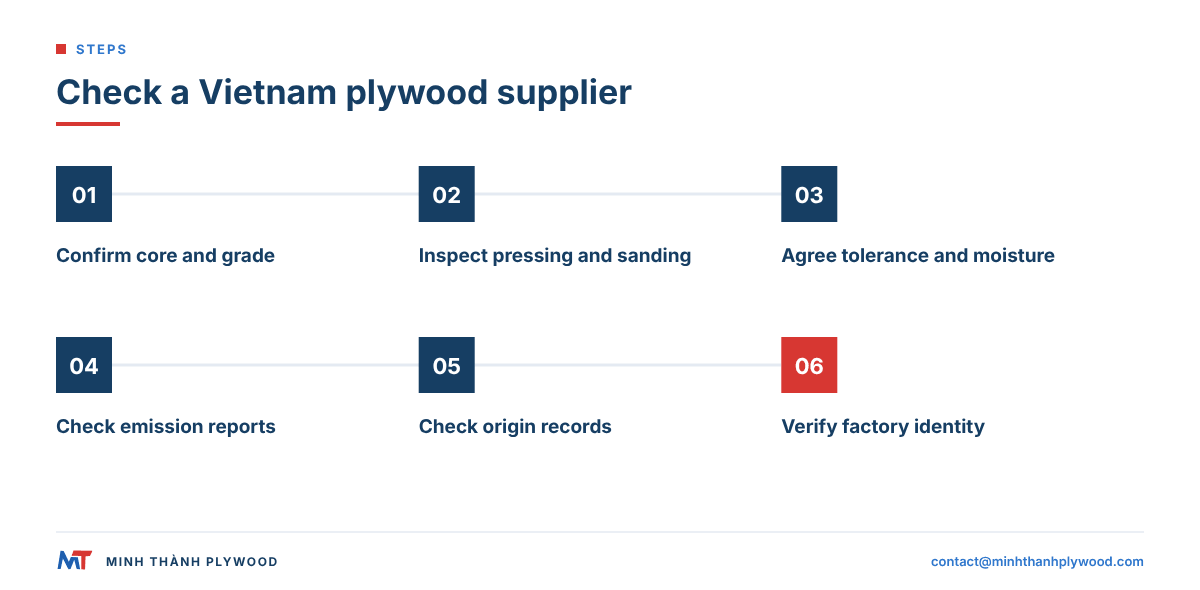
Check the panel build, the evidence and the mill, in that order. The table pairs each advantage with the proof that makes it real.
| What the offer promises | What to check | What a good answer looks like |
|---|---|---|
| Furniture-grade core | Core species and grade, stitched or not | “White Styrax core, stitched horizontally and vertically” |
| Flat face for coating | Pressing method, sanding | “Pressed twice: core calibrated, then face and back pressed on” |
| Tight thickness | Tolerance in writing | “Sanded furniture panels ±0.2–0.3 mm” |
| Low emission | Certificate number and test reports | Certifier and mill number, laboratory, method and date |
| EU traceability | Dossier contents | Origin records and geolocation files with the order |
| Stable moisture | Moisture at dispatch | “8–12 % moisture content” |
| Real factory | Video call, loading video, registration | Same company name on contract, bank account and registration |
If an offer cannot fill the right-hand column, keep looking. The full method is in how to choose a plywood supplier in Vietnam.
Vietnam plywood misconceptions: what buyers still hear
Five Vietnam plywood misconceptions keep coming up in buyer calls. Each one has a short, checkable correction.
- “It is Chinese plywood with a new label.” Vietnamese manufacturers peel, dry, lay up and press their own panels from Vietnamese plantation cores. The certificate of origin follows the production, and a factory video shows the press.
- “Vietnamese plywood is low grade.” The country makes every segment, from packing plywood to top-grade furniture panels. The grade you receive is the grade you specify and approve on the sample.
- “The glue is weak.” UF glue at E0 emission is standard for indoor furniture panels; melamine-fortified and phenolic (WBP) bonds are made for damp and outdoor uses. The bond is a specification line, not a gamble.
- “Emission levels are unknown.” Furniture mills hold CARB P2 / TSCA Title VI certification and test in chambers; Minh Thanh’s six ASTM D6007 chamber tests ran from April 2025 to June 2026 on 9, 15 and 18 mm panels, three by Shanghai Hongjun and three by ICTT Vietnam. They averaged 0.014–0.032 ppm. The EPA’s TSCA Title VI guidance lists a 0.05 ppm formaldehyde emission limit for veneer-core hardwood plywood, matching the CARB Phase 2 limit.
- “There is not enough wood.” Plantation forestry supplies the core logs year after year; the scarce item is premium thin face veneer, which is why 4 mm faces can take longer.
Is Vietnamese plywood made entirely from Vietnamese timber?
The core of Vietnamese plywood is Vietnamese timber; the face depends on the look you order. That split is normal and stated on a good specification.
- Cores: white Styrax or Eucalyptus as standard for furniture panels, Acacia and Pine on order. No poplar or birch cores are made in Vietnam.
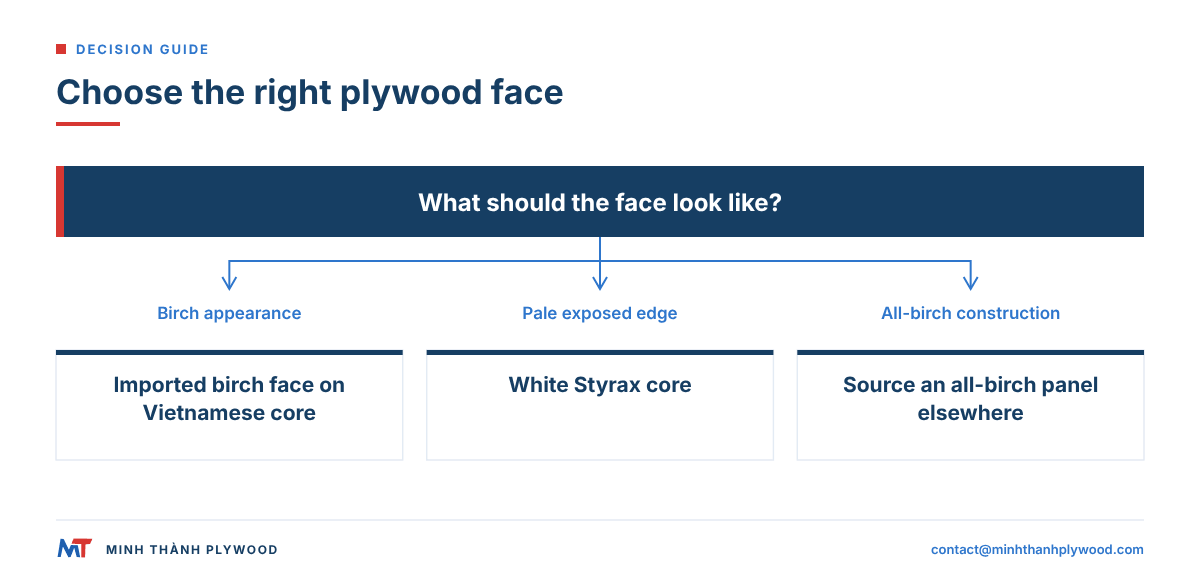
- Faces: chosen for the look you order. Eucalyptus faces come from Vietnamese plantations; birch and okoume faces are imported veneers, pressed onto the Vietnamese core.
For EU buyers this matters in the EUDR dossier, which covers species and origin per veneer, with imported faces documented from their country of origin. Minh Thanh supplies that dossier, with origin records and geolocation files, with orders.
Which core suits lightweight furniture panels?
White Styrax core is the choice for lightweight furniture panels. It is the lightest common Vietnamese core, with a pale, even edge that looks clean on exposed cabinet edges.
| 18 mm, 1220 × 2440 mm | Styrax | Acacia | Eucalyptus |
|---|---|---|---|
| Reference density | 500 kg/m³ | 580 kg/m³ | 650 kg/m³ |
| Weight per sheet | 26.8 kg | 31.1 kg | 34.8 kg |
| Sheets per 40HC | 990 sheets | 880 sheets | 795 sheets |
| Volume per 40HC | about 53 m³ | about 47 m³ | about 43 m³ |
Many European furniture buyers choose Styrax for the light weight and the clean face it gives under veneer. Eucalyptus suits panels that carry more load, such as shelves with long spans. Switching a furniture panel from Acacia to Styrax often gives a better face, a lighter sheet and more cubic metres per container at once.
Can Vietnam supply birch-faced plywood without a birch core?
Yes: Vietnamese birch plywood is birch-faced plywood, with imported birch face and back veneers pressed onto a Vietnamese core. It is not an all-birch panel, and a good offer says so.
Face grades are named D+, D and E in Vietnam and quoted as face/back pairs such as D+/D or D/E. As a buying comparison with the European birch grades, D+ is close to B, D close to BB and E close to CP/C, so D+/D reads roughly as B/BB. The approved sample fixes the appearance of your order.
Buyers choose it for cabinet doors, carcasses and shop fittings where the birch face shows and the edge is banded. All-birch panels come from Baltic, Finnish and Chinese mills; Vietnamese birch-faced panels use a lighter plantation core; the birch plywood comparison sets the three side by side, and the birch plywood page lists the builds.
Does UV-ready plywood arrive with a UV coating?
No. UV-ready plywood arrives sanded to the standard your UV coating line needs, on both faces, without a coating. The mill prepares the surface; the buyer coats it.
This suits furniture plants that run their own UV lines, because the coating colour, gloss and layer count stay under their control. Ask for both faces UV-ready on the specification, with the sanding grit you use, and test the free sample on your line before the order.
What panel sizes and thicknesses can you source?
Vietnamese furniture mills supply the two standard sizes, custom sizes and cut-to-size panels. At Minh Thanh:
- Standard sizes: 1220 × 2440 mm and 1250 × 2500 mm.
- Custom sizes: for example 1220 × 2500 mm and 1220 × 2280 mm.
- Thickness: 3–40 mm; thin panels from 3 to 5 mm are always five plies.
- Cut-to-size: one sheet cut into 4, 6 or 8 pieces, shipped regularly to Italy and other European markets.
- Tolerance: length and width ±2 mm.
The cut-to-size plywood page shows the common layouts.
How much furniture plywood fits in a 40HC, and how long does an order take?
A 40HC carries 795 to 990 sheets of 18 mm furniture plywood, depending on the core, within a planning payload of 28,000 kg. The order then takes production time plus sea time.
- Production: 15–45 days after the 30% deposit.
- Balance: 70% against the scanned bill of lading, or an irrevocable L/C at sight.
- Sea time from Hai Phong: 30–40 days to Northern Europe, 25–35 days to the Mediterranean, 20–30 days to the US West Coast.
- Mixed loads: mixed specifications in one container by agreement.
Every container is photographed and filmed before loading, and the photos and video reach you before the balance is due. Terms and Incoterms (FOB Hai Phong, CFR, CIF) are on the trade terms page.
Why do European importers choose Vietnamese plywood over other origins?
European importers who add Vietnam to their sources usually do it for three reasons: furniture-grade builds on light cores, the documents their own customers now ask for, and a second origin beside their existing suppliers.
The documents point has grown in 2026. From 6 August 2026, the REACH restriction in Regulation (EU) 2023/1464 limits formaldehyde emission from furniture and wood-based articles placed on the EU market, so furniture plants need evidence for their panels. EU importers also need deforestation-regulation origin files for the panels they place on the market, and EU shipments carry EUR.1 origin proof for the EU-Vietnam trade agreement. A mill that already holds CARB P2 / TSCA Title VI certification, runs chamber tests and prepares geolocation files saves the importer that work.
Vietnam is listed as a low-risk country under Implementing Regulation (EU) 2025/1093. Simplified due diligence applies only when every commodity in the product comes from low-risk countries, so imported birch or okoume faces need their own origin check. The EUDR applies to plywood from 30 December 2026.
Each origin has its place: Baltic all-birch panels for exposed edges, local merchants for small urgent lots, Vietnamese mills for container volumes of furniture and interior panels.
How should you start buying plywood from Vietnam?
Start small and specific: one panel you buy every month, one mill, one trial container. That gives you real data on quality, documents and timing before you commit volume.
- Pick the panel: the specification you use most, written as application, core, glue and emission, face, size and tolerance.
- Request the free sample of exactly that build and test it in your line.
- Verify the mill: registration, factory video, certificates with numbers.
- Order one 40HC, mixing two or three specifications if your volume needs it.
- Check the arrival against the approved sample and the packing list.
- Set a schedule: monthly or quarterly call-offs on the approved specification.
The step-by-step import guide is how to import plywood from Vietnam. To start with Minh Thanh, send your specification and destination port to contact@minhthanhplywood.com; we reply within hours.
Buyer questions, answered
Why do European furniture makers buy plywood from Vietnam?
For light white cores that machine cleanly, flat double-pressed faces ready for coating, documented low formaldehyde emission and EUDR origin files, at a better price than comparable mills. The panels are built to order for the furniture line.
What are the pros and cons of Vietnamese plywood?
The pros are plantation cores, furniture-grade builds, emission and traceability evidence, custom sizes and cost. The limits to plan for are a one-container minimum, about six to twelve weeks from deposit to arrival at a Northern European port, and the need to specify every panel in writing.
Is Vietnamese plywood made entirely from Vietnamese timber?
The cores are Vietnamese plantation wood: Styrax, Eucalyptus and Acacia. Faces are chosen for the look you order: eucalyptus faces are Vietnamese, while birch and okoume faces are imported veneers pressed onto the Vietnamese core.
Is Vietnamese plywood just Chinese plywood relabelled?
No. A Vietnamese manufacturer peels, dries, lays up and presses its own panels from local plantation cores, and the certificate of origin follows that production. Ask for factory video and the origin records to see it for yourself.
Which core is best for lightweight furniture panels?
White Styrax core. At a reference density of about 500 kg/m³ it is the lightest common Vietnamese core, with a pale, even edge, so an 18 mm sheet of 1220 × 2440 mm weighs about 26.8 kg.
Can Vietnam supply birch-faced plywood without a birch core?
Yes, that is how Vietnamese birch plywood is built: imported birch face and back veneers pressed onto a white Styrax or Eucalyptus core. It is birch-faced plywood, not an all-birch panel.
Does UV-ready plywood arrive with a UV coating?
No. UV-ready means both faces are sanded to the standard your own UV coating line needs; the mill does not apply the coating.
What panel sizes can I source from Minh Thanh?
1220 × 2440 mm and 1250 × 2500 mm as standard, plus custom sizes such as 1220 × 2500 mm and 1220 × 2280 mm, in thicknesses from 3 to 40 mm. Panels can also be cut to size into 4, 6 or 8 pieces.
Can I mix plywood specifications in one order?
Yes. The minimum order is one 40HC, and mixed specifications in it are arranged by agreement, usually one or two and more when the packs plan works.
How should I start a Vietnam furniture plywood sourcing programme?
Start with one specification you buy every month, test a free sample in your own line, ship one trial container with full loading photos, and turn it into a call-off schedule once the arrival check passes.