
Chinese birch plywood is usually birch face and back on a poplar or mixed hardwood core; Baltic and Finnish birch is birch all through; Vietnamese birch plywood is imported birch faces on a white Styrax or Eucalyptus core. Choose all-birch for exposed edges and laser work, birch-faced for cabinets and furniture with banded edges. Minh Thanh Plywood makes the birch-faced build.
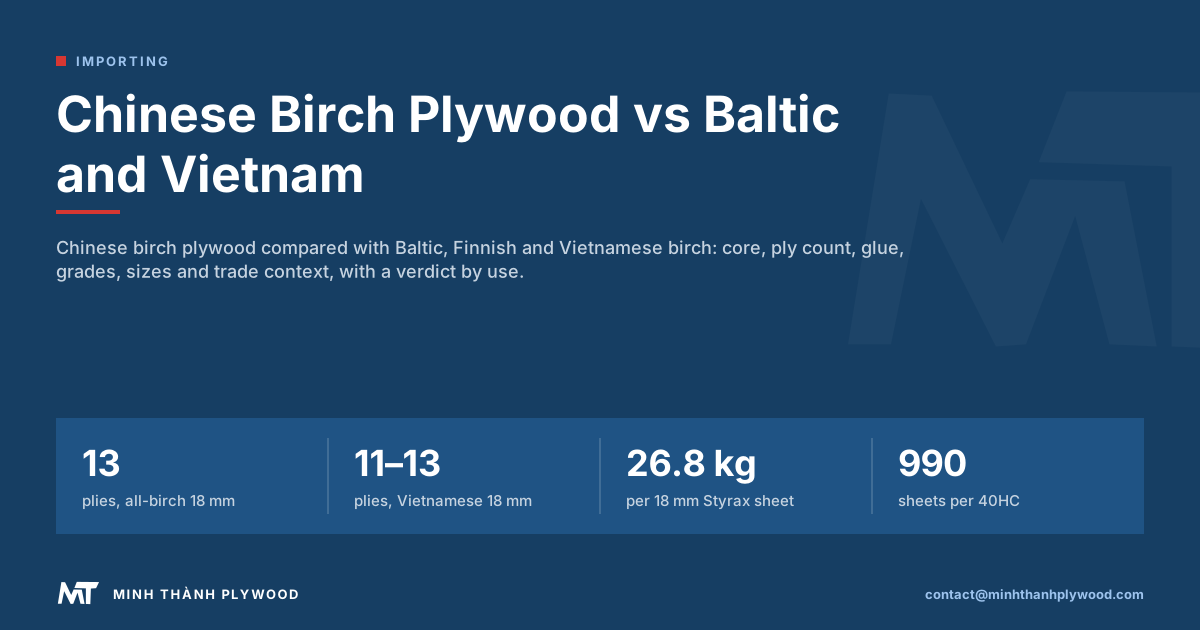
Chinese birch plywood vs Baltic and Vietnamese birch: the short answer
Chinese birch plywood, Baltic birch and Vietnamese birch plywood share a birch face and differ in what is underneath. That one difference decides weight, edge look, cost and the jobs each panel suits.
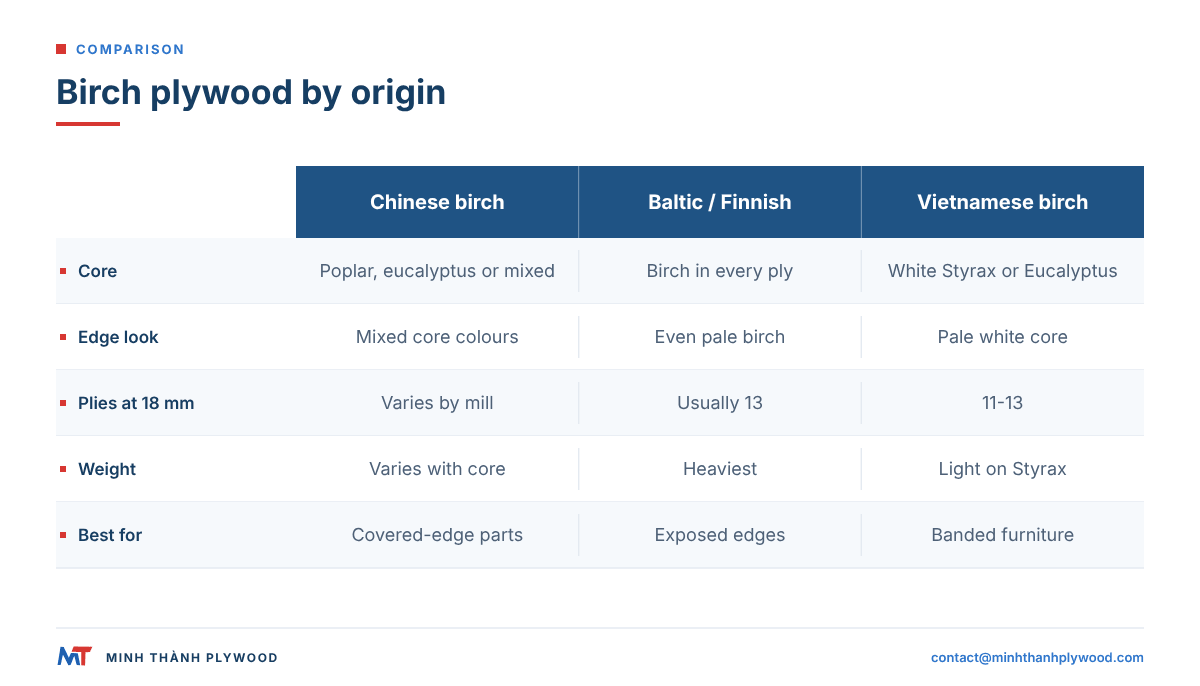
| Chinese birch plywood | Baltic and Finnish birch | Vietnamese birch plywood | |
|---|---|---|---|
| Face and back | Birch | Birch | Imported birch |
| Core | Poplar, eucalyptus or mixed hardwood; some all-birch | Birch in every ply | White Styrax or Eucalyptus |
| Edge look | Mixed core colours | Even pale birch plies | Pale white core (Styrax) |
| Plies at 18 mm | Varies by mill | Usually 13 plies | 11–13 plies |
| Weight | Varies with core | Heaviest (dense birch) | Light on Styrax |
| Typical glue | UF to E0, E1 or E2; others on order | Phenolic (exterior) or MR | UF glue at E0 emission; MR, melamine or phenolic on order |
| Face grades | Chinese codes, often B/BB, BB/CC | B/BB, BB/CP, CP/CP and lower | D+, D, E (D+ close to B) |
| Best for | Price-led furniture parts with covered edges | Exposed edges, laser cutting, drawer boxes | Cabinets, carcasses, furniture with banded edges |
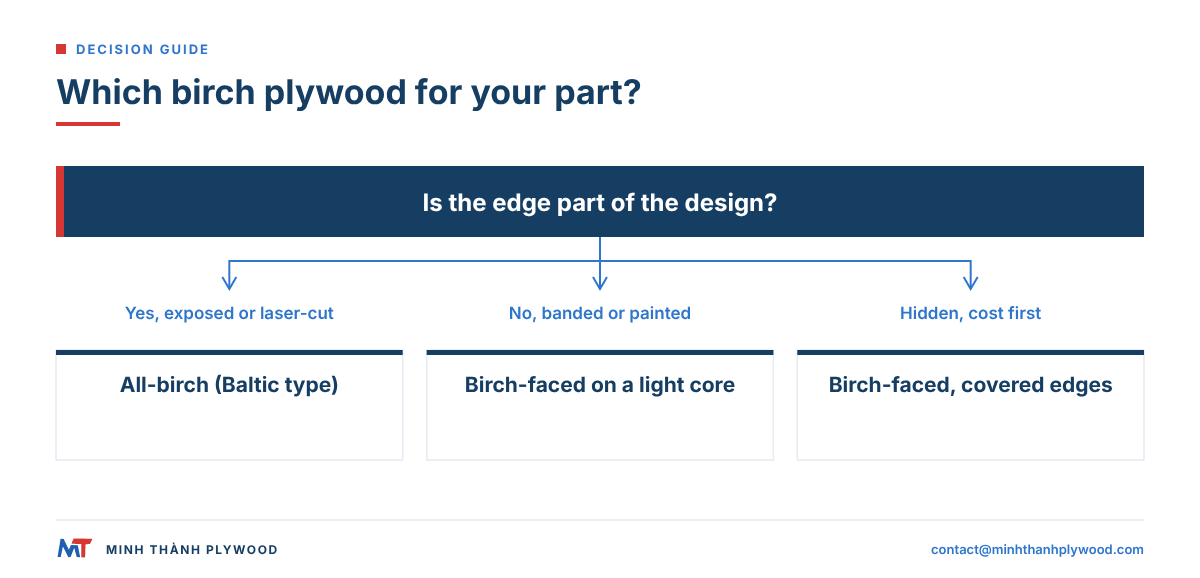
Verdict by use: buy all-birch where the edge is the design; buy birch-faced plywood where the face is the design and the edge is banded, painted or hidden.
What is China birch plywood (Chinese birch)?
Chinese birch plywood is plywood pressed in China with birch face and back veneers, usually on a poplar, eucalyptus or mixed hardwood core. The word “birch” in the name refers to the faces.
China birch plywood covers many builds, because China has many mills and many core options:
- Birch-faced on poplar core: the most common build; light, easy to machine.
- Birch-faced on hardwood or combi core: heavier, stiffer, with a mixed edge.
- All-birch from imported birch veneer: pressed by some mills as an alternative to Baltic panels.
The China birch label alone does not tell you which you will receive. Name the core species, ply count, glue and emission class on the order, and ask for a cut sample showing the edge.
What is red birch or pink birch plywood?
“Red birch” and “pink birch” are trade names for birch faces cut from the darker heartwood of the tree, often sold out of China and South-East Asia. The colour is the face’s only difference; the core underneath can be any of the builds above, so the same questions apply. Order the colour range against a signed sample, because heartwood faces vary more in shade than pale sapwood faces.
What is Baltic and Finnish birch plywood?
Baltic and Finnish birch plywood is all-birch: every ply, face to core, is birch veneer, cross-laminated. That gives a dense, stiff panel with an even, pale multi-ply edge that many designers leave visible. It is typically made in thin, even plies, 13 plies at 18 mm, with very few voids.
Key features buyers order it for:
- 13 plies at 18 mm, thin and even, with very few voids.
- Exposed-edge quality for furniture, shop fittings and drawer boxes.
- Phenolic (exterior) glue as a common option, for damp uses and film-faced versions.
- Grade ladder B, BB, CP, C (and WG for hidden uses) for each face.
“Baltic birch” is a trade name for birch plywood from the Baltic region and neighbouring countries; “Finnish birch” comes from Finland. Both are all-birch builds.
Can Vietnam make full birch plywood with a birch core?
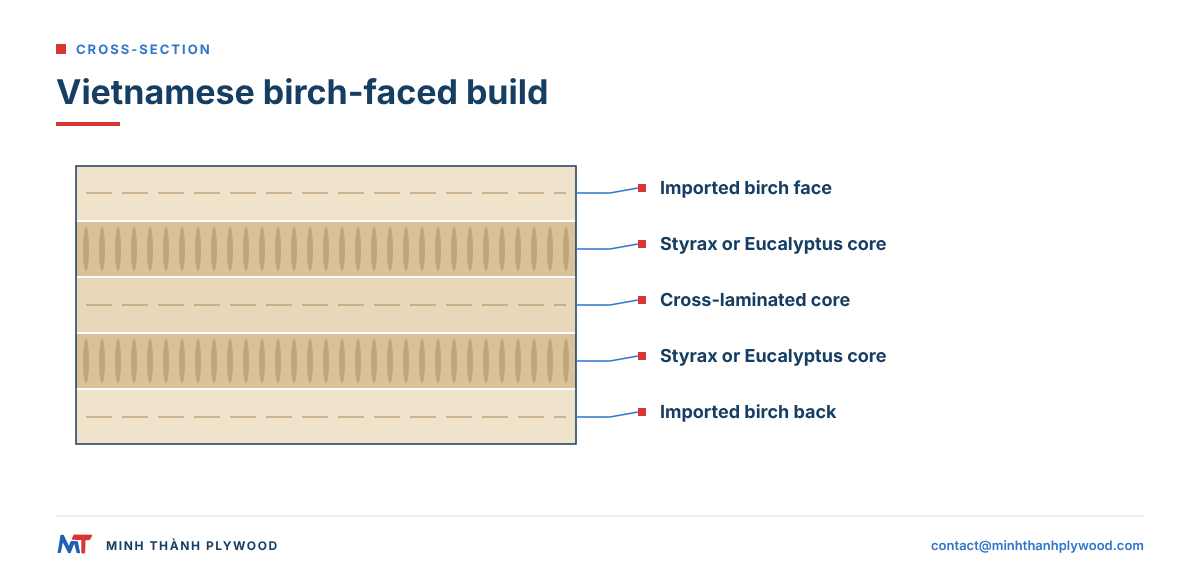
No. Vietnamese plywood production uses local hardwood cores rather than birch cores. Vietnamese birch plywood is birch-faced plywood: imported birch face and back veneers pressed onto a Vietnamese core of white Styrax or Eucalyptus. Ask for the face and core species as separate quotation lines.
At Minh Thanh Plywood the furniture build is:
- Core: white Styrax as standard for light furniture panels, Eucalyptus where stiffness matters; core layers stitched horizontally and vertically.
- Glue and emission: UF glue at E0 emission; MR, melamine-fortified or phenolic bonds to the customer’s specification.
- Pressing: twice. The core board is pressed and calibrated, then face and back are pressed on.
- Faces: birch, graded D+, D or E, quoted as pairs such as D+/D, sanded or polished, both faces UV-ready.
- Tolerance: sanded furniture panels ±0.2–0.3 mm, down to ±0.2 mm.
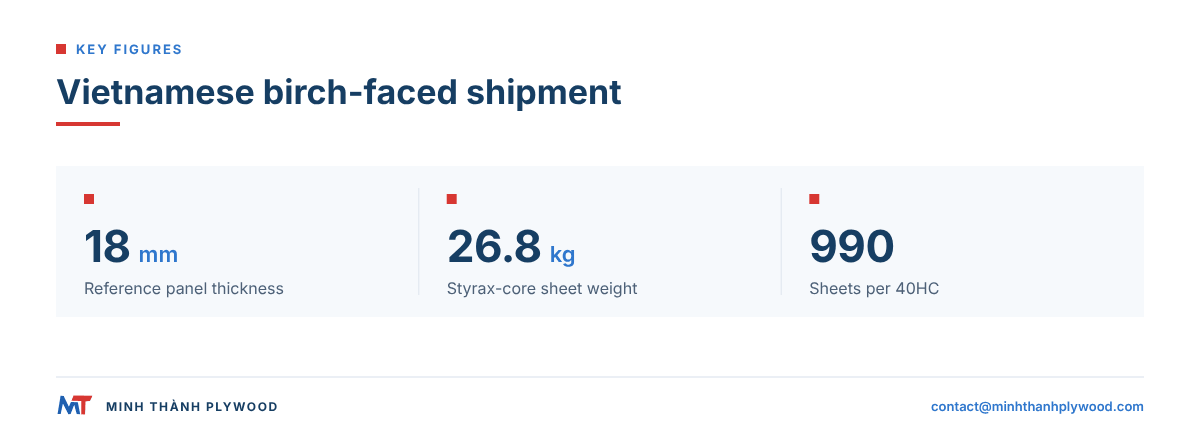
The result is a flat, light birch-faced sheet for cabinets and furniture: at 18 mm on a Styrax core (reference density 500 kg/m³), a 1220 × 2440 mm sheet weighs about 26.8 kg.
How do core and construction differ?
The core decides the edge, the weight and the stiffness, so compare cores before faces. Four builds sit behind the word “birch”:
| Build | Core | What the edge shows | Weight | Stiffness |
|---|---|---|---|---|
| All-birch | Birch veneer in every ply | Even pale birch lines | Highest | Highest |
| Birch-faced on Styrax | White Styrax veneers | Pale, even, slightly softer lines | Lowest | Good for furniture spans |
| Birch-faced on Eucalyptus | Eucalyptus veneers | Pinkish-brown lines | Middle to high | High |
| Birch-faced on poplar or mixed core | Poplar or mixed hardwoods | Light or mixed colours | Low to middle | Moderate |
For a carcass with banded edges, the stiffness of a Styrax or Eucalyptus core is more than enough, and the lower weight helps on the line and in the container. For an exposed edge, the all-birch build is the one that looks right. On price, Minh Thanh’s furniture and interior plywood starts from US$350/m³ (October 2026).
How many plies, and why does ply count matter?
More, thinner plies give a more stable panel and a finer edge. All-birch 18 mm panels usually have 13 plies; Vietnamese birch-faced 18 mm panels are built with 11–13 plies.
Ply count matters in three places:
- Exposed edges: more plies look finer and more even.
- Screw holding and edge machining: thin, even plies with no voids hold screws and routing better.
- Flatness: a balanced build with cross-laminated plies stays flat in service.
For a banded edge, ply count is less visible, and core quality (closed joints, no overlaps, calibrated thickness) matters more. Stitched cores and double pressing are how a birch-faced mill keeps the core closed and the face flat.
How do glue and emission compare?
Glue type and emission class are two separate lines on a birch plywood order, whatever the origin. Ask for both, and for the evidence behind the emission class.
| Origin | Common glue options | Emission evidence to ask for |
|---|---|---|
| Chinese birch plywood | Varies by mill; ask each supplier | Emission class and the test method, certificate where relevant |
| Baltic and Finnish birch | Phenolic (exterior) and MR | Emission class and the test method |
| Vietnamese birch plywood (Minh Thanh) | UF glue at E0 emission as standard; MR, melamine-fortified, phenolic on order | CARB P2 / TSCA Title VI certification (ICTT mill no. 23024) and chamber test reports |
Minh Thanh’s six ASTM D6007 chamber tests between April 2025 and June 2026, on 9, 15 and 18 mm panels, averaged 0.014–0.032 ppm against the 0.05 ppm limit of the US rule for veneer-core hardwood plywood. That 0.05 ppm limit is published in EPA’s TSCA Title VI guidance. Third-party testing to the buyer’s method, for example EN 717-1, is arranged through SGS on request.
How do birch face grades compare between origins?
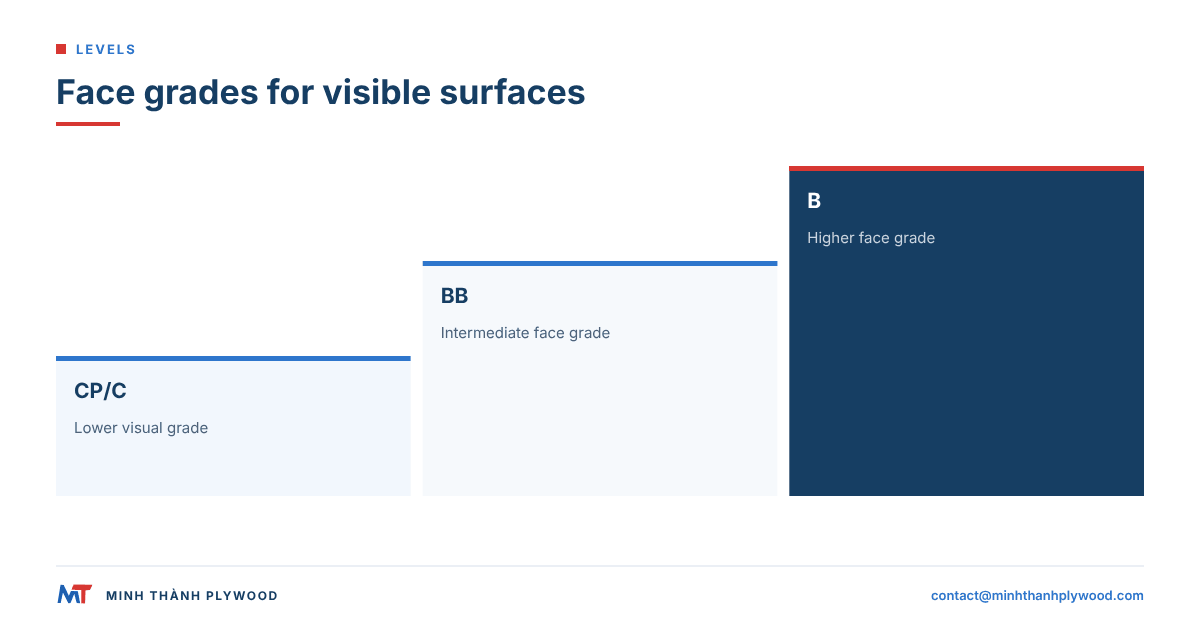
Each origin names birch face grades in its own way, but the ladders line up closely enough to buy against. Fix the final appearance with an approved sample.
| European birch grade | Vietnamese face grade | Chinese code often used | What it allows |
|---|---|---|---|
| B | D+ | B | Few small sound knots, colour variation, no open defects |
| BB | D | BB | Patches and more knots, for clear coating or staining |
| CP / C | E | CC / CP | More patches and features, for paint or overlay |
Grades are quoted as face/back pairs. As a buying comparison, D+/D reads roughly as B/BB and D/D as BB/BB. The detailed acceptance rules are in birch plywood grades and acceptance criteria.
Which sizes and thicknesses does each origin supply?
Baltic and Finnish mills are known for square and large formats; Chinese and Vietnamese mills work mainly in the 4 × 8 ft family and the European 1250 × 2500 mm size.
| Origin | Typical sizes | Thickness range |
|---|---|---|
| Baltic and Finnish | Square formats, large formats, 1250 × 2500 mm | Thin to very thick |
| Chinese | 1220 × 2440 mm, 1250 × 2500 mm, cut sizes | Wide range |
| Vietnamese (Minh Thanh) | 1220 × 2440 mm, 1250 × 2500 mm, custom such as 1220 × 2500 mm and 1220 × 2280 mm | 3–40 mm |
Minh Thanh also cuts panels to size, one sheet into 4, 6 or 8 pieces, a service shipped regularly to Italy and other European markets. See cut-to-size plywood.
Which birch plywood should you buy for each use?
Choose by what the user of the panel will see and touch. The table gives a verdict by use.
| Use | Best choice | Why |
|---|---|---|
| Laser cutting, models, signs | All-birch (Baltic or Finnish) | Thin even plies, void-free edge |
| Furniture with exposed edges | All-birch | The edge is part of the design |
| Drawer boxes with finger joints | All-birch | Joints show every ply |
| Kitchen and bathroom cabinet carcasses | Birch-faced on Styrax or Eucalyptus core | Banded edges; light, flat, cost-effective |
| Cabinet doors for clear coating | Birch-faced D+/D on Styrax core | Even face, both faces UV-ready |
| Painted or laminated furniture | Birch-faced D/E or other faces | Face hidden under paint or laminate |
| Shop fitting with banded edges | Birch-faced | Large volumes, lower weight |
| Damp or outdoor use | All-birch phenolic, or birch-faced with phenolic glue | Bond class is what matters |
Many furniture plants use both: all-birch where the edge shows, birch-faced on a white core for the carcass.
Vietnamese birch plywood vs Baltic birch: when does each win?
Vietnamese birch plywood wins on weight, cost per container and face choice for banded furniture; Baltic birch wins on the exposed edge and laser work. Both are good panels for the right job.
Where the Vietnamese birch-faced build gives the buyer more:
- Lighter sheets: about 26.8 kg for an 18 mm Styrax-core sheet of 1220 × 2440 mm, easier on the line.
- More sheets per container: 990 sheets of 18 mm per 40HC on a Styrax core.
- Furniture-oriented build: pressed twice, sanded, both faces UV-ready, tolerance down to ±0.2 mm.
- Documents: emission certificate, chamber tests, and the EUDR compliance dossier for EU orders, with origin records and geolocation files.
Where all-birch remains the reference: visible edges, laser and CNC parts with exposed plies, finger-jointed drawer boxes. A buyer who needs both buys both.
What about Russian birch plywood and trade measures?
Russian and Belarusian birch plywood is no longer an option for EU importers: since 2022 the EU has banned imports of wood products originating in or exported from both countries. That is why European buyers now compare Baltic, Finnish, Chinese and Vietnamese sources.
The measures, for reference: for Russia, Regulation (EU) 2022/576 added wood products of CN chapter 44, which includes plywood, to the import ban of Regulation 833/2014, effective 9 April 2022.
For Belarus, the EU did the same in Regulation (EU) 2022/355.
Imports from China are subject to their own trade measures. In 2025 the EU set definitive anti-dumping duties on hardwood plywood from China under Regulation (EU) 2025/2333: 43.3% for one named company and 86.8% for all other companies, on the stated product scope. Your customs broker checks whether a given panel falls inside that scope before you compare landed costs.
How do you specify birch plywood on an order?
Write the birch order so that the core can never be a surprise. Six lines cover it:
- Build: all-birch, or birch-faced with the core species named (Styrax, Eucalyptus, poplar).
- Glue and emission: glue type and emission class on separate lines.
- Faces: grade pair (for example D+/D, or B/BB), sanded or polished, both faces UV-ready.
- Sheet: thickness, size, ply count where it matters, thickness tolerance.
- Use: exposed edge or banded edge, so the mill can advise.
- Packing and quantity: packs, marks, sheets or m³, destination port.
For a Vietnamese birch-faced order, Minh Thanh’s minimum is one 40HC with mixed specifications by agreement, and free samples are sent with the quotation. Send your specification to contact@minhthanhplywood.com, or see the birch plywood page for the builds.
Buyer questions, answered
What is Chinese birch plywood?
Plywood pressed in China with birch face and back veneers, usually on a poplar, eucalyptus or mixed hardwood core. Some Chinese mills also press all-birch panels from imported birch veneer, so the core must be named on the order.
Is Chinese birch plywood the same as Baltic birch?
Usually not. Baltic birch is birch in every ply, with a dense, void-free edge; most Chinese birch plywood has birch only on the faces. The two look alike on the face and differ on the edge.
Can Vietnam produce full birch plywood with a birch core?
No. Vietnamese mills make birch-faced plywood: imported birch face and back veneers on a white Styrax or Eucalyptus core. There are no birch cores in Vietnamese production.
Is Vietnamese birch plywood as good as Baltic birch?
For cabinets, carcasses and furniture with banded or covered edges it does the same job at lower weight and cost. For exposed multi-ply edges and laser cutting, all-birch Baltic panels remain the reference.
How does Vietnamese birch plywood compare with Russian birch plywood?
Russian birch plywood is all-birch, like Baltic panels. Since 2022 the EU has banned imports of wood products, plywood included, from Russia and Belarus, so EU buyers compare Baltic, Finnish, Chinese and Vietnamese sources instead.
How many plies does 18 mm birch plywood have?
All-birch 18 mm panels usually have 13 plies. Vietnamese birch-faced 18 mm panels are built with 11–13 plies, depending on core veneer thickness.
What do birch grades B/BB and D+/D mean?
They are face/back grade pairs. B/BB is the European birch ladder; D+, D and E are the Vietnamese face grade names. As a buying comparison, D+ is close to B and D close to BB, so D+/D reads roughly as B/BB.
Which birch plywood is best for laser cutting?
All-birch panels with thin, even plies and a void-free core, usually Baltic or Finnish. Birch-faced panels on a softer core cut well too, but the edge shows the core species.
Which birch plywood is best for kitchen cabinets?
Birch-faced plywood on a light white core suits carcasses and doors with banded edges: it is lighter to handle, flat after double pressing and cost-effective per container.
Is birch-faced plywood from Vietnam low emission?
Minh Thanh's furniture panels use UF glue at E0 emission and are covered by CARB P2 / TSCA Title VI certification; six chamber tests averaged 0.014–0.032 ppm against the 0.05 ppm limit.