
Vietnamese plywood is good quality when it comes from a mill that specialises in your product and you specify the build in writing. Furniture, birch-faced, poplar-faced and film-faced lines ship to Europe every month. Quality differs by mill, not by country: here is a verdict per line and the checks that separate them, from Minh Thanh Plywood's own production line.
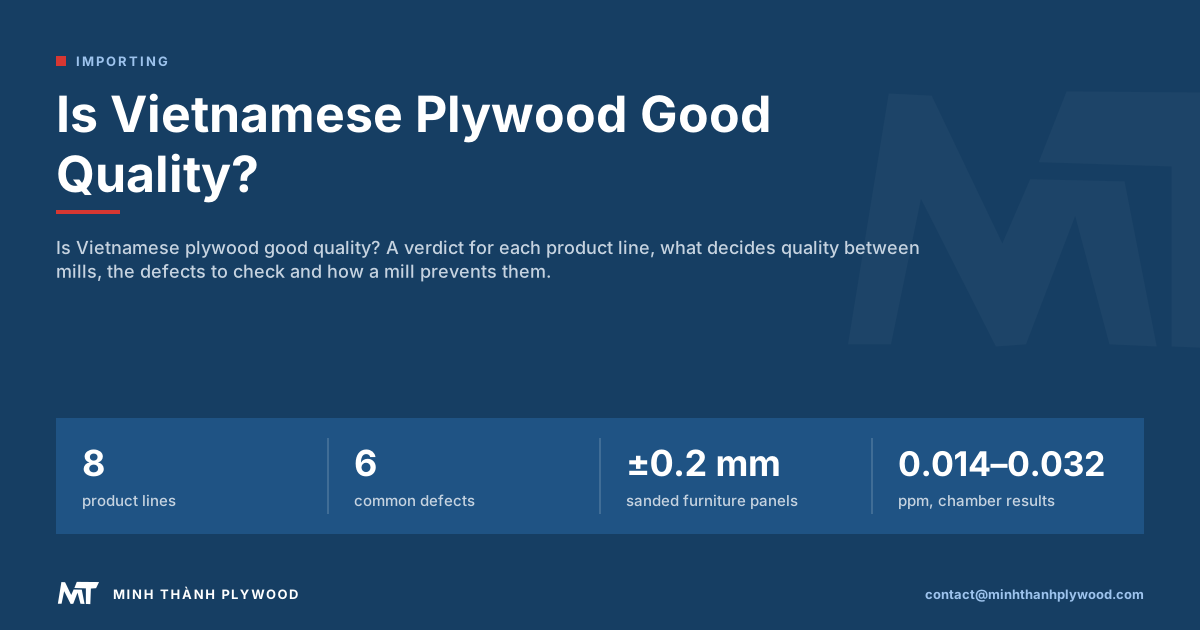
Is Vietnamese plywood good quality? The verdict by product line
Vietnamese plywood is good quality when it comes from a mill that makes your product every week and builds it to a written specification. Every segment is made in Vietnam, from packing panels to top-grade furniture plywood, so the answer depends on the line.
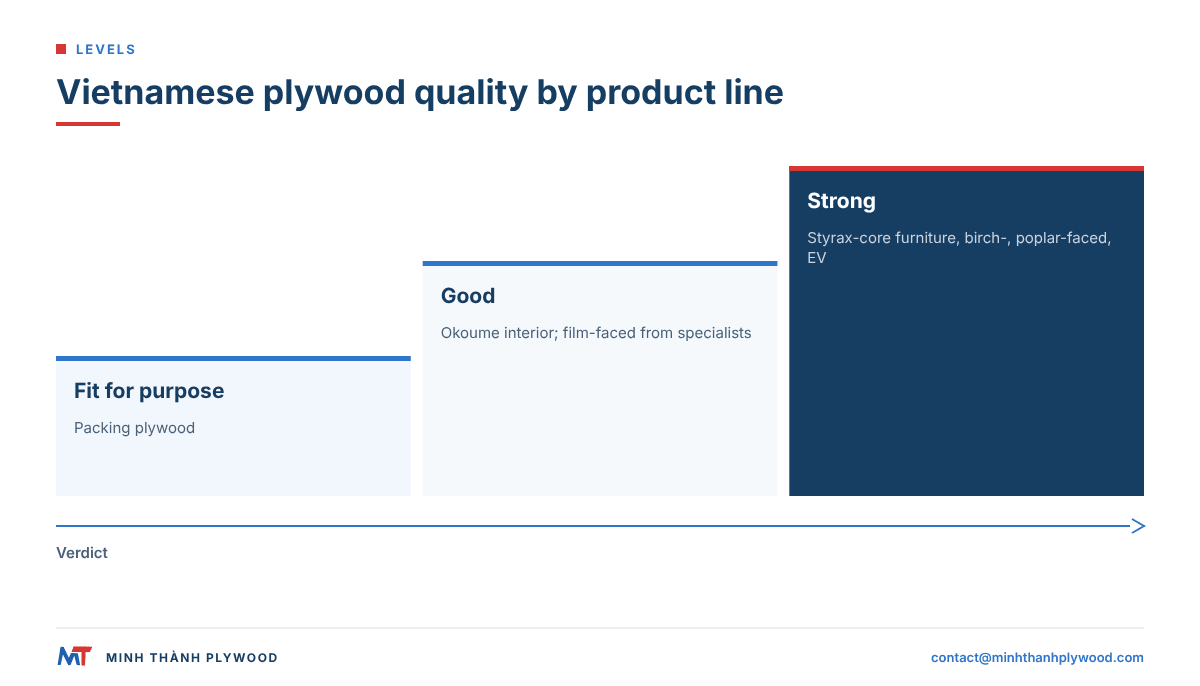
| Product line | Verdict | What decides quality | Typical buyers |
|---|---|---|---|
| Furniture plywood on white Styrax core | Strong | Stitched core, pressing twice, sanding, tolerance | European cabinet and furniture plants |
| Birch-faced plywood | Strong for banded furniture | Core quality under the birch face, face grade | Cabinet makers, shop fitters |
| Poplar-faced plywood | Strong for furniture and interiors | Face grade pair, core and sanding | Furniture plants, distributors |
| Engineered veneer (EV) plywood | Strong for decorative uses | Veneer colour consistency, pressing | Interior and furniture makers |
| Eucalyptus-faced and Eucalyptus-core | Strong for stiff parts | Core density, face grade | Shelving, tops, structural furniture parts |
| Okoume-faced interior plywood | Good for interiors | Face selection, core | Interior panels, furniture |
| Film-faced plywood | Good from specialist mills | Core grade, film weight, glue | Contractors and formwork companies |
| Packing plywood | Fit for purpose | Price, thickness tolerance for packing | Crate and pallet makers |
The country is not the variable; the mill and the build are. The rest of this guide explains what decides quality, which defects to check, and how a mill prevents each one.
What decides the quality of Vietnamese plywood?
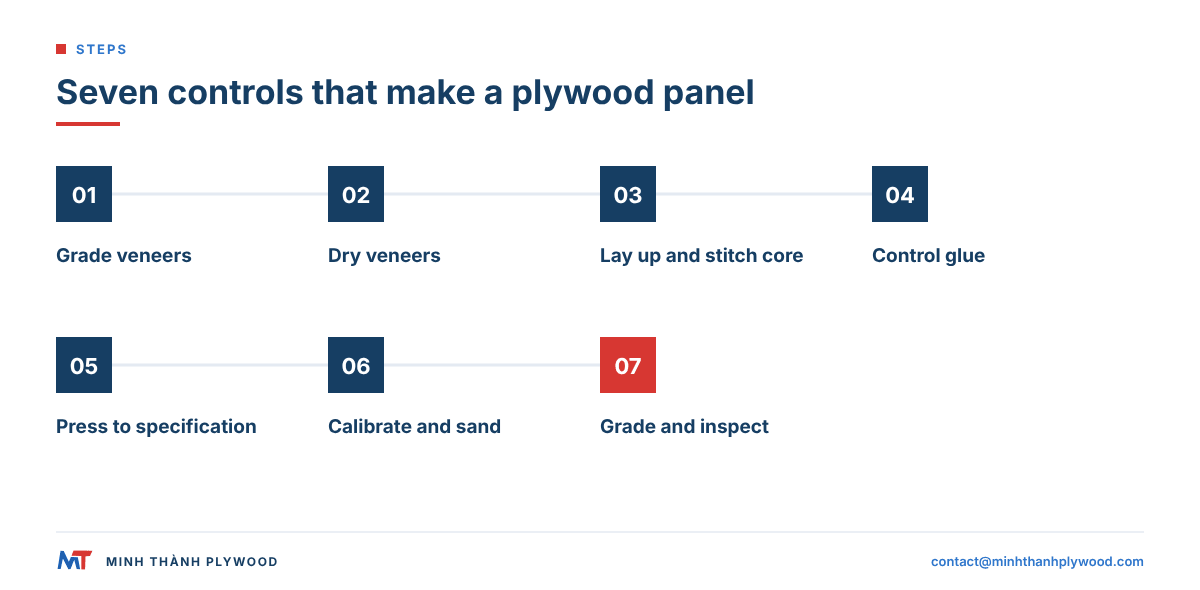
Seven production steps decide plywood quality, and they are the same in every Vietnamese mill. A furniture mill and a packing mill both have them; they run them to different standards.
- Veneer grading: sorting core and face veneers by defects before lay-up.
- Veneer drying: moisture down to a stable level before gluing.
- Core lay-up: closing joints without gaps or overlaps; stitching cores where the build calls for it.
- Glue control: glue type, spread and mixing to the specification.
- Pressing: temperature, pressure and time; once or twice.
- Calibration and sanding: thickness brought to tolerance and faces finished.
- Grading and QC: every sheet against the order and the sample, and a reject rate the mill accepts.
Furniture mills put more time and cost into steps 3, 5 and 6: stitched cores, a calibrated core before the faces go on, and sanding to a tight tolerance. At Minh Thanh, furniture panels are pressed twice as standard and leave at 8–12% moisture. That is why a furniture panel and a commercial panel of the same thickness differ in price.
Is Vietnamese furniture plywood good for European furniture plants?
Yes. Furniture plywood on a white Styrax or Eucalyptus core is the line Vietnamese mills such as Minh Thanh are built for, and Europe is its main market.
The build that European plants order:
- Core: white Styrax as standard, Eucalyptus where stiffness matters, stitched horizontally and vertically.
- Glue and emission: UF glue at E0 emission; MR, melamine-fortified or phenolic bonds on order.
- Pressing: twice. The core board is pressed and calibrated, then face and back are pressed on.
- Faces: poplar, birch, EV, okoume, pine and more, sanded or polished, both faces UV-ready.
- Tolerance: sanded furniture panels down to ±0.2 mm thickness, ±2 mm on length and width.
- Moisture: 8–12 % at dispatch.
Emission evidence comes with the panels: CARB P2 / TSCA Title VI certification as ICTT mill no. 23024. Six ASTM D6007 chamber tests ran from April 2025 to June 2026 on 9, 15 and 18 mm panels, three by Shanghai Hongjun and three by ICTT Vietnam. They averaged 0.014–0.032 ppm against the 0.05 ppm limit. See furniture plywood.
Is Vietnamese birch plywood good for furniture?
Vietnamese birch plywood is good for furniture with banded or covered edges: it is birch-faced, with imported birch veneers on a white Styrax or Eucalyptus core, and it is lighter than all-birch panels.
Use it for kitchen carcasses, cabinet doors and shop fittings, where the birch face is seen and the edge is banded. For exposed edges, order all-birch; a birch-faced panel shows its non-birch core at the edge.
Face grades are named D+, D and E in Vietnam and quoted as pairs such as D+/D; as a buying comparison, D+ is close to European B and D close to BB. The birch comparison sets the builds side by side.
How good are Vietnamese poplar, eucalyptus, okoume and EV plywood?
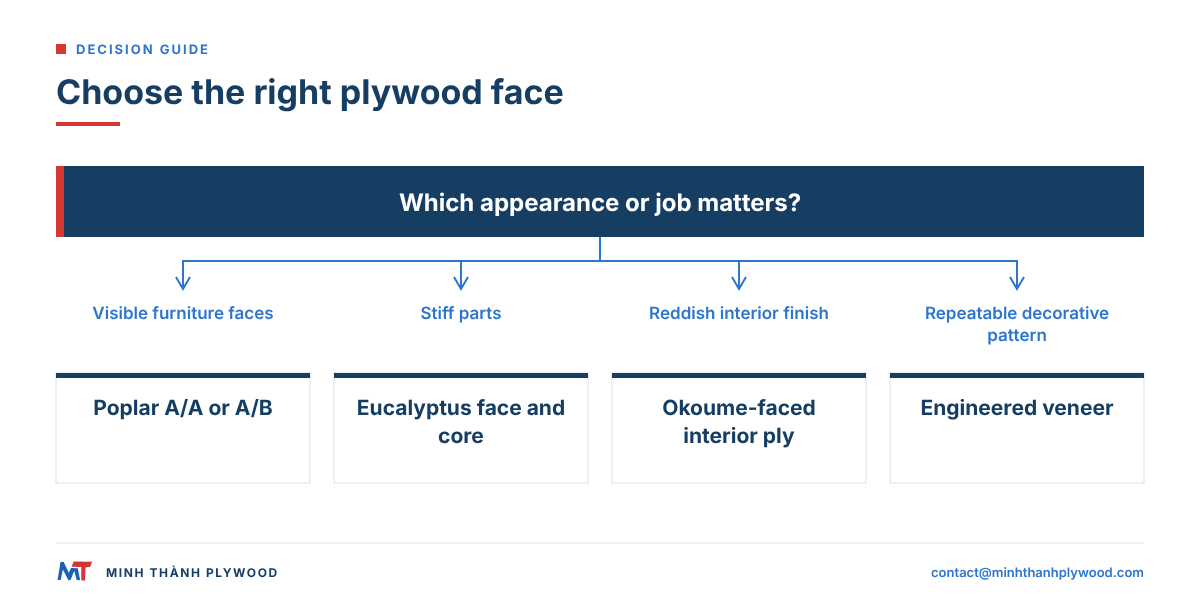
Each face line is good for its own job when the grade pair is specified and matched to an approved sample.
| Face | Grades quoted | Where it does well | What to specify |
|---|---|---|---|
| Poplar | A/A, A/B, B/B; also Chinese codes B/BB, BB/CC, CP | Furniture, painted and laminated panels | Grade pair, sanding, core |
| Eucalyptus | A/A, A/B, B/B | Visible faces with a warm tone, stiff parts | Grade pair, core density |
| Okoume | Matched to sample | Interior panels with a reddish face | Interior use only; not a marine build |
| Engineered veneer (EV) | Colour and pattern by reference | Decorative furniture and interiors | Colour reference, batch consistency |
| Pine | A/A, A/B, B/B (B/C for utility parts) | Furniture and joinery with a pine look | Grade pair, knot rules |
A/A suits two visible faces, A/B one visible face, B/B panels that will be painted or overlaid. Okoume-faced interior plywood is a furniture and interior panel; it is not sold as marine plywood.
Is Vietnamese film-faced plywood good quality?
Vietnamese film-faced plywood is good from specialist mills that use an A-grade core, a film weight matched to the job, and phenolic or melamine glue. It is a separate segment from furniture plywood, made on lines set up for construction panels; Minh Thanh makes a film-faced range alongside its furniture panels.
What decides a film-faced panel’s life:
- Core: Acacia or Eucalyptus, A-grade and joined, without gaps.
- Glue: phenolic glue gives the most reuses; melamine-fortified is a cost-effective middle.
- Film: weight and brand matched to the finish and number of pours.
- Edges: sealed at the mill and resealed after every cut on site.
- Handling: release agent, cleaning and dry storage on site.
As a rule of thumb, melamine-glued panels give around 12 to 15 reuses and phenolic-glued panels up to about 25, always with proper handling, release agent and edge sealing. See film-faced plywood.
What are the common quality problems with plywood, and how does a mill prevent them?
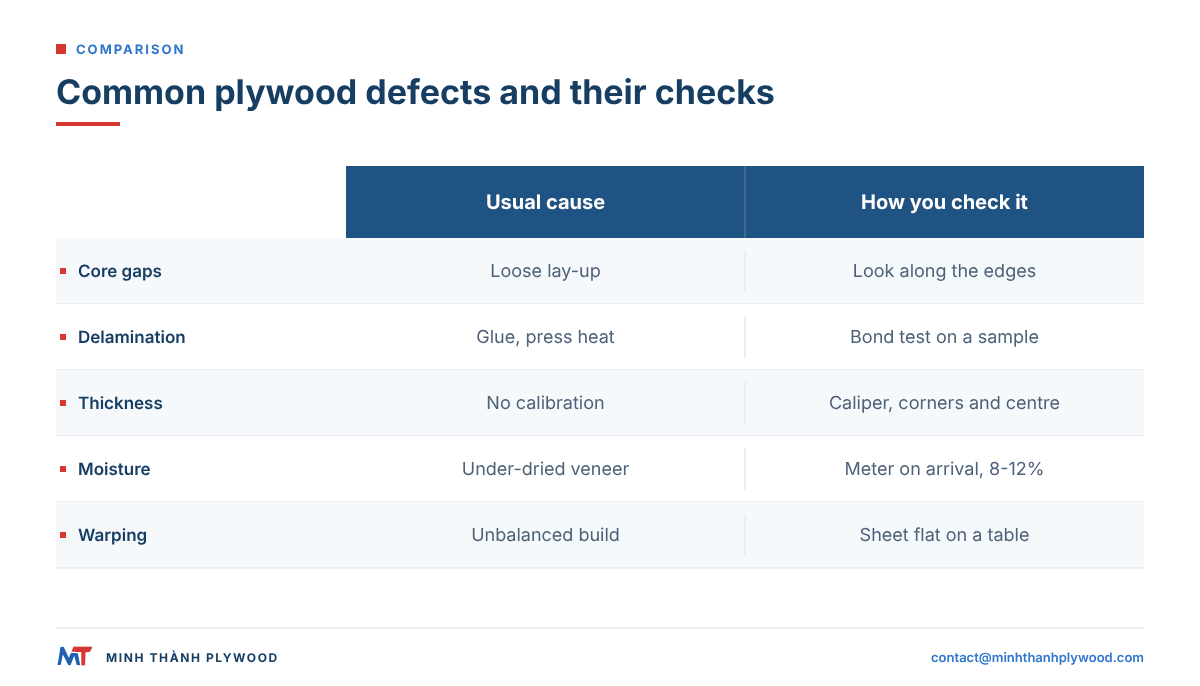
Six defects cover most plywood quality questions from any origin. Each has a cause in production, a way a good mill prevents it, and a check the buyer can run.
| Defect | Usual cause | How a mill prevents it | How you check it |
|---|---|---|---|
| Core gaps and overlaps | Loose lay-up, unjoined cores | Careful lay-up, stitched cores, calibrated core | Look along the edges; tap test on the face |
| Delamination | Wrong glue, poor spread, low press heat | Glue control, correct press cycle | Bond test on a sample; look for blisters |
| Thickness variation | Uneven veneer, no calibration | Calibration sanding of the core, final sanding | Caliper at corners and centre |
| High moisture | Veneers not dried enough | Drying to 8–12 % before gluing | Moisture meter on arrival |
| Face defects | Poor veneer grading | Grading faces against the sample | Compare with the approved sample |
| Warping | Unbalanced build, uneven moisture | Balanced lay-up, stable moisture | Sheet flat on a table |
Glue-line quality has its own standard: BS EN 314-2 sets the bonding-quality requirements for plywood.
Minh Thanh’s furniture line stitches cores, presses twice and sands to tolerance because those steps stop the first three defects at source. Quality control by stage is described on our quality control page.
Why do Vietnamese plywood quality complaints happen?
Most quality complaints about Vietnamese plywood trace back to a mismatch between what was ordered and what the buyer expected, not to the country. Three patterns explain most of them, and a written specification with an approved sample prevents all three before production starts.
- Comparing segments: a commercial-grade panel bought at a commercial price and judged against furniture expectations.
- No specification: an order by product name only, so the core, glue and face grade were the supplier’s choice.
- No approved sample: face appearance argued after arrival instead of fixed before production.
The cure is on the order: write the build, approve a sample of exactly that build, and agree how arrival differences are measured. Plywood quality claims explains how evidence settles a difference when one does arise.
What wood is Vietnamese plywood made from, and is it made in China?
Vietnamese plywood is made in Vietnam from Vietnamese plantation cores, with faces chosen for the look ordered. It is not Chinese plywood with a Vietnamese label.
- Cores: white Styrax (grown only in the north), Eucalyptus and Acacia; rubberwood in the south as a niche core; Pine on order.
- Faces: eucalyptus faces from Vietnamese plantations; birch and okoume as imported veneers; poplar, EV, pine and others for the look ordered.
- Production: peeling, drying, lay-up, pressing, sanding and packing in the Vietnamese mill.
For EU buyers, the EUDR compliance dossier, with origin records and geolocation files, lists the species and origin of the veneers in the panel, with imported faces documented from their country of origin. Minh Thanh supplies it with orders.
Why is Vietnamese plywood cost-effective?
Vietnamese plywood is cost-effective because the core timber grows near the mills and the workforce is skilled. That lets a mill in a region such as Ha Hoa, Phu Tho reach high-grade quality at a better price than comparable mills.
Two notes keep the comparison fair. First, a low price for “18 mm plywood” usually means a different build: lower core grade, loose cores, no sanding or a looser tolerance. Second, the price follows the specification: face, core, glue, thickness, size, quantity and delivery term. In October 2026, furniture and interior plywood started from US$350/m³ and commercial plywood from US$250/m³. See how to compare plywood quotations.
How do you check the quality of Vietnamese plywood before and after shipment?
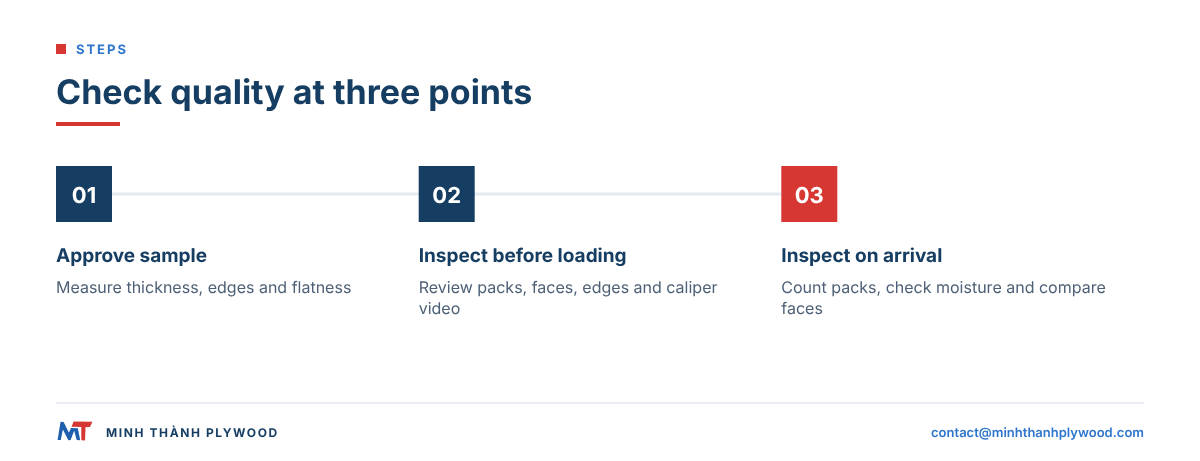
Check plywood quality three times: on the sample, before loading and on arrival. Each check uses the same measurements, so the results line up.
- Sample: measure thickness at several points, check flatness, look at the edges, and run it through your own process.
- Before loading: photos and video of packs, faces, edges and caliper readings on camera; or a third-party inspection.
- On arrival: count packs, caliper sheets from several packs, check moisture and compare faces with the sample.
Minh Thanh photographs and films every container before loading and sends the photos and video to the buyer. Name the product standard on the order: BS EN 636:2012+A1:2015 covers plywood for structural and general-purpose use in dry, humid or exterior conditions. Third-party testing to your method, for example EN 717-1 formaldehyde testing, is arranged through SGS on request.
How has Vietnamese plywood’s reputation changed in Europe?
Vietnamese plywood’s reputation in Europe has grown with its furniture lines, built on light white Styrax cores, flat calibrated faces and the documents buyers now need. The main caution is to choose the right mill for the product.
What shapes that reputation:
- Documents: emission certificates, chamber tests and EU origin files, now asked for by furniture buyers.
- Traceability: Vietnam is listed as low risk under Implementing Regulation (EU) 2025/1093, which allows simplified due diligence only when every commodity in the product comes from low-risk countries.
- Specialisation: Vietnamese mills usually serve one segment, so matching the mill to the product line decides how consistent the containers are.
Minh Thanh ships regularly to European buyers, with repeat orders into Italy, and shares loading photos of comparable containers on request.
What this means for your order
To get good-quality Vietnamese plywood, order it the way a furniture plant orders any critical material: a written build, an approved sample, measured tolerances and evidence at loading.
- Write the build: core, glue and emission, face and back grade, thickness, size, tolerance, packing.
- Approve a sample of exactly that build, and keep it at both ends.
- Agree the evidence: loading photos and video, caliper and moisture readings.
- Choose a specialist mill for your product line.
Minh Thanh’s minimum order is one 40HC with mixed specifications by agreement, and free samples are sent with the quotation. Send your specification to contact@minhthanhplywood.com.
Buyer questions, answered
Is Vietnamese plywood good quality?
Yes, from a mill that specialises in your product and builds to a written specification. Vietnamese furniture, birch-faced, poplar-faced and film-faced plywood ships to European buyers every month; quality differs between mills, so verify the mill and approve a sample.
What wood is Vietnamese plywood made from?
Cores are Vietnamese plantation wood: white Styrax, Eucalyptus and Acacia, with rubberwood in the south. Faces are chosen for the look ordered, including imported birch and okoume.
Is Vietnamese plywood made in China?
No. Vietnamese manufacturers peel, dry, lay up and press their own panels from local plantation cores. Some faces, such as birch, are imported veneers; the panel is made in Vietnam.
Why is Vietnamese plywood cost-effective?
Plantation cores grow close to the mills and the workforce is skilled, so a mill reaches high-grade builds at a lower cost than comparable mills elsewhere. The price still follows the build: core grade, glue, face and tolerance.
Is Vietnam or China plywood better quality?
Both countries make every grade, from packing plywood to top furniture panels. Compare the specific mill, build and evidence, not the country.
What are the common quality problems with plywood, such as voids or delamination?
Core gaps and overlaps, delamination, thickness variation, high moisture, face defects and warping. Each has a cause in production and a check the buyer can run on the sample and on arrival.
Is Vietnamese eucalyptus plywood good quality?
Yes for stiff, load-bearing parts. Eucalyptus is denser than Styrax, around 650 kg/m³ for planning, so it gives stiffer shelves and tops at a higher sheet weight.
Is Vietnamese film-faced plywood good quality?
From a specialist mill with an A-grade core, the right film weight and phenolic or melamine glue, yes. Reuse depends on the glue and on handling, release agent and edge sealing on site.
How do I check the quality of a plywood container from Vietnam before shipment?
Ask for photos and video of packs and loading, caliper readings on camera, moisture readings, and faces against the approved sample, or appoint an inspection company before loading.
Is okoume plywood from Vietnam marine plywood?
No. Okoume-faced interior plywood is a furniture and interior panel. Marine plywood is a separate build to its own standard; do not buy interior okoume panels for boat building.
Do Vietnamese plywood exporters supply the Baltic states, Latvia and Ireland?
Yes. Europe is Minh Thanh's main market, and orders to the Baltic states and Ireland follow the same terms: one 40HC minimum, a 30% deposit, production after the deposit and 30–40 days at sea from Hai Phong to Northern Europe. Ask any exporter for the origin records EU buyers need.
What payment terms do Vietnamese plywood suppliers usually accept?
Most accept a 30% deposit with the 70% balance against the scanned bill of lading, or an irrevocable letter of credit at sight. Paying in full before production is a warning sign with a new supplier.