
Two quotes for "18 mm plywood" can differ widely in price because they describe different panels: another core, fewer plies, a lower-cost glue, a thinner real thickness, a thinner face or fewer sheets per pack. To compare plywood quotations, put both on the same sheet, line by line, and price each difference before you look at the total. This plywood quotation guide gives that sheet, a worked example and the checklist from quote to proforma invoice and contract, from Minh Thanh Plywood, a manufacturer in Phu Tho.
How to compare plywood quotations: the short answer
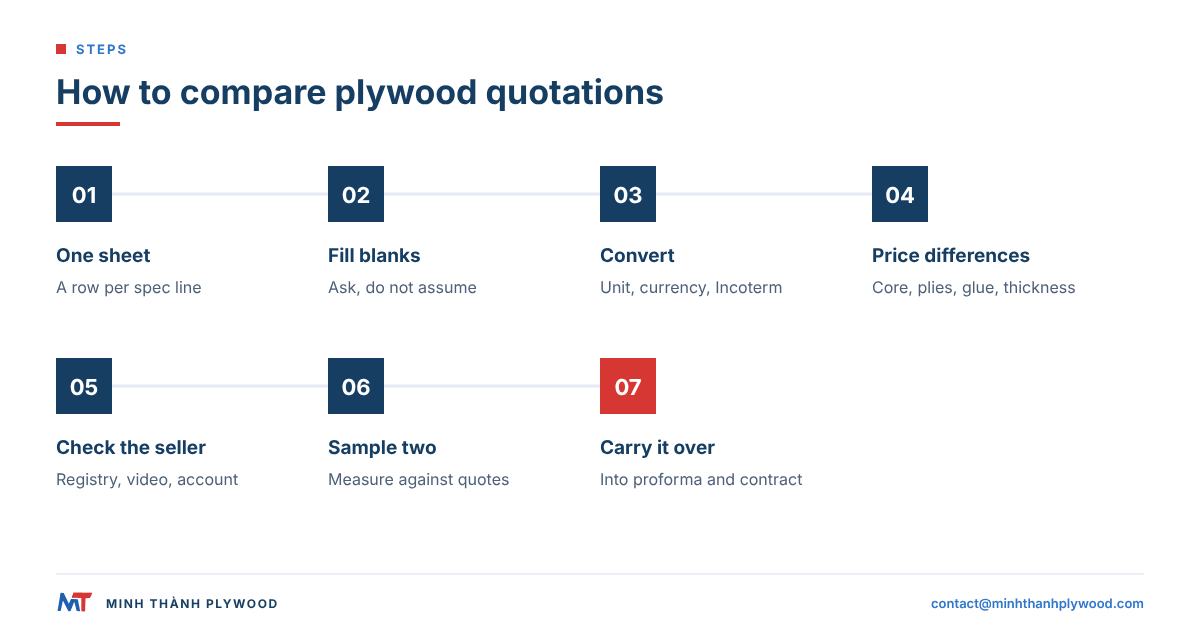
How to compare plywood quotations comes down to one rule: compare the panel, not the price. Two quotes for “18 mm plywood” are only comparable when they describe the same build, packed the same way, on the same terms. A line the quote leaves blank is a question to ask, not a free choice for the mill.
- Put every quote on one sheet, one row per specification line, one column per supplier.
- Fill the blanks by asking: a line the quote leaves out is a question, not a free choice for the mill.
- Convert prices to the same unit, currency and Incoterm.
- Price each difference: core, plies, glue, real thickness, face, sanding, packing.
- Check the seller: registry, factory video, certificates and bank account in one name.
- Sample the two best and measure them against their own quotes.
- Carry the winning build unchanged into the proforma invoice and the contract.
The rest of this guide works through each step, with a side-by-side example of two 18 mm commercial plywood quotes.
Why are two 18 mm plywood quotes so different?
Two 18 mm quotes differ because “18 mm plywood” names a size, not a panel. Behind the same words, mills build very different products: the core species and grade, the number of plies, the glue, the real thickness and the face veneer each move the cost.
| Line on the quote | What can change | Effect on cost | Effect on the buyer |
|---|---|---|---|
| Core species | Styrax, eucalyptus, acacia, poplar or a mix | Largest single cost driver | Weight, screw holding, flatness, machining |
| Core grade | Grade A, AB, or mixed | Better grade costs more | Gaps, overlaps, telegraphing through the face |
| Ply count | More, thinner veneers or fewer, thicker ones | More plies cost more labour and glue | Stability, edge appearance, screw holding |
| Pressing | Single pressing or double pressing with a calibrated core | Double pressing costs more | Flat, even thickness; clean face |
| Glue | MR, WBP melamine or phenolic | Moisture-resistant glues cost more | Bond in humid or exterior use |
| Emission class | E2, E1, E0, CARB P2 | Lower emission costs more | Market access, indoor air |
| Real thickness | Full 18 mm or less | Thinner panel uses less wood | Fit in hinges, grooves and CNC programmes |
| Face veneer | Species, thickness and grade | Better and thicker faces cost more | Appearance, sanding margin |
| Sanding | Unsanded, sanded, calibrated | Sanding costs more | Ready for finishing or not |
| Packing | Sheets per pack, pallet, covers, edge guards | Better packing costs more | Damage on arrival |
None of these is wrong in itself. A packing crate does not need a calibrated, double-pressed panel. What matters is that both quotes describe the build you need.
What does the mill’s segment have to do with price?
Vietnamese mills usually serve one segment: top-grade furniture, commercial and packing, premium film-faced or budget film-faced. A furniture mill and a packing mill both quote “18 mm plywood”, and both are honest. Their prices differ because their panels differ. A common mistake is comparing two offers from different segments as if they were the same product.
Plywood quote comparison: a side-by-side example
A worked plywood quote comparison shows how much sits behind the headline price. Here are two illustrative quotes for “18 mm commercial plywood, 1220 × 2440 mm, one 40HC”, as a buyer might receive them.
| Line | Quote A | Quote B | What to ask |
|---|---|---|---|
| Size | 1220 × 2440 mm | 1220 × 2440 mm | Length and width tolerance (±2 mm) |
| Thickness | 18 mm, ±0.5 mm | “18 mm” | B: tolerance and real thickness |
| Core | Eucalyptus, grade AB | “Hardwood core” | B: which species and grade |
| Plies | 11–13 plies | Not stated | B: ply count |
| Glue | MR glue, E1 | Not stated | B: glue and emission class |
| Face and back | Eucalyptus, B/B | “BB/CC” | Both: face species, grade against a sample |
| Sanding | Sanded both sides | Not stated | B: sanded or not |
| Packing | Export pallet, plywood covers, steel straps | Not stated | B: pack size, sheets per pack, protection |
| Moisture | 8–12% | Not stated | B: moisture at dispatch |
| Quantity | Sheets and m³ stated | m³ only | B: sheets per container |
| Price basis | FOB Hai Phong | CIF | Convert to one Incoterm |
| Payment | 30% deposit, 70% against B/L | Full payment before loading | B: why full payment |
| Validity | Stated | Not stated | B: validity date |
Quote B is lower on the total, but it describes almost nothing. Before it can be compared, the buyer needs nine answers. When they arrive, the gap usually shrinks or reverses.
Which differences did the example hide?
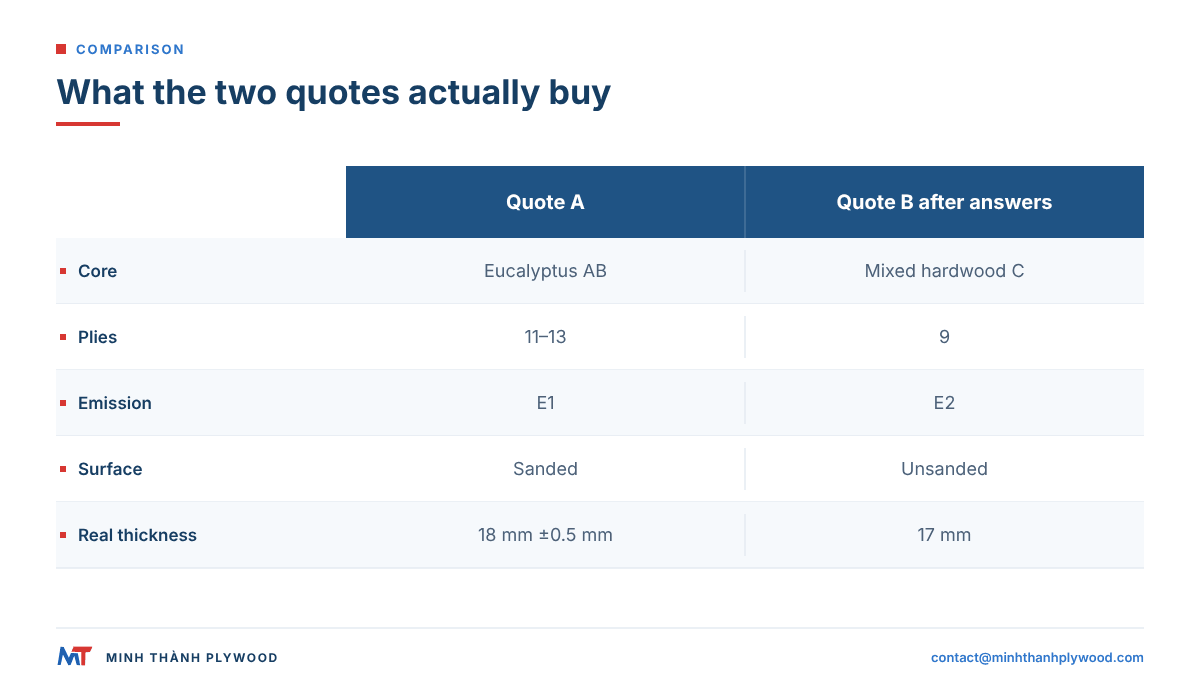
When Quote B’s answers came back in this example, they showed a mixed hardwood core in grade C, nine plies, E2 emission, unsanded faces and a real thickness of 17 mm. Each of those lowers cost:
- Mixed grade-C core: lower-cost veneer, more gaps and overlaps.
- Nine plies instead of 11–13 plies: fewer, thicker veneers, less glue and labour.
- E2 emission class: higher formaldehyde release, which may not meet your market’s emission rules.
- Unsanded faces: no sanding line cost; the buyer sands or accepts a rough face.
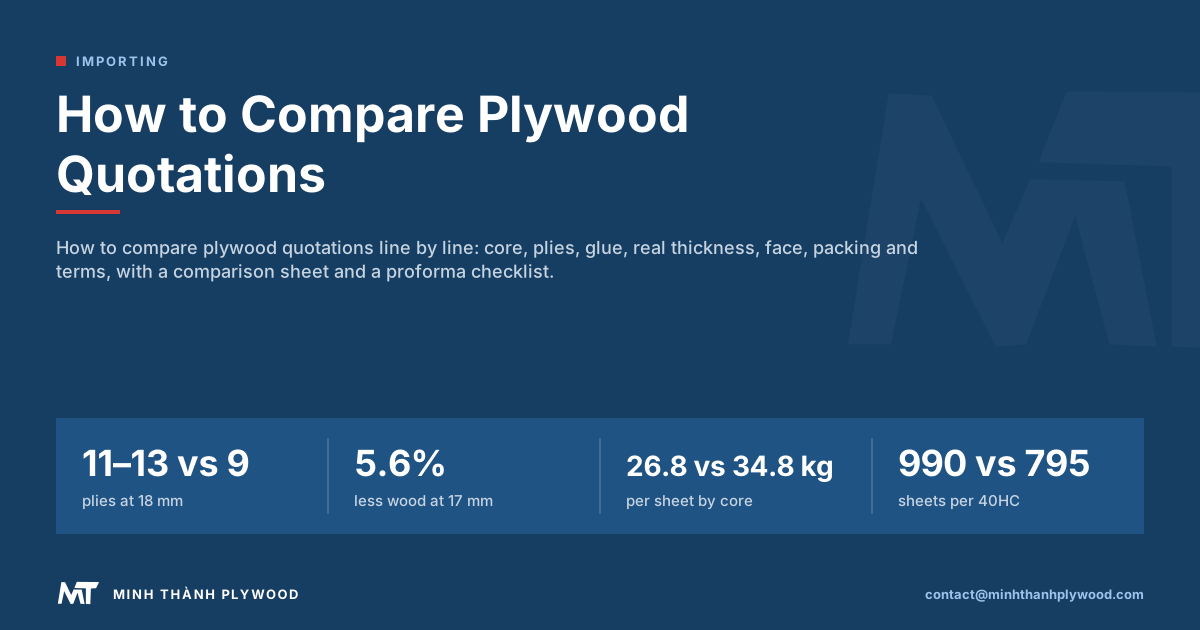
- 17 mm real thickness: about 5.6% less wood than a full 18 mm panel.
Quote B was a different, lower-cost product. It may still suit a packing use, but it is not the same panel as Quote A.
How do you build a plywood quote comparison sheet?
A comparison sheet turns several quotes into one table you can read in a minute. Build it before you read the prices.
- List the rows from your own specification: size, thickness and tolerance, core species and grade, ply count, pressing, glue, emission class, face and back species and grades, sanding, moisture, packing, quantity in sheets and m³, price and unit, Incoterm and port, payment terms, lead time, validity, documents.
- Add one column per supplier, and copy each quote into it word for word.
- Mark blanks in a colour: each blank is a question to send back.
- Send the questions in one email to each supplier, with the same wording.
- Normalise prices to one currency, one unit and one Incoterm.
- Add a row for the seller check: registry, factory video, certificates, bank account.
- Add a row for samples: received, measured, approved.
| Row | Your target | Supplier 1 | Supplier 2 | Supplier 3 |
|---|---|---|---|---|
| Thickness and tolerance | 18 mm, ±0.5 mm | |||
| Core species and grade | ||||
| Ply count | ||||
| Pressing | ||||
| Glue and emission class | ||||
| Face and back, grade | ||||
| Sanding | ||||
| Moisture at dispatch | 8–12% | |||
| Packing and sheets per pack | ||||
| Sheets and m³ per container | ||||
| Price, unit, currency | ||||
| Incoterm and port | ||||
| Payment terms | ||||
| Lead time after deposit | ||||
| Validity | ||||
| Seller verified | Yes | |||
| Sample approved | Yes |
Our RFQ checklist gives the same rows as an enquiry template, which makes quotes easier to compare from the start.
How do samples confirm the quote?
A sample is the quote made physical, and it should match the quote line by line. When the samples arrive, measure each against its own supplier’s quote before comparing them with each other.
- Count the plies on the edge and compare with the quoted ply count.
- Measure the thickness with a caliper at the corners and mid-edges, against the quoted tolerance.
- Weigh the sample and scale to a full sheet: the weight points to the core species.
- Look at the face and back against the quoted grades.
- Check the moisture with a meter, against 8–12%.
A sample that does not match its own quote tells you how the production will be quoted and shipped. Sign and keep a piece of the sample you approve, and name it on the proforma invoice.
How much does the core species change a plywood quote?
The core is most of a plywood panel’s volume, so its species and grade move the price more than any other line. It also changes the weight, and with it how many cubic metres you can ship in one container.
| Core (18 mm, 1220 × 2440 mm) | Weight per sheet | Sheets per 40HC | Volume per 40HC | Typical use |
|---|---|---|---|---|
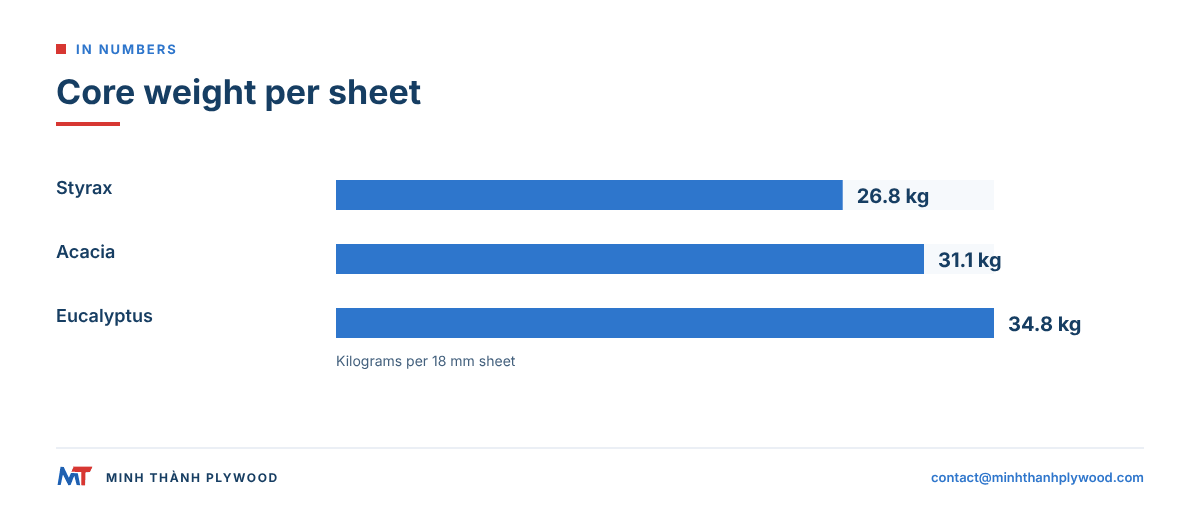
| Styrax | about 26.8 kg | 990 sheets | about 53 m³ | Furniture and interior, light panels |
| Acacia | about 31.1 kg | 880 sheets | about 47 m³ | Commercial, furniture, film-faced |
| Eucalyptus | about 34.8 kg | 795 sheets | about 43 m³ | Furniture, film-faced, heavier duty |
A heavier core reaches the container’s weight limit before its volume limit. With a planning payload of 28,000 kg, a 40HC holds about 53 m³ of 18 mm Styrax-core panels but about 43 m³ on eucalyptus. The freight is the same per container, so the freight per cubic metre is higher on the heavier core.
Why does “hardwood core” tell you nothing?
“Hardwood core” covers almost every species a Vietnamese mill uses, and it can mean a mix of species and grades in one sheet. A quote should name the species and the grade. Mixed cores are not always bad, but they cost less to make, and they change weight, colour at the edge and how the panel machines.
Many European furniture buyers choose a Styrax core because it is light and gives a clean face; switching from acacia to Styrax can lower the cost per cubic metre delivered, because more cubic metres fit in the container.
How do ply count and pressing change the price?
More, thinner plies make a flatter, more stable panel with better screw holding, and they cost more in veneer handling and glue. An 18 mm panel is usually built with 11–13 plies, most often eleven.
What fewer plies change:
- Thicker core veneers, which hide gaps more easily and can telegraph through the face.
- Less glue and labour, which lowers the price.
- Weaker screw holding and edges that look coarse when exposed.
Pressing matters as much. In double pressing, the core board is pressed and calibrated first, then the face and back are pressed on. A single-pressed panel is lower-cost but less even in thickness, and defects in the core show through the face more often. Our furniture panels are double-pressed as standard.
How do you check ply count from a quote and a sample?
Ask for the ply count in writing, then count the plies on the sample edge. Face and back count as plies. If the quote says 11–13 plies and the sample shows nine, the quote and the sample are for different panels, and the lower-cost one usually ships.
How do glue and emission class change a plywood quote?
Glue type and emission class are two separate lines, and quotes often merge them or leave both out. The glue decides how the bond behaves in moisture; the emission class decides how much formaldehyde the panel releases.
| Glue | Bond behaviour | Typical use | Cost |
|---|---|---|---|
| MR (UF) | Interior, dry conditions | Furniture, interior, commercial | Lowest |
| WBP melamine | Better moisture resistance | Humid interiors, some film-faced | Higher |
| WBP phenolic | Exterior and wet conditions | Exterior, premium film-faced | Highest |
| Emission class | What it means | Where it is needed |
|---|---|---|
| E2 | Higher formaldehyde release | Packing and some commercial uses |
| E1 | Standard low emission in many markets | General interior use |
| E0 | Lower emission | Furniture for demanding markets |
| CARB P2 / TSCA Title VI | Certified to the US limit | US market; accepted as proof in Europe |
The TSCA Title VI limit for veneer-core hardwood plywood is 0.05 ppm under EPA’s formaldehyde emission limits. Furniture plywood uses UF glue at E0 emission, and our panels are certified CARB P2 / TSCA Title VI as ICTT mill number 23024. Our six ASTM D6007 chamber tests ran from April 2025 to June 2026 on 9, 15 and 18 mm panels, three by Shanghai Hongjun and three by ICTT Vietnam. They averaged 0.014–0.032 ppm against that CARB Phase 2 / TSCA Title VI limit.
A quote that says “E0 glue” with no test behind it tells you little. Ask for the certificate number and a recent result for the product line, and compare them across quotes.
Real thickness and tolerance: how much is the missing millimetre worth?
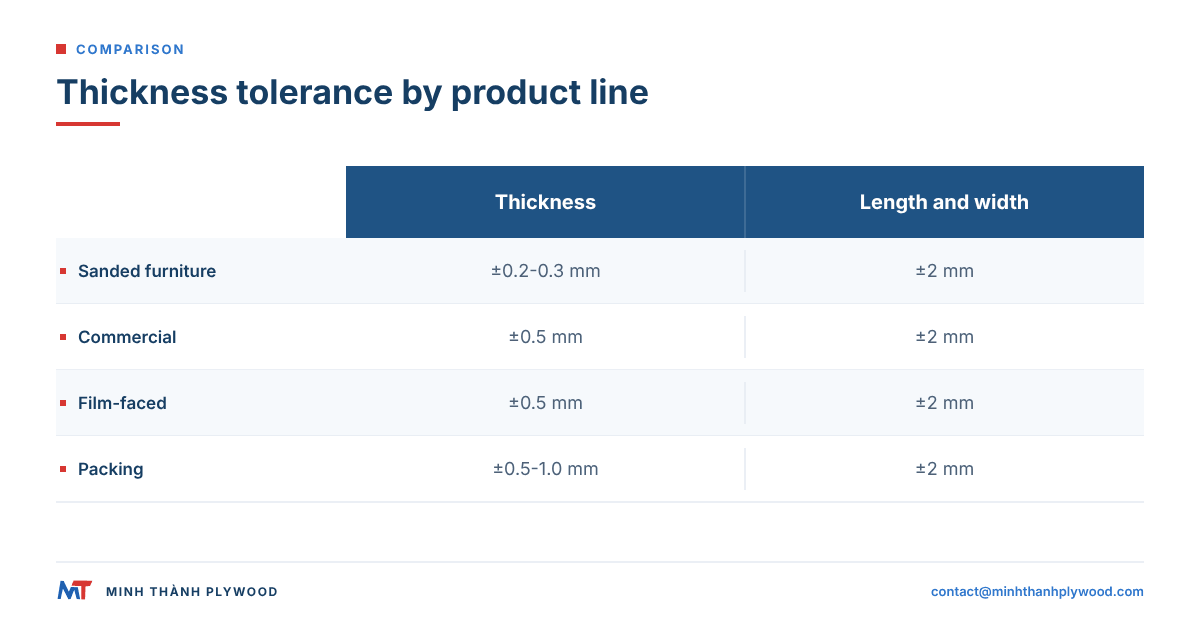
The thickness on a quote is nominal unless a tolerance is written next to it. A panel quoted at 18 mm and delivered at 17 mm contains about 5.6% less wood, and the buyer pays for the full 18 mm.
Tolerances by product line, as we build them:
| Product line | Thickness tolerance | Length and width |
|---|---|---|
| Sanded furniture panels | ±0.2–0.3 mm, down to ±0.2 mm | ±2 mm |
| Commercial plywood | ±0.5 mm | ±2 mm |
| Film-faced plywood | ±0.5 mm | ±2 mm |
| Packing plywood | ±0.5–1.0 mm | ±2 mm |
The price of a tight tolerance is calibration: sanding the core board and the finished panel to an even thickness. A furniture plant running CNC and edge banding pays for it many times over in fewer rejects.
How is the volume calculated on a quote?
Volume per sheet is length × width × thickness. For a 1220 × 2440 × 18 mm sheet that is about 0.0536 m³. Check two things on every quote:
- The thickness used in the calculation is the nominal 18 mm, and the panel is delivered within the tolerance.
- Both quotes use the same method, so a price per cubic metre means the same amount of panel.
A quote priced per cubic metre on a panel that arrives thin charges you for wood you never receive.
How do face veneer and grade change the price?
The face is what the end customer sees, and its species, thickness and grade move the price. Two quotes that both say “B/B” may use different face species, different veneer thicknesses and different grading habits.
What to compare:
- Face and back species: poplar, eucalyptus, birch, okoume, pine or engineered veneer.
- Face and back grades: written as a pair, for example A/B or B/B, and fixed by an approved sample.
- Face veneer thickness: a thicker face survives sanding and finishing better; ask for it in tenths of a millimetre.
- Grade codes: buyers order poplar faces by the Chinese codes B/BB, BB/CC and CP, which map onto the same A/B ladder; birch faces are graded D+, D and E in Vietnam.
| Face grade language | What it usually means | How to fix it on the order |
|---|---|---|
| A/A, A/B, B/B | Face/back pairs on a mill’s ladder | Approved signed sample |
| B/BB, BB/CC, CP | Chinese grade codes for poplar faces | Map to the mill’s ladder, then sample |
| D+/D, D/E | Vietnamese birch face grades | Approved signed sample |
| C/D | Utility faces for exterior or CDX-type panels | Sample, plus the use |
Grades differ from mill to mill. The only reliable comparison is two samples side by side under the same light.
Does sanding and finishing show up in the quote?
Sanding is a production step with its own cost, and quotes often leave it unstated. An unsanded panel costs less; a calibrated, sanded panel is ready for finishing.
- Unsanded: normal for packing and some commercial uses.
- Sanded: one or both faces sanded smooth.
- Calibrated: sanded to a tight, even thickness, the standard for furniture.
- Polished or UV-ready: both faces prepared for the buyer’s own UV coating.
A furniture buyer who receives unsanded panels pays twice: once for the panel and again for sanding in their own plant, if their line can do it.
What does the moisture line tell you?
Moisture at dispatch shows how well the veneers and panels were dried. Our veneers and finished panels leave at 8–12% moisture content, the normal range for furniture plywood. A quote without a moisture line leaves room for panels that move, warp or show glue problems once they dry out in a heated European warehouse. Ask for the range in writing and check it on samples and on arrival.
Packing: how many sheets per pack, and what protects them?
Packing decides how the panels arrive and how many fit in the container. Two quotes with the same price per cubic metre can differ by the pallet, the covers and the number of sheets per pack.
Packs are about a metre high, so the number of sheets per pack depends on the thickness: 55 sheets of 18 mm panels in one pack. The pack count per container then depends on the core weight.
| Packing line | What a good quote states | Why it matters |
|---|---|---|
| Sheets per pack | 55 sheets at 18 mm, for example | Counting and checking against the packing list |
| Pallet | Export pallet type; treated and marked if solid wood | ISPM 15 applies to solid-wood pallets |
| Covers | Plywood or carton top and bottom, plastic wrap | Protection from water and scuffing |
| Straps and corners | Steel straps, corner protectors | Pack stability, edge damage |
| Marks | Labels per pack: specification, grade, count | Unloading, stock control, claims |
| Packs per container | 18 packs on Styrax core at 18 mm | Load plan and weight |
A container packed beyond its limit can break pack bases and leave the receiver unloading by hand. Ask for the load plan with the quote.
How do you compare quotes for a mixed container?
A mixed container carries several thicknesses, face grades or products in whole packs. Compare it line by line, not by the total.
- Ask for a price per line, with sheets, packs and cubic metres for each.
- Check the load plan: thin panels mean more sheets per pack, heavy cores mean fewer packs per container.
- Check the weight: a mix that is heavy on thick eucalyptus panels can reach the payload before the container is full.
- Compare each line with the same line on the other quotes.
At Minh Thanh Plywood one 40HC can carry several specifications by agreement, which suits a trial order or a buyer who needs several thicknesses each month.
How do you compare quotes on different Incoterms?
Quotes on FOB, CFR and CIF are not comparable until you bring them to one basis. The cleanest way is to convert all of them to the cost at your warehouse door.
| Term | Included in the quoted price | Still to add |
|---|---|---|
| FOB Hai Phong | Panel, packing, export clearance, loading on board | Sea freight, insurance, destination charges, duty, inland transport |
| CFR | FOB plus sea freight | Insurance, destination charges, duty, inland transport |
| CIF | CFR plus minimum insurance | Destination charges, duty, inland transport |
Ask your forwarder for the freight and destination charges per container, divide by the cubic metres in each quote’s container, and add them. A heavier core carries more freight per cubic metre, which a FOB-only comparison hides.
Why does CIF sometimes cost more than it looks?
A CIF price includes freight booked by the seller, and the destination charges the carrier’s agent then bills you can be higher than with your own forwarder. Compare a CIF quote with your own FOB-plus-freight figure before choosing it.
What does a landed-cost comparison look like?
Bring each quote to the same delivered cost per cubic metre in four steps:
- Start from the FOB price per cubic metre, or take the freight and insurance out of a CIF price using your forwarder’s figures.
- Add the sea freight and insurance per container, divided by that quote’s cubic metres per container.
- Add destination charges, duty and inland transport, divided the same way.
- Compare the delivered cost per cubic metre, then per sheet.
The quote with the lowest FOB price is not always the lowest delivered, because a heavier core or a lighter load spreads the same freight over fewer cubic metres.
What do payment terms and lead time add to a quote?
Payment terms carry risk, and risk has a cost. A quote that asks for full payment before production looks lower on paper and more expensive if anything goes wrong.
| Payment term | Your risk | How to compare |
|---|---|---|
| Full payment before production | Highest | Treat as a warning sign with a new supplier |
| 30% deposit, 70% against the scanned B/L | Moderate | Standard for first and repeat orders |
| Deposit, balance after inspection | Lower | Add the inspection fee to the comparison |
| Irrevocable L/C at sight | Low | Add bank charges to the comparison |
Lead time matters too. Our production runs 15–45 days after the 30% deposit. A quote with a much shorter lead time for a furniture-grade panel deserves a question about where the stock comes from.
How do you compare a factory quote with a trading company quote?
Compare the build first, then the seller. A trading company adds its margin to the mill’s price, but a trader’s quote can still be lower when it describes a lower-cost panel.
- Put both quotes on the comparison sheet and fill every blank.
- Ask the trader which mill presses each line, and whether the certificates are that mill’s.
- Compare like with like: when the builds match, the factory price has one margin fewer.
- Weigh the service: a trader can combine plywood, MDF and other products on one invoice.
Our guide on telling a factory from a trading company shows how to check which one you are dealing with.
Which differences matter for your use?
Not every line matters equally for every buyer. Decide which differences you will pay for before reading the totals.
| Use | Lines that matter most | Lines you can relax |
|---|---|---|
| Furniture and cabinets | Core grade, double pressing, calibrated thickness, E0 or CARB P2, face grade, moisture | Packing beyond standard export |
| Interior fit-out | Face grade and species, emission class, flatness | Ply count beyond 11–13 plies |
| General commercial resale | Consistent core, thickness at ±0.5 mm, glue class, price | Face grade above B/B |
| Packing and crates | Price per cubic metre, thickness at ±0.5–1.0 mm, loading speed | Face grade, sanding, emission class above market minimum |
| Formwork | Core grade, glue for reuse, film weight, sealed edges | Face species under the film |
A buyer who knows the use can accept a lower-cost build where it does no harm, and refuse a lower-cost build where it does.
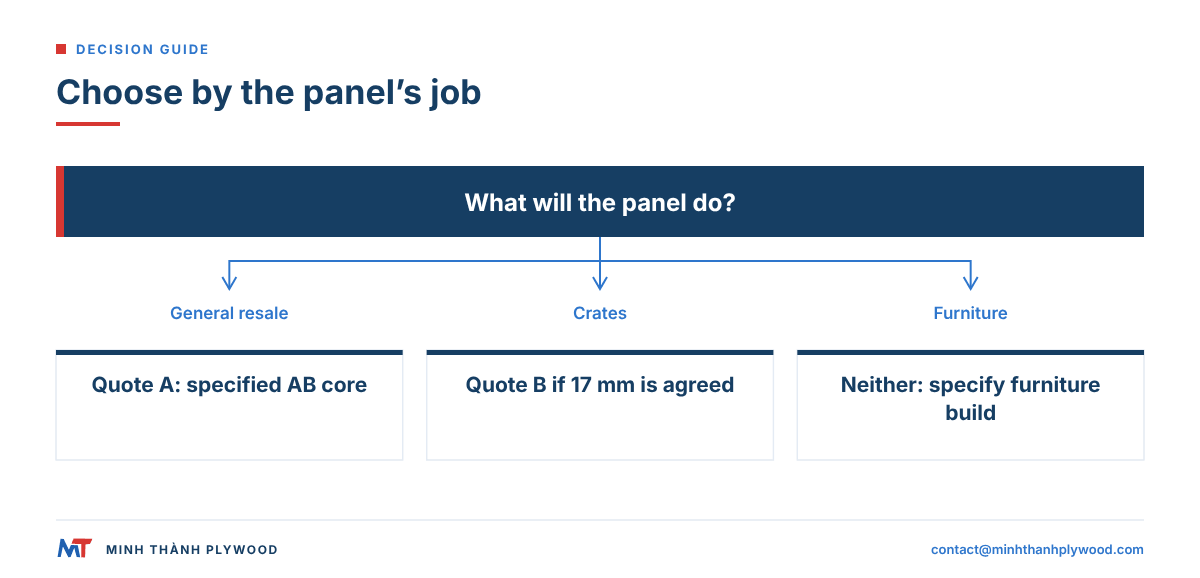
Which quote wins in the side-by-side example?
Back to the two quotes for 18 mm commercial plywood. Once Quote B’s blanks were filled, the verdict depended on the use.
- For a merchant selling general-purpose panels, Quote A wins. Its eucalyptus AB core, 11–13 plies, MR glue at E1 and ±0.5 mm tolerance give a panel customers come back for. Quote B’s thin, unsanded E2 panel would bring complaints and returns.
- For a crate maker, Quote B can win, provided the real thickness is written into the order and the price is set for a 17 mm panel. Face grade, sanding and emission class matter little in a crate, as long as the importing country accepts the emission class.
- For a furniture plant, neither quote fits. It needs a grade-A core, double pressing, calibrated sanding, UF glue at E0 emission and certification its market accepts, which is a different product with a different price.
The same two quotes can be right or wrong depending on who buys them. That is why the comparison sheet starts with your target column, and why the use comes before the price.
How do you compare emission claims across quotes?
Put the glue type and the emission class on separate rows, and add a third row for the proof: certificate number, issuer and the date of the latest test. A claim without proof scores as a blank. When two quotes both show proof, compare the test results for the product line and thickness you are buying, not a result for another product.
What should you check on a plywood proforma invoice?
The proforma invoice is where the quote becomes an order, and it is the document your deposit pays against. Check it line by line before paying.
- Seller: the registered company name, matching Vietnam’s National Business Registration Portal.
- Bank account: in the same company’s name; any later change confirmed by phone on a number you already hold.
- Each line’s full specification: size, thickness and tolerance, core, plies, glue, emission class, face and back grades, sanding, moisture.
- Quantities: sheets and cubic metres per line, and the total.
- Unit price, currency and total.
- Incoterm and named port.
- Payment terms: deposit and balance, with the trigger for the balance.
- Shipment window: production time after deposit and the latest shipment date.
- Packing and marks.
- Documents to be supplied: invoice, packing list, B/L, certificate of origin, and any emission, FSC or EUDR papers.
- Approved sample reference: the label of the signed sample.
- Validity: the date after which the price must be confirmed again.
Any line that differs from the quote you chose is a change. Ask why before paying.
What goes into the sales contract after the proforma?
For a first order, a short sales contract adds the clauses a proforma invoice usually leaves out. They cost nothing to write and save weeks if something goes wrong.
- Inspection: who inspects, when, against which sample, and what happens on failure.
- Tolerances and acceptance: the measurements that decide whether goods conform.
- Claims: how soon a claim must be raised after arrival, the evidence it needs, and the remedies.
- Delay: what happens if shipment is late.
- Force majeure and governing law.
- Documents for your market: EUDR dossier for the EU from 30 December 2026 (30 June 2027 for smaller operators not under the EUTR), emission certificates, declarations of performance where CE applies.
Our guide on plywood quality claims explains how to write the claim clause.
Plywood quotation guide: units, currency, validity and price changes
This plywood quotation guide would be incomplete without the small print, because the units, the currency and the validity date change what a price means. Two quotes can name the same number and still cost you different amounts.
| Small-print line | What to check | Why it matters |
|---|---|---|
| Price unit | Per cubic metre, per sheet or per container | Convert all quotes to the same unit before comparing |
| Volume method | Nominal size and thickness used for the cubic metres | A different method changes the price per panel |
| Currency | US dollars, euros or another currency | Exchange-rate risk sits with whoever pays in the foreign currency |
| Validity | The date until which the price holds | Veneer and glue prices move; an expired quote is a new negotiation |
| Price adjustment | Whether the price can change between the proforma and shipment | A fixed price protects you; an open one does not |
| Quantity basis | Sheets, packs and m³ per container | Reveals short packs and different load plans |
| Bank charges | Who pays the sending, intermediary and receiving bank fees | Small per order, real over a year |
How do you convert a price per cubic metre into a price per sheet?
Multiply the price per cubic metre by the volume of one sheet. For a 1220 × 2440 × 18 mm sheet the volume is about 0.0536 m³, so the price per sheet is the price per cubic metre times 0.0536. Do the same for every thickness on the order, and you can compare a per-sheet quote with a per-cubic-metre one on the same basis.
Why do plywood prices change between quote and order?
Plywood is priced from veneer, glue, energy and labour, and veneer prices move with log supply. A mill that holds its quote for a short validity is being honest about that. Confirm the price on the proforma invoice, and pay the deposit only against the confirmed figure.
How do you negotiate once the quotes are comparable?
Negotiation works only after every quote describes the same build. Then the conversation is about real differences, not about missing information.
- Share the build, not the competitor’s price: tell each mill the specification you have chosen and ask for its best offer on that build.
- Trade specification for price where the use allows: a lower face grade on the back, a looser tolerance for packing panels, a different core species.
- Trade volume for price: a schedule of repeat containers is worth more to a mill than one order.
- Trade terms for price: a letter of credit or a faster balance payment lowers the mill’s risk.
- Keep quality lines fixed: core grade, glue, emission class and tolerance are the lines that cause claims when they slip.
- Put the agreed build on the proforma before the deposit, unchanged.
A mill that lowers its price without changing anything in writing may be planning to change the panel instead. Ask what changes when the price falls.
What is a fair margin between quotes?
When two quotes describe the same written build from verified mills, the difference is usually small: margins, efficiency and how full each mill’s order book is. A large gap on the same build is a question, not a bargain. Sample both and measure them against their quotes before choosing.
Red flags in a plywood quotation
Some quotes tell you more by what they leave out than by what they say. These signs deserve a question before you go further.
| Red flag | What it often means | What to ask |
|---|---|---|
| Thickness without tolerance | Panels may arrive thin | The tolerance in writing |
| “Hardwood core” or no core named | Mixed or low-grade core | Species and grade |
| No glue or emission class | Lowest-cost resin | Glue type, class and certificate |
| No ply count | Fewer, thicker plies | Ply count, then count on the sample |
| Price far below the others | A different, lower-cost build | What is different, in writing |
| Full payment before production | Risk shifted to you | Deposit and balance against B/L, or an L/C |
| No validity date | Price may change after the deposit | Validity and the price on the proforma |
| Bank account in another name | Possible fraud | Stop and verify by phone |
Our guide on how to avoid scams when buying plywood from Vietnam covers the fraud side in depth.
How does Minh Thanh Plywood write a quotation?
We write every quote so that it can be compared line by line. Each line states the build, the packing and the terms, and the price applies to that build only.
| Line | What our quote states |
|---|---|
| Size and thickness | 1220 × 2440 mm or 1250 × 2500 mm, thickness with tolerance by product line |
| Core | Styrax or eucalyptus as standard, acacia and pine on order; grade and stitching |
| Plies and pressing | Ply count; double pressing for furniture panels |
| Glue and emission | UF glue at E0 emission, or the glue your use needs; CARB P2 / TSCA Title VI |
| Face and back | Species and grade pair, fixed by the approved sample |
| Sanding and moisture | Sanded or calibrated; 8–12% moisture at dispatch |
| Packing | Sheets per pack, pallet, covers, straps and marks |
| Quantity | Sheets and m³ per line, packs per container |
| Price and terms | From US$350/m³ furniture and US$250/m³ commercial (October 2026); FOB Hai Phong, CFR or CIF |
| Payment and lead time | 30% deposit, 70% against the scanned B/L or irrevocable L/C at sight; production after deposit |
| Minimum | One 40HC, mixed by agreement; free samples |
Send us your specification through the furniture plywood page, or fill in our RFQ checklist, and we will reply with a written quote you can put next to any other.
Buyer questions, answered
Why are two 18 mm plywood quotes so different?
Because they usually describe different panels. The core species and grade, the number of plies, the glue and emission class, the real thickness, the face veneer and grade, sanding, packing and the Incoterm all change the cost. Put both quotes on one sheet, line by line, before comparing the totals.
What should I check on a plywood proforma invoice?
Check the seller's registered name and bank account, and the full specification of each line. Then check quantities in sheets and cubic metres, unit price and currency, Incoterm and port, payment terms and shipment window. Finish with tolerances, packing and marks, the documents to be supplied, the approved sample reference and the validity date.
Should I compare plywood prices per sheet or per cubic metre?
Use both. Per cubic metre compares the material across thicknesses; per sheet is what you sell or use. Check that the cubic metres are calculated from the nominal size and thickness, and that both quotes use the same method.
What is the difference between FOB and CIF when buying plywood from Vietnam?
Under FOB you book and pay the sea freight and insurance from the Vietnamese port; under CIF the mill does. Destination charges, duty and inland transport stay with you under both, and the risk passes to you at loading either way.
Can I mix different plywood products in one container?
Yes, usually. At Minh Thanh Plywood one 40HC can carry several thicknesses, face grades or products by agreement, in whole packs. A quote for a mixed container should price each line separately.
How much does the core species change the price of plywood?
The core is most of the panel's volume, so it moves the price more than any other line. It also changes the weight: an 18 mm sheet weighs about 26.8 kg on a Styrax core, 31.1 kg on acacia and 34.8 kg on eucalyptus, which changes how many cubic metres fit in a container.
How do I know the real thickness of the plywood quoted?
Ask for the thickness tolerance in writing, and measure samples with a caliper at the corners and mid-edges. A quote that names only the nominal thickness leaves the real thickness open.
Is the lowest plywood quote ever the best?
It can be, when its written build matches the others and the seller is verified. More often the lowest quote carries a lower-cost core, fewer plies, a weaker glue, a thinner panel or a looser tolerance. Price the differences before deciding.
How long is a plywood quotation valid?
Mills usually state a short validity, because veneer and glue prices move. Check the date on the quote and confirm the price on the proforma invoice before paying the deposit.
What is a plywood quote comparison sheet?
A table with one row per specification line and one column per supplier: core, plies, glue, emission, thickness and tolerance, face and back, sanding, size, moisture, packing, quantity, price, Incoterm, payment, lead time and validity. Blank cells are questions to send back.
What documents should a plywood quote list?
Commercial invoice, packing list, bill of lading and certificate of origin as standard, plus the emission certificate, test results, FSC claim, EUDR dossier or declaration of performance where your market or product needs them.
How do I compare plywood quotes from a factory and a trading company?
Compare the written build first, then ask the trader which mill presses the panel. When the build is the same, the factory's price has one margin fewer; when it differs, the build explains more of the gap than the margin does.