
Before a first plywood order, ask the supplier 30 questions in six groups: who presses the panels, what goes into them, how quality is checked, which certificates and documents come with the container, how payment works and how the goods are packed and shipped. A real manufacturer answers each with a number, a document or a photo. This guide gives every question, the answer Minh Thanh Plywood gives as a worked example, and the answers that should stop the order.
What are the questions to ask a plywood supplier before a first order?
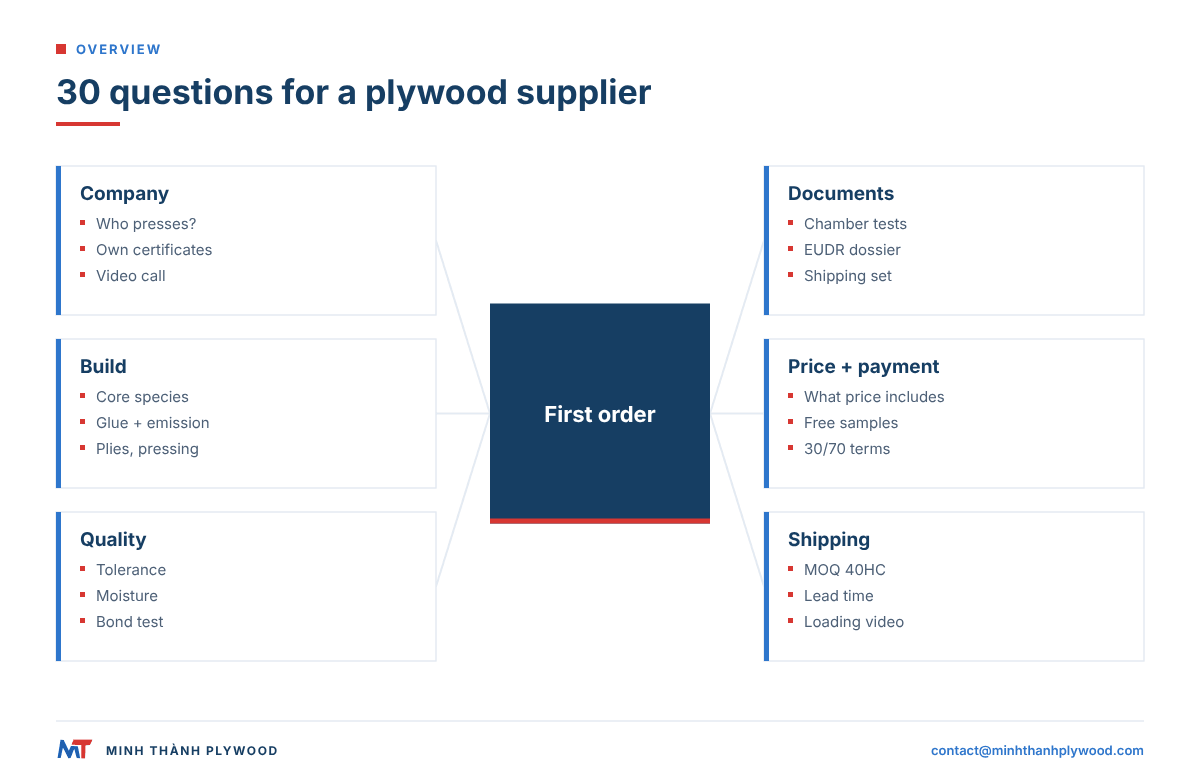
The questions to ask a plywood supplier before a first order fall into six groups, five questions each, covering origin, panel build, quality control, documents, price and shipping. Every one has an answer a real manufacturer can give with a number, a document or a photo:
| Group | What the five questions settle |
|---|---|
| 1. The company | Who presses the panels, and whether the certificates are theirs |
| 2. The panel build | Core, glue, faces, plies and pressing |
| 3. Quality control | Tolerances, moisture, bond tests and inspection |
| 4. Certificates and documents | Emission proof and the shipping file |
| 5. Price, samples and payment | What the price includes, how samples and money move |
| 6. Packing and shipping | Container plan, lead time and the loading record |
Send the questions in writing before you ask for a final price. The answers tell you more than the price does: two quotations for “18 mm furniture plywood” can describe two very different panels.
Each group below gives the question, the answer Minh Thanh Plywood gives as a worked example, and the answer that should stop the order.
Group 1: Which questions show who really makes the plywood?
Start with the company, because every other answer depends on who stands behind it.
| Question | A real mill’s answer (Minh Thanh) | Red flag |
|---|---|---|
| 1. Do you press the panels yourselves? | Yes. The factory is in Ha Hoa, Phu Tho, Vietnam, with 50,000+ m³ a year of capacity | “We work with several factories” for a product sold as your own |
| 2. Whose name is on your certificates? | Our own: CARB P2 / TSCA Title VI, ICTT mill no. 23024; ISO 9001:2015, KAC25/0185 | Certificates in another company’s name, or no mill number |
| 3. Can we see the factory on a video call? | Yes, the press, sanding and packing lines, live | Only stock photos or showroom images |
| 4. Which products do you make, and which do you buy in? | We make furniture, commercial, film-faced and packing plywood; FSC and CE are available* | A list of every panel on the market, all “our production” |
| 5. Which markets do you ship to now? | Europe is our strongest market, with repeat orders into Italy; also the Americas, Asia and Africa | No market, or only the buyer’s own country named |
*Supplied directly or through qualified partner mills.
A factory shows its own press; a trader shows other people’s. For the full method, read factory or trading company?
Group 2: Which questions pin down the panel build?
The build is what you pay for. Ask for each element by name, not by grade label.
| Question | A real mill’s answer (Minh Thanh) | Red flag |
|---|---|---|
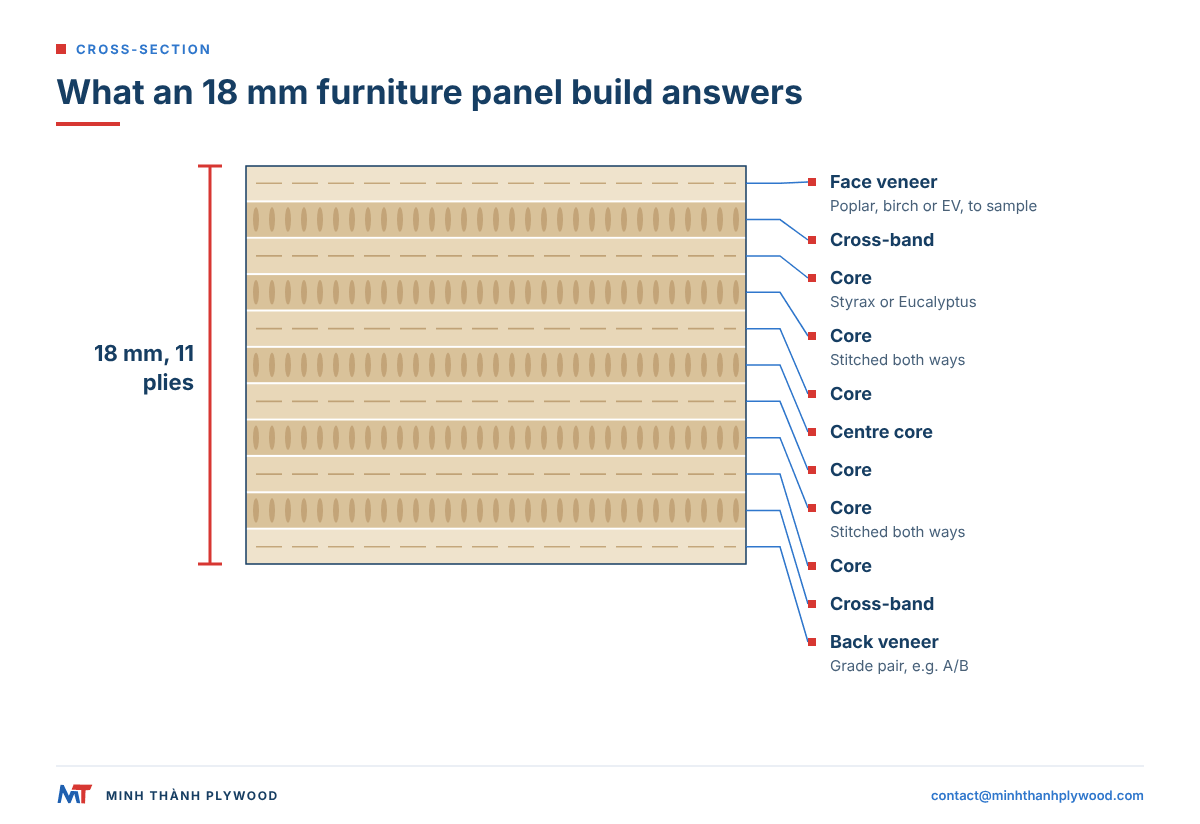
| 6. Which core species do you use? | White Styrax or Eucalyptus core as standard, plantation timber grown around the factory; Acacia and Pine on order | “Hardwood core” with no species |
| 7. Which glue, and which emission class? | UF glue at E0 emission for furniture and interior panels; MR (melamine-fortified) or WBP (phenolic) glue to your specification | “E0 glue” as one answer, or no answer on the resin |
| 8. How many plies in 18 mm? | Usually 11 plies in an 18 mm furniture panel; thin 3–5 mm panels are always 5 plies | A ply count that does not fit the thickness |
| 9. Is the panel pressed once or twice? | Twice for furniture panels: the core board is pressed and calibrated, then the face and back are pressed on | “Twice” with no description of each press |
| 10. Is the core stitched? | Yes, core layers stitched horizontally and vertically | No answer, or “not needed” for a furniture panel |
A build answered line by line becomes your specification sheet. Put it on the purchase order word for word.
Group 3: Which questions test the supplier’s quality control?
Quality control is a list of checks with numbers. Ask for the numbers.
| Question | A real mill’s answer (Minh Thanh) | Red flag |
|---|---|---|
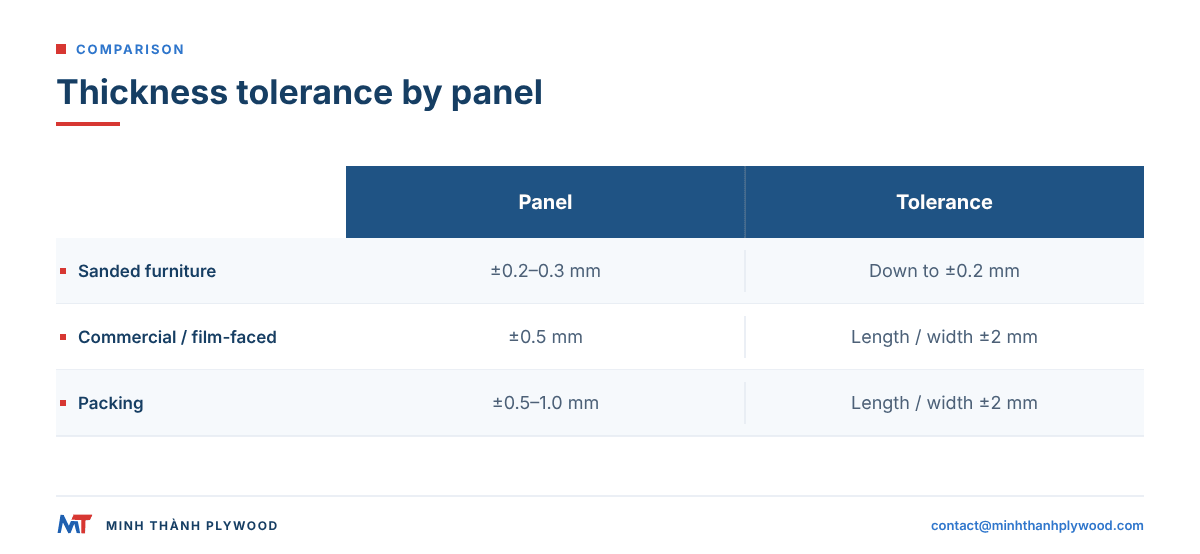
| 11. What thickness tolerance do you hold? | Sanded furniture panels ±0.2–0.3 mm, down to ±0.2 mm; commercial and film-faced ±0.5 mm; packing ±0.5–1.0 mm; ±2 mm on length and width | “Standard tolerance” with no figure |
| 12. What moisture content do panels leave at? | 8–12%, measured with a moisture meter before lay-up | No meter, no figure |
| 13. How do you test the glue bond? | Boil test on production samples: UF glue at E0 holds about 6 hours, melamine-fortified glue about 12 hours | “Our glue is very strong” |
| 14. How many quality checkpoints run on an order? | Eight, from core veneer intake to the sealed container; panels from every pack measured with a digital caliper | Only a final look before loading |
| 15. Can my inspector come before loading? | Yes. Give the date with the order; production and loading are planned around it, and our measurement records are open to the inspector | Inspection refused, or allowed only after payment |
See how the eight checkpoints run on the floor at plywood quality control.
Questions 7 and 16 rest on one emission limit. The US TSCA Title VI limit for veneer-core hardwood plywood is 0.05 ppm, as listed in EPA’s formaldehyde limits.
Group 4: Which certificates and documents should you ask for?
Ask for the files your market needs before you pay, not after the container sails.
| Question | A real mill’s answer (Minh Thanh) | Red flag |
|---|---|---|
| 16. What proves your formaldehyde emission? | Six ASTM D6007 chamber tests, April 2025 – June 2026, on 9, 15 and 18 mm panels, averaging 0.014–0.032 ppm against the 0.05 ppm limit; three by Shanghai Hongjun, three by ICTT Vietnam | A test report with no method, lab or date |
| 17. Do your panels meet European requirements? | Yes. Panels meet the emission and quality requirements European buyers ask for; CARB P2 / TSCA Title VI and the chamber tests are the proof, and SGS tests to your method, such as EN 717-1, on request | A “European certificate” nobody can name |
| 18. Can you supply the EUDR file? | Yes. We supply the EUDR compliance dossier, origin records and geolocation files, with orders | “We have an EUDR certificate” |
| 19. Which shipping documents come with the container? | Commercial invoice, packing list, B/L, certificate of origin (EUR.1 for the EU), phytosanitary and fumigation certificates where required, insurance under CIF | No certificate of origin, or a list that changes by email |
| 20. Is your export packing tested? | Yes. SGS, September 2026, under Regulation (EU) 2025/40: lead, cadmium, mercury and hexavalent chromium not detected in the four packaging materials | No answer on packaging rules for the EU |
A fumigation certificate is a wood-packaging question, not a panel one: the UK government guidance says its wood packaging rules “do not apply to processed, non solid WPM like plywood”.
There is no official “EUDR certificate”. The importer files its own due diligence statement from the supplier’s dossier under Regulation (EU) 2023/1115 (checked October 2026). A supplier who offers a certificate has not read the regulation. For every paper in detail, read the plywood import documents checklist.
Group 5: Which questions cover price, samples and payment?
The price only means something next to the build it buys. Ask what it includes and how the money moves.
| Question | A real mill’s answer (Minh Thanh) | Red flag |
|---|---|---|
| 21. What does your price include? | A dated quotation per m³ by face, core, glue, thickness, size, quantity and term: FOB Hai Phong, CFR or CIF | A price per sheet with no build or term |
| 22. Where do your prices start? | Commercial plywood from US$250/m³, furniture and interior plywood from US$350/m³ (October 2026); the build sets the final figure | A price far below the market for the same build |
| 23. Do you send samples? | Free samples, cut from your build | Paid samples that differ from the quoted build |
| 24. What are your payment terms? | 30% deposit with the order, 70% against the scanned B/L, or irrevocable L/C at sight | Full payment before production on a first order |
| 25. Who receives the money? | The manufacturer’s own company account, named on the proforma invoice | A personal account, or a bank name that changes by email |
Compare quotations line by line, not total by total; how to compare plywood quotations shows how.
Group 6: Which questions cover packing, lead time and shipping?
The last group decides whether the panels arrive the way they left.
| Question | A real mill’s answer (Minh Thanh) | Red flag |
|---|---|---|
| 26. What is your minimum order? | One 40HC, with several specifications in one container by agreement | No minimum at all, from stock of unknown build |
| 27. How many sheets go in a 40HC? | At 18 mm, 1220 × 2440 mm: 990 sheets on Styrax core (18 packs, about 53 m³), 880 on Acacia, 795 on Eucalyptus, capped by the booking’s weight | A sheet count that ignores weight |
| 28. What is the lead time? | 15–45 days of production after the deposit, then sea transit, for example 25–35 days to the Mediterranean | A date that does not move with the specification |
| 29. How is the container recorded? | Every shipment photographed and filmed before loading; photos and video go to the buyer | No loading photos |
| 30. How fast do you reply? | Within hours, by email or WhatsApp | A week per answer before the order |
Ask question 29 early. The loading video is the record both sides use when the container is opened at your warehouse; see how to check plywood quality on arrival.
Which supplier answers should stop the order?
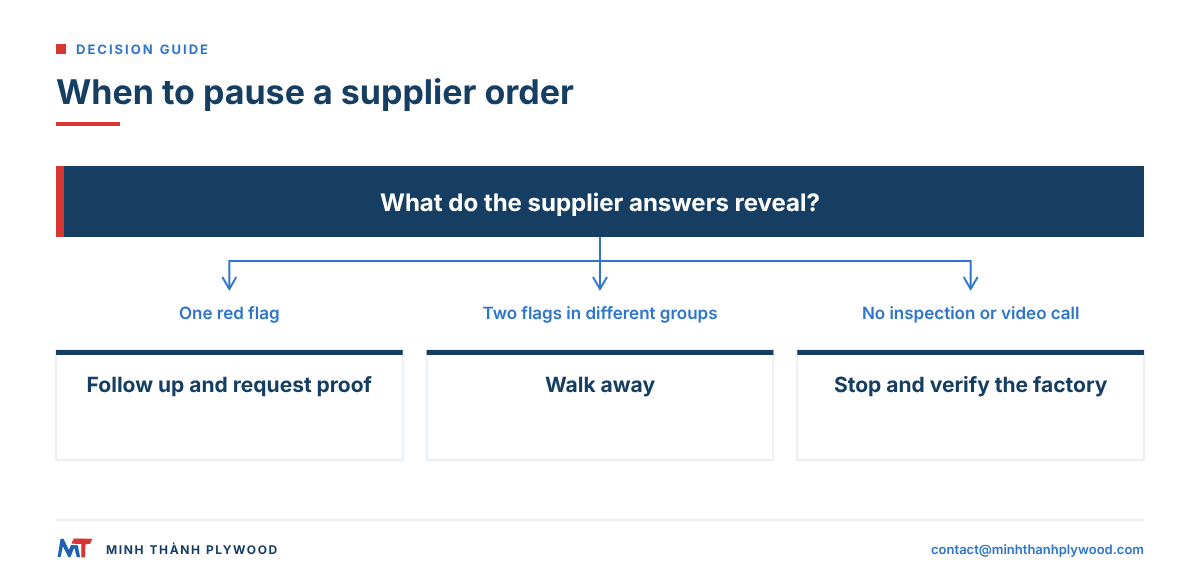
One red flag is a question to follow up; two in different groups is a reason to walk away. The answers that stop most first orders:
- Certificates in another company’s name. The panel comes from somewhere else.
- No core species or glue named. The specification you pay for is not fixed.
- A price well below comparable quotes for the same build. Something in the build is cheaper: core, glue, face or ply count.
- No inspection, no video call. A factory has nothing to hide on its own floor.
- Full payment before production. The deposit-and-balance structure exists to share risk.
- No loading record. Without photos and video, the condition at loading is your word against theirs.
The mistakes when buying plywood from Vietnam guide covers the scams behind these answers.
How should you score the supplier’s answers?
Score each answer in one of three ways, so suppliers can be compared on paper:
| Score | Meaning | Example |
|---|---|---|
| Proven | Answered with a document, number or live view | Certificate with mill number; caliper readings; video call |
| Stated | Answered clearly, proof to follow | “UF glue at E0”, report promised with the sample |
| Open | Vague, missing or contradicted | “Good quality glue”; no answer on core |
A supplier with all thirty answers proven or stated is ready for a sample and a trial container. Any group with two open answers needs a call before you go further. Keep the scored sheet; it becomes the base of your plywood factory audit checklist when you visit.
Which questions matter most for each type of buyer?
All thirty apply to every first order, but each buyer leans on a different group:
| Buyer | Questions to ask first | Why |
|---|---|---|
| Furniture or cabinet maker | 7, 9, 10, 11, 16 | Glue, pressing, stitching and tolerance decide how panels machine and finish |
| Importer or distributor | 2, 19, 24, 26, 29 | Certificates, documents, payment and the loading record decide the risk |
| Contractor buying film-faced panels | 7, 11, 21, 27, 28 | Bond, tolerance and the container plan decide the cost per pour |
| Buyer for the EU | 17, 18, 19, 20 | Emission evidence, EUDR dossier, EUR.1 and packaging rules |
| Buyer for the US | 2, 16, 19 | TSCA Title VI certification, chamber tests and labels |
How do you turn the answers into a first order?
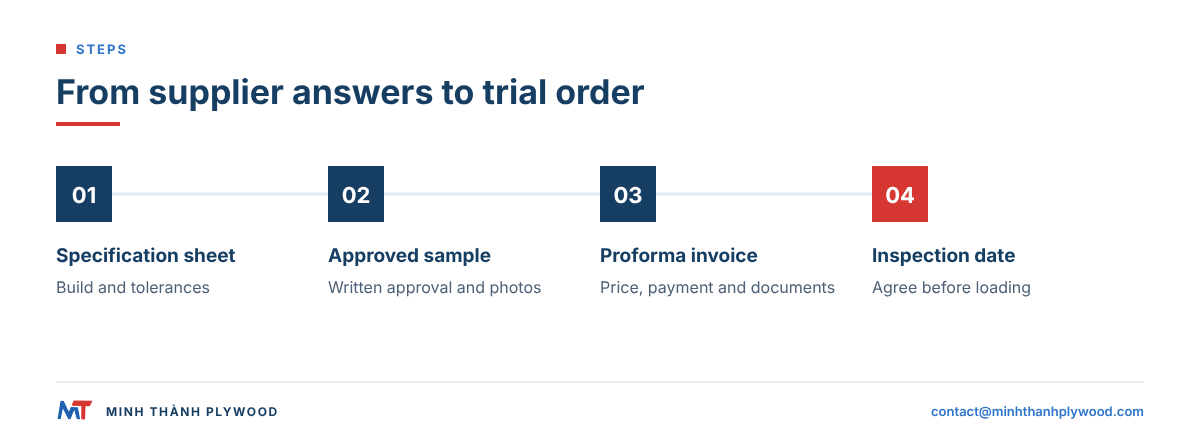
The answers become the order in four steps:
- Specification sheet: the build from group 2 and the tolerances from group 3, in one table.
- Approved sample: free samples of that build, approved in writing, with photos.
- Proforma invoice: price, term, payment, documents and loading record from groups 4 to 6.
- Inspection date: if you use an inspector, the date goes on the order.
Start with one container. A first 40HC proves the build, the paperwork and the arrival on a real shipment; the trial order to long-term supply guide shows how buyers scale from there.
What should you send a plywood supplier with your questions?
Send your own facts with the questions, so the answers come back specific:
- Use: furniture, cabinets, formwork, packing.
- Build you have in mind: face, core, glue, thickness, size.
- Quantity: per specification and per year.
- Destination port and term.
- Documents your market needs: TSCA labels, EUR.1, EUDR dossier.
Send the list to contact@minhthanhplywood.com or WhatsApp +84 988 586 601 (Lisa), and every one of the thirty questions comes back answered, with the free samples and a dated quotation. For the wider supplier search, read how to choose a plywood supplier in Vietnam.
Buyer questions, answered
What questions should I ask a plywood supplier before the first order?
Ask who presses the panels, which core, glue and face go into them, what thickness tolerance they hold, which certificates are in their own name, what documents come with the container, how payment works and how the container is packed and recorded.
How do I know if a plywood supplier is a real factory?
Ask for certificates issued in the supplier's own name with a mill number, a live video call from the press and sanding line, and unedited clips of your type of panel. A trader cannot show its own press or its own certificate.
What certifications should a plywood supplier have?
For furniture plywood sold to the US or Europe, CARB P2 / TSCA Title VI certification with recent chamber test reports, plus ISO 9001 for the quality system. FSC and CE apply only when your product or market needs them.
What thickness tolerance should a plywood supplier guarantee?
It depends on the product line. A furniture plywood mill sanding to size holds ±0.2–0.3 mm; commercial and film-faced panels run to ±0.5 mm and packing plywood to ±0.5–1.0 mm, with ±2 mm on length and width.
What payment terms are normal for plywood from Vietnam?
A 30% deposit with the order and the 70% balance against the scanned bill of lading, or an irrevocable letter of credit at sight. A request for full payment before production is a red flag on a first order.
What is a normal minimum order for plywood from a Vietnamese factory?
One 40HC container is the usual minimum. Several specifications can often share it by agreement, typically one or two and up to three to six.
How long does plywood production take after the order?
At Minh Thanh, 15–45 days after the deposit, depending on the specification and the face veneer. Sea transit comes on top, from about 5–12 days to South-East Asia to 35–45 days to the US East Coast.
Should a plywood supplier send free samples?
Yes. A manufacturer can cut samples of your exact build from production; Minh Thanh sends free samples. The approved sample then becomes the standard for faces and finish on the order.
What are red flags when choosing a plywood supplier?
Certificates in another company's name, no answer on the core species or glue, a price far below the market for the same build, refusal of an inspection or video call, full prepayment demanded, and no loading photos.
What should I ask about plywood emission and glue?
Ask which glue goes into the panel and which emission class it meets, as two separate answers, and for the chamber test reports with the method, the laboratory and the date. Furniture panels usually use UF glue at E0 emission.
Can I inspect plywood before it ships?
Yes. A real factory welcomes your inspector or an agency such as SGS, Intertek or Bureau Veritas, plans loading around the date and opens its measurement records to them.