
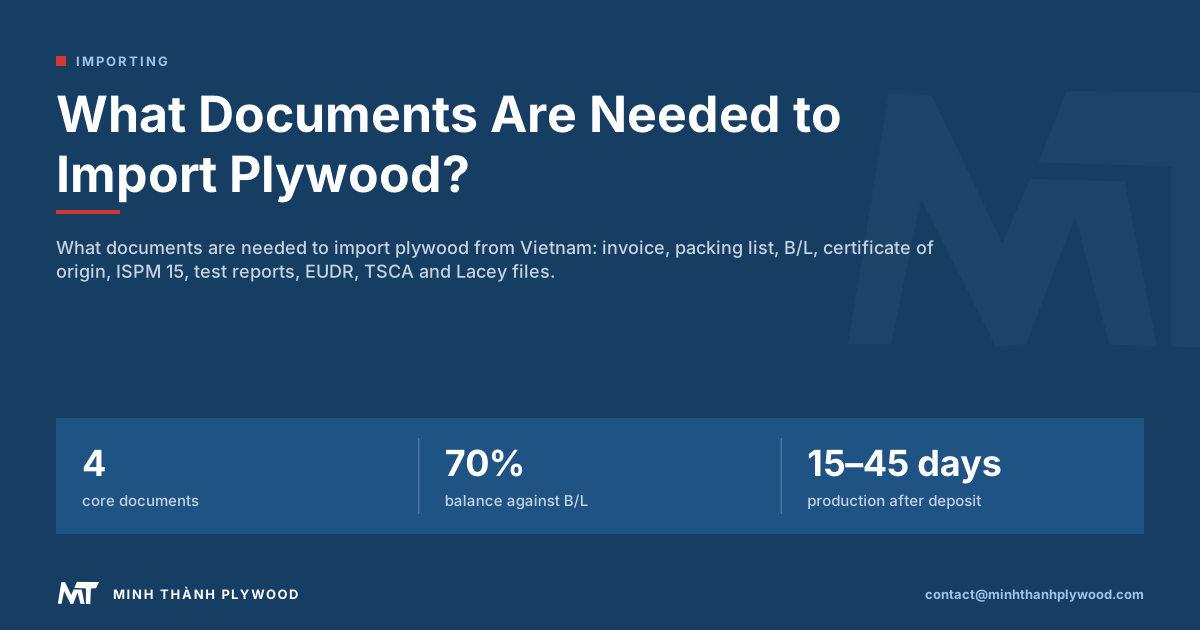
To import plywood from Vietnam you need four shipping documents for customs (commercial invoice, packing list, bill of lading, certificate of origin) plus the files your market asks for: emission certificates and labels, EUDR origin data, the packing test and, for the US, Lacey and TSCA papers. Minh Thanh Plywood prepares the full set with every container.
What documents are needed to import plywood, whatever the destination?
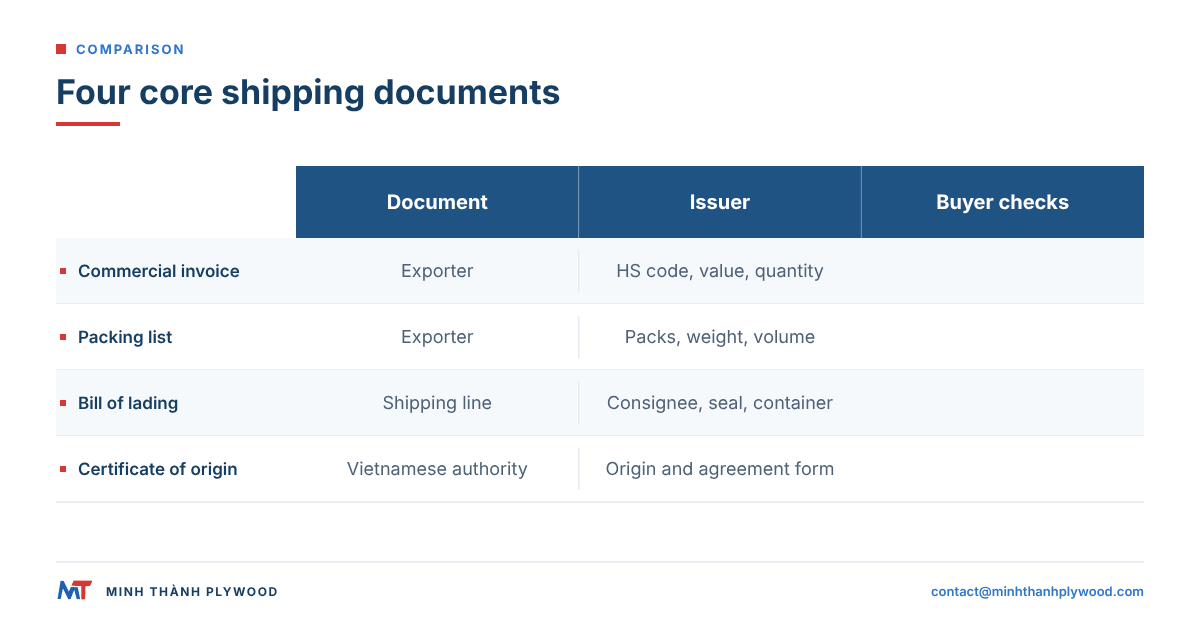
Every plywood shipment from Vietnam travels with four core documents, whatever the destination: the commercial invoice, the packing list, the bill of lading and the certificate of origin. Customs in your country clears the goods on them, and your bank or forwarder works from the same set.
| Document | Who issues it | What it proves | What to check |
|---|---|---|---|
| Commercial invoice | The exporter | What was sold, to whom, at what value and term | Consignee, HS code, quantity in m³ and sheets, Incoterm |
| Packing list | The exporter | What is in each pack and the whole container | Sheets per pack, pack count, net and gross weight, volume |
| Bill of lading (B/L) | The shipping line or its agent | That the goods were loaded, and who may collect them | Consignee, notify party, container and seal number |
| Certificate of origin | A Vietnamese issuing authority | Where the goods were made, for duty | Origin criterion, description, the trade agreement form |
The four must agree with each other line by line. Most customs delays on plywood come from a small mismatch: a different weight on the packing list and the B/L, an HS code that changes between the invoice and the declaration, or a consignee spelled two ways.
What goes on a plywood commercial invoice?
The commercial invoice is the document customs reads first. For plywood it should state, for each order line:
- Product description in plain trade terms: “18 mm furniture plywood, poplar face A/B, Styrax core, UF glue at E0”.
- HS code, agreed in advance with your customs broker (plywood sits under heading 4412).
- Thickness, size and quantity: sheets and cubic metres.
- Unit price and total value, in the currency of the contract.
- Incoterm and port: FOB Hai Phong, CFR or CIF your port.
- Origin: Vietnam.
- Market statements your country needs, for example “TSCA Title VI compliant” for the United States.
For a mixed container, each specification is its own line. That keeps the invoice, the packing list and your stock system in step when the packs arrive.
What should the packing list show?
A good plywood packing list lets your warehouse book in the container without opening every pack. It shows, per specification:
| Column | Example |
|---|---|
| Pack number | 01 to 18 |
| Specification | 18 mm, poplar A/B, Styrax core, 1220 × 2440 mm |
| Sheets per pack | 55 |
| Packs | 18 |
| Volume | about 53 m³ |
| Net and gross weight | panel weight, then weight with packing |
Pack numbers matter more than they seem. They link each pack to its production lot, to the loading photos, and to any question you raise after arrival. Minh Thanh photographs and films every container before loading, so the pack numbers on the list match what you see in the video.
Which bill of lading should you ask for?
The bill of lading is issued by the shipping line once the container is on board. Three forms are common for plywood:
- Original B/L: paper originals sent by courier; the consignee needs one to collect the cargo. Safe, but slow if the courier is late.
- Telex release (surrendered B/L): the originals are surrendered at origin and the line releases the cargo electronically. Fast, used once payment is settled.
- Sea waybill: no original at all; the named consignee collects the cargo. Used between parties with an established relationship.
With Minh Thanh’s standard terms, the 70% balance is paid against the scanned B/L, and the release follows payment. Agree the form on the contract, so nobody waits for paper at the destination port.
Which certificate of origin do you need?
The certificate of origin tells your customs where the plywood was made. Its form depends on the trade agreement your country has with Vietnam:
| Destination | Origin proof usually requested | Why it matters |
|---|---|---|
| European Union | EUR.1 under the EU-Vietnam Free Trade Agreement | Preferential duty rate instead of the standard rate |
| United Kingdom | EUR.1 under the UK-Vietnam Free Trade Agreement | Preferential duty rate |
| Other agreement partners | The form named in that agreement | Preferential rate where the agreement covers plywood |
| Countries without an agreement | A non-preferential certificate of origin | Origin statement for customs and statistics |
The rules for each agreement are published by the European Commission’s Access2Markets portal (checked October 2026). Ask your customs broker which proof your entry needs before the invoice is issued, so the exporter applies for the right form. Minh Thanh supplies the EUR.1 for EU orders as standard.
Does plywood need a phytosanitary certificate or ISPM 15?
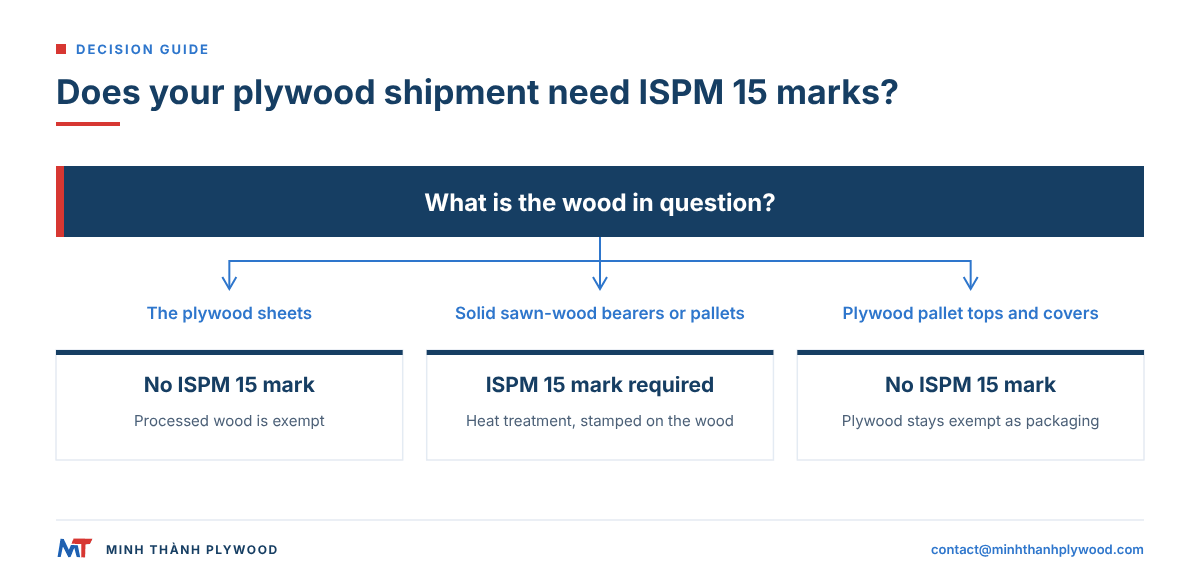
Plywood is a processed wood product: veneers are peeled, dried and pressed with glue at heat. That is why the international standard for wood packaging, ISPM 15, exempts it, and why most countries do not ask for a phytosanitary certificate for the plywood itself.
What does need attention is the packaging under the panels:
- Solid wood pallet bases and bearers must be treated and carry the ISPM 15 mark (heat treatment or fumigation).
- Plywood tops, covers and corner boards are processed wood and need no mark.
- Some destinations still ask for a phytosanitary or fumigation certificate as a national rule; check your port’s rule before shipment.
Minh Thanh’s shipping documents include phytosanitary and fumigation certificates where the destination requires them. Our export packing was tested by SGS in September 2026 under the EU packaging regulation, (EU) 2025/40: lead, cadmium, mercury and hexavalent chromium were not detected in any of the four packaging materials (cardboard, plywood and pallet blocks, strapping band, wrapping film). See PPWR packaging test.
Which documents does a US plywood importer need?
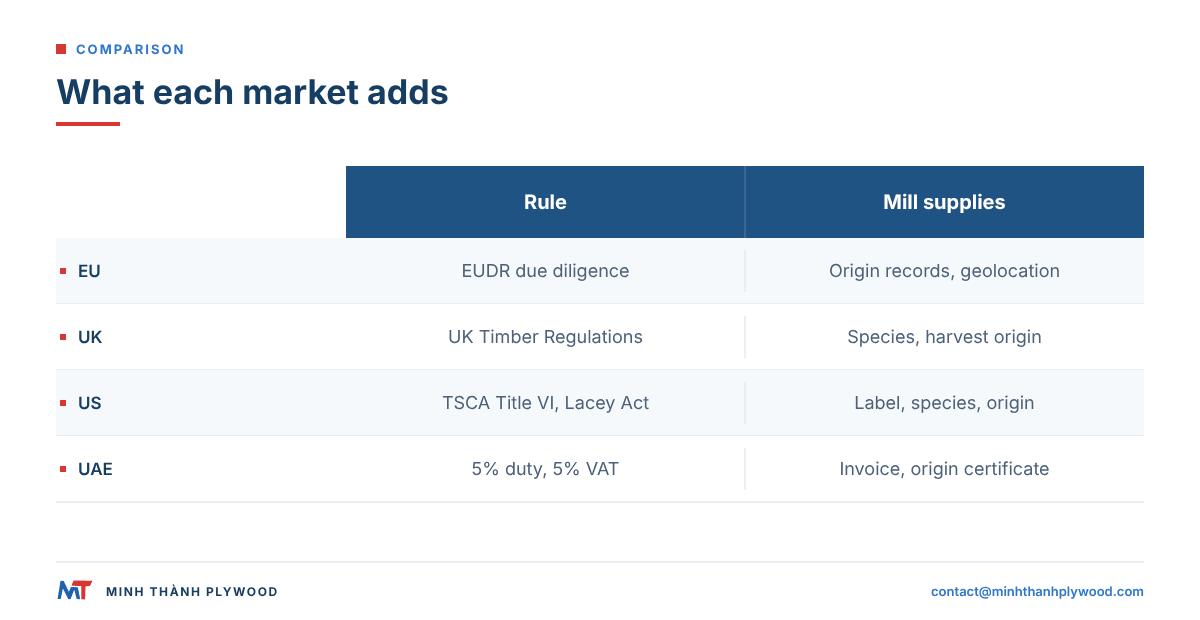
The United States adds three layers on top of the core set:
- TSCA Title VI formaldehyde compliance. Hardwood plywood must come from a certified mill and be labelled. The panels carry a TSCA Title VI label with producer, lot and certifier number, and the commercial invoice and B/L state “TSCA Title VI compliant”. The rule is set out by the US EPA (checked October 2026). Minh Thanh holds CARB P2 / TSCA Title VI certification, ICTT mill no. 23024, and its US labels carry certifier number TPC-43.
- Lacey Act declaration. The importer declares the genus and species of every wood in the panel, face and core, with the country of harvest. Minh Thanh supplies face and core species with Vietnamese harvest origin for the core; imported faces are declared with their own country.
- Importer Security Filing (ISF). The importer, through its broker, files cargo data with US Customs and Border Protection at least 24 hours before the container is loaded on the vessel in Vietnam, as 19 CFR 149.2 requires. CBP’s ISF page describes the 10+2 rule. The broker needs the seller, the manufacturer, the consignee, the HS code and the container stuffing location, so send the booking details and the final packing list to your broker as soon as the loading date is fixed.
The CARB P2 / TSCA Title VI page has the certificate and the chamber test results behind it.
Which documents does an EU importer need?
For the European Union, three files sit beside the core set:
- EUDR origin data. Under the EU Deforestation Regulation, the importer (the “operator”) files a due diligence statement before placing wood products on the market. Minh Thanh supplies the EUDR compliance dossier, origin records and geolocation files, with orders; your statement is built from it. The regulation and its timetable are on the European Commission EUDR page (checked October 2026). See EUDR traceability.
- Emission evidence for furniture and interior uses. European buyers ask for proof that panels meet their emission requirements; our CARB P2 / TSCA Title VI certification and chamber tests are that proof, and SGS testing to your own method, such as EN 717-1, is arranged on request.
- A Declaration of Performance (DoP) only when the plywood is a construction product under EN 13986 and carries CE marking. Furniture and interior plywood does not need one.
Which test reports and certificates come with an order?
Beyond the customs set, Minh Thanh sends the certificate files your market and your customers ask for, on order:
| File | What it covers |
|---|---|
| CARB P2 / TSCA Title VI certificate | ICTT mill no. 23024, veneer-core hardwood plywood, 3–50 mm |
| Chamber test reports (ASTM D6007) | Six tests, April 2025 – June 2026, averaging 0.014–0.032 ppm against the 0.05 ppm limit |
| ISO 9001:2015 certificate | Quality management for plywood manufacturing, KAC25/0185 |
| TCVN 11902:2017 certificate | Veneer-faced plywood, VietCert 141.1-VNC-HC |
| PPWR packaging test (SGS, September 2026) | Heavy metals in the export packaging, PASS against the 100 mg/kg limit |
| EUDR compliance dossier | Origin records and geolocation files |
The chamber reports come from two laboratories, three each: Shanghai Hongjun (HJ-QAT-250597, HJ-QAT-251303, HJ-QAT-261036) and ICTT Vietnam (ICTTVN-QAT-250841, ICTTVN-QAT-251173, ICTTVN-QAT-260272).
What documents are required to import plywood from Vietnam, and when does each arrive?
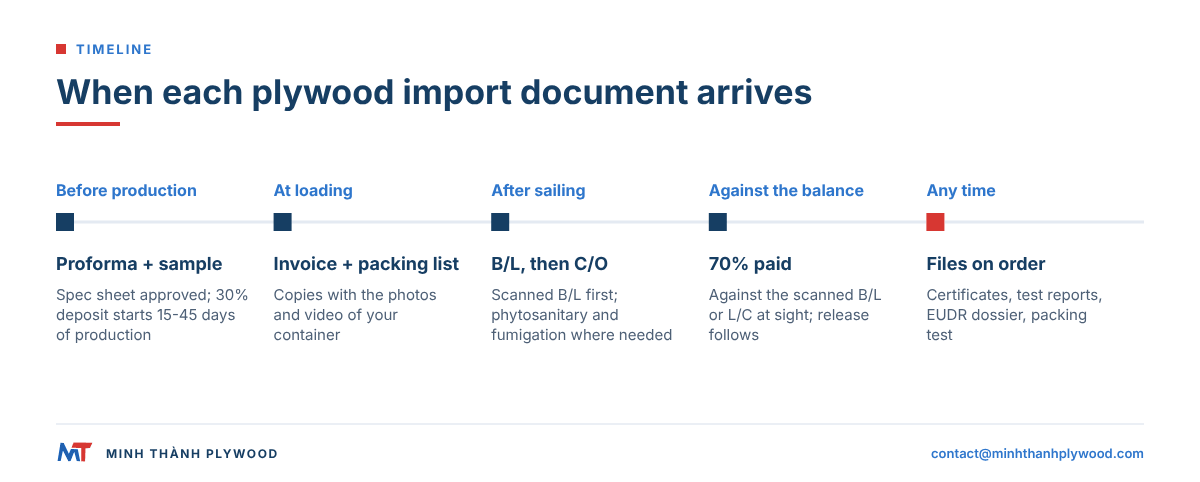
The documents required to import plywood from Vietnam follow the order in a fixed rhythm. Knowing it avoids chasing papers that are not due yet:
- Before production: proforma invoice, specification sheet and approved sample. The 30% deposit starts production, which takes 15–45 days.
- At loading: copies of the commercial invoice and packing list, with the photos and video of your container.
- After sailing: the bill of lading (scanned first), then the certificate of origin and, where needed, phytosanitary and fumigation certificates.
- Against the balance: the 70% balance is paid against the scanned B/L, or by irrevocable L/C at sight; release or originals follow.
- On order, any time: certificate files, test reports, the EUDR dossier and the packing test.
Typical sea transit from Hai Phong is 25–35 days to the Mediterranean, 30–40 days to Northern Europe, 20–30 days to the US West Coast and 35–45 days to the US East Coast, so the full set is in your hands well before the vessel arrives.
What causes plywood shipments to be held at customs?
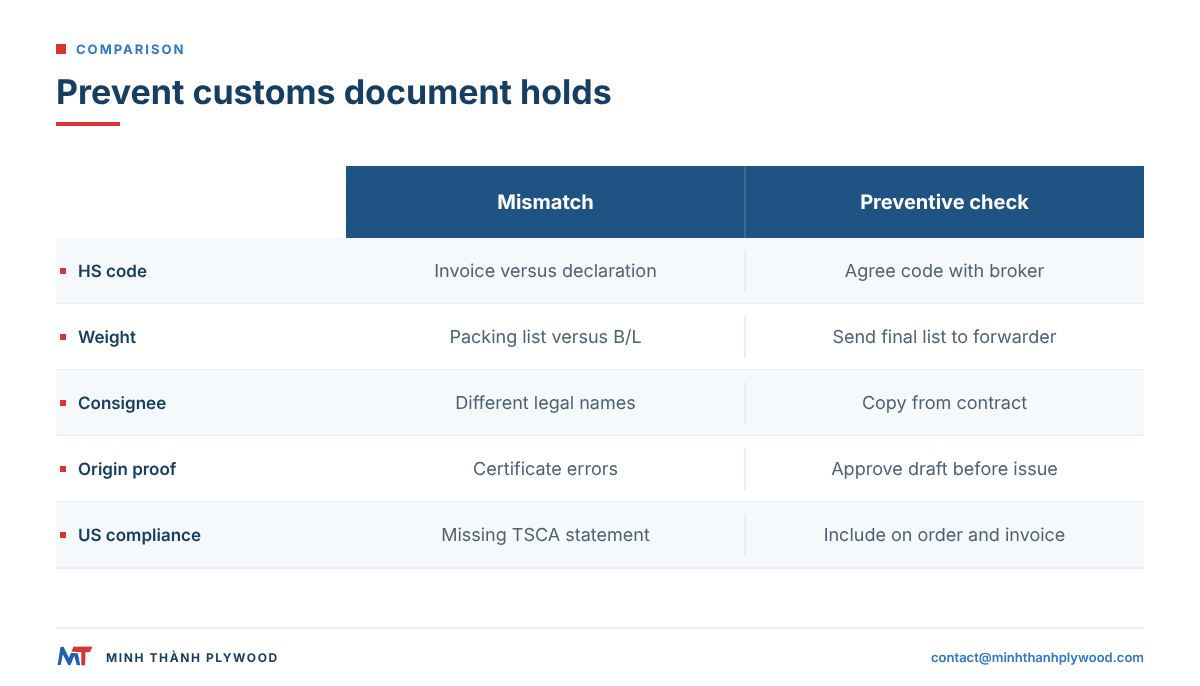
Holds are rarely about the plywood. They are about the paper. The common causes, and how to prevent each:
| Cause | Prevention |
|---|---|
| HS code differs between invoice and declaration | Agree the code with your broker before the invoice |
| Weights differ between packing list and B/L | Send the final packing list to the forwarder before the B/L draft |
| Consignee or notify party spelled differently | Fix the legal names on the contract and copy them |
| Error on the certificate of origin | Check the draft certificate before it is issued |
| Solid wood pallets without ISPM 15 marks | Order marked bearers, or plywood-only packing |
| Lacey species that differ from the panel build | Declare face and core species from the specification sheet |
| Missing TSCA statement on a US invoice | Put the statement on the order so it reaches the invoice |
The fastest fix is a draft check: ask for drafts of the invoice, packing list, B/L and certificate of origin, and approve them before they are final. A draft check takes a day; a held container can cost a week of demurrage and storage at the destination port.
What does a complete set of plywood import documents from Vietnam look like?
A finished set of plywood import documents from Vietnam usually runs to a handful of PDFs for one container. For an EU furniture importer buying one 40HC of 18 mm poplar-faced furniture plywood, CIF Genoa, it would hold:
- commercial invoice and packing list, one line per specification, with pack numbers;
- bill of lading, scanned first, then released against the balance;
- EUR.1 certificate of origin;
- insurance certificate (CIF terms);
- phytosanitary or fumigation certificate where the port requires it;
- the EUDR compliance dossier for your due diligence statement;
- emission certificate and recent chamber test reports;
- loading photos and video of the container.
For a US cabinet maker on CIF Los Angeles terms, the EUR.1 gives way to a standard certificate of origin, and the set adds TSCA Title VI labels on the panels, the compliance statement on invoice and B/L, and the species list for the Lacey declaration.
How do Incoterms change who handles which document?
The delivery term decides who arranges freight and insurance, and so who produces those papers:
| Term | Exporter arranges | Importer arranges | Extra document from the exporter |
|---|---|---|---|
| FOB Hai Phong | Export clearance, loading on board | Sea freight, insurance, import clearance | — |
| CFR your port | Export clearance and sea freight | Insurance, import clearance | Freight-prepaid bill of lading |
| CIF your port | Export clearance, sea freight and insurance | Import clearance | Insurance certificate |
Whichever term you choose, the core four documents come from the exporter. Under FOB your own forwarder issues the bill of lading, so send the final packing list to your forwarder as well, or the weights on the B/L may not match it.
Which documents do other markets add?
Outside the EU and the US, plywood importers meet their own legality and product rules. The pattern is the same: the core set, plus a file that proves where the wood came from or how the product performs.
- Japan: under the Clean Wood Act, importers confirm that the wood was legally harvested; the species and harvest country from the exporter feed that check.
- Australia: under the Illegal Logging Prohibition rules, importers of regulated timber products, plywood included, carry out due diligence and declare it at the border.
- United Kingdom: the UK Timber Regulation asks for legality due diligence, and the EUR.1 under the UK-Vietnam agreement gives the preferential duty rate.
- Gulf and North Africa: construction plywood, film-faced in particular, often needs a conformity certificate to the local standard; the destination articles cover each market.
For every market, the species list, the harvest origin and the origin certificate are the base; Minh Thanh supplies all three.
Who keeps the documents, and for how long?
Customs clearance is not the end of a document’s life. Several rules ask the importer to keep the file and show it on request:
| Record | Kept by | How long |
|---|---|---|
| TSCA Title VI records (certificates, invoices, labels) | Importers, distributors and fabricators in the US | Three years |
| EUDR due diligence information | The EU operator placing the wood on the market | Five years |
| Customs entry and origin proofs | The importer of record | As your customs authority sets it, often several years |
| Lacey Act declaration and supporting species data | The US importer | With the entry records |
The practical rule: keep one folder per container, named by B/L number, with the full set from this article. When a customer, an auditor or customs asks a question months later, the pack numbers on the packing list lead straight to the production lot, the loading photos and the test reports that cover it.
Minh Thanh keeps the same set on its side for every shipment, so a missing page can be re-sent on the same day.
Can scanned documents replace the originals?
For most of the set, yes. Commercial invoice, packing list, test reports, certificate files and the EUDR dossier work as PDFs. Three papers are different:
- The original bill of lading, unless the cargo moves on a telex release or a sea waybill.
- The certificate of origin, where your customs asks for the original stamped EUR.1 or form; many now accept electronic versions, but check before the vessel arrives.
- Documents under a letter of credit, which the bank checks against the L/C terms; they must match the wording of the credit exactly.
Tell us at the order which papers your bank and your customs need as originals, and they go by courier the day they are issued.
What should you send to get the documents right first time?
Most document problems are prevented on the order, not fixed at the port. With your request for quotation, send:
- Consignee and notify party, with legal names and addresses exactly as customs knows them.
- Destination port and Incoterm.
- Market statements you need on the invoice, such as TSCA Title VI.
- Origin proof your broker wants (EUR.1 or another form).
- Packing rules at your port, for example ISPM 15 marked bearers.
- The certificate files your customers ask for.
- Your customs broker’s contact, so the HS code and drafts are agreed early.
Minimum order is one 40HC, with mixed specifications by agreement on one set of documents. Payment terms, lead time and delivery terms are on the trade terms page. Send the list to contact@minhthanhplywood.com with your specification, and the drafts come back for your approval before anything is final.
Buyer questions, answered
What documents are needed to import plywood?
Four travel with every container: commercial invoice, packing list, bill of lading and certificate of origin. Your market then adds its own files, such as emission certificates and labels for the US, EUDR origin data for the EU, and treatment marks on wooden pallets.
What is the HS code for plywood from Vietnam?
Plywood falls under HS heading 4412. The subheading depends on the face and ply species and the thickness; the exporter and the importer's customs broker should agree the exact code before the invoice is issued, so invoice, packing list and declaration match.
Does plywood need a phytosanitary certificate?
Usually not for the plywood itself, which is a processed wood product. Some destinations still ask for one, and solid wood pallets or bearers under the packs need ISPM 15 treatment marks; check the rule for your port before shipment.
Is plywood covered by ISPM 15?
No. ISPM 15 exempts processed wood such as plywood. It applies to solid wood packaging, so pallet bases and bearers made of sawn wood must carry the ISPM 15 mark, while plywood pallet tops and covers do not need it.
Which certificate of origin do I need for the EU or the UK?
For the preferential duty rate under the EU-Vietnam and UK-Vietnam trade agreements, ask for the origin proof those agreements accept, typically an EUR.1 certificate issued in Vietnam. Without valid origin proof the standard duty rate applies.
What extra documents does a US plywood importer need?
TSCA Title VI labels on the panels and a compliance statement on the invoice and bill of lading, the species and harvest country of every veneer for the Lacey Act declaration, and the data for the Importer Security Filing before the container is loaded.
Does Minh Thanh provide the EUDR dossier?
Yes. We supply the EUDR compliance dossier, origin records and geolocation files, with orders. The importer uses it for its own due diligence statement in the EU information system.
When do I receive the shipping documents?
Copies of the commercial invoice and packing list come at loading, together with the photos and video of your container. The bill of lading, certificate of origin and other certificates follow once the vessel sails; the 70% balance is paid against the scanned bill of lading.
What causes customs delays with plywood shipments?
Mismatches: a different HS code, quantity, weight or consignee between invoice, packing list and bill of lading, a typo on the certificate of origin, missing ISPM 15 marks on solid wood pallets, or species on the Lacey declaration that differ from the panel build.
Can one container carry several plywood specifications on one set of documents?
Yes. A mixed container is invoiced line by line, with one packing-list line per specification and the pack numbers of each; one bill of lading and one certificate of origin cover the whole container.
Do I need a Declaration of Performance for plywood?
Only for plywood used in construction works and sold in the EU or UK under EN 13986, where CE or UKCA marking applies. Furniture and interior plywood does not need one.