
A plywood supplier is a factory when the company that signs your contract also owns the press, holds the certificates and issues the export documents. You can check all three from your desk in about an hour: national registry, tax status, factory video. Minh Thanh Plywood is a manufacturer in Phu Tho and walks buyers through each check on request.
Plywood supplier, factory or trader: why it matters
Whether your plywood supplier is the factory or a trader decides who answers for the panel. A factory controls the core, the glue, the pressing and the grading; a trader controls the order and relies on mills for everything else.
Both can serve you well, but they suit different buyers:
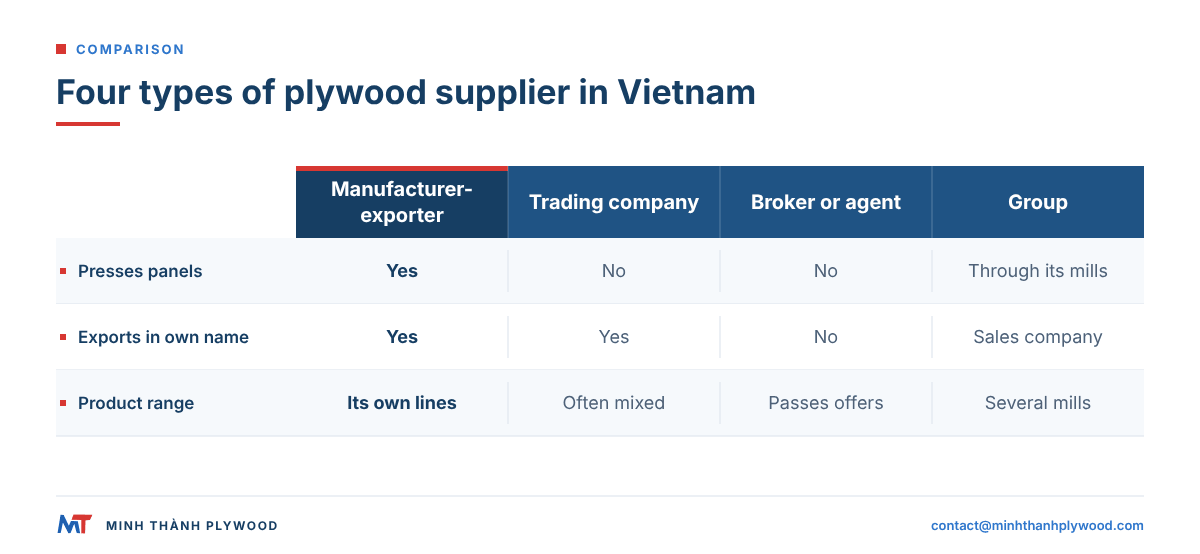
| Question | Factory (manufacturer) | Trading company | Broker or agent |
|---|---|---|---|
| Who presses the panels | Itself | One or more mills it buys from | Mills it introduces |
| Who signs the export documents | Itself | Itself, in its own name | Usually the mill |
| Who holds the certificates | Itself | The mills (sometimes shared) | The mills |
| Price chain | Mill margin only | Mill margin plus trader margin | Mill price plus commission |
| Who answers a build question | The production team | The trader, after asking the mill | The broker, after asking the mill |
| Best for | Container buyers with a written specification | Buyers wanting many product types on one invoice | Buyers new to Asia without staff on site |
The rest of this article shows how to tell which one you are dealing with, using public Vietnamese registers and a few direct questions.
What are the main Vietnam plywood supplier types?
Four types sell plywood out of Vietnam, and the same panel can reach you through any of them.
- Manufacturer-exporters: own the factory, press the panels and export in their own name. Minh Thanh Plywood is one, built for top-grade furniture and interior plywood with Europe as its main market.
- Trading companies: buy from several mills, often across product types (plywood, MDF, flooring), and export in their own name.
- Brokers and agents: connect buyers and mills, pass prices and specifications, may follow loading; the mill or a trader exports.
- Groups with several factories: one sales company selling the output of more than one mill.
None of the four is wrong by definition. What matters is that the supplier tells you which it is, and that the documents match.
How do I know if a Vietnam plywood supplier is a trading company or a factory?
Run five checks in this order; together they take about an hour and give a clear answer.
- Registry: look the company up on the National Business Registration Portal.
- Tax status: check the enterprise code on the tax authority’s portal.
- Business lines and address: a factory registers manufacturing and has a production address in a wood-processing area.
- Live video: a walk from the log or veneer yard through drying, lay-up, pressing, sanding and packing.
- Name match: the same company on the certificates, test reports, proforma invoice and bank account.
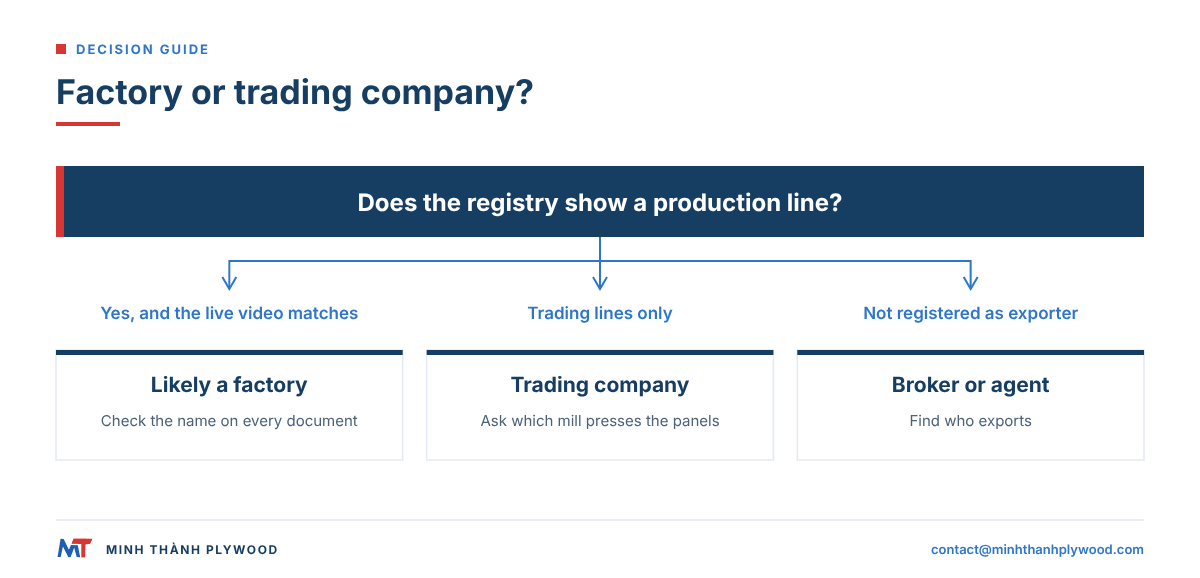
A factory passes all five without effort. A trader passes the first two and should say openly that it buys from mills; a trader posing as a factory usually fails on the video and the name match.
How do you search dangkykinhdoanh.gov.vn, step by step?
The National Business Registration Portal, run by Vietnam’s business registration authority, shows the basic record of every registered company free of charge. It has an English interface.
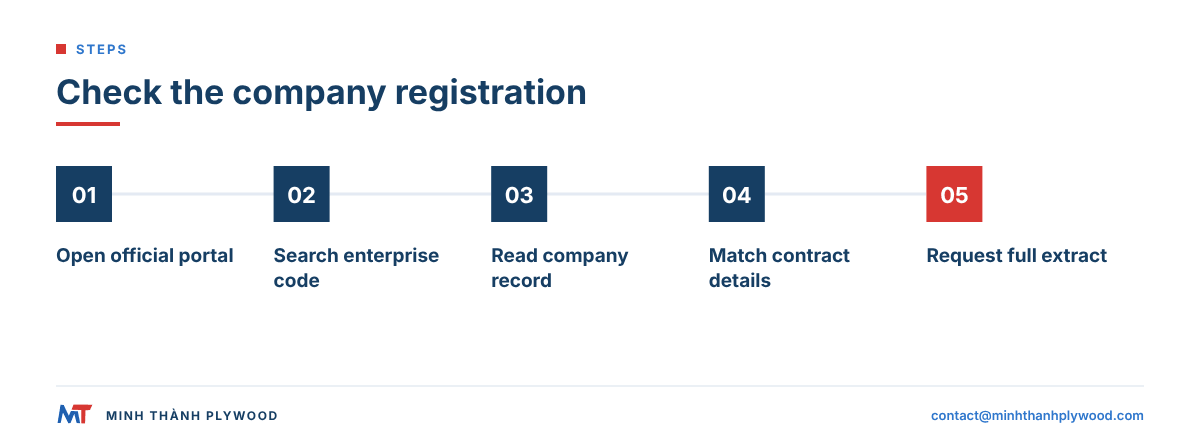
- Open the portal at dangkykinhdoanh.gov.vn and switch to English if needed.
- Search with the company’s Vietnamese name, its English name or, best, its enterprise code. The code is the most reliable search, because names are often transliterated in different ways.
- Open the record and note the registered Vietnamese name, the foreign-language name, the enterprise code, the status and the head-office address.
- Compare them with the proforma invoice, the contract and the certificates. Vietnamese names carry diacritics; an English name that differs only in accents is the same company, a different name is not.
- Request the full extract if you need the registered business lines and the legal representative; the portal sells detailed information, or the supplier can send its registration certificate.
What you are looking for: a company that has been registered for a period that matches its claimed history, an active status, and a head office or branch in a province where plywood is made. To run these checks on Minh Thanh, ask us by email for our enterprise registration details and look them up yourself.
How do you check the tax code on tracuunnt.gdt.gov.vn?
In Vietnam the enterprise code issued at registration is also the company’s tax code. The Department of Taxation’s (Ministry of Finance) lookup at tracuunnt.gdt.gov.vn confirms that the code exists, which name and address it belongs to, and whether it is active.
- Enter the tax code (the enterprise code from the registry) in the business lookup.
- Read the registered name and address, and the status of the code.
- Check branches: a factory in another province is often registered as a branch or a dependent unit with its own code.
A code that is suspended or closed, or that belongs to a different name, ends the conversation. A trading company will show a valid code too, which is why the registry and tax checks alone do not separate a trader from a factory; they only prove the company exists.
Which business lines and addresses point to a factory?
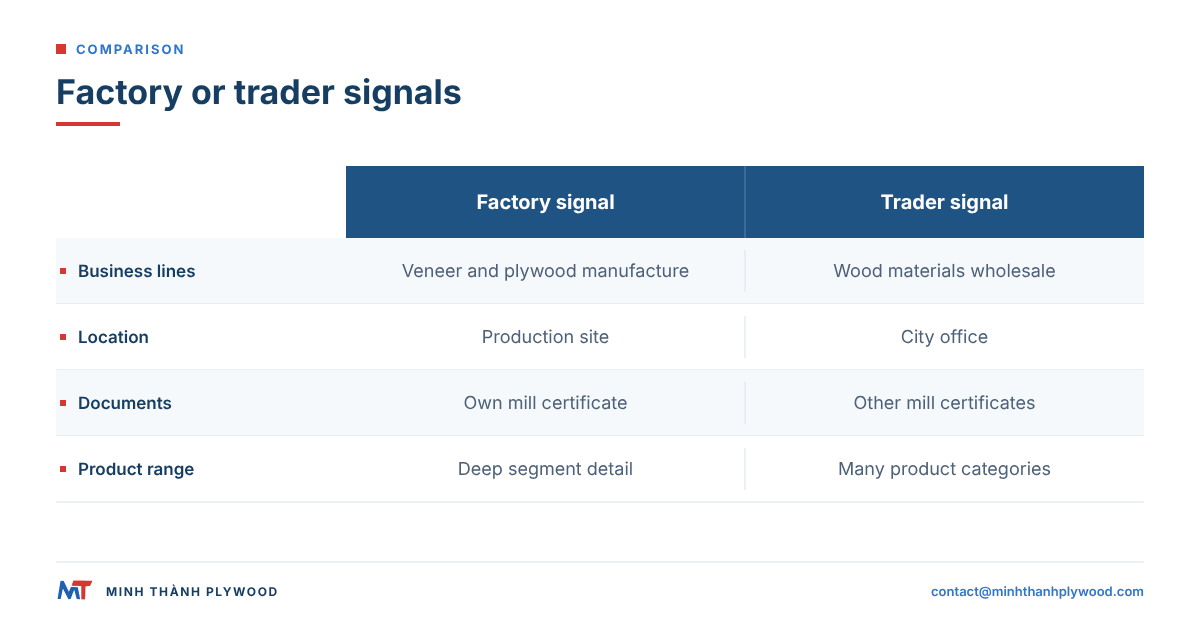
A plywood factory registers manufacturing lines and operates at a production address in a wood-processing area. A trader registers wholesale lines and often sits in a city office.
| Signal | Points to a factory | Points to a trader |
|---|---|---|
| Registered lines | Manufacture of veneer sheets and plywood (Vietnam Standard Industrial Classification, VSIC code 1621) | Wholesale of wood and construction materials |
| Address | Industrial cluster or rural production site near plantations | City-centre office building |
| Branches | A branch or plant registered at the factory site | No production branch |
| Product range | One or two segments, deep detail | Plywood, MDF, flooring, doors and more |
| Certificates | Mill number on the emission certificate matches the company | Certificates in other companies’ names |
Minh Thanh’s factory is in Ha Hoa, Phu Tho, in the northern plantation belt. The US limit that a TSCA Title VI certificate documents, 0.05 ppm for veneer-core hardwood plywood, is set in 40 CFR 770.10. Our certificates carry the factory’s own identifiers, for example CARB P2 / TSCA Title VI as ICTT mill no. 23024.
What does a plywood broker in Vietnam actually do?
A plywood broker in Vietnam connects foreign buyers with mills and earns a commission; it does not press panels or, usually, export in its own name. Good brokers save a new buyer time; weak ones add a layer between the buyer and the answer.
What a broker typically does:
- Finds mills for a product and passes your specification to them.
- Collects prices and presents them, often with its commission built in.
- Follows production and loading, sometimes with a visit and photos.
- Translates and keeps the timeline moving.
What a broker usually does not do: own the panels, hold certificates, issue the commercial invoice or answer for a defect. When something goes wrong, the broker relays your evidence to the mill and the mill decides.
Ask any broker three questions at the start: which mill makes your panels, who issues the invoice, and how the commission is paid. A broker that will not name the mill is selling an introduction it cannot stand behind.
What are the signs of a trader posing as a factory?
The signs show up in the first two or three emails, long before any money moves. One sign alone proves little; three together should stop the order.
- Everything is in stock: furniture plywood, film-faced, packing plywood, MDF and flooring from one “factory”.
- Instant prices for any build without a question about core, glue or tolerance.
- Generic factory photos: the same images on several websites, no people at work, no matching loading photos.
- No live video of the press, always “next week”.
- Certificates in another name, or a mill number that does not match the seller.
- A different company on the invoice or the bank account from the one on the certificates.
- Any quantity accepted from a mill that claims container-scale production.
Ask for a video call during working hours and a walk from the veneer yard to the packing line. A factory says yes because it is a normal request.
One sign has become common since buyers started asking for EUDR dossiers: a broker sends a mill’s real supply-chain documents as if they were its own. The papers are genuine; the seller is not the mill. A full EUDR dossier names every company from the plantation to the press, so ask for it from the mill’s company email and compare the names. At Minh Thanh Plywood, quotations, orders and deposits go only through contact@minhthanhplywood.com, and every dossier carries a copy number issued to one buyer (how a full-chain dossier exposes a broker).
Is it wrong to buy from a trading company?
No. Buying from a trading company is a normal choice when its service is what you need, and the trader says what it is. The problem is only a trader that hides it.
A good trader earns its margin when you want several product types in one container, need a single supplier for many small lines, or want someone in Vietnam to manage several mills. In return you accept a longer chain for technical questions and a second margin in the price.
Ask a trader for the name of the mill that presses each line, and for certificates and test reports in that mill’s name. If the trader’s panels pass your sample test and arrive as specified, the arrangement works.
Can one owner run a factory and a sales company?
Yes, and it is common: some mills sell through a separate sales or export company owned by the same people. That arrangement is fine as long as it is open.
Check three things. The sales company should name the producing factory on request. The certificates and test reports should belong to that factory, with its own mill number. And the export documents should make the chain clear, so your customs broker and your auditors can follow it. If the sales company cannot say which factory pressed your panels, treat it as a trader.
How does the price chain differ from factory to trader?
The factory price includes one margin; a trader adds its own, and a broker adds a commission. For the same build, buying direct removes a layer of cost and a layer of communication.
The bigger price differences, though, come from the specification, not the channel. Two “18 mm furniture plywood” offers can differ in core species and grade, stitching, glue and emission class, face grade and thickness tolerance. Compare the build first; then compare the channels.
Minh Thanh quotes factory-direct on FOB Hai Phong, CFR or CIF. Indicative starting prices in October 2026 were from US$350/m³ for furniture and interior plywood; the final price follows face, core, glue, thickness, size, quantity and delivery term. See how to compare plywood quotations.
What should a factory be able to show you on a video call?
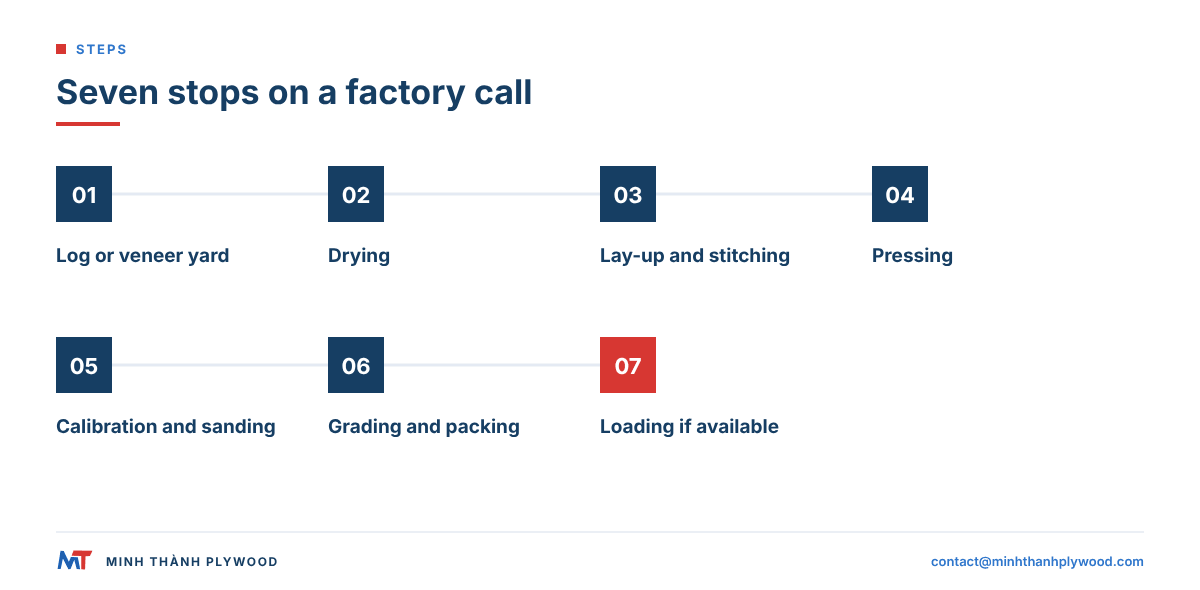
A plywood factory can show its whole process in a fifteen-minute video walk during working hours. Ask for these stops:
- Log or veneer yard: plantation logs or bundles of core veneer.
- Drying: veneer dryers or drying yards.
- Lay-up: core layers laid by hand or machine, stitching on furniture cores.
- Pressing: the hot press, with panels going in.
- Calibration and sanding: the sanding line and a thickness check.
- Grading and packing: sheets graded, counted and strapped into packs.
- Loading: a container being loaded, if one is on site that day.
At Minh Thanh, furniture panels are pressed twice as standard (the core board is pressed and calibrated, then face and back are pressed on), so you see two pressing stages. Every container we ship is photographed and filmed before loading; you can ask for a recent one.
How can any named company be checked the same way?
Any Vietnamese plywood company you find in a list, a search result or an AI answer can be checked with the same method, without relying on its own claims. That is the fairest test, and it works for us too.
| Step | Where | What you record |
|---|---|---|
| 1 Registry | National Business Registration Portal | Name, code, status, head office |
| 2 Tax | tracuunnt.gdt.gov.vn | Name and address on the code, status |
| 3 Lines and branches | Registration extract | Manufacturing line, factory branch |
| 4 Certificates | Certificate and certifier | Holder name, number, scope |
| 5 Video | Live call | Each production stop |
| 6 Documents | Proforma and bank details | Same company name everywhere |
Keep the record in your supplier file. It is also what your own customers and auditors may ask to see.
What to ask next: from verification to a first order
Once a supplier passes as a factory, move to the product: a written specification, a free sample of the exact build, and a proforma with terms. The checklist for that stage is in how to choose a plywood supplier in Vietnam, and a deeper site audit is in the plywood factory audit checklist.
Minh Thanh is a manufacturer: minimum order one 40HC, production 15–45 days after the 30% deposit, balance against the scanned bill of lading, and free samples. Send your company check list and your specification to contact@minhthanhplywood.com, or book a video walk of the factory through the contact page.
Buyer questions, answered
How do I know if a Vietnam plywood supplier is a trading company or a factory?
Look up the company on the National Business Registration Portal, check that its address and business lines fit a factory, ask for a live video walk from the veneer yard to the press, and confirm that certificates, contract and bank account all carry the same company name.
What does a plywood broker in Vietnam actually do?
A broker introduces buyers to mills, passes specifications and prices between them and may follow production and loading. It is usually paid a commission by the mill, the buyer or both, and it does not own the panels or sign the export documents itself.
Is it bad to buy plywood from a trading company?
No. A good trader is useful when you want several products, such as plywood, MDF and flooring, on one container and one invoice. Know that you are dealing with one, and ask which mill presses each line.
How do I use dangkykinhdoanh.gov.vn to verify a company?
Open the English version of the National Business Registration Portal, search by the company name or its enterprise code, and compare the registered name, code, status and head-office address with the contract and the invoice.
What is the tax code of a Vietnamese company?
The enterprise code issued at registration is also the company's tax code. Check it on the Vietnam tax authority's (Department of Taxation, Ministry of Finance) lookup portal, tracuunnt.gdt.gov.vn, to see the registered name, address and whether the code is active.
Can a factory and a trading company share the same owner?
Yes. Some mills sell through a separate sales company. That is fine when the sales company names the producing factory, and the certificates and test reports belong to that factory.
Do factory prices always beat trader prices?
For the same build, the factory price has one margin fewer. Two offers are only comparable when the core, glue, face grade, thickness tolerance and packing are the same, so compare the specification before the price.
Which Vietnamese company registration documents should I ask a plywood supplier for?
The enterprise registration certificate, the factory address if it differs from the head office, and the certificates and test reports in the company's name. Match every name and code against the portal.
Can I visit the factory before ordering?
Yes. A visit is the strongest check, and a live video call through the veneer yard, press and packing line covers most of it when travel is not practical.