
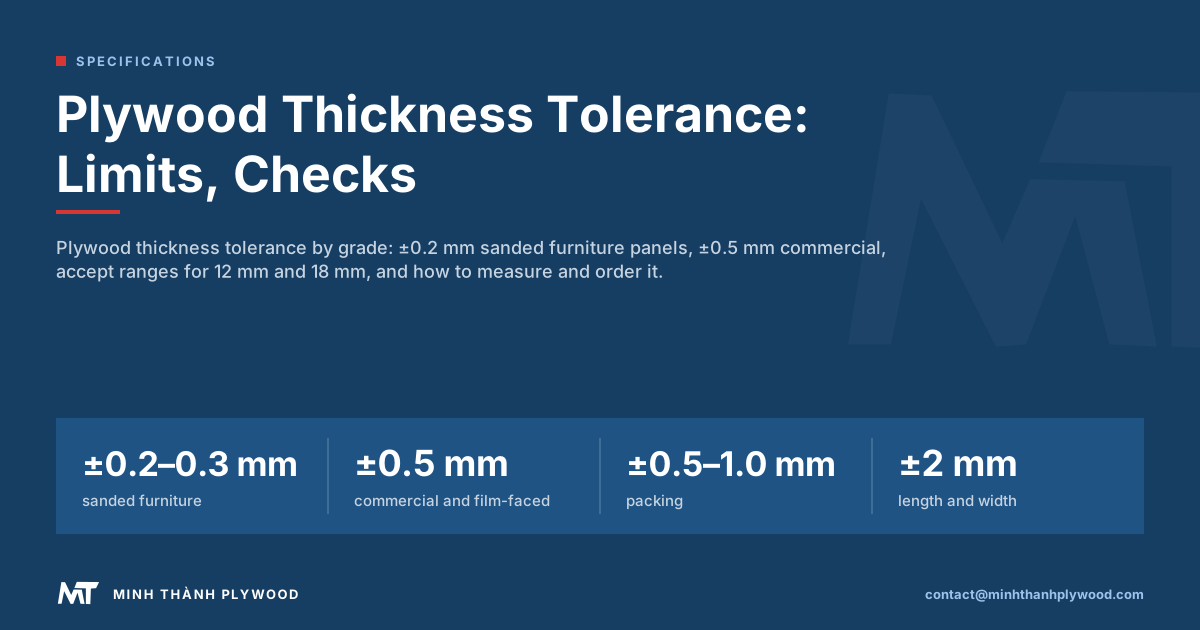
Plywood thickness tolerance is how far a sheet's measured thickness may sit from its nominal size and still conform to the order. Sanded furniture plywood from Minh Thanh Plywood is held to ±0.2–0.3 mm, down to ±0.2 mm; commercial and film-faced panels to ±0.5 mm. This guide gives accept ranges, the causes of variation, a measuring routine and the order wording.
What is plywood thickness tolerance?
Plywood thickness tolerance is the permitted difference between a sheet’s nominal thickness and its measured thickness. An 18 mm panel at ±0.2 mm conforms if every reading lies between 17.8 and 18.2 mm. The figure depends on the grade: sanded furniture panels are held to ±0.2–0.3 mm, commercial panels to ±0.5 mm.
Two numbers describe it fully:
- Tolerance on nominal thickness: how far any reading may sit from the stated size.
- Variation within one sheet: how far the thickest and thinnest points of the same sheet may differ.
A furniture plant feels both. The first decides whether a groove, a hinge cup or a panel joint fits; the second decides whether a sheet lies flat on a CNC bed and takes a laminate without a visible step.
Nominal and actual thickness are often confused. Nominal thickness is the size the panel is sold as, 18 mm, 12 mm or 9 mm. Actual thickness is what a caliper reads on the sheet. A conforming sheet’s actual thickness can be a little above or below the nominal size, never outside the tolerance band. Imperial sizes add a third number: a panel sold as 3/4 inch is often made to 18 mm, so write the metric size and tolerance on the order.
Plywood thickness tolerance by grade
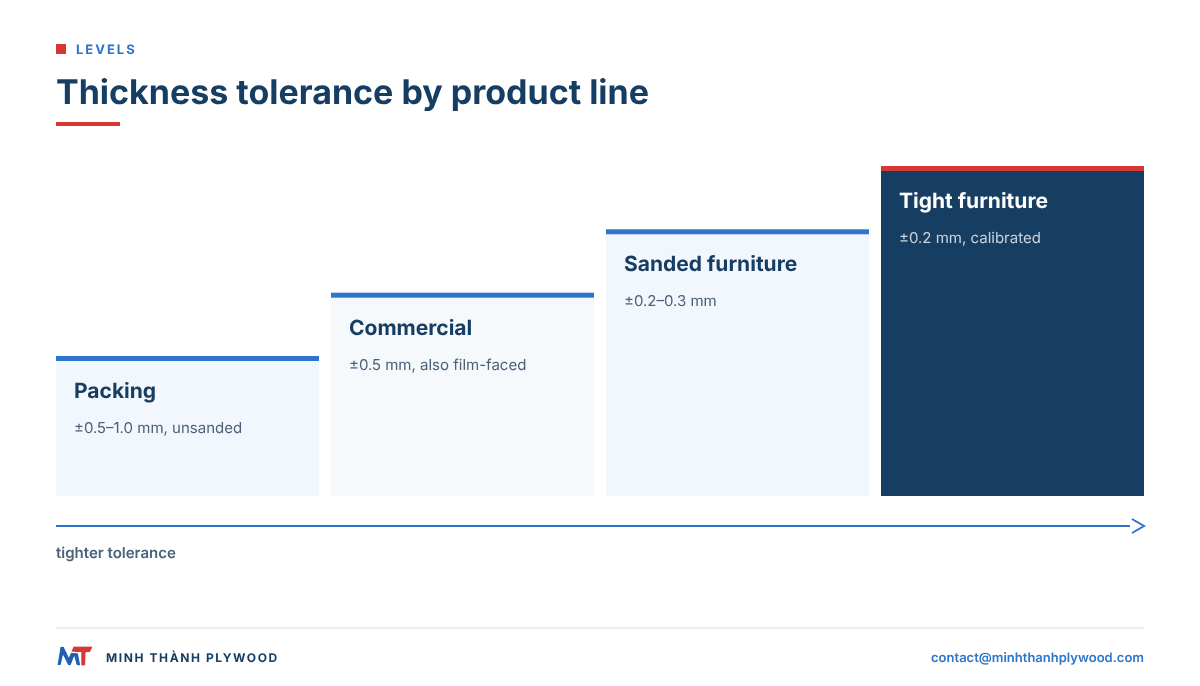
Thickness tolerance follows the product line, because sanding and the build differ. These are Minh Thanh’s tolerances for each line, measured at dispatch.
| Product line | Surface | Thickness tolerance | Length and width |
|---|---|---|---|
| Furniture and interior plywood | Sanded and polished | ±0.2–0.3 mm, down to ±0.2 mm | ±2 mm |
| Commercial plywood | Unsanded or lightly sanded | ±0.5 mm | ±2 mm |
| Film-faced plywood | Film-faced, unsanded | ±0.5 mm | ±2 mm |
| Packing plywood | Unsanded | ±0.5–1.0 mm | ±2 mm |
The table is also the plywood dimensional tolerance most buyers need: thickness by grade, length and width at ±2 mm. Always write the tolerance next to the product line, because “±0.5 mm” is a good figure for formwork and a poor one for cabinet doors.
12 mm plywood thickness tolerance in Vietnam
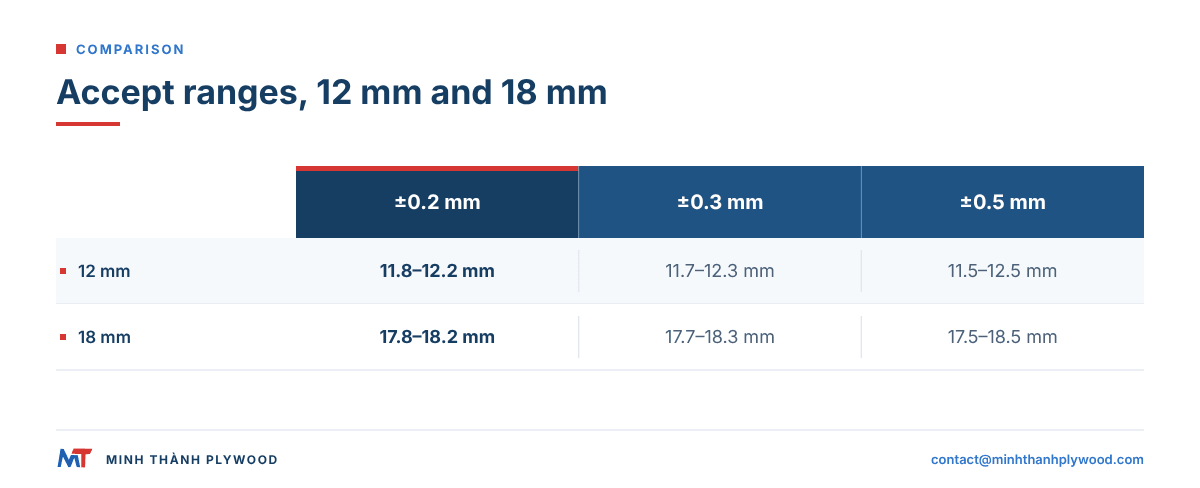
A 12 mm sanded furniture panel from Vietnam is held to ±0.2–0.3 mm, which means every reading between 11.8 and 12.2 mm at ±0.2 mm, or 11.7 and 12.3 mm at ±0.3 mm. Commercial 12 mm panels at ±0.5 mm read 11.5–12.5 mm.
| 12 mm panel | Tolerance | Accept range |
|---|---|---|
| Sanded furniture, tight | ±0.2 mm | 11.8–12.2 mm |
| Sanded furniture | ±0.3 mm | 11.7–12.3 mm |
| Commercial or film-faced | ±0.5 mm | 11.5–12.5 mm |
Thin and mid-thickness panels show tolerance most, because the same 0.3 mm is a larger share of the panel. A 12 mm drawer side at the top of its band and its neighbour at the bottom differ by 0.6 mm, enough to show at a mitred corner. For drawer boxes, back panels in grooves and shelves in housings, order ±0.2 mm. 12 mm plywood covers grades, plies and sizes.
18 mm plywood thickness tolerance in Vietnam
An 18 mm sanded furniture panel from Vietnam reads 17.8–18.2 mm at ±0.2 mm and 17.7–18.3 mm at ±0.3 mm. At the commercial ±0.5 mm, the range is 17.5–18.5 mm.
| 18 mm panel | Tolerance | Accept range |
|---|---|---|
| Sanded furniture, tight | ±0.2 mm | 17.8–18.2 mm |
| Sanded furniture | ±0.3 mm | 17.7–18.3 mm |
| Commercial or film-faced | ±0.5 mm | 17.5–18.5 mm |
18 mm is the cabinet carcass thickness, and its tolerance shows in two places: the depth of dados and rebates cut by CNC, and edge banding. An edge band sized for 18 mm on a 18.5 mm panel leaves a lip to trim; on 17.5 mm it leaves the core exposed. 18 mm plywood covers plies, cores and weight.
4x8 plywood thickness tolerance from Vietnam
4x8 plywood from Vietnam is the 1220 × 2440 mm sheet, and its thickness tolerance is the same as for any size of the same line: ±0.2–0.3 mm on sanded furniture panels, ±0.5 mm on commercial panels. Length and width are held to ±2 mm.
The sheet size changes one thing: a larger sheet has more area over which thickness can drift. That is why the measuring points below cover the corners, the edge midpoints and the centre, not one spot near the edge. The 1250 × 2500 mm size and custom sizes such as 1220 × 2500 mm and 1220 × 2280 mm carry the same tolerances.
What does EN 315 say about plywood thickness tolerance?
EN 315:2000, Plywood. Tolerances for dimensions, is the European standard for the dimensional tolerances of plywood: length, width, thickness, squareness and edge straightness. It sets thickness limits that grow with the panel’s thickness and gives separate limits for unsanded and sanded panels.
EN 315 also says what buyers find in practice: some uses need narrower tolerances, and those are set in product standards or in the contract. Its limits cover plywood from utility to furniture grade, so a furniture plant usually needs a tighter figure than the standard allows.
EN 315 limits in numbers
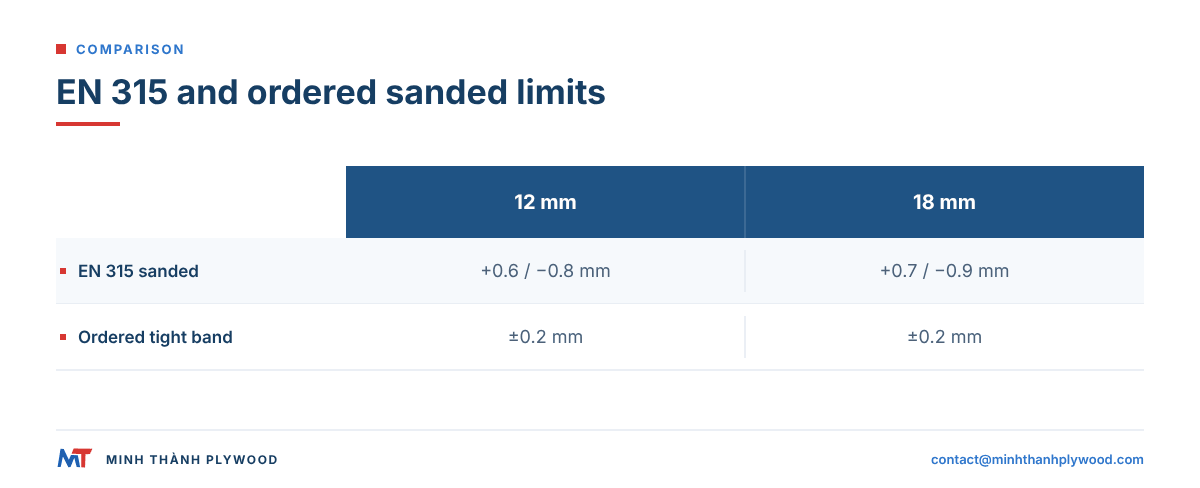
EN 315 sets the tolerance on nominal thickness by formula: for sanded panels +(0.2 + 0.03t) and −(0.4 + 0.03t) mm, for unsanded panels +(0.8 + 0.03t) and −(0.4 + 0.03t) mm, where t is the nominal thickness; a separate column limits thickness variation within one sheet. Worked out, with Minh Thanh’s sanded furniture band beside them:
| Nominal thickness | EN 315 sanded (mm) | EN 315 unsanded (mm) | Minh Thanh sanded furniture (mm) |
|---|---|---|---|
| 6 | +0.4 / −0.6 | +1.0 / −0.6 | ±0.2–0.3 |
| 9 | +0.5 / −0.7 | +1.1 / −0.7 | ±0.2–0.3 |
| 12 | +0.6 / −0.8 | +1.2 / −0.8 | ±0.2–0.3 |
| 18 | +0.7 / −0.9 | +1.3 / −0.9 | ±0.2–0.3 |
| 24 | +0.9 / −1.1 | +1.5 / −1.1 | ±0.2–0.3 |
The sanded window of EN 315 at 18 mm is 1.6 mm wide, from 17.1 to 18.7 mm; a Minh Thanh panel at ±0.2 mm sits in a 0.4 mm window, four times narrower. At 12 mm the standard allows a 1.4 mm window against 0.4 mm, about three and a half times. Figures are taken from published EN 315 tables (checked 21 October 2026) and rounded to 0.1 mm; read the clause of the edition you buy against before you cite them in a contract.
Two other standards set the same kind of limits for the other readers of this page. ISO 1954:2013 (ISO catalogue entry) holds length and width to ±1.5 mm per metre with a maximum of ±3.5 mm, edge straightness to 1 mm per metre and squareness to 1 mm per metre, at a reference moisture content of 10 ± 2 %, measured to ISO 9426 with moisture to ISO 16979.
For the United States, NIST lists PS 1-22. It allows ±1/64 in (0.4 mm) on sanded panels up to 3/4 in and ±1/32 in (0.8 mm) on unsanded, touch-sanded and overlaid panels up to 13/16 in. On a 2,440 mm sheet ISO 1954 allows ±3.5 mm (the per-metre figure, capped), so Minh Thanh’s ±2 mm on length and width is tighter than the standard.
The practical rule for an order:
- Write the number, for example ±0.2 mm, sanded.
- Add the standard only as a method reference, for example “measured in accordance with EN 315”.
- Never write the standard alone. “EN 315 compliant” leaves the sanded or unsanded limit, and the actual figure, open to reading.
The current edition is listed by the national standards bodies of CEN members, for example the Irish standards shop (checked 20 October 2026). The British Standards Institution lists the same title as BS EN 315:2000.
Why does plywood thickness vary?
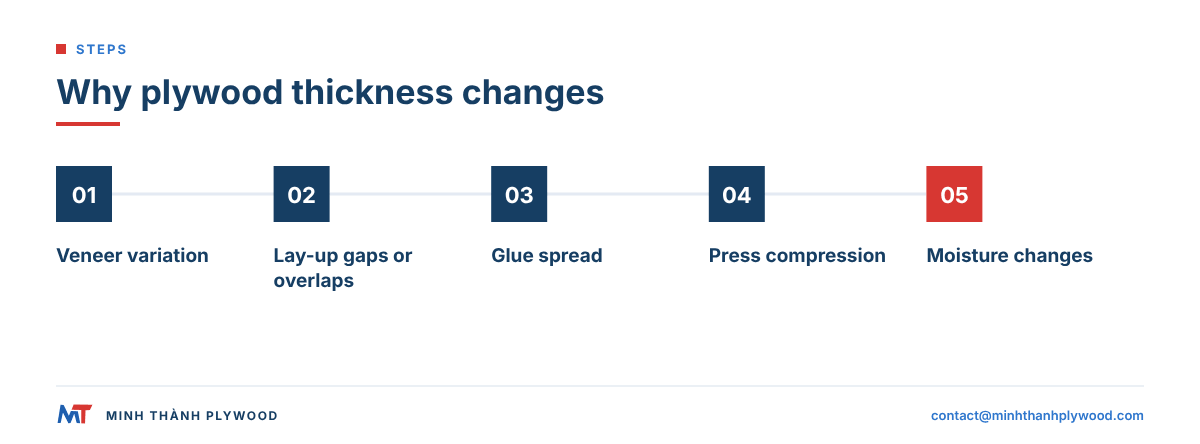
Plywood thickness varies because each of its veneers varies a little, and the press, the glue and the moisture add their own spread. Face veneers are usually 0.2–0.5 mm (0.3 mm is common for Europe) and core veneers 1.4–2.0 mm, and an 18 mm panel usually has 11–13 plies, so small differences add up.
The main sources, in the order a panel meets them:
- Veneer thickness. Rotary-peeled core veneer is never perfectly even; grading sorts out the thick and thin sheets.
- Lay-up. Overlaps and gaps between core veneers create local thick or thin spots; stitching keeps them closed.
- Glue spread. Uneven glue lines change the pressed thickness.
- Press pressure and temperature. The press compresses the stack; uneven pressure leaves uneven panels.
- Moisture. Panels gain or lose thickness as their moisture changes after pressing.
Grading, stitching and controlled pressing narrow the spread; calibrating the core and sanding the face remove what is left.
How double pressing and sanding reach ±0.2 mm
Minh Thanh reaches ±0.2 mm on furniture panels by pressing them twice: the core board is pressed and calibrated first, then the face and back are pressed on and the panel is sanded. Each step corrects the one before.
- Core board pressed. The cross-banded core veneers are glued and pressed into one board.
- Core calibrated. The core board is sanded to an even thickness, so the faces go onto a level base.
- Faces pressed on. Face and back veneers are pressed onto the calibrated core.
- Panel sanded and polished. Both faces are sanded to the final thickness.
- Measured. Thickness is checked against the order tolerance before packing.
A single-press panel carries all its core variation into the finished sheet, and sanding it flat would cut through thin faces in places. Calibrating the core first lets the final sanding stay light. Calibrated plywood explains the process step by step.
Why thickness tolerance matters in furniture, cabinets and CNC
Thickness tolerance decides whether parts fit without rework. On a furniture line, a panel out of tolerance costs time at every joint.
| Operation | What goes wrong out of tolerance |
|---|---|
| CNC grooves and dados | Shelves loose in thin panels, forced in thick ones |
| Hinge cups and drilled fittings | Depth changes, fittings sit proud or break through |
| Edge banding | Lips to trim on thick panels, exposed core on thin ones |
| Lamination and HPL pressing | Thin spots show as dips under a glossy film |
| Flat-pack assembly | Cam-lock and dowel joints misalign |
| UV coating lines | Rollers miss low spots, coating thickness varies |
This is why sanded furniture panels carry ±0.2–0.3 mm and construction panels ±0.5 mm: a formwork panel is covered and reused, while a cabinet door is machined, edged and finished.
How to measure plywood thickness at loading or on arrival
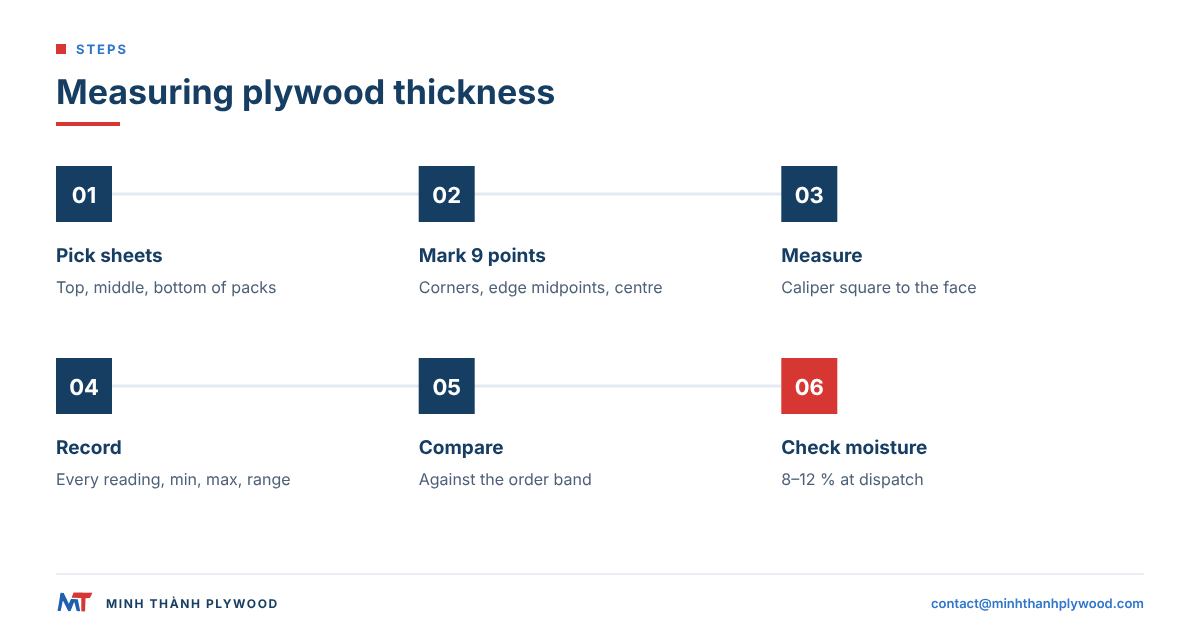
Measure thickness with a digital caliper or micrometer at several points on each sample sheet, away from the cut edges, and record every reading. A sheet conforms only when every reading is inside the agreed band.
- Choose sample sheets from different packs and from the top, middle and bottom of each pack.
- Mark the points: the four corners and four edge midpoints, set back from the edge, plus the centre.
- Measure each point with the tool square to the face, without pressing into the veneer.
- Record each reading with the sheet and pack number, then the minimum, maximum and range per sheet.
- Compare with the order: every reading inside the tolerance band, and the range inside any within-sheet limit.
- Photograph the tool on the sheet for any reading outside the band.
- Check moisture on the same sheets; a wet sheet reads thick.
Agree the routine and the sample size with the mill before production, so both sides measure the same way. Every Minh Thanh shipment is photographed and filmed before loading, and buyers receive the photos and video.
Thickness variation within one sheet and flatness
Variation within one sheet is the difference between its thickest and thinnest readings, and it matters as much as the tolerance on nominal size. A sheet that reads 18.2 mm at one corner and 17.8 mm at the centre is inside ±0.2 mm, but it has a 0.4 mm step across its face.
Within-sheet variation comes from core gaps, overlaps and uneven pressing, the same causes as variation between sheets. A calibrated core reduces it at source. For lamination, high-gloss lacquer and CNC nesting, ask the mill for a within-sheet limit as well as the nominal tolerance.
Flatness is a separate property: a sheet can have an even thickness and still bow. Balanced construction, dispatch moisture of 8–12 % and flat storage keep panels flat. Plywood warping and flatness covers storage and handling.
How moisture changes plywood thickness after dispatch
Plywood takes up and releases moisture with the air around it, and its thickness follows. Minh Thanh dries veneers and finished panels to 8–12 % moisture at dispatch, the normal range for furniture plywood, and measures tolerance at that state.
A panel stored in a damp warehouse can read thicker on arrival than it did at loading, and a panel moved into a heated, dry plant can read thinner a few weeks later. Measure thickness and moisture together. If the moisture is in range and the thickness is still out, the panel is out of tolerance; if the moisture is high, condition the panel before you judge it.
Thickness tolerance and face veneer: the sand-through limit
Sanding brings a panel into tolerance, but a face veneer of 0.2–0.5 mm leaves little to sand. A mill that tries to sand an uneven, single-pressed panel down to ±0.2 mm can cut through the face where the core is thick, which shows as a patch of core colour on the surface.
This is why the tight figure belongs to panels whose core was calibrated before the faces went on. On those panels the final sanding removes only a thin, even layer, and the face keeps its full grade. When you check a panel for thickness, check the face too, under a raking light:
- Sand-through: patches where the face is gone and the core shows.
- Sanding marks: lines across the face from a worn or uneven belt.
- Thin spots at the edges: a sign the panel was sanded harder at one side.
A panel inside the thickness band with sand-through is still a face-grade defect, and it is judged against the approved sample.
What to write in your purchase order
Write the tolerance as a number for each item, with the surface and the measuring method. A complete order line reads:
18 mm × 1220 × 2440 mm, sanded both faces, thickness tolerance ±0.2 mm, length and width ±2 mm, moisture 8–12 % at dispatch, measured at nine points per sample sheet.
Rules that prevent disputes:
- One tolerance per item. A mixed container of 12 mm sanded and 18 mm film-faced panels needs two figures.
- Sanded or unsanded on every line. The surface sets the achievable tolerance.
- Name the measuring routine. Points per sheet, sheets per pack, tool.
- Approve a sample. Measure it and keep the readings with the order.
Minh Thanh sends free samples, so you can measure a panel before you place the order.
Custom thickness and custom tolerance from Vietnam
Custom plywood tolerance from Vietnam is ordered the same way as a standard one: state the figure per item and approve a sample. Minh Thanh makes panels from 3 to 40 mm, in 1220 × 2440 mm, 1250 × 2500 mm and custom sizes, with sanded furniture panels held down to ±0.2 mm.
A non-standard thickness, for example a panel to match an existing furniture system, is built from the same graded veneers, with the core veneer thickness chosen to reach the size. Thin panels of 3–5 mm are always 5-ply. Send the thickness, tolerance, face, core and quantity to contact@minhthanhplywood.com or WhatsApp +84 988 586 601 for a quotation; replies come within hours.
Buyer questions, answered
What is the standard thickness tolerance for plywood?
There is no single figure. Sanded furniture plywood is commonly held to about ±0.2–0.3 mm, commercial and film-faced panels to about ±0.5 mm and packing plywood to ±0.5–1.0 mm. Write the number on the order rather than relying on a standard's name.
What thickness tolerance should I expect from Vietnamese furniture plywood?
From a mill that presses twice and sands, ±0.2–0.3 mm on sanded furniture panels. Minh Thanh holds furniture panels down to ±0.2 mm, commercial and film-faced panels to ±0.5 mm and length and width to ±2 mm.
What is nominal vs actual plywood thickness?
Nominal thickness is the size the panel is sold as, for example 18 mm. Actual thickness is what a caliper reads. A sheet conforms when every reading falls inside the nominal size plus or minus the agreed tolerance.
What is the tolerance on 18 mm plywood?
On a sanded furniture panel at ±0.2 mm, an 18 mm sheet must read between 17.8 and 18.2 mm. At ±0.5 mm, the commercial figure, the range is 17.5–18.5 mm.
What is the tolerance on 12 mm plywood?
At ±0.2 mm, a 12 mm sheet must read 11.8–12.2 mm; at ±0.3 mm, 11.7–12.3 mm; at ±0.5 mm, 11.5–12.5 mm.
Does EN 315 set plywood thickness tolerance?
Yes. EN 315:2000 is the European standard for plywood dimensional tolerances: thickness, length, width, squareness and edge straightness. Its thickness limits widen with panel thickness and differ for sanded and unsanded panels, so buyers needing tighter panels write a number.
How do I measure plywood thickness?
Use a digital caliper or micrometer, measure each sample sheet at several points away from the edges, including corners, edge midpoints and the centre, and record every reading. One reading outside the agreed band means the sheet is out of tolerance.
Why does plywood thickness vary?
Veneer thickness varies from sheet to sheet, glue spread and press pressure add their own variation, and moisture changes the panel after pressing. Calibrating the core and sanding the finished panel remove most of it.
Does tighter tolerance cost more?
Yes. Grading veneer, pressing the core twice and calibrated sanding take time and remove material. Pay for ±0.2 mm on furniture, CNC and lamination parts; ±0.5 mm is enough for formwork and crates.
Can I order a custom thickness tolerance?
Yes. State the tolerance per item, sanded or unsanded, and approve a sample. Minh Thanh makes 3–40 mm panels, sanded furniture panels down to ±0.2 mm.