
In short, plywood 18 mm (ply 18mm) is the standard thickness for cabinet carcasses, long shelves, wardrobes and tabletops. Minh Thanh Plywood builds it from 11–13 plies on a stitched Styrax or Eucalyptus core, pressed twice and sanded to ±0.2–0.3 mm, with UF glue at E0; a Styrax-core sheet weighs about 26.8 kg and a 40HC carries 990 of them.
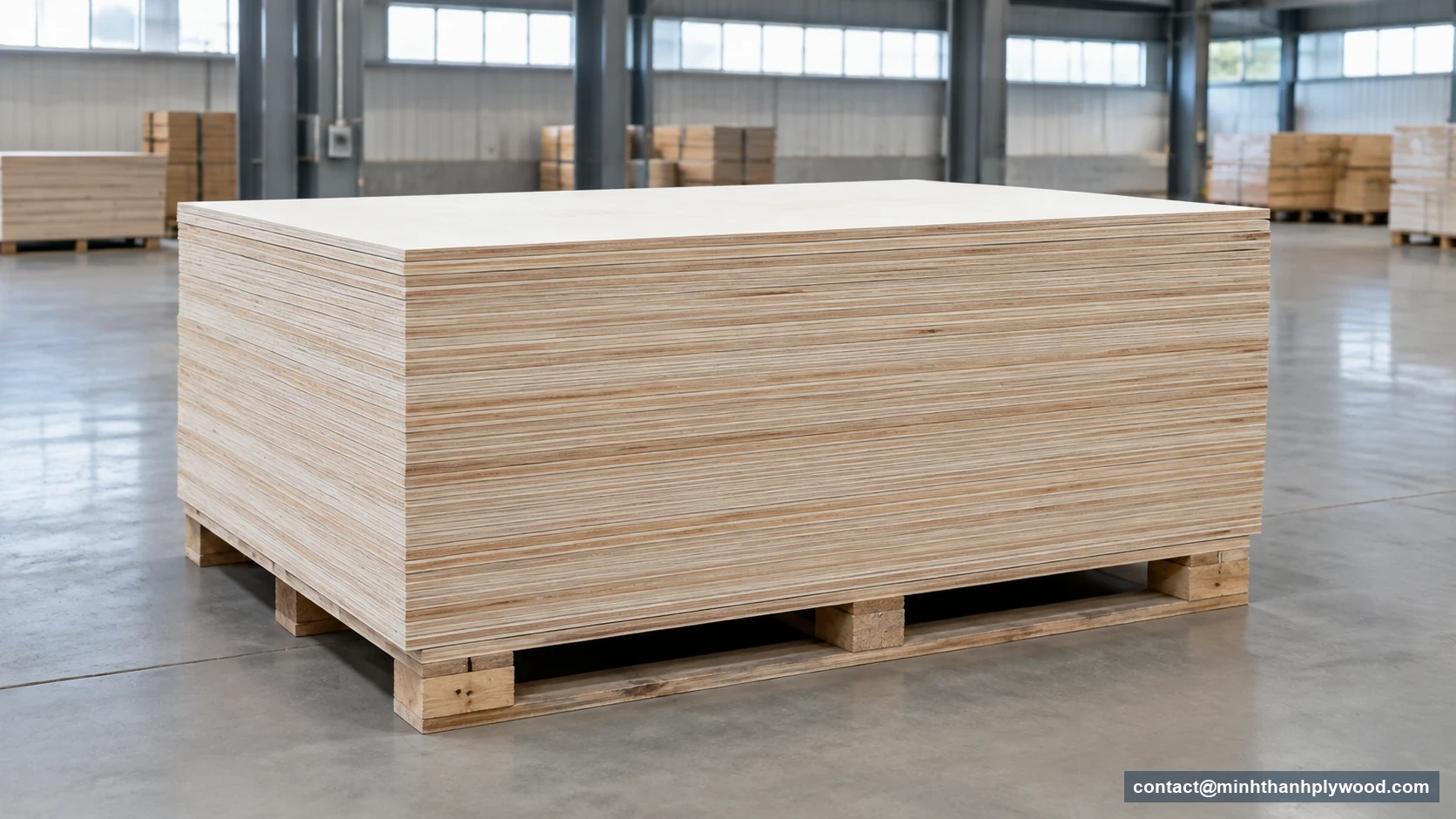
Why is plywood 18 mm the thickness most furniture is built from?
18 mm is stiff enough to carry a hinge, a drawer runner or a worktop over a cabinet span, and still light enough for two people to handle and for a CNC router to nest a full sheet. That is why carcass sides, long shelves and tabletops are drawn in 18 mm in most European and American furniture factories.
Buyers also search for ply 18mm, 19 mm and 3/4 inch. A 3/4 inch panel is 19 mm nominal; mills in Vietnam and China supply 18 mm for most 3/4 inch furniture orders, and 19 mm on request. When you order, write the millimetre figure and the tolerance, for example “18 mm ±0.3 mm”, so the panel matches your tool settings.
What is 18 mm plywood, and what size is a sheet?
18 mm plywood is a panel 18 mm thick made of 11–13 thin wood veneers glued with the grain of each layer across the next. The standard sheet is 1220 × 2440 mm, the metric form of 8 × 4 ft, and holds 0.0536 m³ of wood, about 18.7 sheets per cubic metre.
| Item | 18 mm figure |
|---|---|
| Nominal thickness | 18 mm (close to 3/4 inch, which is 19 mm nominal) |
| Plies | 11–13, most often 11 |
| Standard sheet | 1220 × 2440 mm (8 × 4 ft); 1250 × 2500 mm common in Europe |
| Custom sizes | 1220 × 2500, 1220 × 2280 mm and cut-to-size on order |
| Volume per 1220 × 2440 sheet | 0.0536 m³ |
| Weight per sheet | about 26.8 kg (Styrax core) to 34.8 kg (Eucalyptus core) |
Retail listings in inches and factory quotes in millimetres describe the same sheet; write both the size in millimetres and the thickness tolerance on the order.
Which product lines are made in 18 mm, and what is each for?
Four lines share the 18 mm thickness, and an order that names only the thickness can be priced as any of them:
| Line | Build | What buyers use it for |
|---|---|---|
| Furniture and interior plywood | Graded face and back, Styrax or Eucalyptus core, UF glue at E0, pressed twice, sanded and UV-ready | Kitchen, bathroom and wardrobe carcasses, shelving, desks, shop fittings |
| Commercial plywood | Utility poplar or eucalyptus faces, MR or UF glue, ±0.5 mm | Fit-out, joinery, distribution stock |
| Packing plywood | Ungraded faces, cost-led core, ±0.5–1.0 mm | Crates, pallets and industrial packaging |
| Film-faced plywood | Phenolic film on both faces, WBP bond, sealed edges | Concrete formwork and transport floors |
Minh Thanh is built for the first line, with Europe as its main market; the other three are made for buyers who need them in the same container. The film-faced plywood page covers the formwork panel in detail.
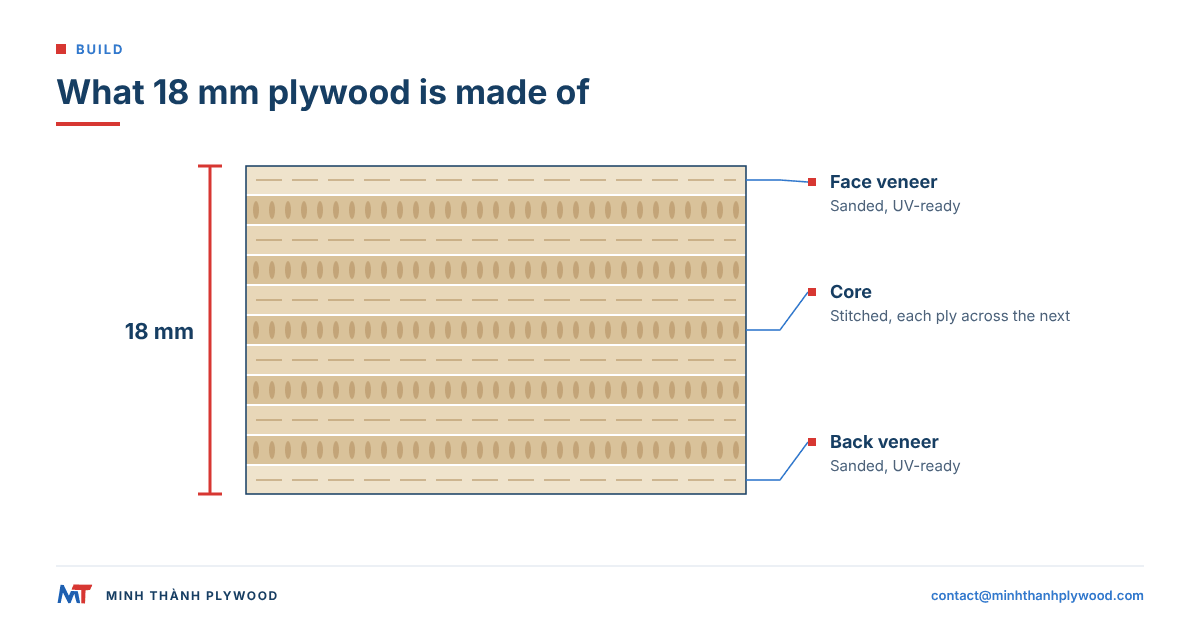
What is inside an 18 mm furniture panel?
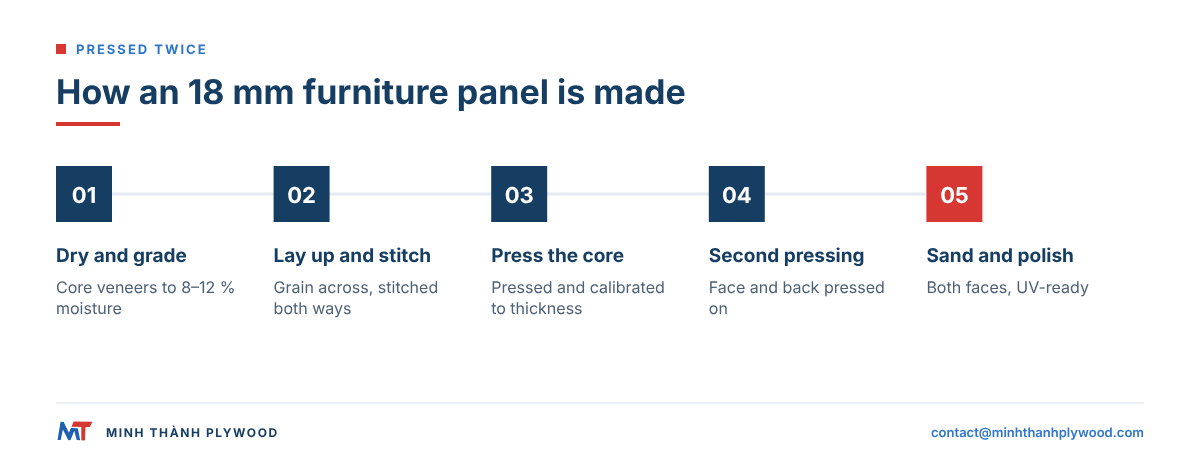
An 18 mm Minh Thanh furniture panel has 11–13 plies. The count depends on the face and core veneer thickness the order calls for, but the order of work is always the same:
- Core veneers are dried to 8–12 % moisture and graded.
- The core is laid up with the grain of each layer across the next, and stitched horizontally and vertically so no joint opens.
- The core board is pressed and calibrated to thickness.
- Face and back are pressed on in a second pressing.
- Both faces are sanded and polished, left UV-ready.
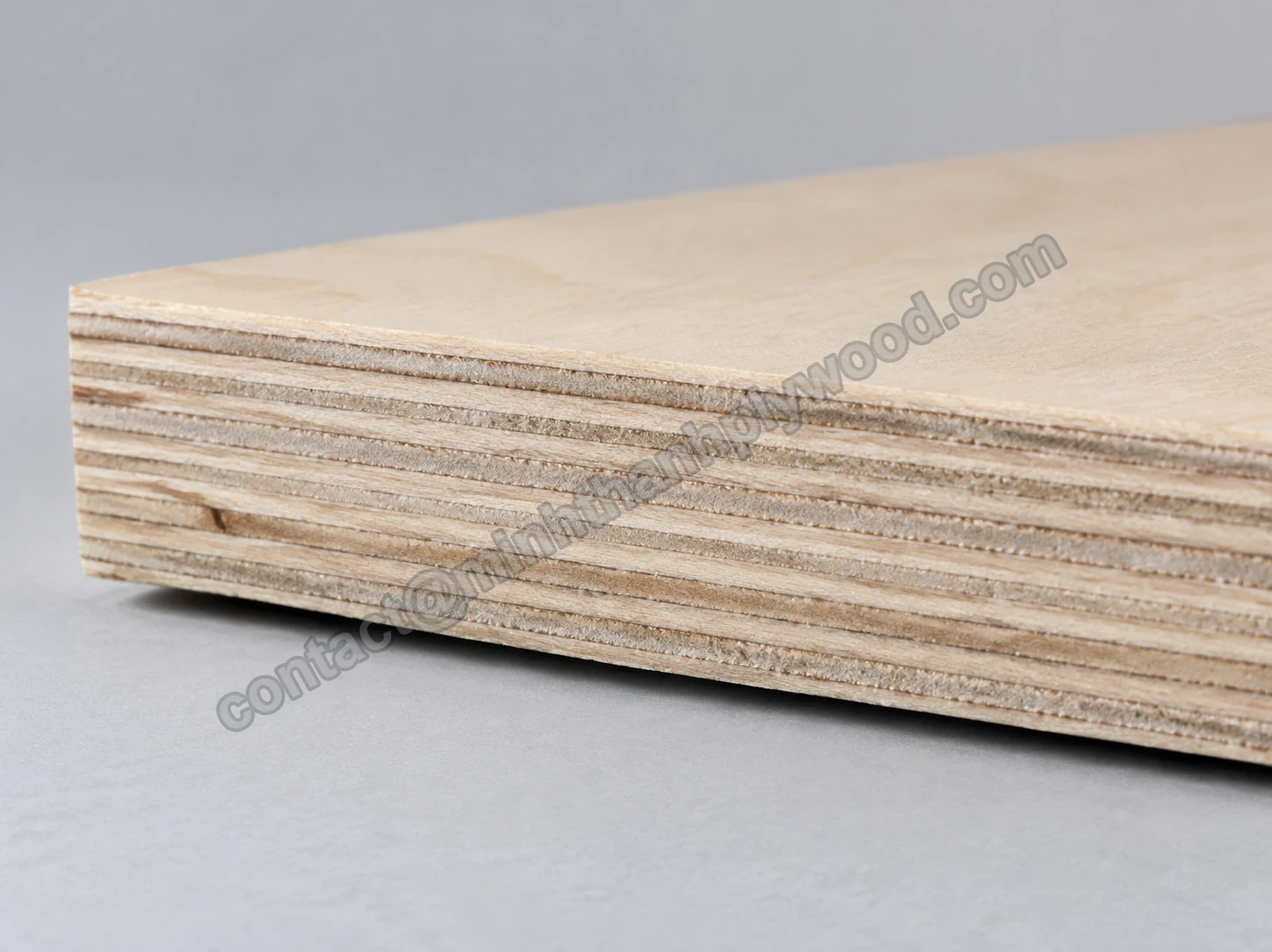
The second pressing is the step a commercial mill skips. Calibrating the core first is what lets an 18 mm sheet hold ±0.2–0.3 mm across the whole face, and what keeps it flat after the faces are glued on. Cut a sample and look at the edge: even glue lines, no voids and no overlapping core joints are the signs of a calibrated core.
Which core species for 18 mm, and what does each weigh?
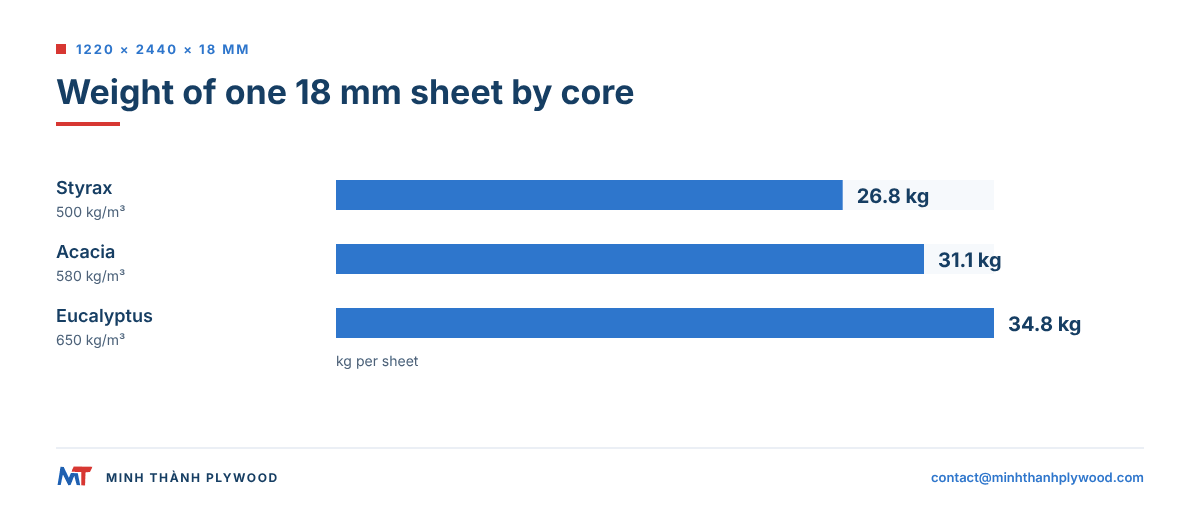
At 18 mm the core decides almost everything a buyer feels: weight in the hand, screw-holding in the edge and the number of sheets in the container. A 1220 × 2440 × 18 mm sheet holds 0.0536 m³ of wood.
| Core | Reference density | Weight per 18 mm sheet | Character |
|---|---|---|---|
| Styrax (white) | 500 kg/m³ | about 26.8 kg | Light and pale; the standard furniture core |
| Acacia | 580 kg/m³ | about 31.1 kg | Made on order; firmer than Styrax |
| Eucalyptus | 650 kg/m³ | about 34.8 kg | Dense, stiff edge for heavy-duty parts |
A kitchen factory that builds tall units and moves panels by hand usually chooses Styrax. A shop-fitting or office-furniture buyer who drills many connectors into the edge often prefers Eucalyptus. Both are standard cores at Minh Thanh, and Acacia and Pine cores are made on order.
How many plywood sheets 18mm fit in a 40HC?
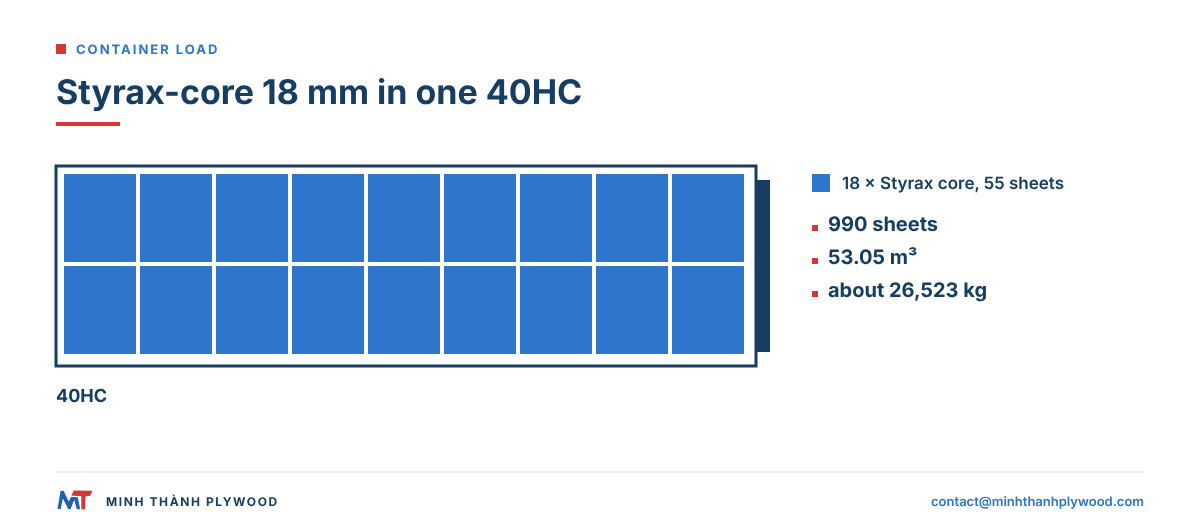
The 40HC plan for plywood sheets 18mm thick in 1220 × 2440 mm uses packs about 1,000 mm high, 55 sheets of 18 mm per pack, and a planning payload of 28,000 kg.
| Core | Pack plan | Sheets per 40HC | Volume | Cargo weight |
|---|---|---|---|---|
| Styrax | 18 packs × 55 sheets (16 lying, 2 upright) | 990 | 53.05 m³ | about 26,523 kg |
| Acacia | 16 packs × 55 sheets | 880 | 47.15 m³ | about 27,348 kg |
| Eucalyptus | 15 packs × 53 sheets | 795 | 42.60 m³ | about 27,689 kg |
With Styrax, space fills before weight. With Eucalyptus, weight comes first, so the packs are trimmed to 53 sheets. If your booking allows less than 28,000 kg, give us the figure with the order and the plan is reworked. For other thicknesses and sizes, use the container packing calculator.
The cost logic follows from the table: the price is per cubic metre, so a Styrax container carries more volume of the same order line than a Eucalyptus one for the same freight.
How tight should the tolerance be on ply 18mm?
Tolerance matters more at 18 mm than at any other thickness, because 18 mm parts meet in joints. An 18 mm gable in an 18 mm dado, a shelf in a groove, a door edge under a 19 mm edge band: each fit assumes the sheet is close to nominal.
- Sanded furniture panels: ±0.2–0.3 mm; ±0.2 mm on request for CNC nesting and grooves.
- Commercial and film-faced panels: ±0.5 mm.
- Length and width: ±2 mm.
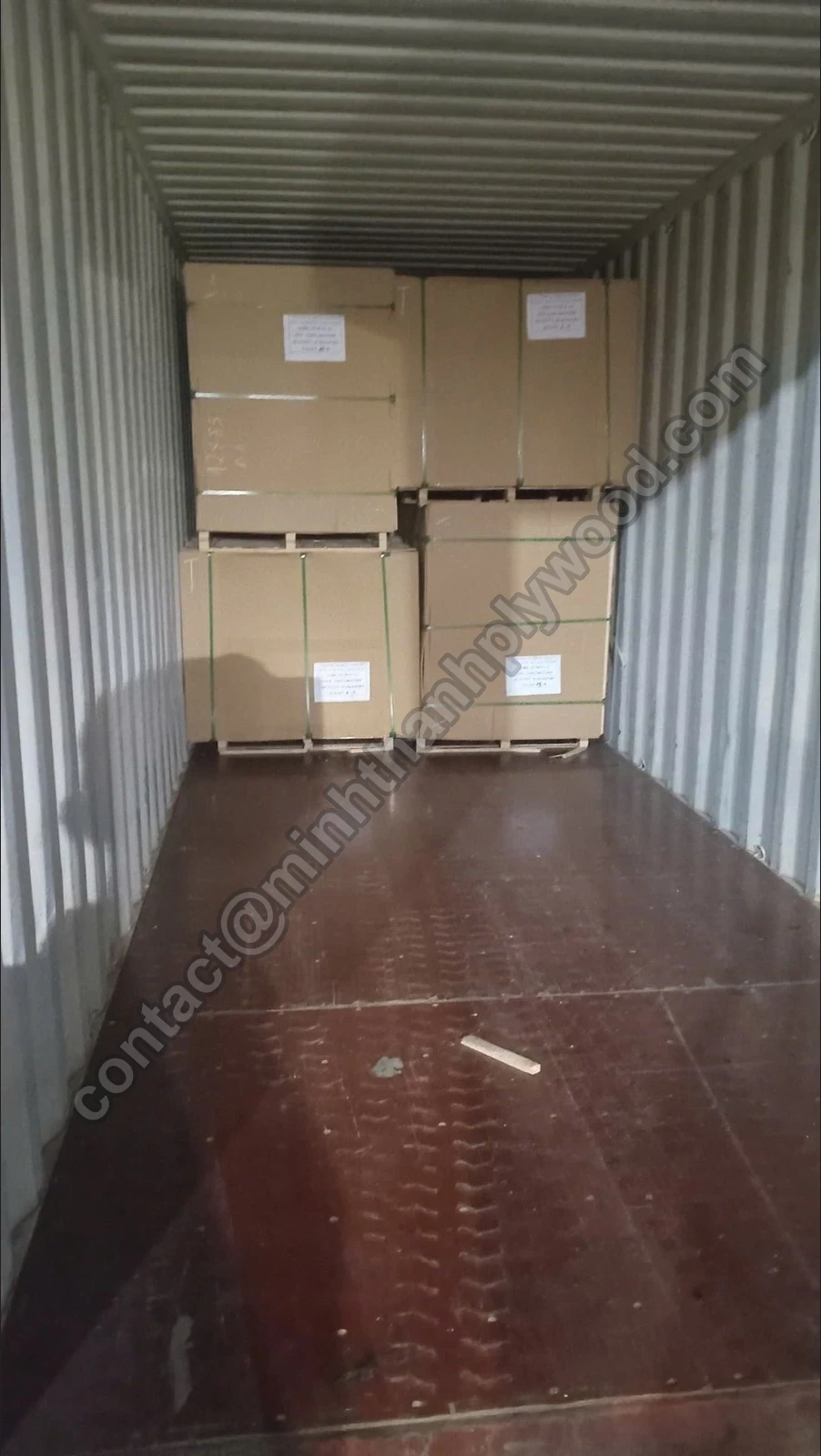
Check five sheets from different packs with a caliper at four points each, 50 mm in from the edge. Every Minh Thanh container is photographed and filmed before loading, so the readings can be agreed before the panels leave the factory, not after they reach your saw.
Which grades suit which 18 mm parts?
| Part | Visible faces | Grade pair to order |
|---|---|---|
| Clear-lacquered door or visible gable | Both, close up | Birch D+/D (close to B/BB) or poplar/eucalyptus A/A |
| Carcass side inside a kitchen unit | One face | Birch D/E or A/B |
| Shelf seen from above and below | Both | Birch D/D (close to BB/BB) or A/A |
| Painted or laminated part | None as wood | B/B, or birch D/E |
| Formwork panel | Film | Film-faced, WBP bond |
The grade describes appearance only; the core, glue and tolerance are separate lines. Pine-faced panels follow the same A/A–A/B–B/B ladder, with B/C for utility parts. The approved sample fixes the look of every sheet in the order.
Is birch-faced 18 mm the same as Baltic birch?
No. Baltic birch, also sold as Russian birch, is birch in every ply, usually 13 plies at 18 mm. A Vietnamese birch-faced 18 mm panel has an imported birch face and back on a Styrax or Eucalyptus core of 11–13 plies, so the face looks like birch but the edge shows the core.
| All-birch (Baltic type) 18 mm | Birch-faced 18 mm from Minh Thanh | |
|---|---|---|
| Plies | Usually 13, all birch | 11–13, birch face and back |
| Core | Birch | White Styrax or Eucalyptus |
| Weight per 1220 × 2440 sheet | Heavier, as birch is a dense core | about 26.8 kg on Styrax, 34.8 kg on Eucalyptus |
| Face grades | B/BB, BB/BB, BB/CP and similar | D+/D (close to B/BB), D/D (close to BB/BB), D/E |
| Best fit | Exposed multi-ply edges, drawer boxes, jigs | Carcasses, shelves and doors that are edged, painted, laminated or lacquered on the face |
For a visible pale edge under clear lacquer, a Styrax core comes closest to the all-birch look at a lower weight. Supply also matters: for Russia, Regulation (EU) 2022/576 added wood products of CN chapter 44, which includes plywood, to the import ban of Regulation 833/2014, effective 9 April 2022. The birch plywood comparison covers the three sources side by side.
Glue, emission and the evidence behind them
18 mm furniture plywood from Minh Thanh is made with UF glue at E0 emission. E0 is the emission class; UF is the resin. Melamine-fortified (MR) and phenolic (WBP) bonds are made to the buyer’s specification, for example WBP for an 18 mm film-faced formwork panel.
The evidence that travels with an order:
- CARB P2 / TSCA Title VI certification, ICTT mill no. 23024, veneer-core hardwood plywood 3–50 mm, against the limits of the California Air Resources Board and the US EPA TSCA Title VI rule (checked October 2026).
- Chamber tests to ASTM D6007: six tests between April 2025 and June 2026 on 9, 15 and 18 mm panels averaged 0.014–0.032 ppm, against the 0.05 ppm CARB Phase 2 / TSCA Title VI limit (three by Shanghai Hongjun, three by ICTT Vietnam).
- E0 testing every three months, and SGS testing to your own method, such as EN 717-1, on request.
- ISO 9001:2015 quality management for plywood manufacturing and the TCVN 11902:2017 veneer-faced plywood certificate.
UF glue at E0 is an interior bond, so 18 mm furniture plywood is not waterproof. For damp or outdoor work on land, order a phenolic (WBP) or melamine-fortified bond; for boats, order marine plywood to BS 1088, which the BS 1088 guide explains.
Under 40 CFR 770.10, the TSCA Title VI limit for hardwood plywood with a veneer or composite core is 0.05 ppm.
What should 18 mm be used for, and when is 15 or 21 mm better?
Stiffness grows with the cube of the thickness. That single rule explains most thickness choices:
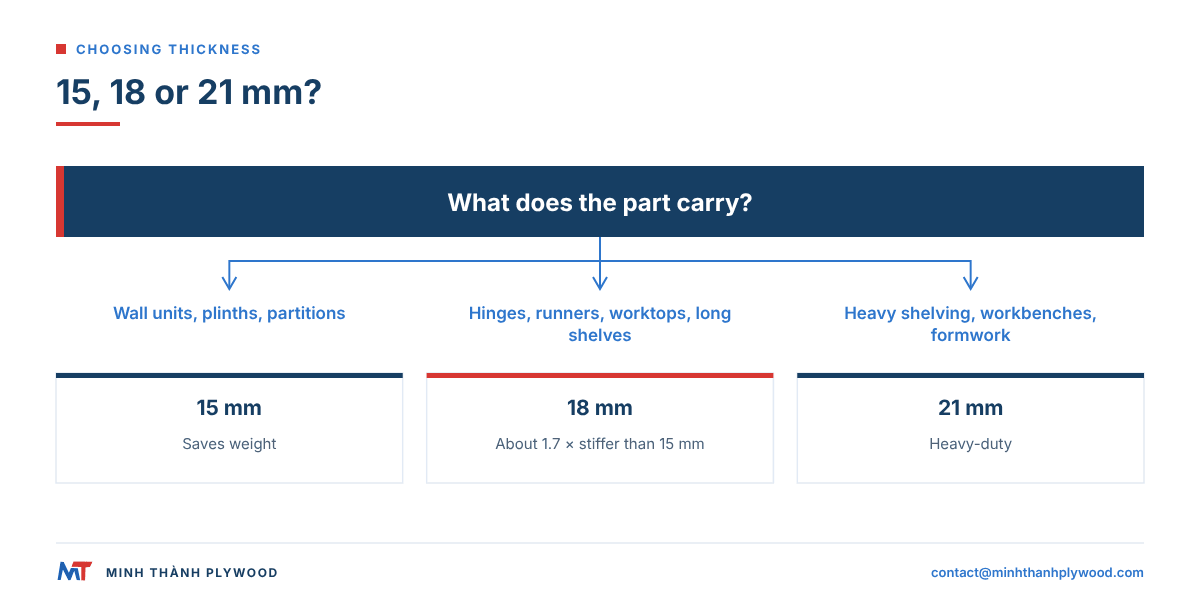
- 18 vs 15 mm: 18 mm is about 1.7 times stiffer. Use 18 mm for base-unit sides, tall wardrobe gables, long shelves and anything carrying a worktop; 15 mm saves weight on wall units, plinths and partitions.
- 18 vs 21 mm: 21 mm is for heavy-duty shelving, workbenches and formwork with many pours. In furniture, 21 mm adds weight where a better core or a front lipping would do the job.
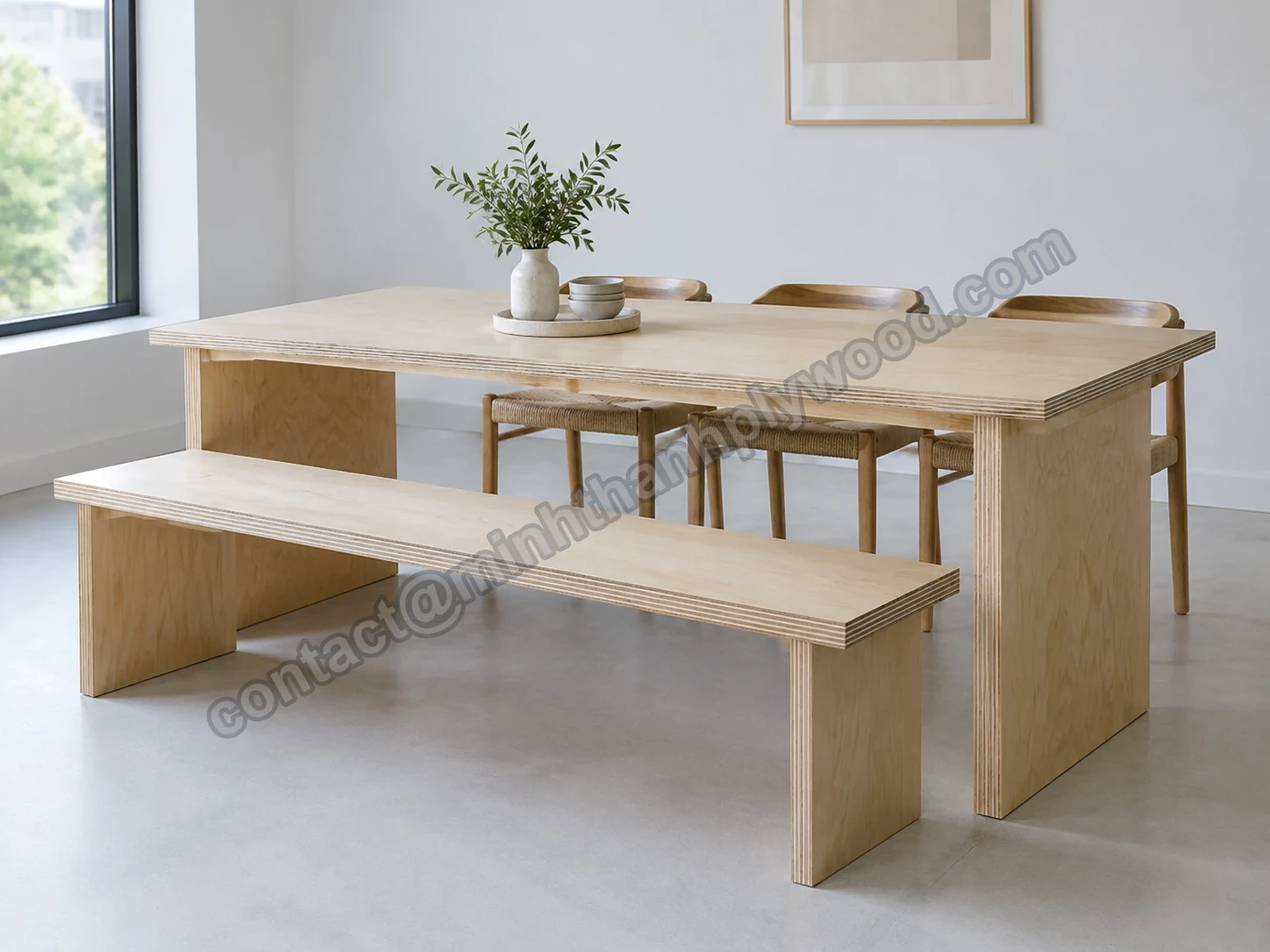
- Tabletops and desks: 18 mm is common for desks and tables with a frame; for a frameless top, double two 18 mm sheets or move to a thicker panel.
Typical 18 mm parts in Minh Thanh orders: kitchen and bathroom carcasses, wardrobe and bookcase gables, office desks, shop fittings, bed frames and worktop substrates under laminate.
How do you check an 18 mm delivery when it arrives?
Open three packs from different positions in the container, not only the pack by the door, and check six things on five sheets from each:
- Thickness with a caliper at four points, 50 mm in from the edge. Write the readings against the order line.
- Flatness. Lay a sheet on a flat bench or two trestles; an 18 mm furniture panel should lie flat without rocking at the corners.
- Face against the sample. Compare the face and back with the approved sample under the same light. Grade is judged on the whole sheet, not on one knot.
- Edge. Cut one sheet across and look at the edge: no voids, no overlapping core veneers, even glue lines.
- Moisture. A pin meter on the face should read inside 8–12 %, the range the panels left the factory with.
- Pack count against the packing list.
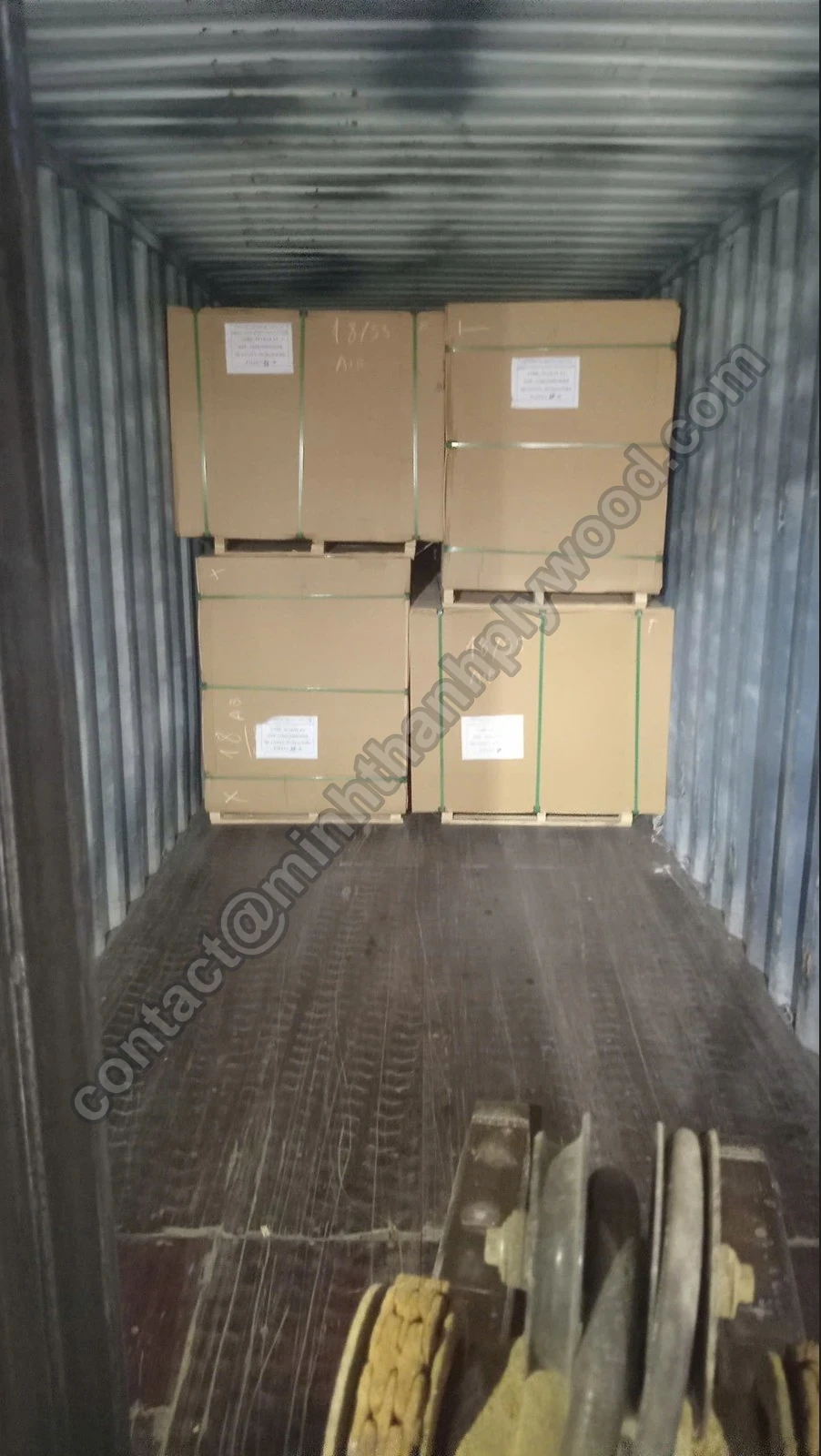
Record the results with photos and send them to us the same week. The loading photos and video we sent before shipment show the same packs leaving Hai Phong, so any question can be traced to a pack and a production lot.
What do 18 mm panels need in your workshop?
Edge banding. An 18 mm sheet sanded to ±0.2–0.3 mm takes a 19 mm or 22 mm edge band with a clean overhang on both faces; tighter tolerance means the trimming unit does not need resetting between packs. A pale Styrax core makes a visible plywood edge look good under clear lacquer.
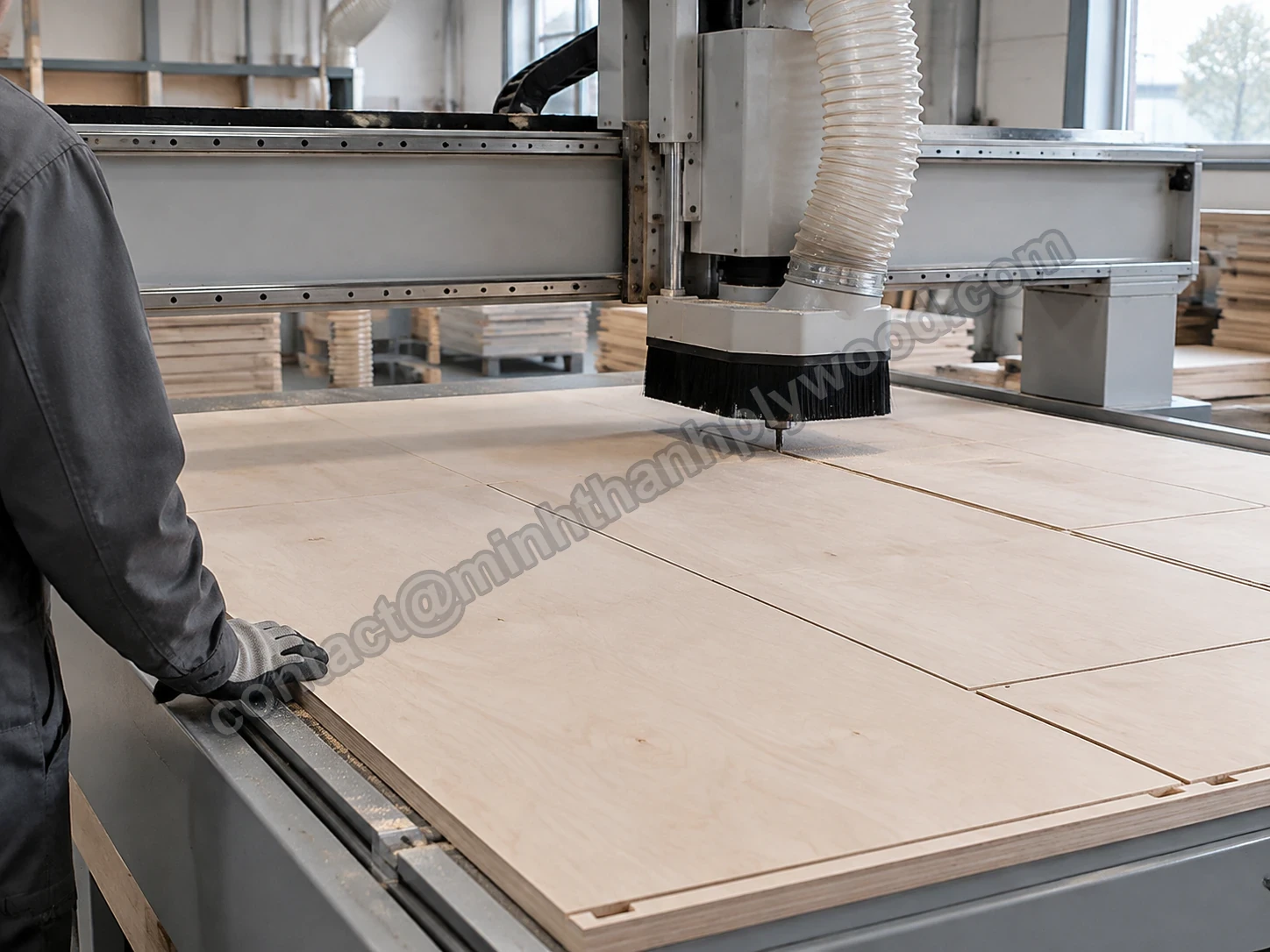
Machining. Use sharp, positive-hook blades and a scoring blade to avoid breakout on the bottom face. On CNC, the calibrated core keeps grooves and dados at a constant depth across the sheet.
Fixings. Confirmat screws, dowels and cam connectors all hold well in an 18 mm cross-laminated edge. For many fixings close to the edge, a Eucalyptus core gives a firmer bite.
Finishing. Both faces leave the line sanded, polished and UV-ready. A light denib before your lacquer or UV coat is enough; no heavy sanding that would cut through a thin face veneer.
Storage. Keep packs flat on bearers, under cover and away from direct heat, and let them settle to your workshop climate before machining large parts.
Which sizes, faces and finishes are available at 18 mm?
- Sizes: 1220 × 2440 mm and 1250 × 2500 mm; custom sizes such as 1220 × 2500 and 1220 × 2280 mm.
- Cut-to-size: one panel cut into 4, 6 or 8 pieces, shipped regularly to Italy and other European markets.
- Faces: engineered veneer, poplar, birch, okoume and pine most often; bintangor, eucalyptus, gurjan and sapele on request.
- Finish: both faces sanded and polished, UV-ready for the buyer’s own UV coating.
Engineered veneer (EV) is the face Minh Thanh produces most: a recomposed veneer with a straight, repeatable grain that keeps a large 18 mm furniture order uniform from the first sheet to the last.
How much does an 8x4 sheet of 18 mm plywood cost?
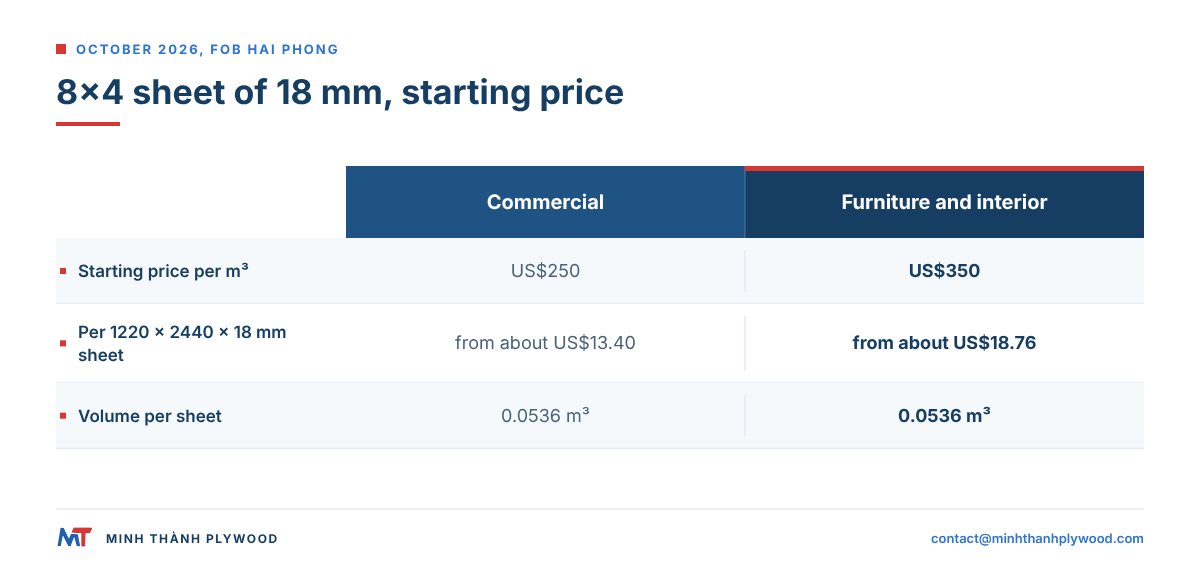
At factory level, an 8x4 (1220 × 2440 mm) sheet of 18 mm plywood costs the price per cubic metre times 0.0536 m³. At Minh Thanh’s indicative starting prices for October 2026, that is from about US$18.76 per sheet FOB Hai Phong for furniture plywood and from about US$13.40 for commercial plywood.
| Line (October 2026) | Starting price per m³ | Per 1220 × 2440 × 18 mm sheet, from |
|---|---|---|
| Commercial plywood | US$250/m³ | about US$13.40 FOB |
| Furniture and interior plywood | US$350/m³ | about US$18.76 FOB |
These are starting points, not a price list: higher face grades, imported birch or okoume faces, a denser core, WBP glue and tighter tolerance all lift the figure, and the quote is set per order. A retail sheet in a store also carries sea freight, duty, warehousing and each seller’s margin, so shelf prices are not comparable with an FOB price per sheet. The 4x8 plywood price guide works through that gap.
18 mm is priced per cubic metre, not per sheet, so the same line is comparable across thicknesses. What moves the price from the starting figure:
| Line on the order | Why it changes the price |
|---|---|
| Face species and grade | Imported birch or okoume and higher grades cost more veneer |
| Core | Eucalyptus is denser and costs more per cubic metre than Styrax |
| Glue and emission | WBP and certified E0 cost more than plain UF |
| Tolerance and sanding | ±0.2 mm needs more calibration and sanding time |
| Size and cut-to-size | 1250 × 2500 mm and cutting add work |
| Quantity and mix | One specification per container is cheapest |
| Delivery term | FOB Hai Phong, CFR or CIF |
The plywood price guide explains every price line in more depth.
What to send when you order 18 mm
Send one line per specification. An example European kitchen order:
18 mm furniture plywood, engineered veneer face A/B, Styrax core, UF glue at E0, CARB P2 / TSCA Title VI, sanded UV-ready, 1250 × 2500 mm, ±0.3 mm, export packing, 1×40HC (about 990 sheets), CIF Genoa.
Minimum order is one 40HC, with mixed specifications by agreement, so 18 mm carcass panels can share a container with 12 mm drawer stock. Samples are free. Production takes 15–45 days after the 30% deposit, and the balance of 70% is paid against the scanned B/L or by irrevocable L/C at sight. Typical sea transit from Hai Phong is 25–35 days to the Mediterranean and 30–40 days to Northern Europe.
Before loading, thickness, size, grade against the approved sample, moisture and pack count are checked, and the photos and video of your container are sent to you. The plywood thickness guide compares 18 mm with every other thickness we make, from 3 to 40 mm.
Buyer questions, answered
How many plies does 18 mm plywood have?
An 18 mm furniture panel from Minh Thanh has 11–13 plies, with the core veneers stitched in both directions and the core pressed and calibrated before the faces go on.
Is 18 mm plywood the same as 3/4 inch?
Nearly. 3/4 inch is 19 mm nominal; buyers in the US who order 3/4 inch furniture plywood from Asia usually receive 18 mm, and 19 mm can be made on order. State the millimetre thickness on the order.
How heavy is a sheet of 18 mm plywood?
A 1220 × 2440 × 18 mm sheet is about 26.8 kg on a Styrax core, 31.1 kg on Acacia and 34.8 kg on Eucalyptus, using reference densities of 500, 580 and 650 kg/m³.
How many 18 mm sheets fit in a 40HC?
About 990 sheets on Styrax (18 packs of 55), 880 on Acacia (16 packs of 55) and 795 on Eucalyptus (15 packs of 53), within a 28,000 kg planning payload.
What is 18 mm plywood used for?
Cabinet and wardrobe carcasses, long shelves, desks, tabletops, worktops under laminate, shop fittings and, in film-faced form, concrete formwork.
What tolerance does 18 mm furniture plywood have?
±0.2–0.3 mm for sanded furniture panels, down to ±0.2 mm on request; ±0.5 mm for commercial and film-faced panels; ±2 mm on length and width.
Which glue is used in 18 mm furniture plywood?
UF glue at E0 emission is standard for furniture and interior panels. Melamine-fortified (MR) and phenolic (WBP) bonds are made to the buyer's specification.
Is Minh Thanh's 18 mm plywood CARB P2 compliant?
Yes. The mill holds CARB P2 / TSCA Title VI certification (ICTT mill no. 23024), and 18 mm panels were among those chamber-tested at 0.014–0.032 ppm against the 0.05 ppm limit.
Should I choose 15 mm or 18 mm for kitchen carcasses?
18 mm for carcass sides that carry hinges, runners and worktops; it is about 1.7 times stiffer than 15 mm of the same build. 15 mm saves weight on wall units and partitions.
How much does an 8x4 sheet of 18 mm plywood cost?
At factory level it is priced per cubic metre, and a 1220 × 2440 × 18 mm sheet holds 0.0536 m³. At the October 2026 starting prices that is from about US$18.76 per sheet FOB for furniture plywood (US$350/m³) and from about US$13.40 for commercial plywood (US$250/m³); face, core, glue, size, quantity and delivery term set the final price.
What size is a sheet of 18 mm plywood?
The standard sheet is 1220 × 2440 mm, the metric form of 4 × 8 ft (8x4). 1250 × 2500 mm is common in Europe, and sizes such as 1220 × 2500 or 1220 × 2280 mm are made on order.
Is birch-faced 18 mm plywood the same as Baltic birch?
No. Baltic birch is birch in every ply, usually 13 plies at 18 mm. Vietnamese birch-faced 18 mm has imported birch on the face and back over a Styrax or Eucalyptus core, 11–13 plies, and is lighter at about 26.8 kg per sheet on Styrax.
Is 18 mm furniture plywood waterproof?
No. UF glue at E0 is an interior bond. For damp or outdoor work on land, order a phenolic (WBP) or melamine-fortified bond; for boats, order marine plywood to BS 1088.
Can 18 mm plywood be cut to size before shipping?
Yes. Panels are cut into 4, 6 or 8 pieces on order, a service shipped regularly to Italy and other European markets.