
In short, ply 12mm (12 mm plywood) is a mid-weight panel for drawer boxes, cabinet backs, shelves on short spans and fit-out linings. Minh Thanh Plywood makes it as sanded furniture plywood with white Styrax or Eucalyptus cores, UF glue at E0 and a ±0.2–0.3 mm tolerance, in 1220 × 2440 or 1250 × 2500 mm, and loads up to 1,494 sheets of 1220 × 2440 mm in one 40HC.
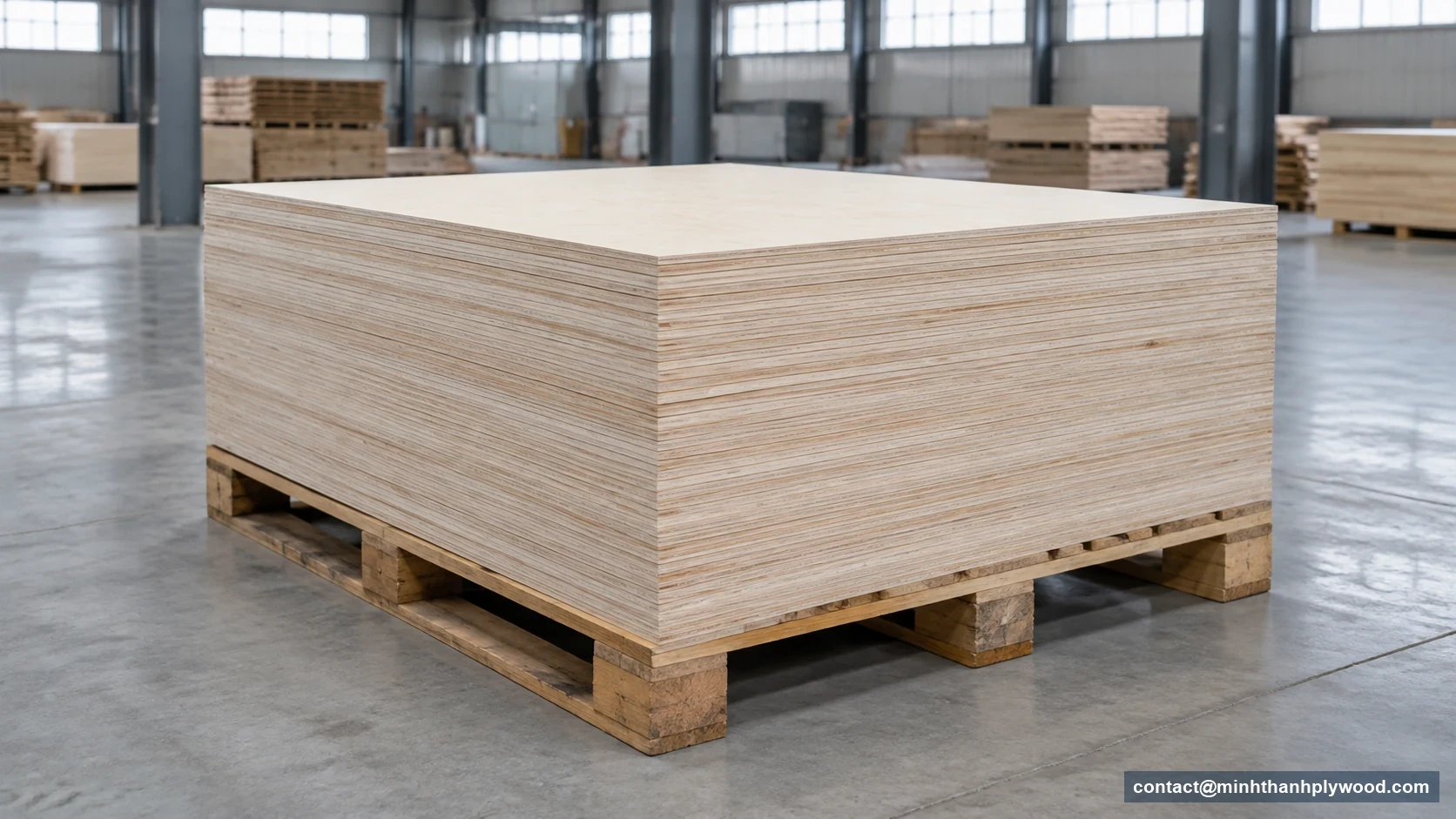
What is ply 12mm, and what arrives on your floor?
12 mm plywood is a cross-laminated panel with a nominal thickness of 12 millimetres, sold mostly in 1220 × 2440 mm (8 × 4 ft) sheets. “Nominal” is the word that matters: every mill works to a target and a tolerance, and the tolerance is what decides whether your rebates, grooves and edge-banding settings work without adjustment.
At Minh Thanh Plywood a sanded 12 mm furniture panel is held to ±0.2–0.3 mm, so a sheet measures between 11.7 and 12.3 mm at the worst and usually much closer. Commercial and film-faced panels are held to ±0.5 mm. Length and width are held to ±2 mm.
Buyers also search for 12.5 mm and 1/2 inch. 12.5 mm is a nominal size some markets list for panels in the 1/2 inch class; a 1/2 inch panel is 12.7 mm nominal. Mills in Asia produce 12 mm for those orders unless the buyer asks otherwise, and Minh Thanh makes any thickness from 3 to 40 mm, so a 12.5 mm build-up is made on order when your machines or your market need it. Put the thickness you want in millimetres on the order and add the tolerance in the same line, for example “12 mm ±0.3 mm”.
Which product lines are made in 12 mm?
The thickness is the same; the panel behind it is not. The four lines a Vietnamese mill makes in 12 mm serve different buyers:
| Line | Face | Core and glue | Typical buyer |
|---|---|---|---|
| Furniture and interior plywood | Birch, poplar, pine, engineered veneer, okoume and other faces, sanded both sides | Styrax or Eucalyptus core, UF glue at E0, pressed twice | Furniture and kitchen factories in Europe and the US |
| Commercial plywood | Utility poplar or eucalyptus faces | Mixed hardwood core, MR or UF glue | Distributors, fit-out, general joinery |
| Packing plywood | Utility faces, appearance not graded | Plantation core, cost-led build-up | Crate, pallet and packaging makers |
| Film-faced plywood | Phenolic film | WBP phenolic bond | Formwork and transport floors |
Minh Thanh is built for the first line: top-grade furniture and interior plywood for Europe. Commercial, packing and film-faced 12 mm panels are made on the same lines when a buyer needs them in the same container.
How is a 12 mm furniture panel built?
A 12 mm panel is a stack of thin veneers with the grain of each layer turned across the one below it, glued and pressed into one board. The cross-lamination is why plywood does not split along the grain like solid timber and why it holds screws near an edge.
Two construction steps separate a furniture panel from a commercial one:
- Stitched core. Core veneers are stitched both horizontally and vertically before laying up, so joints do not open and leave gaps that telegraph through a lacquered face.
- Double pressing. The core board is pressed and calibrated first, then the face and back are pressed on. Calibrating the core before the faces go on is what makes the tight thickness tolerance possible and keeps the face flat.
After pressing, both faces are sanded and polished and left UV-ready, so a buyer can roll a UV coating directly on the panel without extra sanding. Moisture content at dispatch is 8–12 %, the normal range for furniture plywood, which keeps the panel stable when it arrives in a heated European workshop.
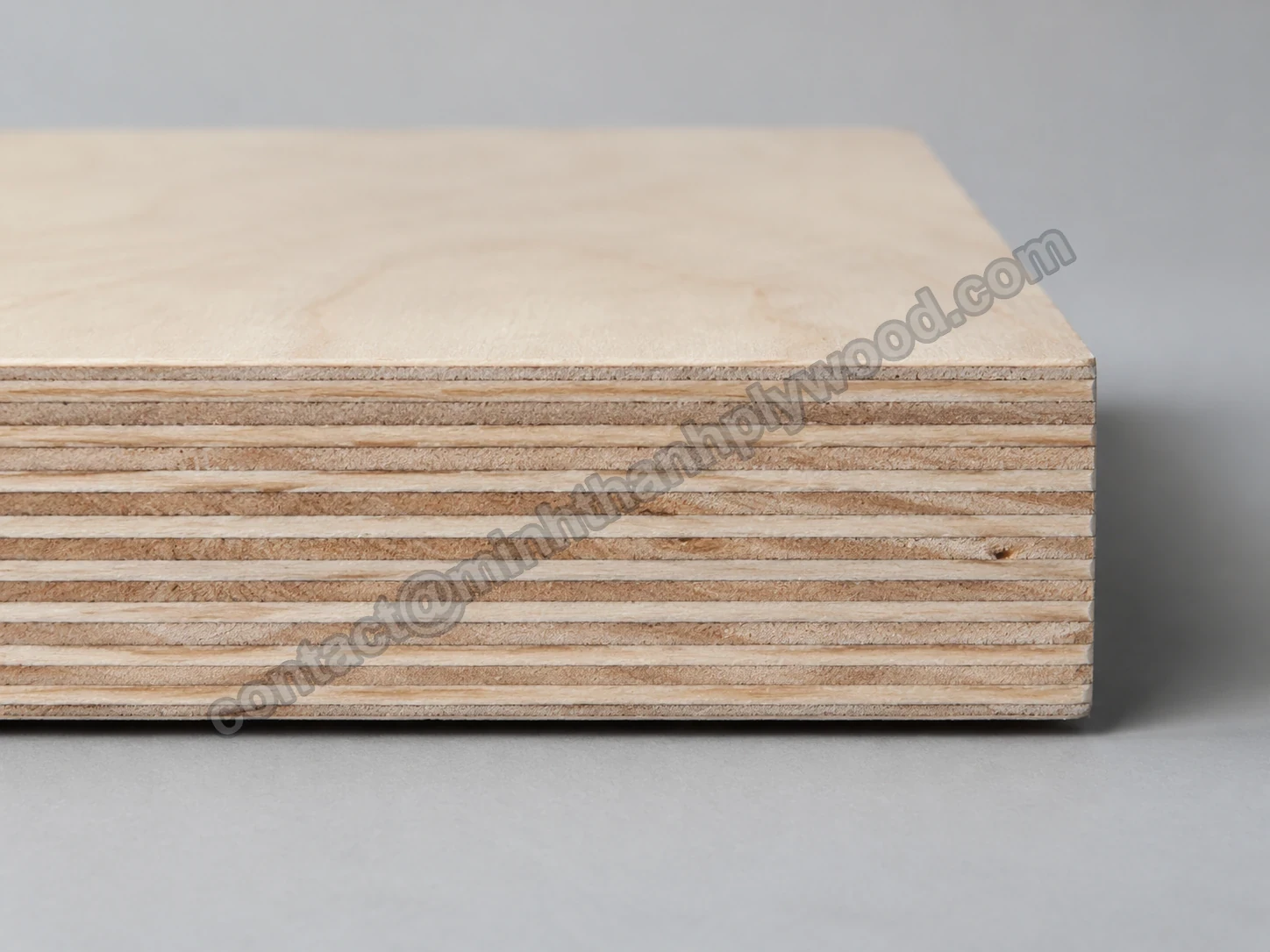
Styrax, Acacia or Eucalyptus: which core for 12 mm?
The core sets the weight, the colour of the edge and the screw-holding of the panel. Minh Thanh uses white Styrax and Eucalyptus cores as standard and makes Acacia and Pine cores on order.
| Core | Reference density | Edge colour | When to choose it |
|---|---|---|---|
| Styrax | 500 kg/m³ | Pale, almost white | Light furniture parts, visible edges, the most sheets per container |
| Acacia | 580 kg/m³ | Light brown | A middle choice when the buyer wants more density than Styrax |
| Eucalyptus | 650 kg/m³ | Pink to light brown | Parts with more screws, hinges or load; firmer edges |
For drawer boxes and cabinet backs with exposed edges, Styrax gives a clean pale edge that looks good under clear lacquer. For shelves that carry books or kitchenware, Eucalyptus adds stiffness without moving to 15 mm. All three take the same faces and the same UF glue at E0.
What tolerance should you ask for, and how do you check it?
Ask for the tolerance your machines need, not the tightest number on a brochure. Typical settings:
- Sanded furniture panels: ±0.2–0.3 mm; down to ±0.2 mm when the parts go into grooves or CNC nesting with fixed tool depths.
- Commercial and film-faced panels: ±0.5 mm.
- Packing plywood: ±0.5–1.0 mm.
- Length and width: ±2 mm for all lines.
On arrival, take five sheets from different packs and measure each with a digital caliper at four points, 50 mm in from the edge, plus once in the centre with a micrometer if you have one. Record the readings against the order line. A 12 mm order that measures 11.8–12.2 mm across all points is inside a ±0.3 mm order with room to spare.
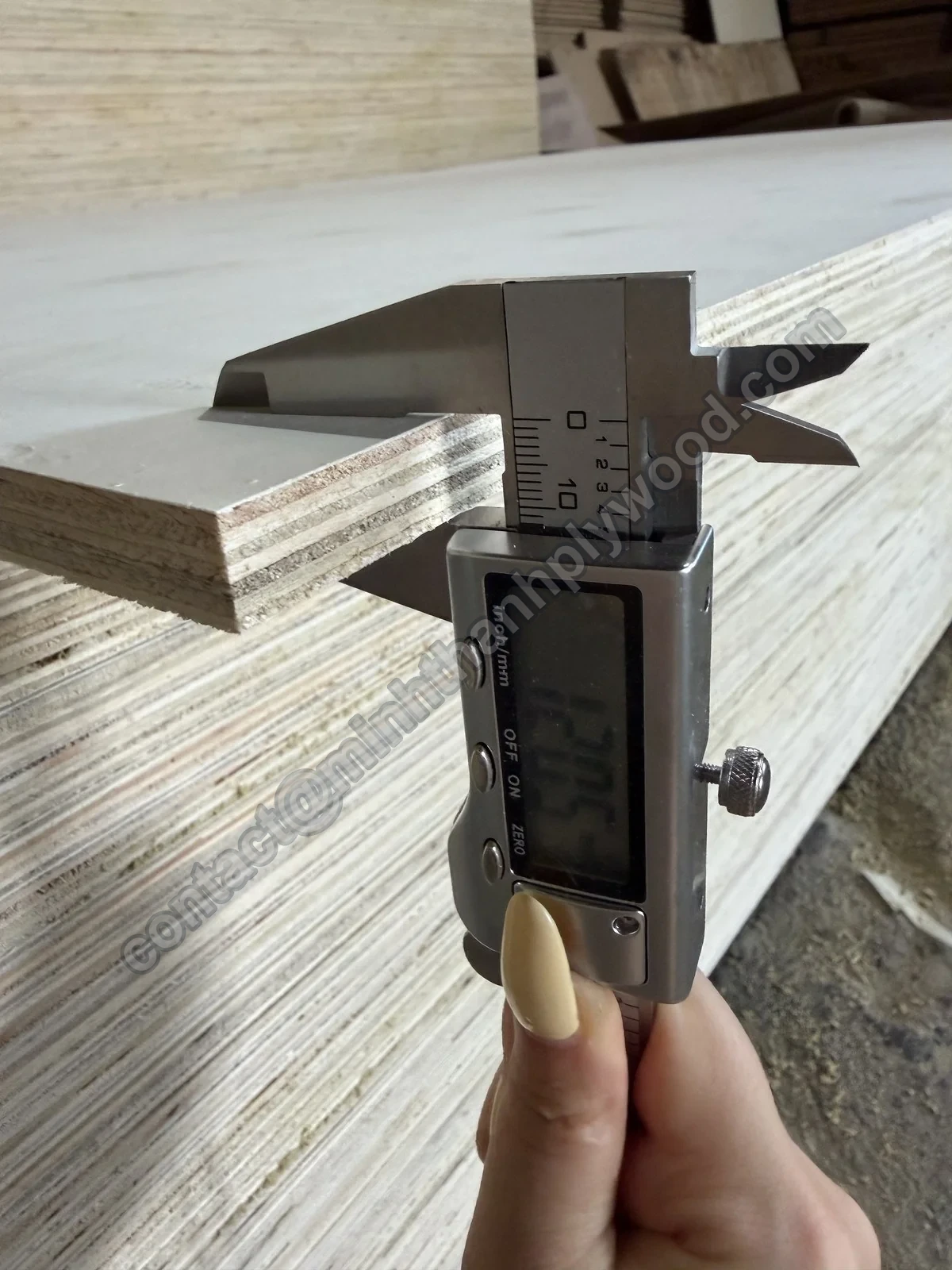
Every Minh Thanh shipment is photographed and filmed before loading, and the buyer receives the photos and video, so the same caliper readings can be checked before the container leaves Hai Phong.
Which sizes do ply sheets 12mm come in?
Ply sheets 12mm are made as standard in 1220 × 2440 mm, the 8 × 4 ft sheet most buyers ask for. European buyers often order 1250 × 2500 mm, which fits metric cutting plans with less waste. Custom sizes such as 1220 × 2500 and 1220 × 2280 mm are made on order.
Cut-to-size is a regular service: one panel cut into 4, 6 or 8 pieces, shipped regularly to Italy and other European markets. For a 12 mm drawer-side or shelf programme it removes a cutting step from your factory and cuts freight on offcuts you would throw away.
How much does a 12 mm sheet weigh?
A 1220 × 2440 × 12 mm sheet holds 0.0357 m³ of wood (a 1220 × 2440 mm face times 12 mm). Multiply by the core density:
| Core | Density | Weight per 12 mm sheet |
|---|---|---|
| Styrax | 500 kg/m³ | about 17.9 kg |
| Acacia | 580 kg/m³ | about 20.7 kg |
| Eucalyptus | 650 kg/m³ | about 23.2 kg |
These are planning values. Faces, glue and moisture move a real sheet a little either way. For handling in your factory the practical point is simple: one person can carry a 12 mm Styrax sheet, while a Eucalyptus sheet is a two-person lift on a long day.
How many 12 mm sheets fit in a 40HC?
The loading plan for a 40HC with 1220 × 2440 mm sheets uses packs about 1,000 mm high: 83 sheets of 12 mm per pack. The number of packs depends on the core, because the heavier the core, the sooner the container reaches its planning payload of 28,000 kg.
| Core | Packs | Sheets per pack | Sheets per 40HC | Volume | Cargo weight |
|---|---|---|---|---|---|
| Styrax | 18 | 83 | 1,494 | 53.37 m³ | about 26,684 kg |
| Acacia | 16 | 83 | 1,328 | 47.44 m³ | about 27,514 kg |
| Eucalyptus | 15 | 80 | 1,200 | 42.87 m³ | about 27,863 kg |
Eucalyptus is the case where weight, not space, sets the load: 15 packs of 83 would pass 28,000 kg, so each pack is cut to 80 sheets. If your booking has a lower payload than 28,000 kg, tell us when you order and the plan is recalculated. You can run the same numbers for other thicknesses in the container packing calculator.
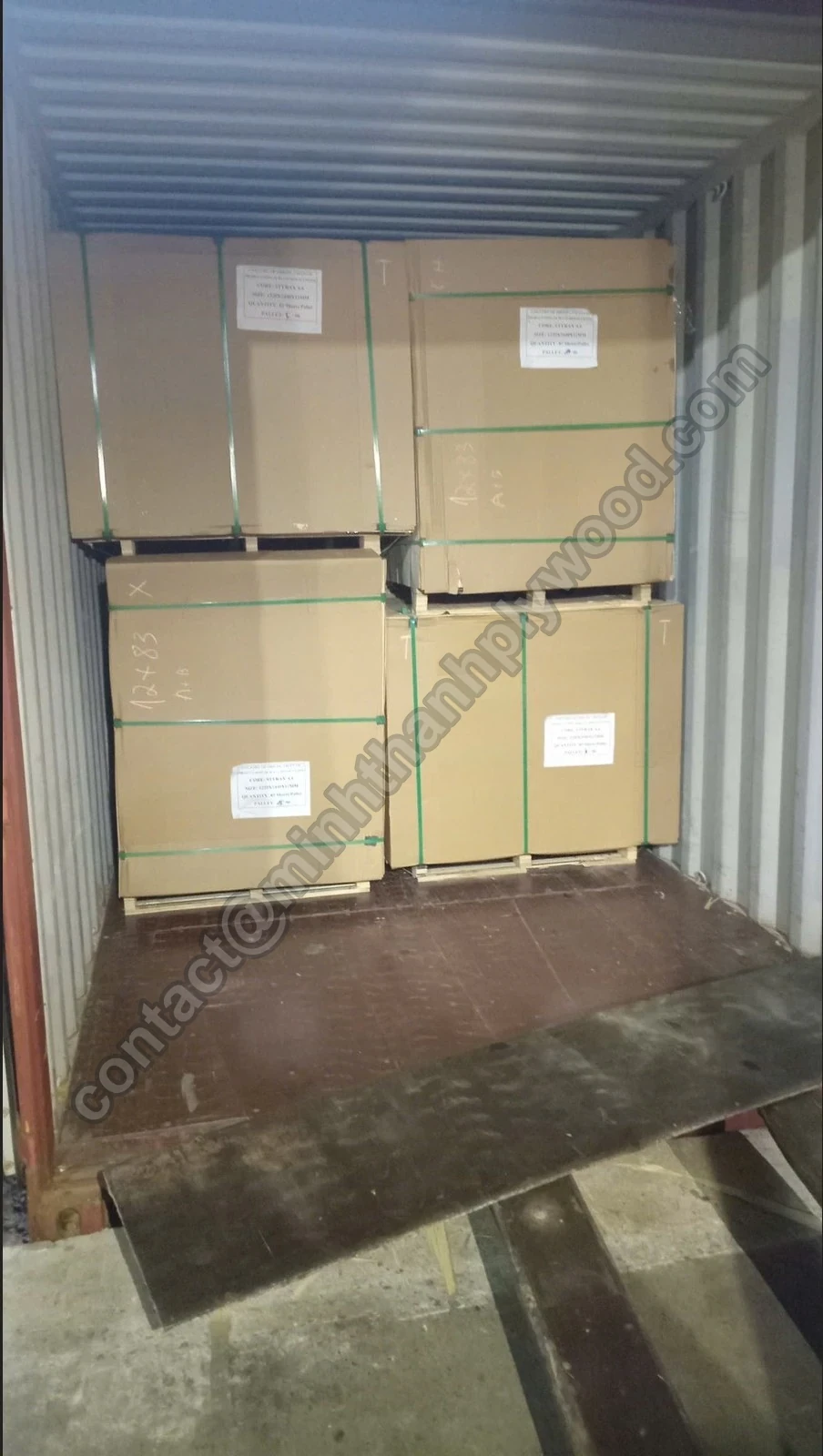
The minimum order is one 40HC. A container can carry more than one specification by agreement: usually one or two, and three to six when the volumes justify it, so a 12 mm drawer programme can share a container with 18 mm carcass panels.
Which face grades are ordered in 12 mm?
Grades describe the face and back appearance and are quoted as pairs. Minh Thanh’s ladders by face species:
| Face | Grade pairs | What they mean for a 12 mm part |
|---|---|---|
| Birch | D+, D and E, quoted as D+/D, D/D or D/E | D+ is close to B: clear-lacquered drawer fronts and visible shelves. D/D is close to BB/BB for parts seen on both sides. D/E for parts with a hidden back. |
| Poplar | A/A, A/B, B/B | A/A for two visible faces, A/B for one, B/B for painted or overlaid parts. Buyers also order by B/BB, BB/CC and CP on the same ladder. |
| Pine | A/A, A/B, B/B | The same logic; B/C for utility parts. |
| Eucalyptus | A/A, A/B, B/B | A/A for two visible faces, B/B for painting or laminating. |
At 12 mm the back is often visible: the inside of a drawer, the underside of a shelf, the inner face of a cabinet back. Order the back grade for the face your customer sees when the drawer is open, not for the side the drawing calls “back”. The approved sample fixes the appearance for the whole order.
Which glue and emission class for 12 mm?
Glue type and emission class are two separate lines on an order. For furniture and interior 12 mm panels the standard is UF glue at E0 emission. Melamine-fortified (MR) and phenolic (WBP) bonds are made to the buyer’s specification for kitchens, bathrooms, vehicle interiors or outdoor parts.
The emission evidence buyers in Europe and the US ask for:
- CARB P2 / TSCA Title VI certification for veneer-core hardwood plywood, ICTT mill no. 23024, covering 3–50 mm. The limits are set by the California Air Resources Board composite wood products rule and the US EPA TSCA Title VI standard (both checked October 2026).
- Six ASTM D6007 chamber tests between April 2025 and June 2026 on 9, 15 and 18 mm panels, averaging 0.014–0.032 ppm against the 0.05 ppm CARB Phase 2 / TSCA Title VI limit; three by Shanghai Hongjun and three by ICTT Vietnam.
- E0 tested every three months, and third-party testing to your own method, for example EN 717-1, arranged through SGS on request.
Under EPA’s TSCA Title VI requirements, the TSCA Title VI limit for hardwood plywood with a veneer or composite core is 0.05 ppm.
US orders carry the TSCA Title VI label on the panels and the compliance statement on the invoice and bill of lading.
What is 12 mm plywood used for, and when is it too thin?
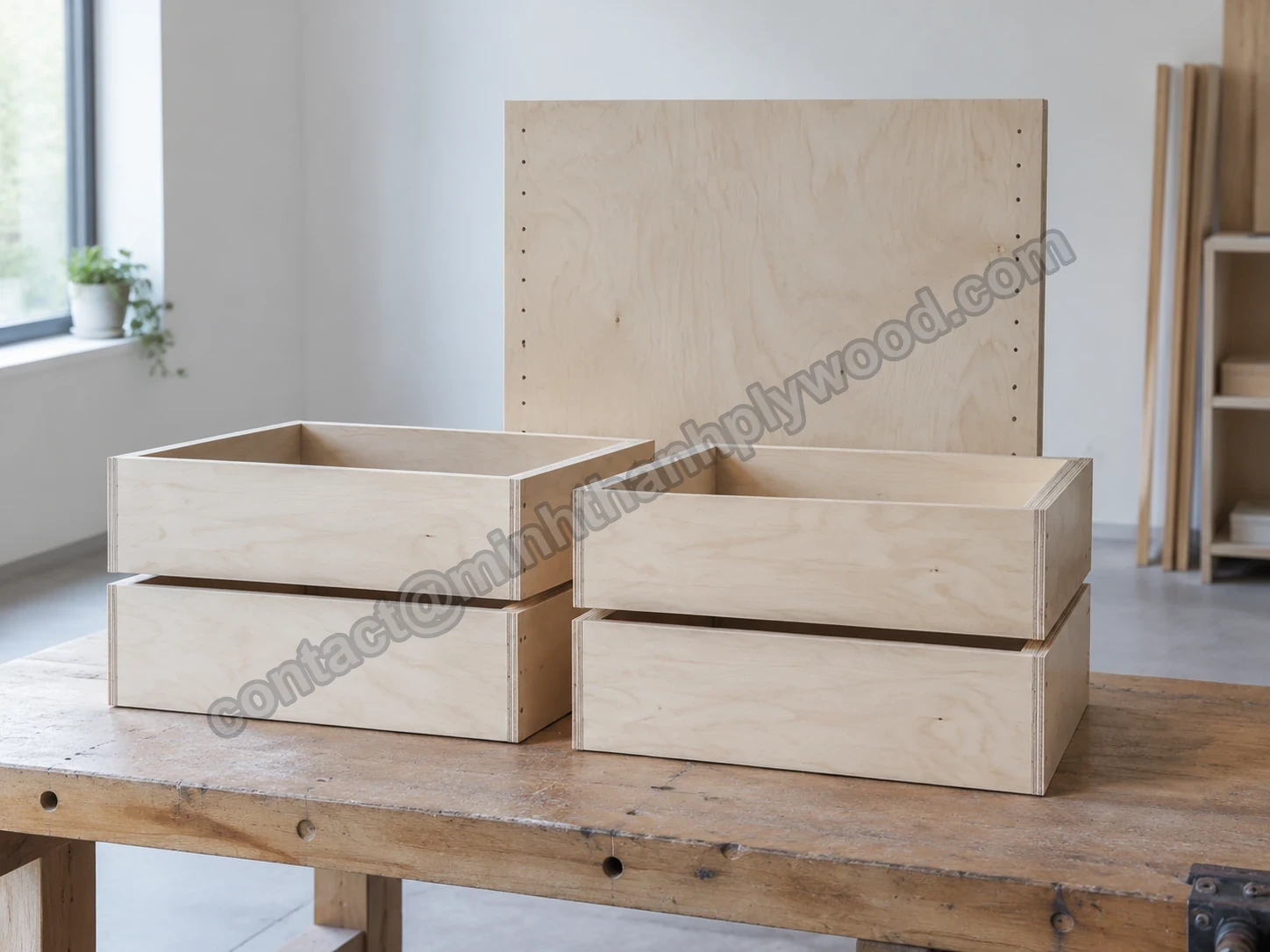
12 mm is the thickness for parts that need a real plywood edge and screw-holding but not the weight of 18 mm:
- drawer sides, fronts and backs, often with a 6 or 9 mm bottom;
- cabinet backs and bottoms in frameless kitchens;
- shelves on short spans or supported on three sides;
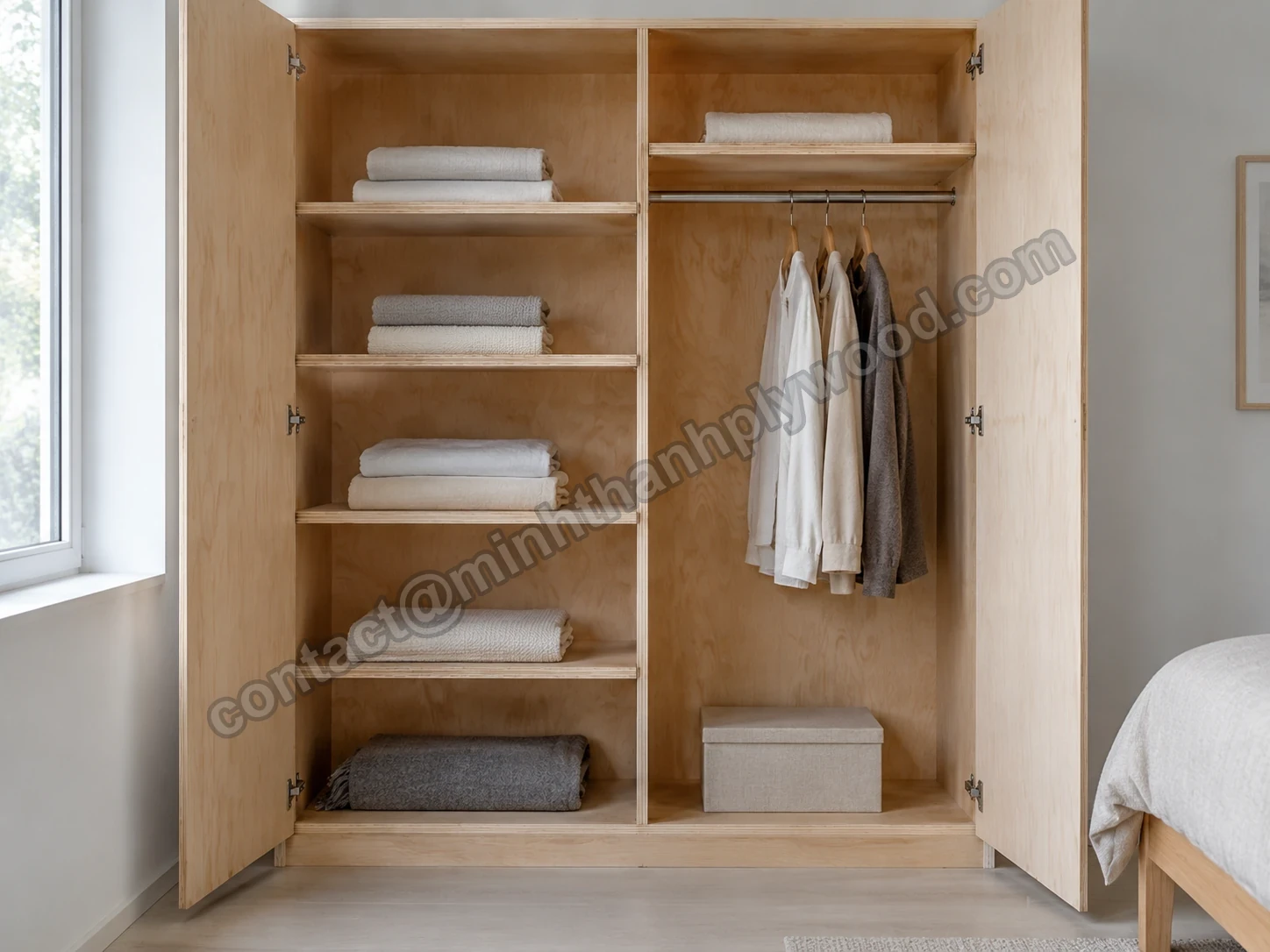
- wardrobe interiors, partitions and display units;
- wall and ceiling linings in fit-out;
- van and camper interiors, where every kilogram counts;
- packaging and crate panels in the packing line.
Step up when the part works harder. Carcass sides that carry hinges and drawer runners, long shelves, worktops and tabletops are normally 15 or 18 mm, because stiffness rises with the cube of the thickness: an 18 mm panel is about 3.4 times stiffer than a 12 mm panel of the same build. If a 12 mm shelf must span further, add a front lipping or a batten, or choose a Eucalyptus core before moving to the next thickness.
How do you write the 12 mm line on a quotation request?
A quotation is only as exact as the line you send. A complete 12 mm line reads like this:
12 mm furniture plywood, birch face D/D, Styrax core, UF glue at E0, CARB P2 / TSCA Title VI, sanded both sides UV-ready, 1220 × 2440 mm, ±0.3 mm, 8–12 % moisture, export packing with cardboard and steel straps, 1×40HC (about 1,494 sheets), FOB Hai Phong.
Each element changes the price: the face species and grade, the core, the glue and emission class, the sanding, the size, the tolerance, the packing, the quantity and the delivery term. Leave one out and two mills will quote two different panels. Our full checklist, with a template you can copy, is in How to request a plywood quote.
What happens after you order 12 mm from Vietnam?
- Sample. Free samples of the face, core and grade you specify; you approve one and it becomes the reference for the order.
- Deposit and production. 30% deposit; production takes 15–45 days, depending on face availability and the mix in the container.
- Inspection before loading. Thickness, size, face grade against the sample, moisture and pack count are checked; every shipment is photographed and filmed before loading and the files go to you.
- Shipment. FOB Hai Phong, CFR or CIF. Balance of 70% against the scanned B/L, or an irrevocable L/C at sight.
- Documents. Commercial invoice, packing list, B/L, certificate of origin (EUR.1 for the EU), phytosanitary and fumigation certificates, insurance with CIF, and the CARB P2 / TSCA files, test reports and EUDR dossier on order.
Typical days at sea from Hai Phong are 25–35 to the Mediterranean, 30–40 to Northern Europe and 20–30 to the US West Coast.
Where does 12 mm sit in the thickness range?
Minh Thanh makes panels from 3 to 40 mm. In a furniture programme 12 mm sits between the thin panels (3–5 mm, always 5-ply, for drawer bottoms and backs) and the carcass thicknesses (15 and 18 mm). The plywood thickness guide compares every thickness by use; the 18 mm guide covers the panel most 12 mm parts are paired with.
Indicative starting prices, October 2026: furniture and interior plywood from US$350/m³ and commercial plywood from US$250/m³. A 12 mm order is priced per cubic metre like every other thickness, and the final price follows the spec line above. Send it and the reply comes within hours, Monday to Friday, Vietnam time.
Buyer questions, answered
Is 12 mm plywood exactly 12 mm thick?
A 12 mm panel is made to a nominal thickness with a tolerance. Minh Thanh sands furniture panels to ±0.2–0.3 mm, down to ±0.2 mm on request, and holds commercial and film-faced panels to ±0.5 mm.
How much does a sheet of 12 mm plywood weigh?
A 1220 × 2440 mm sheet holds 0.0357 m³ of wood, so it weighs about 17.9 kg on a Styrax core, 20.7 kg on Acacia and 23.2 kg on Eucalyptus, using reference densities of 500, 580 and 650 kg/m³.
How many sheets of 12 mm plywood fit in a 40HC container?
About 1,494 sheets on a Styrax core (18 packs of 83), 1,328 on Acacia (16 packs of 83) and 1,200 on Eucalyptus (15 packs of 80, capped by weight). Mixed specifications in one container are possible by agreement.
What is 12 mm plywood used for?
Drawer boxes, cabinet backs and bottoms, short-span shelves, wardrobe interiors, wall linings, display units and packing parts. Carcass sides, long shelves and tabletops are usually 15 or 18 mm.
Which core is best for 12 mm furniture plywood?
White Styrax is the light, pale core for furniture and is the default at Minh Thanh; Eucalyptus is denser and firmer for parts that take more screws or load. Acacia and Pine cores are made on order.
Is 12 mm the same as 1/2 inch plywood?
Close but not identical. 1/2 inch is 12.7 mm nominal; North American buyers who order 1/2 inch from Vietnam normally receive a 12 mm panel, so state 12 mm and the tolerance on the order.
Can 12 mm plywood be made with waterproof glue?
Yes. UF glue at E0 emission is the standard for furniture and interior panels; melamine-fortified (MR) and phenolic (WBP) bonds are made to the buyer's specification for humid or exterior parts.
Does 12 mm furniture plywood meet CARB P2 and TSCA Title VI?
Yes. Minh Thanh holds CARB P2 / TSCA Title VI certification for veneer-core hardwood plywood from 3 to 50 mm, and six chamber tests on its panels averaged 0.014–0.032 ppm against the 0.05 ppm limit.
What grades can 12 mm plywood be ordered in?
Face/back pairs by face species: birch D+, D and E (D+/D is close to B/BB); poplar, pine and eucalyptus A/A, A/B and B/B. The approved sample fixes the appearance of the order.
What is the lead time and minimum order for 12 mm plywood?
One 40HC is the minimum, with mixed specifications by agreement; production takes 15–45 days after the 30% deposit and samples are free.