
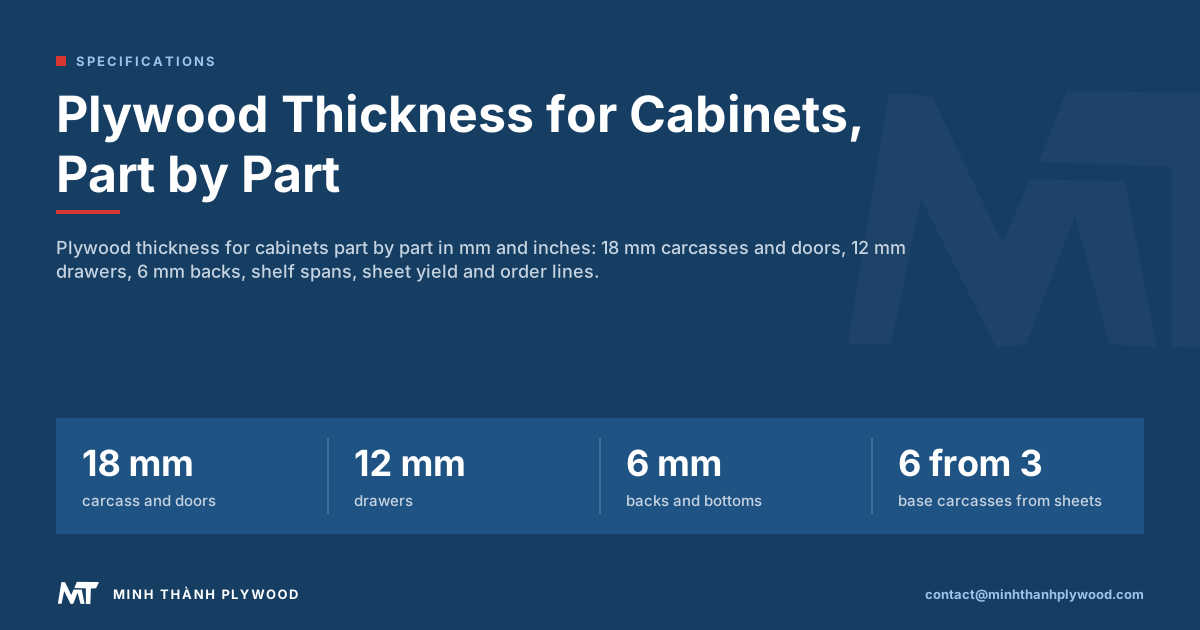
Cabinet makers build carcasses, fixed shelves and doors from 18 mm (3/4 inch) plywood, drawer boxes from 12 mm (1/2 inch) and backs and drawer bottoms from 6 mm (1/4 inch). Minh Thanh Plywood supplies all three on Styrax or Eucalyptus cores, sanded to ±0.2–0.3 mm, and can load them together in one 40HC.
Which plywood thickness for cabinets is standard?
The standard plywood thickness for cabinets is 18 mm, the metric equivalent of 3/4 inch, for the parts that carry load: sides, tops, bottoms, fixed shelves, doors and drawer fronts. Drawer boxes use 12 mm (1/2 inch), and backs and drawer bottoms use 6 mm (1/4 inch).
Three things make 18 mm the default. Hinge plates, drawer runners and confirmat screws need the depth to hold for years. A wide box built from 18 mm stays square when it is moved, levelled and loaded with a stone worktop. And a shelf or bottom in 18 mm resists sag across a normal kitchen span.
The thinner parts are not a saving at the cost of strength. A back captured in a groove and a drawer bottom held on four sides carry almost no bending load, so 6 mm does the job and takes weight off the cabinet. Buying the right thickness for each part is what a cabinet plant does by habit and what a first-time importer often gets wrong.
Cabinet plywood thickness by part, in mm and inches
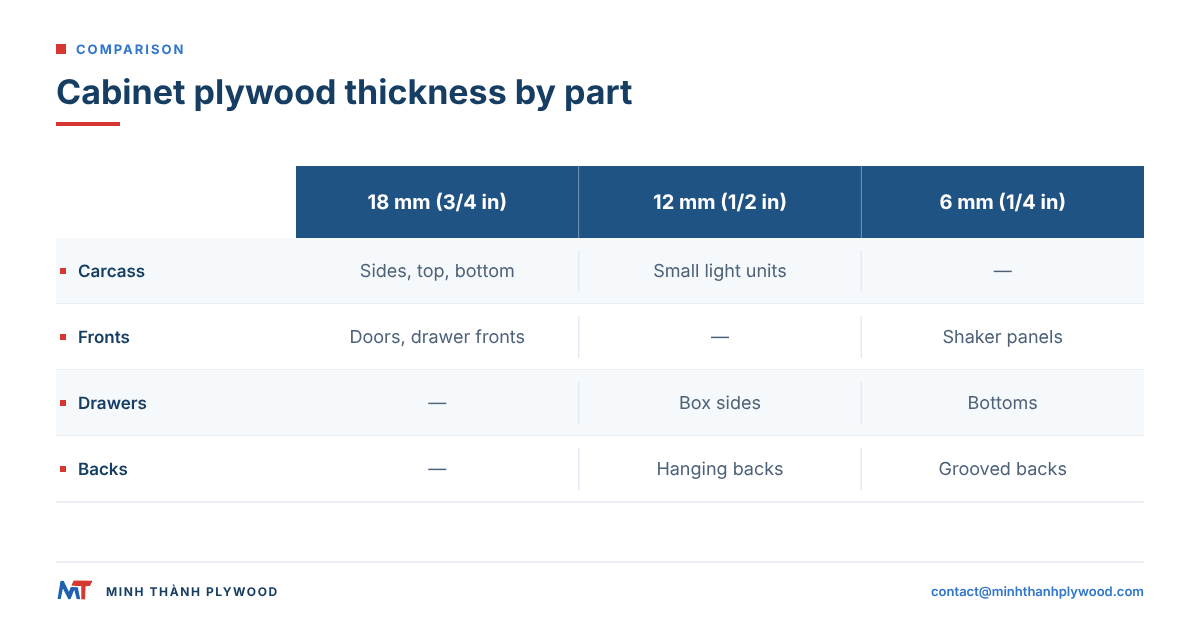
This table gives the working thickness for every part of a frameless (European-style) cabinet, with the metric size you order and the imperial size it replaces:
| Cabinet part | Metric order size | Imperial nominal | Imperial actual (US sheets) | Why this thickness |
|---|---|---|---|---|
| Sides, tops and bottoms | 18 mm | 3/4 inch | 23/32 inch, 18.3 mm | Hinge plates, runner screws, racking, worktop load |
| Fixed shelves | 18 mm | 3/4 inch | 23/32 inch, 18.3 mm | Bending across the span |
| Adjustable shelves | 18 mm | 3/4 inch | 23/32 inch, 18.3 mm | Shelf pins and span; 20–25 mm for long spans |
| Doors and drawer fronts | 18 mm | 3/4 inch | 23/32 inch, 18.3 mm | Concealed hinge cups, flatness |
| Drawer box sides and backs | 12 mm | 1/2 inch | 15/32 inch, 11.9 mm | Joints and runner screws without bulk |
| Drawer bottoms | 6 mm; 8–9 mm for wide drawers | 1/4 inch | 7/32 inch, 5.6 mm | Captured in a groove |
| Backs in a groove | 6 mm | 1/4 inch | 7/32 inch, 5.6 mm | Squares the box, light |
| Hanging backs | 12 mm | 1/2 inch | 15/32 inch, 11.9 mm | Screws through the back into the wall |
| Light wall cabinets, wardrobe interiors | 15 mm | 5/8 inch | 19/32 inch, 15.1 mm | Lower load, less weight on the wall |
| Toe kicks and plinths | 12–18 mm | 1/2–3/4 inch | — | Hidden; offcuts work |
Mixing thicknesses is how cabinet plants control cost. A kitchen built in 18 mm everywhere pays for stiffness in backs and drawer bottoms that never need it. The plywood for cabinet boxes guide goes deeper into carcass construction; this article stays on thickness.
1/2 plywood for cabinets or 3/4 inch plywood for cabinets: which goes where?
Use 3/4 plywood for cabinets’ carcasses, shelves and doors, and 1/2 plywood for drawer boxes and hanging backs. The two are not alternatives for the same part; each does a different job.
| Question | 1/2 inch (12 mm) | 3/4 inch (18 mm) |
|---|---|---|
| Holds a concealed hinge plate? | Poorly; short screws, risk of pull-out | Yes, the standard |
| Holds drawer runner screws? | Yes on a drawer box | Yes on a carcass side |
| Stays flat as a door? | No at full door size | Yes |
| Sags as a 600 mm shelf? | Visibly under a full load | Little |
| Weight per 1220 × 2440 mm sheet, Styrax core | about 17.9 kg | about 26.8 kg |
| Stiffness, 18 mm = 1.00 | about 0.30 | 1.00 |
A 12 mm panel has about 30% of the bending stiffness of 18 mm, which is fine for a drawer side and too little for a shelf. Building whole base cabinets in 12 mm to save material is a common shortcut that shows up later as stripped hinge screws and bowed shelves. Building drawer boxes in 18 mm is the opposite mistake: heavy drawers, wide sides and less inside space.
1/2 inch plywood for cabinets is right in three places: drawer boxes, backs that carry a wall cabinet, and small cabinets where the load is light, such as bathroom wall units. 3/4 inch plywood for cabinets is right everywhere a hinge, a runner or a span is involved.
Why is 18 mm cabinet plywood not exactly 3/4 inch?
18 mm and 3/4 inch are two different systems that meet in the same part. One inch is defined as exactly 25.4 mm. 3/4 inch is 19.05 mm nominal, but most North American 3/4 sheets are sanded to 23/32 inch, about 18.3 mm. Metric cabinet plywood from Asia and Europe is made to 18 mm.
The difference matters in three places:
- Grooves and dados. A groove cut for a true 3/4 inch panel is 1 mm wider than an 18 mm panel; the joint is loose. Cut grooves to the measured stock.
- Back grooves. A 1/4 inch back groove is 6.35 mm; a 6 mm metric back moves 0.35 mm in it. US 1/4 inch plywood often measures 7/32 inch, 5.6 mm.
- CNC programmes. A nesting programme written for 19 mm will cut shallow pockets and loose dadoes in 18 mm stock. Set the material thickness to the caliper reading.
Tolerance is the second half of the story. Minh Thanh holds sanded furniture panels to ±0.2–0.3 mm, and down to ±0.2 mm, so 18 mm stock measures 17.7–18.3 mm at worst. Commercial and film-faced panels are held to ±0.5 mm. For cabinet parts that go into grooves and CNC nests, write “18 mm ±0.2 mm” on the order and measure five sheets per delivery with a caliper at four points, 50 mm in from the edges.
How thick should cabinet shelves be for each span?
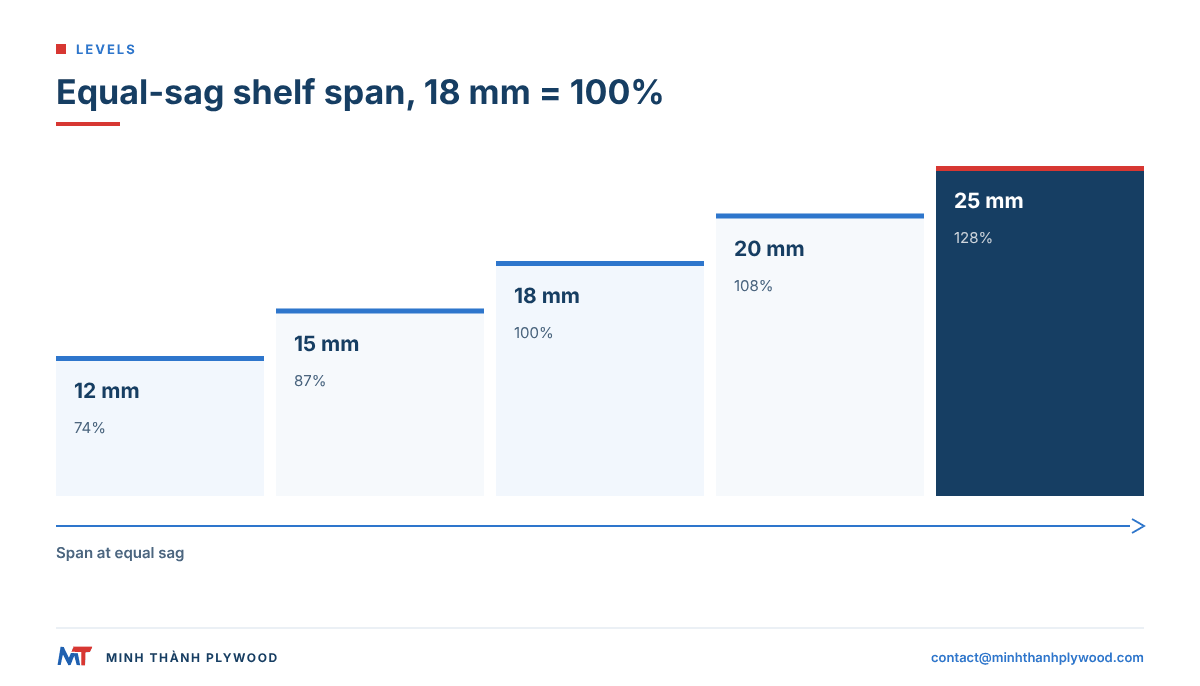
Shelf sag depends on span as much as thickness: a short shelf in 12 mm stays flat, a long one in 18 mm bends under books or plates. Bending stiffness rises with the cube of thickness, and under an even load the span at which shelves sag equally rises with thickness to the power of three quarters. With 18 mm as the reference:
| Shelf thickness | Stiffness, 18 mm = 1.00 | Equal-sag span, 18 mm = 100% | If 18 mm is right at 800 mm |
|---|---|---|---|
| 12 mm | about 0.30 | about 74% | about 590 mm |
| 15 mm | about 0.58 | about 87% | about 700 mm |
| 18 mm | 1.00 | 100% | 800 mm |
| 20 mm | about 1.37 | about 108% | about 865 mm |
| 25 mm | about 2.68 | about 128% | about 1,025 mm |
Use the table to compare options for the same load, not as a load rating. Three practical fixes keep 18 mm when a span runs long:
- Add a front lip of solid wood or a strip of plywood on edge under the front; it stiffens the shelf far more than a millimetre of extra thickness.
- Fix the back edge into the carcass back or onto a cleat, so the shelf is supported on three sides.
- Break the span with a divider or a centre support.
The core matters too. A Eucalyptus core at 650 kg/m³ is firmer than Styrax at 500 kg/m³; for library shelving with heavy loads, an 18 mm Eucalyptus-core shelf is a better choice than moving to 20 mm on Styrax.
What thickness plywood for cabinet doors and drawer fronts?
Cabinet doors and drawer fronts are 18 mm, because the hardware is built for it. Concealed cup hinges are designed around doors of about 16–22 mm, with the cup bored into the back of the door and the screws set beside it. A thinner slab door leaves too little wood behind the cup.
Door flatness is the other reason. An 18 mm door is about 3.4 times as stiff as a 12 mm one, so it resists the twist that shows when a tall door closes against a frame. For tall larder doors, the core and the build matter as much as the thickness: Minh Thanh presses furniture panels twice, calibrating the core board before the faces are pressed on, and balances face and back veneers so the panel stays flat.
Shaker and frame-and-panel doors are the exception. The frame is 18–22 mm solid wood or plywood, and the centre panel is 6–9 mm plywood in a groove. The plywood for cabinet doors guide covers slab, shaker and veneered fronts in full.
What thickness for drawer boxes and drawer bottoms?
Drawer box sides, fronts and backs are 12 mm; drawer bottoms are 6 mm, or 8–9 mm for wide or heavily loaded drawers. That pairing keeps a drawer light enough to run smoothly on its runners and strong enough to hold dovetail, finger or dowel joints.
- 12 mm sides take runner screws and joints and leave more inside width than 15 mm sides.
- 6 mm bottoms in a groove carry normal kitchen loads. Thin panels from 3 to 5 mm at Minh Thanh are always 5-ply; for a 6 mm bottom, state the ply count with the order.
- 8 mm bottoms suit wide pan drawers and file drawers: about 2.4 times as stiff as 6 mm.
- 15 mm sides are worth it only on very wide drawers or where the box is the visible front.
For drawers with an exposed plywood edge, the core decides the look. A white Styrax core gives a pale, even edge under clear lacquer, which is why exposed-edge drawer makers ask for it.
What thickness plywood for a cabinet back?
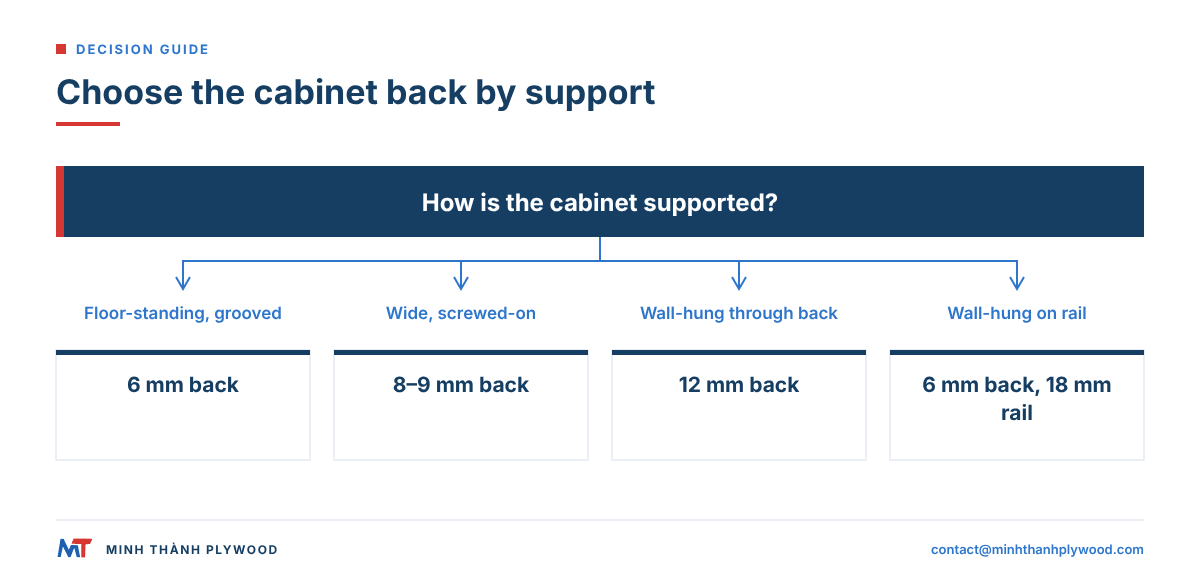
Use a 6 mm back when it sits in a groove and the cabinet stands on the floor, and a 12 mm back when the cabinet hangs on the wall through it. A 6 mm back captured on four sides squares the box; it is not meant to carry the cabinet’s weight on screws.
| Back type | Thickness | When to use it |
|---|---|---|
| Grooved back | 6 mm | Base cabinets, tall cabinets, wardrobes standing on the floor |
| Screwed-on back | 8–9 mm | Wide wardrobes and cabinets without a back groove |
| Hanging back | 12 mm | Wall cabinets screwed to the wall through the back, no hanging rail |
| Hanging rail plus thin back | 6 mm back, 18 mm rail | Wall cabinets on rail hangers |
A 1220 × 2440 mm sheet of 6 mm yields six backs of 600 × 720 mm, the size of a standard base cabinet back, with a strip left over.
How many cabinet parts can you cut from one sheet?
From three 1220 × 2440 mm sheets of 18 mm plywood you can cut the sides, bottoms and rails of six 600 mm base carcasses. The worked example uses a frameless base cabinet 600 mm wide, 720 mm high and 560 mm deep:
| Part | Size | Per sheet of 1220 × 2440 mm | For six carcasses |
|---|---|---|---|
| Sides | 720 × 560 mm | 6 (three rows of two) | 12 parts, 2 sheets |
| Rails | 564 × 100 mm | 7 from the offcut strips of a side sheet | 12 parts, from the same 2 sheets |
| Bottoms | 564 × 560 mm | 8 (four rows of two) | 6 parts, 1 sheet with 2 to spare |
| Backs, 6 mm | 600 × 720 mm | 6 | 6 parts, 1 sheet of 6 mm |
Wall cabinets of 600 × 720 × 320 mm work out at five carcasses from two sheets of 18 mm: sides at 720 × 320 mm, tops and bottoms at 564 × 320 mm, cut from strips ripped along the sheet.
Sheet size changes yield. A 1250 × 2500 mm sheet has about 5% more area than 1220 × 2440 mm and fits metric cutting plans with less waste. Cut-to-size goes further: Minh Thanh cuts one panel into 4, 6 or 8 pieces and ships cut-to-size orders regularly to Italy and other European markets, so the parts arrive ready for edge banding.
Which core should each cabinet part use?
Choose the core by what the part does. Minh Thanh uses white Styrax and Eucalyptus cores as standard for furniture panels, and makes Acacia and Pine cores on order.
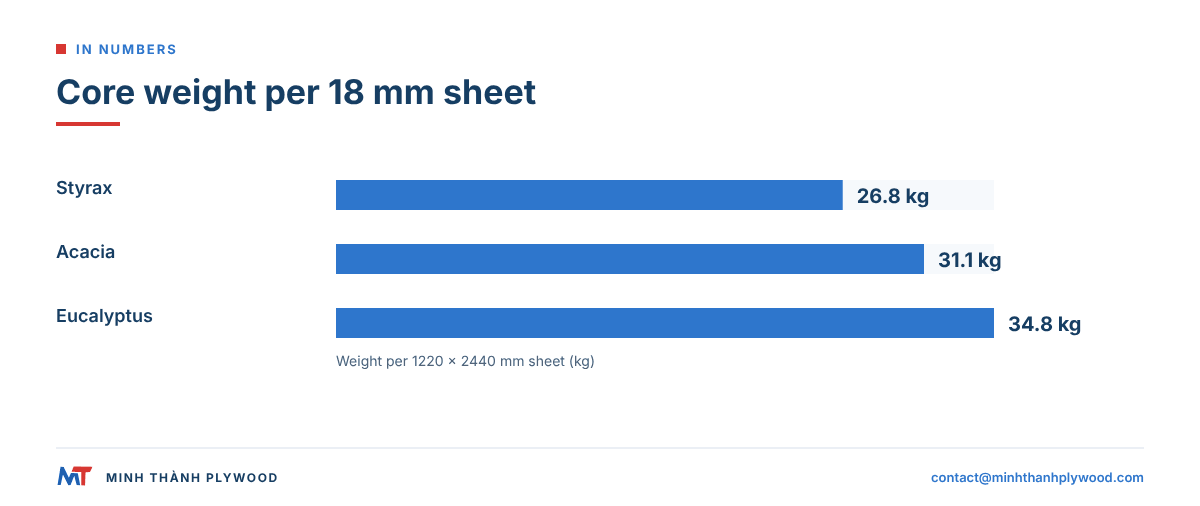
| Core | Reference density | 18 mm sheet weight | Best cabinet parts |
|---|---|---|---|
| Styrax | 500 kg/m³ | about 26.8 kg | Wall cabinets, doors, exposed-edge drawers and carcasses, anything lifted onto a wall |
| Acacia | 580 kg/m³ | about 31.1 kg | Middle choice for base carcasses |
| Eucalyptus | 650 kg/m³ | about 34.8 kg | Base carcasses that carry stone worktops, heavy shelves, hinge-side panels that are adjusted often |
A wall cabinet in Styrax 18 mm is about 8 kg lighter per sheet used than the same cabinet in Eucalyptus, which matters to the installer holding it up and to the wall fixings. Many European furniture buyers choose Styrax for that reason and for its pale, clean edge.
On furniture panels the core veneers are stitched horizontally and vertically, so the core has no open gaps between pieces. That is what lets a confirmat screw or a hinge screw bite into solid wood wherever it lands, and what keeps a lacquered face free of telegraphed joints.
Which face and grade for each cabinet part?
Face and grade follow what the customer sees. Grades are quoted as face/back pairs and fixed by the approved sample:
| Part | Seen from | Suggested face and grade |
|---|---|---|
| Doors and drawer fronts | Front, and the back when open | Birch D+/D (close to B/BB) for clear lacquer; poplar B/B under paint or laminate |
| Carcass sides | Inside, and outside on end panels | Birch D/D (close to BB/BB) or poplar A/B; end panels to match the doors |
| Shelves | Both faces and the front edge | Birch D/D or poplar A/A |
| Drawer boxes | Inside and the top edge | Birch D/D on Styrax for exposed edges |
| Backs | Inside only | Poplar B/B or birch D/E |
Birch faces are imported veneer laid on a Vietnamese core, so the panel is birch-faced plywood with a Styrax or Eucalyptus core. Minh Thanh makes 10+ face veneers, most often engineered veneer (EV), poplar, birch, okoume and pine. Both faces of furniture panels are sanded, polished and UV-ready, so a cabinet plant can roll its own UV coating directly onto the panel. The birch plywood for cabinets guide compares birch faces in detail.
Which glue, emission class and moisture content for kitchen and bath cabinets?
For cabinet carcasses, doors and shelves in dry rooms, the standard is UF glue at E0 emission. Sink bases, bathroom vanities and laundry cabinets get a melamine-fortified (MR) or phenolic (WBP) bond, made to the buyer’s specification. Glue and emission class are two separate lines on the order.
Emission matters most in kitchens, because cabinets fill a closed room. Minh Thanh’s proof for European and US buyers:
- CARB P2 / TSCA Title VI certification for veneer-core hardwood plywood, ICTT mill no. 23024, 3–50 mm. The rules are the US EPA formaldehyde emission standards for composite wood products (checked October 2026).
- Six ASTM D6007 chamber tests between April 2025 and June 2026 on 9, 15 and 18 mm panels averaged 0.014–0.032 ppm against the 0.05 ppm CARB Phase 2 / TSCA Title VI limit; three by Shanghai Hongjun and three by ICTT Vietnam. The limit for hardwood plywood with a veneer core is set in 40 CFR 770.10.
- E0 tested every three months, and third-party tests to EN 717-1 or another method through SGS on request.
Veneers and finished panels are dried to 8–12 % moisture content at dispatch, the normal range for furniture plywood, so cabinet parts stay flat when they reach a heated European kitchen. The moisture-resistant plywood for sink and vanity cabinets guide covers wet zones.
Can you use Baltic birch or formwork plywood for cabinets?
Baltic birch is a good cabinet plywood for exposed-edge drawers and boxes; formwork plywood is not a cabinet plywood at all.
Baltic birch is all-birch plywood with many thin plies. It is valued for its pale edge and its strength in drawer joints. Birch-faced plywood on a stitched Styrax core gives a similar pale face and a pale edge, at about 500 kg/m³ it is lighter, and it is held to ±0.2–0.3 mm. For cabinet plants that lacquer or band their edges, that is often the better-value panel.
Formwork plywood is film-faced: a phenolic film surface, a WBP phenolic bond, a ±0.5 mm tolerance and dark glue lines on the edge. It is built to be stripped from concrete and reused, so it does not take lacquer, paint or edge banding the way a sanded furniture face does. Use it for site work, not kitchens.
The full comparison of cabinet panels, including MDF and melamine boards, is in the plywood for kitchen cabinets guide.
How do you order 18, 12 and 6 mm cabinet plywood in one container?
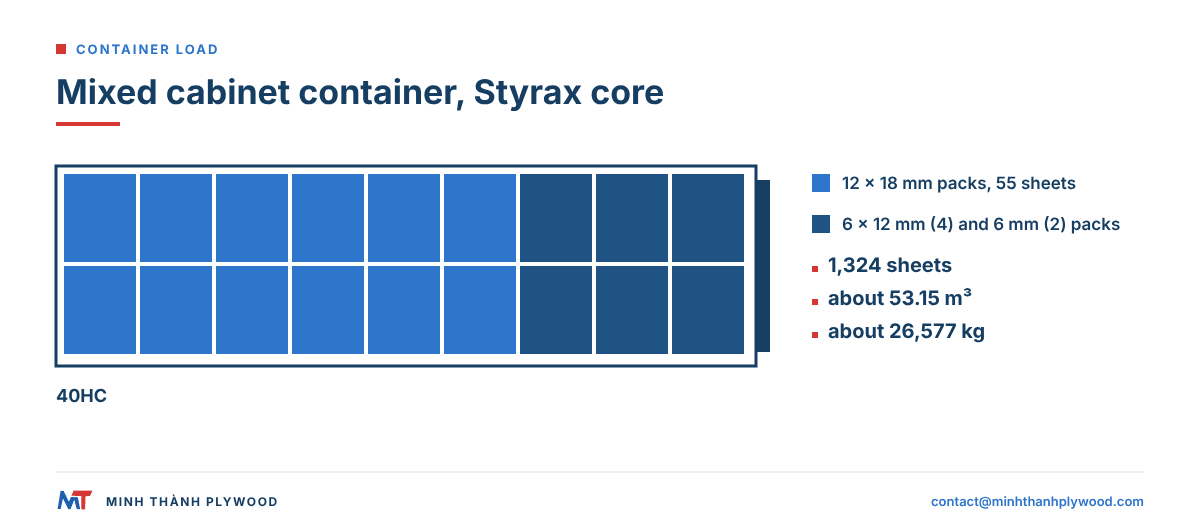
A cabinet programme needs three thicknesses, and one 40HC can carry them together by agreement. Packs are about 1,000 mm high, so a pack holds 55 sheets of 18 mm, 83 of 12 mm or 166 of 6 mm; a Styrax-core container holds 18 packs.
| Thickness | Full 40HC, Styrax core | Example mix, Styrax core | Sheets in the mix |
|---|---|---|---|
| 18 mm | 990 sheets | 12 packs | 660 |
| 12 mm | 1,494 sheets | 4 packs | 332 |
| 6 mm | 2,988 sheets | 2 packs | 332 |
| Total | — | 18 packs | 1,324 sheets, about 53.15 m³, about 26,577 kg |
The mix stays under the 28,000 kg planning payload. A container usually carries one or two specifications, and three to six by agreement when volumes justify it. The container packing calculator checks your own mix and payload.
How do you write cabinet plywood lines on a quotation request?
Write one line per thickness, each with everything that changes the panel or the price:
18 mm furniture plywood, birch face D+/D, Styrax core, UF glue at E0, CARB P2 / TSCA Title VI, sanded both sides UV-ready, 1220 × 2440 mm, ±0.2 mm, 8–12 % moisture, 12 packs.
12 mm furniture plywood, birch face D/D, Styrax core, UF glue at E0, same certification and finish, 1220 × 2440 mm, ±0.2 mm, 4 packs.
6 mm furniture plywood, poplar face B/B, Styrax core, UF glue at E0, 1220 × 2440 mm, ±0.2 mm, 2 packs. Export packing, 1×40HC, FOB Hai Phong.
Then the order runs in steps: free samples of each face and grade; a 30% deposit and 15–45 days of production; inspection of thickness, face and moisture before loading, photographed and filmed for you; the 70% balance against the scanned B/L or by irrevocable L/C at sight. Documents include the commercial invoice, packing list, B/L, certificate of origin (EUR.1 for the EU), phytosanitary and fumigation certificates, and the CARB P2 / TSCA files, test reports and EUDR compliance dossier on order.
Indicative starting price, October 2026: furniture and interior plywood from US$350/m³. Typical days at sea from Hai Phong are 25–35 to the Mediterranean, 30–40 to Northern Europe, 20–30 to the US West Coast and 35–45 to the US East Coast.
Buyer questions, answered
What thickness plywood for cabinets?
18 mm (3/4 inch) for cabinet sides, tops, bottoms, fixed shelves, doors and drawer fronts; 12 mm (1/2 inch) for drawer boxes; 6 mm (1/4 inch) for backs in grooves and drawer bottoms.
Should I use 1/2 or 3/4 plywood for cabinets?
Use 3/4 inch (18 mm) for the carcass, shelves and doors, because hinge and runner screws need the depth. Use 1/2 inch (12 mm) for drawer boxes and for backs that hang the cabinet on a wall.
What thickness of plywood is best for cabinet boxes?
18 mm. It holds hinge plates, drawer runners and confirmat screws, keeps a wide box square and resists sag in fixed shelves; 15 mm is used for light wall cabinets and wardrobe interiors.
What thickness plywood for cabinet doors?
18 mm for slab and veneered doors, because concealed cup hinges are designed for doors of about 16–22 mm. Thinner door panels of 6–9 mm sit inside a solid frame on shaker doors.
Is 3/4 plywood really 3/4 inch thick?
Usually not. Most North American 3/4 sheets measure 23/32 inch, about 18.3 mm. Metric cabinet plywood is 18 mm, held by Minh Thanh to ±0.2–0.3 mm.
How thick should plywood shelves be?
18 mm for most kitchen and wardrobe shelves. A 15 mm shelf sags the same as 18 mm at about 87% of the span, a 12 mm shelf at about 74%; use 20 or 25 mm or add a front lip for long spans.
What is the best plywood for cabinets?
Sanded furniture plywood with a stitched, void-free core, a tight thickness tolerance and low-emission glue, for example 18 mm birch-faced on a Styrax core, UF glue at E0, CARB P2 / TSCA Title VI certified.
Is Baltic birch the best plywood for cabinets?
Baltic birch is one good choice for exposed-edge drawers. Birch-faced plywood on a stitched Styrax core gives a similar pale face and edge, is lighter, and is held to the same tight tolerance.
Can I use formwork plywood for cabinets?
No. Film-faced formwork plywood has a phenolic film surface, a ±0.5 mm tolerance and dark glue lines, so it does not take lacquer or edge banding like sanded furniture plywood.
How many cabinets can I build from one sheet of plywood?
From three 1220 × 2440 mm sheets of 18 mm you can cut the sides, bottoms and rails of six 600 mm base carcasses, and two sheets give five 600 mm wall carcasses.
Can I order 18 mm, 12 mm and 6 mm cabinet plywood in one container?
Yes, by agreement. For example 12 packs of 18 mm, 4 of 12 mm and 2 of 6 mm on Styrax cores load 1,324 sheets in one 40HC, about 26,577 kg.
What thickness plywood for a cabinet back?
6 mm (1/4 inch) when the back sits in a groove and the cabinet stands on the floor; 12 mm (1/2 inch) when the cabinet hangs on the wall through its back.