
Good plywood for cabinet doors is 18 mm, balanced (same face species and finish on both sides), calibrated flat, and dry at delivery. Slab doors, shaker panels and veneered fronts all start there; the face is chosen for the finish. Minh Thanh Plywood, a Vietnamese maker of furniture plywood, explains how to keep plywood kitchen doors flat, how they compare with MDF, and how to write the order.
Plywood for cabinet doors: the short answer
The plywood for cabinet doors that stays flat is 18 mm thick, balanced and dry. Balanced means the same face species, grade and finish on both sides, so the door takes in and loses moisture evenly; dry means it arrives at a normal furniture moisture content and is stored flat until it is machined.
From there, the face decides the look:
- Birch for clear-finished and painted doors.
- Engineered veneer (EV) for matched wood patterns across a run of doors.
- Poplar for painted doors at lower cost.
- Eucalyptus, okoume or pine for warmer or more rustic wood looks.
Slab doors, shaker doors and veneered fronts all use the same panel rules; only the joinery changes.
Why do plywood cabinet doors warp, and what keeps them flat?
Plywood doors warp when one face takes in or loses more moisture than the other. The usual causes are an unequal finish (three coats on the front, none on the back), a door stored leaning against a wall, or a panel that arrived wet and dried unevenly in the shop.
Five things keep a plywood door flat:
- A balanced build. Face and back in the same species and similar thickness, around a symmetrical core.
- Even pressing. Our furniture panels are pressed twice: the core board is pressed and calibrated, then face and back are pressed on. A calibrated core gives the faces a flat base.
- Dry stock. Veneers and finished panels are dried to 8–12 % moisture content at dispatch, the normal range for furniture plywood.
- The same finish both sides, coat for coat.
- Flat storage on level bearers, under cover, before and after machining.
Plywood starts with an advantage: its cross plies resist movement in both directions, so a balanced plywood slab moves far less than a glued-up solid wood panel of the same size.
What thickness plywood for cabinet doors?
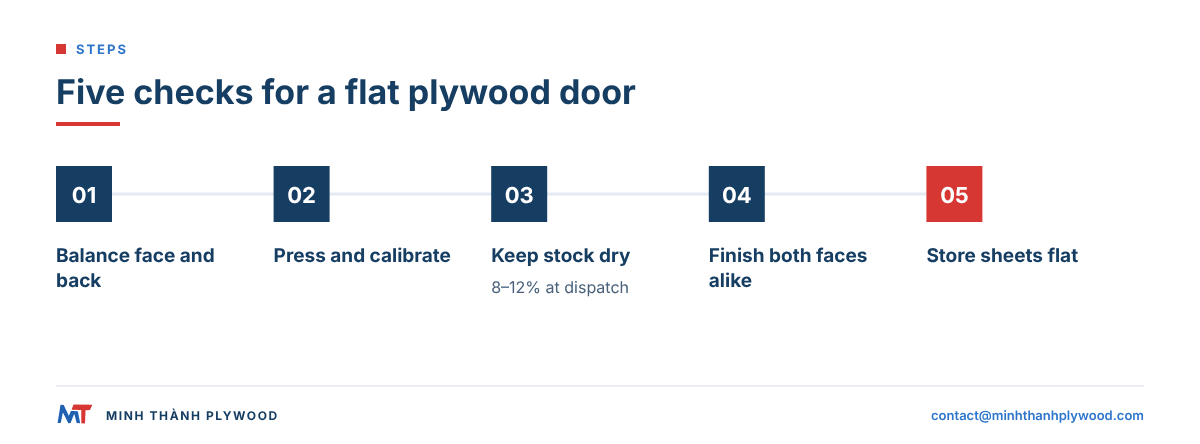
Use 18 mm (3/4 in) plywood for slab cabinet doors and drawer fronts. It matches the hinge cup depth and the screw lengths most concealed hinges are made for, and it is stiff enough to stay flat over a normal base or wall door.
| Door type | Plywood thickness | Notes |
|---|---|---|
| Slab door, base and wall units | 18 mm | The standard; matches most concealed hinges |
| Drawer front | 18 mm | Same panel as the doors, so grain and colour match |
| Tall slab door (larder, wardrobe) | 18–21 mm | Add a third hinge; consider a balancing strip |
| Shaker door frame | 18 mm | Plywood or solid wood rails and stiles |
| Shaker centre panel | 6 mm | Captured in a groove in the frame |
| Glass-front frame | 18 mm | Frame only; rebate for the glass |
Width and hinge boring are the next two numbers to fix. Keep a plywood slab door to about 600 mm (24 in) wide or less: US made-to-size door makers such as Barker Door cap slab doors at 24 in wide, because a wider single leaf bows more and carries more hinge load.
Concealed hinges use a 35 mm cup, bored 63–102 mm (2.5–4 in) from the top and bottom edges, with 89 mm (3.5 in) the standard position, and a third cup in the centre for a tall door. Fix the boring distance once and use it on every door, so hinge plates line up across the kitchen.
Check your hinge maker’s minimum door thickness before you settle the line; some inset and thin-door hinges are made for 15–16 mm fronts.
Veneer, laminate or paint-grade: which plywood face for doors?
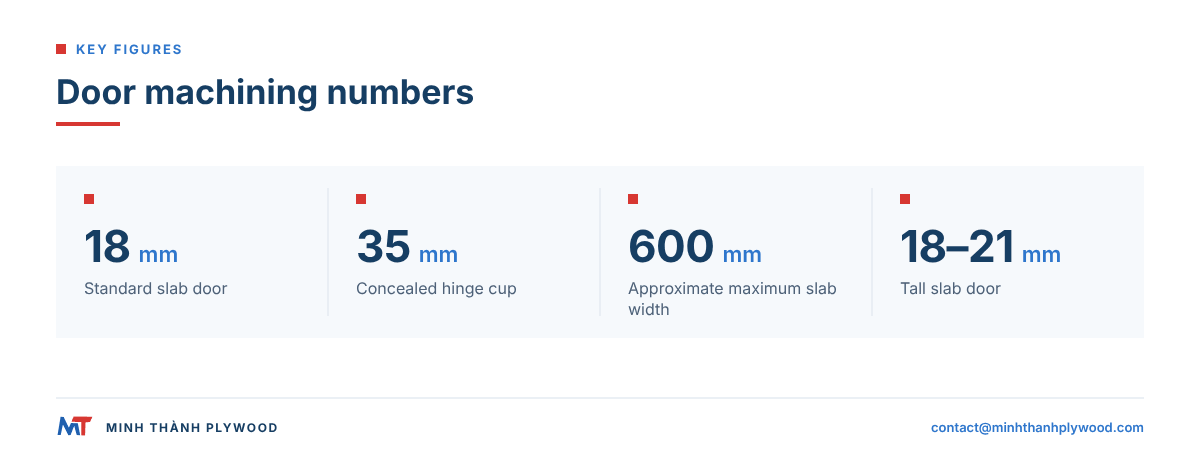
Choose the face for the finish the door will have. The panel underneath can stay the same.
| Door finish | Face to order | Why |
|---|---|---|
| Clear lacquer, natural wood | Birch D+/D, EV, eucalyptus A/A | Even, clean faces that look good under a clear coat |
| Stain | EV, or birch with a conditioner | EV takes stain more evenly; birch can blotch |
| Paint | Birch D/D, poplar A/B | Smooth, closed-grain faces that hide under primer |
| High-pressure laminate or veneer overlay | Poplar or birch B/B | The overlay hides the face; flatness matters more |
| UV coating | Any sanded face | Our faces are UV-ready on both sides for your own line |
For laminate overlays, press the same laminate or a matching balancer on the back. A laminate on one face only is the most common reason a slab door bows.
Which face grade for a plywood kitchen door?
A plywood kitchen door is the most-seen part of a kitchen, so order the top face grade for the front and a good back, because the back shows every time the door opens.
| Face | Grade pair for doors | Notes |
|---|---|---|
| Birch | D+/D (about B/BB) | Clear finish; D/D (about BB/BB) for paint |
| Poplar | A/A or A/B | Paint-grade fronts |
| Eucalyptus | A/A | Both faces seen; matched to the approved sample |
| Engineered veneer | Matched pattern both sides | Mark the pattern direction |
| Pine | A/A or A/B | Rustic and Nordic styles |
Grades are matched to the buyer’s approved sample. Keep one signed sample door of each face, and judge incoming sheets against it under the same light.
Plywood vs MDF cabinet doors
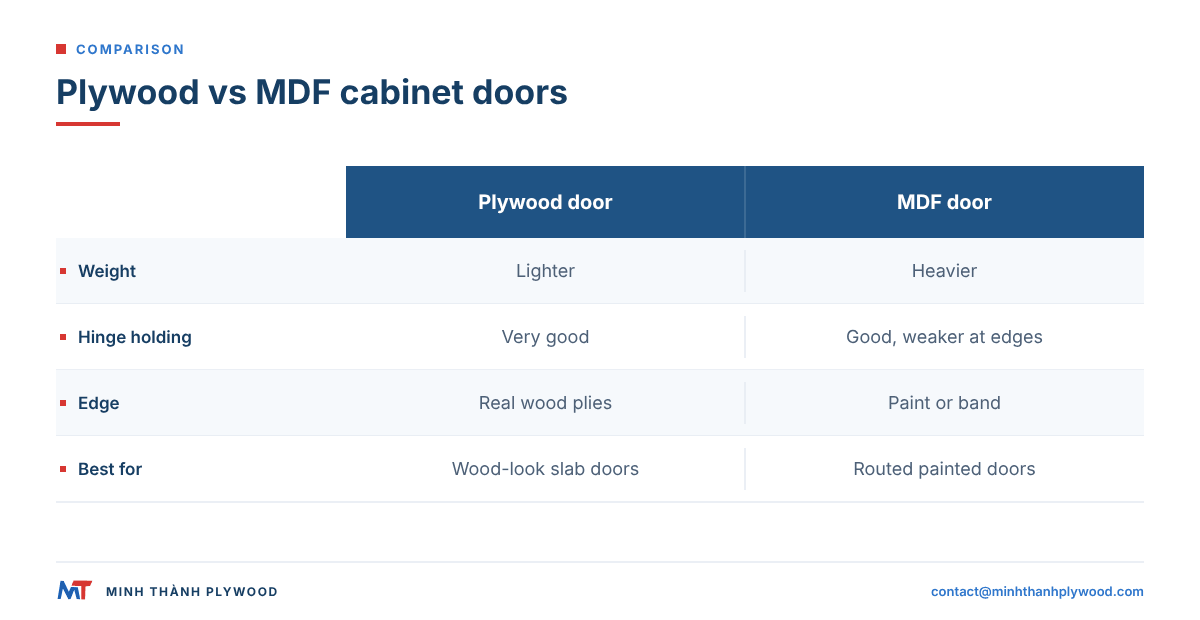
Plywood doors and MDF doors suit different kitchens. Plywood wins on weight, hinge holding and real wood edges; MDF wins on a dead-smooth painted face and routed profiles.
| Metric | Plywood door | MDF door |
|---|---|---|
| Weight at 18 mm | Lighter, by core species | Heavier |
| Hinge screw holding | Very good | Good, weaker near edges |
| Edge | Real wood plies; band or expose | Must be painted or banded |
| Routed profiles and handles | Possible; shows ply lines in the cut | Clean, the classic painted shaker |
| Painted face | Smooth after priming | Smoothest |
| Clear wood finish | Yes | No |
| Flatness | Good when balanced and finished both sides | Good |
| Water at the bottom edge | Swells slowly | Swells faster at a cut edge |
Verdict by use: plywood for wood-look slab doors, exposed-edge designs and long, light doors; MDF for routed, painted profile doors; plywood frame with an MDF or plywood centre panel for painted shakers. The plywood vs MDF guide compares the boards beyond doors.
How to make slab cabinet doors from plywood
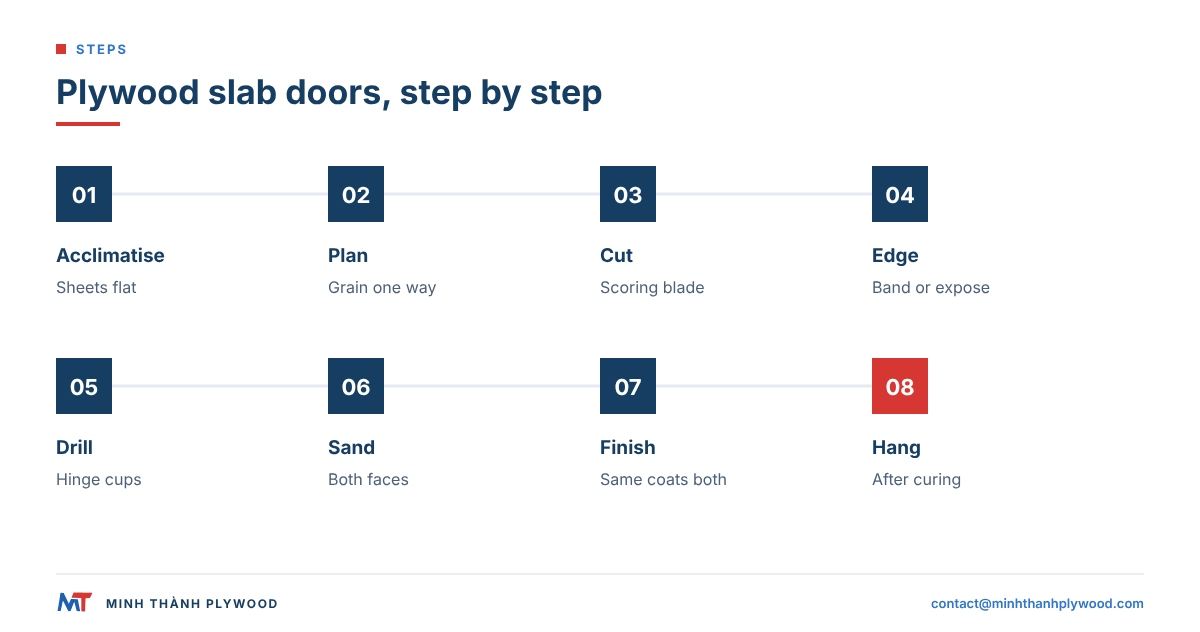
Slab doors are the simplest plywood door: one panel, edged and finished. A cabinet shop makes them in this order:
- Acclimatise the sheets flat in the shop for a few days before cutting.
- Plan the cut so doors and drawer fronts on one run come from the same sheet or pack, with the grain running the same way.
- Cut the doors to size on a panel saw or CNC, with a scoring blade to keep the face clean.
- Edge them: veneer banding, ABS for painted doors, or a sanded exposed edge.
- Drill the hinge cups and handle holes with a jig or on the CNC.
- Sand both faces and break the edges lightly.
- Finish both faces with the same coats, flat on racks, not leaning.
- Hang and adjust after the finish has cured.
For shaker doors, the frame is cut and jointed first and the 6 mm plywood panel slides into its groove before glue-up. A plywood panel does not shrink in the frame the way a solid panel does, so it needs no expansion gap.
Edges on plywood doors for kitchen cabinets
On plywood doors for kitchen cabinets, plan the edge before the panel, because the edge decides the face, the core and the finish line.
- Exposed ply edge: sanded and lacquered; looks best on all-birch panels with even plies. Chamfer slightly to stop chipping.
- Wood veneer banding: iron-on or hot-melt, in the face species; the usual edge for clear-finished doors.
- ABS or PVC banding: for painted and coloured doors; matches the paint.
- Solid wood lipping: glued on before finishing; takes knocks best on busy kitchens.
- Painted edge: fill and sand the edge with filler, prime it before the faces, so ply lines do not show through the topcoat.
Band before the finish goes on, so edge and faces take the same coats.
Flatness spec for plywood cabinet doors: how to write and check it
A flatness spec for plywood cabinet doors names the method, the condition and the limit, so supplier and buyer measure the same thing. Write it into the order and check it on the first sample, then repeat the check on each delivery.
- Condition: measure after the doors or panels have acclimatised in the room where they will be used, finished on both faces.
- Method: lay the door on a flat reference table, or stand it against a straight reference, and place a straightedge across both diagonals.
- Measure: read the largest gap under the straightedge with a feeler gauge.
- Limit: compare with the maximum bow agreed in the contract, set so your hinges can adjust it out.
- Sample size: check a fixed number of doors from each delivery, and record results by pack.
On the panel itself, two numbers support a flat door: thickness tolerance, which we hold to ±0.2–0.3 mm on sanded furniture panels, and moisture content of 8–12 % at dispatch. Panels that meet both, finished evenly, rarely fail a flatness check.
How do you fix warped plywood cabinet doors?
Fix a warped plywood door by removing the cause first, then the bow. Most bowed doors have an unfinished or under-finished back face.
- Check the back. If it is bare or has fewer coats, seal it to match the front, and lay the door flat with weights on the high points for a few days.
- Adjust the hinges. Concealed hinges adjust depth, height and side; a small bow often disappears at the closing line.
- Add a hinge. A third hinge in the middle of a tall door pulls the bow in.
- Fit a door straightener on the back of tall doors, or a hidden steel or aluminium strip in a routed slot.
- Remake it from flat, balanced stock if the bow is large. Use the same face on both sides and finish both evenly.
A door that keeps moving after these steps usually sits next to a heat or steam source, such as an oven or dishwasher; protect its edges and back with an extra coat.
Plywood kitchen cupboard doors: how many sheets, and what cost?
Count doors by sheet yield: lay out every door and drawer front on the sheet size you buy, 1220 × 2440 or 1250 × 2500 mm, keeping the grain the same way and runs on one sheet. Add a waste allowance for kerf, defects and a spare door.
What does a plywood door cost from a sheet?
A 1220 × 2440 mm sheet cut into slab doors gives these door counts and raw material cost per door, at US$350/m³ and 0.0536 m³ per 18 mm sheet (about US$19 raw FOB, before freight, duty and cutting):
| Slab door size | Doors per sheet | Raw FOB per door |
|---|---|---|
| 15 × 30 in (380 × 760 mm) | 9 | About US$2.1 |
| 18 × 30 in (460 × 760 mm) | 6 | About US$3.2 |
| 21 × 30 in (530 × 760 mm) | 6 | About US$3.2 |
The counts ignore kerf and defects, so plan on one door fewer per sheet for waste. The buyer’s alternatives sit well above that. Barker Door sells a made-to-size slab plywood door from US$29.95, adding US$30 for a height of 16–30 in and up to US$250 for 84–92 in, with species upcharges (alder US$25, red oak and maple US$35, walnut and sapele US$95, rift white oak US$125) and finishes at US$25–85 (read 21 October 2026).
For a prefinished sheet, Woodworkers Source lists a 3/4 in (18 mm) 4 × 8 ft prefinished UV2 birch sheet at US$95, and Berta sells 4 × 8 ft prefinished cabinet-grade sheets in birch or white melamine with 10 % off at ten sheets. A cabinet plant that cuts its own doors saves that margin per door.
Factory-direct furniture plywood from Vietnam starts from US$350/m³ (October 2026); the face, grade, core and quantity set the final price. Doors use the top face grades, so they cost more per sheet than carcass stock. A common way to save is to order top-grade faces only for door sheets and a lower grade for the boxes behind them, as our guide to plywood for cabinet boxes shows.
What this means for your cabinet door plywood order
Door sheets are a separate line from carcass sheets on the order, with their own face grade, sanding and packing. From us that means:
- Faces: birch D+, D or E; poplar, eucalyptus and pine A/A to B/B; engineered veneer patterns, among 10+ face veneers.
- Cores: white Styrax for light doors, eucalyptus for stiffer tall doors.
- Pressed twice, sanded and polished, UV-ready on both faces.
- Tolerance ±0.2–0.3 mm on sanded furniture panels.
- Sizes 1220 × 2440 and 1250 × 2500 mm, plus custom sizes and cut-to-size panels.
- MOQ one 40HC, mixed with carcass stock by agreement; production 15–45 days after the deposit; free samples.
Face grade names follow the North American hardwood plywood standard ANSI/HPVA HP-1 on many buyers’ drawings; the Decorative Hardwoods Association (formerly HPVA) publishes it, and we map our grades to the buyer’s approved sample. Our kitchen cabinet plywood buyer guide covers doors in the context of the whole kitchen.
How to specify plywood for cabinet doors on an RFQ
Send the door line on its own:
Plywood for cabinet doors, 18 mm, 1250 × 2500 mm, birch D+/D face/back, Styrax core, UF glue at E0 emission, pressed twice, sanded and polished both sides, tolerance ±0.2–0.3 mm, moisture 8–12 %, 6 packs, CIF your port.
Add the finish you will apply (lacquer, paint, UV, laminate), the door sizes or a cutting list if you want cut-to-size panels, and whether drawer fronts must match the doors. The furniture plywood product page lists the faces; we reply within hours.
Name the emission rule of the destination on the same line. The US limit for hardwood plywood with a veneer core is 0.05 ppm under 40 CFR 770.10, and the EU limit for furniture and wood-based articles is 0.062 mg/m³ from 6 August 2026 under Regulation (EU) 2023/1464. For EU delivery, ask for the origin records too: plywood under heading 4412 is a relevant product of Regulation (EU) 2023/1115.
Buyer questions, answered
What is the best plywood for cabinet doors?
An 18 mm sanded hardwood plywood with the same face species on both sides, a calibrated core and a tight thickness tolerance. Birch suits clear-finished and painted doors, engineered veneer suits patterned wood looks, and poplar suits painted doors on a budget.
What thickness plywood for cabinet doors?
18 mm (3/4 in) for slab doors and drawer fronts. Shaker doors use an 18 mm frame with a 6 mm centre panel. Tall slab doors may need 21 mm or a balancing strip on the back.
Do plywood cabinet doors warp?
They can, if the two faces are finished or stored differently, or the panel arrives wet. A balanced panel, the same coats on both faces, dry stock at 8–12 % moisture and flat storage keep plywood doors flat.
Are plywood cabinet doors better than MDF?
Plywood doors are lighter, hold hinge screws better and show real wood at the edge. MDF doors give a smoother painted face and routed profiles without visible grain. Choose plywood for wood-look and exposed-edge fronts, MDF for profiled painted doors.
How do you make slab cabinet doors from plywood?
Cut 18 mm plywood to the door size, edge it with veneer banding or leave the edge exposed, sand, drill the hinge cups, then finish both faces with the same number of coats. Hang and adjust once the finish has cured.
How do you fix warped plywood cabinet doors?
First check the finish: seal any bare back face so both faces match. Mild bows can be pulled out with hinge adjustment, a third hinge or a door straightener; a strongly bowed slab is usually remade from flat, balanced stock.
Can you paint plywood cabinet doors?
Yes. Fill and sand the edges, prime with a sanding sealer or primer, then apply two topcoats. Birch and poplar faces paint smoothly; open-grain faces need a grain filler for a glass-smooth finish.
What is a flatness spec for plywood cabinet doors?
A flatness spec names the method, the condition and the limit: the door lies on a flat table after acclimatising, a straightedge goes across both diagonals, and the gap is measured against a maximum bow agreed in the contract.
Can I use plywood for shaker cabinet doors?
Yes. Use 18 mm plywood or solid wood for the frame and a 6 mm plywood panel in the groove. The plywood panel stays flat and does not shrink in the frame like a solid wood panel.
What edge banding works on plywood cabinet doors?
Wood veneer banding matching the face, ABS or PVC banding for painted and coloured doors, or a lacquered exposed edge on all-birch panels. Band before finishing so the edge and faces take the same coats.
Is engineered veneer plywood good for kitchen doors?
Yes. Engineered veneer (EV) repeats the same grain pattern across every sheet, so a run of doors and drawer fronts matches. Mark the pattern direction on the cutting plan.