
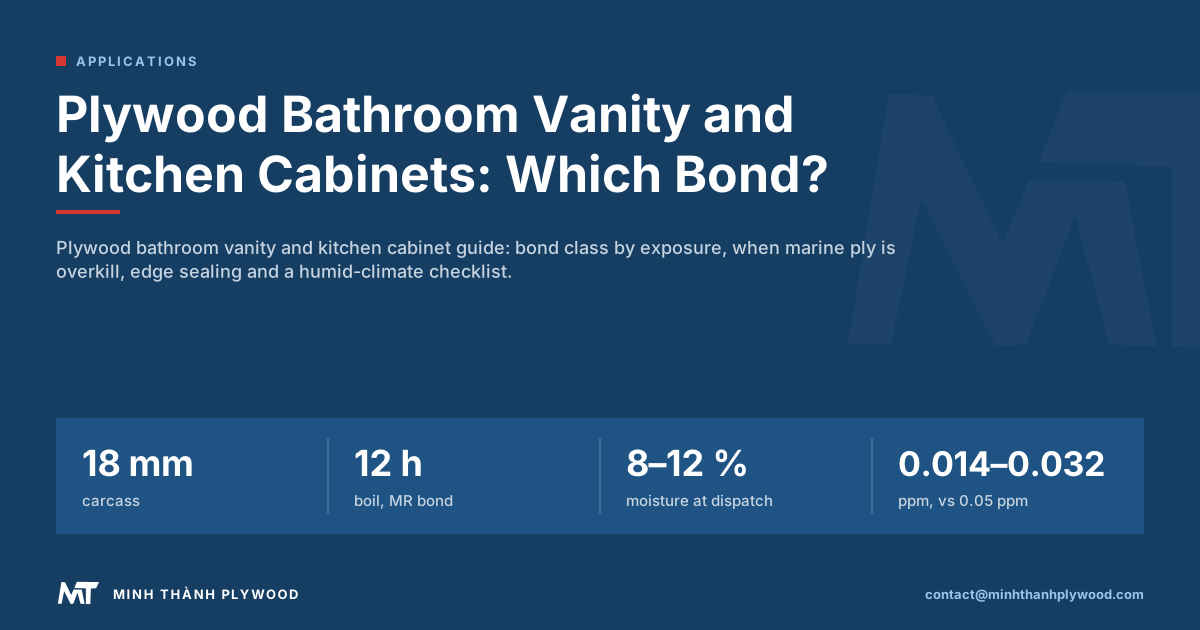
For a plywood bathroom vanity or a sink base, specify melamine-fortified (MR) bonded plywood with sealed edges and a moisture-resistant finish; it handles splashes, steam and humid air. Phenolic WBP or marine plywood is only needed where a cabinet can stand in water. Minh Thanh Plywood makes furniture plywood with UF, melamine-fortified and WBP bonds; this guide matches the bond to each cabinet part.
Plywood bathroom vanity: which plywood should you use?
Use melamine-fortified (MR) bonded plywood for a bathroom vanity, 18 mm thick for the carcass, with every edge sealed and both faces finished. That combination handles steam, splashes and daily wiping. Plain interior UF glue is too weak for the sink zone, and marine plywood adds cost without adding cabinet life.
A good vanity specification has five lines:
- Bond: melamine-fortified (MR), 12-hour boil class, or phenolic WBP for a wet-room floor plinth.
- Core: stitched hardwood core with no gaps, so water cannot travel inside the panel.
- Thickness: 18 mm for sides, base and doors; 9 to 12 mm for backs.
- Faces: sanded, ready for paint, lacquer, UV coating or laminate.
- Edges: sealed or banded on every cut.
The bond keeps the plies together when damp. The finish and the edge seal keep water out of the wood. Both matter, and buyers who only specify one usually get swollen edges after a year.
Plywood bathroom vanity sizes and how much plywood each takes
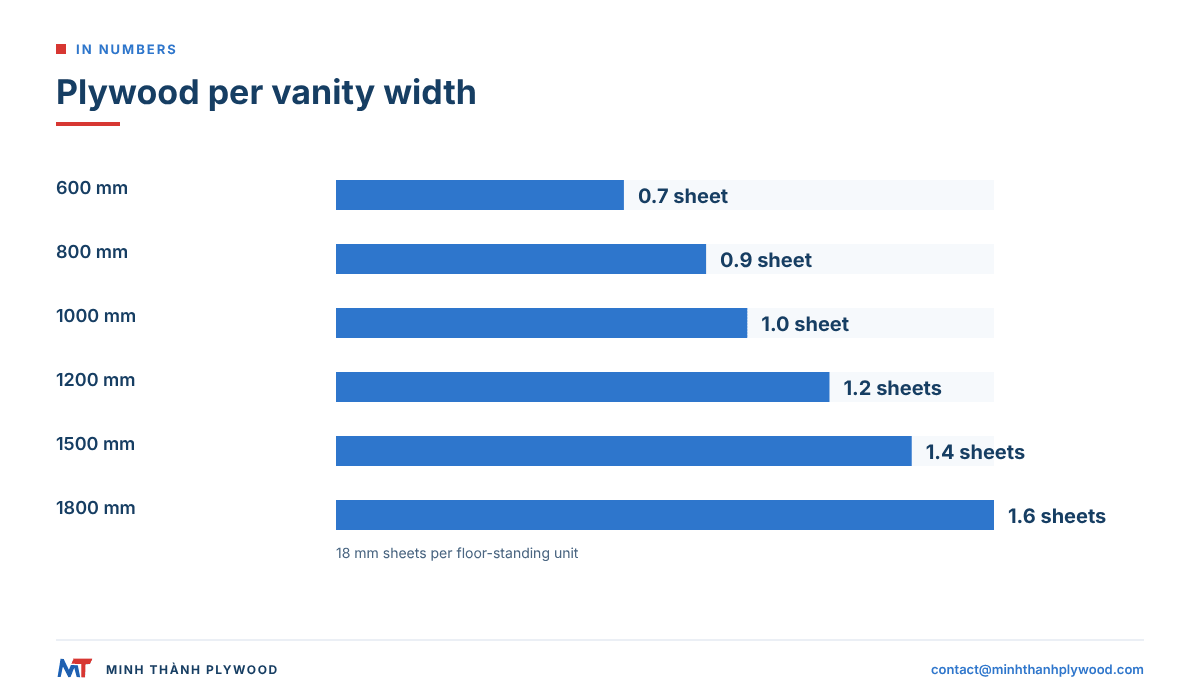
A plywood bathroom vanity comes in a fixed set of widths, and the width sets how much 18 mm plywood the cabinet maker cuts. Retailers such as Vanity-Plus list vanity units in a fixed set of widths. UK and European units are sold in 600, 800, 1000, 1200, 1500 and 1800 mm widths; US units come in 24, 30, 36, 48, 60 and 72 in. Single-basin units run up to about 1200 mm and double-basin units from 1200 to 1800 mm.
| Unit width | Nearest US width | Basin | 18 mm sheets of 1220 × 2440 mm per unit |
|---|---|---|---|
| 600 mm | 24 in | Single | 0.7 |
| 800 mm | 30 in | Single | 0.9 |
| 1000 mm | 36 in | Single | 1.0 |
| 1200 mm | 48 in | Single or double | 1.2 |
| 1500 mm | 60 in | Double | 1.4 |
| 1800 mm | 72 in | Double | 1.6 |
The sheet counts are a planning calculation for a floor-standing unit 450 mm deep and 850 mm high with two doors, one shelf and a top rail, plus 15 % for cutting waste. A wall-hung unit is lower, about 400–500 mm high, and uses a little less. Add a 9 mm back panel from a separate sheet.
Three styles sell in plywood, and each sets the face and edge:
- Exposed birch edge: a clear-lacquered birch face with the plies left showing on the door edge; order birch D+/D, sanded, with the edge sealed under lacquer.
- Painted: poplar or birch B/B faces, primed and painted, the lowest-cost route for white and coloured vanities.
- Oak-look: EV (engineered veneer) faces, so every door in a run carries the same grain.
What UK and EU buyers specify
For a UK vanity maker the terms are EN ones. BS EN 636 covers plywood for dry, humid or exterior conditions, and the glue bond is classified under EN 314-2. Part 2 of EN 636 covers humid conditions (service class 2) and part 3 exterior conditions. A bathroom vanity sits in the humid class, so order MR (melamine-fortified) glue for the carcass and write the EN 636 part on the order. BS 1088 is the marine standard and a vanity does not need it. State FSC on the enquiry if your customers ask for it.
Trade buyers can order 18 mm MR birch-face and poplar-face plywood by the 40HC from Minh Thanh Plywood, 30–40 days at sea from Hai Phong to Northern Europe, with free samples for a soak test.
Is plywood good for a bathroom vanity?
Plywood is one of the best materials for a bathroom vanity. Crossed veneers keep it flat, it holds hinge and drawer-runner screws through repeated damp cycles, and a water-resistant glue line stops the plies from separating.
The common alternatives fail in different ways:
| Material | Behaviour in a humid bathroom | Screw holding after damp | Best use in a vanity |
|---|---|---|---|
| MR-bonded plywood, sealed | Stays flat, edges stable when sealed | Good | Carcass, doors, shelves |
| WBP / phenolic plywood | Bond survives soaking | Good | Plinth, base near the floor drain |
| Standard MDF | Edges swell quickly when wet | Weak once swollen | Painted doors, kept dry |
| Moisture-resistant MDF | Better than standard MDF, still swells at cuts | Fair | Painted doors |
| Melamine-faced particleboard | Faces protected, raw edges absorb water | Weak once wet | Budget carcasses, dry zones |
| Solid timber | Moves with humidity, may split or cup | Good | Face frames, trims |
Our guide to melamine vs plywood cabinets compares carcass strength and cost in more detail.
Is plywood better than MDF for a bathroom vanity?
For the vanity box, plywood is better than MDF: it swells less, keeps its screw grip and is lighter for its strength. MDF is still useful for painted fronts, because it machines into profiles and takes paint smoothly.
Many cabinet makers combine the two. They build the carcass, base and shelves from MR plywood and use MDF only for profiled doors that stay above the splash zone. A plywood door works too, and gives a cleaner edge when the design shows the plies.
If the door sits below the basin, where water runs down, choose plywood with a sealed edge or a laminate-faced plywood door. The cut edge is where every board type fails first.
Which bond class fits each kitchen and bathroom cabinet part?
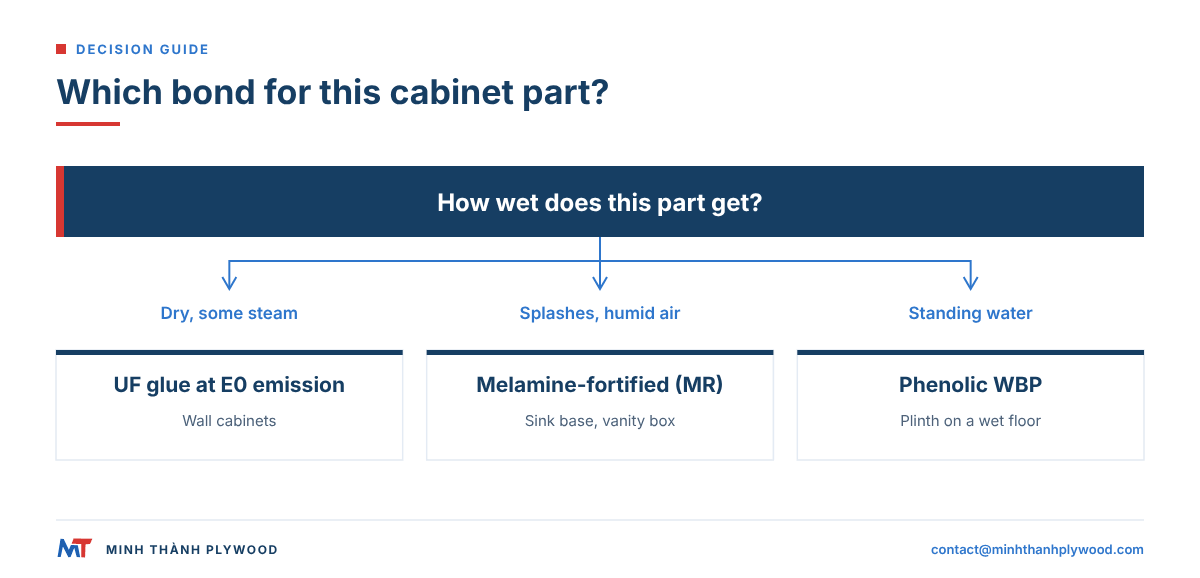
Match the bond to the real exposure of each part, not to the room. A wall cabinet in a ventilated kitchen is a dry part; a sink base and a vanity box are humid parts; a plinth on a wet-room floor is a wet part.
| Cabinet part | Real exposure | Bond to specify | Edge and finish |
|---|---|---|---|
| Kitchen wall cabinets | Dry, some steam | UF glue at E0 emission, or MR | Finished faces, banded front edge |
| Kitchen base cabinets | Spills, mopping at the plinth | MR (melamine-fortified) | Sealed bottom edges, banded fronts |
| Sink base | Leaks, condensation, wet cleaning | MR, or WBP for the base panel | All edges sealed, base lined or coated |
| Dishwasher flank | Hot steam when the door opens | MR, or WBP in coastal homes | Edge facing the dishwasher sealed, vapour shield fitted |
| Range and oven sides | Heat and grease | MR | Heat shield as the appliance maker requires |
| Bathroom vanity box | Steam, splashes, wet cleaning | MR | All edges sealed, interior finished |
| Bathroom wall cabinet | Steam | MR | Finished faces and edges |
| Plinth or toe kick | Floor water, mopping | WBP / phenolic | Sealed on all six sides |
| Countertop substrate under stone or laminate | Splashes at cut-outs | MR or WBP | Cut-outs sealed before fitting |
European specifications describe the same ladder with bond classes: Class 1 for dry interiors, Class 2 for humid interiors and Class 3 for exterior exposure, and EN 636 uses the same three service conditions for plywood. In practice, MR glue covers Class 2 parts and phenolic WBP covers Class 3. Ask for the bond in words on the order, not only a class number.
Marine ply kitchen: when is marine plywood overkill?
Marine plywood is overkill for nearly every kitchen. A marine ply kitchen costs more and weighs more, while the parts that fail in kitchens, the cut edges and the finish, fail just as fast on marine ply if they are left unsealed.
True marine plywood is made to BS 1088: a boil-proof bond, durable face and core species, very few core gaps and tight limits on defects. Those rules exist for boat hulls that sit in water for years. A cabinet only needs a bond that survives humidity and occasional wetting, a gap-free core and a sealed surface.
Marine plywood makes sense in three places:
- A cabinet on a boat, where the whole panel lives in damp air and salt spray.
- An outdoor kitchen without a roof.
- A base panel in a wet room that is flooded every time the floor is washed.
Everywhere else, MR-bonded furniture plywood with sealed edges gives the same cabinet life for less. For boat interiors and structures, see our marine plywood buying guide.
Laminated plywood for cabinet doors
Laminated plywood doors, with a high-pressure laminate (HPL) or melamine face pressed onto MR or WBP plywood, give a wipe-clean, water-resistant front for kitchens and bathrooms. The laminate seals the faces; the edge banding seals the edges.
How to build them well:
- Start from a flat, calibrated panel, so the laminate does not telegraph core joints or thickness steps.
- Laminate both faces, or use a balancing sheet on the back, so the door stays flat.
- Use a moisture-resistant adhesive for the laminate.
- Band all four edges with PVC or ABS, glued with a moisture-resistant hot-melt.
- Seal hinge cups before fitting hardware.
Our furniture panels are sanded and polished, with tight thickness and flat faces from double pressing, which is what a laminate press needs. Cabinet makers press their own laminate on them.
What makes a moisture-resistant core?
A moisture-resistant panel needs a core without gaps or overlaps, because water and glue failures start in the voids. The glue holds the plies; a solid core gives the glue full contact on every square centimetre.
Our cores are built for that:
- Core veneers stitched both horizontally and vertically, so joints stay closed in the press.
- Double pressing: the core board is pressed and calibrated first, then face and back are pressed on. That gives an even glue line under the face.
- White Styrax or Eucalyptus cores as standard. Styrax is about 500 kg/m³ and keeps a pale, clean edge; Eucalyptus at 650–750 kg/m³ is harder and heavier.
- 8–12 % moisture at dispatch, the normal range for furniture plywood, so panels start stable.
For a sink base or a vanity in a very humid market, Eucalyptus gives more screw grip and surface hardness. Styrax keeps the cabinet lighter and is easier to machine, and with an MR bond it performs well in kitchens and bathrooms.
Glue and emission: two separate lines on the order
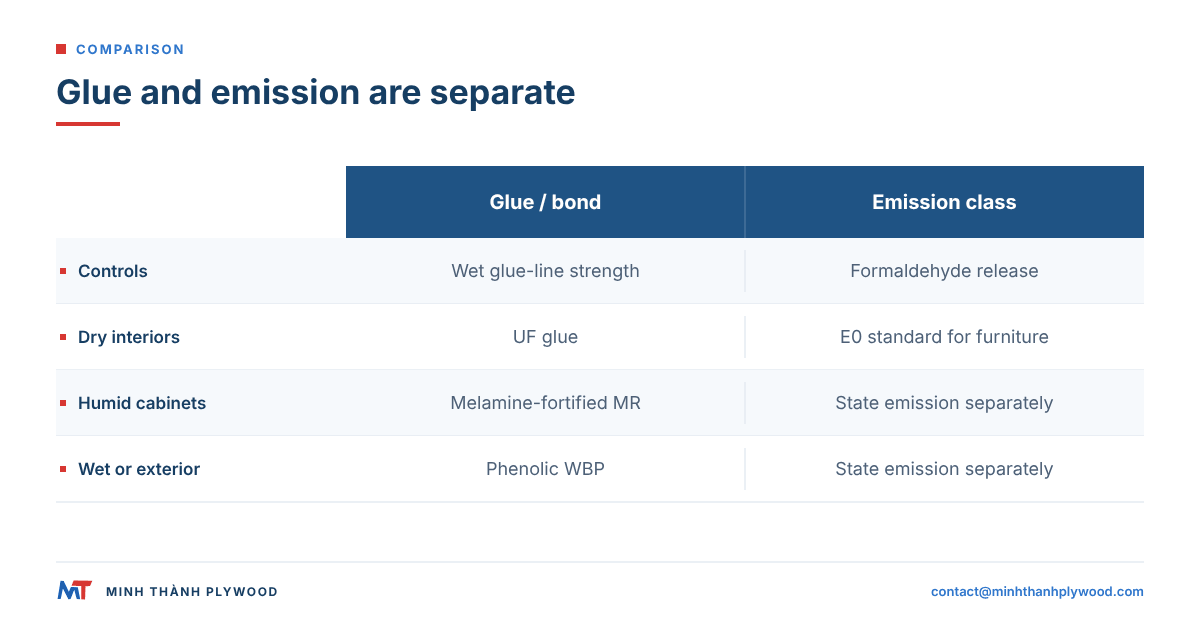
Glue type and emission class are two different specifications, and both belong on the order. The glue decides water resistance; the emission class decides how much formaldehyde the panel releases indoors.
| Order line | What it controls | Our options |
|---|---|---|
| Glue / bond | Strength of the glue line when wet | UF for dry rooms; melamine-fortified (MR) for kitchens and bathrooms; phenolic WBP for wet and exterior parts |
| Emission class | Formaldehyde released into the room | E0 standard for furniture; E1 to order |
| Proof of emission | Third-party evidence | CARB P2 / TSCA Title VI certification (ICTT mill no. 23024) and chamber tests |
A common mistake is to write “E0 glue” and assume it means water resistance. It does not. Furniture plywood made with UF glue at E0 emission is a dry-room panel. For a vanity, write “melamine-fortified glue, E0 emission” on two lines.
On emissions, our six ASTM D6007 chamber tests between April 2025 and June 2026, on 9, 15 and 18 mm panels, averaged 0.014–0.032 ppm. The limit for veneer-core hardwood plywood under CARB Phase 2 and TSCA Title VI is 0.05 ppm, set in 40 CFR 770.10. That matters in small, closed bathrooms where cabinets sit close to the user.
Edge sealing: where cabinets fail first
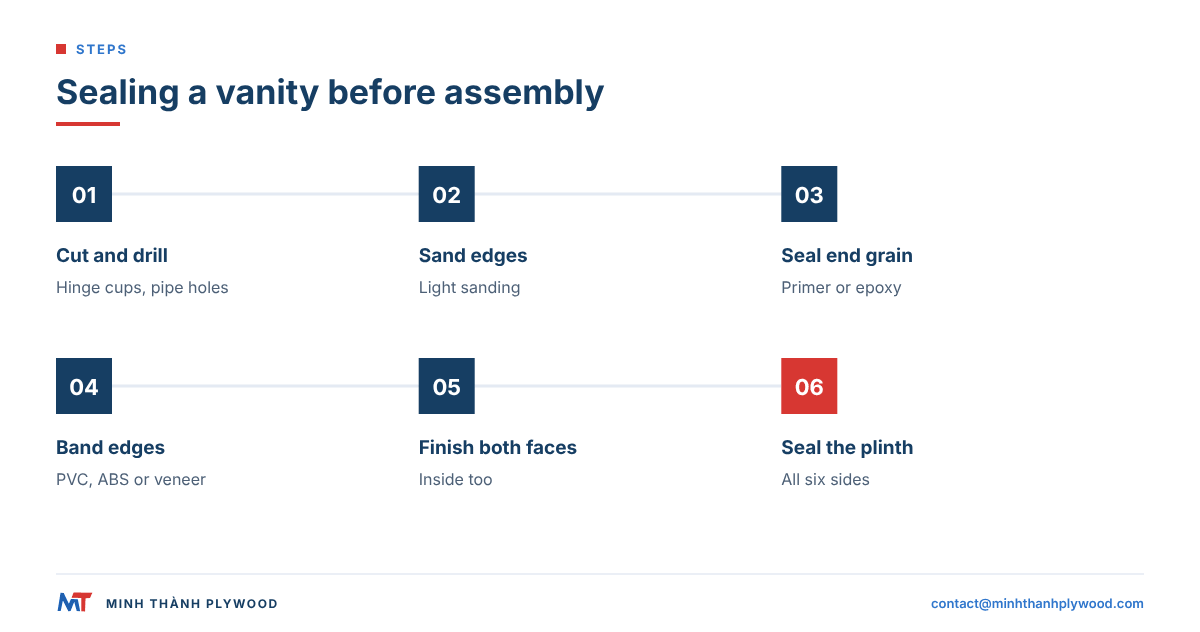
Seal every edge before assembly, because water enters plywood fastest through cut end grain. A face with a good finish can sit in steam for years; a raw edge on the floor of a sink base can swell after one leak.
Steps a cabinet shop can follow:
- Cut and drill first, including hinge cups, pipe holes and shelf-pin holes.
- Sand edges lightly so the sealer bonds.
- Seal end grain with primer, lacquer, epoxy or a sealing coat; give hinge cups and pipe holes the same treatment.
- Band the visible edges with PVC, ABS or veneer edge banding, glued with a moisture-resistant adhesive.
- Finish both faces, including the inside of the carcass, so the panel takes up and releases moisture evenly.
- Raise or seal the plinth, because floor water reaches it first.
The inside finish is often skipped. A panel finished only on the outside can cup as the raw inner face takes up moisture.
Plywood bathroom cabinet thickness and parts
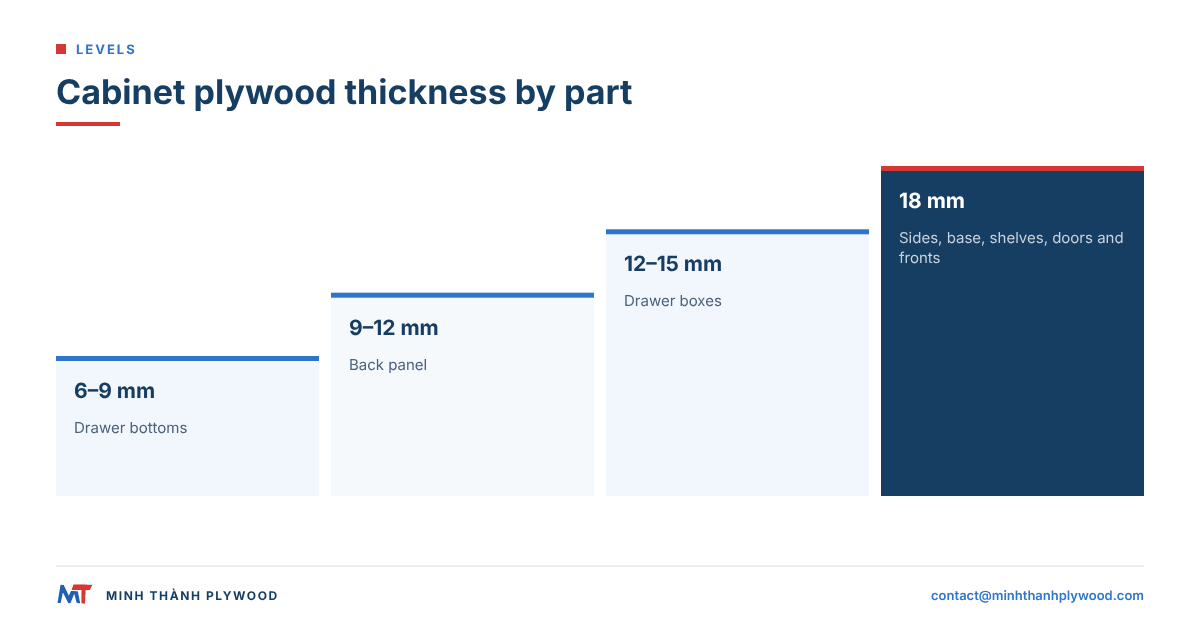
A plywood bathroom cabinet uses 18 mm for every structural part and thinner panels only where nothing hangs on them. The same rule works for kitchen boxes.
| Part | Thickness | Note |
|---|---|---|
| Sides, base, top rails | 18 mm | Holds hinges, runners and the basin |
| Fixed shelves | 18 mm | Thinner shelves sag under bottles and towels |
| Doors and drawer fronts | 18 mm | Keeps hinges secure; seal all edges |
| Back panel | 9 to 12 mm | Glued and screwed into a rebate |
| Drawer boxes | 12 to 15 mm | Thinner sides save weight |
| Drawer bottoms | 6 to 9 mm | Seal the underside too |
Weight helps installers plan wall fixings. An 18 mm sheet of 1220 × 2440 mm weighs about 26.8 kg on a Styrax core and about 34.8 kg on a Eucalyptus core. See our guide to plywood thickness for cabinets for kitchen parts.
Faces and finishes for bathroom vanities
Choose the face for the finish you will apply, then make sure the finish closes the surface. A painted, lacquered or laminated face protects the plywood; a raw face does not.
Common choices:
- Birch or poplar faces for painted and clear-lacquered vanities. Birch grades D+/D give a cleaner face for clear finishes.
- EV (engineered veneer) faces for an even colour across a run of doors.
- Okoume faces for warm-toned interior fronts; they are interior furniture panels, not marine plywood.
- Laminate or veneer overlays pressed by the cabinet maker, on a sanded face.
All our furniture faces are sanded and polished, with both sides ready for the customer’s own UV coating. Thickness tolerance on sanded furniture panels goes down to ±0.2 mm, which keeps door gaps even and edge banding flush.
How to check plywood on delivery
Check four things when cabinet plywood arrives: moisture, thickness, core and bond. Each takes minutes and settles most questions before cutting starts.
- Moisture: meter readings on several sheets should sit in the 8–12 % range.
- Thickness: caliper at several points; sanded furniture panels should be within ±0.2–0.3 mm.
- Core: look at the cut edge of a sample sheet for gaps and overlaps.
- Bond: cut a small offcut, boil it for longer than 6 hours, let it cool and try to split the plies with a chisel. MR and WBP glue lines hold; standard UF glue, which lasts about 6 hours, opens. For MR, the 12-hour boil specification is the reference.
Every Minh Thanh shipment is photographed and filmed before loading, and buyers receive the photos and video. That record shows packs, labels and panel faces as they left the factory.
What this means for your order
Write the bond, emission, core, thickness and finish on separate lines, and order separate specifications for dry parts and humid parts if the volumes justify it. A mixed container can carry both.
For kitchen and bathroom cabinet makers, Minh Thanh Plywood offers:
- Furniture plywood from 3 to 40 mm on Styrax or Eucalyptus cores.
- Bonds: UF glue at E0 emission as standard; melamine-fortified (MR) and phenolic WBP made to your specification.
- Sizes: 1220 × 2440 mm and 1250 × 2500 mm, plus custom sizes and cut-to-size panels.
- Order terms: MOQ one 40HC with mixed specifications by agreement; production 15–45 days after the 30% deposit; FOB Hai Phong, CFR or CIF.
- Free samples for a soak test and a finishing trial.
For the full kitchen picture, read our plywood for kitchen cabinets guide and the guide to plywood for cabinet boxes.
Best plywood for kitchen cabinets in the Philippines and other humid climates
In the Philippines and other humid tropical markets, the best plywood for kitchen cabinets has a melamine-fortified or phenolic bond, a dense stitched core, 18 mm carcasses, sealed edges and a finished interior. Humidity stays high all year, so the panel must hold its bond and shape in air that never dries out.
“Marine plywood” in Philippine and Southeast Asian trade often means any water-resistant plywood, not BS 1088 material. The label alone does not tell you the glue, the core or the ply count. Ask the seller three questions and get the answers on the invoice:
- Which glue is in the panel? MR, phenolic WBP or plain UF.
- What is the core species and how many plies? An 18 mm panel with few, thick plies is weaker and more likely to have gaps.
- Is the core gap-free? Gaps hold water and let screws pull out.
For Singapore, Malaysia, Cambodia and coastal Vietnam the same checklist applies. Kitchens and bathrooms there also need ventilation: plywood with the right bond stays sound for many years, but a cabinet that never dries will grow mould on any material.
IS 710, IS 303, BWP, BWR and MR: what the labels mean
The labels on cabinet plywood in India, the Philippines and much of South and Southeast Asia come from Indian standards and local trade names. They describe the bond, and in the case of IS 710, a full marine construction.
| Label | What it means | Glue type | Cabinet use |
|---|---|---|---|
| MR (IS 303) | Moisture-resistant general-purpose plywood | Urea-formaldehyde based | Dry wall cabinets, wardrobes |
| BWR (IS 303) | Boiling-water-resistant grade | Melamine-urea or similar | Base cabinets, vanities |
| BWP (IS 303 or IS 710) | Boiling-water-proof bond | Phenol-formaldehyde | Sink bases, wet zones |
| Marine (IS 710) | Marine plywood construction with a BWP bond | Phenol-formaldehyde | Boats; sink bases in coastal homes |
| Marine (BS 1088) | British marine plywood standard | Phenolic, boil-proof | Boats; rarely needed in kitchens |
Labels and bonds do not line up exactly across markets. The Indian “MR” grade is a UF-based interior bond, while European and Vietnamese mills use “MR” for melamine-fortified glue that passes a 12-hour boil specification. Ask for the glue chemistry in words, and the test the panel passes, so you compare like with like.
Send your vanity or kitchen specification
A typical line for a UK vanity maker: “18 mm MR birch-face plywood for bathroom vanities, EN 636-2, E0 emission, 1220 × 2440 mm, plus 9 mm backs, one 40HC, CIF a UK port”. A typical line for a Philippines kitchen maker: “Furniture plywood for bathroom vanities, 18 mm, Eucalyptus core, melamine-fortified glue, E0 emission, birch face D+/D, sanded, 1220 × 2440 mm, plus 9 mm backs in the same spec, one 40HC, CIF Manila.” Send it through the contact page or to contact@minhthanhplywood.com; we reply within hours.
Buyer questions, answered
Is plywood good for a bathroom vanity?
Yes. Plywood holds screws and hinges well, stays flat and swells far less than standard MDF or particleboard when it gets wet. Use a melamine-fortified (MR) bond, seal every edge and finish the faces.
Is plywood better than MDF for a bathroom vanity?
For the carcass, yes: plywood resists swelling at cut edges and keeps screw grip after damp cycles. MDF still makes good painted doors because it machines smoothly, but a vanity box in plywood lasts longer.
Do I need marine plywood for kitchen cabinets?
No, not for normal kitchens. A melamine-fortified bond with sealed edges handles the sink base and humid air. Marine plywood (BS 1088) is built for boats and costs more without making a cabinet last longer.
What is the best plywood for kitchen cabinets in the Philippines?
A dense, well-stitched core with a melamine-fortified or phenolic bond, 18 mm for carcasses, sealed edges and a finished face. Ask for the glue type in writing, because the word marine is used for very different panels in local trade.
What glue should cabinet plywood have for a bathroom?
Melamine-fortified (MR) glue, which passes a 12-hour boil test, is the right bond for vanities and bathroom wall cabinets. Plain UF glue suits dry rooms only; phenolic WBP is for parts exposed to water or weather.
How do I protect plywood edges in a bathroom?
Seal every cut edge, drilled hole and hinge cup with paint, lacquer, epoxy or PVC/ABS edge banding before assembly. Raw edges take up water fastest, and most vanity failures start there.
What thickness plywood is used for a bathroom vanity?
18 mm for the sides, base, top rails and doors, and 9 to 12 mm for backs and drawer bottoms. Use 18 mm for any part that carries a basin or stone top.
Does E0 mean the plywood is moisture resistant?
No. E0 is a formaldehyde emission class, not a glue strength. A panel can be UF glue at E0 emission for dry rooms, or melamine-fortified at E0 emission for humid rooms; order both lines separately.
Can plywood cabinets go in a humid tropical climate?
Yes, with the right bond, sealed edges, a finished interior and panels delivered at 8–12 % moisture. Store sheets flat and wrapped on site so they do not take up moisture before assembly.
Is a plywood bathroom cabinet heavier than a particleboard one?
Usually lighter or similar, depending on the core. An 18 mm sheet of 1220 × 2440 mm on a Styrax core weighs about 26.8 kg, and on Eucalyptus about 34.8 kg.