
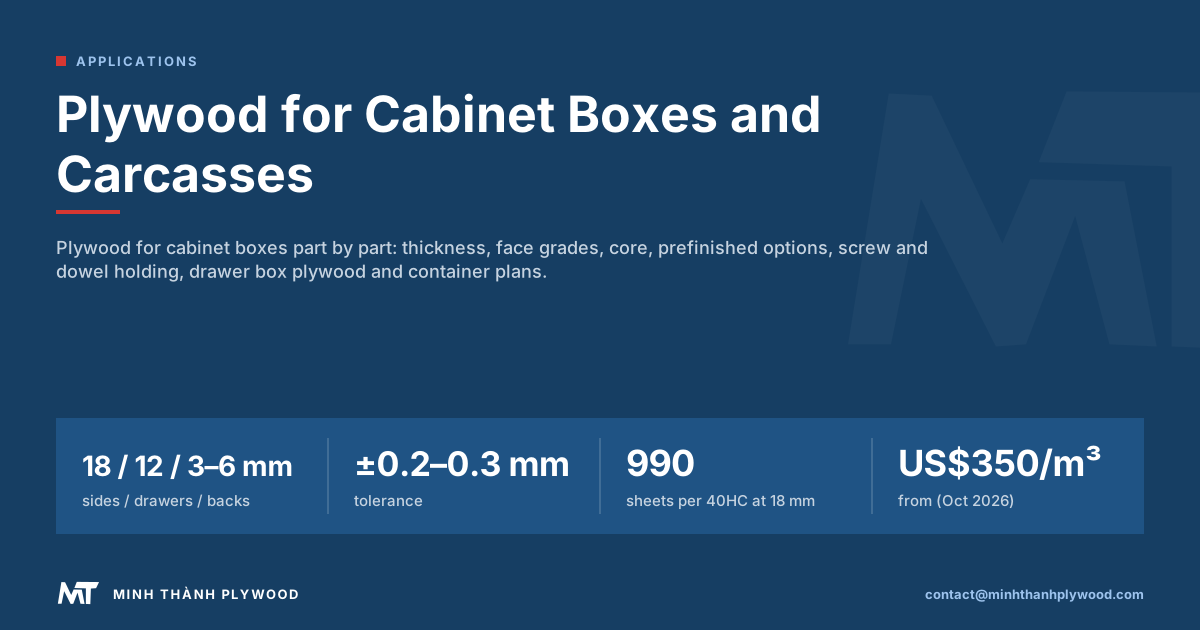
The best plywood for cabinet boxes is an 18 mm sanded panel with a good face on both sides, a dense, void-free core and a tight thickness tolerance, with 12–15 mm for drawer boxes and 3–6 mm for backs. Minh Thanh Plywood, a furniture plywood manufacturer in Vietnam, gives the carcass and drawer specification part by part, with face grades, cores and container plans for cabinet makers.
Plywood for cabinet boxes: the short answer
Plywood for cabinet boxes should be 18 mm, sanded, with a good face on both sides, a dense core without voids and a thickness tolerance tight enough for your joinery. That covers the sides, tops, bottoms and fixed shelves of base, wall and tall units. Thinner panels fill the rest: 12–15 mm for drawer boxes and 3–6 mm for backs and drawer bottoms.
A cabinet box, or carcass, is the part of the kitchen that carries every hinge, drawer runner and worktop. Customers never choose it, but they notice when it sags, swells or loses a hinge, so the box is where plywood earns its place over particleboard.
What do kitchen cabinet boxes need from plywood?
Kitchen cabinet boxes need plywood that holds fixings, stays square and keeps its size. Five properties decide that:
- Screw and connector holding, at the face and close to the edge, for hinges, runners and carcass connectors.
- Flatness, so gables stand straight and doors line up.
- Thickness tolerance, so every part fits the same dado, groove and hinge plate.
- Clean faces on both sides, because the inside of the box is seen.
- Resistance to the odd leak, especially in the sink base.
Plywood scores well on all five because its plies cross. The cross-grain layers grip a screw thread in every direction and hold the panel flat, and a leak swells plywood more slowly than particleboard.
Kitchen cupboard carcass: plywood spec by part
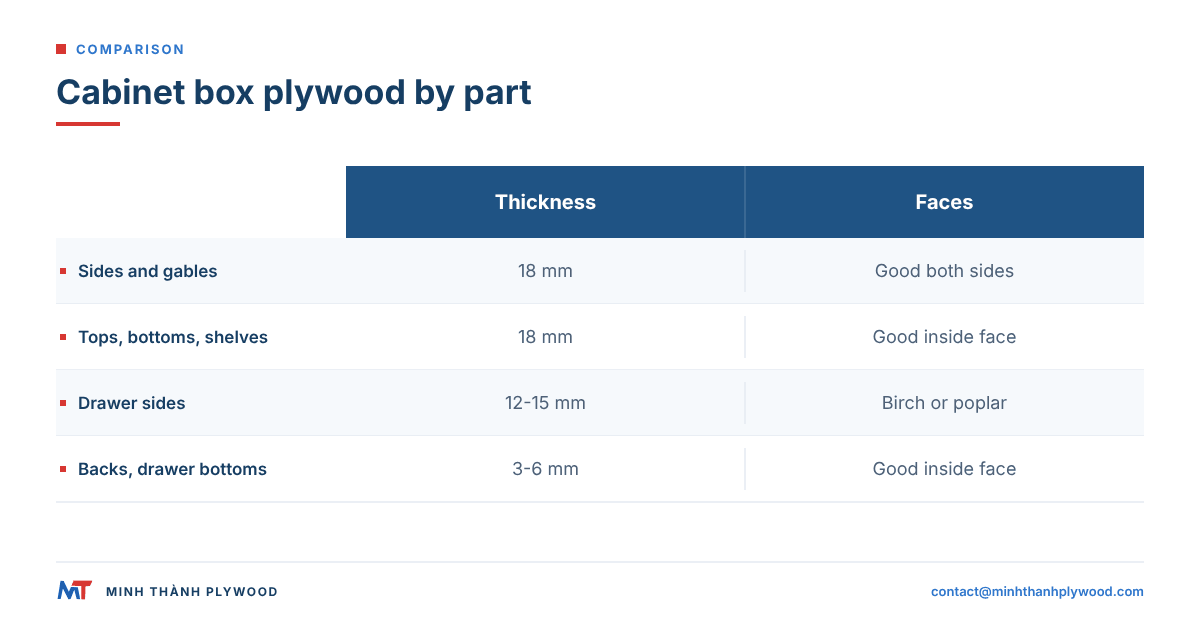
Specify each part of a kitchen cupboard carcass separately: thickness, faces and the fixings it carries. Base and tall unit sides, tops, bottoms and fixed shelves start at 18 mm, wall unit sides at 15–18 mm and backs at 3–6 mm. These are the starting points cabinet makers order from our 3–40 mm range.
| Part | Thickness | Faces | Carries | Notes |
|---|---|---|---|---|
| Base and tall unit sides (gables) | 18 mm | Good both sides; end gables top grade outside | Hinges, runners, connectors | The most loaded part of the box |
| Wall unit sides | 15–18 mm | Good both sides | Hinges, shelf pins | 18 mm if your hinge system expects it |
| Tops and bottoms | 18 mm | Good inside face | Connectors, worktop fixings | Bottom of a wall unit is seen from below |
| Fixed shelves | 18 mm | Good both sides | Load | Stiffens the box |
| Adjustable shelves | 18 mm | Good both sides, edged front | Load on pins | 18 mm up to about 800 mm between supports; 21–25 mm or a centre support beyond 800–900 mm or under heavy load |
| Backs | 3–6 mm | Good inside face | Squareness | Thicker if the back hangs the cabinet |
| Rails and stretchers | 18 mm | Hidden | Worktop fixing | Lower grade is fine |
| Toe kick / plinth | 18 mm | Seen from the front | Floor contact | MR bond near sinks and dishwashers |
Our thin 3–5 mm plywood is always five plies, so backs stay flat in their grooves rather than bowing between fixings.
Which face grade for the inside and outside of a box?
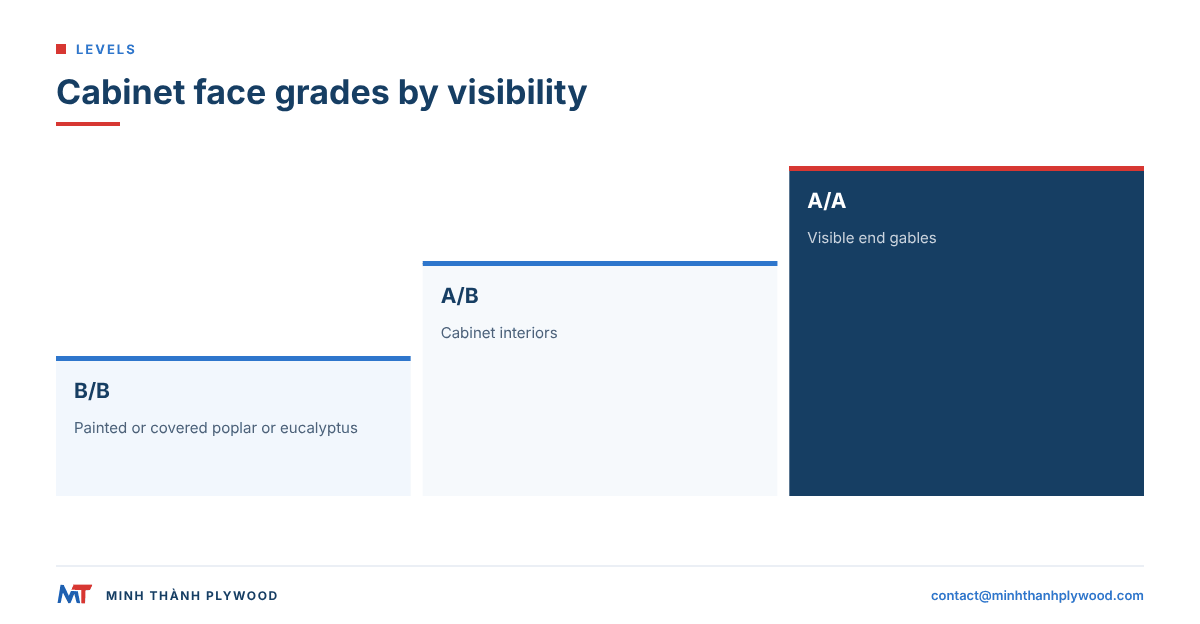
Order the face grade for the side that is seen most and the back grade for the other side. On a cabinet box both sides usually count: the inside shows whenever a door opens, and end gables show their outside face.
| Face species | Grade pairs we quote | Inside of the box | Visible end gables |
|---|---|---|---|
| Poplar | A/A, A/B, B/B | A/B or B/B, painted or clear | A/A, or painted |
| Birch | D+/D, D/D, D/E | D/D or D/E | D+/D (about B/BB) |
| Eucalyptus | A/A, A/B, B/B | A/B or B/B | A/A |
| Engineered veneer (EV) | To the approved pattern | Matched pattern both sides | Matched pattern |
Grades are matched to the buyer’s approved sample, so sign a sample of each face you order and keep it. The birch plywood for cabinets guide covers birch grades in more depth.
Which core works best for cabinet boxes?
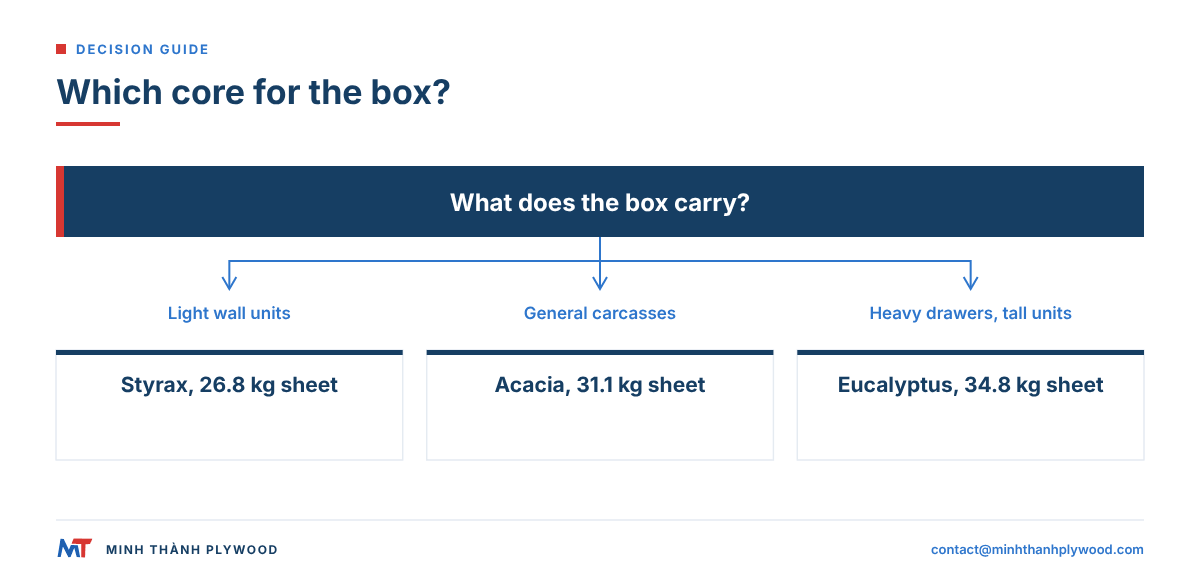
The core carries the screws and the stiffness, so choose it by load and weight. Our furniture panels use a white Styrax core or a eucalyptus core as standard; acacia and pine cores are made on order.
| Core | Reference density | 18 mm sheet weight (1220 × 2440 mm) | Best for |
|---|---|---|---|
| Styrax | 500 kg/m³ | About 26.8 kg | Light boxes, wall units, easy handling |
| Acacia | 580 kg/m³ | About 31.1 kg | General carcasses |
| Eucalyptus | 650 kg/m³ | About 34.8 kg | Heavy drawers, tall units, hinge sides under load |
Whatever the species, the core must be free of open gaps and overlaps. A void under a hinge plate or runner is where a screw spins. Our core layers are stitched both horizontally and vertically, and furniture panels are pressed twice: the core is pressed and calibrated, then face and back go on. The result is a flat, even core that drills cleanly anywhere on the sheet.
How well does plywood hold screws and dowels in a carcass?
Plywood holds screws and dowels well in a carcass because its cross plies grip a thread in every direction, at the face and near the edge. That matters most at three points: hinge plates on the gable, drawer runners, and the connectors that join gable to top and bottom.
Good practice for each joint type:
- Confirmat screws: drill the stepped pilot hole, keep the screw centred in the panel edge, and stay clear of the outer ply line.
- Dowels with glue: drill to depth with a jig; plywood takes glue well on its face and cut edges.
- Dado and rabbet joints: a tight tolerance on thickness keeps the joint snug; a loose dado weakens the box.
- Cam and dowel connectors: use the system’s drilling pattern and keep the cam away from the corner.
Reassembly is where plywood pulls ahead: a plywood box can be taken apart and refitted with less loss of holding than particleboard.
Why does thickness tolerance matter in a cabinet box?
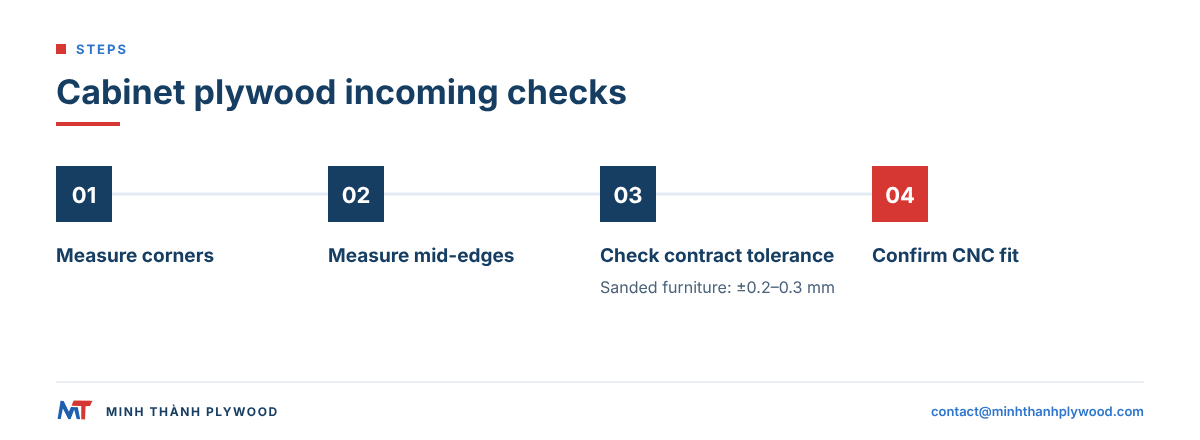
Thickness tolerance decides whether every 18 mm part fits the same dado, groove, hinge plate and drawer runner. A panel that runs thin leaves loose joints; one that runs thick will not seat in a machined groove, and a CNC program cut for 18.0 mm fails on both.
Our sanded furniture panels are held to ±0.2–0.3 mm, down to ±0.2 mm; commercial panels are ±0.5 mm and length and width ±2 mm. For a cabinet plant with grooves, dadoes and system hinges, the sanded furniture tolerance is the one to order. Measure incoming sheets with a caliper at the corners and mid-edges and compare with the tolerance on your contract.
Plywood vs particleboard and MDF for cabinet boxes
Plywood costs more than particleboard or MDF per sheet, and pays it back in fixing strength, lower weight and tolerance to leaks.
| Metric | Plywood | Melamine particleboard | MDF |
|---|---|---|---|
| Screw holding at the face | Very good | Fair | Good |
| Screw holding near the edge | Good | Poor | Fair |
| Reassembly | Holds well | Loses holding | Loses some holding |
| Weight at 18 mm | Light to medium, by core | Heavy | Heaviest |
| A leak at the sink | Swells slowly; dries | Swells and crumbles | Swells at edges |
| Inside finish | Wood face, paint, lacquer or UV | Ready finished | Needs paint |
| Cost per sheet | Higher | Lowest | Medium |
Particleboard suits low-cost, flat-pack carcasses that are assembled once. Plywood suits cabinet makers who sell on quality, ship assembled units, or build boxes that carry stone worktops. Our plywood vs MDF guide compares the two boards in detail.
Prefinished, coated or raw: which plywood for cabinet boxes?
Raw sanded plywood is the flexible choice: you finish it in your own line, and every face takes paint, lacquer or UV coating. Prefinished and coated panels save the finishing step inside the box.
- Raw sanded panels: finish the parts after machining; edges and faces are coated together.
- UV-coated in your plant: our faces are UV-ready on both sides, sanded and polished to the standard customers need for their own UV coating. Coat full sheets, then cut, or cut first and coat parts.
- Clear lacquer: a light finish keeps the wood look inside the box and is easy to wipe.
- Paint: prime first; birch and poplar both paint smoothly.
Whichever you choose, finish both faces of each part the same way, so the panel stays balanced and flat.
Drawer box plywood: thickness, species and joints
Drawer boxes take the hardest daily use in a kitchen, so they need a hard, stable plywood that holds joints. Birch and poplar are the common faces.
| Drawer part | Thickness | Species | Joint |
|---|---|---|---|
| Sides | 12 mm | Birch or poplar | Dovetail, box joint, dowel or screw |
| Sides, wide or heavy drawers | 15 mm | Birch | Dovetail or dowel |
| Back | 12 mm | Same as sides | Dado or dowel |
| Bottom | 6 mm | Birch or poplar | Captured in a groove |
| Bottom, wide pan drawers | 12 mm | Birch | Screwed under, or a centre support |
For birch-faced or poplar-faced plywood, the core construction determines joint quality, screw holding and most of the weight; the face veneer determines the visible finish. A drawer box in 12 mm sides with a 6 mm bottom in a groove is the common build for kitchen drawers on concealed runners.
How much plywood does a cabinet project need?
As a rule of thumb, one 1220 × 2440 mm sheet of 18 mm plywood builds about one base cabinet box with its fixed shelf, and wall cabinets need a little less. Count drawer stock, backs and doors separately.
To get the real figure:
- List every part with its finished size and thickness.
- Nest the parts on the sheet size you buy, 1220 × 2440 or 1250 × 2500 mm, in your cutting software.
- Add a waste allowance for saw kerf, defects and test pieces.
- Group by thickness and face, because each is a separate line on the order.
For a cabinet plant, the same count turns into a container plan. Sheet size is worth checking: a 1250 × 2500 mm sheet can nest more parts for some cabinet widths.
How much does cabinet plywood cost?
What does a sheet cost in the UK, and a whole kitchen?
UK merchants price the common 2440 × 1220 mm, 18 mm sheets as follows (ex VAT, read 21 October 2026; 20% VAT on top):
| 18 mm sheet, 2440 × 1220 mm | Ex VAT per sheet | Source type |
|---|---|---|
| Birch plywood throughout, BB/BB | £111.98 (pack of 22) | Materials Market |
| Poplar-faced plywood (birch alternative) | £94.54 | Harlow Bros |
| White melamine faced chipboard | £34.95 | Sheet Materials Wholesale |
| MDF | £26.45 | Sheet Materials Wholesale |
A 3 × 3 m kitchen runs to about 10–14 carcass sheets at one sheet per base unit. That is roughly £1,100–1,570 of birch plywood against £350–490 of melamine chipboard, so plywood adds about £750–1,100 to the box of a typical kitchen before delivery and cutting charges. Merchants add delivery on top: Ply Direct charges £10 to £60 plus VAT by order value and zone, and cuts to ±0.1 mm. Factory-direct container pricing removes the merchant margin; the next section converts it.
Factory-direct furniture plywood from Vietnam starts from US$350/m³ (October 2026). The face species and grade, core, thickness, tolerance and quantity set the final price.
To turn a cubic-metre price into a sheet price, multiply by the sheet’s volume: a 1220 × 2440 × 18 mm sheet is 0.0536 m³. Compare quotes on the same unit, and on the same build: two “18 mm cabinet plywood” quotes can differ in core, ply count, glue and tolerance.
Against the UK shelf price, a 1220 × 2440 × 18 mm sheet at US$350/m³ is about US$19 raw FOB (0.0536 m³ × US$350), before freight, duty and margin. That gap is why cabinet plants that use several hundred sheets a year import by the 40HC.
Three ways to lower carcass cost without lowering quality:
- Use a lower back grade where the back face is hidden.
- Use poplar or a lower birch grade for carcass interiors and keep the top faces for doors and end gables.
- Fill the container. One 40HC with mixed thicknesses spreads freight across more sheets.
What compliance does a UK or EU cabinet box need?
Ask for four lines on a UK or EU order. Plywood for dry, humid or exterior conditions is covered by BS EN 636:2012+A1:2015, and its bond is tested to BS EN 314-2, with Class 2 for sink bases and Class 3 for any exterior part. Formaldehyde is declared as E1 or E0; our furniture panels are E0.
For timber sourcing, the UK Timber Regulation puts due diligence on operators first placing timber on the GB market. The EU Deforestation Regulation also requires importer due diligence. We supply the EUDR compliance dossier (origin records and geolocation files) with orders to support the importer’s sourcing file when a retailer or a kitchen brand asks where the veneer came from. That is the sourcing answer that sustainability-led kitchen sellers such as Urban Kitchens give their customers, backed by paperwork.
What this means for your cabinet box plywood order
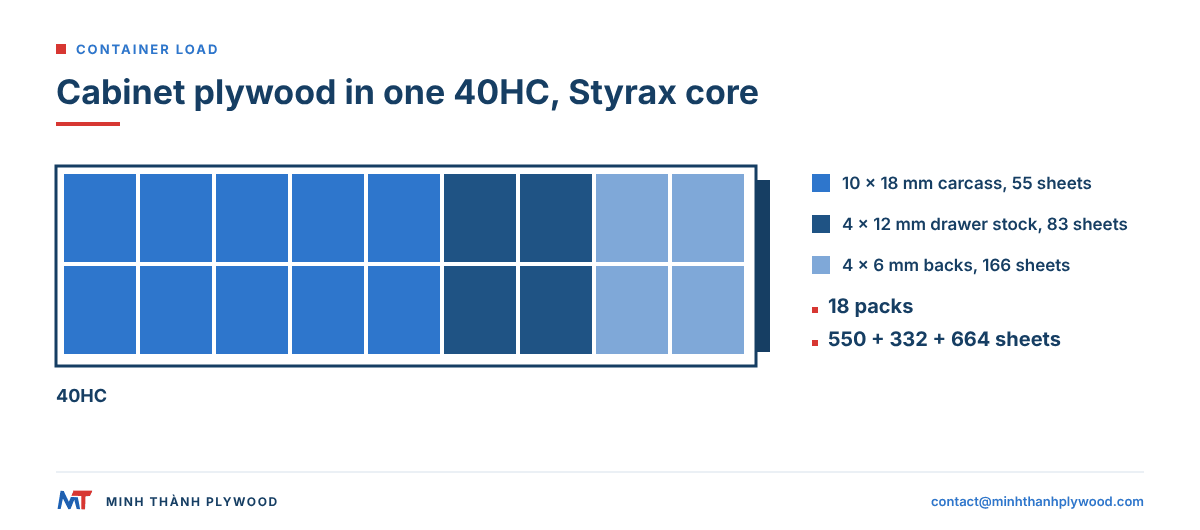
A cabinet plant usually orders carcass sheets, drawer stock and backs in one container. On a Styrax core, sheets per 40HC are capped by height and by a planning payload of 28,000 kg:
| Thickness | Sheets per pack | Packs | Sheets per 40HC | Weight per sheet |
|---|---|---|---|---|
| 18 mm | 55 | 18 | 990 sheets | 26.8 kg |
| 15 mm | 66 | 18 | 1,188 sheets | 22.3 kg |
| 12 mm | 83 | 18 | 1,494 sheets | 17.9 kg |
| 6 mm | 166 | 18 | 2,988 sheets | 8.9 kg |
A mixed container takes whole packs of each thickness, for example 18 mm carcass sheets plus 12 mm drawer stock and 6 mm backs. Order terms: MOQ one 40HC, mixed specifications by agreement, production 15–45 days after the 30% deposit, FOB Hai Phong, CFR or CIF. Transit from Hai Phong runs about 30–40 days to Northern Europe and 20–30 days to the US West Coast.
For the cabinet industry’s own performance tests on finished cabinets, the Kitchen Cabinet Manufacturers Association publishes ANSI/KCMA A161.1; the panel spec above is what feeds those tests. Our kitchen cabinet plywood buyer guide covers the whole kitchen.
How to specify plywood for cabinet boxes on an RFQ
Send one line per thickness and face, for example:
- Carcass: furniture plywood for cabinet boxes, 18 mm, 1220 × 2440 mm, poplar A/B face/back, Styrax core, UF glue at E0 emission, sanded both sides, tolerance ±0.2–0.3 mm, 10 packs.
- Drawer sides: 12 mm birch D/D, same core and glue, 4 packs.
- Backs: 6 mm poplar B/B, 4 packs.
- Delivery: one 40HC, CIF your port.
Add the parts each line is for, your finish (raw, lacquer, UV), and any MR-bond sheets for sink bases. The furniture plywood product page shows the range; we reply within hours with the build, the container plan and a price.
Buyer questions, answered
What is the best plywood for cabinet boxes?
An 18 mm sanded hardwood plywood with a good face on both sides, a void-free core and a tight thickness tolerance. Birch, poplar or engineered veneer faces over a Styrax or eucalyptus core are common choices for kitchen carcasses.
What thickness plywood is used for cabinet boxes?
18 mm (3/4 in) for sides, tops, bottoms and fixed shelves; 15 mm in some light wall units; 12 mm for drawer sides; 3–6 mm for captured backs and drawer bottoms.
Is plywood better than particleboard for cabinet boxes?
Plywood holds screws better, especially near edges and after reassembly, takes water damage more slowly at a leak, and weighs less for the same stiffness. Particleboard costs less and is common in flat-pack carcasses.
Does a cabinet box need a good face on both sides?
Yes, wherever both sides are seen: the inside of a box shows whenever a door is open, and end panels show their outer face. Order face/back grades such as A/B or B/B so the inside face is clean.
What plywood is best for drawer boxes?
Use 12 mm plywood for drawer sides and backs, 15 mm for wide or heavy drawers, and a 6 mm bottom captured in a groove. Specify the core for joint strength and weight, then choose birch or poplar faces for the finish.
How much plywood does a cabinet project need?
As a rule of thumb, one 1220 × 2440 mm sheet of 18 mm plywood builds about one base cabinet box, and wall cabinets need a little less. Nest your actual parts list on the sheet size you buy to get the real count.
How much does cabinet plywood cost per sheet?
Factory-direct furniture plywood from Vietnam starts from US$350/m³ (October 2026). A 1220 × 2440 × 18 mm sheet is 0.0536 m³, so the per-sheet price follows from the cubic metre price for the face, core and grade you choose.
Should I use prefinished plywood for cabinet boxes?
Prefinished or coated panels save finishing time inside the box and are easy to clean. Our faces are UV-ready on both sides, so cabinet plants with their own UV line coat the panels before or after cutting.
What plywood should I use for a sink base cabinet?
Use a moisture-resistant (MR) or phenolic WBP bond for the sink base, seal every cut edge and the cut-outs for pipes, and keep the rest of the kitchen on standard furniture plywood.
Can I build cabinet boxes from 15 mm plywood?
Yes, for light wall units and furniture with short shelves. Base cabinets, tall units and anything carrying heavy loads or worktops are better in 18 mm, which also suits most hinge and connector systems.
What screws and joints work best in plywood cabinet boxes?
Confirmat screws, dowels with glue, and dado or rabbet joints all hold well in plywood. Drill pilot holes, stay at least the panel thickness from an edge, and avoid coarse screws into the edge without a pilot.