
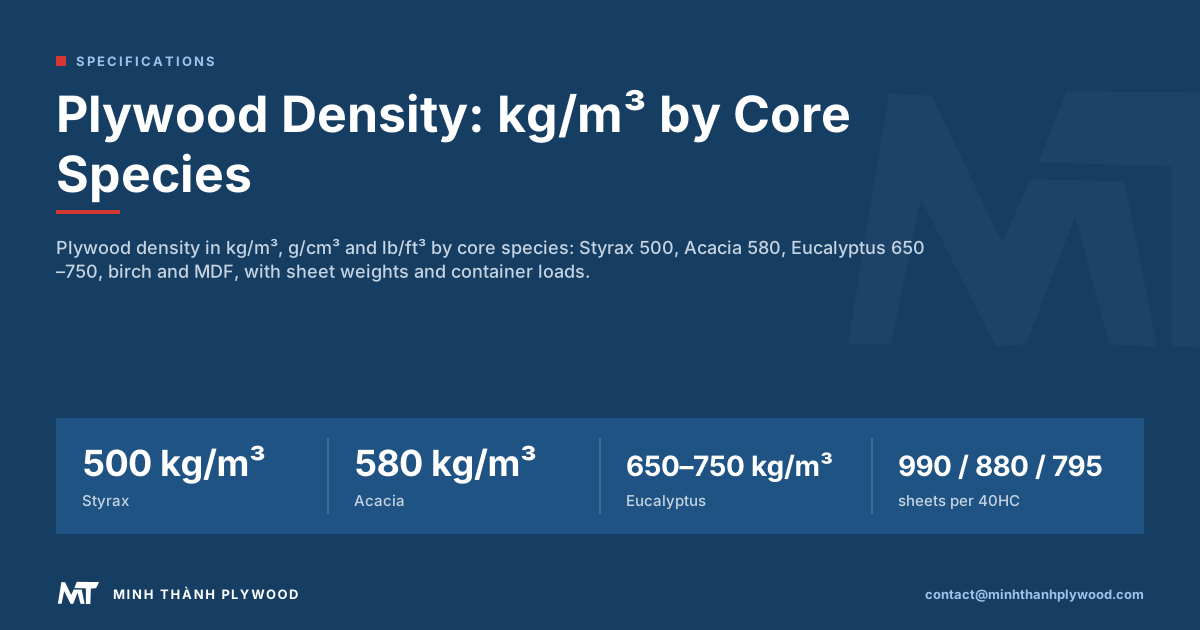
Plywood density is the mass of one cubic metre of panel, and for hardwood plywood it runs from about 500 kg/m³ on a light Styrax core to 650–750 kg/m³ on Eucalyptus, with birch at 650–700 kg/m³. The core species decides the number, because the core is most of the panel. Minh Thanh Plywood plans every sheet weight and container from these core references.
What is plywood density, or plywood mass density?
Plywood density is the mass of one cubic metre of the finished panel, written in kg/m³. It is the figure behind every sheet weight, pack weight and container plan, and it tells you how firm the panel will feel under a screw.
Plywood mass density is measured on the whole panel: face veneers, core veneers, glue lines and the moisture inside. That is why it differs from the density of the timber species alone. Pressing compresses the veneers slightly and the glue adds mass, so a finished panel is usually a little denser than the loose veneer it was made from.
For a buyer, one sentence covers it: the core species sets the density, the thickness sets the weight. A 9 mm and an 18 mm sheet made on the same core have the same density; the 18 mm sheet simply weighs twice as much.
Plywood density by core species: the reference table
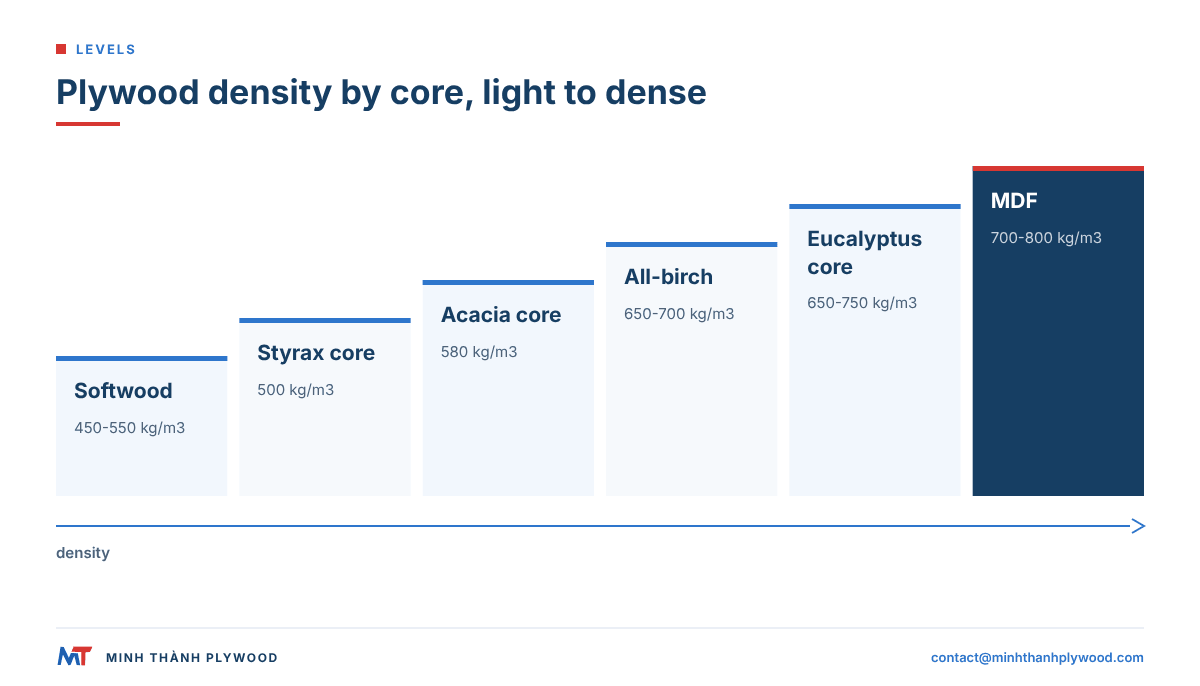
Hardwood plywood runs from about 500 kg/m³ to 750 kg/m³, set by the core. These are the planning references Minh Thanh Plywood uses for weights and container loads, next to common panels a buyer compares.
| Panel and core | Density (kg/m³) | g/cm³ | lb/ft³ |
|---|---|---|---|
| Styrax core (white core, Minh Thanh standard) | 500 kg/m³ | 0.50 | 31.2 |
| Acacia core (Minh Thanh, on order) | 580 kg/m³ | 0.58 | 36.2 |
| Eucalyptus core (Minh Thanh standard) | 650–750 kg/m³ | 0.65–0.75 | 40.6–46.8 |
| Softwood construction plywood | 450–550 kg/m³ | 0.45–0.55 | 28.1–34.3 |
| Combi core (poplar with hardwood or birch) | 550–650 kg/m³ | 0.55–0.65 | 34.3–40.6 |
| Birch face on poplar core | 580–620 kg/m³ | 0.58–0.62 | 36.2–38.7 |
| All-birch plywood | 650–700 kg/m³ | 0.65–0.70 | 40.6–43.7 |
| MDF, for comparison | 700–800 kg/m³ | 0.70–0.80 | 43.7–49.9 |
| Poplar core, UF glue | 520 kg/m³ | 0.52 | 32.5 |
| Poplar core, phenolic (WBP) glue | 530 kg/m³ | 0.53 | 33.1 |
| Pine core | 520 kg/m³ | 0.52 | 32.5 |
| Finger-joint core (poplar with hardwood) | 550 kg/m³ | 0.55 | 34.3 |
| Ultra-light Benuang (Erima) core | 340–380 kg/m³ | 0.34–0.38 | 21.2–23.7 |
Poplar, pine, finger-joint and Benuang (Octomeles sumatrana, sold in Papua New Guinea as Erima) rows are published figures from the Chinese maker Yalong Wood, checked on 21 October 2026. Two small adjustments sit on top of any core figure: a waterproof phenolic (WBP) glue line adds about 10 kg/m³ over urea glue, as in the poplar rows above, and moisture content moves the density by 5-10 kg/m³. Panels in our spec are dried to 8–12 % moisture at dispatch, so the references hold for panels as shipped.
Our core references come from production planning at the factory; the softwood, combi, birch and MDF ranges are published industry figures (sources listed with the article). For a single number on Eucalyptus, we plan at 650 kg/m³ and quote the 650–750 kg/m³ range where the timber is denser.
Why does the core decide plywood density?
The core decides plywood density because it is most of the panel’s volume. On an 18 mm furniture panel the face and back veneers are thin decorative layers; the rest is core veneer and glue.
That is why two “birch plywood” offers can differ by more than 100 kg/m³. A birch face on a poplar core sits at about 580–620 kg/m³, while all-birch reaches 650–700 kg/m³. The face tells you how the panel looks; the core tells you how much it weighs.
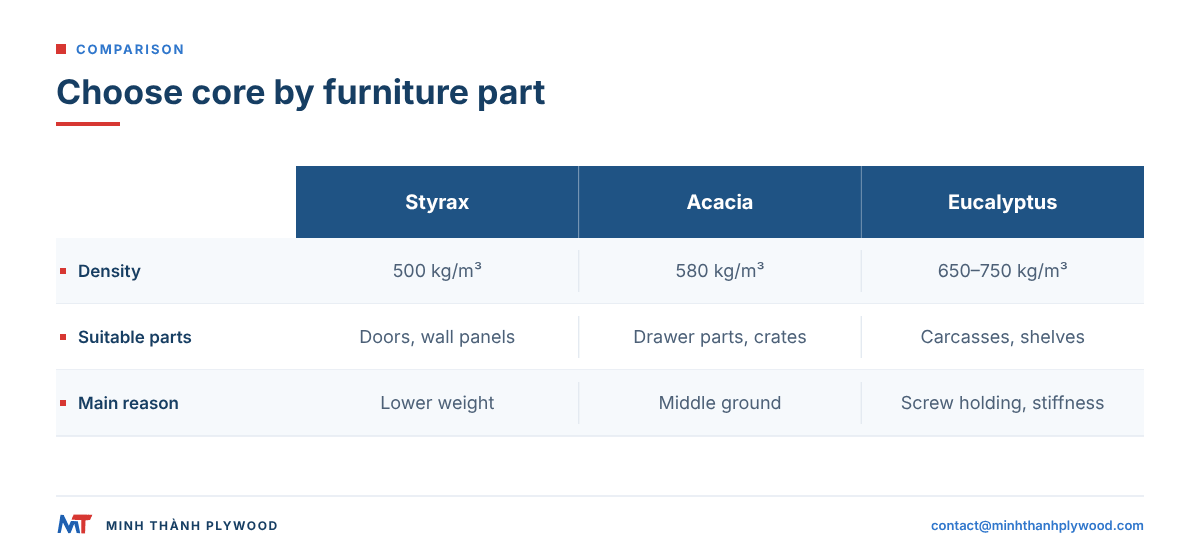
At our factory the furniture cores are white Styrax or Eucalyptus as standard, with Acacia and Pine cores made on order. Each gives a different density and a different reason to choose it:
- Styrax, about 500 kg/m³: light, pale and even, the core for cabinet doors, wardrobe parts and panels where weight and freight cost matter.
- Acacia, about 580 kg/m³: a middle ground, firmer than Styrax and lighter than Eucalyptus.
- Eucalyptus, 650–750 kg/m³: dense and stiff, the core for carcasses with heavy hardware, shelving and parts that take many screws.
The core layers are stitched both horizontally and vertically before pressing, so the density is even across the sheet rather than lower where veneer pieces meet.
How does density change the weight of a plywood sheet?
Sheet weight equals density times volume, so a denser core makes every sheet heavier at the same size. For a 1220 × 2440 mm sheet, each millimetre of thickness is 0.0029768 m³ of panel.
| Thickness | Styrax 500 kg/m³ | Acacia 580 kg/m³ | Eucalyptus 650 kg/m³ |
|---|---|---|---|
| 3 mm | 4.5 kg | 5.2 kg | 5.8 kg |
| 6 mm | 8.9 kg | 10.4 kg | 11.6 kg |
| 9 mm | 13.4 kg | 15.5 kg | 17.4 kg |
| 12 mm | 17.9 kg | 20.7 kg | 23.2 kg |
| 15 mm | 22.3 kg | 25.9 kg | 29.0 kg |
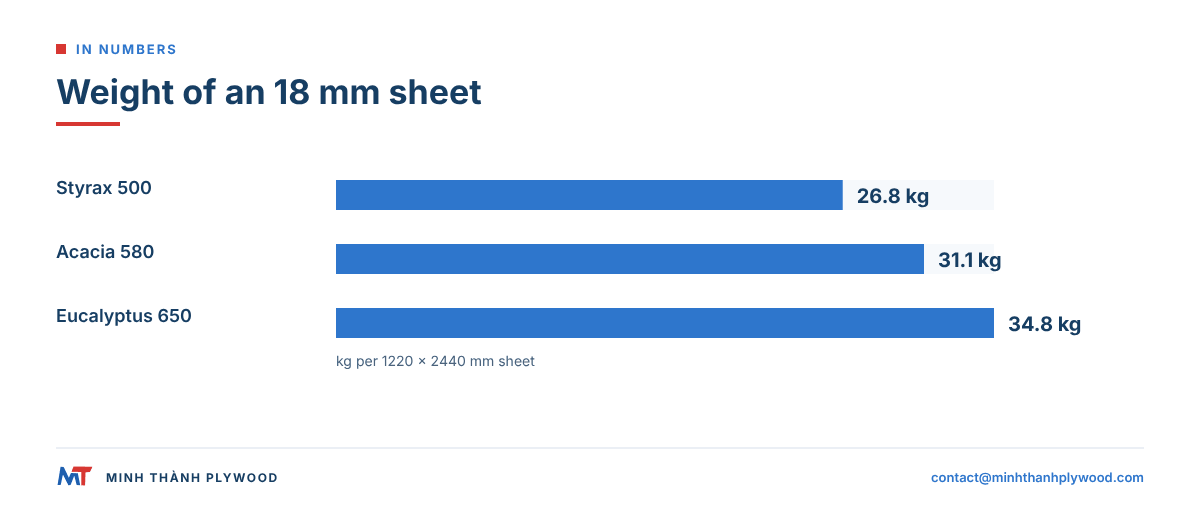
| 18 mm | 26.8 kg | 31.1 kg | 34.8 kg |
| 25 mm | 37.2 kg | 43.2 kg | 48.4 kg |
The same formula applies to the 2500 × 1250 mm sheet that Chinese and Indonesian mills ship. An 18 mm sheet holds 0.05625 m³ and weighs 28.1 kg on a 500 kg/m³ Styrax core, 32.6 kg on a 580 kg/m³ Acacia core and 36.6 kg on a 650 kg/m³ Eucalyptus core. That is about 5 % more than the 1220 × 2440 mm sheet in each case.
Weights are board only, at nominal size and thickness, before pallet and packing. At the top of the Eucalyptus range, 750 kg/m³, an 18 mm sheet weighs 40.2 kg. For other sizes and thicknesses, the plywood weight calculator runs the same formula up to a full 40HC.
How do you calculate the density of plywood?
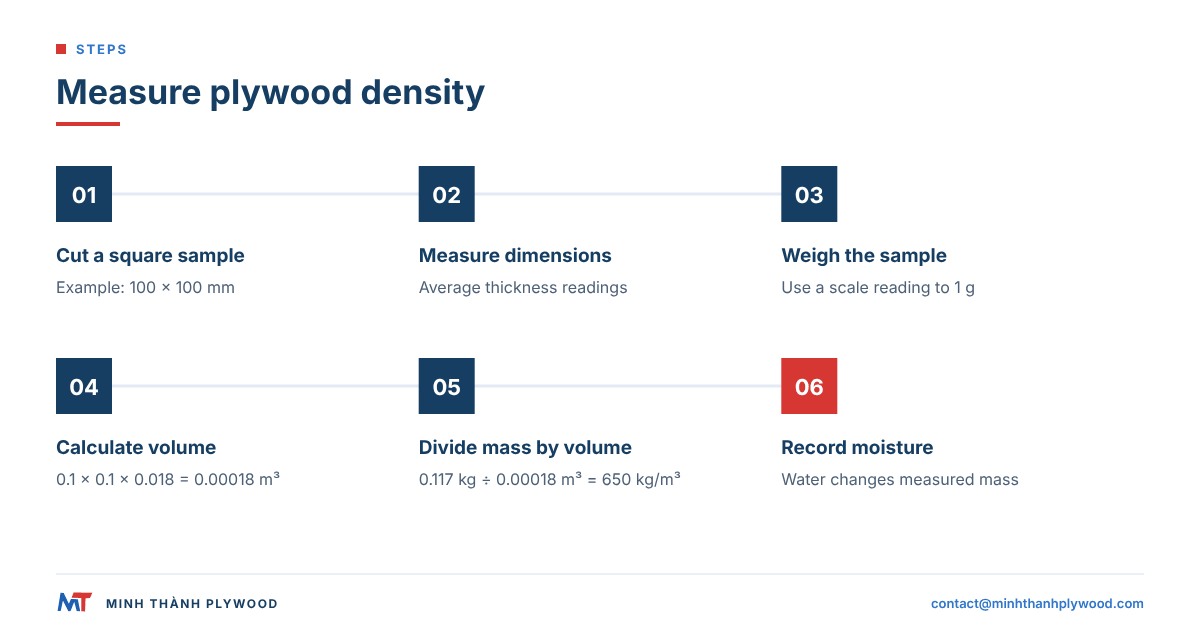
To calculate plywood density, divide the mass of a piece by its volume. Cut a square piece, weigh it, measure its length, width and thickness with a caliper, and divide the mass in kilograms by the volume in cubic metres. You need a scale, a caliper and a tape.
- Cut a clean, square piece, for example 100 × 100 mm, away from the sheet edge.
- Measure length, width and thickness with a caliper; take the thickness at several points and use the average.
- Weigh the piece on a scale that reads to 1 g.
- Work out the volume in m³: 0.1 × 0.1 × 0.018 = 0.00018 m³ for an 18 mm piece.
- Divide mass by volume: 0.117 kg ÷ 0.00018 m³ = 650 kg/m³.
- Note the moisture content, because a damp piece reads heavier.
The laboratory method is BS EN 323:1993, and ISO 9427:2003 covers the same measurement. The method measures density on 50 × 50 mm test pieces cut from the panel and averages them. For a whole-sheet check, weigh the full sheet and divide by its nominal volume: 34.8 kg ÷ 0.0535824 m³ gives 650 kg/m³ for an 18 mm Eucalyptus core sheet.
Plywood density in kg/m³, g/cm³, lb/ft³ and lb/in³
Plywood density converts between units with the fixed factors in the NIST guide to SI conversion factors. 1 g/cm³ equals 1,000 kg/m³, and 1 lb/ft³ equals 16.018 kg/m³. US datasheets sometimes quote lb/in³, where 1 lb/in³ equals 27,680 kg/m³.
| Core | kg/m³ | g/cm³ | lb/ft³ | lb/in³ |
|---|---|---|---|---|
| Styrax | 500 kg/m³ | 0.50 | 31.2 | 0.0181 |
| Acacia | 580 kg/m³ | 0.58 | 36.2 | 0.0210 |
| Eucalyptus | 650 kg/m³ | 0.65 | 40.6 | 0.0235 |
| Eucalyptus, upper | 750 kg/m³ | 0.75 | 46.8 | 0.0271 |
For plywood density in lb/in³, the small numbers are easy to misread; a 4 × 8 ft sheet weight in pounds is the more useful figure on a US order. An 18 mm sheet of 26.8 kg is 59 lb, and one of 34.8 kg is 77 lb.
What does plywood density change in use?
Density changes three things a furniture or cabinet plant notices: screw holding, stiffness and handling. It does not, on its own, change flatness, bond quality or face appearance.
Screw holding. A denser core gives the thread more fibre to bite. For carcasses with heavy drawer runners, lift-up fittings or repeated assembly, a Eucalyptus core holds better than a Styrax core of the same thickness.
Stiffness. Denser veneers are usually stiffer, so a shelf on a Eucalyptus core sags less under the same load and span. Thickness still does more than density: going from 15 mm to 18 mm adds more stiffness than any change of core.
Handling and cost per part. A lighter core saves effort on the shop floor and freight on the container. For doors, drawer fronts and panels hung on hinges, a 500 kg/m³ Styrax core puts less load on the hardware.
Machining. Both cores machine cleanly on CNC. A dense core dulls tools a little faster; a light core needs sharper tools for a crisp edge on fine profiles.
Which core density fits which part?
Match the core to the part’s job: light where weight matters, dense where screws and loads matter. This table is how we advise furniture and cabinet buyers.
| Part | Core we recommend | Density | Why |
|---|---|---|---|
| Cabinet and wardrobe doors | Styrax | 500 kg/m³ | Light on hinges, flat, even pale core |
| Drawer fronts and sides | Styrax or Acacia | 500–580 kg/m³ | Light, good edge for jointing |
| Carcass sides and bottoms | Eucalyptus | 650 kg/m³ | Screw holding for runners and fittings |
| Shelves with long spans | Eucalyptus | 650 kg/m³ | Stiffer at the same thickness |
| Wall panels and interior linings | Styrax | 500 kg/m³ | Easier to lift and fix, lower freight |
| Packing and crates | Acacia or Eucalyptus | 580–650 kg/m³ | Firm nail and staple holding |
You can mix the two in one container: Styrax core for doors and Eucalyptus core for carcasses, one specification each. A 40HC can carry mixed specifications by agreement.
What is high density plywood?
High density plywood is a trade name, not a standard grade. No European or US plywood standard defines a class by that name; buyers use it for panels on dense hardwood cores, usually at 650 kg/m³ and above.
In our range, the high density option is the Eucalyptus core at 650–750 kg/m³. In Northern Europe the same words usually mean all-birch plywood at 650–700 kg/m³. There are also densified or resin-impregnated laminates for electrical and tooling uses, made at far higher pressure; those are a separate product family, not furniture plywood.
When an enquiry says “high density plywood”, we reply with the core species and the density in kg/m³. That turns a vague phrase into a line both sides can check against the delivery.
Birch plywood density, Baltic birch and other faces
Birch plywood density depends on whether the birch is only on the faces or all through. All-birch plywood is usually quoted at 650–700 kg/m³; some all-birch and film-faced birch panels reach 680–760 kg/m³.
The density of Baltic birch plywood in kg/m³ is at the top of that range because every veneer is birch. A birch-faced panel on a lighter core weighs less. On our birch-faced furniture plywood, the face is graded on the Vietnamese ladder (D+, D and E, quoted as pairs such as D+/D), and the core is Styrax or Eucalyptus to order, so the density follows the core:
| Birch-faced build | Density |
|---|---|
| Birch faces on Styrax core | about 500 kg/m³ |
| Birch faces on Eucalyptus core | 650–750 kg/m³ |
| All-birch, for comparison | 650–700 kg/m³ |
Poplar, pine, Okoume and engineered veneer (EV) faces behave the same way: the face is a thin layer, so it moves density only a little. Always quote density by core, not by face. Our birch plywood density guide gives sheet weights for each birch build.
Plywood vs MDF, HDF, particleboard and OSB density
Plywood on a Styrax or Acacia core is lighter than MDF, HDF and particleboard of the same thickness. MDF runs at about 700–800 kg/m³ and HDF at about 900 kg/m³, while our cores run from 500 kg/m³ to 650 kg/m³.
| Panel | Typical density | 18 mm sheet, 1220 × 2440 mm |
|---|---|---|
| Plywood, Styrax core | 500 kg/m³ | 26.8 kg |
| Plywood, Eucalyptus core | 650 kg/m³ | 34.8 kg |
| MDF | 700–800 kg/m³ | 37.5–42.9 kg |
| HDF (thin panels only) | about 900 kg/m³ | made mostly in 2.5–5.0 mm |
The difference that matters most is structure, not only weight. MDF and HDF are fibre panels with smooth paintable faces. In standard MDF, the faces are denser than the core, as the European Panel Federation’s density guidance shows. Plywood is cross-laminated veneer: stronger for its weight, better edge screw holding, and it keeps its shape across the sheet. That is why medium density fibreboard and plywood are often used together: MDF for painted fronts, plywood for the carcass and anything carrying load.
Does moisture content change plywood density?
Yes: water adds mass, so plywood density rises as the panel takes on moisture. A density figure is only comparable when the moisture content is known.
Our veneers and finished panels are dried to 8–12 % moisture content at dispatch, the normal range for furniture plywood, and our 500, 580 and 650 kg/m³ references apply to panels in that range. A panel stored in damp conditions will weigh more on arrival; a panel in a heated workshop will lose a little mass as it dries.
For acceptance checks, measure moisture with a pin or pinless meter before weighing. If moisture is inside 8–12 %, compare the weight with the table above; if it is higher, dry the sample or allow for the extra water before calling it a density difference.
Does density mean better plywood?
Density is not a quality grade. A dense panel with core gaps, a weak glue line or uneven thickness is still a poor panel; a well-built light panel can be the right one.
What makes a panel good is the build, and that is where we control quality at the factory:
- Stitched cores: core layers stitched both horizontally and vertically, so there are no open joints inside the panel.
- Double pressing: furniture-grade panels are pressed twice as standard; the core board is pressed and calibrated, then face and back are pressed on.
- Calibrated thickness: sanded furniture panels to ±0.2–0.3 mm, down to ±0.2 mm, so the weight per sheet stays consistent pack to pack.
- Glue and emission: UF glue at E0 emission for furniture and interior panels, with emission test results published.
Even thickness keeps density even: two sheets of the same core and thickness weigh almost the same. That is the simplest check a buyer can make on arrival.
How does plywood density decide a container load?
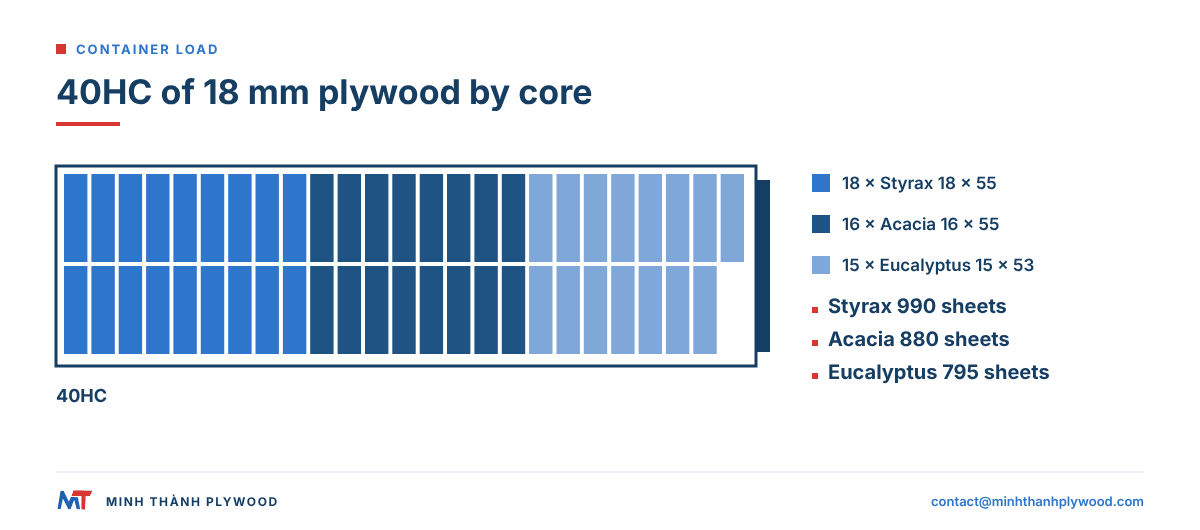
Plywood density decides whether a 40HC fills by volume or by weight. A light core fills the box before it reaches the payload; a dense core reaches the weight limit first and leaves space.
Our 40HC plan for 1220 × 2440 × 18 mm sheets, with a planning payload of 28,000 kg:
| Core | Density | Packs × sheets | Sheets | Volume | Sheet weight |
|---|---|---|---|---|---|
| Styrax | 500 kg/m³ | 18 × 55 sheets | 990 sheets | about 53 m³ | 26.8 kg |
| Acacia | 580 kg/m³ | 16 × 55 sheets | 880 sheets | about 47 m³ | 31.1 kg |
| Eucalyptus | 650 kg/m³ | 15 × 53 sheets | 795 sheets | about 43 m³ | 34.8 kg |
Packs are about 1,000 mm high; sheets per pack are 1,000 ÷ thickness rounded down, then capped by weight. A Styrax container holds 195 more sheets than a Eucalyptus one at 18 mm, so the freight cost per sheet is lower. If your booking carries a lower payload, the counts come down; send us the limit with the enquiry.
Does plywood density change with thickness?
Plywood density stays almost the same across thicknesses when the core species is the same. A 9 mm and an 18 mm panel on a Styrax core both plan at 500 kg/m³; what changes is the number of veneers and the number of glue lines.
Thin panels carry slightly more glue per cubic metre, because a 3 mm panel has glue lines close together. Our thin plywood of 3–5 mm is always 5-ply: 3 mm uses one core veneer, two cross-band veneers and two face veneers, while 4 and 5 mm use three core veneers and two faces, with the core veneer thickness adjusted to the panel. The difference this makes to density is small next to the difference between cores, so we plan thin panels with the same core references.
Thick panels behave the other way: a 25 mm panel is mostly core, so the core density shows through almost one for one. For the 18 mm plywood density question buyers ask most often, the answer is simply the core figure: 500, 580 or 650 kg/m³.
How do you check plywood density when a container arrives?
Check plywood density on arrival by weighing whole sheets and comparing them with the planned sheet weight. It takes ten minutes and a platform scale.
- Pick sheets from three packs, top, middle and bottom of each pack.
- Measure moisture on each sheet; note it next to the weight.
- Measure thickness at four points with a caliper and average it.
- Weigh each sheet on a platform scale.
- Divide by the volume, length × width × measured thickness, to get the density.
- Compare with the planned density on the order, at the moisture you measured.
Sheets on the same core and thickness should weigh almost the same. A sheet much lighter than its neighbours is worth cutting open: an unusually light panel can point to core gaps, which stitched cores and double pressing are there to prevent. Keep the numbers with the delivery records; they are the starting point for any later question about the goods.
What should you write on the order about density?
Write the core species, not only a density number, and add the density you plan with. That one line fixes weight, screw holding and the container plan at the same time.
A density line we would accept on an order:
18 mm, 1220 × 2440 mm, birch D/E faces on Eucalyptus core, planning density 650 kg/m³, UF glue at E0 emission, sanded, thickness tolerance ±0.2–0.3 mm, moisture 8–12 % at dispatch, 1 × 40HC.
Also tell us the parts the panels are for. If doors and carcasses share a container, we will split the core by part and send a packing list with the weight per pack. For an exact plan by thickness and core, send the sizes through the furniture plywood page or check the plywood thickness guide first; free samples of each core are available so your plant can weigh and machine them.
Buyer questions, answered
What is the density of plywood in kg/m³?
Hardwood plywood runs from about 500 kg/m³ on a Styrax core to 650–750 kg/m³ on a Eucalyptus core. Birch plywood sits at 650–700 kg/m³, and softwood construction plywood at about 450–550 kg/m³.
What is the density of 18 mm plywood?
Thickness does not change density; the core species does. An 18 mm sheet of 1220 × 2440 mm weighs 26.8 kg on a 500 kg/m³ Styrax core, 31.1 kg on Acacia and 34.8 kg on Eucalyptus.
How do you calculate the density of plywood?
Weigh a piece, measure its length, width and thickness in metres, and divide the mass by the volume. A 100 × 100 × 18 mm piece weighing 117 g has a density of 650 kg/m³.
What is plywood density in g/cm³ and lb/ft³?
Divide kg/m³ by 1,000 for g/cm³ and by 16.018 for lb/ft³. A 500 kg/m³ Styrax core panel is 0.50 g/cm³ or 31.2 lb/ft³; a 650 kg/m³ Eucalyptus core panel is 0.65 g/cm³ or 40.6 lb/ft³.
What is the density of Baltic birch plywood in kg/m³?
All-birch plywood is usually quoted at 650–700 kg/m³, and up to 680–760 kg/m³ for some all-birch and film-faced panels. A birch face on a lighter core weighs less, so ask for the core species.
Is high density plywood a standard grade?
No standard defines a grade called high density plywood. Buyers use the term for dense hardwood cores, such as Eucalyptus at 650–750 kg/m³ or all-birch, chosen for screw holding and stiffness.
How is MDF different from plywood in density?
MDF is a fibre panel of about 700–800 kg/m³ average density, typically with denser faces and a lower-density core; plywood is cross-laminated veneer. An 18 mm Styrax core plywood sheet weighs 26.8 kg against 37.5–42.9 kg for MDF of the same size.
Does moisture change plywood density?
Yes. Water adds mass, so a panel weighs more when damp. Our panels are dried to 8–12 % moisture content at dispatch, and our density references apply to panels in that range.
Does a denser plywood mean better quality?
Not by itself. Density sets weight, screw holding and stiffness; quality is the build: closed core, good glue line, flat calibrated faces. A well-made 500 kg/m³ Styrax core panel can be the better cabinet door.
Is ply wood density the same as plywood density?
Yes. Ply wood density, plywood mass density and plywood density all mean the mass of a cubic metre of plywood panel, quoted in kg/m³.
What is the density of film faced plywood from Vietnam?
Film-faced plywood follows its core. On a Eucalyptus core plan at 650 kg/m³, the same as the uncoated panel; the phenolic film adds very little to the sheet weight.