
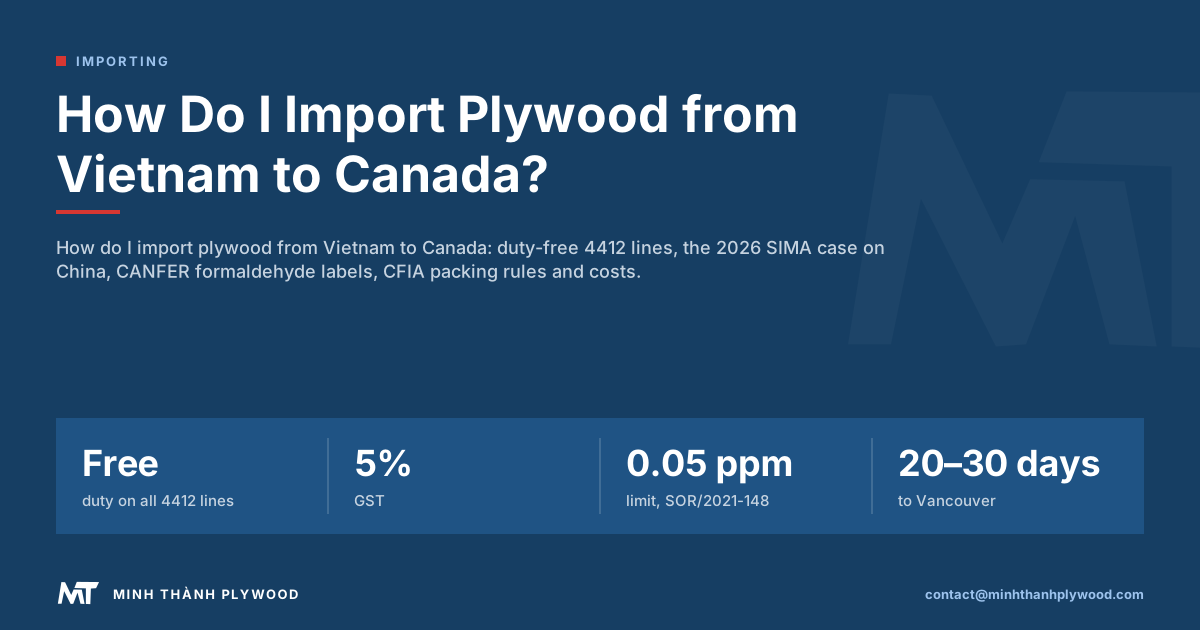
To import plywood from Vietnam to Canada you register with the CBSA as an importer, classify the panels under heading 4412, where every tariff line is duty-free under the 2026 Customs Tariff, and clear them with a commercial invoice, packing list, bill of lading and a formaldehyde label that meets Canada's CANFER rule. GST at 5% is the main tax at the border. Minh Thanh Plywood ships furniture, commercial, film-faced and packing plywood to Canadian ports with the label, the TSCA Title VI certification and the full document set.
How do I import plywood from Vietnam to Canada, step by step?
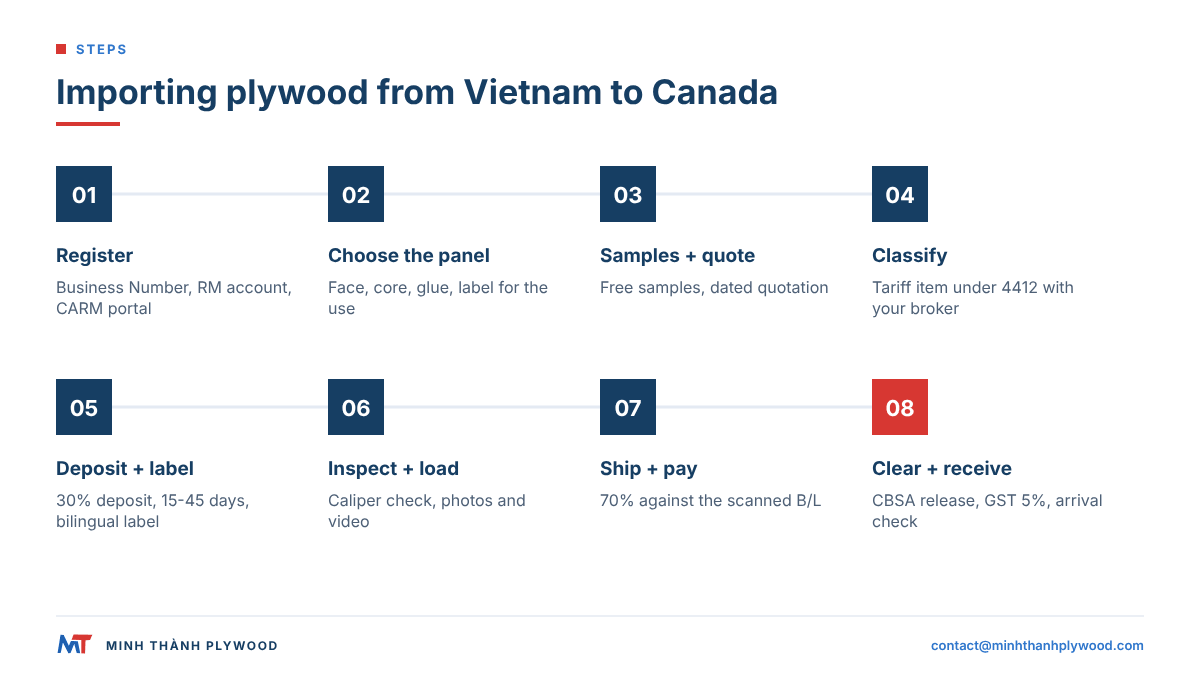
A plywood import from Vietnam to Canada takes eight steps, from your first request to panels in your warehouse. Most first orders run about two to three months door to door, mainly production and sea transit. Register as an importer, agree the specification, then book freight and customs clearance.
- Register as an importer. Get a Business Number from the Canada Revenue Agency with an import-export (RM) program account, then register in the CBSA Assessment and Revenue Management (CARM) Client Portal.
- Choose the panel and the use. Furniture and cabinet panels, commercial plywood, film-faced formwork or packing plywood. The use decides the face, the core, the glue and the label.
- Get samples and a written quotation. Minh Thanh sends free samples; the quotation names face, core, glue, thickness, size, quantity and delivery term.
- Classify the goods. Agree the tariff item under heading 4412 with your customs broker before the invoice is issued.
- Pay the deposit and approve the label. The 30% deposit starts production, 15–45 days. The formaldehyde label text for Canada is fixed at the same time.
- Inspect and load. Panels are measured, counted and packed; the container is photographed and filmed before it is sealed.
- Ship and pay the balance. The 70% balance is paid against the scanned bill of lading, or by irrevocable L/C at sight.
- Clear customs and receive. Your broker releases the goods with the CBSA, the container moves to your warehouse, and you check the packs against the packing list.
The sections below take each Canadian requirement in turn: tariff, trade remedies, formaldehyde, packing, documents and cost.
What duty does Canada charge on plywood from Vietnam?
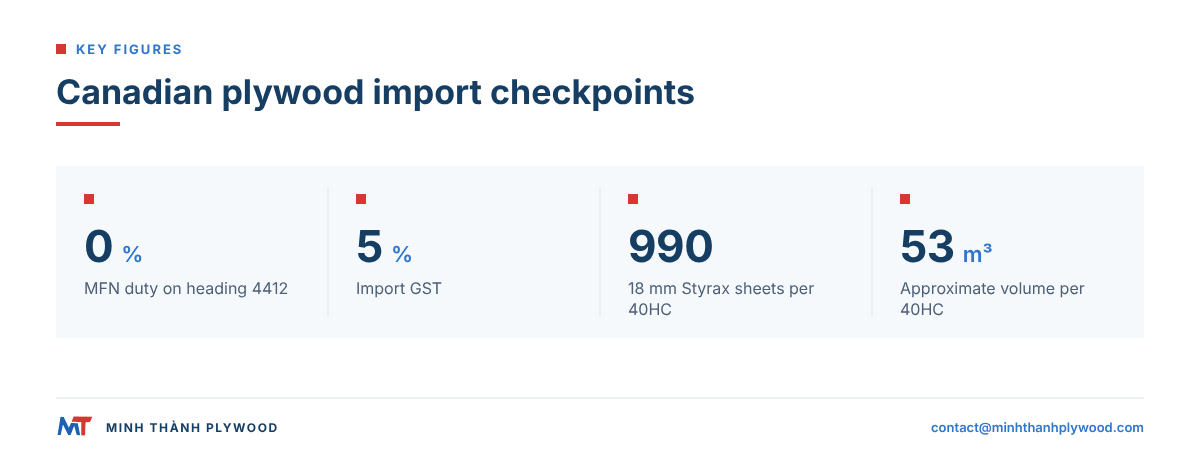
None. Canada’s 2026 Customs Tariff sets a Most-Favoured-Nation (MFN) rate of Free on every plywood line under heading 4412, and Vietnam receives MFN treatment. The CPTPP rate, under the Comprehensive and Progressive Agreement for Trans-Pacific Partnership that Canada and Vietnam both apply, is also Free (CBSA Customs Tariff 2026, Chapter 44, checked October 2026).
| Tariff item | What it covers | MFN rate | CPTPP rate |
|---|---|---|---|
| 4412.31.00 | Plywood, plies ≤ 6 mm, at least one outer ply of tropical wood (bintangor, okoume, meranti) | Free | Free |
| 4412.33.00 | Outer ply of birch, maple, walnut, poplar, eucalyptus and other listed hardwoods | Free | Free |
| 4412.34.00 | Outer ply of other non-coniferous wood (for example engineered veneer) | Free | Free |
| 4412.39.00 | Both outer plies coniferous (pine) | Free | Free |
| 4412.41–4412.49 | Laminated veneer lumber (LVL) | Free | Free |
| 4412.91–4412.99 | Other laminated wood, including plies over 6 mm | Free | Free |
Because the duty is nil, the classification matters for statistics and for trade-remedy screening rather than for cost. Get it right anyway: the CBSA’s SIMA notices list the same 4412 items, and a wrong code invites questions at the border.
The tax that does apply is the Goods and Services Tax (GST) at 5%, charged on the value for duty plus any duty. A GST-registered business normally recovers it as an input tax credit.
Plywood import Canada rules: does the SIMA plywood case touch Vietnamese plywood?
The Special Import Measures Act (SIMA) case now running covers plywood from China, not Vietnam. On 10 April 2026 the Canada Border Services Agency opened dumping and subsidy investigations into decorative and other non-structural plywood originating in or exported from the People’s Republic of China (CBSA notice DONP2 2026, checked October 2026), and made preliminary determinations in August 2026, so provisional duties now apply to subject goods from China.
What the case covers, in the CBSA’s own definition:
- Flat, multilayered plywood or veneered panels with a wood face or back, including panels that meet ANSI/HPVA HP-1-2024 (the North American standard for hardwood and decorative plywood).
- Veneer core platforms used to make such panels.
What it excludes:
- Structural plywood made to CSA O121, CSA O151, CSA O153 or US PS 1 / PS 2 with coniferous face and back, for structural use.
- Finished plywood flooring and non-flat shapes.
- Phenolic film-faced plyform (PFF) with a phenolic film of at least 90 g/m² on both faces and sealed edges.
- Certain LVL door and window components.
Panels made in Vietnam and shipped from Vietnam fall outside the country scope. The test is origin and route: a panel finished in Vietnam on a Chinese core platform, or a container shipped through a Chinese port, invites a closer look. Minh Thanh’s cores are plantation Styrax and Eucalyptus from around Ha Hoa, Phu Tho, and every container is loaded and shipped from Hai Phong, so your certificate of origin and the mill’s production records answer the question in one page each.
The dates matter if your container could ship from China by mistake or through a Chinese consolidator. The preliminary determination came on 24 August 2026, with a provisional all-others rate of 227.5% of export price and eleven named Chinese exporters carrying their own rates from 0% to 173.6%. The final determination is due on 23 November 2026, and the Canadian International Trade Tribunal (CITT) is due to issue its injury finding by 22 December 2026 (Peacock Tariff Consulting, plywood duties, checked October 2026). Vietnamese plywood is not named in any of it; an origin certificate and a Hai Phong bill of lading keep it that way.
Which formaldehyde rules apply to plywood in Canada?
Canada has its own formaldehyde regulation for composite wood, in force since January 2023: the Formaldehyde Emissions from Composite Wood Products Regulations, SOR/2021-148, often called CANFER (Justice Laws, SOR/2021-148, checked October 2026). It prohibits importing or selling composite wood products above its limits.
| Requirement | What SOR/2021-148 says | How a Minh Thanh panel meets it |
|---|---|---|
| Emission limit, hardwood plywood | 0.05 ppm (section 6) | Six ASTM D6007 chamber tests, April 2025 – June 2026, averaged 0.014–0.032 ppm |
| Certification | Product type certified under TSCA Title VI, or confirmed by an accredited third-party certifier (sections 18–19) | CARB P2 / TSCA Title VI certified, ICTT mill no. 23024 |
| Label content | Manufacturer, lot number, and a TSCA Title VI statement with the certifier, or “CANFER compliant / conforme au CANFER” with the certifier (section 20) | Label printed on each panel before packing |
| Label language | English and French, legible (section 25) | Bilingual text fixed with the order |
| Label exemption | Panels whose largest face is 929 cm² or less (section 23) | Applies to small cut-to-size parts only |
| Importer records | Kept for five years in Canada (sections 28–30) | Certificate, test reports and invoices sent with the order |
Section 19(1)(a) is the practical point for a Vietnamese mill: a product type certified under TSCA Title VI, the US rule set out by the US EPA formaldehyde standards for composite wood (checked October 2026), is accepted as certified in Canada. Minh Thanh’s US labels already carry the producer, the lot and certifier number TPC-43; for Canadian orders the same data goes on a bilingual label. Put the wording your compliance team wants on the purchase order so it is printed before the panels are packed.
Furniture and interior panels are made with UF glue at E0 emission as standard. See CARB P2 / TSCA Title VI certification for the certificate and the six chamber reports.
Which plywood do Canadian buyers order from Vietnam?
Canadian buyers order Vietnamese plywood for non-structural work: kitchen and bath cabinets, furniture, millwork, store fixtures, packing and concrete formwork. Structural sheathing and subfloor in Canadian buildings use panels marked to CSA O121 (Douglas fir), CSA O151 (Canadian softwood) or CSA O325 (construction sheathing), which are North American grading systems for structural panels.
| Use in Canada | Panel from Minh Thanh | Key specification |
|---|---|---|
| Cabinet boxes and shelves | Furniture plywood, poplar or EV face, Styrax core | 15–18 mm, A/B or B/B faces, UF glue at E0, ±0.2–0.3 mm |
| Painted doors and furniture | Birch or poplar face, double-pressed | Sanded and polished faces, UV-ready |
| Millwork and store fixtures | Furniture plywood or cut-to-size parts | Custom sizes, one panel cut into 4, 6 or 8 pieces |
| Concrete forms on site | Film-faced plywood | Melamine or phenolic (WBP) glue to order, ±0.5 mm |
| Crates and pallets | Packing plywood | ±0.5–1.0 mm, commercial faces |
For cabinet work, buyers in Canada often specify panels to the decorative plywood standard ANSI/HPVA HP-1. Send the face grade you want against your approved sample: poplar and eucalyptus faces are quoted as A/A, A/B or B/B, and birch faces as D+/D or D/E, comparable to B/BB and BB/CP on the European birch ladder.
CSA sheathing or formwork plywood: which one does a Canadian job need?
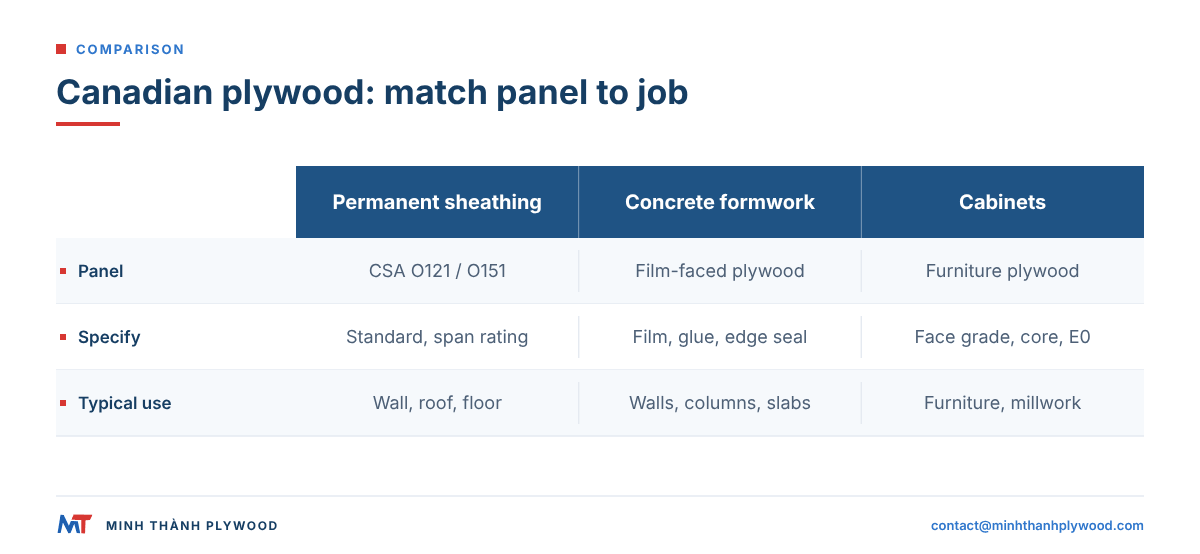
Canadian specifiers use two different panel families, and mixing them up is the commonest reason a plywood RFQ comes back wrong. Permanent sheathing, roof deck and subfloor are CSA O121 (Douglas fir and western larch) or CSA O151 (spruce, pine and fir) panels carrying a grade stamp from an accredited agency. Concrete forming is temporary: film-faced or overlaid plywood chosen by its glue class and overlay, not by a CSA species standard.
| Job on site | Panel family | What the RFQ must state |
|---|---|---|
| Wall, roof and floor sheathing | CSA O121 / O151 stamped softwood plywood | Standard, species group, span rating |
| Concrete walls, columns, slabs | Film-faced plywood, phenolic (WBP) bond | Film weight, glue class, 18 mm for walls and columns, edge sealing |
| Repeated pours on one gang | Film-faced plywood with a higher overlay | Reuse target, sealed edges, re-oiling plan |
| Cabinets, furniture, millwork | Furniture plywood, ANSI/HPVA HP-1 faces | Face grade pair, core, E0 emission, tolerance |
Write the overlay and glue in the RFQ. A Canadian RFQ that asks for “waterproof WBP HDO” and accepts a lighter film-faced sheet because the face looks brown is the swap that ruins a mid-pour schedule. The default Canadian size is 4 × 8 ft, 1220 × 2440 mm, and 18 mm is the usual wall and column gauge; our film-faced plywood is made with a phenolic (WBP) bond, at ±0.5 mm thickness tolerance, and can be cut to a gang module on order.
Reuse is the number a site manager wants. Rival mills quote it: one Vietnamese mill lists up to 10 pours for its basic film-faced grade and up to 20 for its premium grade (Vinawood, checked October 2026), and the real count depends on the pour height, release oil, edge sealing and handling. Send the reuse target and the pour schedule with the RFQ, and we quote the film and edge sealing to match.
Which documents does a plywood import into Canada need?
A plywood import into Canada clears on the same core set as any other market, with two Canadian details: the invoice data the CBSA asks for and the formaldehyde label.
| Document | Issued by | Canadian detail |
|---|---|---|
| Commercial invoice | Minh Thanh | Shows the vendor, the purchaser and the consignee in Canada, the tariff item, quantity in sheets and m³, unit price, currency and Incoterm |
| Packing list | Minh Thanh | Pack numbers, sheets per pack, net and gross weight, volume |
| Bill of lading | Shipping line | Consignee and notify party exactly as on your CBSA account |
| Certificate of origin | Vietnamese issuing authority | Not needed for a duty rate on plywood, but useful proof of Vietnamese origin for any SIMA question |
| Formaldehyde label and certificate | Minh Thanh | Bilingual label on the panels; TSCA Title VI certificate and chamber reports on order |
| Phytosanitary or fumigation certificate | Vietnamese authority | Only where the solid wood packaging or the destination rule asks for it |
| Insurance certificate | Minh Thanh, under CIF | Value and cover |
Minh Thanh sends copies of the invoice and packing list at loading with the photos and video of your container, then the scanned bill of lading and the certificates after sailing. The plywood import documents checklist explains each paper in detail.
How do you register and clear plywood with the CBSA?
The importer of record needs three things before the first container lands (CBSA importing commercial goods, checked October 2026):
- A Business Number with an import-export (RM) account, issued by the Canada Revenue Agency.
- Registration in the CARM Client Portal. Since CARM replaced the old B3 form with the Commercial Accounting Declaration (CAD), importers register their business, delegate access to their broker and, to use release prior to payment, post their own financial security.
- A customs broker or in-house trade compliance. Most first-time importers use a licensed broker, who files the release request and the CAD and pays duties and taxes through your account.
Canada has no importer-side equivalent of the US Importer Security Filing. The ocean carrier sends the cargo data to the CBSA under Advance Commercial Information before the container is loaded in Hai Phong, so send the final packing list to the forwarder as soon as the loading date is fixed.
At release, the CBSA can examine the container or ask for documents. A clean set, where the invoice, packing list and bill of lading show the same weights, pack count and consignee, is what keeps a plywood container moving.
Does plywood need ISPM 15 treatment for Canada?
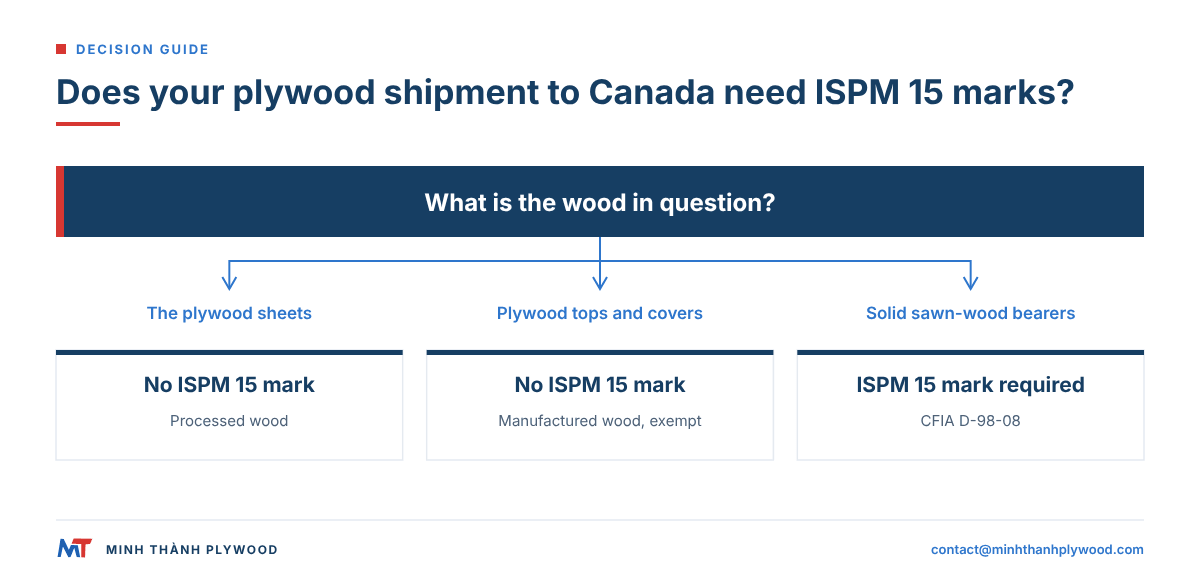
Plywood panels do not; the wood under them may. The Canadian Food Inspection Agency’s directive D-98-08 regulates all wood packaging material, including pallets, crating and dunnage, from every origin except the continental United States. Packaging made entirely of manufactured wood, such as plywood, cardboard, fibreboard or oriented strand board, is exempt (CFIA wood packaging, checked October 2026).
For a plywood container that means:
- The plywood sheets are processed wood: no ISPM 15 mark.
- Plywood pallet tops, covers and corner boards are exempt as manufactured wood.
- Solid sawn-wood bearers or pallet runners must be heat-treated or fumigated and carry the ISPM 15 mark. A pack that mixes plywood with solid wood bracing is regulated as a whole.
Ask for ISPM 15 marked bearers or for plywood-only packing on the order. Minh Thanh’s export packing was tested by SGS in September 2026 under the EU packaging regulation, (EU) 2025/40: lead, cadmium, mercury and hexavalent chromium were not detected in the four packaging materials, a useful file if your customers ask about packaging content.
Plywood importer cost in Canada: what goes into the landed price?
A plywood importer’s cost in Canada is the factory price plus freight, insurance, 5% GST and the local charges of clearance and delivery; the customs duty line is zero. Canada values imports at the price up to the point of direct shipment, so for a container from Hai Phong the value for duty is close to the FOB value: ocean freight and insurance to Canada are not part of it.
| Cost line | Who pays | How it is calculated |
|---|---|---|
| Panel price | Importer to Minh Thanh | Per m³ by face, core, glue, thickness, size and quantity; furniture plywood from US$350/m³, commercial plywood from US$250/m³ (October 2026) |
| Ocean freight | Importer under FOB; Minh Thanh under CFR or CIF | Per container, Hai Phong to Vancouver, Prince Rupert, Montreal or Halifax |
| Marine insurance | Importer under FOB or CFR; Minh Thanh under CIF | A small percentage of the cargo value |
| Customs duty | — | Free on all 4412 lines |
| SIMA duty | — | None on panels of Vietnamese origin shipped from Vietnam |
| GST | Importer | 5% of the value for duty plus duty; recoverable for GST registrants |
| Broker fee | Importer | Per entry |
| Terminal, rail and delivery | Importer | Port handling, rail to inland terminals such as Toronto or Calgary, truck to your door |
Worked example. One 40HC of 18 mm furniture plywood on Styrax core, 1220 × 2440 mm, holds 990 sheets in 18 packs, about 53 m³ and about 26.8 kg per sheet. At the indicative furniture price from US$350/m³, the panel value starts at about US$18,550 (53 × 350), and GST at 5% on that value is about US$928 before the local cost lines. A real quotation fixes the price for your face, core and glue.
For the freight side by port and container, see plywood shipping cost from Vietnam.
How long does shipping take from Vietnam to Canada?
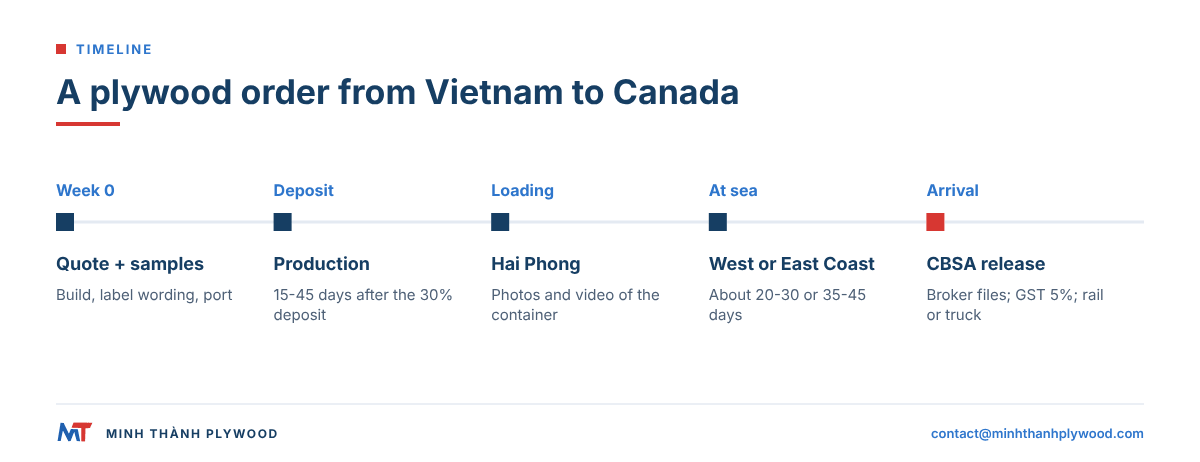
Production takes 15–45 days after the deposit, then the container sails from Hai Phong. Canada is served by two sea routes:
| Destination | Route | Typical days at sea from Hai Phong |
|---|---|---|
| Vancouver, Prince Rupert | Trans-Pacific, as for the US West Coast | about 20–30 |
| Toronto, Calgary, Winnipeg | West Coast port, then rail to the inland terminal | 20–30 at sea, plus rail |
| Montreal, Halifax | Suez or Panama route, as for the US East Coast | about 35–45 |
Importers in Ontario and the Prairies often book through Vancouver or Prince Rupert with rail inland, because the sea leg is shorter; buyers in Quebec and the Atlantic provinces compare that with a direct call at Montreal or Halifax. Transit depends on the carrier and the routing, so the booking confirmation gives the vessel’s own schedule.
How do Incoterms work for a Canadian plywood order?
Minh Thanh quotes FOB Hai Phong, CFR or CIF your Canadian port. The term decides who books the ship and who insures it:
- FOB Hai Phong: Minh Thanh clears export and loads on board; your forwarder books the freight and issues the bill of lading. Best for importers with a contracted forwarder and rail program.
- CFR Vancouver (or another port): Minh Thanh books the freight to the named port; you insure the cargo.
- CIF Vancouver (or another port): Minh Thanh books freight and insurance; the insurance certificate joins the document set.
Under every term you remain the importer of record in Canada: CBSA release, GST and the broker are on your side. Name the inland destination at the RFQ stage, because a rail-linked port can save a week of trucking.
What payment terms and minimum order apply?
The minimum order is one 40HC container, and several specifications can share it by agreement, usually one or two and up to three to six. Payment is 30% deposit with the order and 70% against the scanned bill of lading, or by irrevocable L/C at sight.
A 40HC loaded for Canada carries the same plan as for any market, capped by the weight your booking allows:
| Panel, 1220 × 2440 mm, 18 mm | Packs | Sheets | Volume | Sheet weight |
|---|---|---|---|---|
| Styrax core | 18 (55 sheets each) | 990 | about 53 m³ | 26.8 kg |
| Acacia core | 16 (55 sheets each) | 880 | about 47 m³ | 31.1 kg |
| Eucalyptus core | 15 (53 sheets each) | 795 | about 43 m³ | 34.8 kg |
The plan uses a 28,000 kg payload unless the booking is lower. If your rail or road leg in Canada has a lower weight limit, give it with the RFQ and the pack count is set to it.
How do you check the plywood when it arrives in Canada?
Check the container before you sign for it, then sample the packs within the first days. A short arrival routine:
- Seal and doors: compare the seal number with the bill of lading; photograph the doors before opening.
- Pack count: count packs and read pack numbers against the packing list.
- Thickness and size: measure sheets from several packs with a digital caliper and a tape, against the agreed tolerance.
- Faces and edges: compare faces with the approved sample; look for core gaps and delamination on the edges.
- Labels: check that the formaldehyde label is on the panels and readable in English and French.
Every Minh Thanh container is photographed and filmed before loading, so the pack numbers you read on arrival match the loading video. The full routine, sample sizes and tolerances are in how to check plywood quality on arrival.
Why buy plywood for Canada from a Vietnamese manufacturer?
Three reasons decide it for most Canadian importers: the panel build, the paperwork and the flexibility of a factory order.
- The build. Minh Thanh is a plywood manufacturer in Ha Hoa, Phu Tho, with 50,000+ m³ a year of capacity. Furniture panels are pressed twice, cores are stitched horizontally and vertically, and sanded faces reach a thickness tolerance down to ±0.2 mm.
- The paperwork. CARB P2 / TSCA Title VI certification (ICTT mill no. 23024), chamber results well below the 0.05 ppm limit, ISO 9001:2015 (KAC25/0185) and full shipping documents for every container.
- The order. Custom sizes such as 1220 × 2500 or 1220 × 2280 mm, cut-to-size parts, 10+ face veneers, mixed specifications in one container and replies within hours.
Duty is never the reason to choose a supplier, and in Canada it plays no part: plywood from every MFN country enters at the same Free rate. The choice comes down to the panel and the service.
What should you send to get a quotation for Canada?
A complete request gets a complete quotation in one reply. For a Canadian order, send:
- Use: cabinet, furniture, millwork, formwork or packing.
- Panel build: face species and grade pair, core, glue (UF at E0, MR or WBP), thickness and size.
- Quantity: m³ or sheets per specification, and whether specifications share a container.
- Port and Incoterm: for example CIF Vancouver, or FOB Hai Phong with your forwarder.
- Label wording: TSCA Title VI statement or CANFER compliant, in English and French.
- Packing rules: ISPM 15 marked bearers or plywood-only packing; any weight cap for your inland leg.
- Importer details: legal name and address as registered with the CBSA, and your broker’s contact.
Send it to contact@minhthanhplywood.com or through the contact form; free samples go out with the first reply. For the wider process across all markets, read how to import plywood from Vietnam, or compare the US rules in importing plywood from Vietnam to the USA.
Buyer questions, answered
Is there import duty on plywood from Vietnam to Canada?
No customs duty applies on the 2026 Customs Tariff: every plywood line under heading 4412 carries a Most-Favoured-Nation rate of Free, and the CPTPP rate is Free as well. The importer pays 5% GST on the value for duty.
Do Canadian anti-dumping duties apply to plywood from Vietnam?
The SIMA investigation opened by the CBSA on 10 April 2026 covers decorative and other non-structural plywood originating in or exported from China. Panels made in Vietnam and shipped from Vietnam are outside that country scope; keep the certificate of origin and the mill's records to show it.
Does plywood imported into Canada need a formaldehyde label?
Yes. Under the Formaldehyde Emissions from Composite Wood Products Regulations (SOR/2021-148), hardwood plywood must meet 0.05 ppm and carry a label with the manufacturer, the lot number and either a TSCA Title VI statement or the words CANFER compliant / conforme au CANFER, in English and French.
Is TSCA Title VI certification accepted in Canada?
Yes. Section 19(1)(a) of SOR/2021-148 lets a manufacturer declare certification when the product type is certified under TSCA Title VI. Minh Thanh holds CARB P2 / TSCA Title VI certification, ICTT mill no. 23024.
Does plywood need ISPM 15 treatment for Canada?
The plywood itself does not. Canada's wood packaging directive D-98-08 exempts packaging made entirely of manufactured wood such as plywood, but solid wood bearers or pallets under the packs must be treated and marked to ISPM 15.
Can Vietnamese plywood be used for structural sheathing in Canada?
Structural sheathing in Canadian buildings uses panels marked to CSA O121, CSA O151 or CSA O325. Vietnamese plywood serves non-structural uses: cabinets, furniture, millwork, shopfitting, packing and concrete formwork.
How long does shipping take from Vietnam to Canada?
Production takes 15–45 days after the deposit. Sea transit from Hai Phong runs on the trans-Pacific route to Vancouver or Prince Rupert, about 20–30 days at sea, or about 35–45 days to Montreal and Halifax, before customs and inland delivery.
What is the minimum order for plywood from Vietnam to Canada?
Minh Thanh's minimum order is one 40HC container, with several specifications in one container by agreement. A 40HC holds about 53 m³ of 18 mm furniture plywood on Styrax core.
Do I need a customs broker to import plywood into Canada?
It is not required, but most first-time importers use one. You need a Business Number with an import-export account and registration in the CBSA CARM Client Portal, and the broker can account for the goods on your behalf.
Which documents does Minh Thanh send for a Canadian order?
Commercial invoice, packing list, bill of lading, certificate of origin, phytosanitary or fumigation certificates where required, insurance under CIF, and on order the CARB P2 / TSCA Title VI certificate and the chamber test reports.