
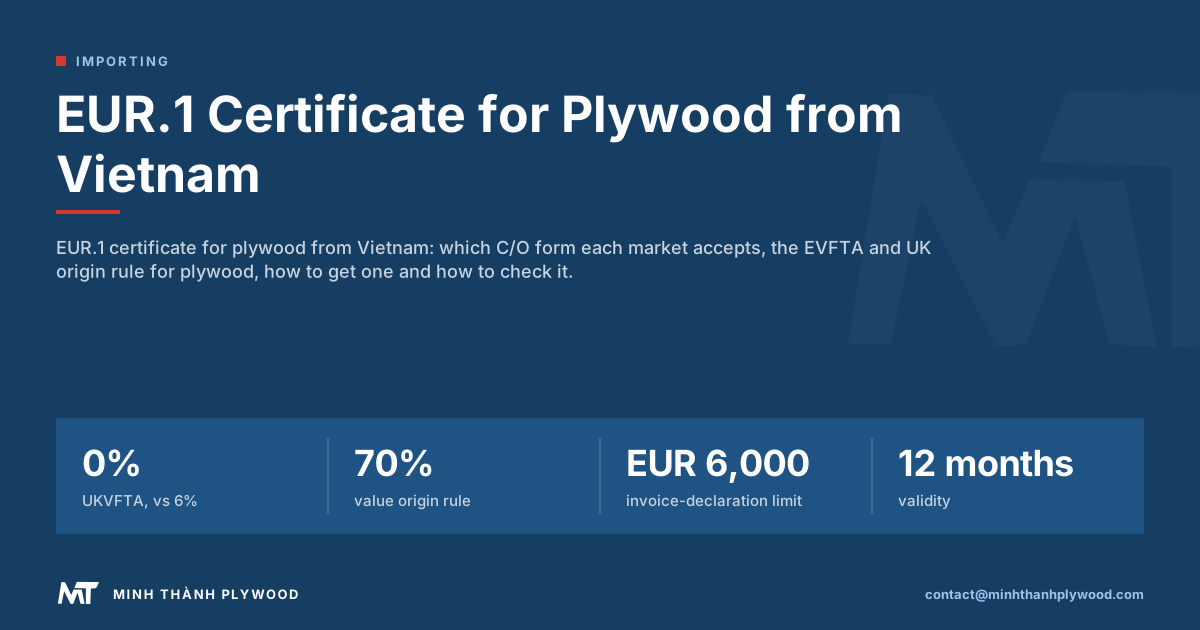
An EUR.1 certificate for plywood from Vietnam is the movement certificate that proves Vietnamese origin under the EU-Vietnam and UK-Vietnam free trade agreements, so your customs applies the preferential duty rate instead of the third-country rate. Other markets use their own forms: CPTPP certification for Canada, Mexico, Chile, Japan and the UK, Form E for China, Form AK or VK for Korea. Minh Thanh Plywood supplies the EUR.1 with every EU order and the form your destination needs for the rest.
What is an EUR.1 certificate for plywood from Vietnam?
An EUR.1 certificate for plywood from Vietnam is a movement certificate, issued in Vietnam, stating that the plywood originates in Vietnam under a preferential trade agreement. EU and UK customs read it to apply the agreement’s duty rate instead of the third-country rate.
Three facts about it matter to a plywood importer:
- It is issued per shipment, against the commercial invoice of that shipment.
- It is issued by a government authority: the Ministry of Industry and Trade (MOIT) in Vietnam, not the exporter.
- It only works if the plywood meets the origin rule of the agreement, which for plywood is about where the panel was pressed and what went into it.
The EUR.1 is one of the four core documents in every EU and UK plywood shipment, next to the commercial invoice, packing list and bill of lading. Minh Thanh supplies it with every EU order as standard.
What trade agreements benefit Vietnam plywood exports?
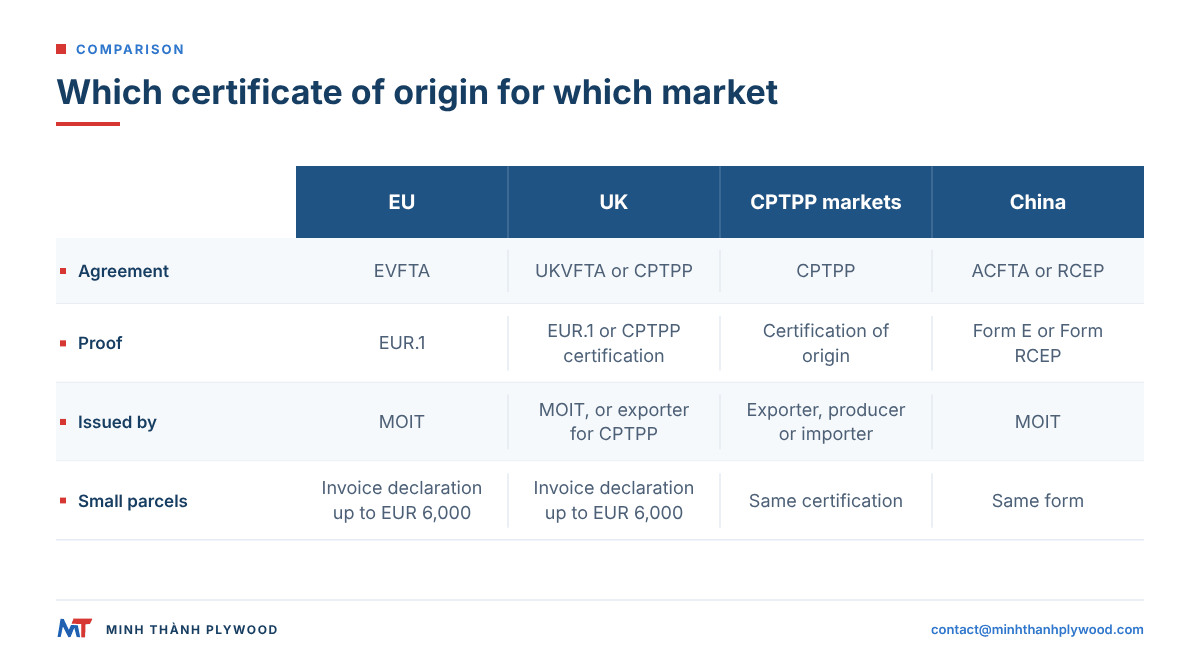
Vietnam has free trade agreements with most of the world’s plywood markets, including the EVFTA with the EU, the UKVFTA with the UK, CPTPP, RCEP and the ASEAN agreements. Each one has its own proof of origin, and the right form is the one your customs authority names for your entry.
| Destination | Agreement | Proof of origin from Vietnam |
|---|---|---|
| European Union | EU-Vietnam FTA (EVFTA) | EUR.1, or an origin declaration for consignments up to EUR 6,000 |
| United Kingdom | UK-Vietnam FTA (UKVFTA); CPTPP | EUR.1 or origin declaration; or CPTPP certification of origin |
| Canada, Mexico, Chile, Peru | CPTPP | Certification of origin by the exporter, producer or importer, or Form CPTPP |
| Japan | CPTPP; Japan-Vietnam EPA; ASEAN-Japan | CPTPP certification, Form VJ or Form AJ |
| Australia, New Zealand | CPTPP; ASEAN-Australia-New Zealand | CPTPP certification or Form AANZ |
| China | ASEAN-China FTA; RCEP | Form E or Form RCEP |
| Republic of Korea | ASEAN-Korea; Korea-Vietnam FTA | Form AK or Form VK |
| ASEAN members | ATIGA | Form D |
| India | ASEAN-India FTA | Form AI |
| Eurasian Economic Union | Vietnam-EAEU FTA | Form EAV |
| United States, Gulf states | No FTA with Vietnam | Non-preferential certificate of origin where required |
Two agreements overlap for several markets. A UK importer can claim preference under the UK-Vietnam agreement with an EUR.1 or under CPTPP with a certification of origin; the broker picks the one that gives the better rate and the simpler paperwork for the tariff code.
What is the EVFTA plywood tariff, and what does an EUR.1 save?
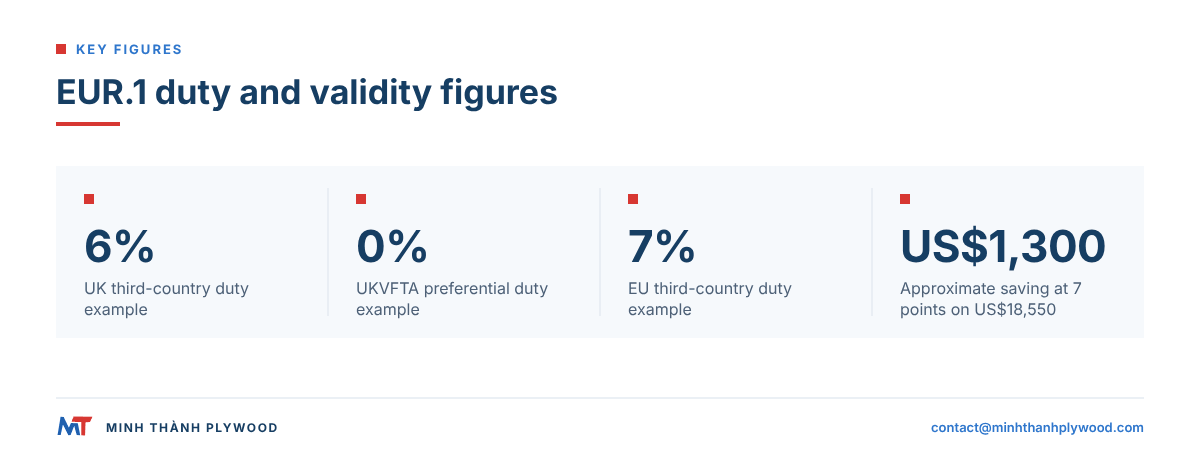
Under the EVFTA and the UKVFTA, plywood originating in Vietnam enters at the preferential rate, which replaces the third-country duty when a valid proof of origin is presented. The UK shows the effect clearly: plywood from Vietnam carries a 6% third-country duty and 0% under the UK-Vietnam agreement, when the origin proof is in order. The rates are those of the UK Trade Tariff, commodity 4412 33 10 12 (checked on 21 October 2026). Other hardwood-faced lines, such as 4412 33 20 10 and 4412 34 00 10, follow the same pattern; confirm the 10-digit code with your broker.
The EU works the same way, with a bigger gap. Plywood of heading 4412 carries a 7% third-country duty on the commonly traded lines such as birch-faced 4412 33 00 (EU TARIC, The Trade Hub mirror of line 4412331014, checked October 2026). Some face-ply lines sit in a 7-10% band.
The EVFTA took effect on 1 August 2020 and removes the EU’s duties on Vietnamese goods in annual steps over seven years, a schedule whose last annual cut falls on 1 January 2027 and covers nearly all tariff lines (European Commission, EU-Vietnam trade agreement; Viet Nam News, EVFTA six years after launch, checked October 2026).
For a plywood importer that means the preferential rate is at or near zero, and only a valid proof of origin unlocks it. On a container of 53 m³ at US$350/m³, which is US$18,550 of goods, every 7 points of duty are about US$1,300 that the EUR.1 keeps out of the importer’s landed cost.
Chinese birch plywood carries EU anti-dumping duties on top of the 7%; Vietnamese plywood does not, which is why European buyers are moving volume to Vietnam. Your customs broker reads the current preferential rate for your 10-digit TARIC code on the European Commission’s Access2Markets portal (checked October 2026).
How long the paperwork adds is short when it is planned. From the deposit to arrival in Northern Europe, a typical order runs 15-45 days of production plus 30-40 days at sea, about 45-85 days in all; the EUR.1 is issued in the days before the vessel sails and does not extend that line.
What the EUR.1 saves, in practice:
| Without valid proof of origin | With a valid EUR.1 |
|---|---|
| Third-country duty on the customs value | Preferential rate under the agreement |
| Duty paid on every container | Duty saving on every container |
| No later claim once the entry is final, unless your customs allows a refund request | Preference applied at entry |
On a container of 18 mm furniture plywood, about 53 m³, the duty line is the single largest difference between a correct and a missing EUR.1. A late certificate can still be used in many cases; see the validity rules below.
How do you get an EUR.1 certificate for plywood from Vietnam?
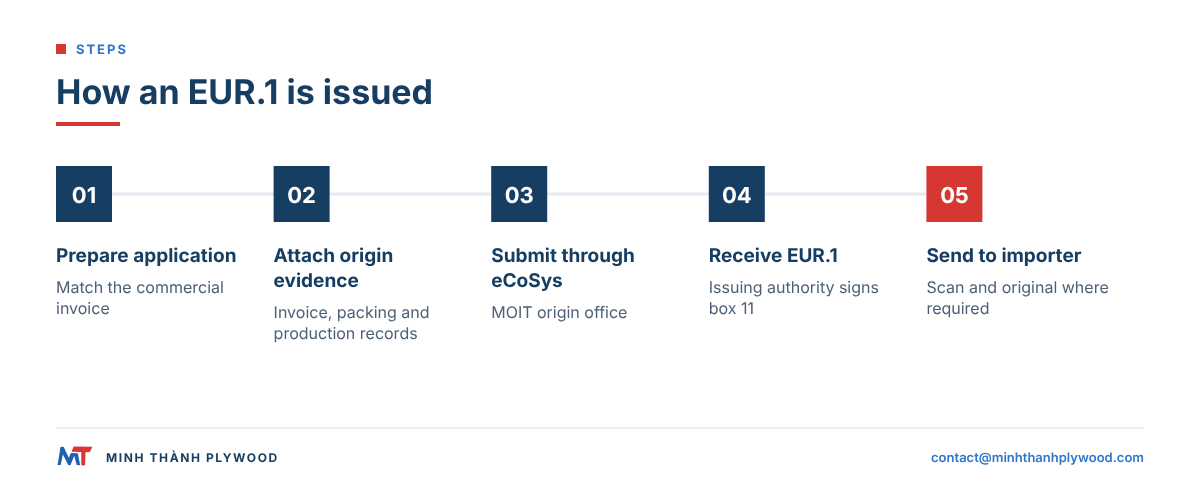
The exporter applies and MOIT issues. For plywood, the exporter runs these steps after the container is loaded:
- Prepare the application: the EUR.1 form and the application, completed in English, with the goods described exactly as on the invoice.
- Attach the evidence: commercial invoice, bill of lading or booking, packing list and the production records showing that the plywood meets the origin rule: veneer purchases, lay-up and pressing in the factory.
- Submit to the issuing office: MOIT’s regional origin offices handle the application, through the eCoSys electronic system.
- Receive the stamped certificate: the issuing office checks the file, signs and stamps box 11.
- Send it to the importer: a scan at once, the original by courier where the importing customs asks for paper.
For a certificate applied for after the goods have left, the issuing office can issue it retrospectively once it has verified the application against its file; the certificate is then endorsed “ISSUED RETROSPECTIVELY”.
Minh Thanh applies for the EUR.1 as part of the export file and sends the scan together with the bill of lading, so the importer has both before the vessel arrives. Payment terms stay the same: 70% balance against the scanned B/L.
EUR.1 or statement on origin: which proof does your plywood need?
The EU-Vietnam and UK-Vietnam agreements accept three proofs of origin (UK origin reference document for Viet Nam, via the UK Trade Tariff rules of origin, checked October 2026):
| Proof | Made out by | When it is used |
|---|---|---|
| EUR.1 movement certificate | Issuing authority in Vietnam (MOIT) | Any consignment value; the standard proof for a plywood container |
| Origin declaration on the invoice | Any exporter | Consignments up to EUR 6,000 |
| Origin declaration by an approved exporter | Exporter approved by the authority | Any value |
A statement on origin under the EU’s Registered Exporter system (REX) is how EU exporters claim preference when they ship to Vietnam; for plywood shipped from Vietnam to Europe in full containers, the EUR.1 is the proof EU and UK brokers ask for.
The value line matters: one 40HC of furniture plywood is worth many times EUR 6,000, so the invoice declaration route is for samples and small parcels, not containers.
What is the rule of origin for plywood under EVFTA and UKVFTA?
Plywood of heading 4412 originates in Vietnam if it meets one of two rules in the agreement’s product-specific list (UK Trade Tariff rules of origin for Viet Nam, heading 4412, checked October 2026):
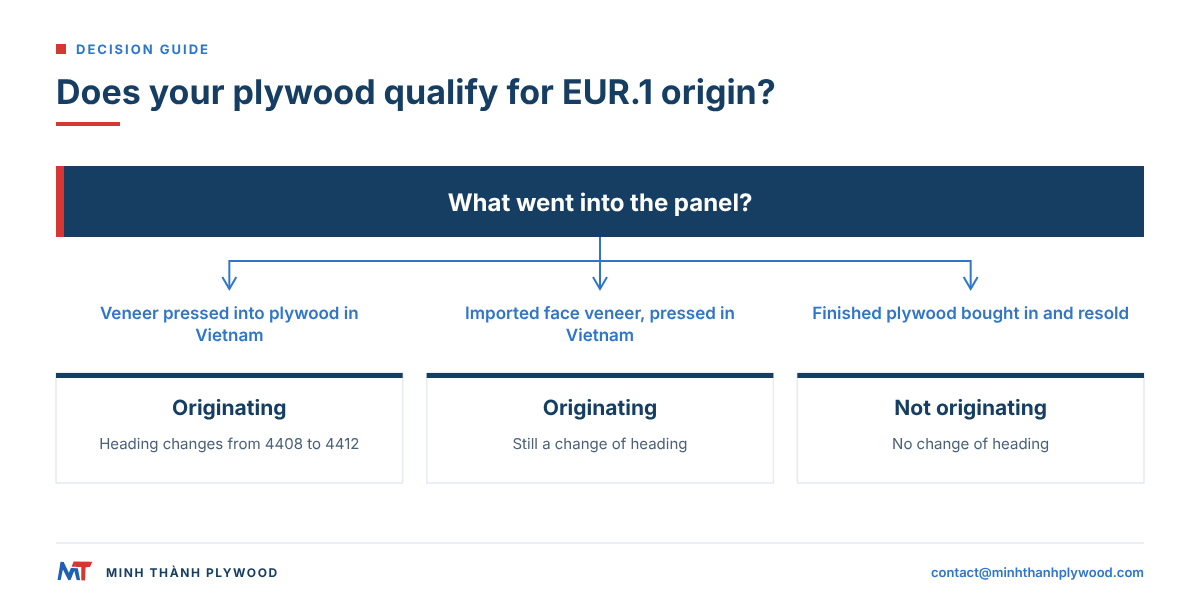
- Change of tariff heading: manufactured from materials of any heading except 4412; or
- Value rule: the value of all non-originating materials used does not exceed 70% of the ex-works price.
The UK-Vietnam agreement carries over the EU-Vietnam rules of origin, so the same test applies to both markets. What it means for a plywood order:
- Plywood pressed in Vietnam from veneer qualifies. Veneer is heading 4408, so a panel laid up and pressed in Vietnam changes heading, even when a face veneer such as birch or okoume is imported.
- Plywood bought in and resold does not change origin. A panel of heading 4412 made elsewhere stays plywood of the same heading; sanding or cutting it in Vietnam does not make it Vietnamese.
- The factory record proves it. Veneer intake, lay-up and pressing records show the change of heading in the issuing office’s file.
Minh Thanh presses its own panels in Ha Hoa, Phu Tho, on plantation Styrax and Eucalyptus cores grown around the factory, with faces chosen for the look the buyer orders. Every panel starts as veneer in the factory and leaves as plywood, which is the change of heading the rule asks for.
What does an EUR.1 for plywood look like, box by box?
The EUR.1 has twelve boxes on the front. For a plywood shipment from Vietnam to the EU, they read:
| Box | Content | What to check |
|---|---|---|
| 1 | Exporter: name and address in Vietnam | Matches the commercial invoice |
| 2 | Agreement: preferential trade between Viet Nam and the European Union (or the United Kingdom) | Names your market |
| 3 | Consignee (optional) | Matches the bill of lading |
| 4 | Country of origin: Viet Nam | — |
| 5 | Country of destination | Your country |
| 6 | Transport details (optional) | Vessel, port of loading Hai Phong |
| 7 | Remarks | “ISSUED RETROSPECTIVELY” when applicable |
| 8 | Item number, marks, number of packages, description of goods | Pack count and plywood description as on the invoice |
| 9 | Gross weight | Matches the packing list |
| 10 | Invoice number and date | Matches the invoice |
| 11 | Customs or issuing authority endorsement | Stamp, signature, office and date |
| 12 | Exporter’s declaration | Signed and dated |
Box 8 is where most problems start. “Plywood” alone is too vague; the description should match the invoice line, for example “18 mm furniture plywood, poplar face, Styrax core, 1220 × 2440 mm, 18 packs”.
How do buyers check that an EUR.1 is genuine?
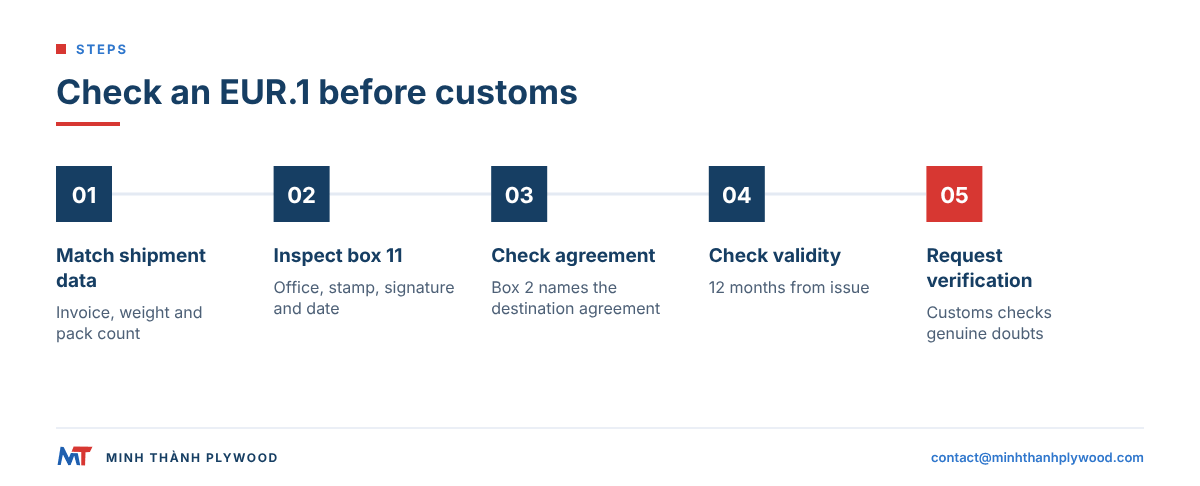
Check the certificate against your own documents first, then use customs verification for any real doubt:
- Match the numbers: invoice number and date in box 10, gross weight in box 9 and pack count in box 8 must match your invoice and packing list.
- Check box 11: an issuing office stamp, a signature, a date and the office name; a blank or photocopied box 11 is not valid.
- Check box 2: the agreement named must be the one with your country.
- Check the date: within the 12-month validity on the day your entry is presented.
- Ask customs to verify: your customs authority can send a verification request to the Vietnamese authority. Under the agreement, if there is no reply within 10 months or the reply is insufficient, the importing customs can refuse the preference.
Buying directly from the manufacturer keeps this simple: the exporter on box 1 is the factory that pressed the panels, so the origin evidence and the certificate come from the same company.
How long is an EUR.1 valid, and who keeps the records?
A proof of origin under the UK-Vietnam agreement is valid for 12 months from issue and must be presented to the importing customs within that period; late presentation can still be accepted for force majeure or when the goods were imported within the 12 months. The EU-Vietnam agreement uses the same periods.
| Record | Kept by | How long |
|---|---|---|
| Copy of the EUR.1 and supporting documents | Exporter | At least three years |
| Application form | Issuing authority in Vietnam | At least three years |
| Proof of origin submitted at entry | Importing customs | At least three years |
| Your import entry and the certificate | Importer | As your customs authority sets it |
Keep the EUR.1 in the container folder with the invoice, packing list and bill of lading, named by the B/L number, so a later audit question takes minutes to answer.
CPTPP rates for Mexico, Chile and Canada: which certificate applies?
The CPTPP uses a certification of origin instead of a fixed form. Under the agreement’s text it can be completed by the exporter, the producer or the importer, needs no prescribed format, must state that the goods are originating and must contain the minimum data the agreement lists. It can cover one shipment or several shipments of identical goods over up to 12 months, and it is valid for one year from issue, or longer where the importing country’s law allows. Vietnam also issues a Form CPTPP through MOIT for exporters who prefer an issued certificate.
For plywood, the CPTPP picture by market:
- Canada: no duty on any plywood line of heading 4412 under the 2026 Customs Tariff, MFN or CPTPP, so the certification is not needed for a rate (CBSA Customs Tariff, Chapter 44, checked October 2026). See importing plywood from Vietnam to Canada.
- Mexico and Chile: both apply CPTPP preferential rates to originating goods from Vietnam; the certification of origin is what the importer’s broker presents to claim them.
- United Kingdom: a second route next to the UKVFTA EUR.1.
Ask your broker which form your entry needs before the shipment leaves, so the exporter prepares it with the export file.
What are the most common EUR.1 mistakes on plywood shipments?
Most rejected certificates fail on paperwork, not on origin. The common ones:
| Mistake | Effect | Prevention |
|---|---|---|
| Box 8 description differs from the invoice | Customs cannot link certificate and goods | Copy the invoice line word for word |
| Gross weight differs from the packing list | Query at entry | Use the final packing list weights |
| Wrong agreement in box 2 | Certificate does not apply | Name the destination agreement |
| Invoice number missing or wrong in box 10 | Link to the shipment broken | Issue the EUR.1 after the final invoice |
| Certificate applied for late, without endorsement | Not valid as issued | Apply retrospectively so box 7 is endorsed |
| Plywood bought in from another mill | Origin rule not met | Buy from the manufacturer that presses the panel |
A draft check prevents all six. Ask the exporter for a draft of the EUR.1 with the drafts of the invoice and packing list, and approve them together.
Is the certificate of origin the same as EUDR or Lacey origin data?
No, and the difference matters for timber. The certificate of origin answers where the plywood was manufactured, for duty. Timber legality and deforestation rules ask where the wood was harvested:
- EUDR (EU): the importer files a due diligence statement using the species, quantity, country of production and the geolocation of every plot the wood came from. Minh Thanh supplies the EUDR compliance dossier, origin records and geolocation files, with orders. See EUDR traceability.
- Lacey Act (US): the importer declares the genus, species and country of harvest of every wood in the panel, face and core.
- UK Timber Regulation and Japan’s Clean Wood Act: legality due diligence based on the same species and harvest data.
A panel with a Vietnamese core and an imported birch face has Vietnamese origin for duty, while its harvest data lists two countries. Both files come with a Minh Thanh order, and they answer different questions.
Which certificates of origin does Minh Thanh supply?
Minh Thanh supplies a certificate of origin with every shipment: the EUR.1 for EU orders as standard, and the form your destination names for the rest, from a CPTPP certificate to Form E or a non-preferential certificate. It travels in the same set as the commercial invoice, packing list, bill of lading, phytosanitary and fumigation certificates where required, and insurance under CIF.
What makes the origin file straightforward with a manufacturer:
- One company from veneer to container. The factory that presses the panels is the exporter on the certificate, so the production evidence is its own.
- Local cores. Styrax and Eucalyptus cores are plantation timber grown around Ha Hoa, Phu Tho.
- Records by pack. Pack numbers on the packing list link to production lots and to the loading photos and video of each container.
For the full document set, read the plywood import documents checklist.
What should you send so the certificate of origin is right first time?
Send these with your order or RFQ:
- Destination country and port, so the agreement and form are fixed.
- The form your broker wants: EUR.1, CPTPP certification, Form E or another.
- Consignee and notify party, with legal names exactly as on your customs registration.
- Original or electronic: whether your customs accepts a scan or needs the stamped original by courier.
- Your broker’s contact, so the tariff code and the box 8 description are agreed before the invoice is final.
Minimum order is one 40HC, with mixed specifications by agreement on one set of documents; production takes 15–45 days after the 30% deposit. Terms are on the trade terms page. Send the details to contact@minhthanhplywood.com and the draft certificate comes to you with the draft invoice for approval. For the EU process end to end, see importing plywood from Vietnam to the EU.
Buyer questions, answered
What is an EUR.1 certificate for plywood?
An EUR.1 is a movement certificate issued in the exporting country that proves the goods originate there under a preferential trade agreement. For plywood from Vietnam it is used under the EU-Vietnam and UK-Vietnam agreements to claim the preferential duty rate.
Who issues the EUR.1 certificate in Vietnam?
The Ministry of Industry and Trade (MOIT) issues EUR.1 certificates for exports to the EU and the UK, on an application by the exporter with the invoice, transport document and evidence that the goods meet the origin rule.
What is the rule of origin for plywood under the EU and UK agreements with Vietnam?
Plywood of heading 4412 qualifies when it is made from materials of any heading other than 4412, or when non-originating materials do not exceed 70% of the ex-works price. Plywood pressed in Vietnam from veneer qualifies even when a face veneer is imported.
How long is an EUR.1 valid?
Under the UK-Vietnam agreement a proof of origin is valid for 12 months from issue in the exporting country and must be presented to the importing customs within that period. The EU-Vietnam agreement uses the same rule.
Can an EUR.1 be issued after the ship has sailed?
Yes. A certificate can be issued retrospectively after the competent authority verifies the application against its file, and it is then endorsed ISSUED RETROSPECTIVELY.
Do I need an EUR.1 if my order is small?
For consignments up to EUR 6,000, an exporter can make out an origin declaration on the invoice instead of an EUR.1. A full container of plywood is above that value, so the EUR.1 is the usual proof.
Which certificate of origin does Canada accept for Vietnamese plywood?
Canada charges no duty on plywood of heading 4412 under its 2026 tariff, so no preferential certificate is needed for a rate. A certificate of origin still proves Vietnamese origin if a trade-remedy question arises.
Is there a preferential certificate for plywood to the United States?
No. The United States has no free trade agreement with Vietnam, so a non-preferential certificate of origin is used where the buyer or bank asks for one.
How can a buyer check that an EUR.1 is genuine?
Check that the description, weights and invoice number match your documents, that box 11 carries the issuing authority's stamp and date, and ask your customs authority to verify it with the Vietnamese authority when in doubt.
Is the certificate of origin the same as EUDR origin data?
No. The certificate of origin proves where the plywood was manufactured, for duty. The EUDR dossier proves where the wood was harvested, with geolocation of the plots, for deforestation due diligence.