
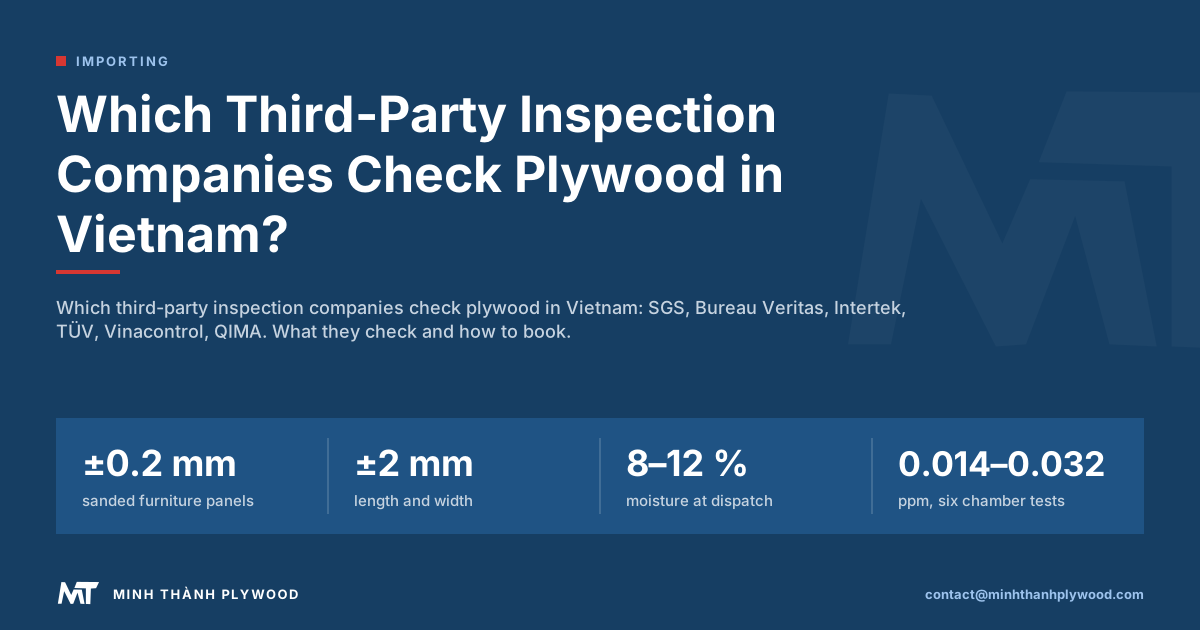
The third-party inspection companies that check plywood in Vietnam are the global groups SGS, Bureau Veritas, Intertek and TÜV, the Vietnamese group Vinacontrol, and specialist sourcing inspectors such as QIMA and V-Trust. Each sends an inspector to the mill to measure, grade and count your order before it ships. Minh Thanh Plywood hosts buyer-nominated inspectors at its factory in Ha Hoa, Phu Tho.
Which third-party inspection companies check plywood in Vietnam, and what do they report?
Seven groups of inspectors cover most plywood orders from Vietnam. All of them send a person to the mill with your specification, measure and grade the goods, and send a report with photos, usually within a day or two of the visit.
| Company | Type | Plywood services in Vietnam | Report buyers usually get |
|---|---|---|---|
| SGS | Global testing, inspection and certification group | Pre-shipment inspection, loading supervision, laboratory tests | Inspection report; test report to the named method |
| Bureau Veritas | Global inspection and certification group | Factory audit, product inspection, loading checks | Inspection report, audit report |
| Intertek | Global quality assurance group | Factory audit, pre-shipment inspection, testing | Inspection report with AQL result |
| TÜV Rheinland, TÜV SÜD | German testing and certification groups | Factory audit, inspection, product testing | Audit or inspection report |
| Vinacontrol | Vietnamese inspection group | Quantity, quality and loading inspection for export goods | Inspection certificate named in many contracts and L/Cs |
| QIMA, V-Trust | Sourcing inspection specialists | Pre-shipment inspection, loading checks, factory audits, booked online | Photo-heavy report, fast turnaround |
| AIM Control and local firms | Vietnamese and regional survey companies | Inspection, loading supervision, cargo surveys | Survey or inspection report |
The name on the report matters less than three things: an inspector who knows plywood, a checklist written from your order, and a report your bank, customer or market accepts. A letter of credit that names an inspection certificate decides the firm for you; read the credit before you book.
Is third-party inspection recommended for Vietnam plywood imports?
Yes, for the orders where a mistake costs most. An inspection is booked per order, so use it where it changes the risk:
- First order with a mill, before you know its grading and packing.
- A new specification, such as a new face, a thinner panel or a tighter tolerance.
- A tight end use, for example furniture parts cut on CNC or panels that go straight to lacquer.
- A destination far from the mill, where a rejected container costs freight both ways.
- A customer or bank that asks for it, in the contract or the L/C.
After several consistent containers, many importers move to spot checks, or rely on the mill’s own records. At Minh Thanh, every shipment is photographed and filmed before loading, and the buyer receives the photos and video. That record does not replace an independent inspection on a first order, but it covers the repeat ones well.
What types of plywood inspection can you book?
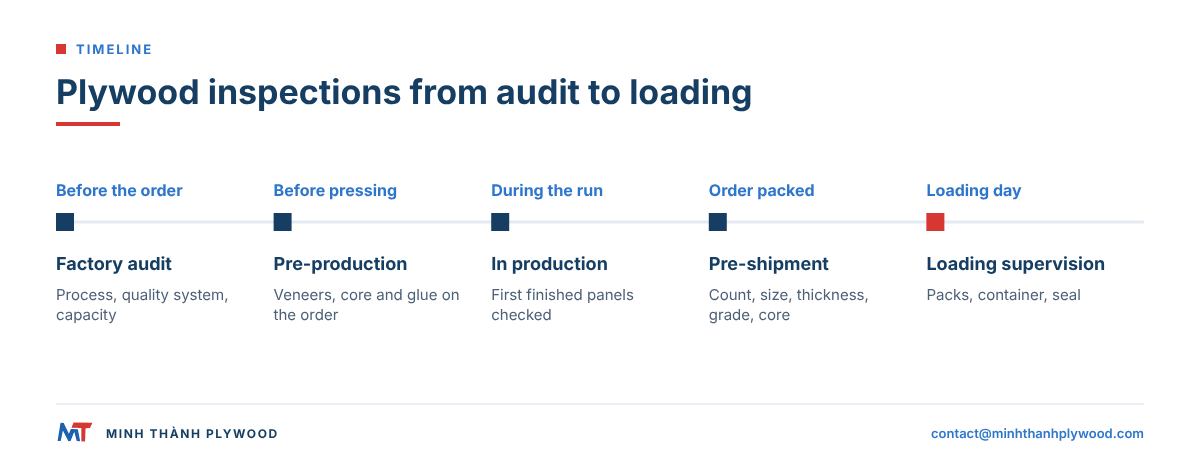
Plywood buyers book five services. Each answers a different question at a different time:
| Service | When | Question it answers |
|---|---|---|
| Factory audit | Before the first order | Is this a real mill with the process, quality system and capacity it claims? |
| Pre-production check | Before pressing starts | Are the veneers, core and glue the ones on the order? |
| During-production check | While the order runs | Do the first finished panels meet the specification? |
| Pre-shipment inspection | When the order is finished and mostly packed | Does the finished order match the specification and the sample? |
| Loading supervision | At container loading | Are the right packs loaded, protected and counted into a sound container? |
Most plywood importers book the pre-shipment inspection, and add loading supervision on a first order. A factory audit makes sense before you commit to a long programme with one mill.
What does an inspector check on plywood?
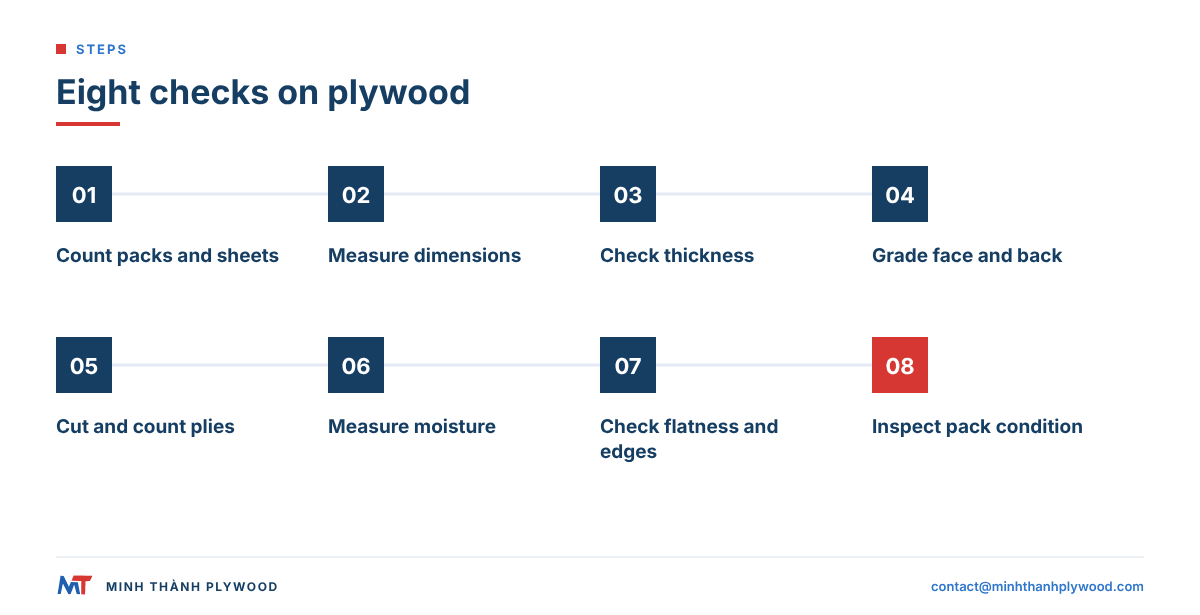
A plywood pre-shipment inspection checks the goods against your order and your approved sample, sheet by sheet on a random sample:
- Quantity and packing. Packs, sheets per pack, pack marking and labels, against the draft packing list.
- Dimensions. Length and width with a tape, squareness on the diagonals.
- Thickness. With a caliper at several points per sheet, against the tolerance on the order.
- Face and back grade. Against the approved sample sheet, under daylight.
- Core build. A sheet cut open to count plies, look for core gaps and overlaps, and see the glue line.
- Moisture content. With a meter on a sample of sheets.
- Flatness and edges. Warp, edge splits, delamination at the edges.
- Pack condition. Corner protection, straps, covers, pallet bases.
Write the numbers into the inspector’s checklist. For Minh Thanh panels they come from our standard tolerances:
| Item | Minh Thanh standard |
|---|---|
| Thickness, sanded furniture panels | ±0.2–0.3 mm, down to ±0.2 mm |
| Thickness, commercial and film-faced | ±0.5 mm |
| Thickness, packing plywood | ±0.5–1.0 mm |
| Length and width | ±2 mm |
| Moisture content at dispatch | 8–12 % |
| Face grade | The face/back pair agreed against your approved sample |
A checklist with numbers turns “generally acceptable” into a pass or a fail on each line, which is the only report worth paying for.
Which plywood tests need a laboratory?
Some properties cannot be judged by eye or meter at the mill. The inspector draws sample panels, seals them, and sends them to a laboratory. The usual tests for plywood, with the European standard names:
- Formaldehyde emission: EN 717-1 chamber method, or ASTM D6007 for CARB and TSCA.
- Bond quality: EN 314-1 and EN 314-2, with the pre-treatment for the bond class you ordered.
- Bending strength and stiffness: EN 310 (MOR and MOE).
- Moisture content and density: EN 322 and EN 323.
- Thickness and dimensions: EN 324-1.
Minh Thanh already holds the emission evidence European and US furniture buyers ask for: CARB P2 / TSCA Title VI under ICTT mill no. 23024, and six ASTM D6007 chamber tests between April 2025 and June 2026 on 9, 15 and 18 mm panels, averaging 0.014–0.032 ppm against the 0.05 ppm CARB Phase 2 limit. Three were run by Shanghai Hongjun and three by ICTT Vietnam. For a test to your own method, EN 717-1 or another, SGS tests the panels on request.
How do you choose the inspection company?
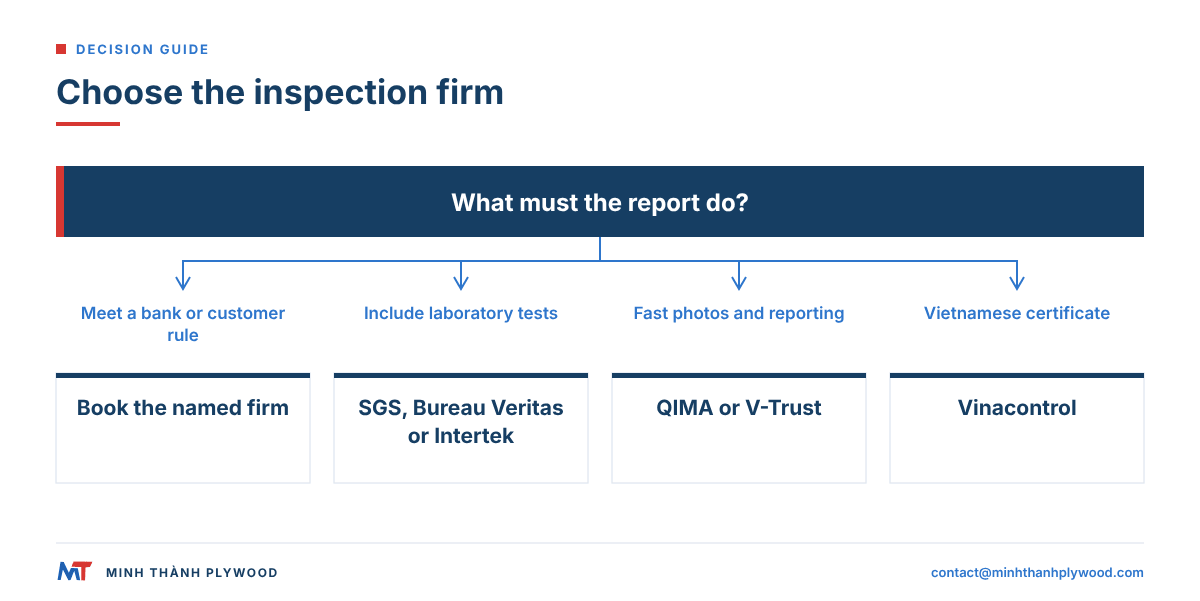
Choose the firm by what the report must do for you:
- Your bank names a firm in the letter of credit: book that firm, with the exact certificate wording the credit asks for.
- Your customer names a firm: book it, because the report is for them.
- You need a lab test as well: a group with its own laboratory, such as SGS, Bureau Veritas or Intertek, keeps sampling and testing in one chain of custody.
- You need speed and photos: sourcing inspectors such as QIMA or V-Trust book online and report fast.
- You need a Vietnamese certificate: Vinacontrol issues inspection certificates many regional buyers and banks know.
Then ask each firm two questions: has the inspector checked plywood before, and can they cut and read a core sample. A general consumer-goods inspector who has never seen a core gap will pass a sheet you would reject.
How much does a plywood inspection cost, and who pays?
Inspection firms charge per man-day, plus travel from their nearest office to the mill unless the rate is all-inclusive. One container of plywood is usually one man-day; loading supervision adds time on the loading day. As a public reference, TESTCOO advertises an all-inclusive US$259 per man-day for pre-shipment inspection in Vietnam’s manufacturing regions, with free cancellation up to 12 hours before the inspection date (rate checked October 2026). Global groups quote by service, location and days, so ask each firm for an all-inclusive price that names the mill’s location.
Set that against the cargo. A 40HC of furniture plywood holds about 53 m³; at the starting price of US$350/m³ that is about US$18,550, so one man-day at US$259 is about 1.4% of the order value.
The buyer normally pays, because the report protects the buyer. Two clauses are common in plywood contracts:
- Re-inspection cost. If a lot fails and the mill re-sorts it, the second visit is paid by the mill.
- Inspection in the price. The buyer adds the inspection to the order value and the mill books it.
Compare the cost with what it protects: the value of a 40HC of furniture plywood, the freight both ways, and the time your production line waits if a container is rejected at your port.
How do you book a plywood inspection in Vietnam?
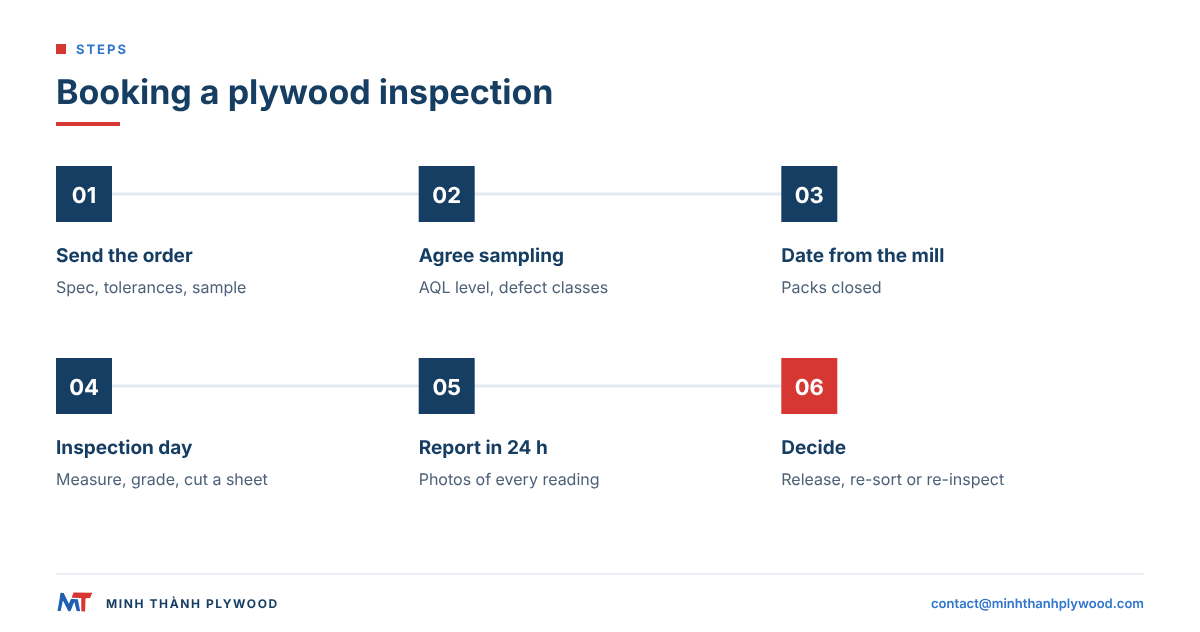
Booking is quick if the order is clear. The steps:
- Send the order to the firm: specification, quantities, tolerances, grade pair, sample reference, packing rules.
- Agree the sampling plan, usually by ISO 2859-1 (AQL) levels, and what counts as a critical, major and minor defect for plywood.
- Get the date from the mill: when production finishes and the packs are closed.
- Confirm the address and contact at the factory.
- Tell the inspector what to cut: which sheets may be cut open for the core check.
- Ask for the report within 24 hours, with photos of every measurement.
- Decide: release, re-sort, or re-inspect, by the rule already written in the order.
At Minh Thanh, send the inspection firm’s name and the date you want to sales; we confirm the date against the production plan and send the factory contact.
What does the mill prepare before the inspector arrives?
A good inspection day is prepared at the mill. Before a buyer-nominated inspector arrives at Minh Thanh, we have ready:
- The finished packs, closed but accessible, in the order of the draft packing list.
- The approved reference sample for the face/back grade pair.
- The order sheet and drawings, including cut-to-size drawings when the order has them.
- Calipers and moisture meter beside the inspector’s own tools, so readings can be compared.
- Access to finished packs, so the inspector can select sheets for cutting.
- The certificate files for the order: CARB P2 / TSCA Title VI, test reports, the EUDR dossier for EU orders.
- A covered area with daylight for face grading.
Our furniture panels are pressed twice: the core is pressed and calibrated, then face and back go on. Core layers are stitched horizontally and vertically. An inspector who cuts a sheet sees that build directly on the edge.
What should the inspection clause in your order say?
Write the inspection into the order before production starts. Four lines are enough:
- Who inspects and when: the firm, the type of inspection, and that it happens before loading.
- What is measured, and the tolerance: thickness, size, moisture, grade against the sample, packing.
- What counts as a failure: by AQL level and defect class, or by a fixed number of sheets per pack.
- What happens next: re-sort and replace, re-inspection at the mill’s cost, or acceptance with a written adjustment.
Without these four lines, a failed report becomes a negotiation with the vessel already booked. With them, the mill knows the rule before the first sheet is pressed.
What does Minh Thanh check before your inspector does?
An independent inspection works best on top of the mill’s own control. Our routine for every furniture plywood order:
- Veneer grading for face and core before pressing.
- Core stitching horizontally and vertically, and calibration of the pressed core board.
- Thickness checks after sanding, against the tolerance on the order.
- Moisture of veneers and panels, 8–12 % at dispatch.
- Face grading against the approved sample.
- E0 emission testing every 3 months, beside the chamber tests listed above.
- Photos and video of every container before loading, sent to the buyer.
Quality and process details are on the quality control page. An inspector who arrives at a mill with this routine finds what the paperwork says.
What does a good plywood inspection report contain?
A useful report lets you decide without calling the inspector. Check that it has:
- Order reference, date, mill name and address, and the inspector’s name.
- Sampling plan and result: AQL level, sample size, defects found by class.
- Every measurement, not just “OK”: thickness readings per sheet, sizes, moisture.
- Photos: face and back, the cut core, the caliper on the edge, the meter display, the packs and marks.
- A clear verdict: pass, fail, or pending your decision, with the reason.
- For loading supervision: container number, seal number, container condition, packs loaded, and photos at each stage.
File the report with the packing list and the bill of lading for that container. If a question comes up months later, the pack numbers lead back to the lot and the inspection photos.
How do you check that an inspection report or test certificate is genuine?
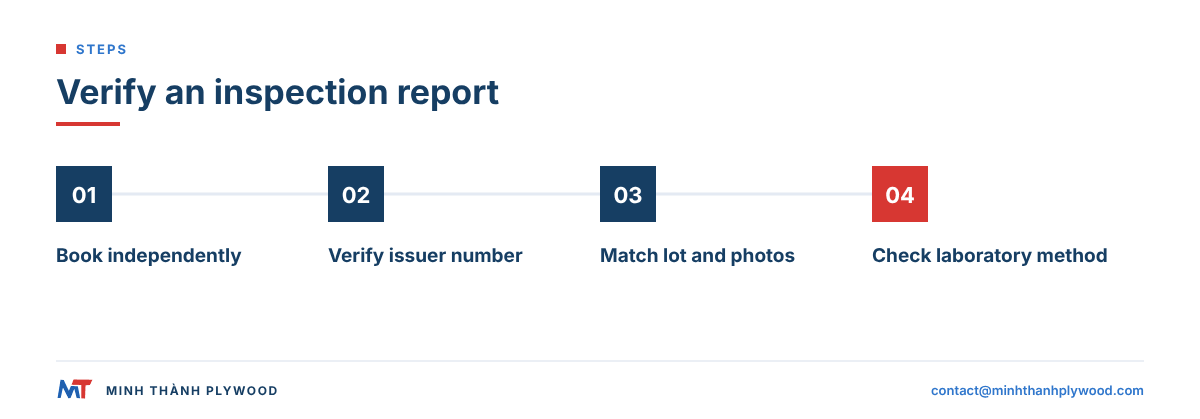
Check it at the issuer, never through the mill. Forged reports and certificates are a known risk in sourcing, and four checks catch most of them:
- Book the inspector yourself. The firm is paid by you and sends the report to you directly, not through the mill or a trading agent.
- Verify the report number with the issuer. SGS runs a document verification form, and Bureau Veritas explains how to check the authenticity of its certificates. Other firms answer the same request by email.
- Match the evidence to the day. The report names the mill, the date, the inspector and the order number, and its photos show your pack marks, the caliper reading and the cut core. Photos without your marks prove nothing.
- Check the laboratory. A formaldehyde report should name an accredited laboratory, a test method (ASTM D6007 or EN 717-1), the panel thickness and the sampling record. For CARB P2 and TSCA Title VI, the third-party certifier and the mill number are listed on the CARB composite wood program page.
At Minh Thanh, every emission report on file names the laboratory and the report number; ask us for the numbers and check them with the laboratory.
Keep the inspector independent of the order. A sourcing agent that earns a margin on the order, or a mill-appointed inspector, has a reason to pass a lot; an inspector booked and paid by the buyer does not.
What does this mean for your order?
For a first order with Minh Thanh, our advice is simple: book a pre-shipment inspection with the firm your bank or customer trusts, and loading supervision if the destination is far. Send us the firm’s name with the order, and we plan the inspection day into production.
Our terms stay the same with or without an inspection: MOQ one 40HC with mixed specifications by agreement, production 15–45 days after the 30% deposit, and the 70% balance against the scanned B/L, or an irrevocable L/C at sight. Free samples come first, so the inspector grades against a sheet you have already approved.
Buyer questions, answered
Which third-party inspection companies check plywood in Vietnam?
SGS, Bureau Veritas, Intertek, TÜV Rheinland and TÜV SÜD, the Vietnamese group Vinacontrol, and sourcing inspectors such as QIMA, V-Trust and AIM Control all inspect plywood in Vietnam. Choose by the report your bank, customer or market accepts.
Is third-party inspection recommended for Vietnam plywood imports?
Yes, on a first order, a new specification or a new mill, and whenever a rejection at your port would be costly. After several consistent containers, many importers move to spot checks or rely on the mill's own loading photos and video.
Does Vinacontrol inspect plywood?
Yes. Vinacontrol is a Vietnamese inspection group that carries out quantity, quality and loading inspections for export goods, plywood included, and issues certificates that some banks and buyers name in their contracts.
What does a plywood pre-shipment inspection check?
Sheet count and packing, length, width and thickness at several points, face and back grade against the approved sample, core build on a cut sheet, glue line, moisture content, marking and the condition of the packs.
How much does a plywood inspection in Vietnam cost?
Inspection firms price per man-day; TESTCOO advertises an all-inclusive US$259 per man-day for Vietnam. One man-day is about 1.4% of a 40HC of furniture plywood at US$350/m³. Ask two or three firms for an all-inclusive quote naming the factory location.
How do I know a plywood inspection report is genuine?
Book the inspector yourself, verify the report number with the issuing firm, check that the photos show your pack marks and the cut core, and confirm that any laboratory report names an accredited laboratory and the test method.
Who pays for a third-party plywood inspection?
Normally the buyer, because the report protects the buyer. Some contracts say the mill pays for a re-inspection after a failed report; agree that in writing on the order.
Can an inspector test formaldehyde emission at the factory?
No. Emission is a laboratory test, such as EN 717-1 or ASTM D6007. The inspector can draw sample panels at the mill and send them to the lab; Minh Thanh arranges SGS testing to your method on request.
When should the pre-shipment inspection take place?
When production is finished and most packs are closed, a few days before loading. That leaves time to re-sort or replace sheets if a lot fails, without missing the vessel.
Does Minh Thanh allow third-party inspection?
Yes. Buyer-nominated inspectors are welcome at the factory, for pre-shipment inspection and loading supervision. We prepare the finished packs, the approved sample, the drawings and a draft packing list before the inspector arrives.
What is the difference between a factory audit and a pre-shipment inspection?
A factory audit checks the mill: its process, quality system, capacity and documents, usually before the first order. A pre-shipment inspection checks one order: the finished goods against your specification.
What if the plywood fails the inspection?
The contract decides: re-sort and replace the failed sheets, re-inspect at the agreed cost, or accept with a written adjustment. Write the failure rule and the next step into the order before production starts.