
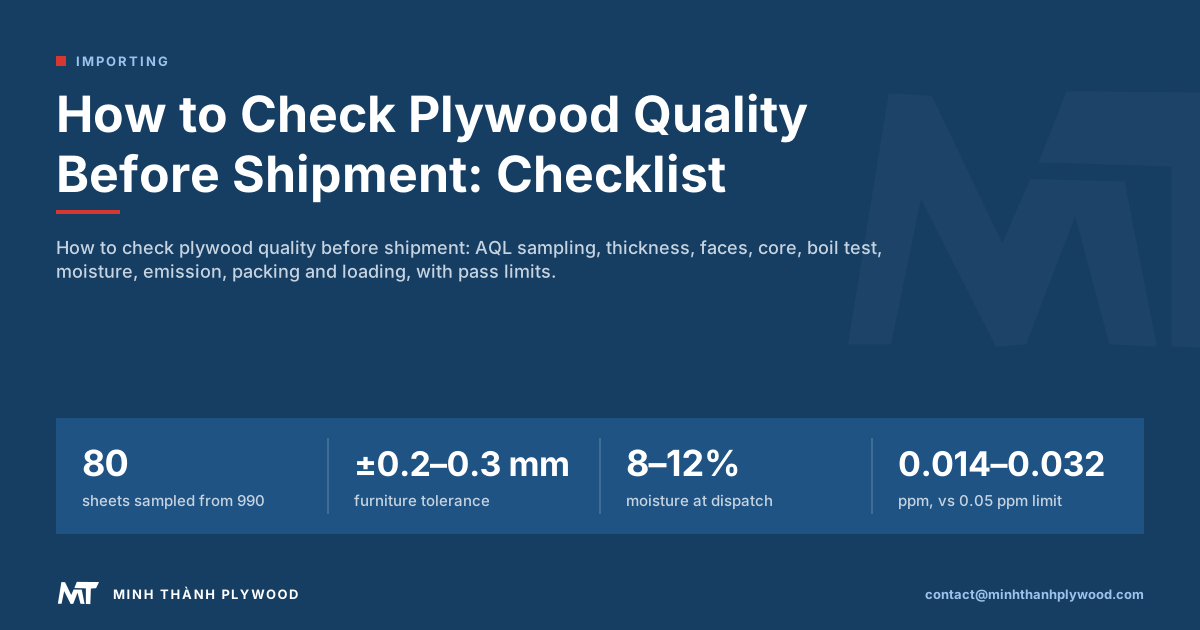
To check plywood quality before shipment, draw a random sample from the finished packs, then measure thickness and size, grade both faces against the approved sample, cross-cut a sheet for the core, boil-test the bond, read moisture, check the emission papers, and watch the packs go into the container. Minh Thanh Plywood runs these checks on every order and films every loading.
How to check plywood quality before shipment: the 12 steps
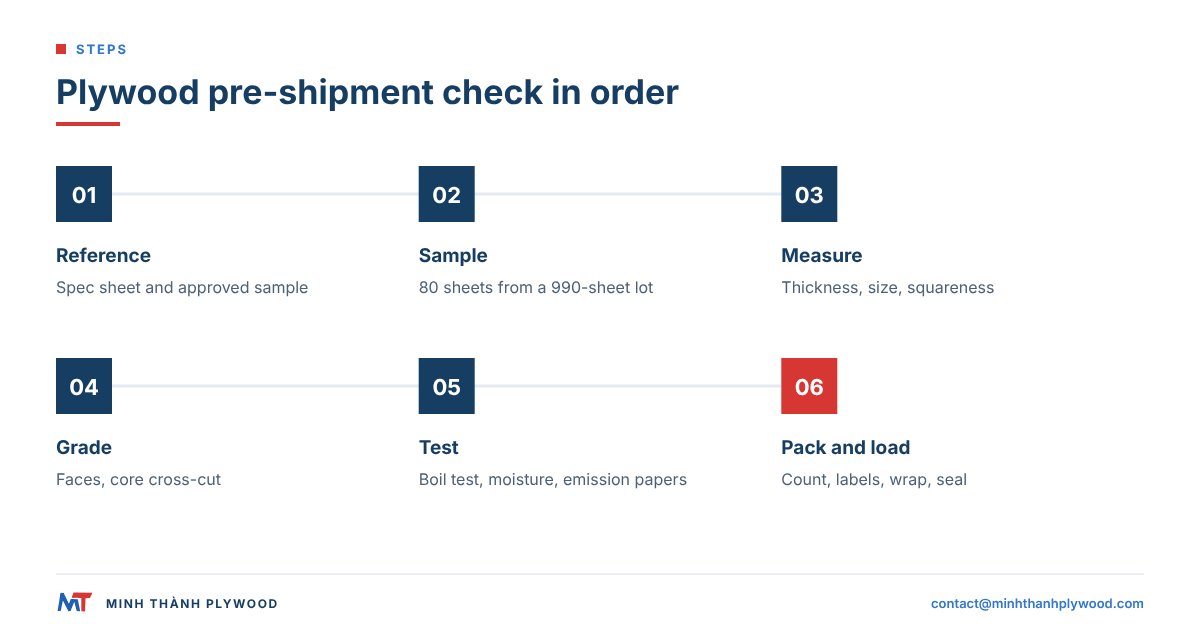
You check plywood quality before shipment by sampling finished packs at random and testing them against the written specification and the approved sample, then watching the loading. Work through the twelve steps below in this order, from the certificate to the loading, and record each result with a photo:
- Fix the reference: the signed specification sheet and the approved sample.
- Draw the sample: a random set of sheets from different packs.
- Measure thickness with a digital caliper.
- Measure length, width, squareness and flatness.
- Grade face and back against the sample, under angled light.
- Cross-cut one sheet to see the core.
- Boil-test cut pieces for the glue bond.
- Read moisture content.
- Check the emission documents and any labels.
- Count packs and sheets against the packing list.
- Check packing and marks: wrap, straps, corners, bearers, labels.
- Watch the loading and record the container and seal.
Each step has a pass limit, set out in the checklist below. A check without a limit is an opinion; write the limits into the order, and the inspection becomes a measurement.
What should a plywood inspection measure against?
A plywood inspection measures against two things agreed before production: the written specification and the approved sample. Without them, an inspector can only report what the panels look like, not whether they pass.
The specification sheet should state, for each item: face and back species and grade, core species, glue type and emission class, thickness and its tolerance, size, quantity, and packing. The approved sample fixes what words cannot: face colour, grain, repairs and the feel of the sanded surface.
At Minh Thanh, faces are matched to the sample you approved, and grade pairs are written the way the trade orders them: A/A, A/B or B/B for poplar, eucalyptus and pine faces, D+/D or D/E for birch. Keep one sample sheet on your side and one at the mill, labelled with the order number.
How do you check plywood quality, item by item? The printable checklist
This checklist gives the method and the pass limit for each check, using Minh Thanh’s in-house limits for sanded furniture plywood. Replace the limits with your own where your specification differs.
| Check | Method | Pass limit (furniture plywood) |
|---|---|---|
| Thickness | Digital caliper, near each corner and the middle | ±0.2–0.3 mm, or ±0.2 mm where ordered |
| Length and width | Steel tape on each edge | ±2 mm |
| Squareness | Use the ISO 9426 mechanical-square method at all four corners | Deviation within 1 mm/m (ISO 1954) |
| Flatness | Lay the sheet on a flat table, sight along a straightedge, check the gap at the corners | No bow or twist beyond the limit written into the order |
| Face and back grade | Raking light, against the approved sample | Grade pair as ordered; no defect outside the sample |
| Core | Cross-cut one sheet | No open gaps or overlaps; ply count fits the thickness |
| Glue bond | Boil test on cut samples | No delamination within the time for the ordered glue |
| Moisture | Pin or pinless meter, several points | 8–12% |
| Emission | Certificate, chamber reports, labels | Class and proof as ordered |
| Count | Packs and sheets against the packing list | Exact |
| Packing | Wrap, straps, corner boards, bearers | As ordered; ISPM 15 mark on solid wood bearers |
| Edge sealing (film-faced) | Look along all four edges of each sampled sheet | Sealed without gaps or chips |
| Labels | Each pack | Specification, size and quantity readable |
| Loading | Photos and video of each pack | Packs intact, container clean and dry, seal recorded |
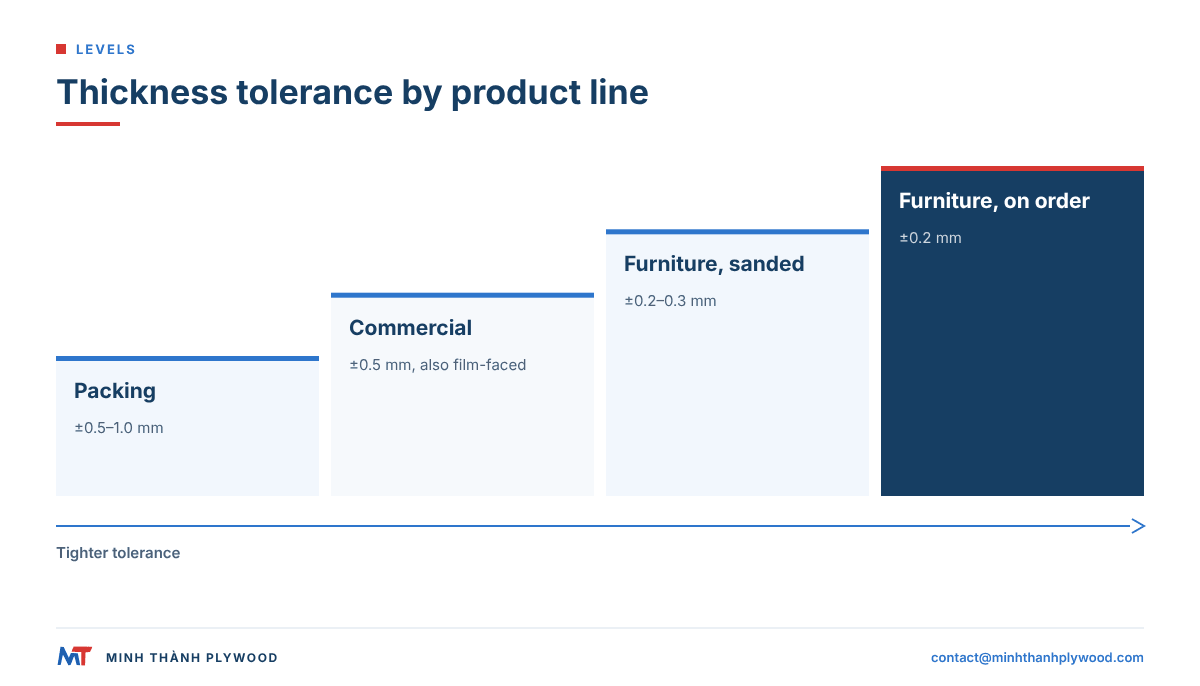
For commercial and film-faced plywood, use ±0.5 mm for thickness; for packing plywood, ±0.5–1.0 mm.
How many sheets should you sample?
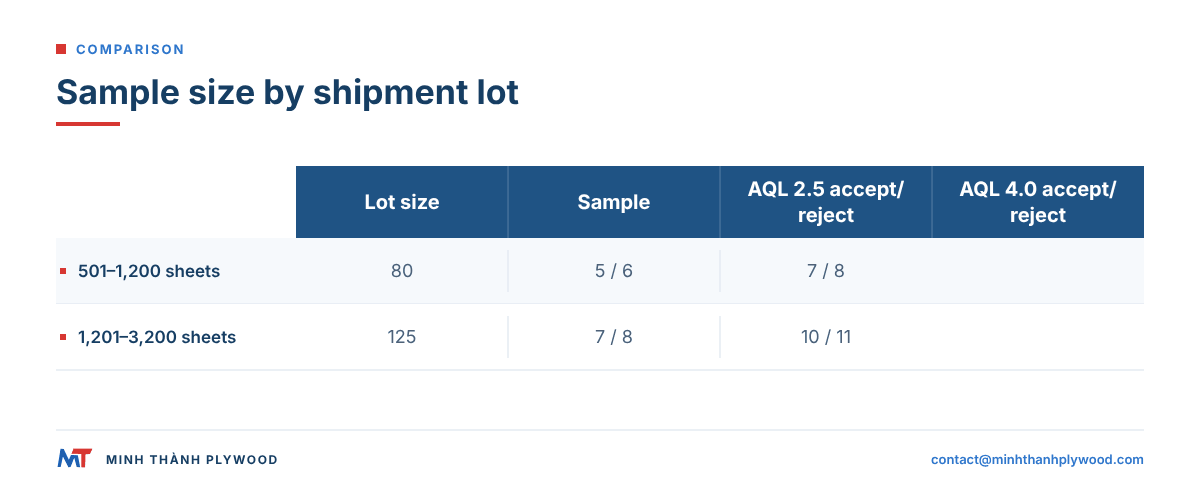
Sample by the lot size, using ISO 2859-1 at general inspection level II, the plan most inspection agencies use for pre-shipment checks. A full 40HC is one lot for each specification.
| Lot size (sheets) | Sample size | Accept / reject at AQL 2.5 | Accept / reject at AQL 4.0 |
|---|---|---|---|
| 501 to 1,200 | 80 | 5 / 6 | 7 / 8 |
| 1,201 to 3,200 | 125 | 7 / 8 | 10 / 11 |
Worked example: 18 mm furniture plywood on a white Styrax core loads 990 sheets in a 40HC, so the inspector checks 80 sheets. At 9 mm the same container holds 1,998 sheets, and the sample rises to 125.
Pull the sheets from several packs and from different heights in each pack, not only the top sheet. AQL 2.5 is a common level for appearance defects; critical defects such as delamination are usually set at zero.
How do you check plywood thickness and size?
Measure thickness with a digital caliper about 50 mm in from the edge, near each corner and once more in the middle, and compare every reading with the tolerance for the product line.
| Product line | Thickness tolerance | Length and width |
|---|---|---|
| Sanded furniture panels | ±0.2–0.3 mm, down to ±0.2 mm | ±2 mm |
| Commercial and film-faced | ±0.5 mm | ±2 mm |
| Packing plywood | ±0.5–1.0 mm | ±2 mm |
For reference, EN 315 allows up to 0.74 mm over nominal on an 18 mm sanded panel; our furniture limit is far tighter. At our plant, panels from every pack are measured with a digital caliper after calibrated sanding, and the readings are open to your inspector.
Then measure length and width on both edges, and both diagonals. Two diagonals of equal length mean a square panel, which matters for CNC nesting and edge banding. ISO 1954 sets squareness and edge straightness at 1 mm per metre.
Flatness is the check buyers skip, and the one that causes complaints. Lay a sampled sheet on a flat table or on the top of its pack, lay a straightedge along each edge and both diagonals, and measure the gap beneath it. A bowed sheet will not feed through a CNC vacuum table or edge bander; a twisted sheet rocks when one corner is pressed. Standards leave the flatness number to the contract, so write the maximum gap into the order, and read the sheets after they have sat in the pack, since stress shows once the strapping has held the panels for a few days.
How do you check face and back grade?
Grade both faces against the approved sample, under light falling at a low angle across the sheet. Angled light shows what flat light hides: sanding marks, overlaps, open joints and filler patches.
Check each sampled sheet for:
- Colour and grain against the sample.
- Splits and open joints in the face veneer.
- Repairs and filler: number and size against the grade.
- Overlaps: a ridge where two face strips sit on top of each other.
- Sanding quality: an even, smooth surface with no burn or chatter marks.
- The back: graded to its own letter of the pair, not to the face.
- Film-faced panels: inspect all four edges for sealing. Unsealed or chipped edge paint lets water into the core, and the film lifts there first on a building site.
Sap stain and mould spots are separate defects; the guide on black spots and blue stain on plywood explains how to tell them apart.
How do you check the plywood core?
Cut one sampled sheet across its width and read the edge: the plies should be continuous, with no open gaps, overlaps or soft wood. The core is invisible in a finished panel, so the cross-cut is the only way to see it.
What to look for in the cut edge:
- Ply count that fits the thickness: an 18 mm furniture panel is usually 11 plies.
- Even layers, with no thick and thin plies side by side.
- No gaps or overlaps: gaps telegraph through the face; overlaps make lumps.
- The ordered core species: white Styrax is pale and light, Eucalyptus denser and heavier.
- Glue lines that are thin and continuous.
Our cores are laid by hand, and gaps and overlaps are fixed before the glue goes on. The outer two to four core layers are stitched horizontally and vertically, and all layers on request. The void-free plywood guide shows how to judge a core gap.
How do you test the glue bond on site?
Cut small pieces from sampled sheets, boil them in water, and check that the plies have not separated after the time set for the ordered glue. A boil test checks bond strength; it says nothing about formaldehyde emission.
| Glue ordered | Boil time held in Minh Thanh production tests | What a pass looks like |
|---|---|---|
| UF glue at E0 emission | About 6 hours | No ply separation when pulled apart by hand |
| Melamine-fortified (MR) | About 12 hours | No ply separation |
| Phenolic (WBP) | The longer cycle named in your standard | No separation; any break runs through the wood |
Run the test on pieces from several sheets and record it with photos. A UF-bonded interior panel that opens after a long boil is not a defect; it was never meant to pass an exterior test. Order the glue for the end use, and name the bond class from EN 314-2 on the order.
How do you check moisture content?
Read moisture with a calibrated meter at several points on sheets from different packs. Furniture plywood is dispatched at 8–12% moisture content, the normal range for furniture plywood.
Take readings from the middle of a pack as well as the outside sheets, because the outer sheets dry or take up moisture first. Note the meter type and the species setting with each reading. Panels too wet at loading can grow mould in a warm container; panels too dry can move when they meet a humid workshop. Our veneers are dried and checked with a moisture meter before lay-up, so the finished panel starts in range.
How do you verify formaldehyde emission before shipment?
Verify emission on paper, not on site: a chamber test takes days in a laboratory. What the inspector checks before loading is the proof behind the class you ordered.
- The certificate: holder, mill number and scope.
- Chamber test reports: laboratory, method, date, panel thickness and result.
- Labels: for US orders, the TSCA Title VI label on each panel.
- Glue named on the invoice as ordered, for example UF glue at E0 emission.
Minh Thanh holds CARB P2 / TSCA Title VI certification, ICTT mill no. 23024. Six ASTM D6007 chamber tests between April 2025 and June 2026, on 9, 15 and 18 mm panels, averaged 0.014–0.032 ppm. The limit for veneer-core hardwood plywood is 0.05 ppm under EPA’s TSCA Title VI guidance. E0 emission is tested every 3 months, and a third-party test to your method, such as EN 717-1, is arranged through SGS on request.
How do you check pack count, packing and marks?
Count every pack and check a few sheet counts against the packing list, then check that each pack is wrapped, strapped and labelled as ordered.
- Packs and sheets: a pack of 18 mm holds 55 sheets in our standard plan; the packing list shows the count for each pack number.
- Wrap: intact, with no tears where water could get in.
- Straps and corner boards: tight, with no crushed edges under the straps.
- Bearers: solid wood bearers carry an ISPM 15 mark; plywood bearers need none.
- Labels: specification, size and quantity on every pack, matching the packing list.
Our export packing was tested by SGS in September 2026 under Regulation (EU) 2025/40: lead, cadmium, mercury and hexavalent chromium were not detected in the four packaging materials. The export packing page shows the pack build.
How do you check the container loading?
Check the empty container first, then each pack as it goes in, and record the container and seal numbers at the end. Most transit damage starts with a wet floor or a pack set down on a corner.
- Empty container: dry floor, no holes in the roof, doors that close and seal.
- Loading order: packs placed flat, not dropped; upright packs braced.
- Load plan: on a white Styrax core, 18 packs in a 40HC, 16 lying and 2 upright.
- Weight: within the booking; our plan caps at 28,000 kg unless the booking is lower.
- Record: photos and video of each pack, then the closed doors, container number and seal.
Every Minh Thanh shipment is photographed and filmed before the container is sealed, and the photos and video go to the buyer. The container loading page shows the load plans.
How to check Vietnam plywood quality before shipping without travelling?
To check Vietnam plywood quality before shipping without travelling, combine three sources: the mill’s own measurement record, an inspection agency on site, and the loading video. Together they cover what you would check in person.
| Source | What it gives you | When |
|---|---|---|
| Mill’s QC record | Caliper readings, cross-section photos, boil-test photos | During and after production |
| Inspection agency | An independent sample check against your checklist | Packs finished, before loading |
| Loading record | Photos and video of every pack, container and seal | At loading |
Ask for the mill record as a matter of routine, and add an agency on first orders and new specifications. Our quality control runs at eight checkpoints from veneer to container, and the records are open to the inspector you appoint.
How does a pre-shipment inspection of plywood in Vietnam work?
A pre-shipment inspection of plywood in Vietnam is booked by the buyer with an agency such as SGS, Bureau Veritas, Intertek, Vinacontrol or QIMA, which sends an inspector to the mill once the packs are finished. The inspector follows your checklist and sends a report the same day or the next.
How to run it:
- Send the agency your checklist and the specification sheet, with the limits.
- Give the mill the date with the order, so production and loading are planned around it.
- Let the mill prepare tools, floor space and access to the finished packs.
- Read the report before you release the container: measurements, photos, defects found against the AQL.
- Decide: pass, replace failed packs, or re-inspect.
The third-party plywood inspection in Vietnam guide compares agencies and what each report covers.
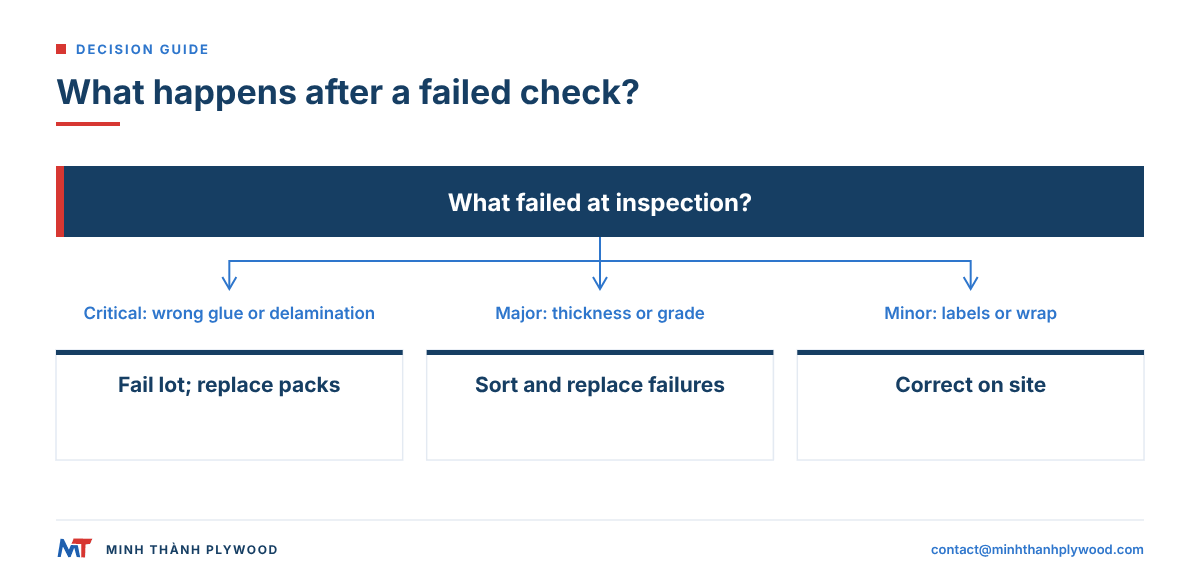
What happens when a plywood check fails?
When a check fails before loading, the failed packs are reworked or replaced, and the inspector checks them again. That is why the inspection belongs between finished packs and loading: after the container sails, the same defect costs far more to fix.
Classify each failure:
- Critical: delamination, wrong glue, wrong core species. The lot fails; the packs are replaced.
- Major: thickness outside tolerance, face grade below the order. Sort the packs; replace what fails.
- Minor: a label error, a torn wrap. Fix on the spot.
With Minh Thanh, payment is a 30% deposit and 70% against the scanned bill of lading. The plywood defects guide explains the causes behind each defect.
What should you send so the inspection has a clear reference?
Send a specification line per item, the tolerance and the checks you want, together with the order. A complete line reads like this:
18 mm furniture plywood, 1220 × 2440 mm, poplar face A/B, white Styrax core, UF glue at E0 emission, sanded ±0.2 mm, moisture 8–12%, export packing, one 40HC; inspection by your agency before loading, AQL 2.5.
Add the inspection date and the agency’s contact, and ask for free samples to fix the reference. Send it to contact@minhthanhplywood.com or through the quotation form; the furniture plywood from Vietnam page lists faces, cores and grades.
Buyer questions, answered
How do you check plywood quality before shipment?
Sample sheets at random from the finished packs, then check thickness, size, both faces, the core, the glue bond, moisture, emission documents, pack count and labels against the written specification and the approved sample, before the container is loaded.
How many sheets should a plywood inspection sample?
Under ISO 2859-1, general inspection level II, a lot of 501 to 1,200 sheets takes a sample of 80 sheets, and a lot of 1,201 to 3,200 sheets takes 125. A 40HC of 18 mm furniture plywood, 990 sheets, falls in the first band.
What thickness tolerance should furniture plywood meet?
Sanded furniture plywood from Minh Thanh is held to ±0.2–0.3 mm, down to ±0.2 mm. Commercial and film-faced plywood is held to ±0.5 mm, and packing plywood to ±0.5–1.0 mm; length and width to ±2 mm.
What moisture content should plywood have at shipment?
Furniture plywood is dispatched at 8–12% moisture content. Read several sheets from different packs with a calibrated meter.
How long should plywood survive a boil test?
It depends on the glue. In Minh Thanh's production tests, UF glue at E0 emission holds about 6 hours in boiling water and melamine-fortified glue about 12; phenolic WBP glue is tested to the longer cycle your standard names.
Can an inspector test formaldehyde emission on site?
No. Emission needs a laboratory chamber test. On site, the inspector checks the certificate, the test reports and the labels; a third-party test to your method can be arranged through SGS.
Which companies inspect plywood in Vietnam?
SGS, Bureau Veritas, Intertek, Vinacontrol and QIMA all run pre-shipment inspections in Vietnam. You appoint and pay the agency; the mill gives access, tools and floor time on the agreed date.
When should a pre-shipment inspection be booked?
Give the mill the inspection date with the order, so production and loading are planned around it. The inspection should fall when the packs are finished but before loading, so a failed pack can still be replaced.
What happens if plywood fails the inspection?
The failed packs are reworked or replaced before loading, and the inspector re-checks them. The 70% balance is paid against the scanned bill of lading.
Can I check plywood quality without travelling to Vietnam?
Yes. Appoint an inspection agency, and ask the mill for caliper readings, cross-section photos and the loading video. Minh Thanh photographs and films every shipment before the container is sealed.