
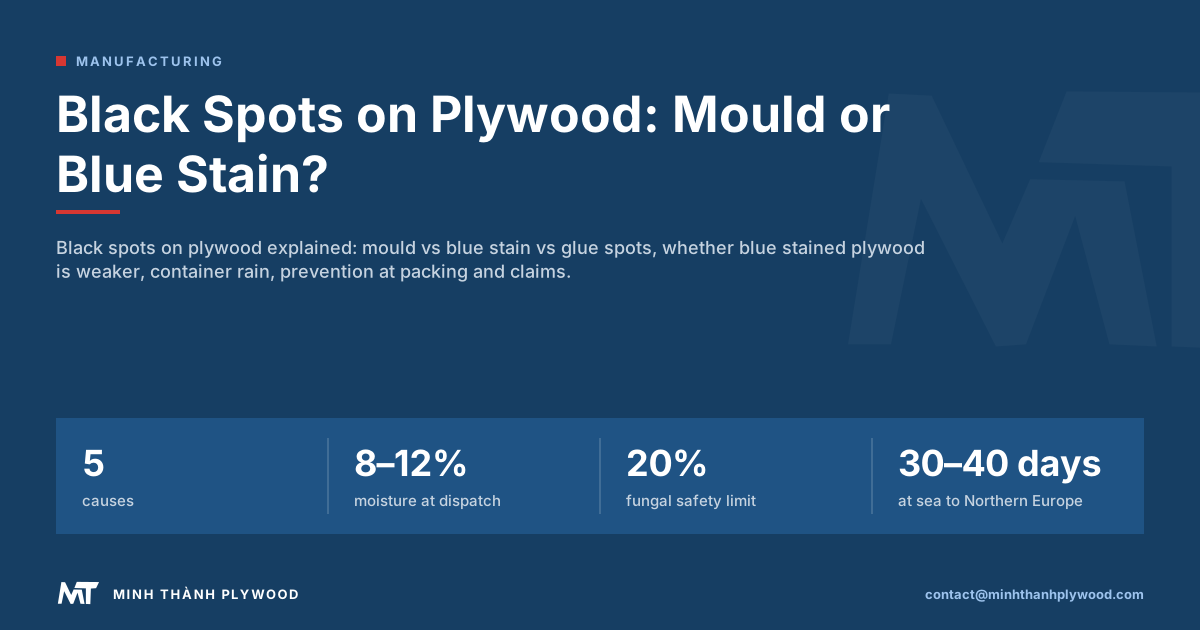
Black spots on plywood are usually one of three things: surface mould from damp storage or container condensation, blue stain fungi already in the veneer, or dark glue and tannin marks from pressing. Mould wipes off and signals wet wood; blue stain sits in the wood and is cosmetic. Minh Thanh Plywood, a furniture plywood mill in Phu Tho, shows how to tell them apart and prevent each.
What are black spots on plywood?
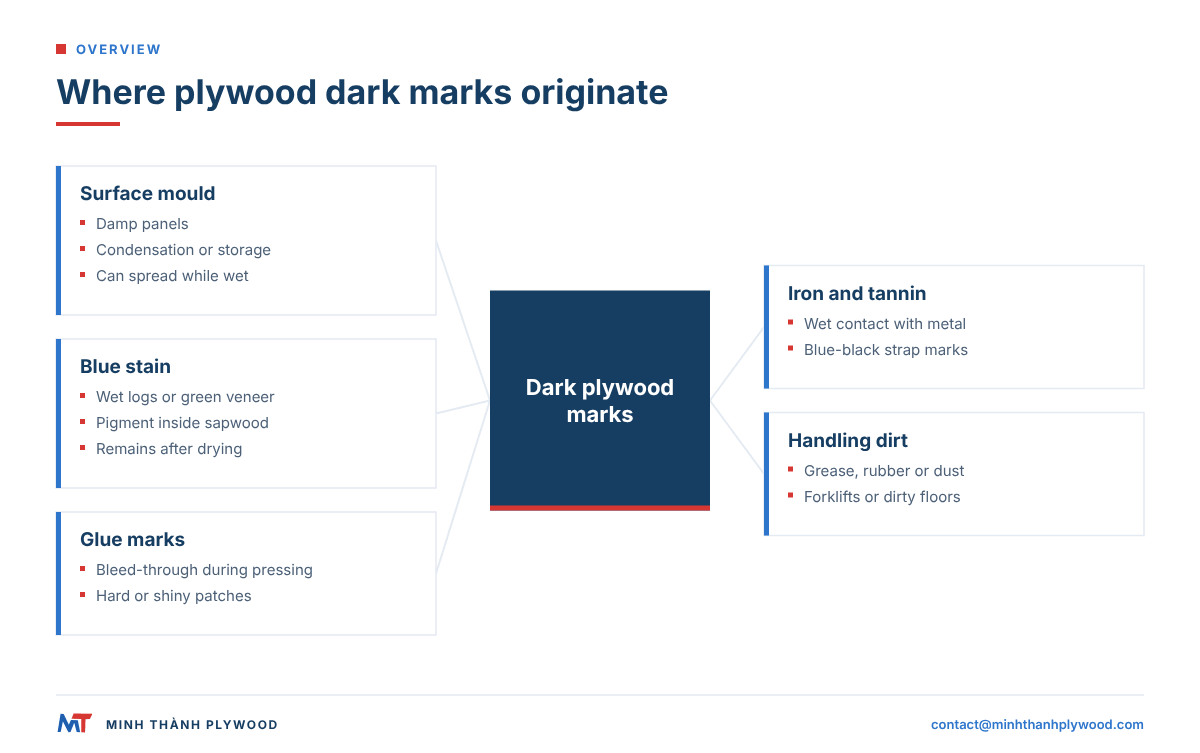
Black spots on plywood are dark marks on the face or back veneer caused by fungi, by moisture, or by the glue and wood chemistry during pressing. Most are surface mould, which wipes off, or blue stain, which does not. Five causes cover almost every case:
| Cause | What it is | How it arrives |
|---|---|---|
| Surface mould | Fungi growing on the surface of damp wood | Wet panels, container condensation, damp storage |
| Blue stain (sap stain) | Fungi that colour the sapwood blue-grey to black | Logs or veneers that stayed wet too long before drying |
| Glue spots and bleed-through | Dark or shiny glue on the face | Excess glue squeezing through thin or porous veneer in the press |
| Tannin and iron stain | Blue-black marks where tannins meet iron and water | Wet panels in contact with steel straps, nails or iron dust |
| Dirt and handling marks | Grease, rubber or dust | Forklifts, hands, dirty floors |
The first step is to tell them apart, because each has a different cause, a different effect and a different answer to “can I still use it?”.
How do you tell mould, blue stain and glue spots apart?
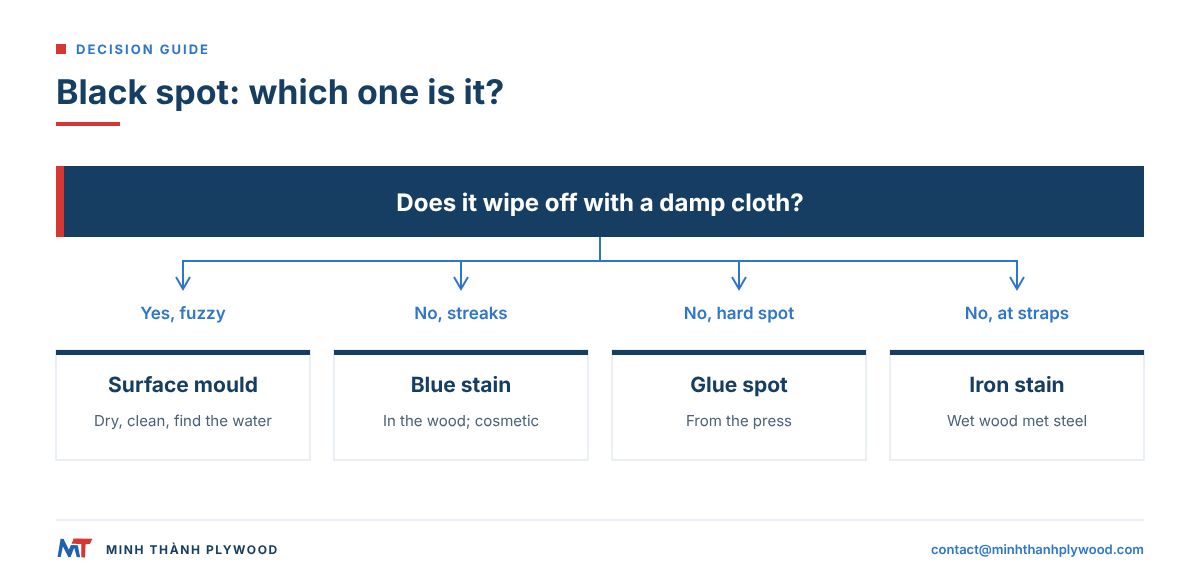
You tell them apart with three quick checks: a wipe, a look at the pattern, and a moisture reading. Do this before cleaning anything, and photograph each spot first.
| Check | Surface mould | Blue stain | Glue spot or bleed-through | Tannin or iron stain |
|---|---|---|---|---|
| Wipe with a damp cloth | Comes off, often fuzzy or powdery | Does not come off | Does not come off; may feel hard or shiny | Does not come off |
| Pattern | Spots or patches, often near edges and pack faces | Streaks following the grain in sapwood | Small spots or shiny patches matching veneer pores or joints | Lines or dots matching strap or nail positions |
| Colour | Black, green, grey, white | Blue-grey to black inside the wood | Dark brown or shiny | Blue-black |
| Moisture reading | Usually high | Any; the panel may now be dry | Normal | Usually high where the stain formed |
| Smell | Musty | None | None | None |
| Spreads in storage? | Yes, while wet | No, once the wood is dry | No | No, once dry |
A hand lens helps: mould sits on top of the wood as threads or dust; blue stain sits inside the cells and looks like ink in the grain.
What is blue stain in timber, and why does it appear on plywood?
Blue stain in timber is a discolouration caused by sap-staining fungi that grow in the sapwood of freshly cut logs and green veneer. Their dark pigmented threads show through the wood as blue-grey to black streaks.
Blue stain needs wet sapwood, warmth and time. It starts in the log yard or in green veneer waiting to be dried, so on plywood it is a sign of how the wood was handled before pressing, not of anything that happened in the container. Once the veneer is dried, the fungi stop growing; the colour stays.
Light-coloured species with wide sapwood show blue stain most: pine, poplar and many plantation hardwoods. That is why mills dry veneer quickly after peeling and grade it before lay-up. Our veneer grading sorts face veneers by grade and colour, and veneer drying for plywood explains the drying stage that stops stain from developing.
Is blue stained plywood weaker? Is blue stain a structural defect?
No. Blue stain is an appearance defect, not a structural one. The USDA Forest Products Laboratory Wood Handbook (2021 edition, chapter on biodeterioration) explains that sap-stain fungi feed mainly on the stored food in sapwood cells, not on the cell walls, so they have little effect on strength.
What blue stain does affect:
- Appearance: on a clear-finished face it is visible and usually outside the grade.
- Absorption: stained sapwood can take up liquids faster, so paint and glue behave a little differently.
- What it tells you: the wood was wet for a period. On a panel that also shows mould or high moisture, look for a packing or storage problem as well.
For a furniture face under a clear finish, blue stain is a grade question. For a painted face, a laminated panel, a hidden core layer or packing plywood, it usually does not matter.
What causes black mould on plywood?
Black mould grows on plywood when the wood surface stays damp: moisture plus warmth plus time. The fungi live on the surface and on traces of starch and sugar in the veneer and glue line.
The Wood Handbook treats wood kept below about 20% moisture content as generally safe from fungal attack. Furniture plywood leaves a well-run mill far below that: our veneers and finished panels are dried to 8–12% moisture content at dispatch, the normal range for furniture plywood. So mould on a delivered panel nearly always means the wood took up water after it was made:
- Rain or wet ground during trucking, port storage or unloading.
- Condensation inside the container on long routes (container rain).
- Damp warehouses, packs stored on the floor or against cold walls.
- Packs left wrapped in plastic in a warm place after arrival, trapping moisture.
- Wet pallets or bearers in the pack or the container.
Mould on a dry panel can be cleaned off, and the panel is not weakened by surface growth. Mould that keeps coming back means the panels or the store are still wet.
Container rain: why can plywood go mouldy at sea?
Plywood can go mouldy at sea because of container rain: water vapour inside a closed container condenses on the cold steel roof and walls at night or in cooler waters, then drips back onto the cargo. A long voyage repeats that cycle many times.
The water comes from inside the box: the air sealed in at loading, any moisture in the panels, pallets and bearers, and a wet container floor. Typical days at sea from Hai Phong show how long the cycle can run:
| Route from Hai Phong | Typical days at sea |
|---|---|
| South-East Asia | 5–12 |
| Middle East | 15–25 |
| US West Coast | 20–30 |
| Mediterranean | 25–35 |
| Northern Europe | 30–40 |
| US East Coast | 35–45 |
| West Africa | 35–50 |
Days vary by carrier and route. Routes that cross from tropical heat into cooler waters, such as Vietnam to Northern Europe, give the largest temperature swings. Dry panels, a full film wrap, desiccant bags and a dry, sound container keep the moisture inside the box low enough that condensation stays small.
Black spots from glue, tannin and iron: what are they?
Not every black spot is fungal. Some form in the press or from the wood’s own chemistry, and these do not spread or smell.
- Glue spots and bleed-through: excess glue squeezes through open pores, splits or joints in a thin face veneer and cures as dark or shiny spots. They come from glue spread or a damaged face, and show as small hard marks matching the veneer. Good glue control and graded faces keep them off a furniture face.
- Tannin and iron stain: woods rich in tannin turn blue-black where wet wood touches iron, such as steel straps, nails or iron dust. On plywood these marks often line up with strap positions on a pack that got wet. Oxalic acid wood bleach lightens them.
- Heat or press marks: dark patches from a press plate or a foreign body pressed into the face. They are production faults and are usually caught at inspection.
If a black spot is hard, does not wipe off and follows the shape of a pore, joint or strap, it is probably one of these. Our guide to common plywood defects covers the other face faults.
How does a plywood mill prevent mould and stain?
A plywood mill prevents mould and stain by drying the veneer fast, hot-pressing, packing dry panels and protecting the packs for the route. Each stage removes one source of moisture.
| Stage | What prevents stain or mould | Our practice |
|---|---|---|
| Veneer drying | Green veneer dried quickly after peeling stops blue stain from developing | Veneers dried to 8–12% moisture content |
| Veneer grading | Stained face veneers sorted out of furniture faces | Faces graded by grade and colour against the approved sample |
| Pressing | Heat in the press cures the glue and dries the surface | Hot pressing; furniture panels pressed twice |
| Moisture at packing | Dry panels give mould nothing to grow on | 8–12% at dispatch |
| Packing | Film and cardboard keep rain and splash off | Plywood pallet on bearers, cover boards, kraft cardboard, plastic film, corner guards, straps |
| Humid routes | Extra wrap and moisture absorbers | Full film wrap and desiccant bags in the container on request |
| Loading record | Shows the packs left clean and dry | Every shipment photographed and filmed before loading |
See plywood export packing for the pack build, and plywood quality control for the inspections before packing.
How do you stop mould in a plywood container?
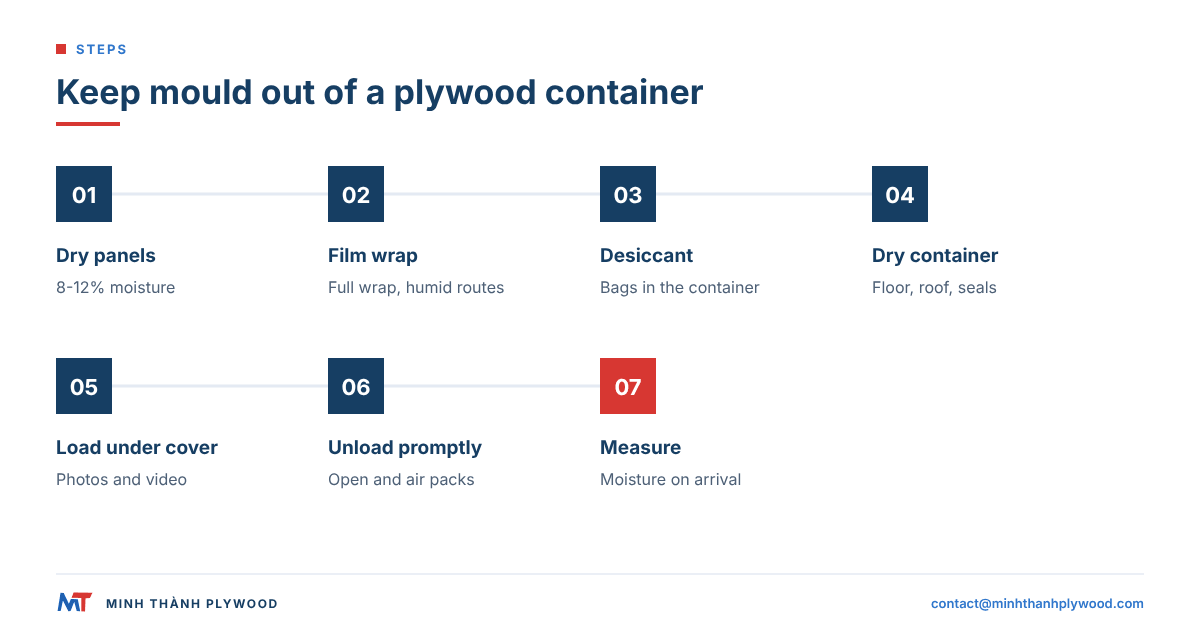
To stop mould in a plywood container, keep moisture out of the box at loading and get the packs out and aired quickly at the other end. Use this checklist:
- Specify moisture in the order: 8–12% for furniture plywood.
- Ask for a full film wrap on humid or long routes.
- Ask for desiccant bags in the container for routes that cross climate zones.
- Check the container before loading: dry floor, no holes, door seals sound.
- Load under cover, never in rain, and keep packs off wet ground.
- Ask for loading photos and video showing dry packs and a dry container.
- Unload promptly on arrival; do not leave the container standing in the sun.
- Open wrapping and air the packs in a dry warehouse, on bearers, off the floor.
- Take moisture readings on arrival from several sheets and packs, and keep the record.
Points 1 to 6 sit with the seller; points 7 to 9 sit with the buyer. Most container mould starts when one side assumes the other handled it. Our container loading page shows how packs go into the box.
What should you do when you find black spots on arrival?
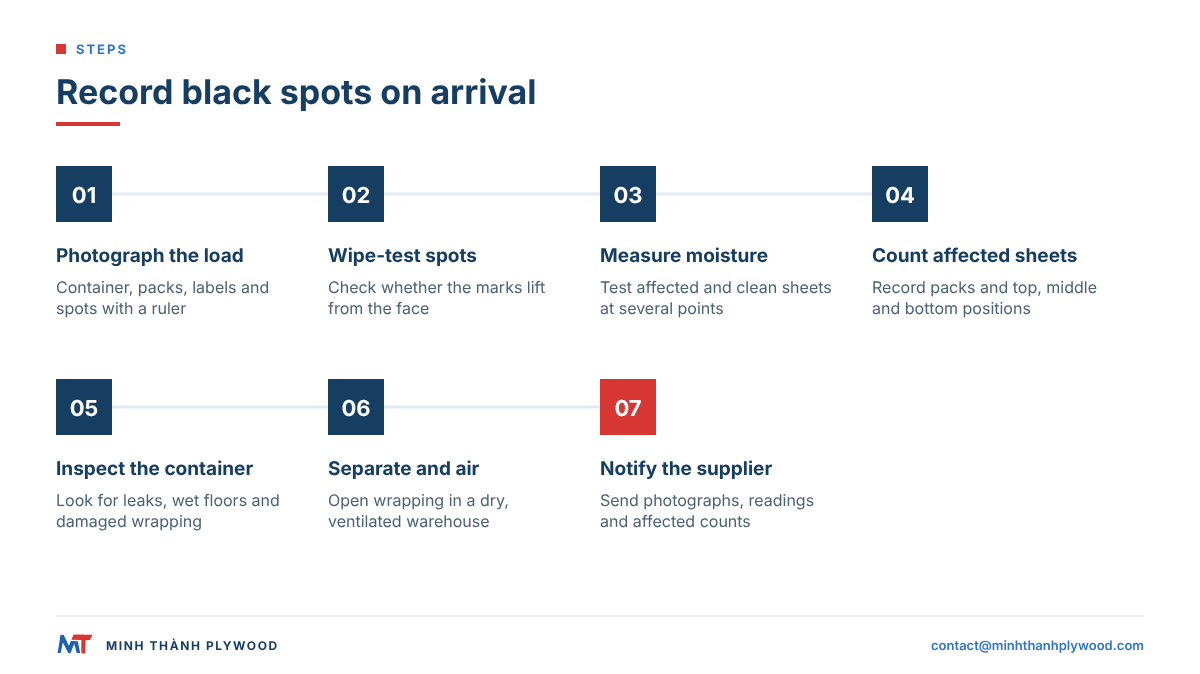
When you find black spots on arrival, record the evidence before anything is cleaned or moved, then stop the moisture. Follow these steps:
- Photograph the container doors, the load as found, the pack labels and the spots with a ruler for scale.
- Wipe-test a few spots to tell surface mould from stain.
- Measure moisture on affected and clean sheets, at several points per sheet.
- Count: affected packs, and affected sheets per pack, top, middle and bottom.
- Check the container for leaks, a wet floor or damaged wrapping.
- Separate and air the affected packs: open the wrapping, stack on bearers in a dry, ventilated place.
- Notify the supplier in writing with the photos, readings and counts.
Readings decide most cases. Wet panels with mould in a container with a damaged roof point to transit; stain inside dry panels points to the veneer; mould in a damp warehouse weeks after arrival points to storage. Our guide on checking plywood quality before shipment covers the checks to run before the goods leave.
Can you remove black spots and blue stain from plywood?
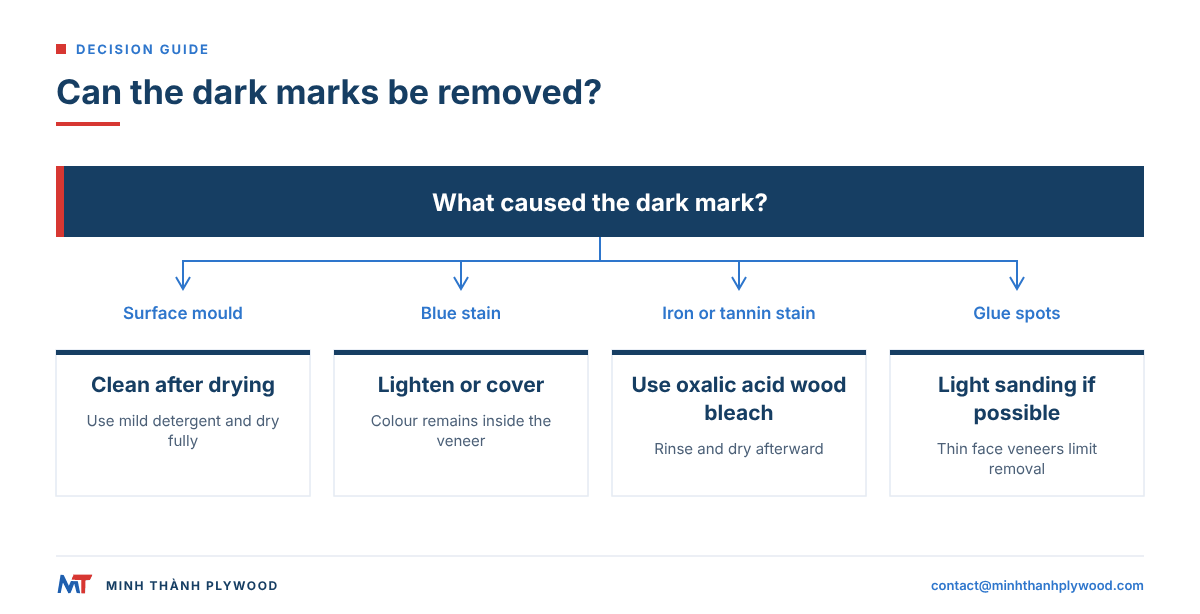
You can remove surface mould from plywood, but you cannot fully remove blue stain. The answer depends on whether the colour sits on the wood or inside it.
| Mark | Can it be removed? | How |
|---|---|---|
| Surface mould | Yes | Dry the panel, brush or vacuum outdoors with gloves and a mask, wipe with a mild detergent, dry fully, sand lightly |
| Blue stain | Lightened only | Thin face veneers cannot be sanded deep enough; bleach lightens it; paint, laminate or hide the face |
| Iron and tannin stain | Mostly | Oxalic acid wood bleach, then rinse and dry |
| Glue spots | Sometimes | Light sanding or scraping on a thick face; on a thin face, often not |
| Dirt and grease | Yes | Cleaner and light sanding |
Always dry the panel first. Cleaning a wet panel spreads mould and drives water into the face. And always fix the source: a panel cleaned and returned to a damp store will grow mould again.
How to clean black mould off plywood in an attic, subfloor or shed
To clean black mould off plywood in an attic, subfloor or shed, fix the water source first, then clean small areas yourself with detergent, dry the wood and seal it only when it is dry. Homeowners meet this problem most often, so the steps are here.
Size decides who does the job. The EPA treats about 10 square feet (1 m²) of mould as the line for DIY cleanup. Larger or recurring patches, damaged sheathing, or an asthma or immune condition in the household call for a remediation professional.
- Protect yourself. The CDC advises at least an N95 respirator (a P100 filters better), gloves and sealed goggles. A paper dust mask is not enough.
- Stop the moisture. Find the leak, the missing soffit vent, the bathroom fan that vents into the attic or the damp slab under the shed. Keep a clear 2 inch gap for soffit-to-ridge airflow. EPA guidance is to dry wet materials within 24 to 48 hours, or mould establishes itself.
- Clean. Scrub with detergent and water first. White vinegar mixed 1:1 with water, or 3% hydrogen peroxide, also work on surface growth. Borax, 1 cup to 1 gallon of warm water, leaves a residue that slows regrowth and needs no rinse. Do not mix cleaners, and never mix bleach with anything.
- Sand if stain remains. After the wood is dry, sand lightly with 120 to 150 grit paper. Mould is on the surface; blue stain and deep staining stay.
- Dry to 12% or less. Check with a pin moisture meter in several places. Do not paint or seal until moisture content is at or below 12%. Sealing wet wood traps the water and leads to delamination and rot.
- Seal the edges. Plywood edges take up moisture faster than faces. Seal them with primer or paint, or fit PVC edge banding.
- Know when to replace. If the sheathing is soft, crumbles under a screwdriver, has delaminated, or the stain runs through several plies of a roof deck, cut it out and replace it. Cleaning does not restore a rotted panel.
Is black mould on attic plywood dangerous? The mould itself is a health risk for people with allergies, asthma or weak immunity, and it signals that moisture is reaching the roof deck. Surface mould on sound sheathing does not make the panel weak, but a damp roof deck left for months will rot.
Mould, blue stain or something else? Use the wipe test above. In an attic, dark streaks that follow the grain and do not wipe off are often blue stain or old water staining from the mill, not growth. Tell them apart before paying for remediation.
Which plywood for damp places? Marine or exterior-glue plywood (WBP) tolerates wetting; moisture-resistant (MR) panels are for occasional damp, not for outdoors or basements.
Can a buyer claim for black spots or blue stain on plywood?
A buyer can claim when the spots break what was agreed: the face grade, the approved sample or the moisture specification. Whether the claim succeeds depends on where the cause arose.
| Finding on arrival | Likely cause | Who usually answers for it |
|---|---|---|
| Blue stain inside dry face veneers, outside the face grade | Veneer before pressing | Seller, if the grade or sample excludes it |
| Blue stain on back or core, face clean | Veneer before pressing | Usually within grade for backs and cores; check the agreed back grade |
| Mould on wet panels, moisture above the specification | Panels shipped wet, or water entry in transit | Seller if loading photos and moisture show wet panels; carrier or insurer if the container leaked |
| Mould on dry panels in a damp warehouse weeks after arrival | Storage | Buyer |
| Glue spots on a furniture face beyond the sample | Production | Seller |
| Iron stain at strap lines on wet packs | Water reaching the packs | Follows the water: transit or storage |
Evidence carries the claim: photos at unloading, moisture readings, counts per pack and the container condition. Our guide on plywood quality claims shows how to file one and how it is usually settled. When the pre-loading photos and video show dry, clean packs, the comparison with the arrival photos shows where the change happened.
What should you write in the order to prevent black spots?
Write moisture, face and back grade, packing and documents into the order, so stain and mould are part of the specification and not a surprise. A furniture plywood order line that covers them:
- Moisture: 8–12% at dispatch.
- Face and back grade: for example poplar A/B or birch D+/D, matched to the approved sample, with blue stain on the face outside grade for clear finishes.
- Core: white Styrax or Eucalyptus as standard; the core is stitched and pressed before the faces go on.
- Glue and emission: UF glue at E0 emission, certified to the EPA TSCA Title VI formaldehyde standards and CARB P2 (see our certificates and test reports), or the water-resistant bond the use needs. The US limit for veneer-core hardwood plywood is 0.05 ppm under 40 CFR 770.10.
- Packing: export packing with full film wrap; desiccant bags in the container for humid routes.
- Documents: phytosanitary and fumigation certificates where the destination requires them; photos and video before loading.
Minh Thanh Plywood makes furniture plywood to these lines, with production 15–45 days after the 30% deposit, FOB Hai Phong, CFR or CIF. Ask for free samples to approve the face, and send your specification to contact@minhthanhplywood.com; we reply within hours.
Buyer questions, answered
What are black spots on plywood?
Most black spots on plywood are surface mould growing on damp panels, blue stain fungi in the veneer, or dark glue and tannin marks from pressing. A wipe test and a moisture reading usually tell which one you have.
Is blue stain a structural defect?
No. Blue stain fungi feed on the sugars and starches in sapwood cells, not on the cell walls, so they cause little or no loss of strength. Blue stain is an appearance defect and a sign the wood was once wet.
Is black mould on plywood dangerous?
Mould on plywood is a moisture problem first. Surface mould on panels that are dried and cleaned does not weaken them, but mouldy panels should be handled with gloves and a mask, cleaned outdoors or in a ventilated area, and dried before use.
Is black mould on attic plywood dangerous?
It can be, for people with asthma, allergies or weak immunity, and it shows that moisture is reaching the roof deck. Surface mould on sound sheathing does not weaken it. Fix the leak or ventilation first, clean areas under about 10 square feet (1 m²) with detergent and an N95 respirator, and call a professional for larger patches.
How do you stop mould in a plywood container?
Ship panels dry, at 8–12% moisture, wrap packs in film, add desiccant bags for humid routes, load in a dry, sound container and unload and unwrap promptly on arrival. Most container mould comes from moisture packed in with the goods.
Can you remove blue stain from plywood?
Not fully. Blue stain runs into the wood, so sanding a thin face veneer cannot remove it, and bleaching only lightens it. Painting, laminating or using the panel where it is hidden are the practical options.
Can you remove mould from plywood?
Yes, if it is on the surface. Dry the panel, brush or vacuum the mould off outdoors, wipe with a mild cleaner, let it dry fully and sand lightly if marks remain. Fix the moisture source, or it returns.
Does blue stained plywood smell?
Blue stain itself has little smell. A musty smell points to active mould on damp panels, which means the packs need drying and airing.
Can I claim for black spots on plywood?
You can claim when the spots break the agreed face grade, the approved sample or the moisture specification on arrival. Photos, moisture readings taken at unloading and the container condition decide whether the cause was production, packing or storage.
What moisture content prevents mould on plywood?
Mould needs wet wood. Panels at 8–12% moisture, the normal range for furniture plywood, are well below the about 20% moisture content under which the USDA Wood Handbook treats wood as generally safe from fungal attack.
What is container rain?
Container rain is condensation that forms on the inside of a container roof as it cools, then drips onto the cargo. Moisture from wet goods, pallets or the air inside the box is the source.