
Film faced plywood standards in the Middle East (SASO, GSO) start at customs: Saudi imports clear through SABER, the SASO platform where the importer registers a product certificate and gets a shipment certificate for each consignment. GSO adopts the ISO plywood classification and vocabulary, and the UAE and Oman run their own conformity routes. Minh Thanh Plywood supplies the specification, test and shipping documents these steps ask for.
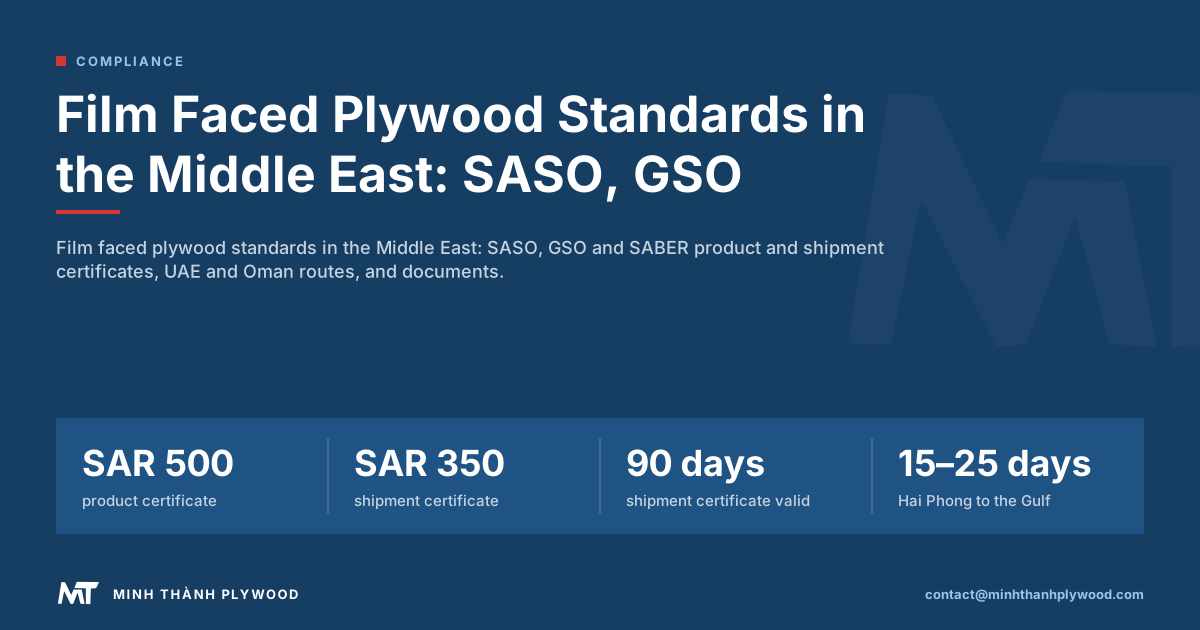
Film faced plywood standards in the Middle East: SASO, GSO, UAE and Oman at a glance
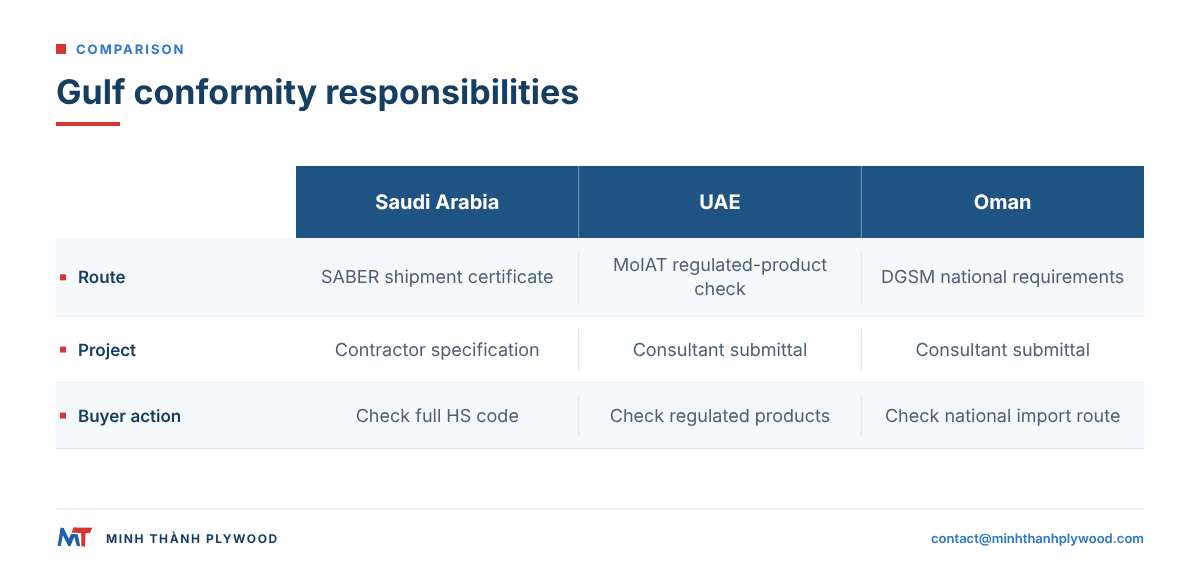
Film faced plywood for the Middle East is judged on two levels: the import conformity route of each country, and the technical standard written into the construction project.
- Saudi Arabia: the importer clears the goods through SABER, the conformity platform of the Saudi Standards, Metrology and Quality Organization (SASO). A product certificate is registered for the product and a shipment certificate is issued for each consignment.
- GCC standards: the GCC Standardization Organization (GSO) has adopted the ISO plywood classification (GSO ISO 1096:2013) and vocabulary (GSO ISO 2074:2015).
- United Arab Emirates: the Ministry of Industry and Advanced Technology (MoIAT) issues product conformity certificates for regulated products.
- Oman: the Directorate General for Standards and Metrology (DGSM) applies Gulf standards adopted through GSO.
- On the project: contractors and consultants specify the panel, usually by thickness, core, glue bond class, film weight and reuse target, often with EN 314 or EN 636 bond classes.
The exporter’s job is to supply the specification, test reports and shipping documents each step asks for. The sections below go through each step.
SASO plywood imports: does plywood need a SABER certificate?
Yes: for SASO plywood imports, every commercial consignment into Saudi Arabia goes through SABER, and the importer needs a shipment certificate for it. What sits behind the shipment certificate depends on the product’s HS code and whether a technical regulation covers it.
SABER lists these services for importers of commercial products (saber.sa, checked 20 October 2026):
| SABER service | What it is | Fee stated on SABER |
|---|---|---|
| Product certificate registration | The product’s conformity certificate, registered once per product | SAR 500, excluding VAT |
| Shipment certificate | Issued for each consignment against the registered product | SAR 350, excluding VAT |
| Products not subject to technical regulations | A shipment conformity route for products outside a technical regulation | As listed on SABER |
| Imported self-declaration | A self-declaration route for imported commercial products | As listed on SABER |
SABER also states that shipment certificate validity was extended from 60 days to 90 days. Fees and routes change, so the importer reads them on SABER on the day of the application.
Plywood falls under HS heading 4412 (plywood, veneered panels and similar laminated wood). The importer enters the full HS code of the panel on SABER, which shows whether a technical regulation applies and which certificate route follows.
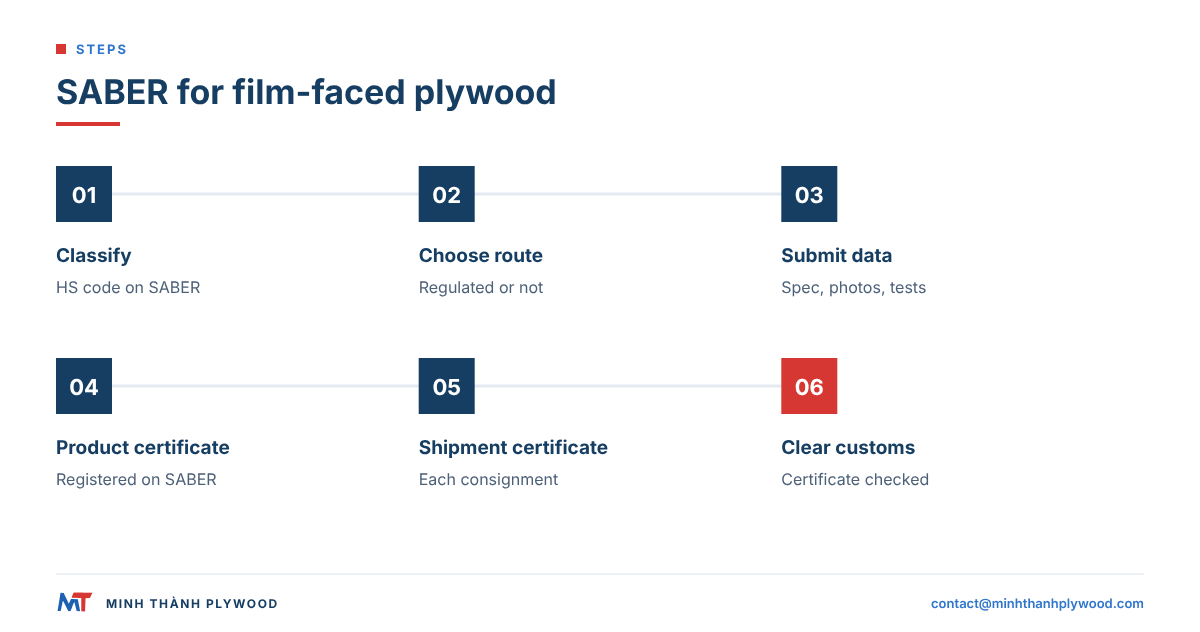
How the SABER process works, step by step
The SABER process runs in a fixed order, and the importer leads every step. The exporter feeds documents into it.
- Classify the product. The importer enters the HS code of the film-faced plywood on SABER and sees whether it is regulated and under which technical regulation.
- Choose the route. For a regulated product, the importer selects a certification body approved by SASO for that regulation. For a product outside the technical regulations, SABER gives the non-regulated or self-declaration route.
- Submit product data. The importer uploads the product description, specification sheet, photos and test reports. The exporter supplies these.
- Get the product certificate. The certification body reviews the file and issues the product certificate, which is registered on SABER.
- Request the shipment certificate. For each consignment, the importer requests a shipment certificate linked to the product certificate, with the commercial invoice and packing list.
- Clear customs. Saudi customs checks the shipment certificate at clearance.
Start step 1 before the order is confirmed. If a test report is needed, it can be made on a production sample while the container is in production.
What does the exporter supply for SABER?
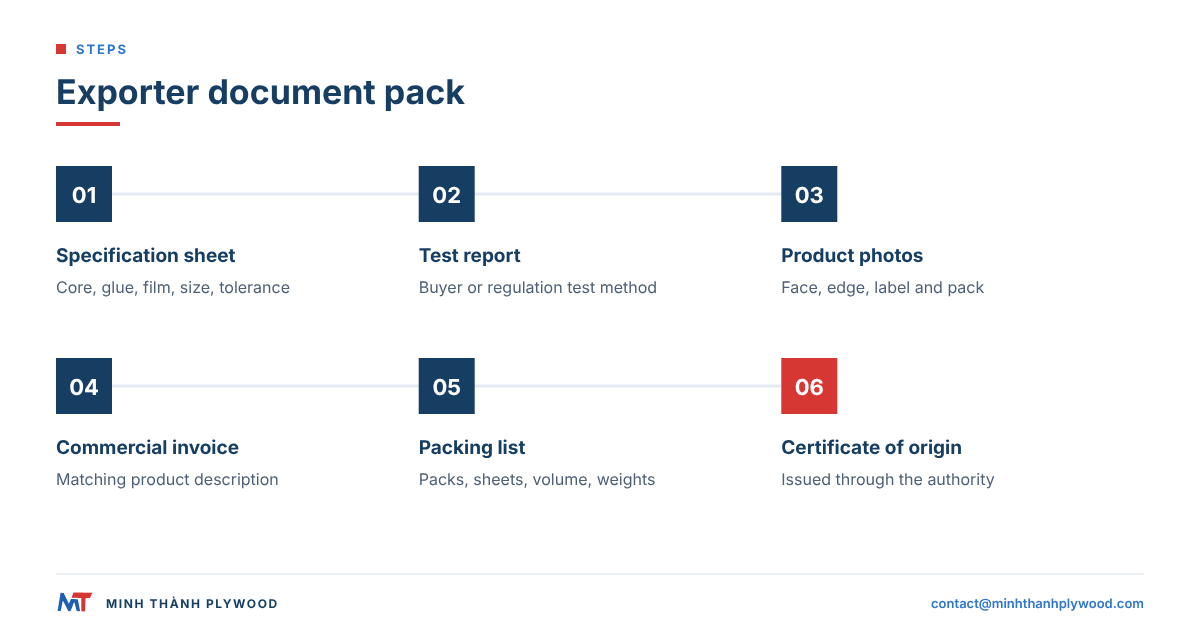
The exporter supplies the facts about the panel; the importer and the certification body turn them into certificates. A complete file on the first request saves weeks.
| Document | What it states | Who makes it |
|---|---|---|
| Specification sheet | Thickness, size, core species, glue, film colour and weight, ply count, tolerance, edge sealing | Manufacturer |
| Test report | The tests the regulation or buyer asks for, such as bond quality or emission | Laboratory, arranged by the manufacturer |
| Product photos | Face, edge, label and pack | Manufacturer |
| Commercial invoice | Product description matching the product certificate, HS code, value | Exporter |
| Packing list | Packs, sheets, volume, weights | Exporter |
| Certificate of origin | Country of origin of the goods | Exporter, through the issuing authority |
Third-party testing to the buyer’s method is arranged through SGS on request. The product description must read the same on the specification, the invoice and the certificate; a mismatch is the most common reason a shipment certificate is held.
Which GSO standards apply to plywood?
GSO has adopted two ISO plywood standards as Gulf standards, in line with its practice: at least 80 % of GSO standards are identical adoptions of international standards (gso.org.sa). GSO ISO 1096:2013 classifies plywood panels. GSO ISO 2074:2015 establishes terminology for plywood manufacture and use. Neither sets a film weight, a reuse count or a bond class for formwork.
The performance of film-faced plywood is therefore written into the project specification. The items a Gulf contractor usually asks for:
| Item | How it is usually specified |
|---|---|
| Bond quality | EN 314-2 class 2 or class 3 (class 3 is the boil test for phenolic panels), or a boil test stated with its duration and method |
| Use class | EN 636 -2 (humid) or -3 (exterior) |
| Film | Colour (brown or black) and weight in g/m²: about 120–135 g/m² for low-reuse slabs, 220 g/m² on high-cycle slabs and walls |
| Core | Species and grade, for example Eucalyptus or Acacia |
| Edges | Sealed with paint |
| Tolerance | Thickness and size tolerance |
| Reuse | A target number of pours under stated site conditions |
Our guide to class 2 vs class 3 plywood explains the EN bond classes, and is plywood waterproof explains what glue does in wet conditions.
Which approvals does film-faced plywood need in the UAE?
In the UAE, conformity of products is handled by the Ministry of Industry and Advanced Technology (MoIAT), which issues product conformity certificates for regulated products through its conformity services (moiat.gov.ae, checked 20 October 2026). The importer checks the HS code against MoIAT’s regulated products before the first order.
On a construction project, a second approval follows: the consultant approves the material against the project specification before the contractor uses it. That submittal usually contains:
- The specification sheet with thickness, core, glue, film weight and edge sealing.
- Bond test results to the class the specification names.
- Photos of face, edge and pack.
- A sample of the panel.
- Supply documents: certificate of origin and the manufacturer’s details.
Film-faced plywood that passes the project submittal is the same panel the importer declares to customs, so the specification sheet should be one document for both.
Which standards apply to film-faced plywood in Oman?
Oman applies standards through the Directorate General for Standards and Metrology (DGSM), which takes part in the GSO system; Gulf standards adopted by GSO, including GSO ISO 1096:2013, are available through it (DGSM standards store). As in the UAE, the project consultant approves formwork plywood against the project specification.
For Oman, Qatar, Kuwait and Bahrain, the practical file is the same as for Saudi Arabia and the UAE: one specification sheet, bond test results, photos, a sample and the shipping documents. The importer checks the national import requirements for the HS code before the order.
What specification does film-faced plywood need for Gulf projects?
Gulf formwork contractors buy film-faced plywood by build and reuse, and the specification should say each item in numbers. Heat and sun on site make the glue and the edge sealing more important than in cooler climates.
| Specification line | Typical Gulf request | Our standard |
|---|---|---|
| Thickness | 12, 15 or 18 mm | Within our 3–40 mm range |
| Size | 1220 × 2440 mm | 1220 × 2440 or 1250 × 2500 mm |
| Core | Eucalyptus or Acacia | Acacia or Eucalyptus core |
| Glue | Phenolic (WBP) or melamine-fortified | To the customer’s specification |
| Film | Brown or black, 120–135 g/m² up to 220 g/m² | Film brand, weight and colour per order |
| Edges | Painted, sealed | Painted edge sealing |
| Moisture content | 8–12 % on the test report | 8–12 % |
| Thickness tolerance | ±0.5 mm | ±0.5 mm |
| Length and width | ±2 mm | ±2 mm |
Reuse depends on the glue and on use: melamine-fortified film-faced panels give about 12–15 pours and phenolic panels up to about 25, with proper handling, release agent and edge sealing. A reuse target written without site conditions cannot be tested; write both.
Heat and humidity on Gulf sites
Gulf pours run in air up to about 50°C and near-saturated humidity on the coast. That favours phenolic (WBP) glue, which keeps its bond in boiling-water tests, over a lower-cost glue line. Seal every cut edge with paint and store sheets in shade under cover rather than in direct sun. Ask for the moisture content (8–12 %) and the EN 314-2 class 3 result on the test report.
Reuse and cost per pour
A premium panel can cost about 40 % more than a budget one and give about 300 % more reuse cycles, which makes it the cheaper choice per pour (Wada Plywood, Middle East project guide, checked 21 October 2026). Our melamine-fortified film-faced panels give about 12–15 pours and phenolic panels up to about 25.
For budgeting, market sources put 18 mm film-faced plywood from Vietnam at about US$400–440/m³ FOB Hai Phong for acacia core with melamine glue and US$480–520/m³ for eucalyptus core with phenolic glue, brown and black similar in price (October 2026). These are market benchmarks to Jebel Ali or Dammam before freight, not our quote; the final price depends on core, glue, film weight, quantity and delivery term.
What documents ship with film-faced plywood to the Middle East?
Each shipment carries a standard export document set, plus the files the importer’s conformity certificate and the project submittal need.
Shipping documents for every shipment:
- Commercial invoice.
- Packing list.
- Bill of lading.
- Certificate of origin.
- Phytosanitary certificate.
- Fumigation certificate.
- Insurance certificate, with CIF.
Conformity and project files, per order:
- Specification sheet matching the invoice description.
- Bond test report for the agreed build.
- Photos and video of the shipment, taken before loading.
- Any third-party test arranged through SGS to the buyer’s method.
Draft shipping documents go to the buyer for approval after loading, so the description on the invoice can be checked against the SABER or MoIAT product file before the originals are issued.
How long does an order take from Vietnam to the Gulf?
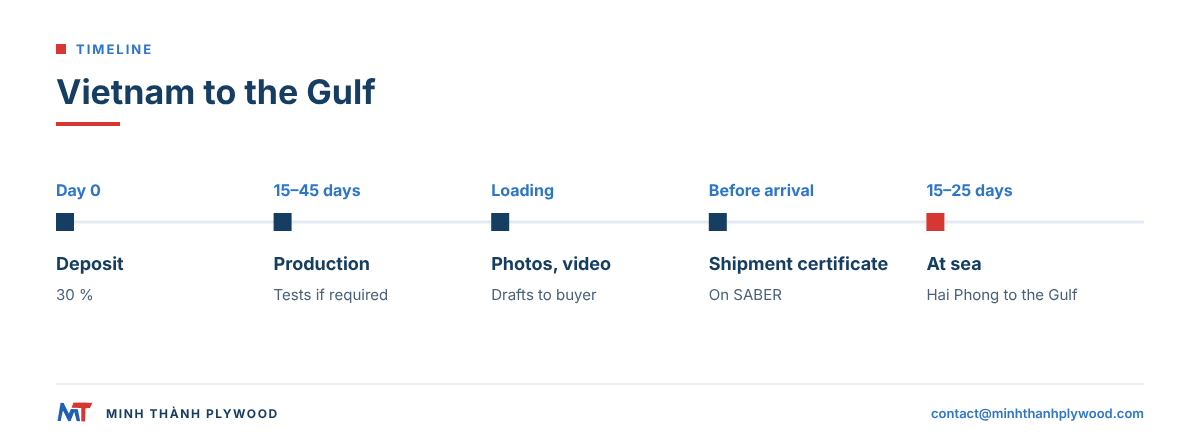
An order from Vietnam to the Gulf takes production time plus about 15–25 days at sea from Hai Phong, by carrier and route. Conformity steps run in parallel when they start early.
| Stage | Time | What happens |
|---|---|---|
| Quote and specification | Days | Specification sheet and sample agreed |
| Product file | In parallel | Importer classifies the HS code and prepares the SABER or MoIAT file |
| Deposit | Day 0 | 30 % deposit |
| Production | 15–45 days after the deposit | Panels made, tested if a test is required |
| Loading | End of production | Photos and video before loading |
| Shipment certificate | Before arrival | Importer requests it on SABER for Saudi Arabia |
| Sea transit | About 15–25 days | Hai Phong to Middle East ports |
| Balance | Against the scanned bill of lading | 70 % balance, or irrevocable L/C at sight |
We ship FOB Hai Phong, CFR or CIF. The minimum order is one 40HC, with mixed specifications by agreement.
Common mistakes on Gulf plywood orders
Most delays on Gulf plywood orders come from paperwork that does not match, not from the panels. These are the common mistakes.
- A product description that differs between documents. “Film faced plywood 18 mm” on the invoice and “shuttering plywood” on the product certificate can hold a shipment.
- Starting SABER after loading. The product certificate takes time; start with the HS code when the order is confirmed.
- An emission class written as a glue type. E0, E1 and E2 are emission classes; phenolic and melamine are glues. Write two lines.
- A reuse number without conditions. Write the glue, film weight and site conditions behind the reuse target.
- No sample kept. A signed approved sample is the reference for face, film and edges if a question comes up.
Our guide on plywood delamination explains the bond failures a good specification prevents.
How does Minh Thanh Plywood support Middle East orders?
We supply film-faced plywood with a specification sheet, test reports and a full document set, so the importer can build the SABER or MoIAT file and the consultant submittal from one source.
| Item | What we supply |
|---|---|
| Specification | Thickness, size, core, glue, film, edge sealing and tolerance in one sheet |
| Testing | Third-party testing to the buyer’s method through SGS on request |
| Quality system | ISO 9001:2015 quality management system (KAC25/0185) |
| Proof per shipment | Photos and video before loading |
| Documents | Commercial invoice, packing list, bill of lading, certificate of origin, phytosanitary and fumigation certificates, insurance with CIF |
| Terms | MOQ one 40HC, 15–45 days after the 30 % deposit, FOB Hai Phong, CFR or CIF |
| Samples | Free samples |
Our factory focus is furniture and interior plywood; film-faced plywood is part of our wider range. To get a quote with the specification written for your project, send your thickness, glue, film and quantity through the film-faced plywood page.
Buyer questions, answered
Does plywood need a SABER certificate for Saudi Arabia?
Every commercial import into Saudi Arabia goes through SABER. The importer registers a product certificate for the product and requests a shipment certificate for each consignment; the HS code decides which technical regulation, if any, applies.
Who applies for the SABER certificate, the exporter or the importer?
The Saudi importer applies on SABER. The exporter supplies the product data, test reports and shipping documents the importer and the certification body need.
How long is a SABER shipment certificate valid?
SABER states that shipment certificate validity was extended from 60 days to 90 days (saber.sa, checked 20 October 2026).
Which GSO standards apply to plywood?
GSO has adopted GSO ISO 1096:2013 for the classification of plywood and GSO ISO 2074:2015 for plywood vocabulary. Bond and performance requirements come from the project specification, often EN 314 or EN 636 classes.
Which approvals does film-faced plywood need in the UAE?
The UAE Ministry of Industry and Advanced Technology (MoIAT) issues product conformity certificates for regulated products. For construction projects, the consultant also approves the material against the project specification before it is used.
Which standards apply to film-faced plywood in Oman?
Oman's Directorate General for Standards and Metrology adopts Gulf standards through the GSO system. Importers check the product's status there and with the project specification.
What documents should ship with film-faced plywood to the Middle East?
Commercial invoice, packing list, bill of lading, certificate of origin, phytosanitary and fumigation certificates, insurance with CIF, plus the specification sheet and test reports the importer's certificate needs.
How long does shipping take from Vietnam to the Middle East?
Typical time at sea from Hai Phong to Middle East ports is 15–25 days, depending on carrier and route. Production takes 15–45 days after the deposit.
What is the minimum order for film-faced plywood from Vietnam?
One 40HC container, with mixed specifications by agreement, usually one or two per container and three to six by agreement.
What thickness tolerance does film-faced plywood have?
Our film-faced plywood is made to ±0.5 mm thickness tolerance and ±2 mm on length and width.