
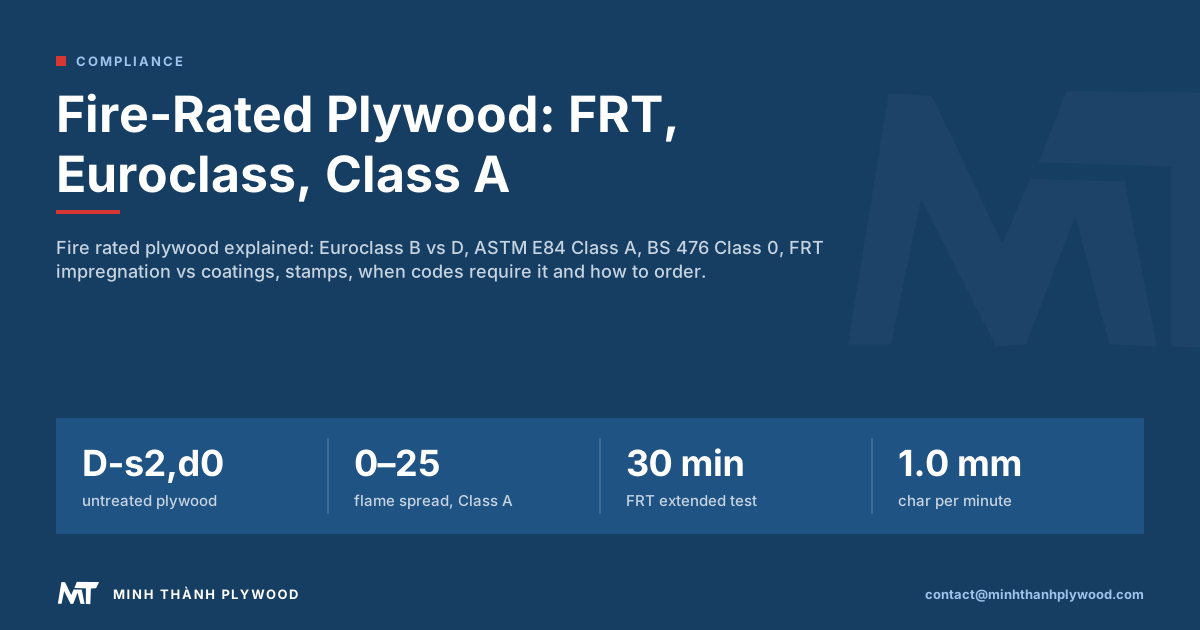
Fire rated plywood is plywood treated or coated so flame spreads slowly over its surface, tested to a reaction-to-fire class such as Euroclass B (EN 13501-1) or ASTM E84 Class A. Qualifying untreated plywood can be classified Euroclass D without testing. In Canada, the National Building Code points to a CAN/ULC-S102 flame spread rating of 25 or less, on 4 x 8 ft sheets in 1/2, 5/8 and 3/4 in. The rating comes from the treatment and its test, not from the panel's glue or species. Minh Thanh Plywood explains each system and the base panel to specify.
Fire-rated plywood in Canada: sizes, ratings and prices
A Canadian buyer asking for fire rated plywood is buying fire-retardant-treated (FRT) plywood, sold in 4 x 8 ft sheets in 1/2, 5/8 and 3/4 in thickness, with a flame spread rating of 25 or less to CAN/ULC-S102. Big-box and lumber-yard listings cover these three thicknesses, and larger quantities are special order.
| What to check | Canada, as sold today |
|---|---|
| Sheet size | 4 x 8 ft (1220 x 2440 mm) |
| Thicknesses | 1/2 in, 5/8 in, 3/4 in |
| Rating | Flame spread rating 25 or less, CAN/ULC-S102; products listed to ASTM E84 (UL 723) carry the same class A level for US projects |
| Interior or exterior | Retail FRT sheets are mostly interior type and must stay protected from weather; exterior use needs an exterior-rated FRT panel |
| Shelf price | 1/2 in sheet C$93.90 at Star Building Materials, Winnipeg (checked 21 October 2026); 3/4 in sheet C$98.92 at Home Depot Canada (checked 21 October 2026) |
| Quantities | Star Building Materials special-orders more than 60 sheets |
| Typical uses | Walls, ceilings and subfloors in commercial buildings, schools and public spaces, where the National Building Code of Canada limits flame spread |
Ask the supplier for the label on the sheet: the third-party classification mark names the flame spread rating, the treatment and whether the panel is interior or exterior type. A sheet without the mark is untreated plywood with a fire story. The price of an FRT sheet follows the treatment and testing behind it, so quote the same thickness and type when you compare shops.
For Canadian importers who buy the base panel and have it treated, the base panel to specify is covered further down, under the base plywood for fire treatment or coating.
What is fire rated plywood?
Fire rated plywood is plywood that has been treated or coated so that it ignites later and spreads flame more slowly, and that carries a tested reaction-to-fire class. In Europe the class is a Euroclass under EN 13501-1, such as B-s1,d0. In North America it is a flame spread class from ASTM E84, usually Class A.
The rating belongs to the treated product and its test, not to the plywood alone. A standard panel and a fire-rated panel can share the same veneers, glue and thickness; the difference is the fire-retardant chemistry added in the factory and the report that proves its effect.
Four terms get mixed up in quotes and on site. The table separates them.
| Term | What it means | Where it is measured |
|---|---|---|
| Fire-rated plywood | Plywood with a tested reaction-to-fire class above untreated wood | Euroclass test or ASTM E84 |
| Fire-retardant-treated (FRT) plywood | Panels impregnated with fire-retardant chemicals under pressure | ASTM E84 extended test, Euroclass test |
| Fire-resistant construction | A wall, floor or door that holds back fire for a time | Assembly test in minutes (EN 13501-2, ASTM E119) |
| Fireproof | A marketing word; no wood product is fireproof | None |
Is plywood fire rated on its own?
Plywood is not fire rated on its own. Untreated plywood is combustible and in Europe is classed D-s2,d0 without further testing, as long as it is at least 9 mm thick with a mean density of at least 400 kg/m³ and meets the specified no-air-gap mounting and substrate conditions (Commission Decision 2007/348/EC). Other panels and mounting arrangements follow the decision’s separate rows or a product test.
Class D means the panel contributes to a fire in a way building codes accept for many rooms, but not for escape routes or public spaces. Untreated plywood in North America typically tests in the Class C or Class B band of ASTM E84, depending on species and thickness; Class A needs treatment.
This is the honest baseline: our standard furniture, commercial and exterior panels are untreated plywood. Where a code asks for more, the answer is a fire-retardant treatment or a tested coating system, specified as its own product.
Plywood fire rating systems: how Euroclass, ASTM E84 and BS 476 compare
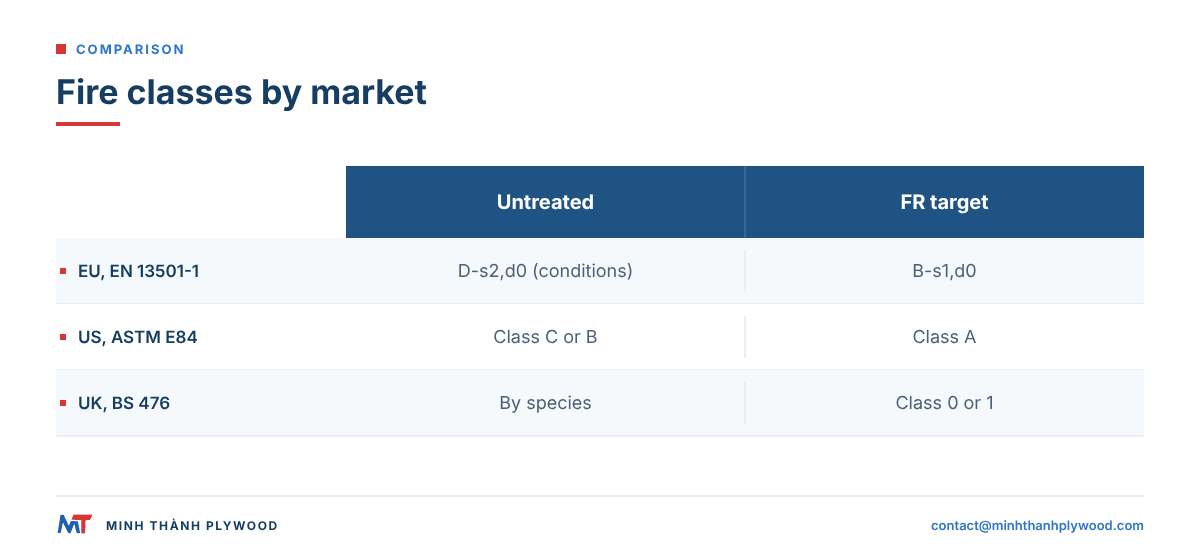
A plywood fire rating is a reaction-to-fire class: it grades how fast a surface ignites, spreads flame and makes smoke. Europe uses Euroclasses, North America uses flame spread classes, and older British specifications still quote BS 476 classes. They rank the same behaviour with different tests, so a class in one system does not convert exactly into another.
| Market | Standard | Classes | Untreated plywood | Typical FR plywood target |
|---|---|---|---|---|
| EU, UK | EN 13501-1 (Euroclass) | A1, A2, B, C, D, E, F, plus smoke s1–s3 and droplets d0–d2 | D-s2,d0 under specified conditions | B-s1,d0 or C-s2,d0 |
| US | ASTM E84 / UL 723 (10-minute tunnel) | Class A 0–25, B 26–75, C 76–200 flame spread index | Class C or B | Class A |
| Canada | CAN/ULC-S102 | Flame spread rating bands | By species and thickness | Rating 25 or less |
| UK, older specifications | BS 476-6 and -7 | Class 1 to 4 surface spread; Class 0 combines both tests | By species and thickness | Class 0 or Class 1 |
| Australia | AS 5637.1 | Groups 1 to 4 | By species and thickness | Group 1 or 2 |
The UK guidance in Approved Document B now states Euroclasses first; Class 0 still appears in older drawings and tenders. When a document says “Class 0 or Euroclass B”, supply the Euroclass test.
The smoke (s) and droplet (d) letters matter as much as the letter grade. A B-s1,d0 panel makes little smoke and no flaming droplets; a B-s3,d2 panel has the same flame spread with far more smoke.
Euroclass B, C and D: what each fire rated plywood rating allows
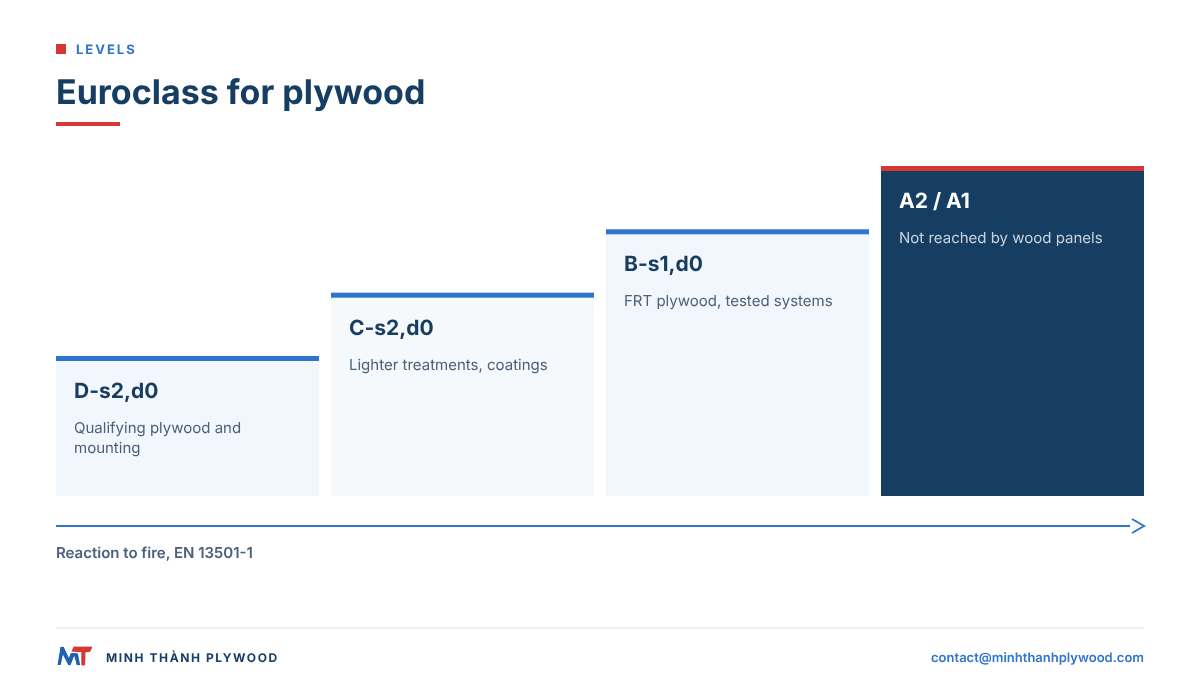
Euroclass B is the usual fire rated plywood rating in Europe, Class C is a middle step, and untreated plywood can qualify for Class D. National codes decide where each class can go. The pattern in most European codes is that the stricter the escape role of a space, the higher the class its linings need.
| Euroclass | Plywood that reaches it | Common uses allowed by national codes |
|---|---|---|
| B-s1,d0 | FRT impregnated plywood, some coated systems | Escape corridors, stairwells, public halls, shop fit-outs |
| C-s2,d0 | Lighter treatments and coatings | Rooms with stricter linings than housing, some circulation areas |
| D-s2,d0 | Untreated plywood at 9 mm or more and 400 kg/m³ or more, with specified mounting and substrate | Most rooms, housing, furniture, concealed linings |
| E | Thin or very light untreated panels | Limited uses |
The EU classes for construction products are set in Commission Delegated Regulation (EU) 2016/364. Floors have their own scale, written with “fl”, such as Dfl-s1 for untreated plywood flooring. Roofs exposed to external fire use another system again, written as B ROOF.
ASTM E84 Class A, B and C: the North American scale
ASTM E84 measures how far flame travels along a 7.3 m specimen in a tunnel over 10 minutes and turns it into a flame spread index. Class A is an index of 0–25, Class B 26–75 and Class C 76–200 under the International Building Code. A smoke-developed index of 450 or less applies to all three.
For fire-retardant-treated wood, the bar is higher than Class A alone. The International Building Code, section 2303.2, requires FRT wood to reach a flame spread index of 25 or less with the test extended to 30 minutes, and the flame front must not progress more than 3.2 m (10.5 ft) beyond the burner centreline. ASTM E2768 now writes this 30-minute test as its own standard.
That 30-minute requirement is why a Class A coated panel is not automatically “FRT plywood” under US codes. Ask which of the two the specification means.
What is FRT plywood?
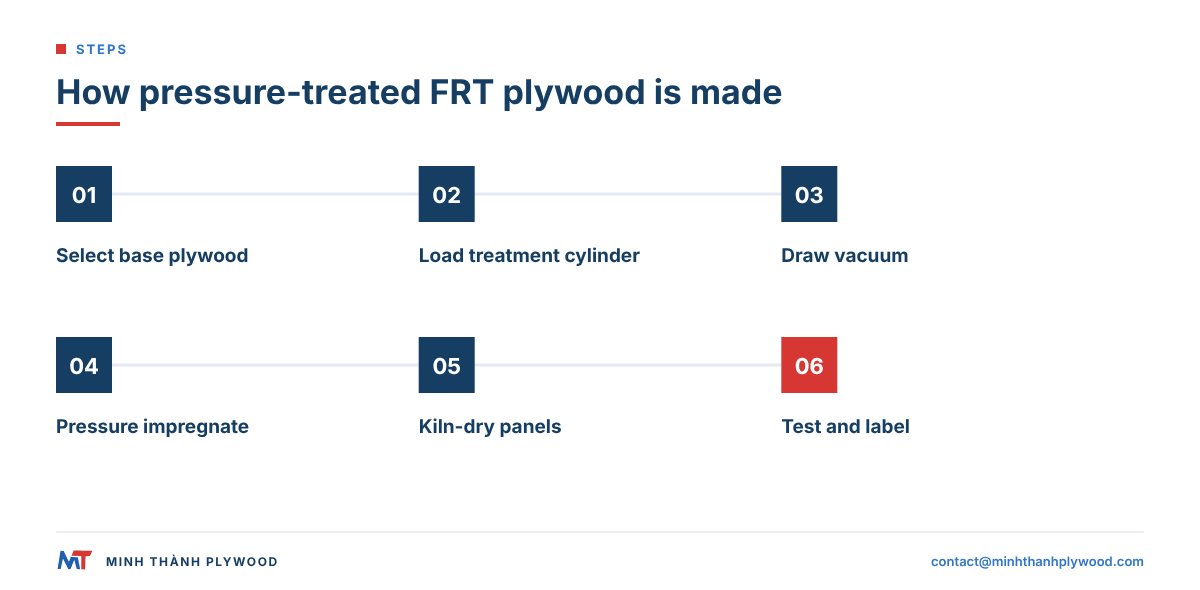
FRT plywood is plywood impregnated with fire-retardant chemicals under vacuum and pressure, then kiln-dried back to service moisture. The chemicals, usually phosphate and borate salts, react in heat to form a char layer and release water and non-flammable gases. That char slows ignition and flame spread across the surface.
The treatment process follows a fixed order:
- Select the base panel. Species, thickness and bond suited to treatment; dense, resin-rich faces take treatment less evenly.
- Load the cylinder. Panels are stacked with spacers and sealed in a treatment cylinder.
- Vacuum. Air is drawn out of the wood cells.
- Pressure-impregnate. Fire-retardant solution is forced into the veneers and glue lines.
- Kiln-dry. Panels are dried back to a moisture level suited to service, without overheating the chemistry.
- Test and label. Samples are tested against the class and each panel is labelled by the listing agency.
Because the chemistry is inside the veneers, a cut edge of FRT plywood is still treated. That is the main advantage over surface coatings.
Impregnated FRT or coated: which fire protection to choose?
Impregnated FRT plywood carries its protection through the panel; coated plywood carries it on the surface. Impregnation suits structural and concealed uses and panels that will be cut on site. Coatings suit visible linings, refits and panels already installed.
| Metric | Impregnated FRT plywood | Coated or painted system |
|---|---|---|
| Where the protection sits | Through veneers and glue lines | Surface film |
| Cut edges | Still protected | Need coating after cutting |
| Typical classes | Euroclass B-s1,d0; ASTM E84 Class A, 30-minute FRT | Euroclass B or C; ASTM E84 Class A or B |
| Appearance | Natural, slight colour change | Paint or clear intumescent film |
| Site work | None | Application to the tested thickness |
| Damage risk | Leaching outdoors if interior type | Scratches and wear remove protection |
| Best for | Roof sheathing, framing, concealed linings, exhibition stands | Visible linings, refurbishment, upgrades |
A coating’s class is only valid at the coverage, number of coats and substrate it was tested on. Write those three on the order, and check that the panel thickness and species match the test report.
Interior FRT vs exterior FRT: the moisture caveat
Interior FRT plywood is for dry service; exterior FRT plywood is for weather. Interior treatments use water-soluble salts that can leach out in rain or condensation and leave the panel unprotected. Exterior treatments are fixed in the wood and tested after accelerated weathering to ASTM D2898 before their fire test.
High humidity also matters indoors. Some interior FRT chemistry draws moisture from the air and can stain or corrode fasteners in very damp spaces. Specify hot-dip galvanised or stainless fixings where FRT panels meet moisture, following the treater’s instructions.
For roof sheathing in hot attics, North American codes ask for FRT plywood tested for strength after exposure to high temperature, so the panel keeps its load capacity over decades.
Is fire rated plywood non combustible or fireproof?
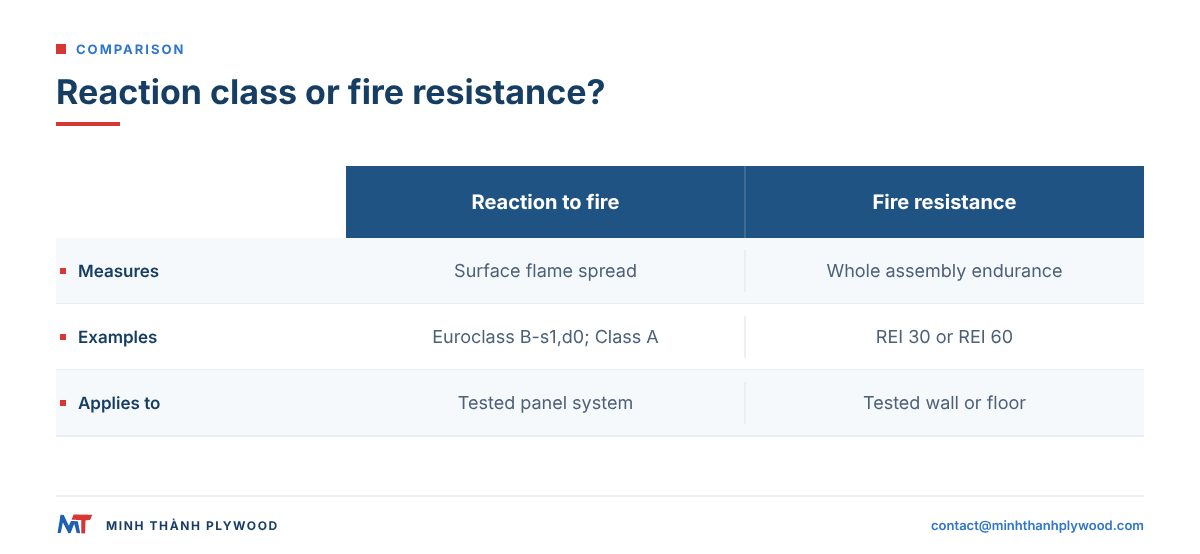
Fire retardant describes a material that slows ignition and flame spread; fire resistant describes an assembly that holds back fire for a stated time; fireproof is not a technical term. Plywood can be fire retardant. A wall built with plywood can be fire resistant. Neither is fireproof.
Fire resistance is tested on full assemblies, such as a stud wall with plywood and plasterboard, and is given in minutes: REI 30 or REI 60 under EN 13501-2, or a one-hour rating under ASTM E119. The plywood is one layer of that system, and any change to the system needs its own approval.
Plain wood has a predictable advantage in fire: it chars at a steady rate and the char protects the wood below. Eurocode 5 (EN 1995-1-2) lists a reference charring rate of 1.0 mm per minute for plywood under specified density and thickness conditions. Fire design uses the rate and adjustments applicable to the actual panel.
Where is fire rated plywood required?
Fire rated plywood is required where a building code asks for a reaction-to-fire class above what untreated wood achieves. The exact rules are national, but the same spaces recur across Europe, the UK and North America.
| Use | Why a rating is asked for | Typical requirement |
|---|---|---|
| Escape corridors and stairwells | Linings must not spread flame along the route | Euroclass B-s1,d0 or ASTM E84 Class A |
| Public halls, shops, schools, hospitals | Many people, longer escape | Euroclass B or C linings |
| Roof sheathing in larger buildings | Codes allow FRT wood where non-combustible material is otherwise required | FRT plywood, 30-minute E84 |
| Walls near a property line | Fire spread to neighbours | Rating set by distance |
| Stages, exhibition stands, theatre sets | Temporary builds in public spaces | Euroclass B or local equivalent |
| Lift shafts, plant rooms, service risers | Concealed fire paths | FRT or non-combustible boards |
| Marine and rail interiors | Sector rules | Sector fire standards |
Housing interiors, furniture and most concealed linings in small buildings accept untreated plywood. Always read the local code for the building and use class, then specify the class it names.
Does fire treatment change strength, finishing or moisture?
Fire treatment changes a panel’s behaviour in three ways a buyer should plan for. Strength can drop a little, because the chemistry and the second drying affect the wood; FRT plywood design values therefore come from the treater’s evaluation report. Finishing needs compatible glues and paints. Moisture uptake can rise with some interior chemistry.
- Strength: use the design values published for the specific FRT product, not the untreated values.
- Gluing and finishing: test laminates, paints and adhesives on treated stock; salts can affect bond and drying.
- Machining: treated panels dull saw blades faster; plan for tool wear.
- Moisture: store and install FRT panels dry; follow the treater’s limits.
These are reasons to order FRT plywood only where the code asks for it. Elsewhere, standard plywood is stronger, cheaper and easier to finish.
Does fire-rated plywood cost more, and why?
Fire-rated plywood costs more than standard plywood because of the treatment, the second kiln-drying, the testing and the listing that each batch carries. Volumes are smaller than standard panels, and treaters ship from fewer plants. Coated systems add the coating and its application by trained crews.
Buyers keep the extra cost under control by mapping where the code really asks for a class. A fit-out that uses FRT panels in the escape corridor and standard panels in the rooms off it pays the premium only where it buys safety.
How to tell if plywood is fire-rated
Fire-rated plywood is identified by its mark and its paperwork, never by its colour. FRT chemicals can tint a panel green, red or not at all, so the label is the only reliable sign: a third-party agency label in North America, a CE or UKCA label with a Declaration of Performance in Europe.
- North America: each FRT sheet carries a label from an approved third-party agency showing the treater, the flame spread class, interior or exterior type and the evaluation report number.
- Europe and UK: the CE or UKCA label and the Declaration of Performance under EN 13986 state the Euroclass, such as B-s1,d0, and the notified body.
- Coated systems: a classification report for the coating on the stated substrate and thickness, plus the applicator’s coverage record.
- Older UK projects: a BS 476-6 and -7 report showing Class 0, if the specification still asks for it.
A delivery note saying “fire rated” without a class, a standard and a report number is not evidence. Reject it and ask for the documents above.
What ordinary plywood does in a fire
Ordinary plywood ignites, burns and chars in a predictable way. Once alight, the face chars and the char layer slows heat into the wood below; thicker panels last longer simply because there is more wood to char. Phenolic and UF glue lines do not change the class of standard plywood.
That predictability is why plywood performs well as part of tested fire-resistant assemblies. The weakness is surface flame spread on large exposed areas, which is exactly what reaction-to-fire classes limit and what fire-retardant treatment improves.
Which base plywood to specify for fire treatment or coating
Specify the base plywood with the treatment or coating in mind, because the fire test covers a defined substrate. Treaters and coating suppliers publish which species, thickness and density their class applies to. Ordering a different base panel can void the class.
| Base panel line | What to write | Why it matters |
|---|---|---|
| Thickness | Exact thickness covered by the classification or tested system | Fire classes are thickness-specific |
| Core species | For example Eucalyptus or Acacia core | Density and absorption affect treatment uptake |
| Faces | Utility C/D for concealed use; sanded faces for coated linings | Coatings need an even, sanded face |
| Bond | Exterior-type bond for exterior FRT | Treatment and redrying stress the glue line |
| Moisture at dispatch | 8–12 % | Treaters start from a known moisture level |
| Sizes | 1220 × 2440 mm or 1250 × 2500 mm | Match the treater’s cylinder and the listing |
Minh Thanh makes untreated plywood in 3–40 mm, on Styrax, Eucalyptus or Acacia cores, with UF glue at E0 emission for interiors and melamine-fortified or phenolic bonds for humid and exterior uses. The fire class always comes from the treater’s or coating supplier’s own tested system.
Choosing the right panel: when FRT is overkill
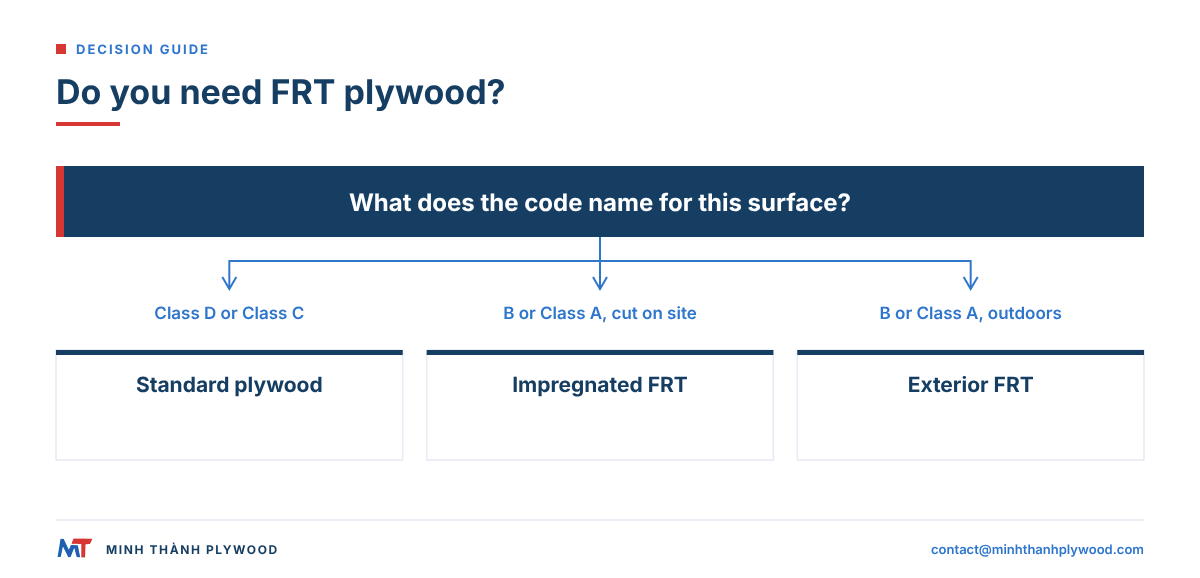
FRT plywood is overkill wherever the code accepts Euroclass D or ASTM E84 Class C, which covers most housing, furniture, packing and concealed structural uses. Use the table to decide panel by panel.
| Question | Answer | Panel to specify |
|---|---|---|
| Does the code name a class above D for this surface? | No | Standard plywood |
| Is the surface on an escape route or in a public space? | Yes | FRT or coated, Euroclass B-s1,d0 |
| Will the panel be cut on site and edges left bare? | Yes | Impregnated FRT |
| Will the panel get wet in service? | Yes | Exterior FRT |
| Is it furniture or a fitted cabinet? | Yes | Standard furniture plywood; furniture fire rules apply to upholstery and fabrics |
What this means for your order
For the plywood in your project, separate two orders: standard panels for the uses that accept them, and fire-rated panels from a listed treater or coating system where the code requires a class. Our furniture, commercial and exterior panels are standard untreated plywood.
For standard panels we supply 1220 × 2440 mm and 1250 × 2500 mm in 3–40 mm, MOQ one 40HC with mixed specifications by agreement, production 15–45 days after the 30% deposit, FOB Hai Phong, CFR or CIF. Free samples are available, and third-party testing to the buyer’s method is arranged through SGS on request.
Send us the thicknesses, cores and faces for your standard panels, and the treater’s base-panel requirements if part of the order goes for treatment after import. See our exterior plywood and furniture plywood pages, the class 2 vs class 3 bond guide or more compliance guides.
Buyer questions, answered
What is fire rated plywood?
Fire rated plywood is plywood treated with fire-retardant chemicals or coated so that flame spreads slowly over its surface. It carries a tested class, such as Euroclass B-s1,d0 in Europe or ASTM E84 Class A in North America.
Is plywood fire rated on its own?
No. Untreated plywood is combustible and in Europe is classed D-s2,d0 without testing when it is at least 9 mm thick with a density of 400 kg/m³ or more and meets the specified no-air-gap mounting and substrate conditions. A better class needs a fire-retardant treatment or coating and a test.
Is fire rated plywood non combustible?
No. Fire-retardant-treated plywood still burns; it ignites later and spreads flame slowly. Only Euroclass A1 and A2 materials count as non-combustible or of limited combustibility, and wood panels do not reach them.
What is FRT plywood?
FRT plywood is fire-retardant-treated plywood: panels pressure-impregnated with fire-retardant salts, then kiln-dried. In the US it must have a flame spread index of 25 or less in an extended 30-minute ASTM E84 test.
Is fire-retardant plywood the same as fireproof?
No. Nothing made of wood is fireproof. Fire-retardant plywood slows ignition and flame spread; fire resistance in minutes belongs to a tested wall, floor or door assembly, not to a single sheet.
How can you tell if plywood is fire-rated?
Look for the mark. In North America FRT plywood carries a third-party label on each sheet with the flame spread class and interior or exterior type; in Europe the CE or UKCA label and Declaration of Performance state the Euroclass.
Is CDX plywood fire rated?
No. CDX is untreated sheathing plywood with an exterior-type bond and C/D faces. It has no fire rating unless it is treated and labelled as FRT plywood.
Can interior FRT plywood be used outdoors?
No. Interior FRT chemicals can leach out in rain and lose their effect. Exterior FRT plywood is tested after accelerated weathering and is the only type for exposed use.
Does fire-rated plywood cost more?
Yes. The treatment, the drying after treatment, the testing and the certification add to the panel price, and FRT panels are made in smaller volumes. Coated systems add the coating and its application.
When is fire rated plywood required?
When a building code sets a reaction-to-fire class above what untreated wood achieves: escape routes, public spaces, some roof sheathing in larger buildings, wall linings near property lines, stage and exhibition builds.