
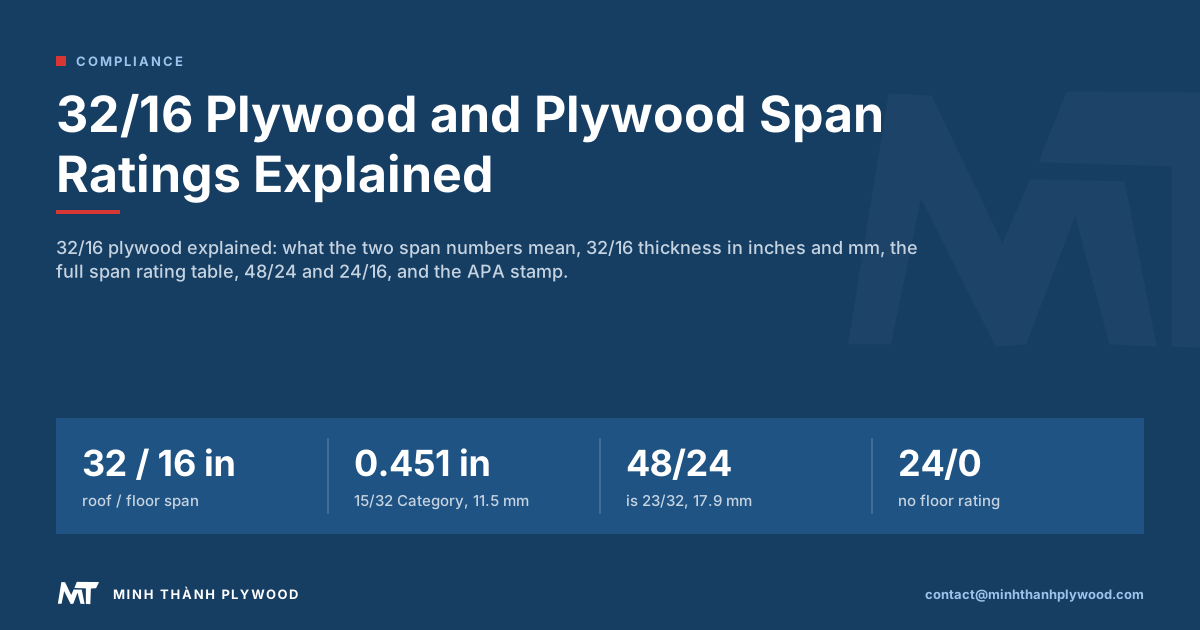
32/16 plywood is structural sheathing rated to span 32 inches between roof supports and 16 inches between floor joists. It is usually 15/32 Performance Category, sold as 1/2-inch, with a mill thickness of about 0.451 in, or 11.5 mm. This guide from Minh Thanh Plywood decodes every span rating, the APA stamp, and what an imported panel without that stamp can and cannot be used for.
What is 32/16 plywood?
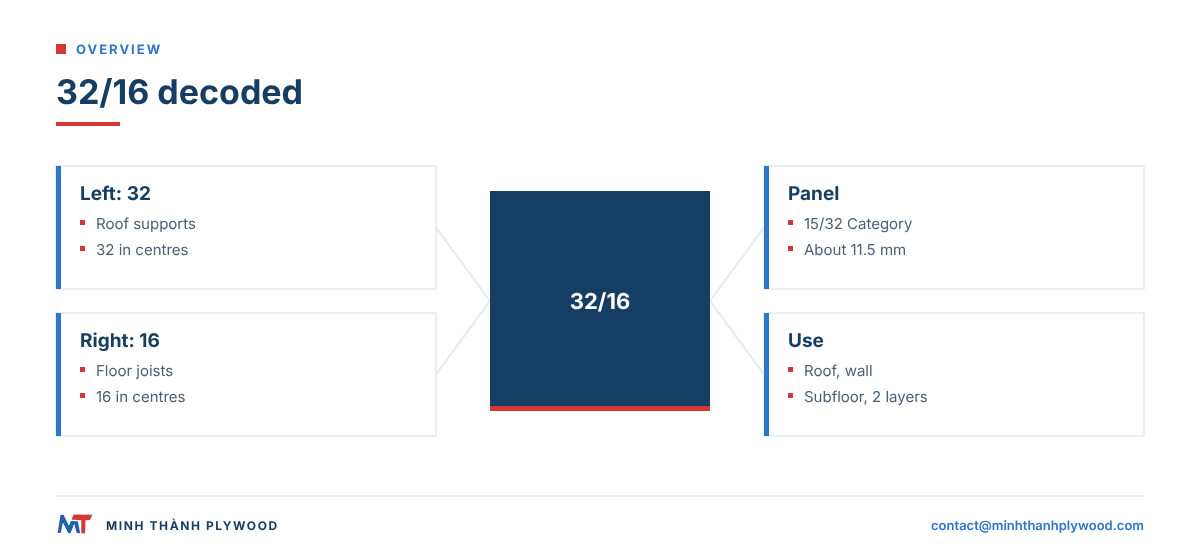
32/16 plywood is structural sheathing whose grade stamp rates it to span 32 inches between roof supports and 16 inches between floor joists. The two numbers are its span rating, and the panel behind them is usually 15/32 Performance Category, sold as 1/2-inch plywood.
The rating appears on panels made to the US standards PS 1 (structural plywood) or PS 2 (performance-rated panels, plywood and OSB), and graded by an agency such as APA. A typical stamp reads “Rated Sheathing 32/16, 15/32 Category, Exposure 1”.
32/16 is the most common rating in North American house building: roof decks on trusses at 24 in centres, wall sheathing, and subfloors on joists at 16 in centres under a second layer.
What is a plywood span rating?
A plywood span rating is the maximum centre-to-centre spacing of supports, in inches, that a structural panel is rated for, with its strength axis across the supports. On sheathing the rating is two numbers; on single-layer floor panels it is one number with “oc” (on centre).
| Rating form | Example | Left number | Right number |
|---|---|---|---|
| Sheathing, two numbers | 32/16 | Roof support spacing: 32 in | Floor joist spacing: 16 in |
| Sheathing, roof only | 24/0 | Roof support spacing: 24 in | 0: not for subfloors |
| Single-layer floor (Sturd-I-Floor) | 24 oc | Floor joist spacing: 24 in | None |
| Wall sheathing | Wall-16, Wall-24 | Stud spacing: 16 or 24 in | None |
The rating assumes the panel runs with its long side across at least three supports, and standard roof and floor loads. A heavier load, a thinner covering or weaker fixing can mean a closer spacing than the rating.
What is 32/16 plywood in inches?
32/16 plywood is 15/32 inch in Performance Category, sold as 1/2-inch, with a declared mill thickness of about 0.451 in. In millimetres that is about 11.5 mm; the nominal 15/32 in is 11.9 mm.
Three thickness words appear on and around one panel:
- Trade size: what the yard calls it, here “1/2-inch”.
- Performance Category: the stamp’s thickness name, here “15/32 Category”.
- Mill thickness: the declared actual thickness, here about 0.451 in.
The Performance Category replaced the old nominal thickness on stamps so that panels from different mills, plywood or OSB, can be matched on one specification. When you order, write the Performance Category, not the trade size.
What does 32/16 plywood cost and what builds are sold?
A 4 × 8 ft sheet of 15/32 CDX 32/16 plywood sold for roughly US$25 to US$32 at US home centres in 2026, against about US$10 to US$11 for a 7/16 OSB sheet with the same 32/16 rating. These are indicative retail prices that vary by region and week, so check your local yard before you budget.
| US 32/16 product | Build and species | Typical use | Indicative US retail price per sheet |
|---|---|---|---|
| 15/32 CDX sheathing, 4-ply | Four veneers, fir or pine, C/D faces | Roof and wall sheathing, subfloor | About US$25 to US$32 (Home Depot fir, 2026) |
| 15/32 sheathing, 3-ply RTD | Three veneers, rated sheathing, ready-to-deliver | Roof and wall sheathing | Set by the yard; ask for the ply count |
| 15/32 Rated Sheathing CD, unsanded | Southern yellow pine (SYP), Group 1, Exposure 1, PS 2 | Sheathing where short wetting is expected | Sold by the bundle and the truck |
| 15/32 CCX ground-contact, pressure-treated | Treated pine, C/C faces | Sill plates, ground contact, wet sites | Priced by the yard; ask for the retention level |
| 7/16 OSB, 32/16 | Wood strands, not veneers | Budget sheathing | About US$10 to US$11 (Lowe’s, 2026) |
Two build points decide stiffness. A 4-ply 15/32 panel is stiffer across the panel than a 3-ply panel of the same thickness, because the extra layer balances the cross-lamination. Southern yellow pine and Douglas fir are both Group 1 species, the strongest and stiffest group in the US plywood standard, so a stamp that lists either one reads at the top of the species table.
These sheets are stamped, graded and code-accepted, and that is what the retail price pays for. Minh Thanh’s exterior CDX-type panels carry no APA stamp, so they do not compete for code sheathing; for crates, stair treads, formwork and other non-code uses, the container price is the reference: commercial plywood from US$250/m³ in one 40HC.
Span rating table: rating, thickness and span
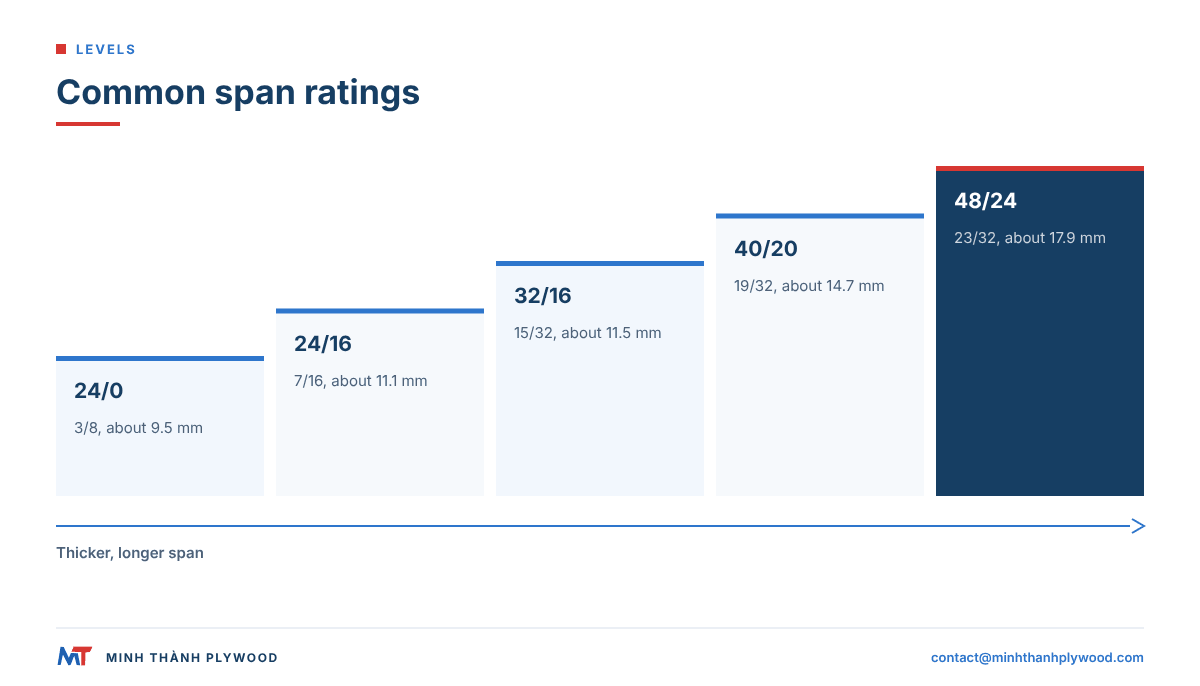
The span rating table links each common rating to its usual Performance Category, its thickness in inches and millimetres, and its roof and floor spans. These are the common pairings for APA Rated Sheathing and Sturd-I-Floor.
| Span rating | Usual Performance Category | Trade size | Approx. thickness | Roof span | Floor span |
|---|---|---|---|---|---|
| 24/0 | 3/8 | 3/8 in | 9.0 mm | 24 in (610 mm) | Not rated |
| 24/16 | 7/16 | 7/16 in | 10.6 mm | 24 in (610 mm) | 16 in (406 mm) |
| 32/16 | 15/32 | 1/2 in | 11.5 mm | 32 in (813 mm) | 16 in (406 mm) |
| 40/20 | 19/32 | 5/8 in | 14.7 mm | 40 in (1016 mm) | 20 in (508 mm) |
| 48/24 | 23/32 | 3/4 in | 17.9 mm | 48 in (1219 mm) | 24 in (610 mm) |
| 16 oc floor | 19/32 | 5/8 in | 14.7 mm | — | 16 in (406 mm) |
| 20 oc floor | 19/32 | 5/8 in | 14.7 mm | — | 20 in (508 mm) |
| 24 oc floor | 23/32 | 3/4 in | 17.9 mm | — | 24 in (610 mm) |
Roof spans assume edge support between rafters, such as panel clips or blocking; without it, the allowed roof span is shorter. Floor spans for two-number sheathing assume a second layer of flooring on top.
48/24 plywood thickness and use
48/24 plywood is usually 23/32 Performance Category, sold as 3/4-inch, with a mill thickness of about 0.703 in, or 17.9 mm. It spans 48 in on a roof and 24 in on a floor, which makes it the panel for joists at 24 in centres and for widely spaced roof purlins.
The same 23/32 thickness, made as single-layer flooring with tongue-and-groove edges, is rated 24 oc. Choose 48/24 sheathing when a second floor layer goes on top; choose 24 oc floor panels when the panel is the only layer under carpet and pad or a finished floor.
24/16 plywood and 24/0 panels
24/16 plywood is a 7/16 Performance Category panel, about 10.6 mm, rated for roofs at 24 in and floors at 16 in. In practice 24/16 is most often an OSB rating; plywood buyers meet it less often than 32/16.
24/0 panels, usually 3/8 Performance Category, are roof and wall sheathing only. The zero is a deliberate “no”: the panel is not rated as subflooring at any spacing. For a shed roof on rafters at 24 in, a 24/0 panel meets the rating; for its floor, it does not.
Reading the APA grade stamp
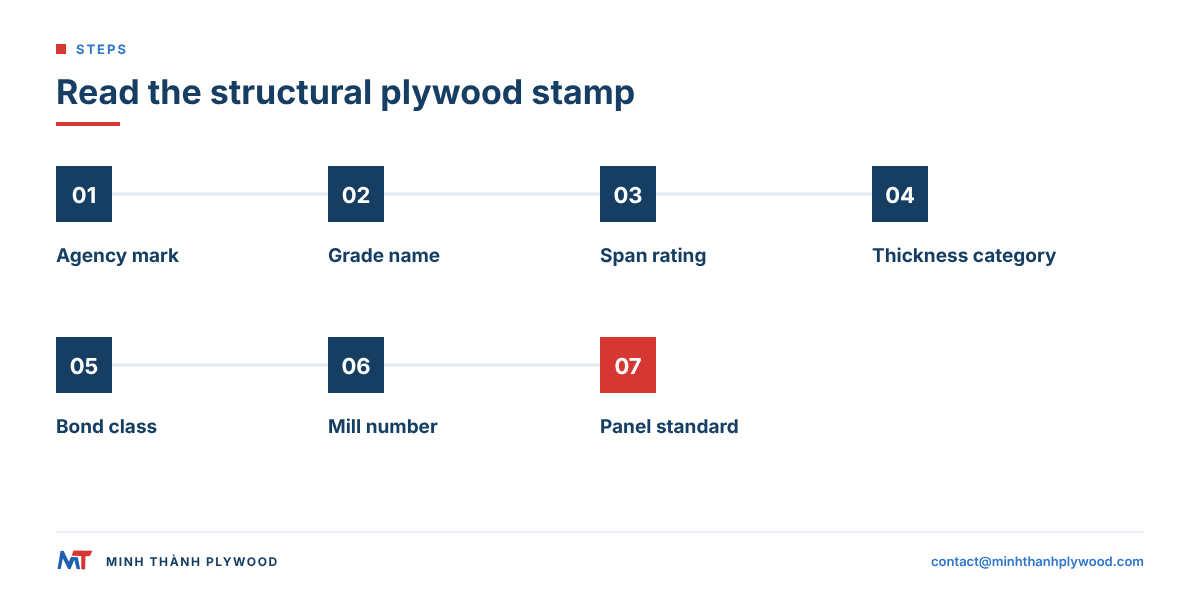
The APA grade stamp shows a structural panel’s rating, thickness, bond and standard in one block, and the span rating sits in the middle of it. A Rated Sheathing stamp contains, in order:
- Agency mark: APA, or another approved agency.
- Grade name: Rated Sheathing or Rated Sturd-I-Floor.
- Span rating: for example 32/16.
- Performance Category: for example 15/32 Category.
- Bond classification: Exposure 1 or Exterior.
- Mill number: the producing mill.
- Standard: PS 1-22 for plywood, PS 2 for performance-rated panels, and often a code report number.
Exposure 1 panels have a fully waterproof bond for construction delays but are made for protected end uses; Exterior panels suit permanent exposure. “CDX” is trade shorthand for C-D faces with an Exposure 1 bond. NIST lists PS 1-22 as the current structural plywood standard (checked 20 October 2026).
Can 1/2 inch plywood span 24 inches?
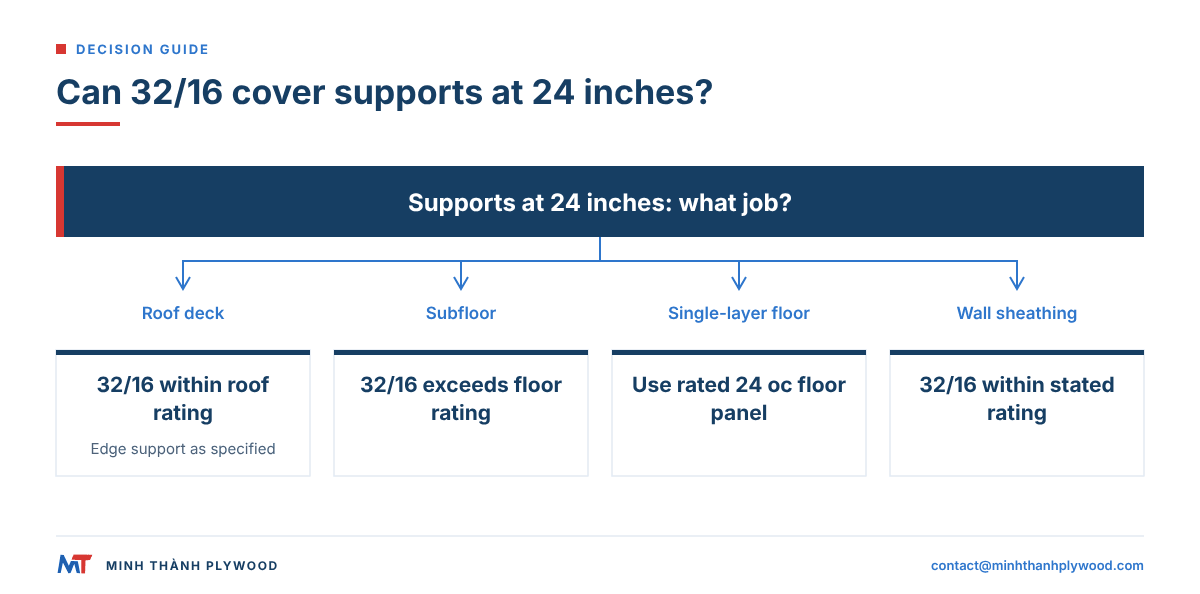
1/2-inch plywood rated 32/16 can span 24 inches on a roof, but not on a floor. Its roof rating is 32 in, so rafters or trusses at 24 in centres are within it; its floor rating is 16 in, so joists at 24 in need a thicker panel.
| Job | Supports at 24 in | 1/2 in (15/32, 32/16) | 3/4 in (23/32, 48/24) |
|---|---|---|---|
| Roof deck | Rafters or trusses | Within rating | Within rating |
| Subfloor under a second layer | Joists | Over rating (16 in) | Within rating |
| Single-layer floor | Joists | Not rated | 24 oc panel within rating |
| Wall sheathing | Studs | Within rating | Within rating |
The answer always comes from the stamp, not the thickness alone: a panel without a span rating has no rated span, whatever its thickness.
How far can 3/4 inch plywood span?
3/4-inch plywood rated 48/24 can span 48 inches on a roof and 24 inches on a floor; rated 24 oc as single-layer flooring, it spans 24 inches between joists. Those are the limits for standard residential loads with the panel’s long side across the supports.
For heavier floor loads, stone or tile finishes, or point loads such as storage racking, the design may call for closer joists or a thicker panel, such as 7/8 in rated 32 oc or 1-1/8 in rated 48 oc. A structural engineer or the building code sets the final figure.
32/16 plywood vs OSB with the same rating
A 32/16 plywood panel and a 32/16 OSB panel are interchangeable for the rated span, because PS 2 rates both on the same performance tests. The differences are in moisture behaviour, edges and weight, not in the rated span.
| Point | 32/16 plywood | 32/16 OSB |
|---|---|---|
| Rated roof and floor span | 32 in / 16 in | 32 in / 16 in |
| Build | Cross-laminated veneers | Oriented wood strands |
| Edge swelling when wet | Low | Higher, mostly at edges |
| Recovery after wetting | Good | Edges stay swollen |
| Cost | Usually higher | Usually lower |
OSB3 and OSB grades explains the European OSB grades and their swelling limits.
Span ratings outside North America
Span ratings belong to North American standards, PS 1, PS 2 and Canada’s CSA O325, and they do not exist in European or Asian plywood standards. A European structural panel is specified by its EN 636 class, its thickness and design values used in the structural calculation, not by a rated span; it is CE marked under EN 13986 and the Construction Products Regulation (EU) No 305/2011.
That matters to importers outside the US. An 18 mm EN 636-2 or EN 636-3 plywood floor on joists at 400 mm or 600 mm centres is checked by calculation or national guidance; a buyer who writes “48/24” for a European job is asking for a US stamp the job may not need. Class 2 vs class 3 plywood covers the EN 636 classes.
How thickness, species and Performance Category relate
A span rating is earned by test performance, not by thickness alone, so two panels of the same Performance Category can carry different ratings. Species, the number of plies and their lay-up all change how stiff and strong a panel is across its supports.
Three relations hold for most rated plywood:
- Thicker panels earn longer spans. Moving from 15/32 to 23/32 Category takes a typical sheathing rating from 32/16 to 48/24.
- Stiffer species and more plies help. A panel with more, thinner plies or stiffer face veneers can earn a higher rating at the same thickness.
- The strength axis decides. Ratings assume the face grain runs across the supports; turned the other way, a panel spans much less.
PS 1 groups species by strength, from Group 1, the strongest, to Group 5. PS 2 rates panels by tests instead, which is why OSB and plywood of the same Performance Category can share a rating.
Span ratings vs formwork panel ratings
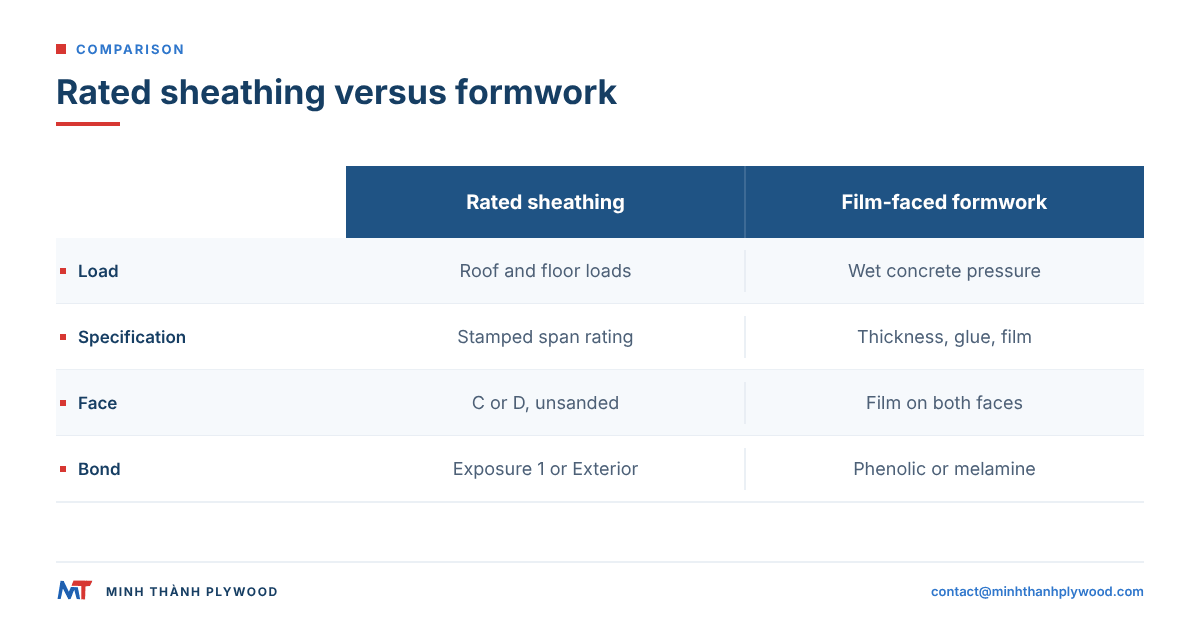
Span ratings describe sheathing under roof and floor loads; formwork panels are rated for a different job, holding wet concrete, and are specified by thickness, glue and face. A 32/16 sheathing panel is not a formwork panel, even at the same thickness.
| Point | Rated sheathing | Formwork (film-faced) plywood |
|---|---|---|
| Load | Roof snow and wind, floor live load | Wet concrete pressure |
| Rating | Span rating on the stamp | Thickness, glue, film weight, reuse with proper handling |
| Bond | Exposure 1 or Exterior | Phenolic or melamine, by order |
| Face | C or D veneer, unsanded | Phenolic film on both faces |
For formwork, the support spacing comes from the formwork design and the panel’s thickness; film-faced plywood is the product to price, not a span-rated sheet.
What an imported panel without an APA stamp can claim
An imported plywood panel without an APA or other approved agency stamp has no span rating and cannot be sold as rated sheathing, whatever its thickness or glue. US building codes ask structural sheathing to carry the grade mark of an approved agency; a panel without it is not accepted for code-governed roof, wall or floor sheathing.
Minh Thanh panels carry no APA stamp or span rating. What they can claim is their build and bond, stated plainly:
- Exterior / CDX-type plywood: utility C/D faces, water-resistant melamine-fortified or phenolic (WBP) glue, for stair treads, wall sheathing and other outdoor uses where a grade mark is not required.
- Thickness and size: 3–40 mm, 1220 × 2440 mm or 1250 × 2500 mm, thickness tolerance ±0.5 mm on commercial panels, ±2 mm on length and width.
- Load in a container: 18 mm Eucalyptus-core panels load 795 sheets per 40HC (15 packs of 53 sheets, about 34.8 kg per sheet), capped by a 28,000 kg payload.
For crates, temporary works, stair treads, export markets that do not use span ratings, and projects designed by calculation, these are the figures the buyer works from.
What to write on your order
Write a span rating only when the job needs a stamped panel; otherwise, write the build, the bond and the thickness. For a US code-governed roof, the line reads “APA Rated Sheathing 32/16, 15/32 Category, Exposure 1, PS 1-22”.
For an exterior plywood order from Minh Thanh, the line reads:
18 mm × 1220 × 2440 mm exterior plywood; faces: C/D utility; core: Eucalyptus; glue: phenolic (WBP); thickness tolerance ±0.5 mm; use: stair treads and wall sheathing; 1×40HC CIF your port.
Minh Thanh sends free samples and replies within hours: contact@minhthanhplywood.com or WhatsApp +84 988 586 601. For the water side of the question, read is plywood waterproof?.
Buyer questions, answered
What is a span rating for plywood?
A span rating is the pair of numbers on a structural panel's grade stamp, such as 32/16: the left number is the maximum spacing of roof supports in inches, the right number the maximum spacing of floor joists, under standard loads.
What is 32/16 plywood in inches?
32/16 plywood is usually 15/32 Performance Category, sold as 1/2-inch plywood, with a mill thickness of about 0.451 in. It spans 32 in on a roof and 16 in on a floor.
What is 32/16 plywood in mm?
About 11.5 mm. The 15/32 Performance Category declares 0.451 in, which is 11.46 mm; the nominal 15/32 in is 11.9 mm.
Can 1/2 inch plywood span 24 inches?
On a roof, yes: a 32/16-rated 15/32 panel spans up to 32 in, so rafters at 24 in are within its rating. As a subfloor, no: its floor rating is 16 in, so joists at 24 in need a 48/24 panel or a 24 oc floor panel.
How far can 3/4 inch plywood span?
A 23/32 Performance Category panel, sold as 3/4-inch, is usually rated 48/24 as sheathing or 24 oc as a single-layer floor: 48 in on a roof and 24 in on a floor.
What thickness is 48/24 plywood?
48/24 plywood is usually 23/32 Performance Category, sold as 3/4-inch, with a mill thickness of about 0.703 in, or 17.9 mm.
What does 24/16 plywood mean?
A 24/16 panel spans 24 in on a roof and 16 in on a floor. It is usually 7/16 Performance Category, about 10.6 mm.
What does 24/0 mean on plywood?
24/0 means the panel may span 24 in on a roof but is not rated as subflooring. It is usually 3/8 Performance Category, about 9.0 mm.
Is 32/16 plywood the same as CDX?
Often, in the trade. CDX means C and D faces with an Exposure 1 bond, and much 1/2-inch CDX is stamped Rated Sheathing 32/16 Exposure 1. The span rating comes from the stamp, not from the letters.
Do span ratings apply outside North America?
No. Span ratings come from US and Canadian standards, PS 1, PS 2 and CSA O325. In Europe, structural plywood is specified by EN 636 class and design values, not by span rating.
Are Minh Thanh panels span-rated?
No. Minh Thanh panels carry no APA stamp or span rating. Its exterior and CDX-type plywood with melamine-fortified or phenolic glue is used for stair treads, wall sheathing and other uses where a US code grade mark is not required.