
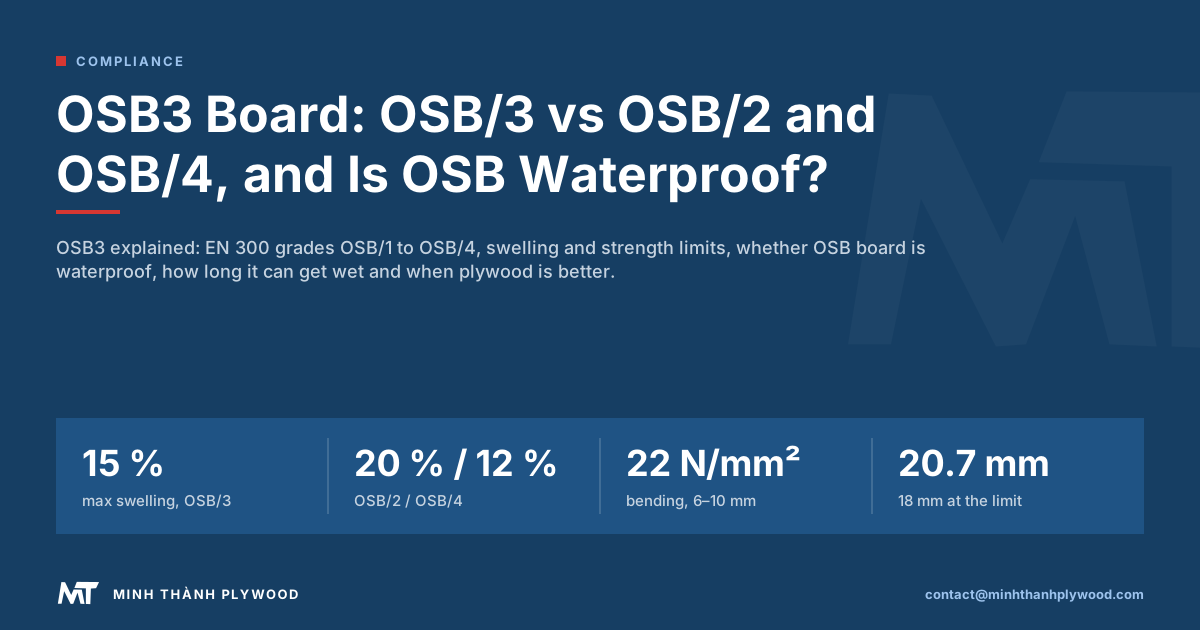
OSB3 is oriented strand board graded OSB/3 under EN 300: a load-bearing board for humid conditions, with thickness swelling of no more than 15 % after 24 hours in water. It is moisture-resistant, not waterproof. This guide from Minh Thanh Plywood sets out the four EN 300 grades, what OSB/3 can and cannot do outdoors, and when exterior WBP plywood is the better panel.
What is OSB3?
OSB3 is oriented strand board graded OSB/3 under the European standard EN 300: a load-bearing board for use in humid conditions. The “3” is the grade, not a thickness or a brand, and the same board is written OSB/3, OSB 3 or OSB3 board.
OSB is made from thin wood strands, about the size of a playing card, coated with resin and laid in three or more layers. The outer layers run lengthways along the board and the core strands run across or at random, then the mat is hot-pressed into a panel. The grade depends on the resin and on how much the board swells and weakens when wet.
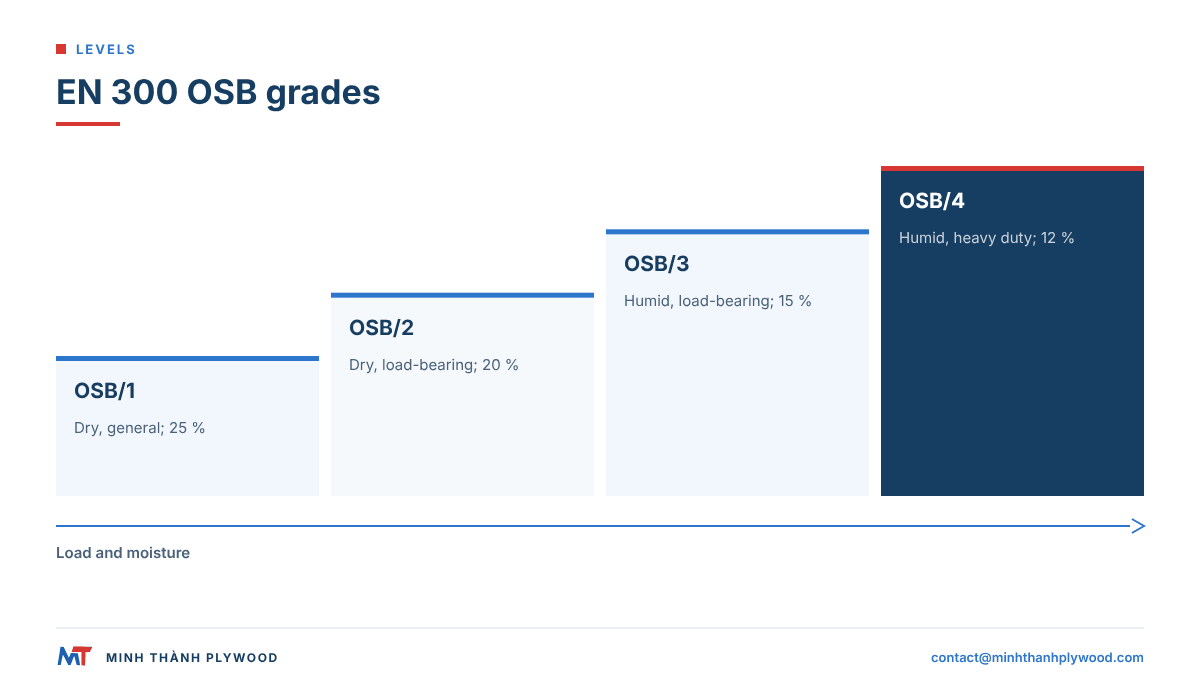
EN 300 defines four grades:
- OSB/1: general-purpose boards and interior fitments, including furniture, for dry conditions.
- OSB/2: load-bearing boards for dry conditions.
- OSB/3: load-bearing boards for humid conditions.
- OSB/4: heavy-duty load-bearing boards for humid conditions.
OSB/3 is the grade most builders’ merchants stock in the UK and Ireland, and the usual board for wall sheathing, roof decking and floors in timber-frame houses.
EN 300 OSB grades compared: OSB/1, OSB/2, OSB/3 and OSB/4
The four EN 300 OSB grades differ in where they may be used, how much they swell in water and how strong they are. This table gives the requirements for boards of 6–10 mm, the thinnest band.
| EN 300 grade | Use | Conditions | Thickness swelling, 24 h (EN 317) | Bending strength, major axis (EN 310) | Bending strength, minor axis |
|---|---|---|---|---|---|
| OSB/1 | General purpose, interior fitments | Dry | 25 % | 20 N/mm² | 10 N/mm² |
| OSB/2 | Load-bearing | Dry | 20 % | 22 N/mm² | 11 N/mm² |
| OSB/3 | Load-bearing | Humid | 15 % | 22 N/mm² | 11 N/mm² |
| OSB/4 | Heavy-duty load-bearing | Humid | 12 % | 30 N/mm² | 16 N/mm² |
Two things stand out. OSB/2 and OSB/3 share the same strength figures; the difference is moisture. And OSB/4 is the only grade that is stronger as well as more water-resistant, which is why it costs more and is stocked less.
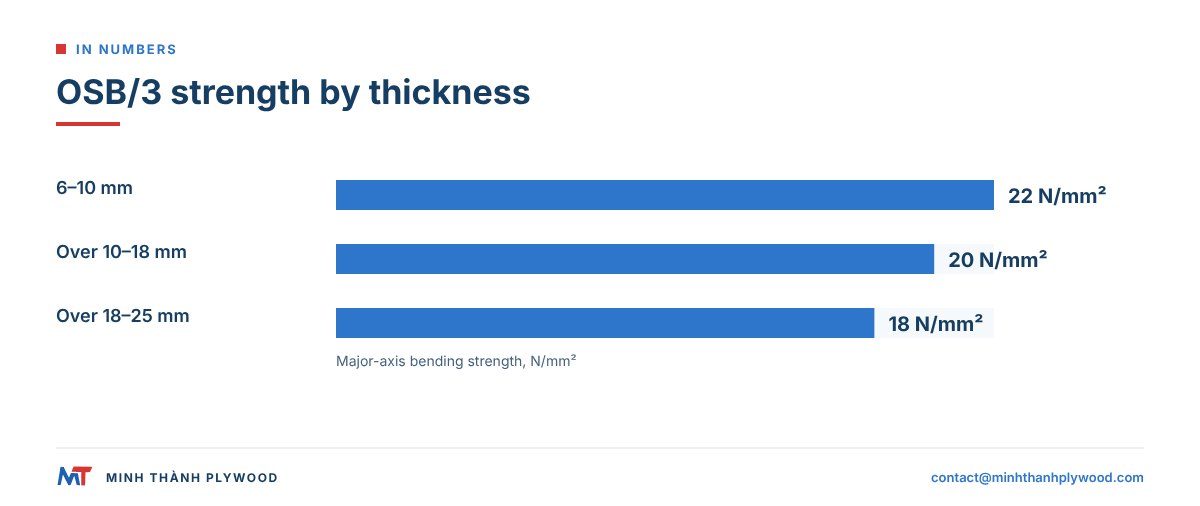
Strength falls slightly as the board gets thicker. For OSB/3 the major-axis bending requirement is 22 N/mm² at 6–10 mm, 20 N/mm² above 10 up to 18 mm, and 18 N/mm² above 18 up to 25 mm.
OSB/3 specification: swelling, strength and stiffness
An OSB/3 board must meet a set of mechanical and moisture limits in EN 300, tested on samples from production. These are the figures a specifier checks on the declaration of performance.
| Property, OSB/3 | Test method | 6–10 mm | over 10–18 mm | over 18–25 mm |
|---|---|---|---|---|
| Bending strength, major axis | EN 310 | 22 N/mm² | 20 N/mm² | 18 N/mm² |
| Bending strength, minor axis | EN 310 | 11 N/mm² | 10 N/mm² | 9 N/mm² |
| Modulus of elasticity, major axis | EN 310 | 3500 N/mm² | 3500 N/mm² | 3500 N/mm² |
| Modulus of elasticity, minor axis | EN 310 | 1400 N/mm² | 1400 N/mm² | 1400 N/mm² |
| Thickness swelling, 24 h in water | EN 317 | 15 % | 15 % | 15 % |
On top of these, OSB/3 must pass a moisture-resistance test, either a cyclic test or a boil test, that measures how much strength remains after wetting and drying. OSB/2 has no such test. That is the real proof behind “humid conditions”.
The strength along the board is about twice the strength across it. Lay OSB with the long side across the joists or rafters, the way the arrow on the board points, or the floor will feel soft.
Is OSB board waterproof?
No OSB board is waterproof, including OSB/3 and OSB/4. They are moisture-resistant: the resin keeps the strands bonded in humid air and through short wetting, but water that stays on the board, or soaks the edges, makes it swell and lose strength.
The swelling limit itself shows this. An OSB/3 board may grow up to 15 % in thickness after 24 hours under water, so an 18 mm board can reach about 20.7 mm. Most of that swelling happens at the edges, and it does not fully recover when the board dries, so floors show raised joints and roofs show lines through thin coverings.
In Eurocode 5 terms (EN 1995), OSB/3 and OSB/4 are for service classes 1 and 2: heated interiors and covered, unheated spaces where the air is humid. Service class 3, wood exposed to the weather, is outside their scope.
Can OSB board get wet during construction?
OSB/3 can get wet during construction for a short time if it dries out again, but it should never stand in water or stay wet. Builders count on this: walls and roofs of OSB/3 often take some rain before the cladding and roof covering go on.
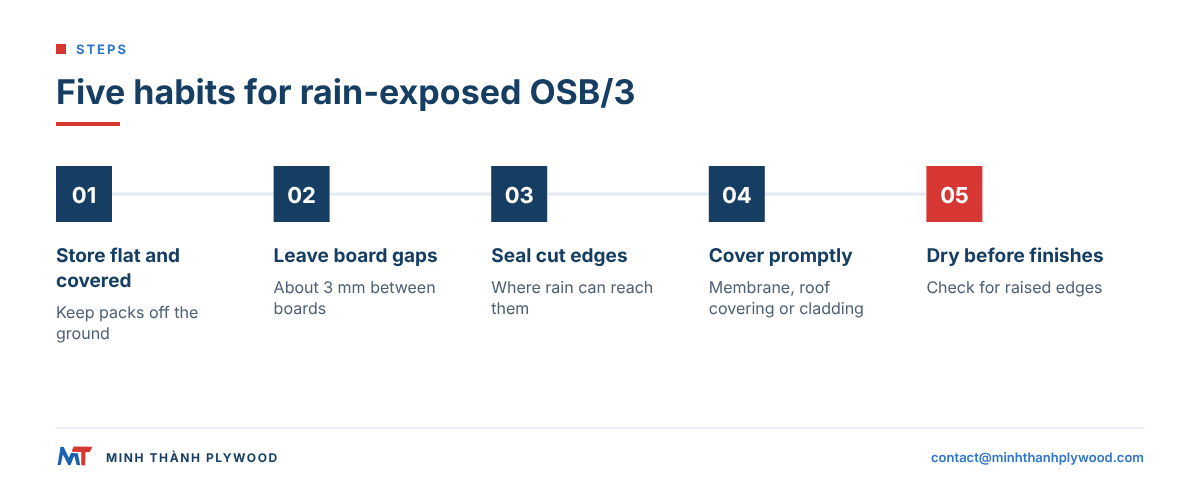
Five habits keep a wet OSB board usable:
- Store packs flat, off the ground and covered, on even bearers.
- Leave a gap of about 3 mm between boards so edge swelling has room.
- Seal cut edges on boards that will see rain before they are covered.
- Cover the deck or wall quickly with membrane, roof covering or cladding.
- Let wet boards dry before fixing floor finishes and check for raised edges.
A board that has swollen at the edges can be sanded flat, but its edge strength is reduced. If a deck will be exposed for weeks, plywood with a phenolic glue line takes the wetting better.
OSB3 vs OSB4: when the heavy-duty grade is worth it
OSB/4 is worth its higher price where a board carries heavy or concentrated loads in humid conditions, such as warehouse mezzanine floors, heavy-duty roof decks and floors under storage. For ordinary walls, roofs and house floors, OSB/3 does the job and is the grade merchants stock.
| Point | OSB/3 | OSB/4 |
|---|---|---|
| Use | Load-bearing, humid | Heavy-duty load-bearing, humid |
| Bending strength, major axis, 6–10 mm | 22 N/mm² | 30 N/mm² |
| Bending strength, minor axis, 6–10 mm | 11 N/mm² | 16 N/mm² |
| Swelling, 24 h | 15 % | 12 % |
| Availability | Stocked widely | Made to order more often |
OSB/4 swells less, but it is still not waterproof. A heavy-duty floor that will see water every day is a job for phenolic-bonded plywood.
OSB3 vs plywood: which to choose
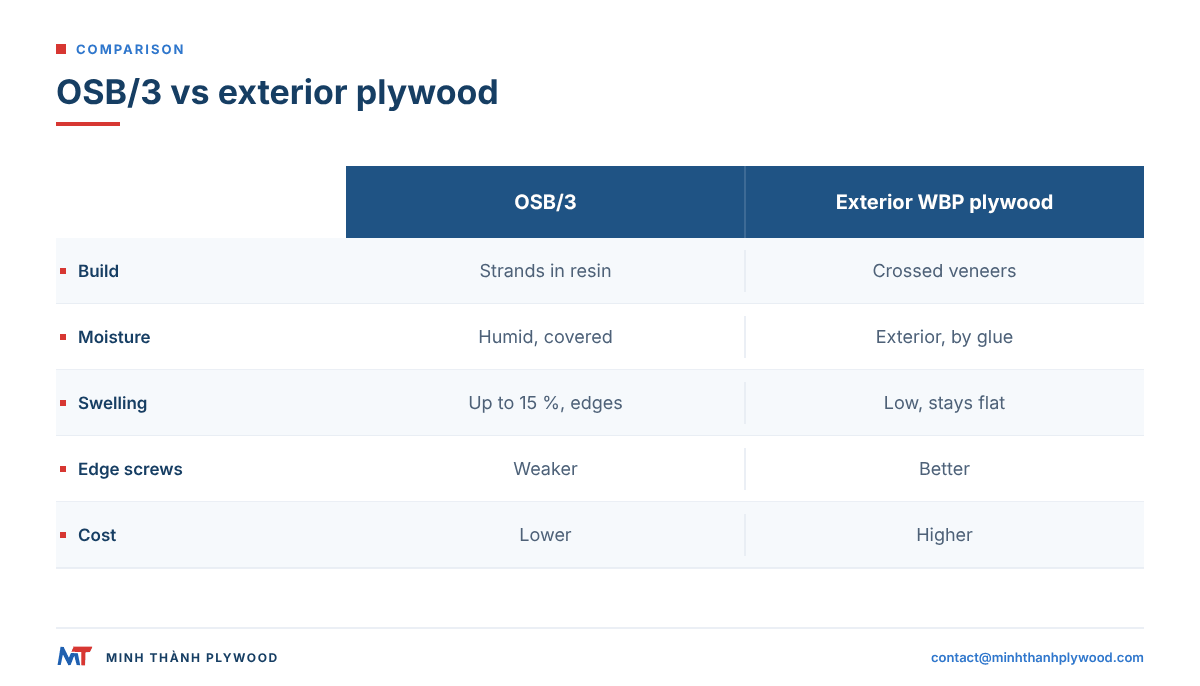
OSB3 and plywood both work as structural sheathing and decking, and the choice comes down to cost, moisture and fixings. OSB/3 is usually the cheaper board per square metre; plywood, built from crossed veneers, is stronger across the sheet, holds screws better near the edges and recovers better from wetting.
| Point | OSB/3 | Exterior WBP plywood |
|---|---|---|
| Build | Wood strands in resin, oriented layers | Peeled veneers, cross-laminated |
| Standard (Europe) | EN 300 | EN 636 (EN 636-3 for exterior) |
| Moisture rating | Humid conditions, covered | Exterior, by glue class |
| Swelling when wet | Up to 15 % in 24 h, mostly at edges | Low; veneers keep the panel flat |
| Strength across the sheet | About half the lengthways strength | Close to lengthways in balanced lay-ups |
| Edge screw holding | Weaker near edges | Better near edges |
| Surface | Strand pattern, uneven | Veneer face, sanded or film-faced options |
| Typical uses | Wall sheathing, roof deck, subfloor | Exterior sheathing, steps, formwork, vehicle floors |
Is OSB3 stronger than plywood? No: plywood is generally stronger and stiffer than OSB3 of the same thickness, and OSB3 is chosen mainly for its lower price while it still meets structural requirements for walls, roofs and floors.
Choose OSB/3 for covered walls, roofs and floors on a budget. Choose exterior plywood where the panel will see water at its edges, carry point loads near the edge, or be visible.
OSB3 vs plywood for flooring
For flooring, OSB/3 and plywood both carry the load when the thickness matches the joist spacing; plywood is the safer choice in kitchens, bathrooms and anywhere water may reach the edges. Floors are where edge swelling shows most, because the joints sit under the floor finish.
Typical thicknesses for floors on joists at 400–600 mm centres are 18–22 mm OSB/3 or 18 mm plywood with tongue-and-groove edges. Glue and screw the boards to the joists, leave expansion gaps at walls, and keep the long side across the joists.
OSB3 vs plywood for roofing
For roofing, OSB/3 is standard under tiles, slates and membranes, and plywood is preferred under thin flexible coverings and where the deck may stay wet for days. A roof deck sees rain during building and condensation in service, which is exactly the humid condition OSB/3 is graded for.
Shed roofs follow the same rule at a smaller scale: 11 mm OSB3 suits a shed roof that is supported at close centres, 18 mm gives a stiffer deck for heavier-duty roofs and floors, and the board is always the deck, never the weatherproof layer, so cover it with roofing felt, a membrane or EPDM.
Use 15–18 mm boards for most pitched roofs, fixed with the long side across the rafters and with clips or noggins at unsupported edges. Under a single-ply membrane or felt, the swelling lines of OSB at board joints can show through; plywood’s flatter joints suit those coverings better.
OSB3 board thicknesses and sizes
OSB3 board is made in thicknesses from about 6 to 25 mm, with 9, 11, 12, 15, 18 and 22 mm the common stock. Square-edged boards come in 1220 × 2440 mm and 1250 × 2500 mm; tongue-and-groove flooring boards are narrower, about 600 mm wide, so they span between joists and lock together.
| Use | Typical OSB/3 thickness |
|---|---|
| Wall sheathing (timber frame) | 9–12 mm |
| Roof deck | 15–18 mm |
| Floor deck on joists | 18–22 mm, tongue and groove |
| Site hoardings (covered or painted) | 9–11 mm |
The final thickness comes from the structural design: span, load and the fixings. The board’s grade, OSB/3, sets how it behaves in moisture; the thickness sets how it carries load.
OSB3 sizes and prices in the UK
UK merchants sell OSB3 in three stock thicknesses, in 8 × 4 ft sheets that are metric by a few millimetres, and the stock sheet size changes with the thickness.
| Thickness | UK sheet size | Pack on a pallet | Typical use |
|---|---|---|---|
| 9 mm | 2400 × 1200 mm | 100 sheets | Wall lining, boxing-in, light shed walls |
| 11 mm | 2440 × 1220 mm | 82 sheets | Supported shed roofs, roof decking |
| 18 mm | 2440 × 1220 mm | 50 sheets | Flooring, loft boarding, stiffer roof decks |
| 18 mm tongue and groove | 2400 × 600 mm | By the board | Floors across joists, continuous deck |
Handy boards cut from the same stock run from 600 × 600 mm to 1220 × 1220 mm for small jobs. Prices move with the week and the carrier: one UK timber merchant lists a 9 mm OSB3 sheet at £12.06 ex VAT in October 2026, and 11 mm and 18 mm sheets cost more because each carries more wood. Sterling Board is a branded OSB3 that UK merchants list beside own-brand sheets. Read the price per square metre, not per sheet, when you compare 9 mm 2400 × 1200 mm with 2440 × 1220 mm.
| Where the OSB3 comes from | Panel | Indicative price basis |
|---|---|---|
| UK merchant, retail | OSB3 9 mm, 2400 × 1200 mm | About £12 ex VAT per sheet (October 2026) |
| Minh Thanh, container | Exterior WBP plywood as the OSB3 alternative | Commercial plywood from US$250/m³, one 40HC |
The second row is a different board, sold to importers and merchants by the container rather than by the sheet, so it is a reference for a buyer who stocks sheet material, not a like-for-like shelf price.
OSB/3 marking, CE and UKCA
An OSB/3 board for construction in Europe is marked with its EN 300 grade and carries the CE marking under EN 13986, the harmonised standard for wood-based panels used in construction. That CE marking is required under the Construction Products Regulation (EU) No 305/2011. In Great Britain the UKCA marking does the same job.
The marking tells a buyer four things: the standard and grade (EN 300 OSB/3), the thickness, the formaldehyde class (usually E1) and the manufacturer’s declaration of performance. A board sold as “OSB3” without the grade on the stamp or the declaration is a board of unknown grade. For the United States, OSB is exempt from the TSCA Title VI emission limits (TSCA §601, 15 U.S.C. 2697) and falls outside the composite wood product definitions in 40 CFR 770.3.
Where OSB/3 does not belong
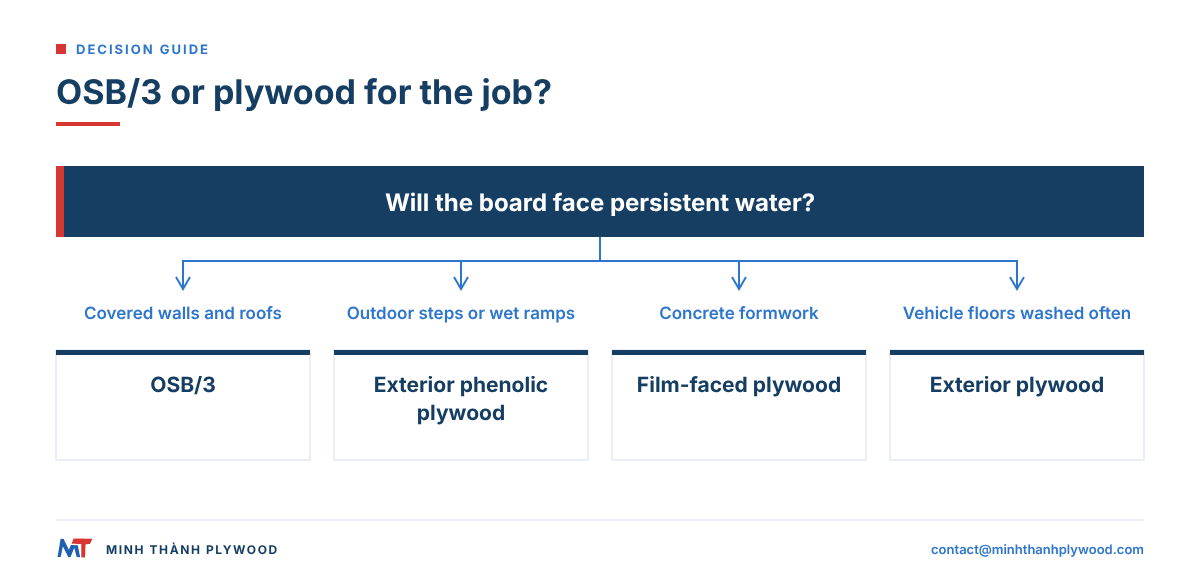
OSB/3 does not belong anywhere it will be wet for long or exposed to the weather without cover. These are the uses where buyers most often regret it:
- Exposed outdoor steps, decks and ramps: edges swell and the surface breaks up.
- Concrete formwork: wet concrete and stripping wear it quickly; film-faced plywood is made for this.
- Bathroom and kitchen subfloors without a waterproof layer.
- Vehicle and trailer floors that see washing and wet loads.
- Visible furniture surfaces where a veneer face is expected.
For these, an exterior plywood with phenolic glue, or a film-faced plywood with a phenolic glue line, is the panel to price.
Plywood alternatives to OSB3 from Minh Thanh
Minh Thanh Plywood does not make OSB; it makes plywood that replaces OSB/3 where water, edges or appearance matter. Two product lines cover most of those uses.
| Panel | Build | Glue | Suited to |
|---|---|---|---|
| Exterior / CDX-type plywood | Utility C/D faces, Eucalyptus or Styrax core | Melamine-fortified (MR/WBP) or phenolic (WBP) | Wall sheathing, stair treads, outdoor uses |
| Film-faced plywood | Phenolic film on both faces | Phenolic or melamine, by order | Concrete formwork, wet sites |
Panels come in 1220 × 2440 mm and 1250 × 2500 mm, 3–40 mm thick, with thickness tolerance of ±0.5 mm on commercial and film-faced panels and ±2 mm on length and width. Production takes 15–45 days after the 30 % deposit, with the minimum order of one 40HC and mixed specifications by agreement.
What to write on your order
Write the grade, the standard and the use on the order, so the board and its paperwork match the job. For OSB the line reads “OSB/3 to EN 300, 18 mm, 1220 × 2440 mm, tongue and groove, CE or UKCA marked, declaration of performance supplied”.
For a plywood alternative from Minh Thanh, the line reads:
18 mm × 1220 × 2440 mm exterior plywood; faces: C/D utility; core: Eucalyptus; glue: phenolic (WBP); thickness tolerance ±0.5 mm; use: wall sheathing and stair treads; 1×40HC CIF your port.
Minh Thanh sends free samples and replies within hours. Send the specification to contact@minhthanhplywood.com or WhatsApp +84 988 586 601. For the plywood side of the moisture question, read is plywood waterproof?, and for structural ratings, plywood span ratings.
Buyer questions, answered
What is OSB 3?
OSB 3 is oriented strand board of grade OSB/3 under EN 300: a load-bearing board for use in humid conditions, with thickness swelling of no more than 15 % after 24 hours in water.
Is OSB 3 waterproof?
No. OSB/3 is moisture-resistant: its resin holds the strands together in humid conditions, but standing water, rain on the edges or permanent outdoor exposure make it swell. Protect it with cladding, a roof covering or a coating.
How does OSB 3 compare to OSB 2?
OSB/2 and OSB/3 have the same bending strength requirements, but OSB/2 is for dry conditions only and may swell up to 20 %, while OSB/3 is for humid conditions, swells no more than 15 % and must pass a moisture-resistance test.
Can OSB board get wet?
OSB/3 can take rain during construction for a short time if it dries out and the edges are protected, but it should not stay wet. Once the board swells at the edges the swelling does not fully recover.
Is OSB board waterproof?
No OSB grade is waterproof. OSB/3 and OSB/4 are rated for humid conditions, service classes 1 and 2 of Eurocode 5, not for direct and permanent wetting.
What is the difference between OSB3 and OSB4?
OSB/4 is the heavy-duty grade: higher bending strength (30 N/mm² against 22 N/mm² for 6–10 mm boards) and lower swelling (12 % against 15 %). Both are for humid conditions.
Can OSB3 be used outside?
Only when it is covered. OSB/3 works as wall sheathing behind cladding and as roof deck under a roof covering; it is not made for exposed exterior use such as hoardings left uncoated or outdoor steps.
Is OSB3 or plywood better for flooring and roofing?
Both work as structural decking when the grade and thickness match the span. Plywood holds screws better at the edges, recovers better from wetting and is stronger across the sheet; OSB/3 is usually cheaper per square metre.
What does OSB/3 on the board stamp mean?
It means the board is declared to EN 300 grade OSB/3, load-bearing for humid conditions. In Europe the stamp sits with the CE or UKCA marking under EN 13986, the standard for wood-based panels in construction.
What thickness of OSB3 do I need?
Common OSB/3 thicknesses are 9, 11, 12, 15, 18 and 22 mm. Walls usually take 9–12 mm, roofs 15–18 mm and floors 18–22 mm, set by joist spacing and load in the design.
Does Minh Thanh make OSB?
No. Minh Thanh makes plywood, including exterior/CDX-type plywood with melamine-fortified or phenolic (WBP) glue and film-faced plywood, for buyers who need a veneer panel in place of OSB/3.