
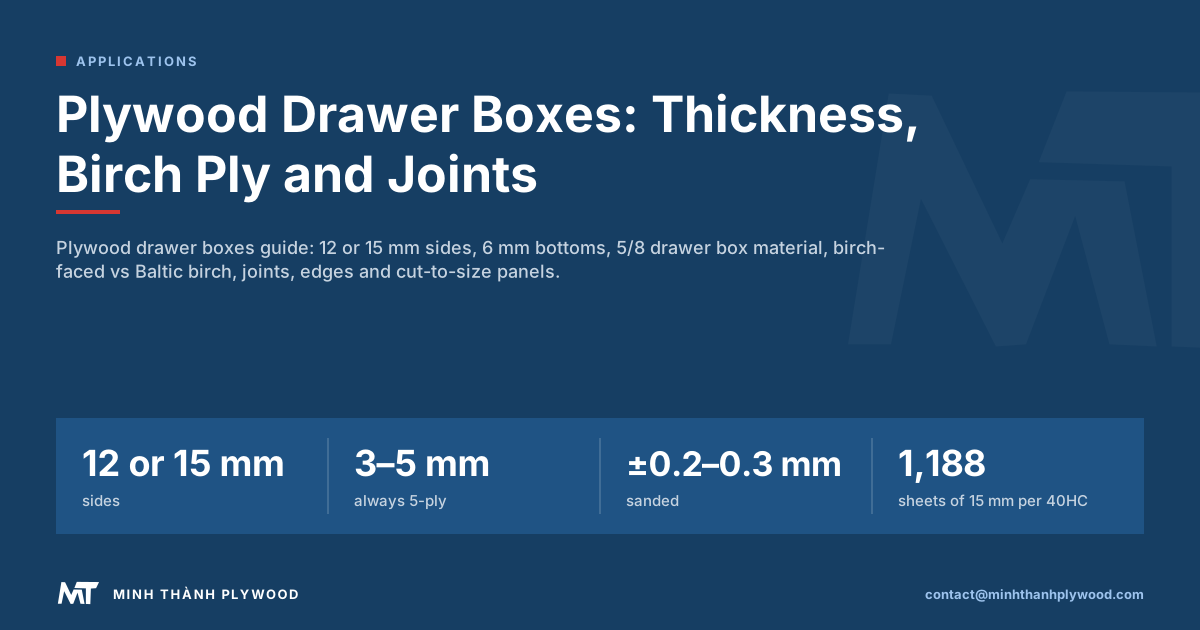
Most plywood drawer boxes are built from 12 mm or 15 mm plywood for the sides, front and back, with a 6 mm plywood bottom set in a groove. Plywood holds screws, dowels and dovetails close to the edge, stays flat and shows a clean layered edge, which is why kitchen and furniture makers choose it over particleboard. Minh Thanh Plywood makes sanded birch, poplar and eucalyptus-faced panels in Phu Tho, Vietnam, and cuts them to size for furniture plants.
Plywood drawer boxes: what they are made of
For US indoor-panel compliance, 40 CFR 770.10 sets a 0.05 ppm formaldehyde limit for hardwood plywood with veneer or composite cores. For British timber procurement, Great Britain applies its UK Timber Regulations to timber products including furniture.
Plywood drawer boxes are four-sided drawer bodies made from plywood sides, front and back, with a thin plywood bottom captured in a groove. A separate decorative drawer front is screwed on the outside, so the box itself is a working part.
A drawer box has five parts:
| Part | Typical plywood | Job |
|---|---|---|
| Sides (2) | 12 or 15 mm, sanded both faces | Carry the runners and the load |
| Front and back | Same as the sides | Close the box and take the front fixing |
| Bottom | 6 mm, or 9–12 mm for heavy drawers | Carries the contents |
| Decorative front | Matches the cabinet | Seen when the drawer is closed |
Kitchen, bedroom, office and hotel furniture makers all build drawer boxes this way. The plywood decides how the drawer feels: straight runs, tight joints and clean top edges.
What size plywood for drawer boxes?
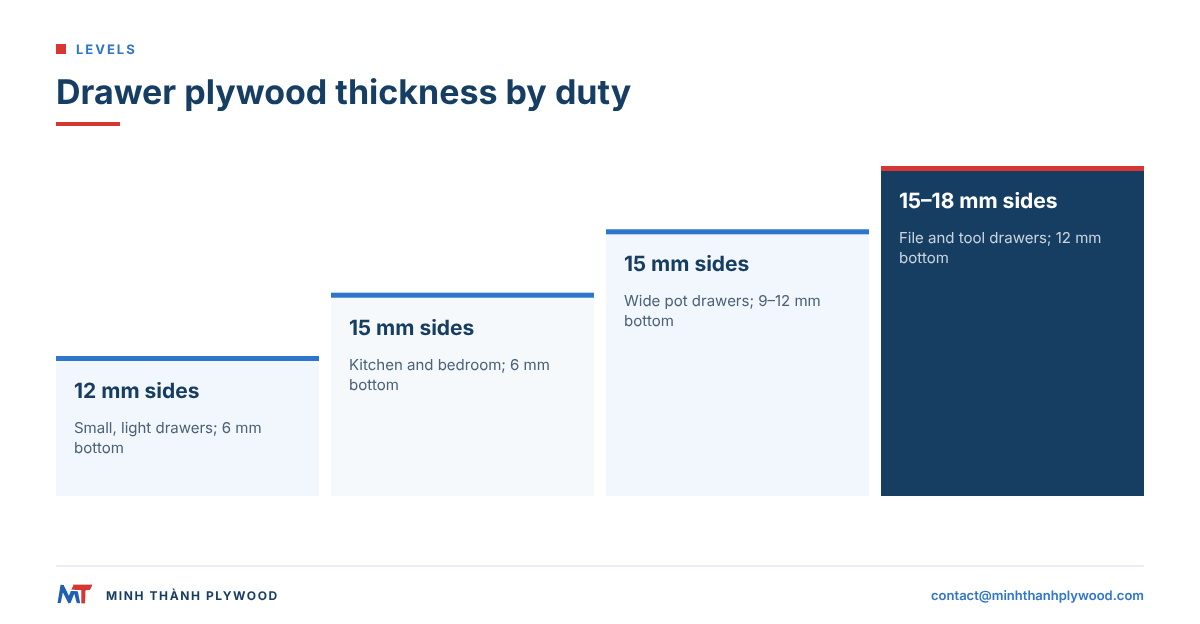
Use 12 mm plywood for small and light drawers, 15 mm for kitchen drawers and most furniture, and 18 mm only for heavy-duty or very large drawers. Bottoms are 6 mm for most drawers.
| Drawer type | Sides, front, back | Bottom | Note |
|---|---|---|---|
| Small drawers, jewellery, desks | 12 mm (1/2 in) | 6 mm (1/4 in) | Light, more inside width |
| Kitchen and bedroom drawers | 15 mm (5/8 in) | 6 mm (1/4 in) | The furniture standard |
| Wide pot and pan drawers | 15 mm (5/8 in) | 9–12 mm | Stiffer bottom under weight |
| File and tool drawers | 15–18 mm | 12 mm | Heavy, frequent use |
Sides and bottoms are usually cut from different panels: a sanded hardwood-faced panel for the sides, and a thin 5-ply panel for the bottom. The plywood thickness guide lists the inch and metric equivalents.
5/8 drawer box material vs 1/2 in: which to choose?
5/8 drawer box material, about 15 mm, is the better choice for kitchen drawers, dovetail joints and wide drawers. 1/2 in, about 12 mm, suits smaller drawers where weight and inside width matter more.
| Measure | 1/2 in, 12 mm | 5/8 in, 15 mm |
|---|---|---|
| Stiffness of sides | Good for short spans | Better for wide drawers |
| Joint strength | Good with rabbets and dowels | Better for dovetails and screws |
| Weight per box | Lower | Higher |
| Inside width lost | Less | About 6 mm more over two sides |
| Runner fixing | Short screws | More screw length available |
| Typical use | Bathroom, desk, small cabinet | Kitchen, wardrobe, file |
Most undermount runners accept sides up to about 16 mm, so 15 mm works with both side-mount and undermount slides. Check the runner maker’s chart before fixing the thickness.
Birch ply drawers: birch-faced plywood vs Baltic birch
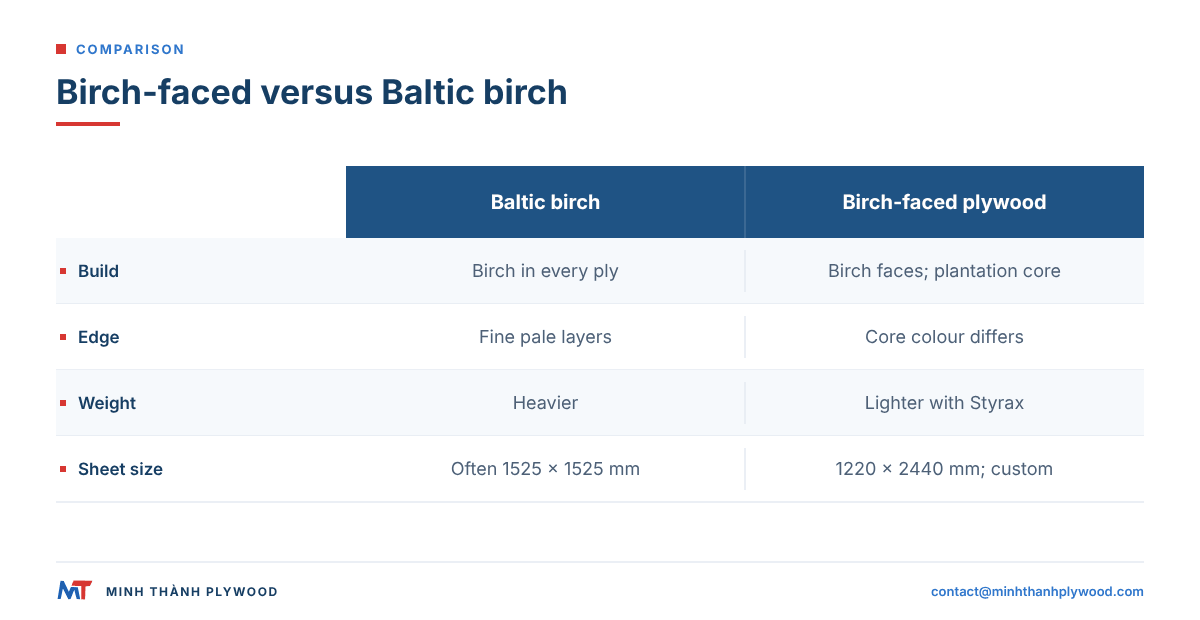
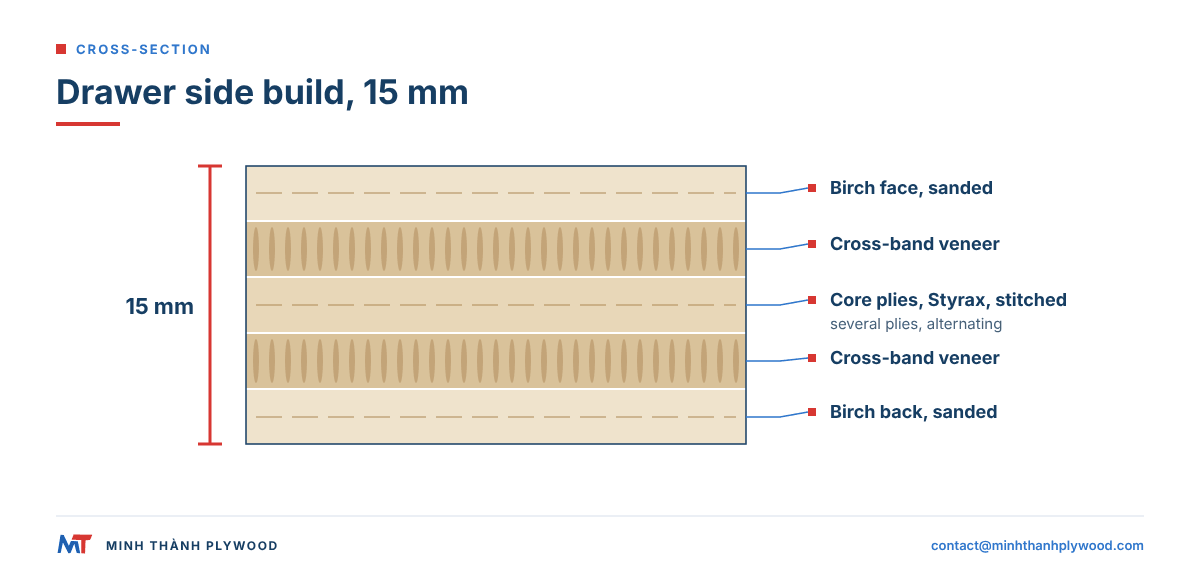
Birch ply drawers are made either from Baltic birch, with birch in every ply, or from birch-faced plywood, with birch face and back veneers over a lighter plantation core. Both make strong drawers; the difference is the edge and the weight.
| Measure | Baltic birch | Birch-faced plywood |
|---|---|---|
| Plies | Birch in every ply | Birch face and back, Styrax or Eucalyptus core |
| Edge look | Fine, pale, even layers | Even layers; core colour differs from the face |
| Weight | Heavier | Lighter on a Styrax core |
| Face | Birch | Birch, graded D+/D, D/D or D/E |
| Sizes | Often 1525 × 1525 mm | 1220 × 2440 mm, 1250 × 2500 mm, custom |
| Cost | Higher | Lower for the same face |
In Vietnamese grading, birch faces are D+, D and E: D+ is close to European B, D close to BB and E close to CP/C, so D+/D is close to B/BB. Our birch-faced panels use white Styrax or Eucalyptus cores, stitched both across and along the panel, so the drawer edge shows even layers without gaps. The Baltic birch plywood guide covers the all-birch panel.
Why plywood beats MDF and particleboard for drawers
Plywood beats MDF and particleboard for drawers because its cross-laminated veneers hold fasteners near edges, resist sagging and tolerate damp. Drawer boxes are opened thousands of times, and the joints take the strain.
| Measure | Plywood | MDF | Particleboard |
|---|---|---|---|
| Screw holding near edges | Good | Poor in edges | Poor, crumbles |
| Dovetail and dowel joints | Clean, strong | Possible, weaker | Not practical |
| Sagging of a loaded bottom | Low | Higher | Highest |
| Damp from sinks and dishwashers | Tolerates, with an MR bond | Swells at edges | Swells and crumbles |
| Visible edge | Layered, attractive | Needs banding | Needs banding |
| Weight, 15 mm sheet | About 22.3 kg on Styrax core | Heavier | Similar |
A kitchen drawer is opened several times a day for years, so the joint and the bottom carry far more cycles than any other cabinet part.
The drawer panel: what makes good drawer plywood
A good drawer panel has sanded, defect-free faces on both sides, a solid core with no voids at the edge, even thickness and a flat sheet. Both faces of a drawer side are seen, inside and out.
- Both faces graded. Specify a two-face grade such as A/A or D+/D: the inside face is visible every time the drawer opens.
- Solid core at the edge. The top edge of the side shows every ply; a void there is a visible hole.
- Even thickness. Sanded panels held to ±0.2–0.3 mm keep grooves and joints the same on every part.
- Flat sheets. Our furniture panels are pressed twice, so the core is calibrated before the faces go on and the sheet stays flat.
- Dry. 8–12% moisture at dispatch, so parts do not move after machining.
Poplar faces are a cost-effective alternative for drawers that will be painted or lacquered white, and eucalyptus faces give a denser, harder surface.
Which joints work for plywood drawer boxes?
Rabbet, lock-rabbet, dowel and dovetail joints all work in plywood drawer boxes; the choice depends on the machines in the plant and the look wanted. Plywood holds each of them better than particleboard.
| Joint | Strength | Machine | Look |
|---|---|---|---|
| Butt joint with screws | Fair | Drill only | Screw heads on the side |
| Rabbet, glued and pinned | Good | Table saw or router | Clean front |
| Lock rabbet | Very good | Router table or shaper | Hidden interlock |
| Dowel joint | Very good | Dowel boring machine | Hidden |
| Dovetail | Excellent | Dovetail jig or CNC | Premium, visible |
| Box joint (finger joint) | Excellent | Jig or CNC | Visible, modern |
Furniture plants on CNC lines often use dowels or lock rabbets; premium brands show dovetails at the front corners. Any of these needs an even panel thickness, or joints close unevenly from part to part.
How to make plywood drawer boxes: step by step
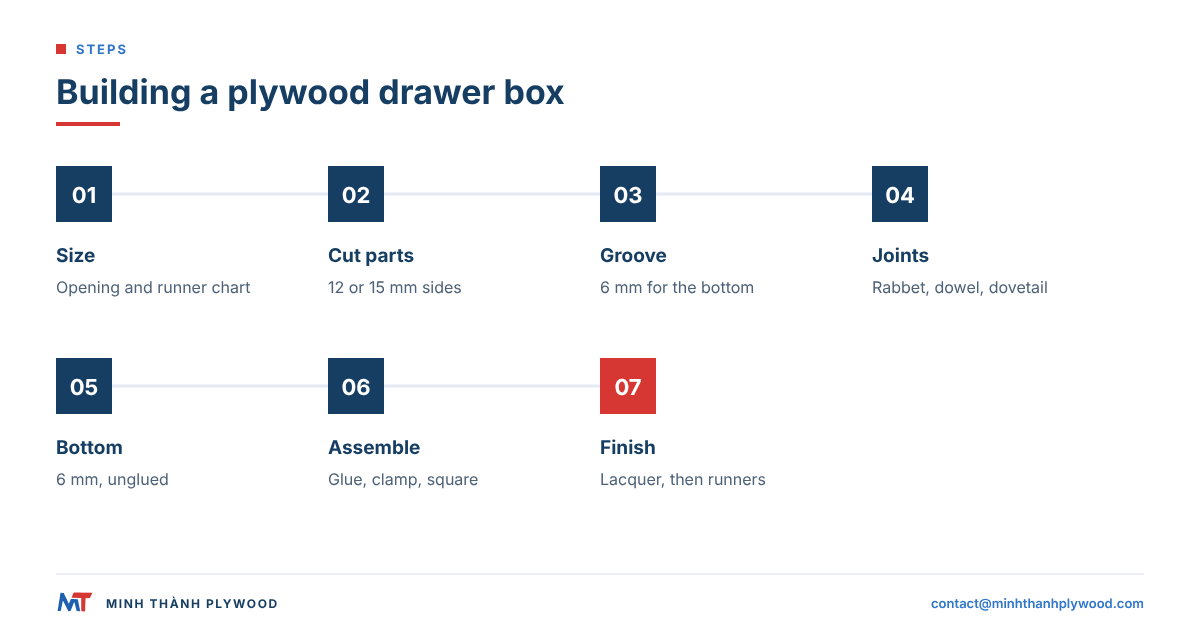
Make plywood drawer boxes by cutting parts to size, grooving for the bottom, cutting the corner joints, then gluing and squaring the box around the bottom. These steps suit a workshop or a production line, and the same order works for any box size:
- Size the box from the cabinet opening and the runner maker’s clearances.
- Cut the parts: two sides, a front and a back from 12 or 15 mm plywood, grain running along the length.
- Groove the bottom: a 6 mm groove, 6 mm deep, about 12 mm above the bottom edge, on all four parts.
- Cut the joints: rabbets, dowels, lock rabbets or dovetails at the corners.
- Sand the edges and break the top edges with a small round-over.
- Cut the bottom from 6 mm plywood, slightly smaller than the groove-to-groove size.
- Assemble: glue the corners, slide the bottom into its groove without glue, clamp, and check the diagonals are equal.
- Finish: lacquer or oil the box before fitting runners.
- Fit runners and the front, then adjust.
Leaving the bottom unglued lets it move slightly with humidity without cracking the box.
Drawer bottoms: thickness and fixing
A drawer bottom is 6 mm plywood set in a groove for most drawers, and 9 or 12 mm for heavy ones. Plywood bottoms stay flat because each ply crosses the one below.
| Bottom | Use | Fixing |
|---|---|---|
| 6 mm captured in a groove | Most kitchen and furniture drawers | Slides in the groove, unglued |
| 6 mm screwed under the box | Fast assembly lines | Screws through the bottom into the sides |
| 9 mm | Wide pot drawers | Groove or screwed, with a centre support |
| 12 mm | File and tool drawers | Screwed under the box, or a deeper groove |
Our thin plywood from 3 to 5 mm is always 5-ply, which gives a flatter, stiffer bottom than three-ply panels of the same thickness; at 6 mm the ply count is confirmed with the order. Both faces are sanded. See the thin plywood page for faces and sizes.
Exposed edges, edge banding and finish
Exposed plywood edges are a feature of modern drawer boxes: sanded, rounded and lacquered, the even layers show the quality of the panel. Edge banding is used when the drawer must match a coloured cabinet.
- Exposed edge: sand to 180 grit, round the top edge, seal with the same lacquer as the faces.
- Edge banding: a thin wood or PVC strip on the top edge, applied before assembly; see the plywood edge banding guide.
- Finish: a clear water-based lacquer or a UV-cured lacquer line in the furniture plant.
Our panels leave the factory sanded and polished, with both faces UV-ready: prepared to the standard a buyer needs to apply its own UV coating. Plants that run their own lacquer lines get an even surface on both sides of every part.
Sizing drawer boxes to the runners
Size the drawer box from the runner, not only from the opening: each slide type sets its own side clearance and side thickness. Get the runner chart before cutting parts.
| Runner type | Side clearance | Side thickness | Bottom |
|---|---|---|---|
| Side-mount ball-bearing slides | About 12.7 mm (1/2 in) each side | Any | Groove or screwed |
| Undermount soft-close slides | Set by the runner maker | Usually up to about 16 mm | Recessed above the runner |
| Wooden runners | Small, set by hand | 12–18 mm | Groove |
For undermount slides, the bottom is set higher in the box so the runner sits underneath; the runner maker gives the exact recess. ### Ready-made drawer box sizes for UK cabinets
UK kitchens are built from 18 mm carcass sides, so ready-made boxes are sized by the external cabinet width. The Baltic birch dovetail boxes sold by Trade Hinges (checked on 21 October 2026) are flat-packed, 12 mm thick in 9 plies of birch, with dovetails at all 4 corners:
| Cabinet width | Box size (W × L × H) |
|---|---|
| 500 mm | 446 × 452 × 150 mm |
| 600 mm | 546 × 452 × 150 mm |
| 700 mm | 646 × 452 × 150 mm |
| 800 mm | 746 × 452 × 150 mm |
| 900 mm | 846 × 452 × 150 mm |
Each box is 54 mm narrower than the cabinet: two 18 mm sides plus 9 mm of runner clearance on each side. Specialist makers such as Probox (checked on 21 October 2026) cut birch plywood boxes in 13 or 15 mm sides, lacquered or raw, with drilling for the popular runner types, and say they have 38 years of manufacturing experience.
On the runner side, Blum’s Movento undermount runners are documented for drawer sides of 13 to 16 mm (16 mm for the standard 40 kg class), with inside box width equal to the opening width minus 42 mm; check the current Blum sheet for the part number and for 40 kg or heavier load classes (Blum Movento, read 21 October 2026).
Price is the last check. The Trade Hinges pack is £40.11 ex VAT (£48.13 inc VAT) for one box with a pair of Blum Tandem Blumotion runners and clips, in any of the five widths. That is a ready-to-assemble kit with the runners included, so a cabinet maker who buys plywood by the container prices only the raw part: our furniture and interior plywood starts from US$350/m³ FOB (October 2026), and the saving comes from cutting boxes in house from panels cut to the sizes in the table.
The half sheets and small panels guide helps plan part sizes from standard sheets.
Cut-to-size drawer panels from a plywood mill
Furniture plants in Europe, including Italy, order drawer plywood cut to size from the mill, so the plant only grooves, joins and finishes. Ordering cut-to-size panels saves sawing time and offcut handling.
At Minh Thanh Plywood, a panel is cut into 4, 6 or 8 pieces on order, and cut-to-size panels ship regularly to Italy and other European markets. Pieces keep the face grade, sanding and moisture of the full sheet.
| Cut plan | Pieces per 1220 × 2440 mm sheet | Typical drawer use |
|---|---|---|
| 4 pieces | Four long panels | Sides for deep drawers, cut down in the plant |
| 6 pieces | Six mid-size panels | Kitchen drawer sides and backs |
| 8 pieces | Eight small panels | Bottoms and small drawer parts |
Send your drawer schedule and the runner type; we propose the cut plan that gives the best yield from 1220 × 2440 mm or 1250 × 2500 mm sheets. The custom plywood guide covers sizes, faces and branding.
Packing and container loads for drawer plywood
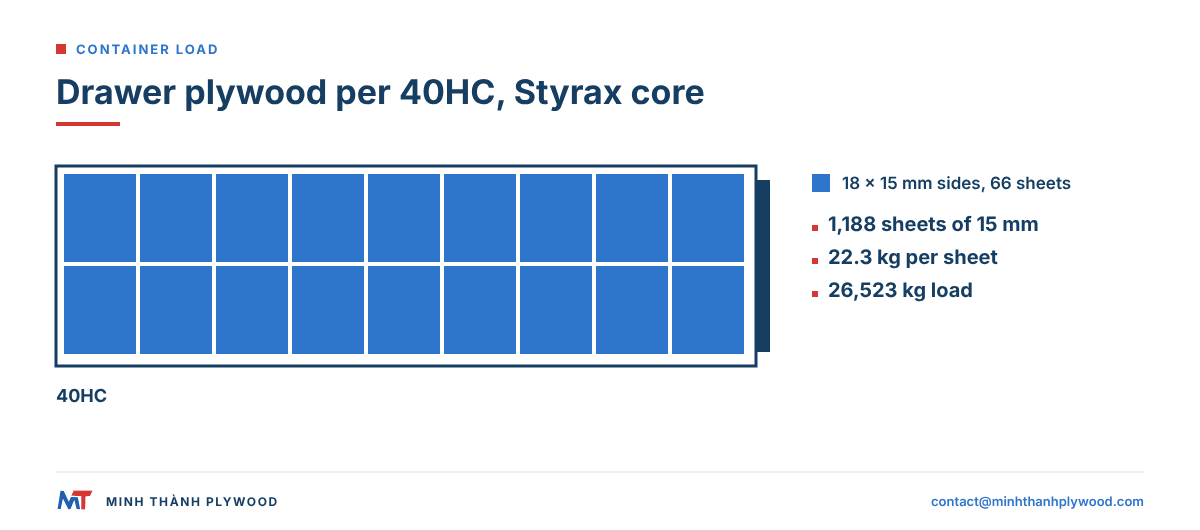
Drawer plywood ships in packs of one thickness, wrapped and strapped on export pallets; one 40HC holds 1,494 sheets of 12 mm or 1,188 sheets of 15 mm on Styrax core. Bottoms in 6 mm can share the container as a mixed load.
| Thickness | Sheets per pack | Sheets per 40HC | Weight per sheet | Load per 40HC |
|---|---|---|---|---|
| 6 mm | 166 | 2,988 sheets | 8.9 kg | 26,684 kg |
| 12 mm | 83 | 1,494 sheets | 17.9 kg | 26,684 kg |
| 15 mm | 66 | 1,188 sheets | 22.3 kg | 26,523 kg |
Figures are for 1220 × 2440 mm sheets on Styrax core, 18 packs per 40HC, within the 28,000 kg planning payload. Mixed specifications in one container are made by agreement; a common drawer order pairs 15 mm sides with 6 mm bottoms.
What to write on a drawer plywood order
A drawer plywood order is complete when it states the part, the thickness and tolerance, both face grades, the core, the bond, the cut size and the packing. Use these lines:
| Spec line | Example for sides | Example for bottoms |
|---|---|---|
| Application | Drawer box sides, fronts, backs | Drawer bottoms in a groove |
| Thickness and tolerance | 15 mm, ±0.2–0.3 mm | 6 mm, ply count as agreed, ±0.2–0.3 mm |
| Face/back | Birch D+/D, sanded | Poplar B/B, sanded |
| Core | White Styrax, stitched, no voids at edges | White Styrax |
| Bond and emission | UF glue at E0 emission | UF glue at E0 emission |
| Size | Cut 6 pieces per 1220 × 2440 mm sheet | Full sheets or cut 8 pieces |
| Packing | Export pallets, corner guards | Same container, mixed load |
For the US, our panels are certified under CARB P2 / TSCA Title VI as ICTT mill no. 23024, under the EPA formaldehyde standards for composite wood products. Production takes 15–45 days after the 30% deposit, and free samples let your plant run a test drawer before ordering. Send your drawer schedule through the cut-to-size plywood page or see birch plywood for face grades; we reply within hours.
Buyer questions, answered
What size plywood for drawer boxes?
Use 12 mm (1/2 in) plywood for light drawers and 15 mm (5/8 in) for kitchen and file drawers, with a 6 mm (1/4 in) bottom. Very wide or heavy drawers take a 9 mm or 12 mm bottom.
Is 1/2 inch or 5/8 inch plywood better for drawers?
5/8 in plywood is better for kitchen drawers, wide drawers and dovetail joints, because it is stiffer and holds fasteners further from the edge. 1/2 in plywood is lighter and gives more inside width for small drawers.
What is the best plywood for drawer boxes?
A sanded hardwood-faced plywood with a solid, void-free core: Baltic birch, or birch-faced plywood on a stitched plantation core. The core matters because the top edge of every drawer side is visible.
Is birch-faced plywood the same as Baltic birch?
No. Baltic birch has birch in every ply; birch-faced plywood has birch face and back veneers over a core of another species, such as Styrax or Eucalyptus. Both make good drawers when the core is solid.
How do you make plywood drawer boxes?
Cut the sides, front and back from 12 or 15 mm plywood, cut a groove for the bottom, join the corners with rabbets, dowels or dovetails, slide the 6 mm bottom in, glue and square the box, then finish the edges and surfaces.
How thick should a drawer bottom be?
A 6 mm (1/4 in) plywood bottom suits most drawers up to about 600 mm wide. Use 9 mm or 12 mm for file drawers, pot drawers and anything carrying heavy loads.
Should drawer box edges be edge banded?
Many makers leave plywood drawer edges exposed, sanded and lacquered, because the even layers are part of the look. Edge banding is used when the drawer must match a cabinet finish.
Can plywood drawer boxes be ordered cut to size?
Yes. Furniture plants order panels cut to their drawer sizes from the mill, so the plant only grooves, joins and finishes. Minh Thanh Plywood cuts one panel into 4, 6 or 8 pieces on order.
Are plywood drawers better than particleboard drawers?
Yes for strength and life. Plywood holds screws and joints near the edge, resists sagging and survives moisture far better than particleboard, which crumbles at the joints when drawers are overloaded or wet.
What glue and emission class should drawer plywood have?
Drawer boxes sit inside closed cabinets, so low emission matters. Specify UF glue at E0 emission, plus the US formaldehyde compliance label for American orders.
What size are plywood drawer boxes for a 600 mm cabinet?
A standard ready-made box for a 600 mm cabinet with 18 mm sides is 546 mm wide, 452 mm long and 150 mm high, in 12 mm Baltic birch. Each box is 54 mm narrower than the cabinet width.