
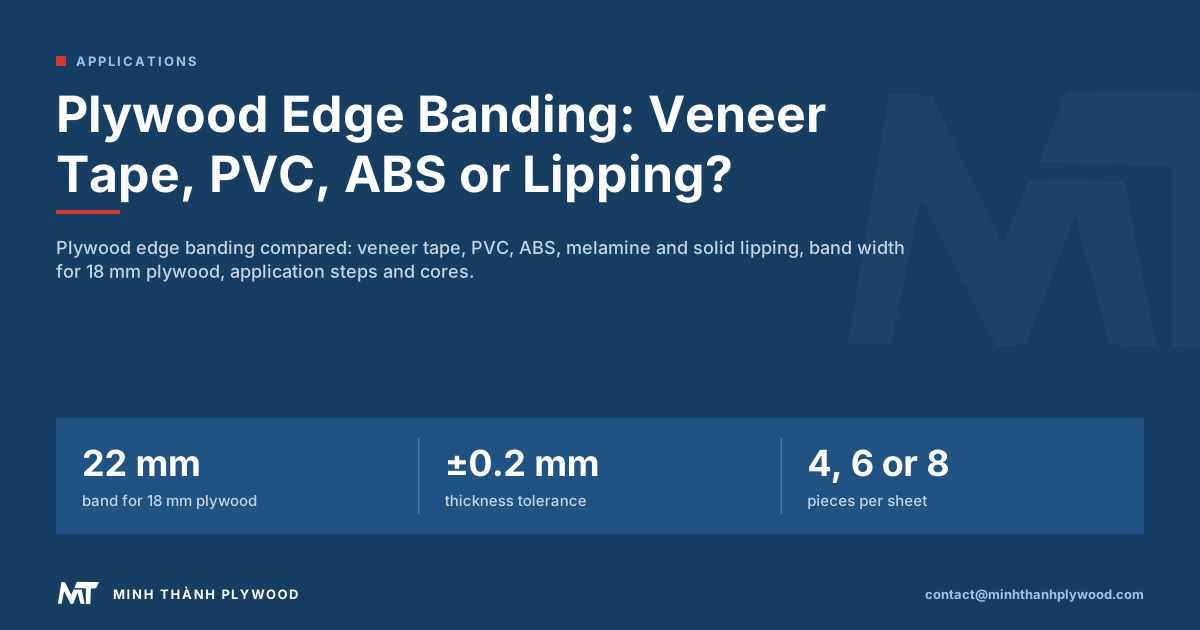
Plywood edge banding is a thin strip of wood veneer, PVC, ABS or melamine glued to the cut edge of a panel to hide the plies, protect the edge and match the face. For 18 mm plywood the usual band is 22 mm wide, trimmed flush after gluing. Veneer tape suits stained or lacquered wood, PVC and ABS suit busy furniture, and solid lipping suits edges that take knocks. Minh Thanh Plywood explains the choice from the panel side.
What is plywood edge banding?
Plywood edge banding is a thin strip of material glued to the cut edge of a plywood panel. It covers the layered edge, protects it from chips and moisture, and makes the edge look like the face. The strip can be real wood veneer, PVC, ABS, melamine-impregnated paper, polyester, or a thicker solid-wood or aluminium lipping.
Banding is applied by hand with an iron or a hot-air tool, or in a factory on an edgebander that glues, presses and trims the strip in one pass. Almost every visible edge of a kitchen cabinet, wardrobe, desk or shelf made from plywood carries edge banding or lipping.
What is the purpose of edge banding plywood?
Edge banding does three jobs: it protects, it finishes and it seals.
- Protection. A bare plywood edge chips at the face veneer and splinters when knocked. A band, and even more a solid lipping, takes the impact.
- Finish. The band hides the plies so the furniture reads as one material; a matching colour or veneer makes the panel look solid.
- Moisture. The cut edge is where plywood takes up water fastest. Banding glued with hot-melt adhesive slows that, which helps in kitchens and bathrooms. The US Forest Products Laboratory’s Wood Handbook covers how wood takes up and loses moisture.
Banding also shapes the design. A thin 0.5 mm veneer tape looks like the face; a 2 mm ABS band with a rounded corner gives the soft, durable edge of office furniture; a 10 mm solid lipping gives a table top visible thickness.
Which types of edge banding work on plywood?
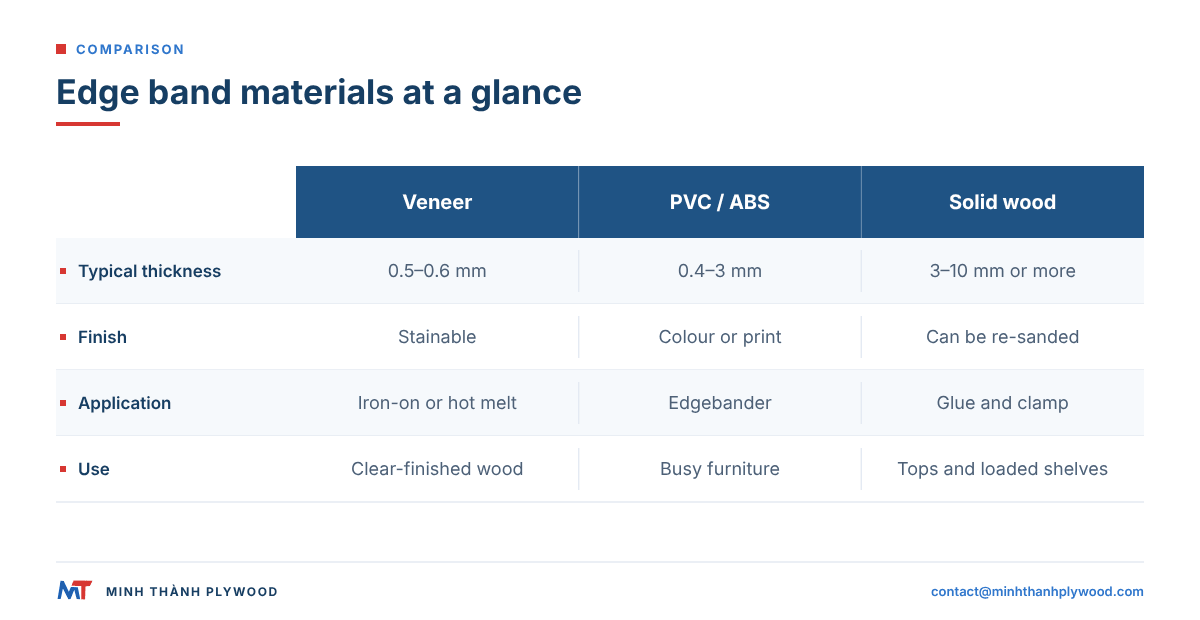
Six materials cover almost all plywood edge banding. Their trade-offs:
| Type | Usual thickness | Look | Durability | How it is applied | Best for |
|---|---|---|---|---|---|
| Wood veneer tape | 0.5-0.6 mm | Real wood, stainable | Low to medium; dents | Iron-on pre-glued, or hot melt | Stained or lacquered furniture, shelves |
| PVC | 0.4-3 mm | Solid colours, wood prints | High; flexible | Hot melt on edgebander; iron-on for thin rolls | Kitchens, office and kids’ furniture |
| ABS | 0.4-3 mm | Like PVC, slightly softer sheen | High; chlorine-free | Hot melt on edgebander | Furniture for markets that prefer chlorine-free plastics |
| Melamine paper | 0.3-0.5 mm | Matches melamine faces | Low; brittle on impact | Iron-on or hot melt | Budget cabinets, hidden shelves |
| Solid wood lipping | 3-10 mm or more | Thick, real wood edge | Very high; can be re-sanded | Glued and clamped, or tongue and groove | Table tops, desks, shelves under load |
| Aluminium profile | 1-2 mm, T or U profile | Metal line, modern | Very high | Pressed into a groove or glued | Displays, shopfitting, retail fixtures |
For a wood face that will be stained or lacquered, match the veneer species: birch tape on birch plywood, oak on oak-faced EV. For a colour, order PVC or ABS matched to the face or the laminate.
What size edge banding do you need for 18 mm plywood?
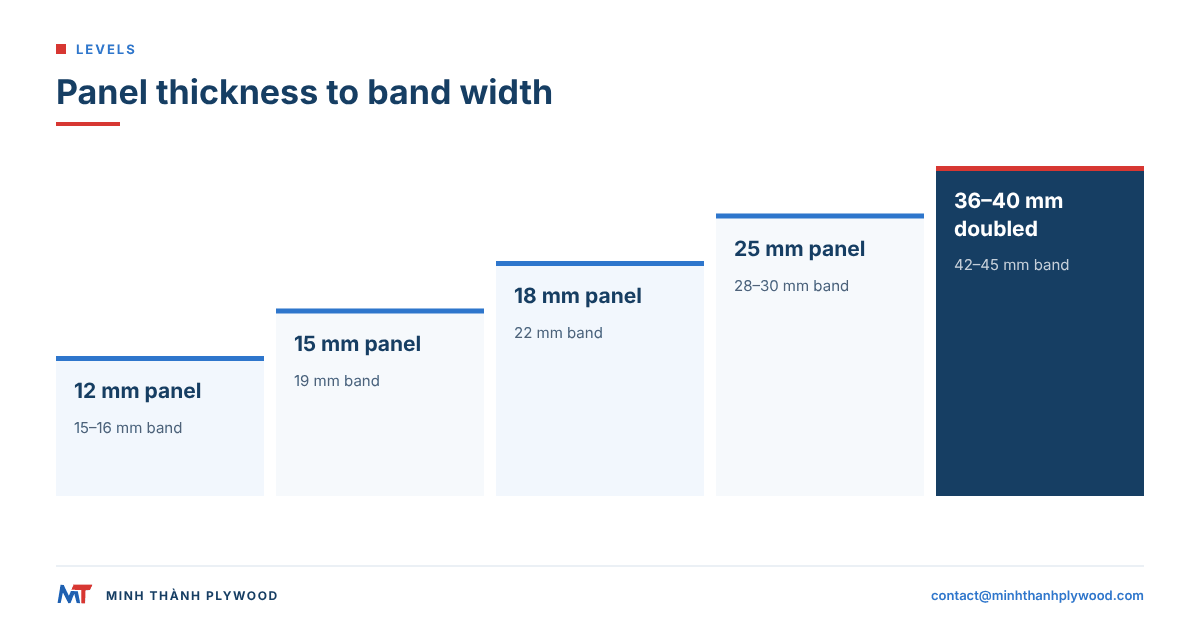
Use 22 mm wide edge banding on 18 mm plywood. The band is chosen wider than the panel, so about 2 mm overhangs each face and is trimmed flush after gluing.
| Panel thickness | Edge band width | Overhang each side |
|---|---|---|
| 12 mm | 15-16 mm | 1.5-2 mm |
| 15 mm | 19 mm | 2 mm |
| 18 mm | 22 mm | 2 mm |
| 3/4 in (19 mm nominal) | 13/16 in (21 mm) or 7/8 in (22 mm) | 1-1.5 mm |
| 25 mm | 28-30 mm | 1.5-2.5 mm |
| 36-40 mm (doubled) | 42-45 mm | 2-3 mm |
The real thickness of the panel decides whether a band fits. Sanded furniture panels from Minh Thanh are held to ±0.2-0.3 mm, down to ±0.2 mm, so an 18 mm sheet measures between 17.8 and 18.2 mm and a 22 mm band always covers it with even overhang. A commercial panel at ±0.5 mm leaves less margin; a packing panel at ±0.5-1.0 mm can leave a band short on one face.
Edge band thickness is a separate choice: 0.4-0.5 mm for a near-invisible edge, 1 mm for everyday furniture, 2 mm for edges that take knocks.
US roll sizes and prices for iron-on veneer edge banding
US suppliers sell pre-glued wood veneer edge banding on rolls in inches. The common widths are 7/8 in, 1 in, 1-1/2 in and 2 in, in rolls of 50, 250 or 500 ft.
| Roll width | Fits | Roll lengths |
|---|---|---|
| 7/8 in | 3/4 in plywood (the standard US panel) | 50, 250, 500 ft |
| 1 in | 3/4 in plywood with a wide trim allowance, or 7/8 in stock | 250, 500 ft |
| 1-1/2 in | 1-1/4 in stock or built-up edges | 250, 500 ft |
| 2 in | 1-1/2 in doubled top | 250, 500 ft |
Prices start at about US$12.95 a roll for common species such as birch, maple, red oak and walnut, rising to US$26.95–54.95 for bamboo, exotic and prefinished veneers (a US retailer’s listing, October 2026). PVC and ABS band is bought in the same inch widths but is applied with hot-melt glue on an edgebander, which is why furniture plants buy it in long rolls from the panel supplier.
A 3/4 in panel is 19 mm, so the 7/8 in (22 mm) band leaves about 1.5 mm of overhang each side to trim.
Iron-on, PVC or solid wood edging: which should you choose?
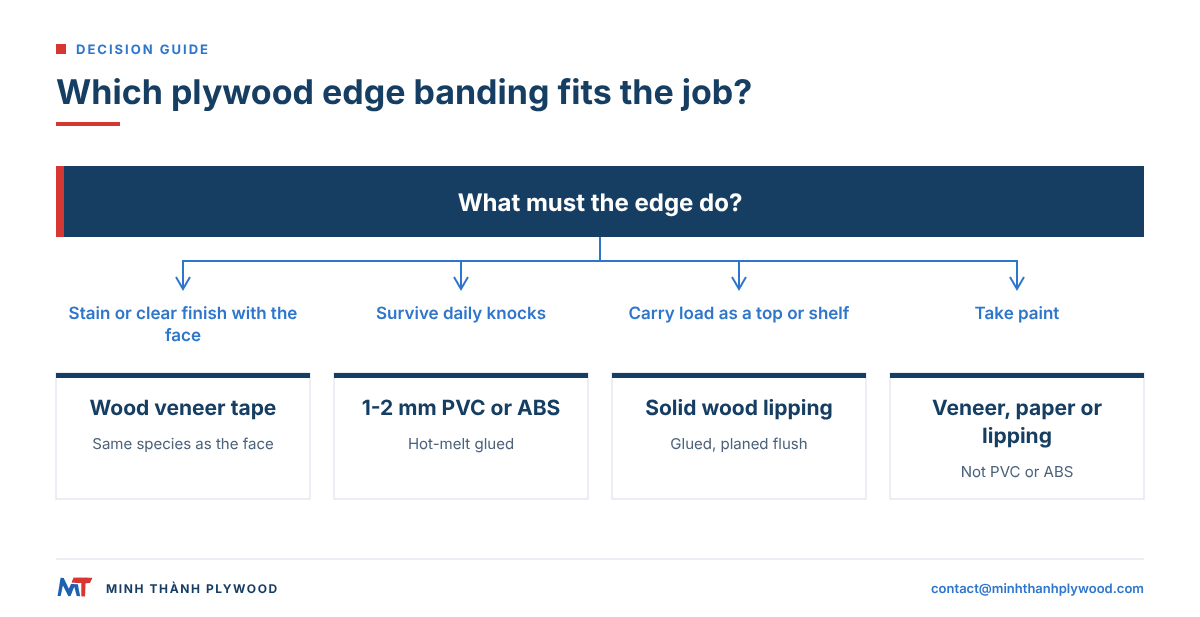
Choose by what the edge has to look like and what it has to survive:
- The edge will be stained or clear-finished with the face: iron-on wood veneer tape in the face species.
- The edge needs to survive daily knocks and cleaning: 1-2 mm PVC or ABS, glued with hot melt.
- The panel is a table top, desk or loaded shelf: solid wood lipping, glued and clamped, then planed and sanded flush.
- The furniture is painted: wood veneer or paper-backed banding, or solid lipping filled and sanded; PVC and ABS do not hold paint.
- The edge is never seen: leave it bare, or seal it with the finish.
Iron-on veneer is the easiest to apply by hand. PVC and ABS give the most durable edge for the money in production, and solid lipping is the only edge you can sand and refinish years later.
How do you apply edge tape for plywood by hand?
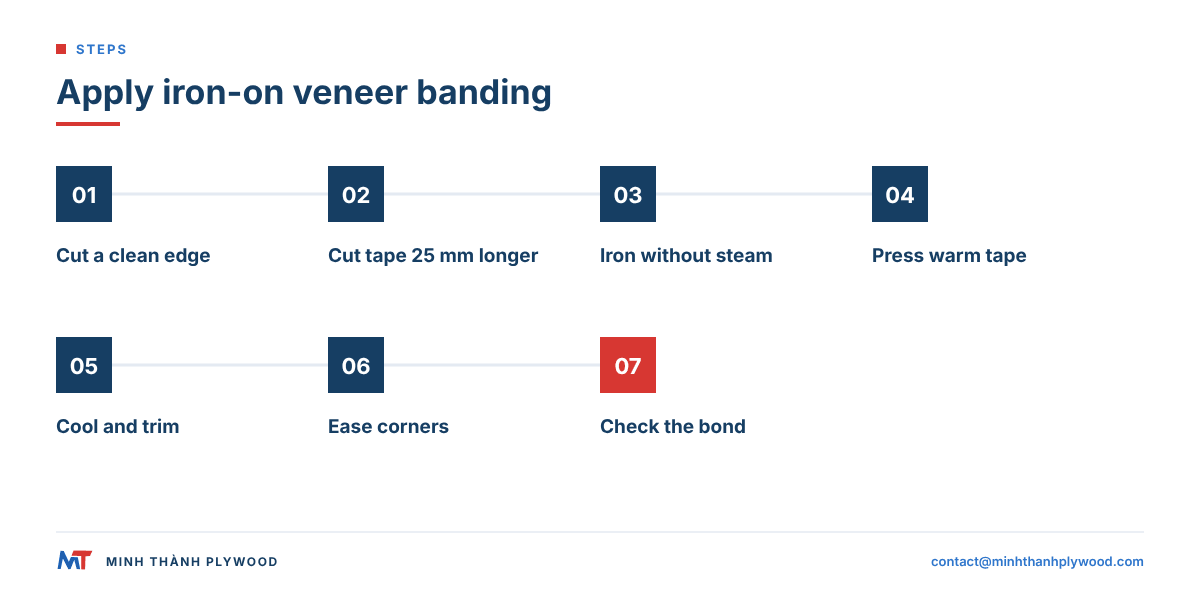
Pre-glued edge tape for plywood goes on with a household iron. The steps:
- Cut the edge clean. A sharp saw blade with a scoring blade, or a router pass, gives a square edge without chips; banding cannot hide a torn face veneer.
- Cut the band to length, about 25 mm longer than the edge.
- Heat the iron to a cotton setting, without steam.
- Position the band so it overhangs both faces, then run the iron slowly from one end, melting the glue under it.
- Press behind the iron with a roller or a wood block while the glue is still warm.
- Let it cool, then trim the ends with a knife or end trimmer and the long edges with an edge trimmer, cutting toward the panel.
- Ease the corners with a fine file or 180-220 grit paper held at an angle, without touching the face veneer.
- Check the bond by running a fingernail along the joint; reheat and press any loose spot.
Non-glued veneer or solid lipping is glued with contact cement or wood glue and clamped instead.
How do you fit solid wood lipping to plywood?
Solid wood lipping is a strip of solid timber, usually 5-10 mm thick, glued to the panel edge and planed flush. It is the strongest plywood edging, the only one you can round over with a router, and the one that survives decades of use on a table top or a heavily loaded shelf.
- Cut the lipping slightly thicker than the panel and a little longer than the edge, from the same species as the face.
- Glue and clamp with a PVA wood glue, using cauls so the clamping pressure is even along the length; a tongue-and-groove or biscuit joint helps align long edges.
- Plane or rout flush once the glue has cured, taking care not to cut into the face veneer; a flush-trim router bit with a bearing riding on the face is the safest tool.
- Shape the edge with a small radius or chamfer, which hides the joint line and resists knocks.
- Sand and finish together with the face.
Shop-made strips are cheaper for one-off work. Woodworkers cut thin strips from solid stock, 1/16 in (about 1.5 mm) up to 4 mm thick and 7/8 in wide, round over the face edge with a 1/4 in bit before ripping, glue them with PVA wood glue such as Titebond, and hold them with a pin nailer or painter’s tape pulled tight as a clamp. Strips under 1/2 in thick are butt-jointed and the profile is routed after gluing; thicker lipping benefits from biscuits for alignment. Flush-trim and round over once the glue has cured.
For hardwood lipping on birch or EV faces, choose a species that takes the same stain; birch lipping on birch plywood finishes as one surface.
How do factories edgeband plywood in production?
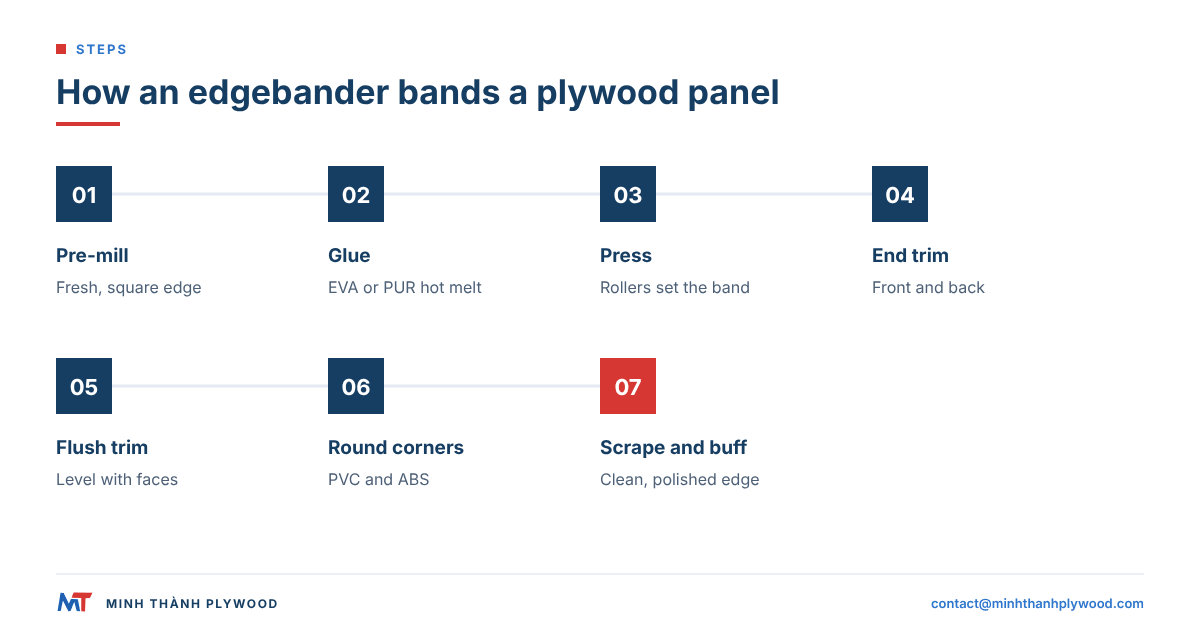
To edgeband plywood at volume, an edgebanding machine applies, presses and trims the band in a single pass, so a furniture plant bands thousands of panel edges a shift with an even, tight glue line. The stations in order:
- Pre-milling cuts a fresh, square edge just before gluing.
- Glue unit rolls hot-melt glue onto the edge: EVA for general furniture, PUR where moisture and heat resistance matter, such as kitchens and bathrooms.
- Pressure rollers press the band onto the edge while the glue sets.
- End trimming cuts the band flush at the front and back of the panel.
- Flush trimming cuts the top and bottom overhang level with the faces.
- Corner rounding shapes the band ends on thicker PVC and ABS.
- Radius and glue scrapers smooth the edge and remove glue squeeze-out.
- Buffing polishes the edge.
An edgebander is set for one thickness at a time. Panels that vary in thickness inside one batch leave the band proud on one face and trimmed into the veneer on the other, so production lines specify a tight tolerance from the plywood supplier.
Which plywood cores take edge banding cleanly?
Plywood with a calibrated thickness and a closed, void-free core takes banding best. A gap or overlap in the core shows through thin banding as a dip, and a sheet that varies in thickness defeats the edgebander’s trimmer settings.
At Minh Thanh, three build steps decide this:
- Stitched cores. Core layers are stitched both horizontally and vertically, so the veneer sheets in each layer butt tightly and the cut edge shows solid plies, not gaps.
- Double pressing. Furniture-grade panels are pressed twice as standard: the core board is pressed and calibrated, then face and back are pressed on. The calibrated core keeps thickness even across the sheet.
- Core species. White Styrax and Eucalyptus cores are standard; both cut to a clean, light edge that banding covers without colour show-through under thin tape.
Moisture matters too: panels dispatched at 8-12 % moisture content are in the range furniture plants work at, so the band does not open as the panel dries out after banding.
Can you stain or paint edge banding?
You can stain unfinished wood veneer banding and paint veneer or paper-backed banding; you cannot stain PVC, ABS or melamine, and paint does not stick to them well.
For a stained piece, sand the banding with the face at the same grit, apply the same conditioner and stain, and finish both together. End grain at the corners of veneer tape soaks up more stain, so wipe the corners quickly. Our guide to how to stain and finish birch plywood covers blotch control on birch faces and edges.
For painted plywood, solid lipping filled with a fine filler and sanded flush gives the most invisible joint; the how to paint plywood guide covers primers.
Where is plywood edge banding used, and where is it not?
Edge banding is used wherever a plywood edge is seen or touched: cabinet doors and drawer fronts, carcass front edges, shelves, desks, wardrobes, office partitions, shop counters and display units.
It is usually left off where the edge is hidden: carcass backs, the inside of plinths, edges inside a joint, and the back edges of shelves against a wall. Two cases also go without banding on purpose:
- Exposed-ply design. Birch plywood edges, sanded and lacquered, are a design feature in modern furniture and shop interiors. They need a void-free core and even plies to look right.
- Outdoor and wet use. Thin banding on outdoor furniture can lift with sun and water. There, the edge is sealed with a coating or protected with solid lipping, and the panel itself needs exterior glue, a service class defined in BS EN 636.
Our guide to how to finish plywood edges compares banding, lipping, filler, paint and exposed edges.
What causes edge banding to fail?
Most banding failures come from the edge, the glue or the panel, not the band itself:
| Failure | Cause | Prevention |
|---|---|---|
| Band peels at the ends | Glue too cold or ends trimmed with a dull knife | Correct glue temperature; sharp end trimmers |
| Visible glue line | Edge not square, or too much glue | Pre-mill the edge; set the glue roller |
| Dips under the band | Gaps in the core edge | Void-free, stitched cores |
| Band proud on one face | Panel thickness varies | Order tight thickness tolerance |
| Band lifts in kitchens | EVA glue softened by heat and steam | PUR hot melt for wet and hot areas |
| Chipped face veneer at the edge | Blunt saw, no scoring blade | Sharp blades; score before cutting |
What does this mean for your plywood order?
If your plant or workshop bands edges, specify the panel for the edgebander, not only for the face:
- Face and grade: birch D+/D, poplar A/B, EV pattern or pine, with the edge band species or colour matched to it.
- Thickness and tolerance: for example 18 mm, held to ±0.2 mm on sanded furniture panels.
- Core: white Styrax or Eucalyptus, stitched, void-free at the edge.
- Glue and emission: UF glue at E0 emission for interior furniture; melamine-fortified or phenolic (WBP) glue for wet areas. Chamber tests on our 9, 15 and 18 mm panels averaged 0.014-0.032 ppm. The CARB Phase 2 / TSCA Title VI limit for veneer-core hardwood plywood is 0.05 ppm under 40 CFR 770.10.
- Size: 1220 x 2440 or 1250 x 2500 mm, or cut-to-size parts; we cut one panel into 4, 6 or 8 pieces.
- Quantity: from one 40HC container, with mixed specifications by agreement.
Our furniture plywood and cut-to-size plywood pages list faces and formats, and the how to finish plywood guide covers the rest of the finishing sequence. Indicative prices for furniture and interior plywood start from US$350/m³ (October 2026), and free samples let you run a test on your edgebander. Send your specification to contact@minhthanhplywood.com for a quote within hours.
Buyer questions, answered
What is plywood edge banding?
A thin strip of wood veneer, PVC, ABS or melamine paper glued to the exposed edge of a plywood panel. It hides the layered edge, protects it from chipping and moisture, and gives the edge the same look as the face.
What size edge banding do I need for 18 mm plywood?
Use 22 mm wide banding for 18 mm plywood. It leaves about 2 mm overhang on each side, which is trimmed flush after gluing.
What size edge banding for 3/4 inch plywood?
13/16 in (about 21 mm) or 7/8 in (about 22 mm) banding suits 3/4 in plywood. Real 3/4 in sheets are often slightly thinner, so the wider band covers any sheet and is trimmed flush.
Which is better, iron-on veneer, PVC or solid wood edging?
Iron-on veneer is best for a wood look you will stain or lacquer, PVC or ABS for hard-wearing, colour-matched furniture, and solid wood lipping for edges that take knocks, such as shelves and table tops.
Can you stain plywood edge banding?
Yes, if it is unfinished wood veneer banding: sand lightly and stain it with the face. PVC, ABS and melamine banding cannot be stained; choose the colour when you order.
Can I apply edge banding without special tools?
Yes. Pre-glued veneer or PVC banding goes on with a household iron, a roller or wood block, and a trimmer or sharp knife. Edgebanding machines are for production volumes.
Does edge banding make plywood waterproof?
No. It slows water reaching the edge, and PUR hot-melt glue gives the best moisture resistance, but the panel's glue bond decides how it handles water. Use exterior-glue plywood for wet areas.
What is the best edge banding for painted plywood?
Paper-backed or primed banding, wood veneer, or solid lipping filled and sanded. PVC and ABS do not hold paint well without a special primer.
Where is edge banding not needed?
On edges no one sees, such as carcass backs, the inside of plinths and edges hidden in joints. Many designers also leave birch edges exposed and lacquered on purpose.
Which plywood takes edge banding best?
Plywood with a calibrated, even thickness and a void-free core. Gaps in the core edge leave dips under thin banding, and uneven thickness leaves the band proud on one side.