
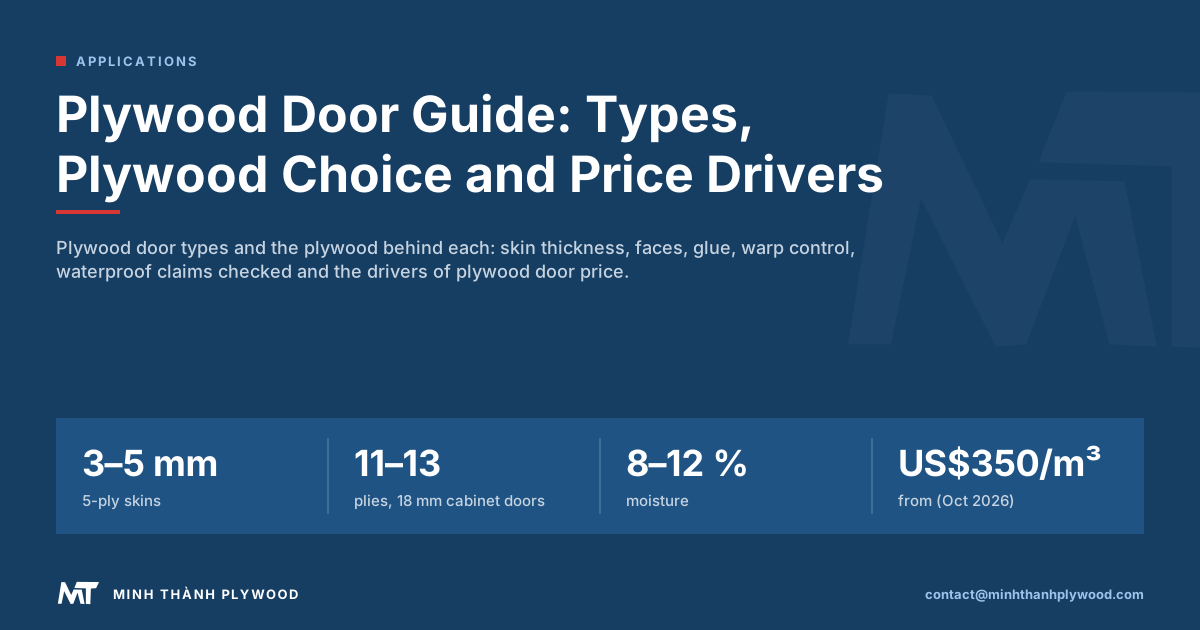
A plywood door is a door whose faces, panels or whole leaf are made of plywood: flush doors with plywood skins over a frame, panel doors with plywood infills, and laminated or veneered doors on a plywood base. The plywood door price follows the skin, core, size and finish. Minh Thanh Plywood supplies the door plywood from Phu Tho, Vietnam.
Plywood door: the short answer
A plywood door uses plywood for its faces, its panels or its whole leaf. Plywood is chosen because it is light for its strength, moves less than solid timber when the humidity changes, and takes paint, veneer and laminate on a flat face. The plywood a door needs depends on the door type:
- Flush doors: two thin plywood skins, usually 3–6 mm, glued to a frame over a core.
- Panel doors: a stile-and-rail frame with plywood infill panels.
- Laminated doors: plywood skins or leaves faced with melamine, HPL or PVC.
- Veneered doors: plywood with a decorative face veneer such as oak, walnut or EV.
- Cabinet and wardrobe doors: 18 mm furniture plywood, edged and finished.
The rest of this guide takes each type, the plywood behind it, how to stop it warping, what “waterproof” really means, and what moves the price.
Door of plywood: the door types and the plywood behind each
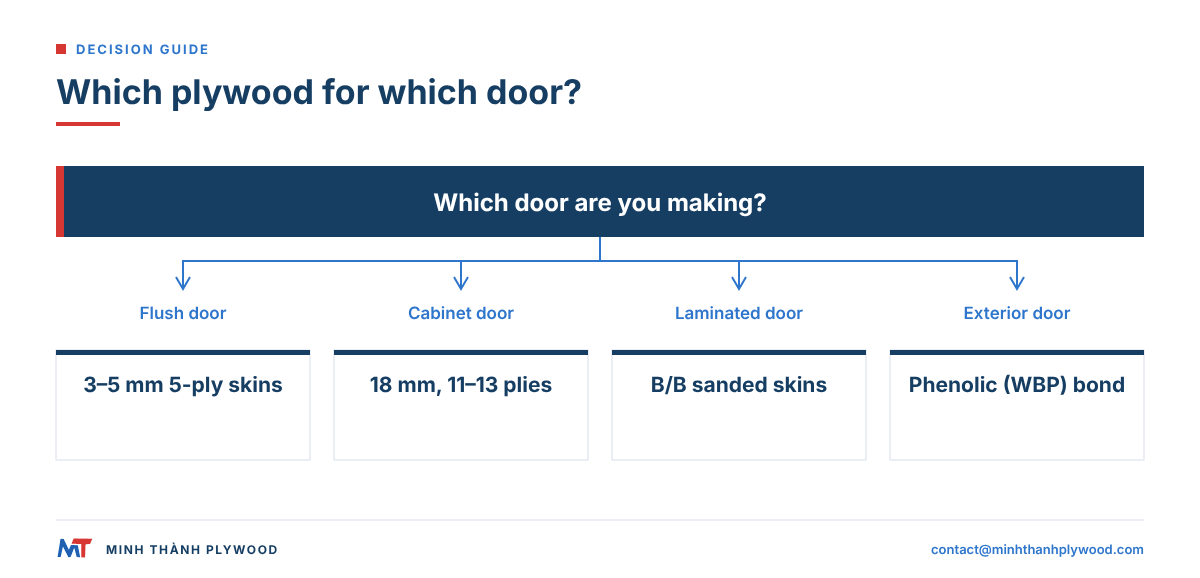
Each door type asks for a different plywood thickness, face and glue. This table is the quick reference:
| Door type | Where plywood is used | Typical plywood | Face to choose |
|---|---|---|---|
| Flush door, hollow or honeycomb core | Both skins | 3–5 mm, 5-ply | Poplar or birch to paint; EV or okoume to veneer look |
| Flush door, solid core | Both skins over a solid core | 3–5 mm, 5-ply | As above, A/A or A/B grade |
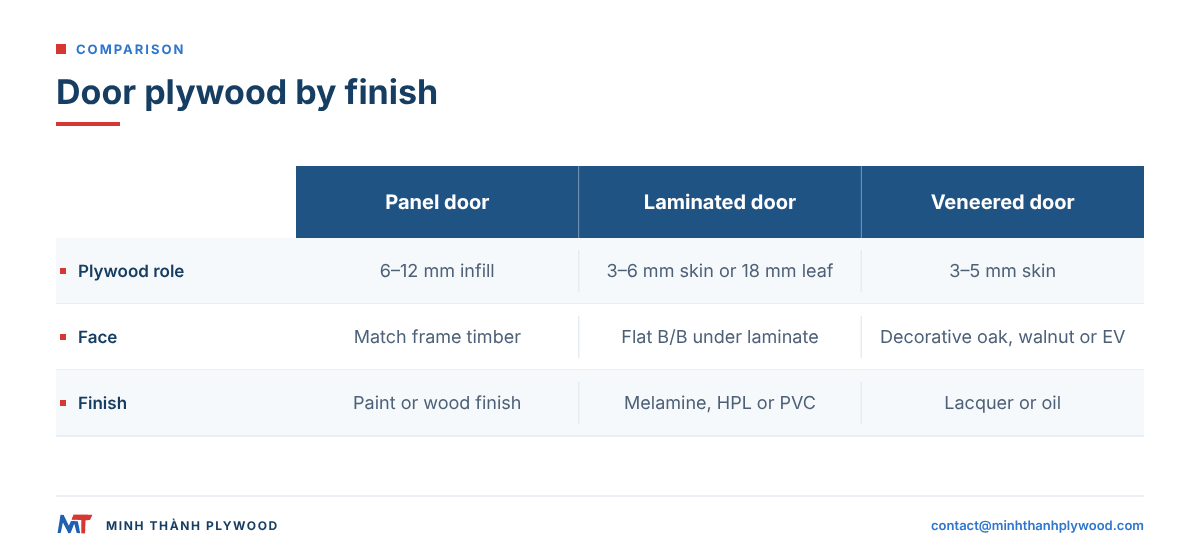
| Panel door | Infill panels in a stile-and-rail frame | 6–12 mm | Face matching the frame timber |
| Laminated door | Skins or leaf under melamine, HPL or PVC | 3–6 mm skins or 18 mm leaf | B/B grade, flat and sanded |
| Veneered door | Skins with decorative veneer | 3–5 mm, 5-ply | EV, oak, walnut, birch |
| Cabinet or wardrobe door | The whole door | 18 mm, 11–13 plies | Birch, poplar, EV, A/A or A/B |
| Exterior or shed door | Skins or boarded leaf | Exterior plywood, phenolic bond | Pine or hardwood, painted |
Doors for factories that build in volume are covered in our guide to plywood for door manufacturing, which explains door blanks and cores.
Plywood door sizes and prices in the US
US interior doors come in a fixed grid, so a plywood door is cut to it. Standard leaves are 24, 28, 30, 32 and 36 in wide by 80 in high and 1-3/8 in (35 mm) thick, with a 30 in bedroom door and a 28 in bathroom door the usual pair. Nominal widths run slightly under: a 30 in slab measures 29-3/4 in and a 36 in slab 35-7/8 in.
Retail prices give a door maker or a DIY builder the benchmark to beat (listings at Lowe’s and Home Depot, checked 21 October 2026):
| US door | Typical retail price |
|---|---|
| Hollow-core primed flush slab, 24–32 in × 80 in | US$54–68 |
| Hollow-core primed flush slab, 36 in × 80 in | US$62–82 |
| Pre-hung flush unit with frame | US$130–300 and up |
| Slab plywood cabinet door, made to size (Barker Door) | from US$29.95, plus US$30–250 by height and US$35–125 for a species face |
Barker Door’s slab plywood cabinet doors top out at 24 in wide and 92 in high; red oak adds US$35, walnut US$95 and rift white oak US$125. These retail prices include the maker’s margin, hardware and finish. A door factory that buys the plywood direct pays for the sheet by the cubic metre: US$350/m³ for furniture plywood and US$250/m³ for commercial plywood from Minh Thanh Plywood (October 2026), before freight.
Which ply is best for doors?
The best ply for a door is balanced, flat and sanded to a tight tolerance, with the face chosen for the finish. Four lines decide it:
- Ply count: 5-ply for 3–5 mm skins; 11–13 plies for 18 mm cabinet doors. More, thinner plies keep the door flat.
- Face: poplar or birch for paint, EV or oak for a wood look, B/B under laminate.
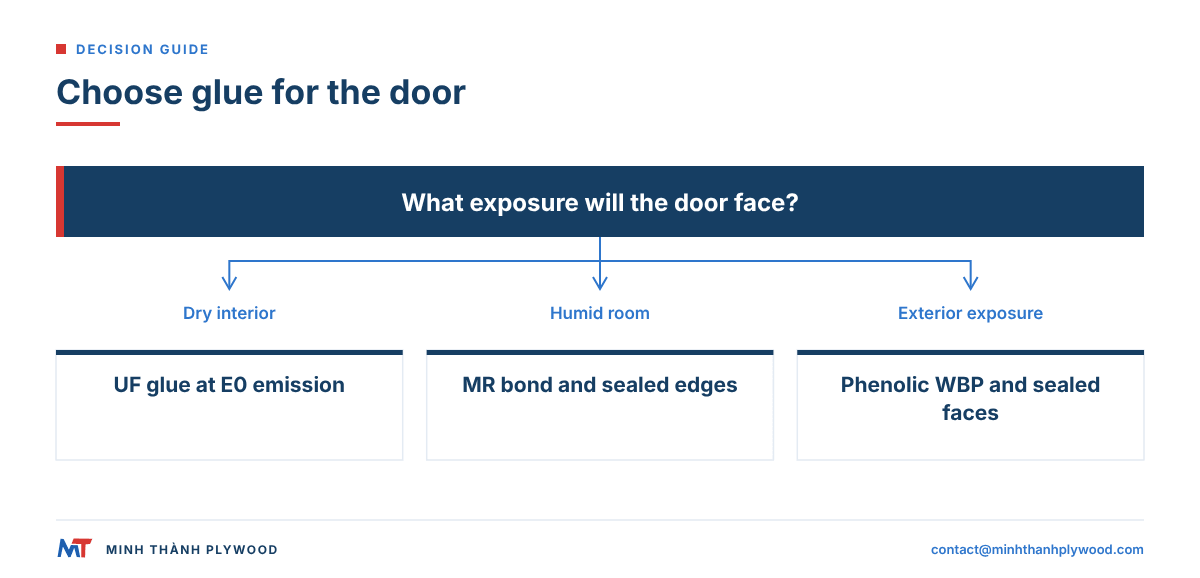
- Glue: UF glue at E0 emission for interior doors; MR for kitchens and bathrooms; phenolic (WBP) for exterior doors.
- Tolerance: sanded furniture panels at ±0.2–0.3 mm, so skins press evenly onto the frame.
At Minh Thanh Plywood, thin plywood of 3–5 mm is always 5-ply, and furniture-grade panels are pressed twice: the core board is pressed and calibrated, then the face and back are pressed on. That calibrated core is what keeps a skin from showing the frame through the face.
Flush plywood doors: skins, frame and core
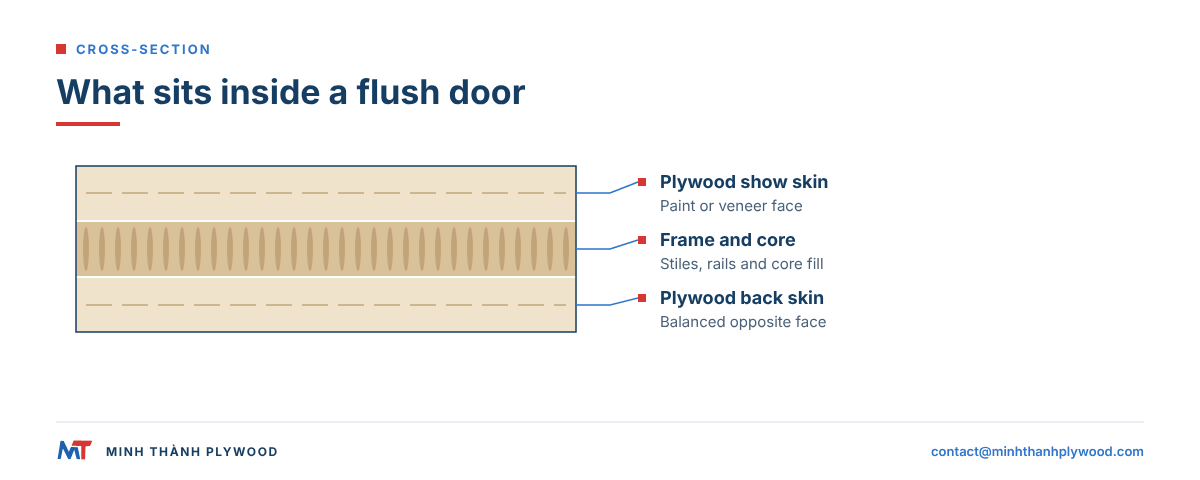
A flush door is a sandwich: two plywood skins glued to a timber frame, with a core filling the space between. The skins take the paint or veneer; the frame takes the hinges and lock; the core sets the weight, sound and stiffness.
- Hollow or honeycomb core: light and low-cost, for interior doors in homes and hotels.
- Tubular or particleboard core: heavier, quieter, better for screws.
- Solid timber or LVL core: heavy-duty, for frequent use, sound and security.
The skins decide how the door looks for its whole life. Thin 5-ply skins sanded on both faces stay flat over the frame; thick-veneer 3-ply skins can show the frame lines through paint. Our guide on 6mm ply explains why the ply count matters in a thin panel.
Fire-rated flush doors are tested as complete doorsets, not as plywood sheets: the rating comes from the door maker’s tested build. For the plywood alone, Commission Decision 2007/348/EC classes untreated plywood of at least 9 mm and 400 kg/m³ as D-s2,d0 without further testing.
How to build an interior plywood door from one 4 x 8 sheet
A flat interior plywood door can come from a single 4 ft × 8 ft sheet plus solid-wood edging. The method below follows the ibuildit.ca plywood door build, which gets a door about 2 ft 4 in wide from one 1/2 in sheet; scale the width to the opening.
- Pick the sheet: 1/2 in (12 mm) plywood with one good side, sanded and void-free, since the faces show. For a heavier door use 3/4 in (18 mm).
- Cut the core: 25-1/2 in × 80 in, with the 80 in along the face grain.
- Rip the stiles and rails: the offcut gives five strips 4-3/8 in wide. Glue them to the core edges, overlapping the core by 3/4 in, and set the centre rail 36 in from the floor to divide the door into two panels.
- Edge the leaf: solid-wood lipping on the vertical edges, with 45-degree scarf joints where lengths meet, covers the plywood plies and takes the trimming plane.
- Check the thickness: the stiles and trim build the leaf up, but a shop-made door rarely matches the 1-3/8 in factory leaf, so test the hinge and jamb depth before you hang it.
- Seal and finish: prime all faces and all four edges before hanging.
For a door that must stay flat for years, use the factory route: a 5-ply 3–5 mm skin each side over a frame and core, as in our guide to flush plywood doors and door blanks.
Panel, laminated and veneered plywood doors
Panel, laminated and veneered doors use plywood differently, and each needs its own face and grade.
- Panel doors: the frame is solid timber or engineered timber; the panels between are plywood, often 6–12 mm. Plywood panels do not split and shrink like solid timber panels, so the door keeps its gaps tight.
- Laminated doors: melamine paper, HPL or PVC is pressed onto plywood skins or an 18 mm leaf. The plywood must be flat and sanded, because any dent shows through a gloss laminate. See laminated plywood.
- Veneered doors: a decorative veneer gives an oak, walnut or other wood face. EV (engineered veneer) repeats the same grain on every door in a project. See oak and hardwood veneered plywood and our EV plywood page.
For painted designs with routed grooves, a thicker skin or an 18 mm leaf leaves enough wood under the groove. Birch and poplar faces take paint with little grain showing.
Plywood cabinet and wardrobe doors
Cabinet and wardrobe doors are usually cut from 18 mm furniture plywood of 11–13 plies, edged and finished. Plywood holds hinge screws better than MDF or particleboard, and it is lighter for the same stiffness.
- Face: birch D+/D for an exposed edge look; poplar or EV for paint and lacquer; A/A when both faces are seen.
- Core: white Styrax for light doors; eucalyptus for tall wardrobe doors that need more stiffness.
- Tolerance: ±0.2–0.3 mm, so doors line up across a run of cabinets.
- Faces UV-ready: both faces of Minh Thanh panels are UV-ready for buyers who apply their own UV coating.
Our guide to plywood for kitchen cabinets covers carcasses and doors together.
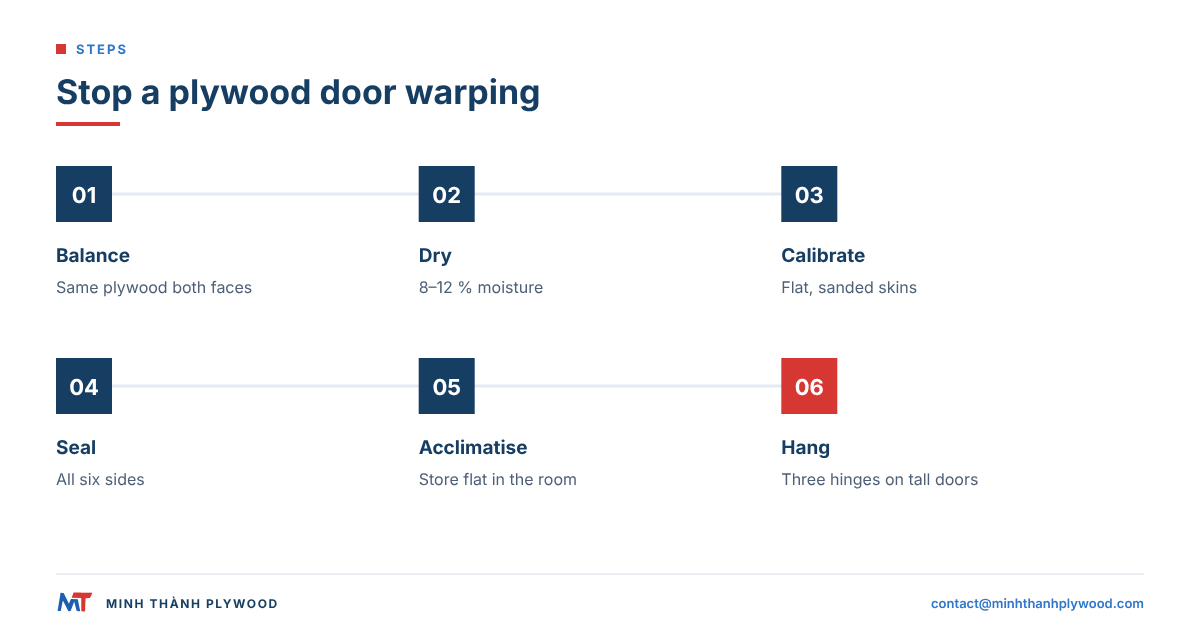
How to prevent a plywood door from warping
A plywood door warps when its two faces take up or lose moisture at different rates. Every rule against warping keeps the two faces equal:
- Balance the build: the same plywood, thickness and glue on both faces. Never a laminate on one face and bare wood on the other.
- Dry parts to the same moisture: Minh Thanh panels are dried to 8–12 % moisture content at dispatch; the frame timber should match.
- Use flat, calibrated skins: double pressing and sanding to ±0.2–0.3 mm give an even glue line.
- Seal all six sides: paint or lacquer the top and bottom edges, not only the faces.
- Acclimatise before finishing: store doors flat, in the room’s own climate, for several days.
- Hang with enough hinges: tall doors take three hinges.
Our guide to plywood warping and flatness explains the physics behind each rule.
Are plywood doors waterproof? The claims checked
No plywood door is waterproof, whatever the advertisement says. The bond decides how much moisture the plywood survives; the finish decides how much water reaches it.
| Claim on the advert | What it really means | What to ask for |
|---|---|---|
| “Waterproof plywood door” | Usually a phenolic (WBP) bond | Bond type in writing, and a finish on all faces |
| “Moisture resistant” | MR or melamine-fortified bond | For humid rooms, not rain |
| “Termite proof” | A treated core or face | The treatment named, with its standard |
| “Marine ply door” | Marine plywood skins | BS 1088 stated on the sheet |
For an exterior or bathroom door, order a phenolic or MR bond, seal every edge, and keep the bottom edge clear of standing water. Our guide is plywood waterproof? sets out the bond classes, which EN 314-2 defines.
Ply board door design ideas
Plywood door design starts with the face. These finishes are made on plywood skins or 18 mm leaves:
- Painted flush: poplar or birch skins, sanded and primed. Clean and low-cost.
- Grooved painted: routed lines on a thicker skin or leaf, painted after routing.
- Veneered: oak, walnut or EV veneer, lacquered or oiled.
- Laminated: melamine or HPL in solid colours, wood grains or stone looks.
- Exposed edge: birch plywood with its layered edge left on show, lacquered.
- Flush with inlay: a strip of metal or a contrasting veneer set into the face.
For a plywood bedroom door design, most buyers pair a painted or veneered flush face with a hidden frame and soft-close hardware. Ply board door design for hotels and apartments favours laminate for durability.
What drives the plywood door price?
A plywood door’s price is set by its core, skins, size, finish, hardware and quantity. No single price applies, because two doors with the same outline can differ several times in build. These are the drivers, in their usual order of weight:
| Price driver | Lower cost | Higher cost |
|---|---|---|
| Core | Hollow or honeycomb | Solid timber, LVL or a tested fire core |
| Skin face | Poplar or commercial face for paint | EV, oak, walnut or birch for clear finish |
| Skin grade | B/B under laminate | A/A for two clear faces |
| Glue | UF at E0, interior | MR or phenolic, exterior |
| Size | Standard leaf | Tall, wide or custom |
| Finish | Primed | Lacquered veneer, HPL, UV coating |
| Hardware and frame | Leaf only | Pre-hung doorset with frame and lock |
| Quantity | Container volumes | Single doors |
The plywood is a share of the door, and it is priced per cubic metre at the mill. As of October 2026, Minh Thanh Plywood’s furniture and interior plywood starts from US$350/m³ and commercial plywood from US$250/m³. The final price follows the face, core, glue, thickness, size, quantity and delivery term.
How to build a plywood shed door
A plywood shed door is a braced timber frame with exterior plywood fixed to the outside. Build it in this order:
- Measure the opening and cut the plywood 5–10 mm smaller each way for clearance.
- Choose exterior plywood with a phenolic (WBP) bond, 12–18 mm thick.
- Build the frame from treated timber: a top rail, a bottom rail, a middle rail and a diagonal brace running down to the hinge side.
- Glue and screw the plywood to the frame, screws every 150–200 mm round the edges.
- Seal every edge, then prime and paint both faces.
- Hang on three strap hinges, with a drip edge over the top and the bottom edge clear of the ground.
The diagonal brace stops the door sagging; it must run from the bottom hinge corner up to the top latch corner.
Plywood door prices in India, the UAE and other markets
Plywood door prices in India, the UAE and South-East Asia are set locally by the door maker, so a factory-direct plywood mill does not publish door price lists. What a door maker in those markets buys from a Vietnamese mill is the plywood: skins, panels and 18 mm leaves.
For a door factory, the useful comparison is the cost of skin plywood per door. Divide the cubic-metre price by the number of skins a cubic metre gives at the skin size and thickness, then add freight. Sea transit from Hai Phong is about 15–25 days to the Middle East and 5–12 days within South-East Asia, by carrier and route.
What this means for a door maker’s plywood order
For a door factory or a furniture maker, the plywood order decides how flat, light and consistent the doors are. Write these lines for skin or leaf plywood:
- Use: flush door skin, panel infill, laminated leaf or cabinet door.
- Thickness and build: 3–5 mm 5-ply skins, or 18 mm with 11–13 plies.
- Face and back: species and grade pair, such as poplar A/B or birch D+/D.
- Core: white Styrax or eucalyptus.
- Glue and emission: UF at E0, MR or phenolic; CARB P2 / TSCA Title VI for the US.
- Tolerance: ±0.2 mm on sanded skins.
- Size: 1220 × 2440 mm, 1250 × 2500 mm, or cut to the skin size.
- Packing and quantity: sheets per pack, packs per container.
For US door makers, Minh Thanh Plywood is certified to CARB Phase 2 / TSCA Title VI under ICTT mill no. 23024. Six chamber tests from April 2025 to June 2026 averaged 0.014–0.032 ppm against the 0.05 ppm limit. The limit for veneer-core hardwood plywood is set in 40 CFR 770.10.
Buying door plywood from Minh Thanh Plywood
Minh Thanh Plywood is a manufacturer of furniture and interior plywood in Ha Hoa, Phu Tho, with a capacity of 50,000+ m³ per year. For door makers we supply three things: thin 5-ply skins, 18 mm furniture plywood for cabinet and wardrobe doors, and cut-to-size panels. One panel can be cut into 4, 6 or 8 pieces before packing.
The minimum order is 1×40HC, with mixed specifications by agreement, so skins and 18 mm leaves can share a container. Production takes 15–45 days after the 30% deposit, with the 70% balance against the scanned B/L. Every shipment is photographed and filmed before loading.
Send your door plywood specification to contact@minhthanhplywood.com or WhatsApp +84 988 586 601. We reply within hours and send free samples. See our furniture plywood, thin plywood, birch plywood and poplar plywood pages.
Buyer questions, answered
Which plywood is best for doors?
For flush door skins, 3–5 mm 5-ply plywood with a birch, poplar, EV or okoume face. For cabinet and wardrobe doors, 18 mm furniture plywood of 11–13 plies. For exterior doors, plywood with a phenolic (WBP) bond and a finish on every face and edge.
Are plywood doors good?
Yes, when they are built balanced: the same plywood on both faces, a dry frame and sealed edges. Plywood doors are lighter than solid timber, move less with humidity and take paint, veneer or laminate well.
What is a flush plywood door?
A flush door has two flat plywood skins glued to a timber frame, with a hollow, honeycomb, tubular or solid core between them. The face has no panels or mouldings, so it can be painted, veneered or laminated.
Are plywood doors waterproof?
No plywood door is waterproof. A door made with a phenolic (WBP) bond resists wetting and drying, but the faces and every edge still need paint, lacquer or a laminate, and the door needs a canopy or frame that sheds rain.
How do I stop a plywood door from warping?
Use the same plywood on both faces, a frame dried to the same moisture as the skins, and seal all six sides, including the top and bottom edges. Store and hang the door flat in the room's own climate before finishing.
What thickness of plywood is used for door skins?
Usually 3–5 mm. Thin plywood of 3–5 mm at Minh Thanh Plywood is always 5-ply, sanded to a tight tolerance so the door face stays flat under paint or veneer.
What is the price of a plywood door?
It depends on the core, the skin face, the size, the finish, the hardware and the quantity. The plywood itself is priced per cubic metre: furniture and interior plywood from Minh Thanh Plywood starts from US$350/m³ (October 2026).
What is the difference between a flush door and a panel door?
A flush door has flat skins over a frame and core. A panel door has a stile-and-rail frame with separate infill panels, which can be plywood. Flush doors are cheaper to make in volume; panel doors show more relief.
Can I make a shed door from plywood?
Yes. Use exterior plywood with a phenolic bond, fix it to a braced timber frame, keep the bottom edge off the ground, and paint every face and edge before hanging.
What is a laminated plywood door?
A door whose plywood skins or leaf carry a decorative laminate such as melamine paper, HPL or PVC. The laminate gives a hard, washable face; the plywood gives the strength and screw holding.
Is plywood better than MDF for doors?
Plywood is lighter, stiffer and holds hinge screws better; MDF gives a smoother face for routed and painted designs. Many door makers use plywood skins or cores and MDF only for moulded faces.
Can I buy door skin plywood directly from a Vietnamese factory?
Yes. Minh Thanh Plywood supplies 3–6 mm skin plywood and 18 mm furniture plywood factory-direct from 1×40HC, with free samples and replies within hours.