
Laminated plywood is plywood with a decorative or protective overlay bonded to its face: melamine paper, high-pressure laminate (HPL), PVC film, polyester or phenolic film. The overlay sets wear, cleaning and look; the plywood under it sets flatness, screw hold and weight. Minh Thanh Plywood makes the substrate: calibrated, sanded panels on Styrax or Eucalyptus core, held to ±0.2 mm.
What is laminated plywood?
Laminated plywood is a plywood panel with a decorative or protective overlay bonded to one or both faces. The overlay can be melamine-impregnated paper, high-pressure laminate (HPL), PVC film, polyester paper or a phenolic film, and it gives the panel a finished face that does not need painting or lacquering.
The plywood underneath stays the structural part. It carries screws, spans shelves and keeps doors flat, while the overlay handles wear, cleaning, colour and pattern. That split matters for anyone buying laminated plywood, laminated panels or plywood laminated sheets: the face and the board are two specifications.
The name is used loosely. Some buyers say laminated plywood for any plywood, because every plywood is a laminate of veneers. In trade quotations it means an overlay on plywood, and that is the meaning in this guide. Laminated veneer lumber (LVL) is a different product, with every veneer running in one direction; see LVL.
Which laminate ply sheets and overlays are used, and how do they compare?
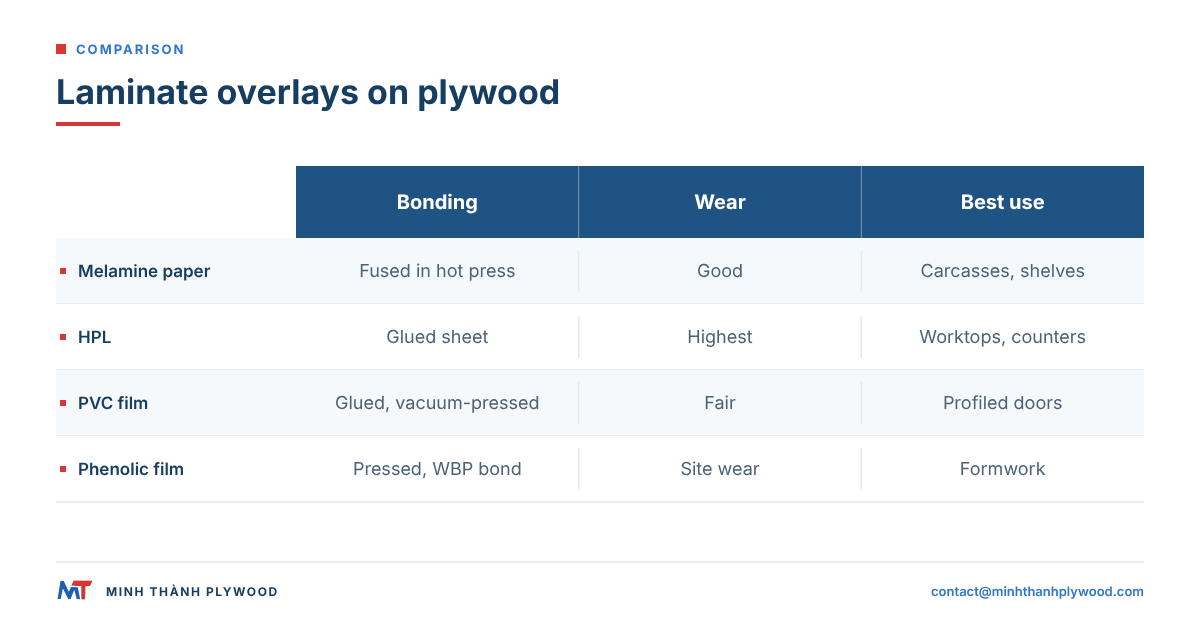
Six overlays cover nearly every order for laminate ply sheets: melamine paper, HPL, PVC film, polyester, prelam and phenolic film. They differ in how they are bonded, how they wear, and what they cost.
| Overlay | How it is bonded | Wear and impact | Moisture on the face | Cost position | Typical buyer |
|---|---|---|---|---|---|
| Melamine paper (low-pressure) | Paper fused to the plywood in one hot press, no separate glue | Good for vertical and light-use surfaces | Sheds splashes | Lowest of the decorative overlays | Furniture plants, flat-pack makers |
| HPL (high-pressure laminate) | Separate sheet made under high pressure, then glued on | Highest of the group; takes knocks and heat | Sheds water and steam | Highest | Worktops, shop fitting, public interiors |
| PVC film or foil | Glued, often vacuum-pressed over shaped parts | Fair; soft to scratches | Sheds water | Low to middle | Doors with profiled edges, wall panels |
| Polyester (PE) paper or coating | Pressed or rolled on, often high-gloss | Fair | Sheds splashes | Low | Shelving, back panels, display units |
| Prelam (factory melamine on plywood) | Melamine paper pressed at the board factory | As melamine paper | As melamine paper | Low to middle | Furniture makers in India, South Asia, Middle East |
| Phenolic film (film-faced) | Phenolic-resin paper pressed on with a water-resistant bond | Built for site wear and concrete pours | Sheds water; edges sealed | Middle | Formwork contractors |
Read the table by use. A wardrobe carcass needs melamine paper; a kitchen worktop or a shop counter needs HPL; a curved or profiled door suits PVC; concrete formwork needs phenolic film.
How is laminated plywood made?
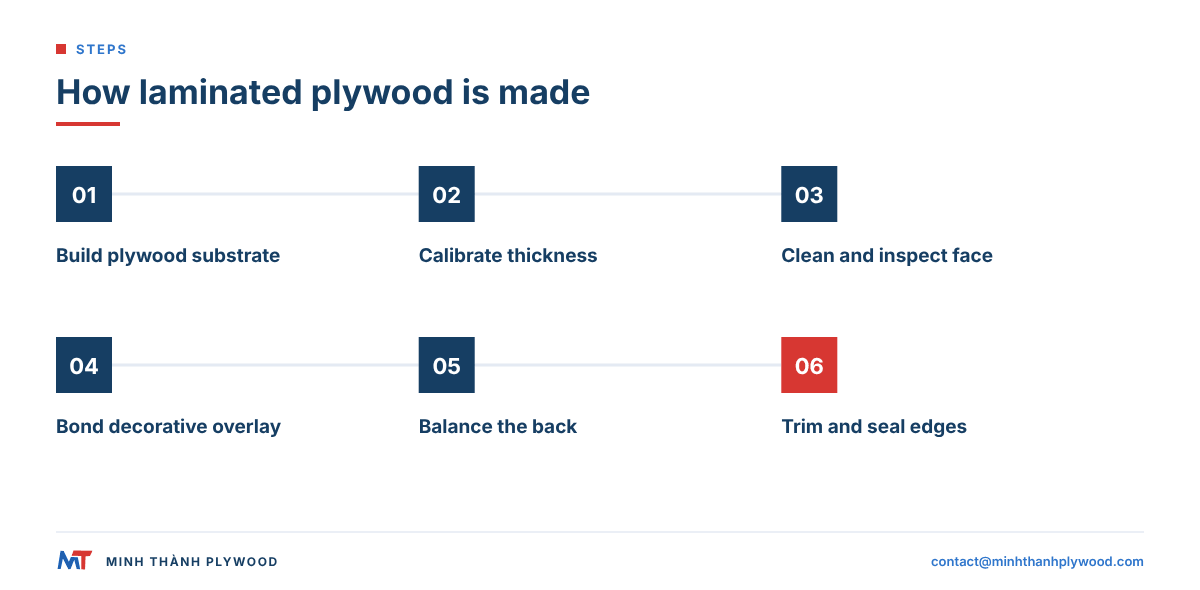
Laminated plywood is made in two stages: first the plywood substrate, then the overlay. Each stage has its own checks, and faults in the first stage show through the second.
- Substrate: veneers dried, laid up with alternating grain, glued and pressed into a plywood panel.
- Calibration: the panel sanded to an even thickness, so the overlay lies flat.
- Surface preparation: dust removed, the face checked for open joints, dents and glue spots.
- Overlay: melamine paper fused in a short-cycle hot press, or HPL and PVC glued and pressed or rolled.
- Balancing: the back laminated with the same or a balancing paper, so the panel stays flat.
- Trimming and edges: panels trimmed; edges sealed or banded at the furniture plant.
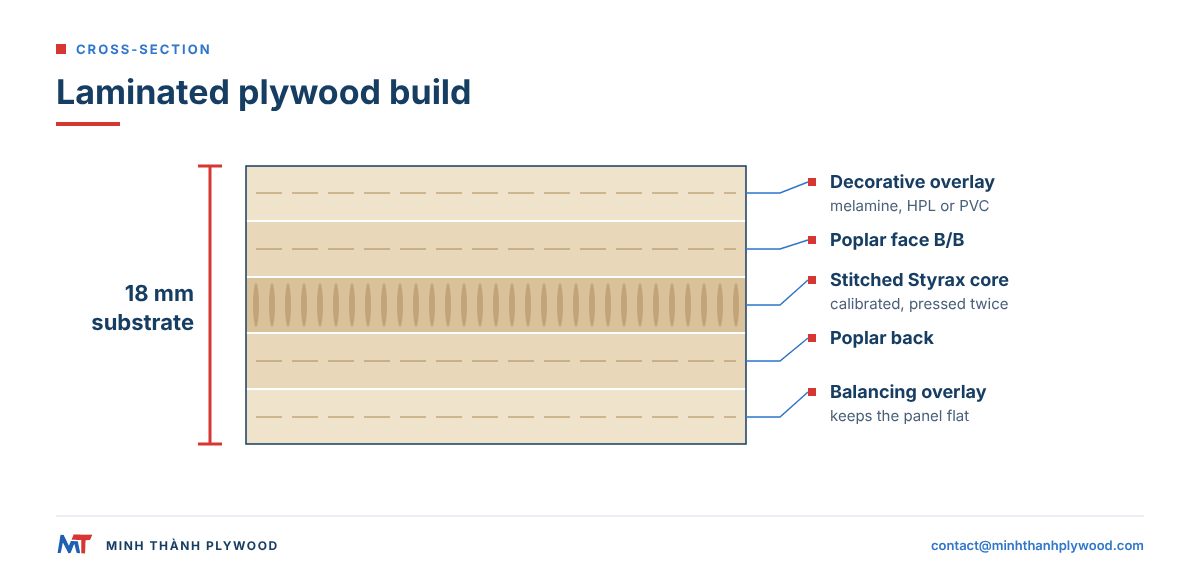
At Minh Thanh, stages 1 and 2 are where the furniture build is set. Furniture-grade panels are pressed twice: the core board is pressed and calibrated, then face and back are pressed on. Core layers are stitched horizontally and vertically, and panels leave at 8–12 % moisture content. A laminator receiving that panel starts from a flat, closed, dry base.
What is the difference between HPL and melamine laminated plywood?
Melamine laminated plywood has a melamine-impregnated paper fused directly to the plywood in a hot press; HPL plywood has a separate, thicker laminate sheet, made under high pressure from layers of resin-soaked kraft paper, glued onto the plywood afterwards.
| Point | Melamine paper on plywood | HPL on plywood |
|---|---|---|
| Layers in the overlay | One decorative paper | Decorative paper over several kraft papers |
| Bonding | Fused in the press, no extra glue line | Separate glue line (contact or press glue) |
| Impact and heat | Fair; chips on hard knocks | High; takes knocks and hot pans |
| Edge look | Banded | Banded or post-formed round edge |
| Where it fits | Carcasses, shelves, wardrobe interiors | Worktops, counters, doors in heavy use |
| Cost | Lower | Higher |
Buyers often name HPL panels by brand, such as sunmica in India or Formica-faced plywood in North America. Both are HPL glued onto plywood. HPL sheets are specified in Europe by the BS EN 438 series, which covers high-pressure decorative laminates. For a deeper look at HPL builds, see HPL plywood.
Prelam, sunmica, laminado: what are plywood laminated sheets called by market?
Prelam, sunmica and laminado are regional names for laminated plywood, and each points to a different way of buying it.
- Prelam or pre-laminated plywood board: plywood laminated at the board factory, usually with melamine paper, sold ready to cut. Common in India, South Asia and the Gulf.
- Sunmica plywood or mica for plywood: plywood with a decorative laminate sheet glued on by the carpenter or furniture plant. Sunmica began as a brand and is now a common word for laminate sheets in India.
- Laminado or contrachapado laminado: Spanish and Latin American trade names for laminated plywood.
- White laminate plywood: plywood with a plain white melamine or HPL face, the most ordered single colour for wardrobes, shelving and shop fittings.
The name changes; the two specifications stay the same. Ask what overlay, what bond and what substrate, whatever the panel is called in your market.
Which plywood substrate gives the best laminated panel?
The best substrate for laminated plywood is a calibrated, sanded panel with a closed core, a smooth face and a balanced build. Thin overlays such as melamine paper show every dent, open joint and thickness step beneath them.
What to specify for the substrate:
- Core: white Styrax for light panels, Eucalyptus for stiff shelves and worktops; both standard at Minh Thanh, with Acacia and Pine cores on order.
- Face: poplar B/B is the usual face under an overlay, since the face is covered; a finer face is wasted money.
- Thickness tolerance: ±0.2–0.3 mm on sanded furniture panels, down to ±0.2 mm, so laminated parts band and fit evenly.
- Pressing: pressed twice, so the core is calibrated before the face goes on.
- Moisture: 8–12 % at dispatch, close to the overlay’s own conditioning.
- Sizes: 1220 × 2440 or 1250 × 2500 mm, plus 1220 × 2500 and 1220 × 2280 mm, matched to the laminate sheet format.
A thickness step of half a millimetre between two parts of a laminated cabinet shows as a misaligned edge band. That is why laminators who buy commercial-grade substrate at ±0.5 mm often switch to sanded furniture panels. Poplar plywood is the face most laminators order.
Why must the back of a laminated panel be balanced?
The back of a laminated panel must be balanced because an overlay on one face only pulls the panel into a curve as moisture changes. A balancing paper or a second overlay on the back pulls the other way and keeps the panel flat.
The rule for buyers is simple. Panels that show one face, such as carcass sides fixed to a wall, still need a balancing back. Panels that show both faces, such as shelves and doors, take the decorative overlay on both. When a supplier quotes a single-faced price, ask what is on the back.
A plywood substrate helps here: its cross-laminated veneers already resist movement better than a particle board. A Minh Thanh panel is built symmetric around its centre ply, so the overlay starts from a balanced board.
Is laminated plywood waterproof?
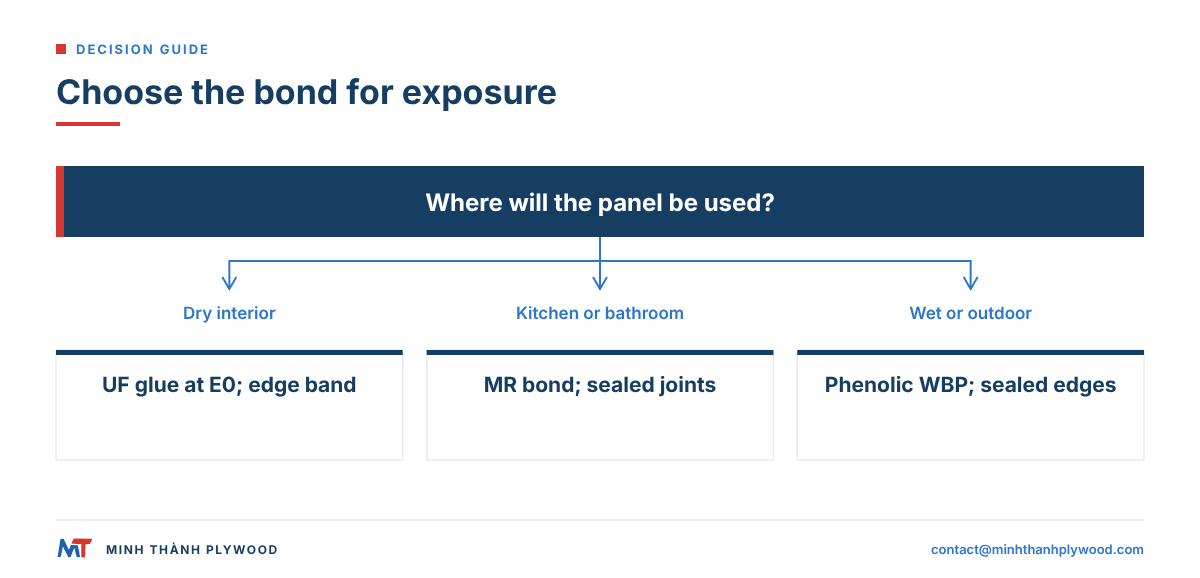
Laminated plywood is not waterproof. The overlay sheds water on the face, but water enters through cut edges, screw holes and the glue line of the plywood, so the bond and the edge sealing decide how long the panel lasts in damp use.
| Use | Glue to order | Edge treatment |
|---|---|---|
| Dry interiors: wardrobes, offices, shelving | UF glue at E0 emission | Edge band |
| Kitchens and bathrooms, splash zones | Melamine-fortified (MR) bond | Edge band with sealed joints |
| Wet or outdoor exposure, formwork | Phenolic (WBP) bond | Sealed edges, resealed after cutting |
Minh Thanh’s furniture panels use UF glue at E0 emission as standard, and MR, melamine-fortified and phenolic (WBP) bonds are made to the customer’s specification. The bond belongs on the order next to the overlay.
Is laminated plywood strong?
Laminated plywood is as strong as the plywood under the overlay; the overlay adds surface hardness, not stiffness. Choose the substrate thickness and core for the load, and the overlay for the surface.
For shelves and worktops, a denser core gives a stiffer panel at the same thickness. At 18 mm, a 1220 × 2440 mm sheet weighs 26.8 kg on a Styrax core, 31.1 kg on Acacia and 34.8 kg on Eucalyptus, using planning densities of 500, 580 and 650 kg/m³. Eucalyptus is the stiffer choice for long laminated shelves; Styrax keeps doors and wall units light.
Screw hold is where plywood beats particle board under the same overlay. Hinges and runners screw into cross-laminated veneers rather than glued particles, which matters on doors opened many times a day. Plywood vs MDF compares the boards in detail.
What thickness of laminated plywood do cabinets and furniture use?
Cabinets use 18 mm laminated plywood for carcasses, tops and shelves, 15 or 16 mm for doors and lighter carcasses, and thinner panels for backs and drawer bottoms. The thickness is the plywood’s; the overlay adds only a fraction of a millimetre.
| Part | Common substrate thickness | Notes |
|---|---|---|
| Kitchen carcass sides and bases | 18 mm | Holds hinges and runners well |
| Shelves | 18 mm | Eucalyptus core for long spans |
| Doors | 15, 16 or 18 mm | 16 mm when hardware is drawn for 16 mm board |
| Backs and drawer bottoms | 3–9 mm | Thin plywood, often laminated one side |
| Worktops | 18 mm and up | HPL overlay |
Minh Thanh makes plywood from 3 to 40 mm, and thin 3–5 mm panels are always 5-ply. Thin plywood covers the backs and drawer bottoms.
How do you apply laminate to plywood?
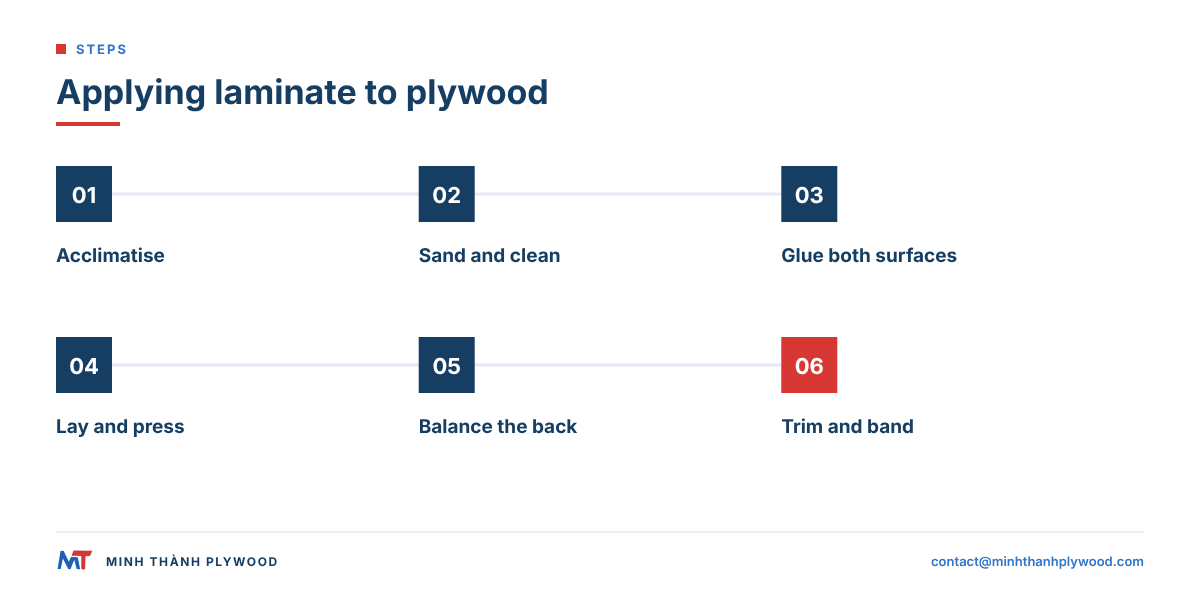
Apply laminate to plywood in six steps, with the same order whether you use contact adhesive by hand or press glue in a workshop.
- Acclimatise: store the laminate and the plywood in the same room for a few days.
- Prepare: sand the plywood face lightly and remove all dust.
- Glue: cut the laminate sheet slightly larger than the panel, then spread contact adhesive on both surfaces, or press glue on the plywood for a cold or hot press.
- Lay and press: lay the sheet from one end, then roll it hard or press it, working out air.
- Balance: laminate the back with the same sheet or a balancing laminate.
- Trim and band: trim the overhang with a router and band or seal every edge.
A flat, calibrated substrate shortens step 2 and removes most of the rework at step 4. Uneven thickness shows as glue starvation in the low spots.
How should you check laminated plywood when it arrives?
Check laminated plywood on arrival against the approved sample, in four steps.
- Face: colour, gloss and texture against the sample under the same light; look for scratches, dents and pressure marks.
- Flatness: lay a straight edge across the sheet and both diagonals; a bowed panel points to an unbalanced back.
- Thickness: caliper at four corners and the centre of sheets from several packs.
- Bond: on an offcut, try to lift the overlay at a corner; it should tear paper, not peel clean.
When the substrate comes from Minh Thanh and the laminating is done at your plant, the mill’s records cover the plywood: thickness against tolerance, moisture, and photos and video of every container before loading.
How is laminated plywood priced?
Laminated plywood is priced as two parts: the plywood substrate per cubic metre, and the overlay per square metre of face. In October 2026, Minh Thanh’s furniture and interior plywood started from US$350/m³ and commercial plywood from US$250/m³, FOB Hai Phong.
What moves the total:
- Overlay: melamine paper is the lowest, HPL the highest.
- One face or two: and what goes on the back.
- Substrate build: core species, glue, face grade and tolerance.
- Thickness and size: the plywood volume per sheet.
- Edges: banding is usually done at the furniture plant.
Buying the substrate and laminating locally suits plants that already run a press or a contact-glue line, since the overlay colours can then change without reordering containers.
What this means for your laminated plywood order
A laminated plywood order works when the overlay and the substrate are written as two specifications. For the plywood part, Minh Thanh’s quotation request asks for six lines.
Laminating substrate for wardrobe carcasses · 18 mm · white Styrax core, stitched, pressed twice · UF glue at E0 emission · poplar face and back B/B, sanded · 1220 × 2440 mm · ±0.2 mm · 1 × 40HC, FOB Hai Phong.
Emission evidence comes with the panels: CARB P2 / TSCA Title VI certification as ICTT mill no. 23024, and six ASTM D6007 chamber tests between April 2025 and June 2026 that averaged 0.014–0.032 ppm against the US limit. That limit is 0.05 ppm for hardwood plywood with a veneer core under 40 CFR 770.10. For EU furniture, the REACH formaldehyde restriction, Regulation (EU) 2023/1464, applies to furniture and wood-based articles from 6 August 2026; third-party testing to the buyer’s method is arranged through SGS on request. See formaldehyde emission classes.
The minimum order is one 40HC with mixed specifications by agreement, production takes 15–45 days after the 30% deposit, and samples are free. Send the specification to contact@minhthanhplywood.com.
Buyer questions, answered
What is laminated plywood?
Laminated plywood is a plywood panel with a decorative or protective overlay, such as melamine paper, HPL, PVC film or phenolic film, bonded to one or both faces.
Is laminated plywood waterproof?
No. The overlay sheds water on its face, but the edges and the glue line decide what happens in wet use. For damp rooms, order a melamine-fortified or phenolic (WBP) bond and seal every cut edge.
Is laminated plywood strong?
Its strength is the strength of the plywood under the overlay. An 18 mm Eucalyptus-core substrate gives a stiffer laminated shelf than a Styrax core of the same thickness.
What is the difference between HPL and melamine laminated plywood?
Melamine paper is fused straight onto the plywood in a hot press. HPL is a separate, thicker sheet made under high pressure and then glued on, so it resists impact and wear better and costs more.
Is laminated plywood the same as film-faced formwork plywood?
Film-faced plywood is a laminated plywood made for concrete formwork, with a phenolic film and a water-resistant bond. Decorative laminated plywood is an interior furniture panel.
What thickness of laminated plywood do cabinets use?
18 mm for carcasses, tops and shelves, 15 or 16 mm for doors and lighter carcasses, and thinner panels for backs and drawer bottoms.
What is prelam or pre-laminated plywood?
Prelam is plywood laminated at the factory, usually with melamine paper, so it arrives with a finished face. The term is common in India, South Asia and the Middle East.
What is sunmica plywood?
Sunmica is a trade name used in India for decorative laminate sheets. Sunmica plywood means plywood with a laminate sheet glued on, usually by the furniture maker.
How do you apply laminate to plywood?
Acclimatise both, sand and clean the plywood, spread contact adhesive or press glue on both surfaces, lay the sheet, roll or press it, laminate the back to balance the panel, then trim and band the edges.
Can you install laminate flooring on plywood?
Yes. Laminate flooring floats on an underlay over a flat, dry plywood subfloor; it is not glued to the plywood and is a different product from laminated plywood panels.
How do you remove laminate from plywood?
Warm the laminate with a heat gun to soften the contact adhesive, lift it with a scraper from one edge, then remove the glue residue and sand the plywood flat.
Is LVL the same as laminated plywood?
No. LVL (laminated veneer lumber) has all veneers running the same way for beams and rails; plywood alternates the grain. Minh Thanh supplies LVL as a separate product.
Where can buyers in the UAE, Australia, New Zealand or the Philippines source laminated plywood substrate?
Laminators and furniture plants in those markets import calibrated plywood from Vietnamese mills and laminate it locally. From Hai Phong, typical days at sea are 15–25 to the Middle East and 5–12 within South-East Asia.